
Life, 1895-08-15 · page 6 of 14
Life — August 15, 1895 — page 6: what you’re looking at
What you’re looking at
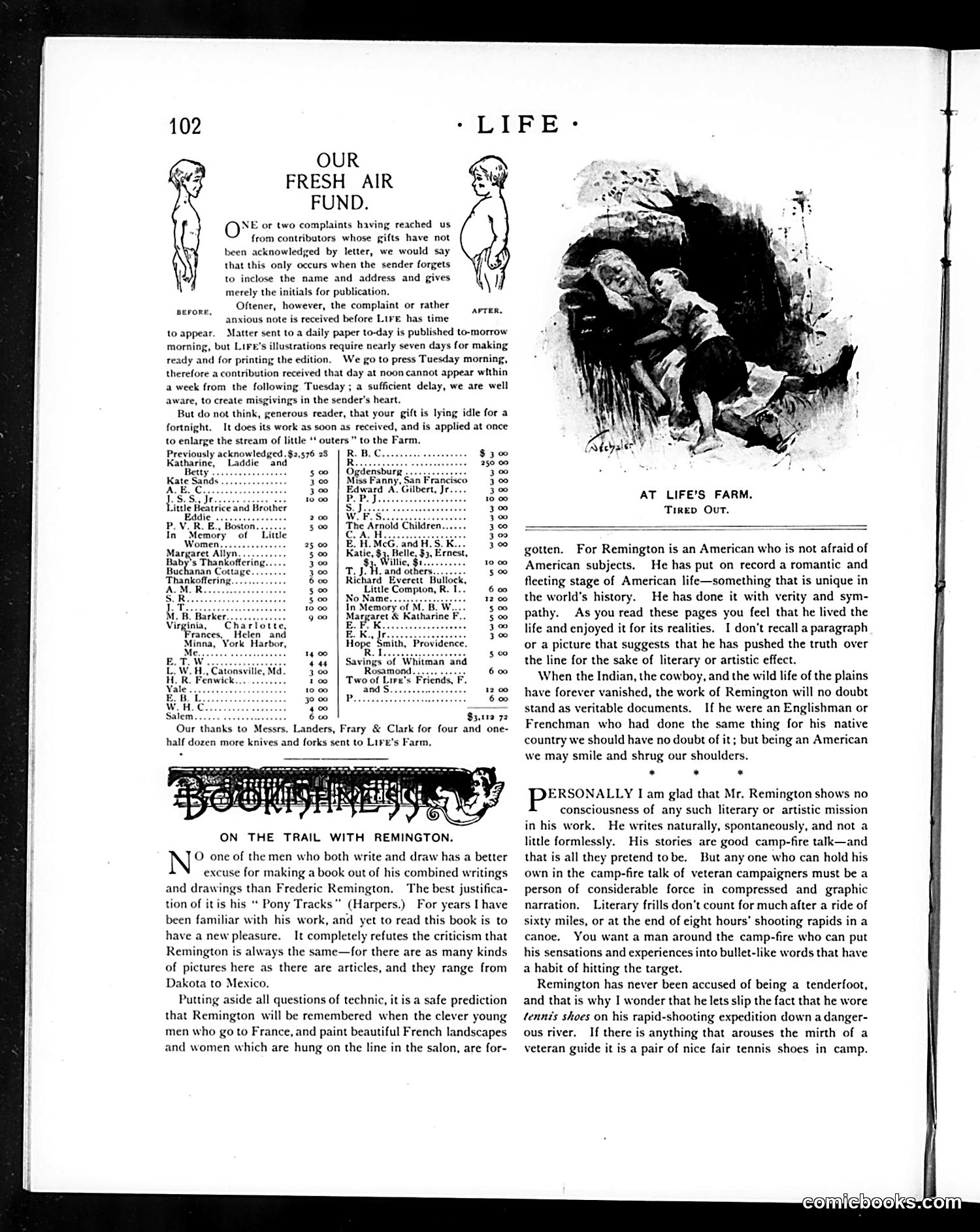
**Top Section - "Our Fresh Air Fund":** This satirizes Life magazine's charitable acknowledgment delays. The "before" and "after" drawings show a thin figure transforming into a robust one, humorously suggesting the magazine's Fresh Air Fund (a program sending urban children to countryside) produces dramatic physical improvement. The text explains that contributions received Monday cannot appear in Tuesday's edition due to printing schedules, addressing reader complaints about unacknowledged gifts. It's gentle self-mockery about administrative lag. **Bottom Section - "On the Trail with Remington":** This discusses Frederic Remington, the famous American artist-writer known for Western and frontier subjects. The author praises Remington's authenticity and natural storytelling style, defending him against charges of prioritizing artistic mission over accuracy. The passage emphasizes Remington's credibility as a recorder of American frontier life, noting his refusal to embellish despite artistic opportunity.
📄 Transcribed text from this page (OCR, searchable)
Machine-transcribed from the original scan — historical spelling and the odd misread are preserved.
OUR FRESH AIR FUND. ONE oF two complaints having reached us from contributors whose gifts have not been acknowledged by letter, we would say that this only occurs when the sender forgets to inclose the name and address and gives merely the initials for publication. Oftener, however, the complaint or rather anxious note is received before Lire has time to appear. Matter sent to a daily paper to-day is published to-morrow morning, but LiFe’s illustrations require nearly seven days for making ready and for printing the edition. We go to press Tuesday morning, therefore a contribution received that day at noon cannot appear within a week from the following Tuesday ; a sufficient delay, we are well aware, to create misgivings in the sender's heart. But do not think, generous reader, that your gift is lying idle for a fortnight. It does its work as soon as received, and is applied at once to enlarge the stream of little outers" to the Farm. Previously acknowledged.$2,576 28 | R. B.C. Katharine, Laddie and R. Betty |. does Og z Kate Sands Shmeme Miss Fanny, E : Edward A sErore, 2o . HL Me Katie, 3, Belle, $3, Erni Villie, $1 nan Cottage T. J. Hi and othe: Thankoffering. Richard Everett AMR Little Compton, R. 1 No Name. In Memory of M.B, Margaret & Katharine E.F. K. EK 1 ings Rosamond Two of Live's Frit p25 ON THE TRAIL WITH REMINGTON. O one of the men who both write and draw has a better ng a book out of his combined writings and drawings than Frederic Remington. The best justifica- tion of itis his * Pony Tracks” (Harpers.) For years I have been familiar with his work, and yet to read this book is to have a new pleasure. It completely refutes the criticism that Remington is always the same—for there are as many kinds of pictures here as there are articles, and they range from Dakota to Mexico. Putting aside all questions of technic, it is a safe prediction that Remington will be remembered when the clever young men who go to France, and paint beautiful French landscapes and women which are hung on the line in the salon, are for- excuse for m: AT LIFE’S FARM. Tirep Out. gotten. For Remington is an American who is not afraid of American subjects. He has put on record a romantic and fleeting stage of American life—something that is unique in the world’s history. He has done it with verity and sym- pathy. As you read these pages you feel that he lived the life and enjoyed it for its realities. I don’t recall a paragraph or a picture that suggests that he has pushed the truth over the line for the sake of literary or artistic effect. When the Indian, the cowboy, and the wild life of the plains have forever vanished, the work of Remington will no doubt stand as veritable documents. If he were an Englishman or Frenchman who had done the same thing for his native country we should have no doubt of it; but being an American we may smile and shrug our shoulders. . . . ERSONALLY I am glad that Mr. Remington shows no consciousness of any such literary or artistic mission in his work. He writes naturally, spontancously, and not a little formlessly. His stories are good camp-fire talk—and that is all they pretend tobe. But any one who can hold his own in the camp-fire talk of veteran campaigners must be a person of considerable force in compressed and graphic narration. Literary frills don’t count for much after a ride of sixty miles, or at the end of eight hours’ shooting rapids in a canoe, You want a man around the camp-fire who can put his sensations and experiences into bullet-like words that have a habit of hitting the target. Remington has never been accused of being a tenderfoot, and that is why I wonder that he lets slip the fact that he wore tennis shoes on his rapid-shooting expedition down a danger- ous river. If there is anything that arouses the mirth of a veteran guide it is a pair of nice fair tennis shoes in camp.