
Life, 1895-08-15 · page 4 of 14
Life — August 15, 1895 — page 4: what you’re looking at
What you’re looking at
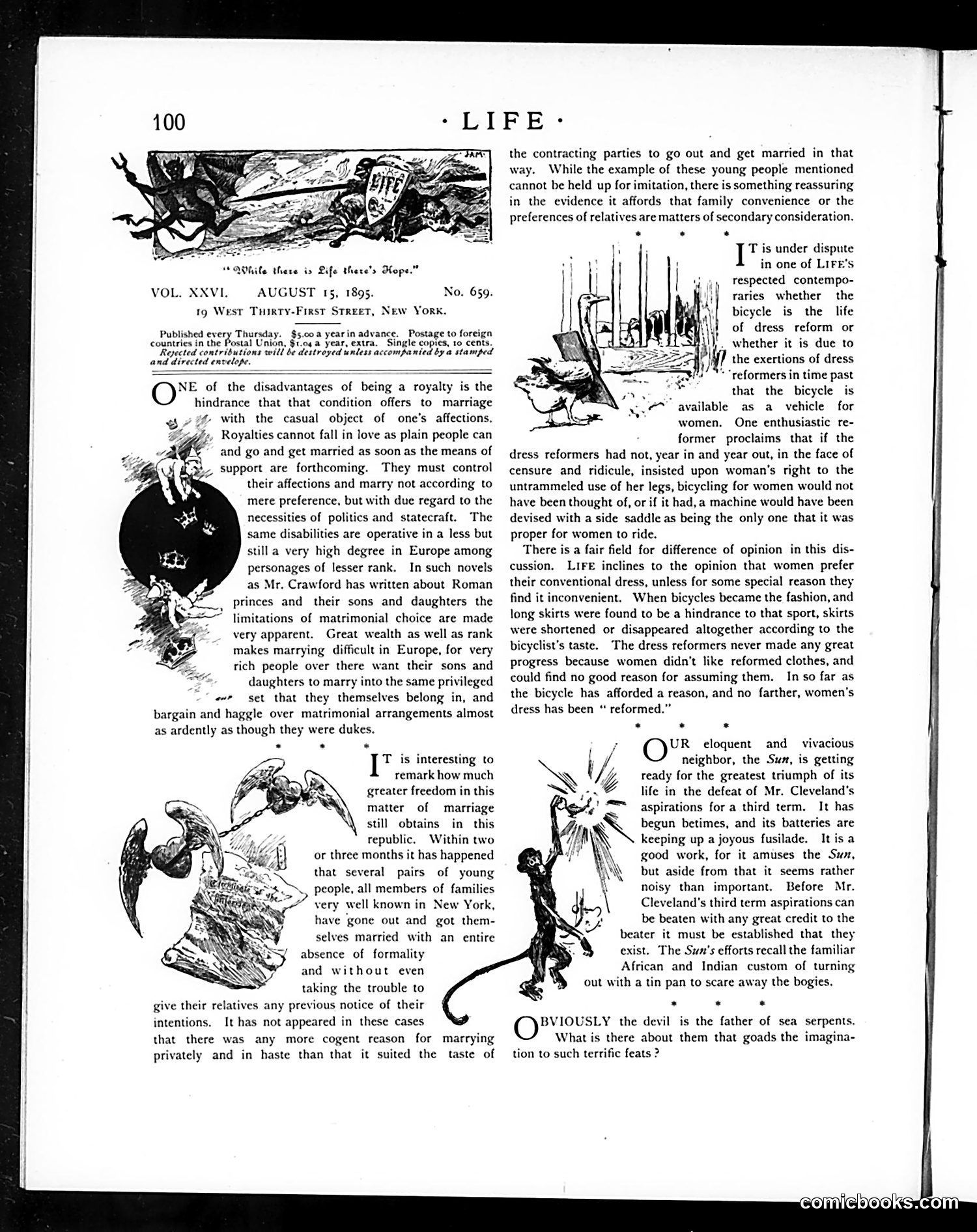
This page discusses marriage customs and dress reform, particularly regarding women's bicycle use. The text debates whether bicycles represent dress reform or are merely practical vehicles, referencing contemporary controversy over shortened skirts worn for cycling. The cartoons satirize this debate: one illustration shows a demon or devil figure (likely representing opposition to reform), while another depicts what appears to be a imp or mischievous creature disturbing a formal gathering—symbolizing how bicycle culture and dress reform disrupted Victorian social conventions. The article notes that dress reformers hadn't achieved much progress because women themselves resisted changes, but bicycles forced practical clothing adaptations. The final paragraph shifts to mocking Cleveland's political prospects, treating it as equally absurd to the reform debate. The overall satire targets Victorian anxieties about women's changing roles and freedoms.
📄 Transcribed text from this page (OCR, searchable)
Machine-transcribed from the original scan — historical spelling and the odd misread are preserved.
- LIFE: While there is Life there's Hope.” VOL. XXVI. AUGUST 15, 1895. No. 659. 1g West Tuirty-First STREET, New York, Published every Thursday. $5.coa yearin advance. Postage to foreign countries in the Postal Union, $t.o4 a year, extra. Single copies, 10 cents. Regected contributions will be destroyed unless accompanied by a stamped and directed envelope. of the disadvantages of being a royalty is the hindrance that that condition offers to marriage vé with the casual object of Z Z one’s affections. Royalties cannot fall in love as plain people can and go and get married as soon as the means of 1 Support are forthcoming. They must control their affections and marry not according to mere preference, but with due regard to the necessities of politics and statecraft. The same disabilities are operative in a less but still a very high degree in Europe among personages of lesser rank. In such novels as Mr. Crawford has written about Roman princes and their sons and daughters the limitations of matrimonial choice are made very apparent. Great wealth as well as rank makes marrying difficult in Europe, for very rich people over there want their sons and daughters to marry into the same privileged set that they themselves belong in, and bargain and haggle over matrimonial arrangements almost as ardently as though they were dukes. T is interesting to remark how much greater freedom in this matter of marriage still obtains in this republic. Within two or three months it has happened that several pairs of young \, people, all members of families very well known in New York, have gone out and got them- selves married with an entire absence of formality and without even taking the trouble to give their relatives any previous notice of their intentions. It has not appeared in these cases that there was any more cogent reason for marrying privately and in haste than that it suited the taste of the contracting parties to go out and get married in that way. While the example of these young people mentioned cannot be held up for imitation, there is something reassuring in the evidence it affords that family convenience or the preferences of relatives are matters of secondary consideration. . T is under dispute in one of LIFE's respected contempo- raries whether the bicycle is the life of dress reform or . whether it is due to the exertions of dress 7 ‘4° ** “reformers in time past re that the bicycle is ee available as a vehicle for women. One enthusiastic re- former proclaims that if the dress reformers had not, year in and year out, in the face of censure and ridicule, insisted upon woman's right to the untrammeled use of her legs, bicycling for women would not have been thought of, or if it had, a machine would have been devised with a side saddle as being the only one that it was proper for women to ride. There is a fair field for difference of opinion in this dis- cussion. LIFE inclines to the opinion that women prefer their conventional dress, unless for some special reason they find it inconvenient. When bicycles became the fashion, and long skirts were found to be a hindrance to that sport, skirts were shortened or disappeared altogether according to the bicyclist’s taste. The dress reformers never made any great progress because women didn’t like reformed clothes, and could find no good reason for assuming them. In so far as the bicycle has afforded a reason, and no farther, women’s dress has been “ reformed.” . . . UR eloquent and vivacious neighbor, the Sus, is getting ready for the greatest triumph of its life in the defeat of Mr. Cleveland's aspirations for a third term. It has begun betimes, and its batteries are keeping up a joyous fusilade. It isa good work, for it amuses the Su, but aside from that it seems rather noisy than important. Before Mr. Cleveland's third term aspirations can be beaten with any great credit to the beater it must be established that they exist. The Sun's efforts recall the familiar African and Indian custom of turning out with a tin pan to scare away the bogies. * * . BVIOUSLY the devil is the father of sea serpents. s there about them that goads the imagina- tion to such terrific feats ?