
A complete issue · 18 pages · 1895
Life — July 4, 1895
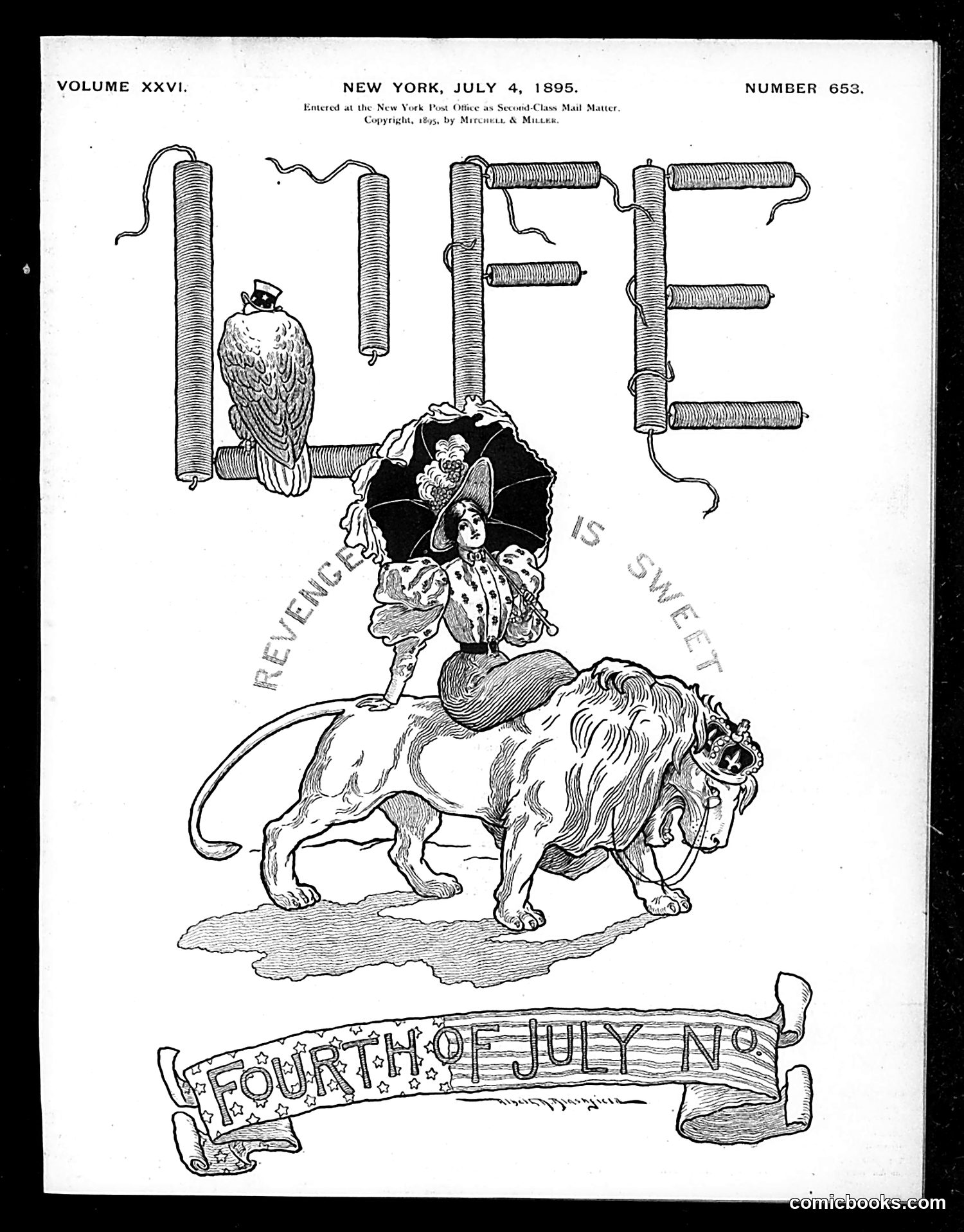
This is a Fourth of July-themed satirical illustration. The large letters "LIFE" are formed from coiled springs and mechanical parts, with a figure doing a handstand atop a lion labeled "REVENGE IS SWEET." The cartoon appears to critique American imperialism or foreign policy around 1895. The figure performing acrobatics on the lion likely represents the United States or American government, while the lion may symbolize a rival nation or colonial power. The "revenge is sweet" caption suggests the cartoon comments on retaliatory actions or aggressive posturing. The mechanical spring imagery and the Fourth of July banner below emphasize nationalism and patriotic themes, while the acrobatic performance suggests the cartoonist viewed such policies as undignified or performative rather than principled.
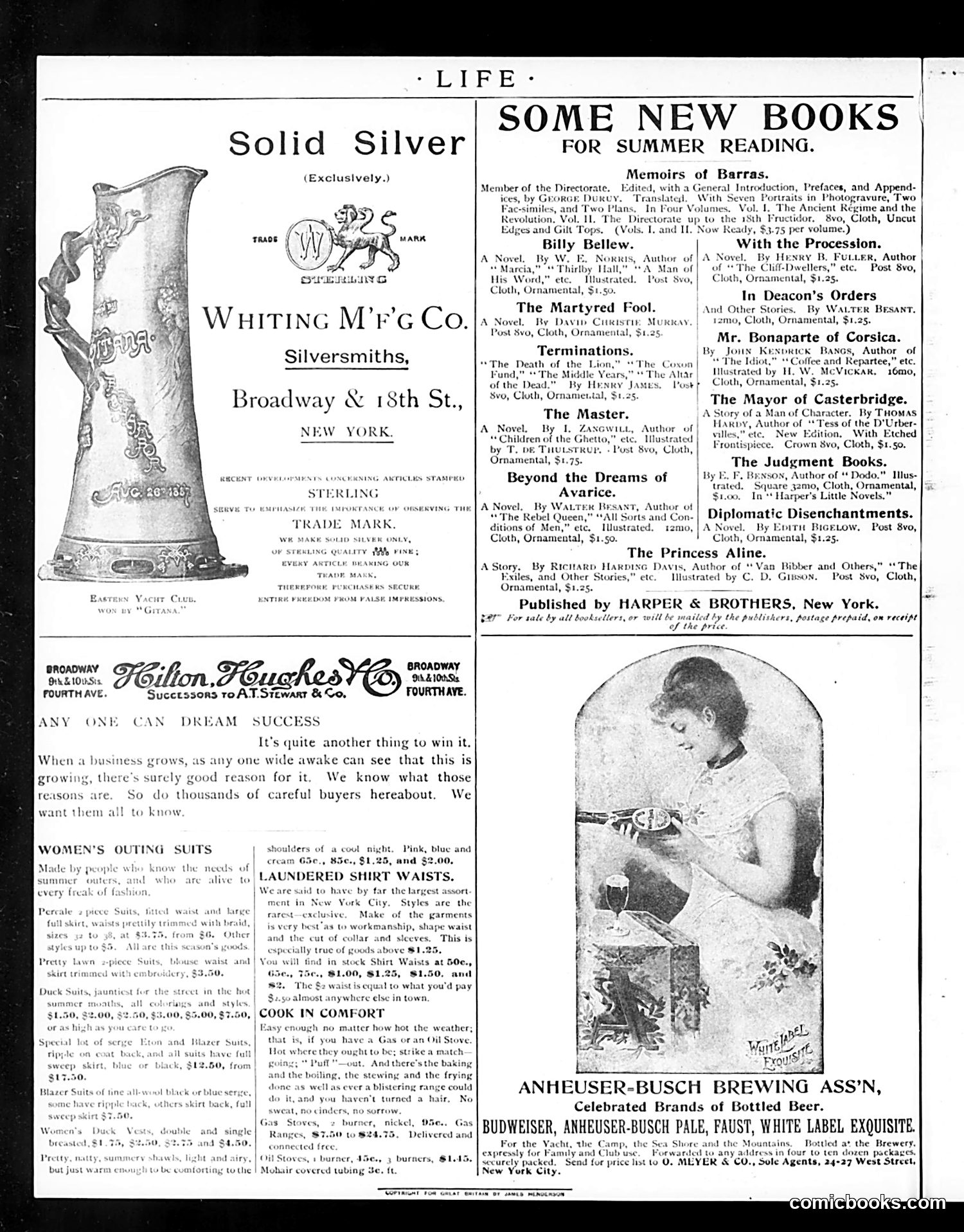
This page is primarily **advertising and book announcements** rather than political satire or cartoons. The upper portion advertises Whiting Manufacturing Company's solid silver goods, emphasizing their "sterling" quality and importance of observing proper hallmarks. Below that, Halton, Huckels & Co. promotes women's clothing—outing suits, shirt waists, and dresses designed for summer comfort. The largest image shows a **woman in domestic dress**, likely advertising cook stoves or household conveniences, emphasizing comfort during hot weather. Bottom advertisements promote Anheuser-Busch beer and various book titles suitable for summer reading (novels by authors like David Christie Murray and Walter Besant). **No significant political cartoon or satire is present**—this appears to be a standard commercial magazine page from the early 1900s, mixing consumer goods advertising with literary promotions.
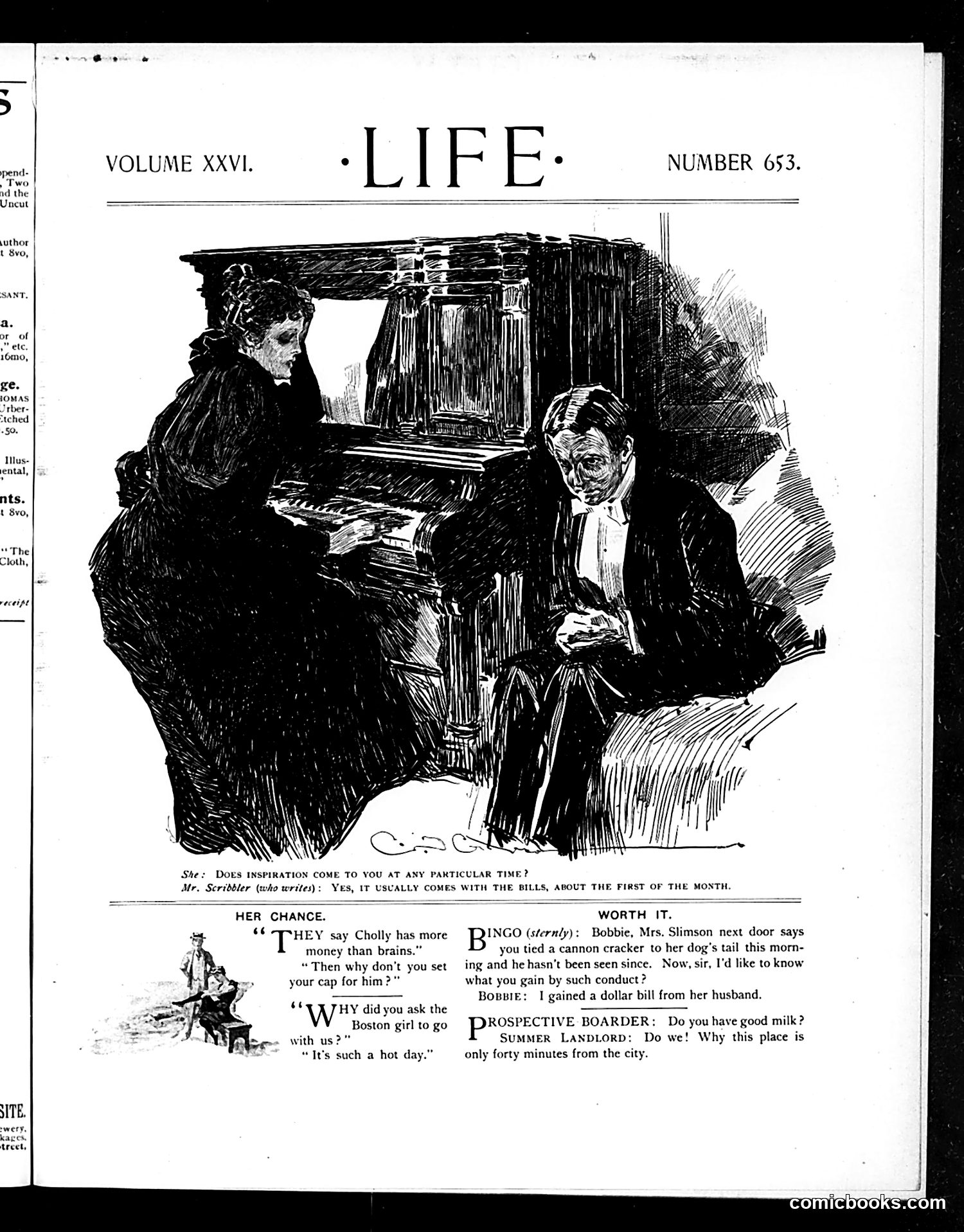
The main cartoon depicts a domestic scene with a woman at a piano and a man sitting nearby. The caption below reads: "Does inspiration come to you at any particular time?" / "Yes, it usually comes with the bills, about the first of the month." This is a straightforward marital satire about financial anxiety. The joke plays on "inspiration" (artistic or creative motivation) being triggered by the arrival of monthly bills—suggesting the wife composes music only when financial pressure demands it, likely to generate household income. The woman at the piano and man's resigned posture underscore the financial stress of the household. The lower section contains unrelated humor snippets about a Boston girl and boarding house conditions, typical of the magazine's miscellaneous joke format.
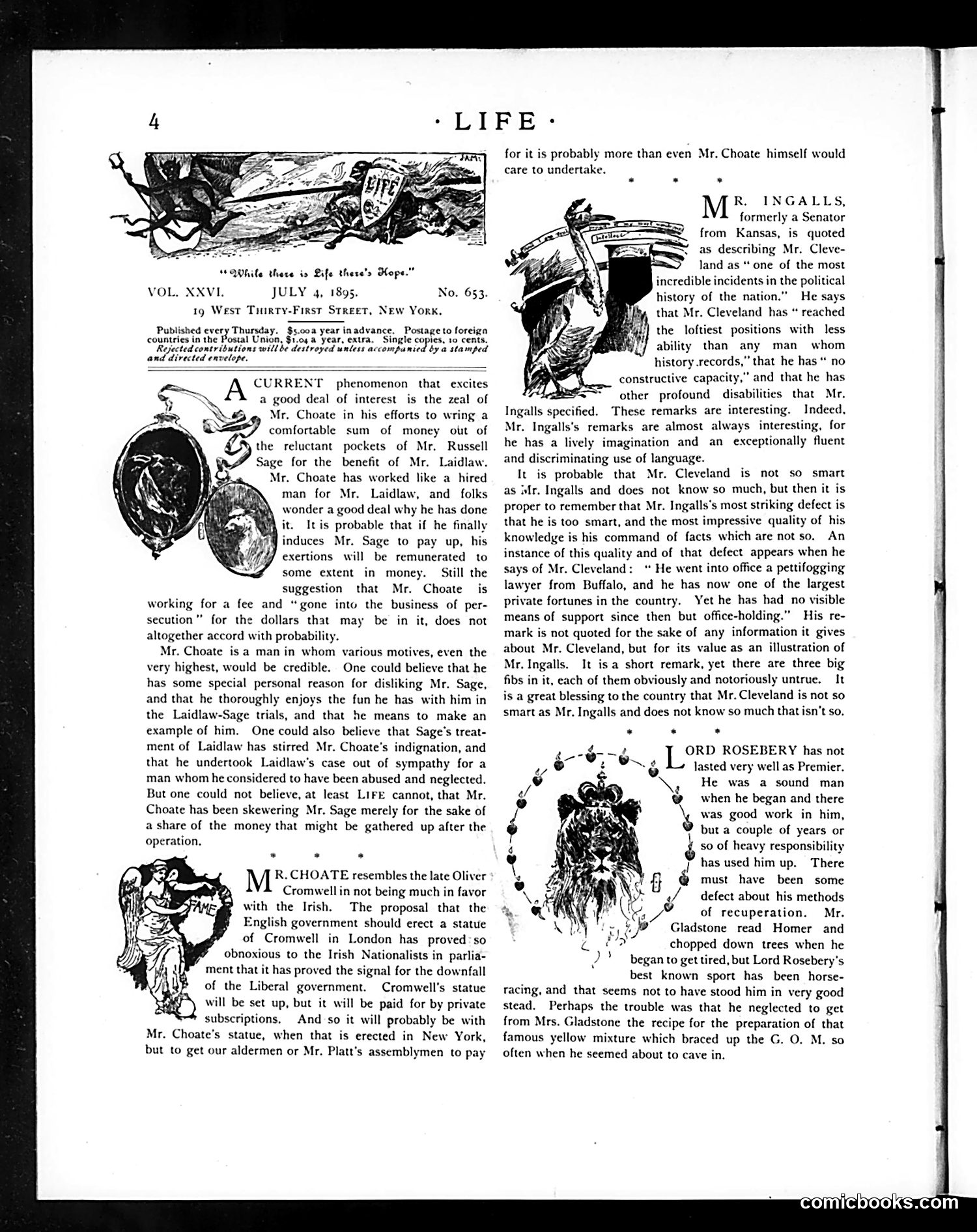
This page satirizes American political figures of the 1890s. The main text discusses **Mr. Choate** (likely Joseph H. Choate, a prominent lawyer/diplomat) working to extract money from **Russell Sage** (the wealthy financier) and **Mr. Laidlaw** for some unspecified "business of persecution." The satirist suggests Choate may be skewing facts against Sage out of personal animosity. The right column critiques **Mr. Cleveland** (President Grover Cleveland) through quotes from **Mr. Ingalls** (likely John James Ingalls, former Kansas Senator), mocking Cleveland's lack of constructive ability and his reliance on office-holding rather than genuine private wealth or accomplishment. The bottom discusses **Lord Rosebery**, Britain's recent Prime Minister, and his apparent inability to manage recovery efforts—possibly referencing his brief, unsuccessful 1894-1895 tenure.
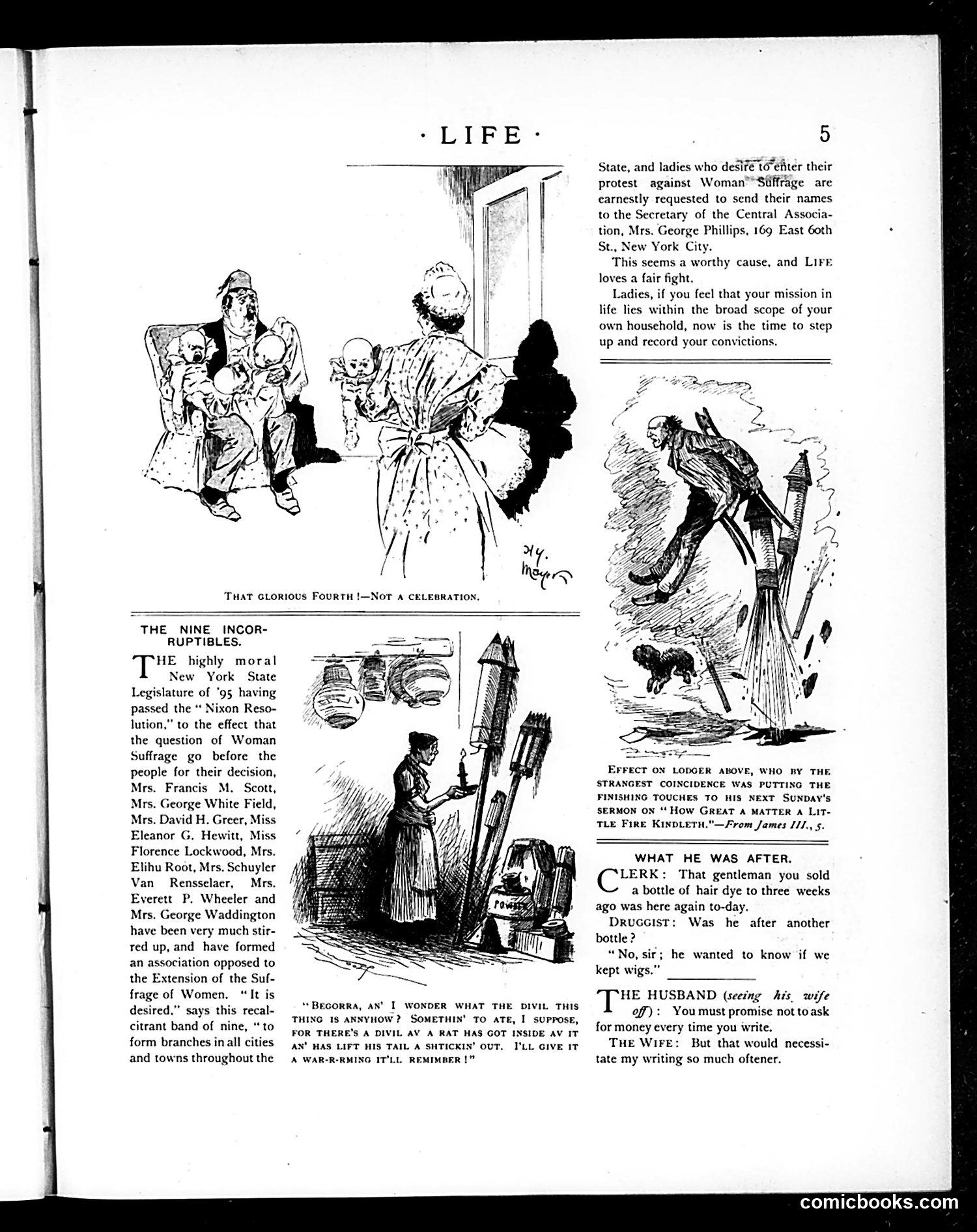
This 1915 *Life* magazine page satirizes opposition to women's suffrage. The top cartoon mocks anti-suffrage arguments by showing a woman activist confronting men who claim they're "too busy" with serious matters (implied: military/governmental concerns) to grant voting rights. The middle section, "The Nine Incorruptibles," lists nine prominent New York women legislators who've formally opposed suffrage extension. The accompanying cartoon depicts a woman literally "bearing arms"—stacking weapons and ammunition—a visual pun suggesting anti-suffrage women are complicit in violent, masculine politics while hypocritically denying themselves political voice. The bottom dialogue jokes about a hair-dye customer, offering comic relief while continuing the page's theme: mocking those who resist women's political participation as absurd or self-defeating.
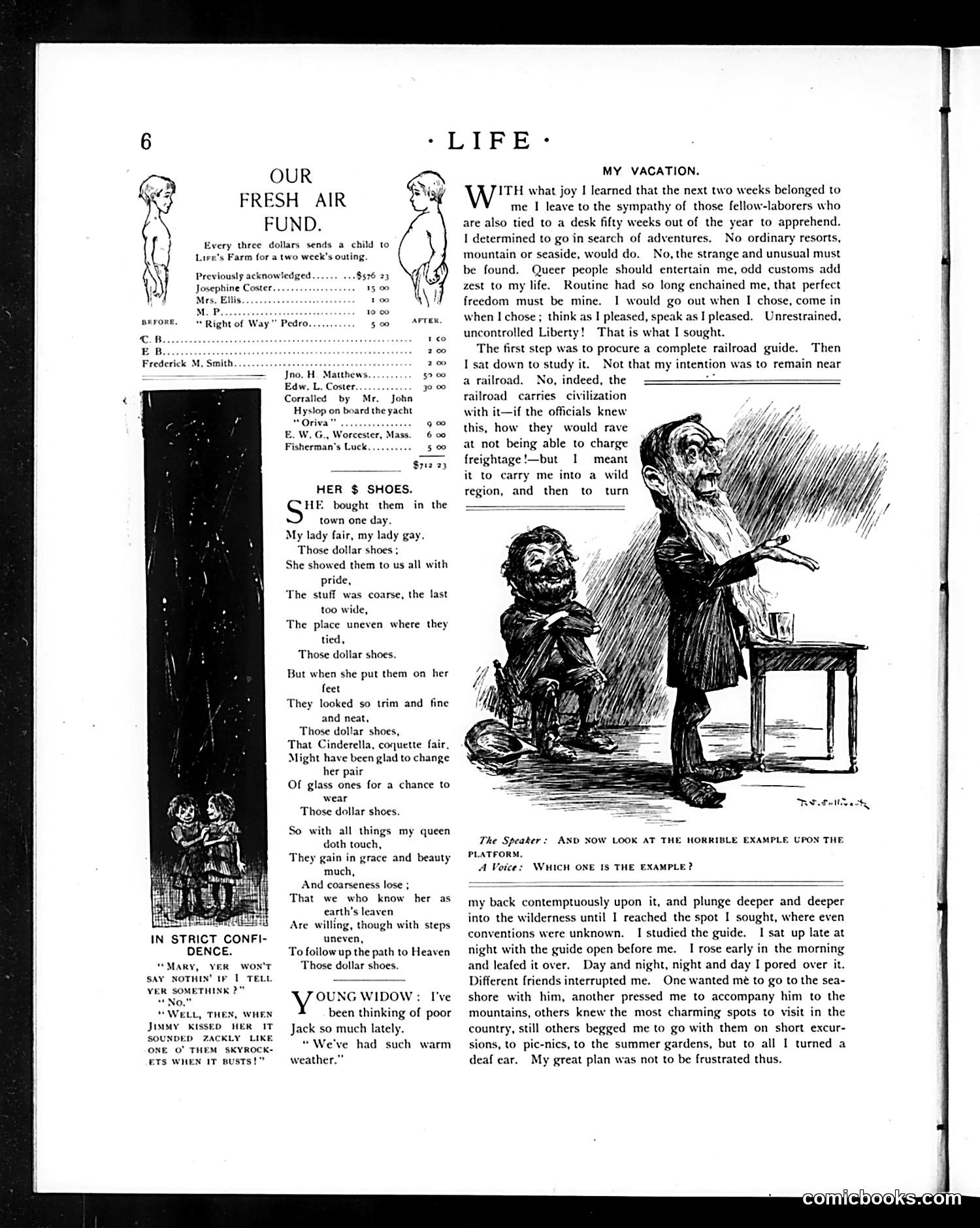
This page contains several distinct satirical pieces: **"Our Fresh Air Fund"** (top left): A before-and-after illustration showing a malnourished child transformed by a week at Life's Farm. The satirical point critiques charitable organizations' claims about their efficacy—the exaggerated contrast between the skeletal "before" and plump "after" child mocks both the programs' promised results and donors' gullible acceptance of such claims. **"Her $ Shoes"** (left column): A poem praising inexpensive shoes, celebrating how affordable footwear can rival luxury goods. This appears to be straightforward consumer satire about material aspirations. **"My Vacation"** (right): An article about railroad travel into wilderness, accompanied by a sketch showing what appears to be con artists or disreputable characters. The satire targets the gap between vacation fantasies and actual experiences. The page exemplifies Life magazine's social commentary through humor.
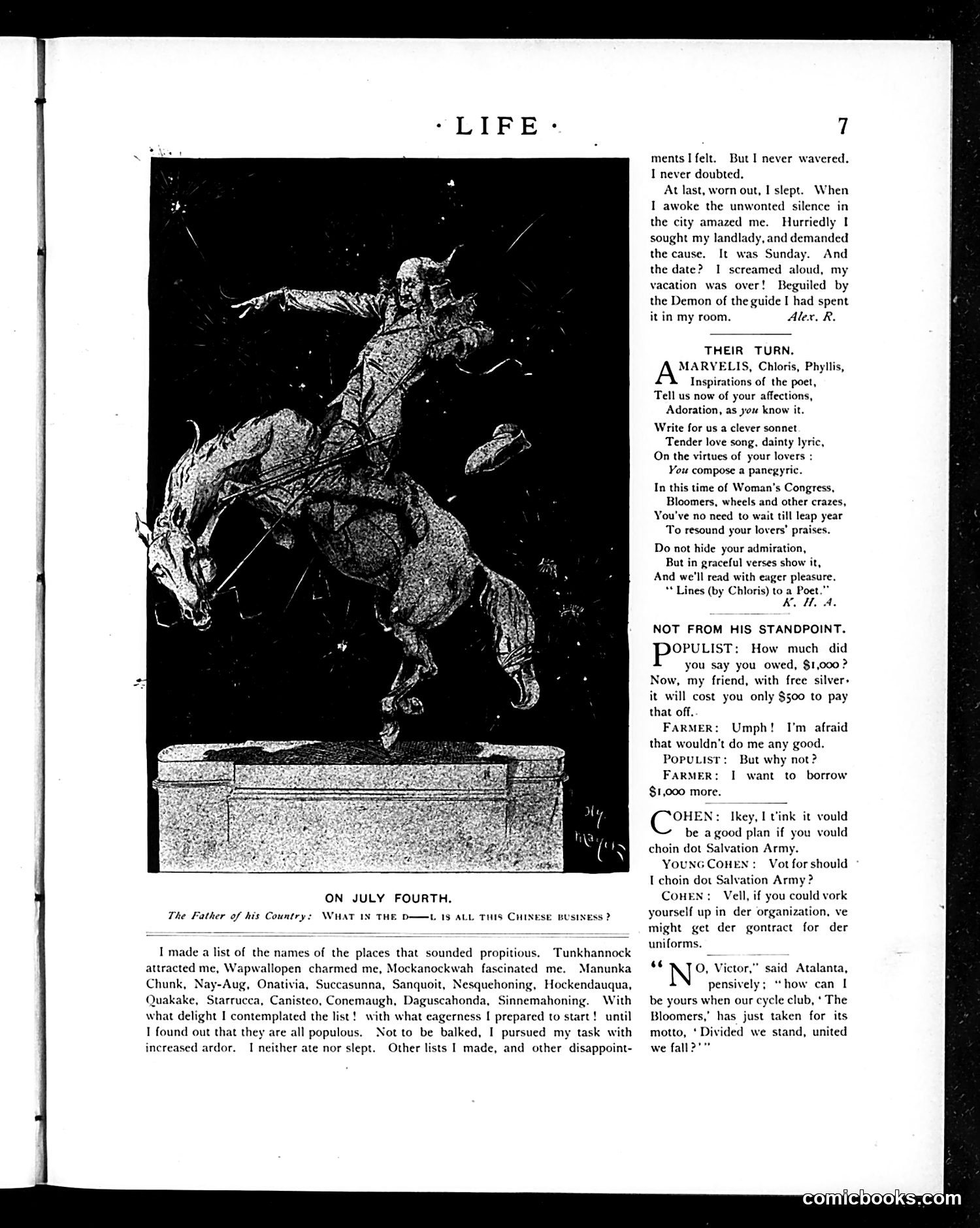
The main illustration depicts a figure on horseback in an exaggerated, dynamic pose, labeled "ON JULY FOURTH" with the caption "The Father of his Country: What is the D——l is all this Chinese business?" This appears to be a satirical commentary on American foreign policy, specifically regarding China. The artist invokes George Washington (implied as "Father of his Country") to question involvement in Chinese affairs—suggesting this contradicts traditional American principles of non-intervention. The accompanying text references Chinese place names, humorously suggesting confusion about distant, unfamiliar locations. The right-side content titled "THEIR TURN" contains humorous dialogues and verses mocking various social groups, typical of Life magazine's satirical approach. Without a specific date visible, the exact historical context remains unclear, though the reference to "Chinese business" suggests concerns about American imperial or interventionist policies in Asia.
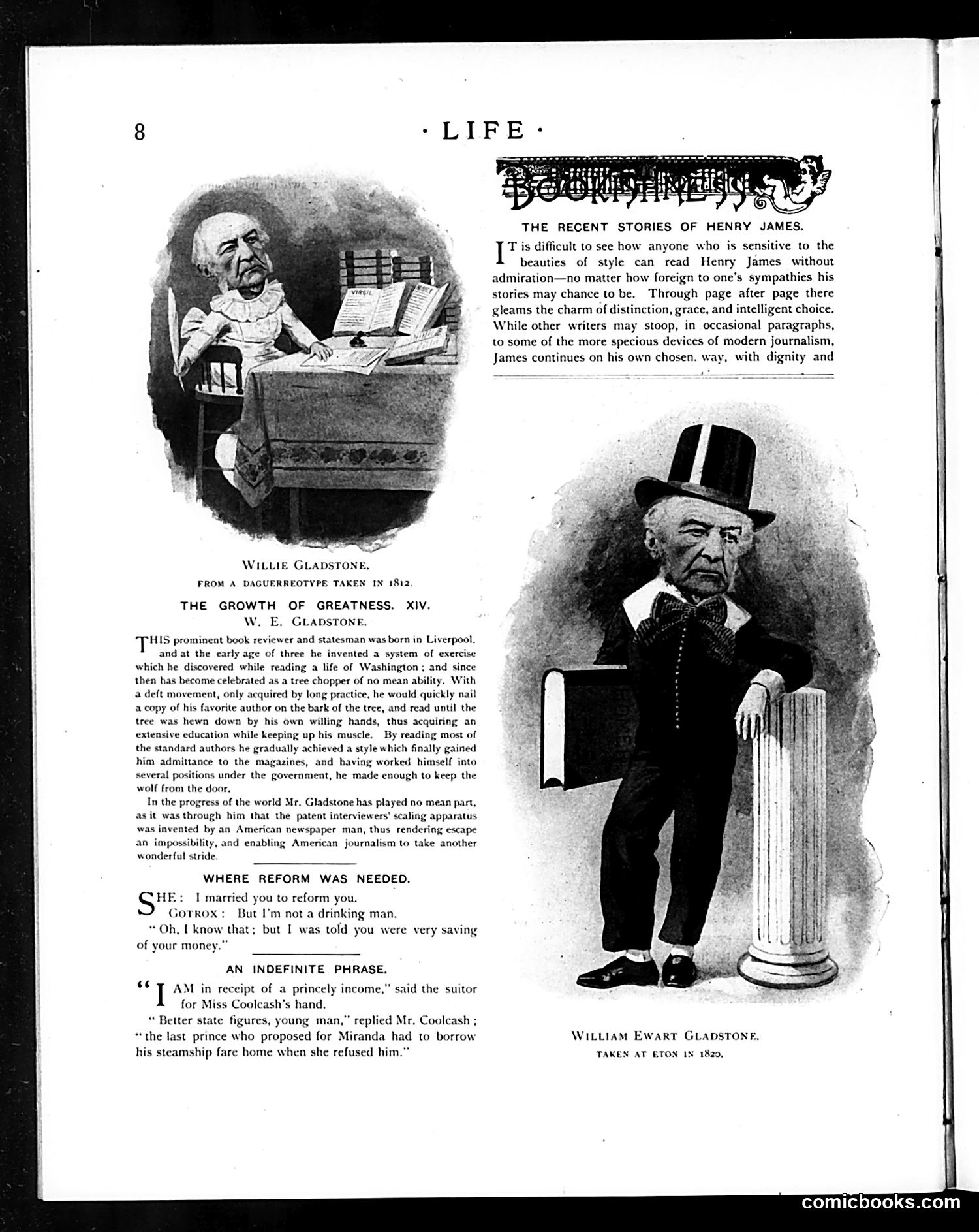
This page features a Henry James literary appreciation alongside two historical photographs. The top section praises James's refined prose style and dignified approach to writing, contrasting his restraint with sensationalist modern journalism. Below are two dated photographs labeled "Willie Gladstone" (1812) and "William Ewart Gladstone" (1822)—apparently showing the same person at different ages. These document William Ewart Gladstone, the prominent British Prime Minister and statesman. The page includes two comedic dialogue snippets: "Where Reform Was Needed" depicts a wife's failed attempt to reform a drinking husband, and "An Indefinite Phrase" presents a satirical exchange about financial proposals, likely poking fun at Victorian courtship customs or political negotiations of the era.
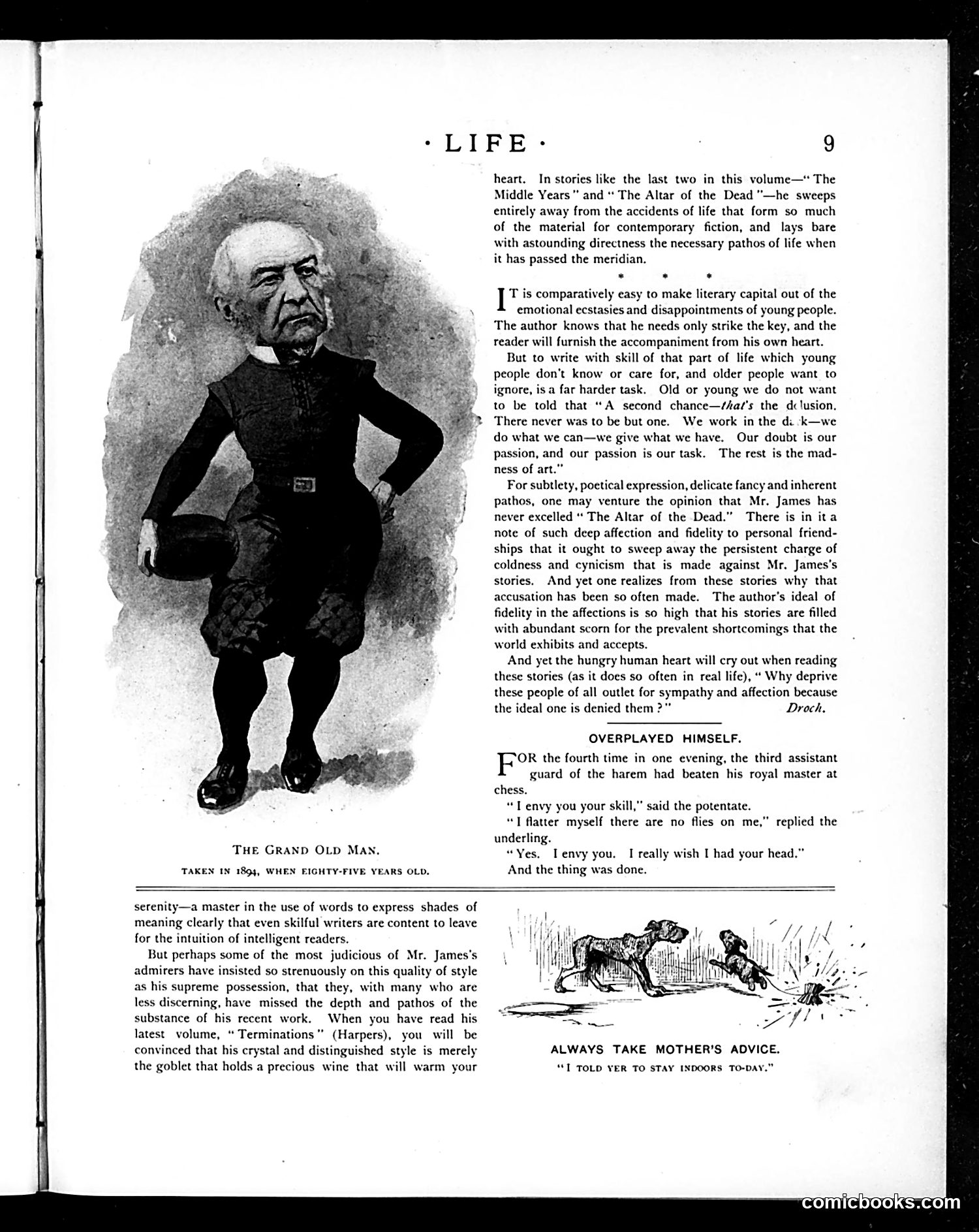
This page contains literary criticism about author Henry James, accompanied by two illustrations. **"The Grand Old Man"** portrait (left) depicts an elderly gentleman taken in 1894 at age eighty-five. The text praises James's subtle, sophisticated writing style while acknowledging criticism that his work lacks emotional warmth and accessibility. The reviewer defends James against charges of coldness, arguing his stories demonstrate deep affection and fidelity to human experience. **"Overplayed Himself"** (bottom right) is a brief comedic sketch about a harem guard who beats a royal master at chess, then boasts about it—resulting in swift punishment. The caption "Always Take Mother's Advice" suggests the moral: hubris leads to downfall. Both pieces exemplify Life magazine's blend of literary commentary and humorous social observation.
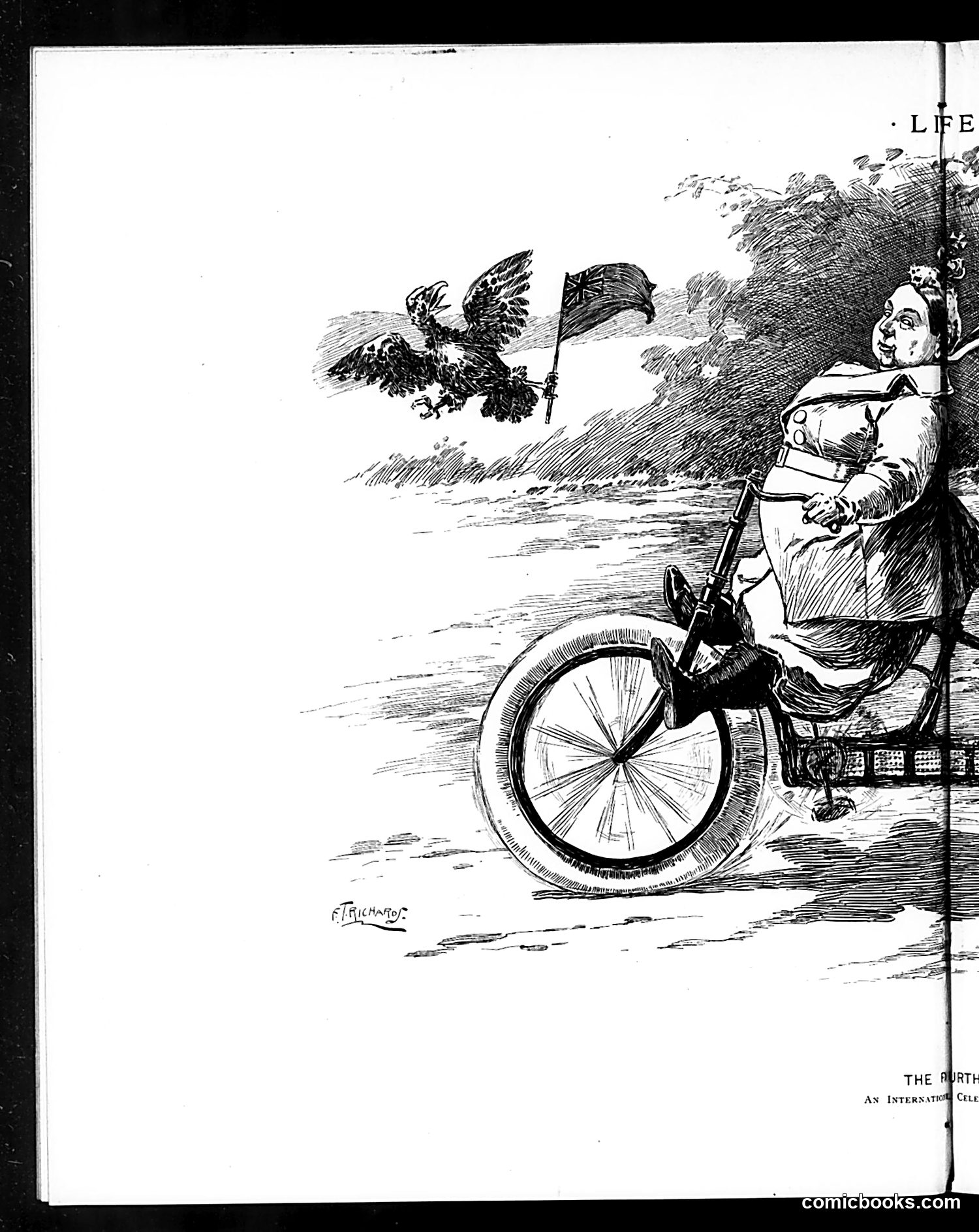
This ink sketch depicts a rotund figure seated by a bicycle near a body of water, watching an eagle carry a flag. The artist's signature reads "F. Buchanan" (or similar). The cartoon likely represents **American isolationism or neutrality**, a common theme in Life magazine during the early 20th century. The eagle carrying the flag suggests military or national involvement, while the seated figure—appearing reluctant or passive—may represent America or American leadership resisting intervention in foreign conflicts. The bicycle and casual pose suggest complacency or unwillingness to act. Without clearer historical dating or caption text visible, the specific political reference remains uncertain, though this aligns with debates about American military engagement during the 1910s-1920s era.
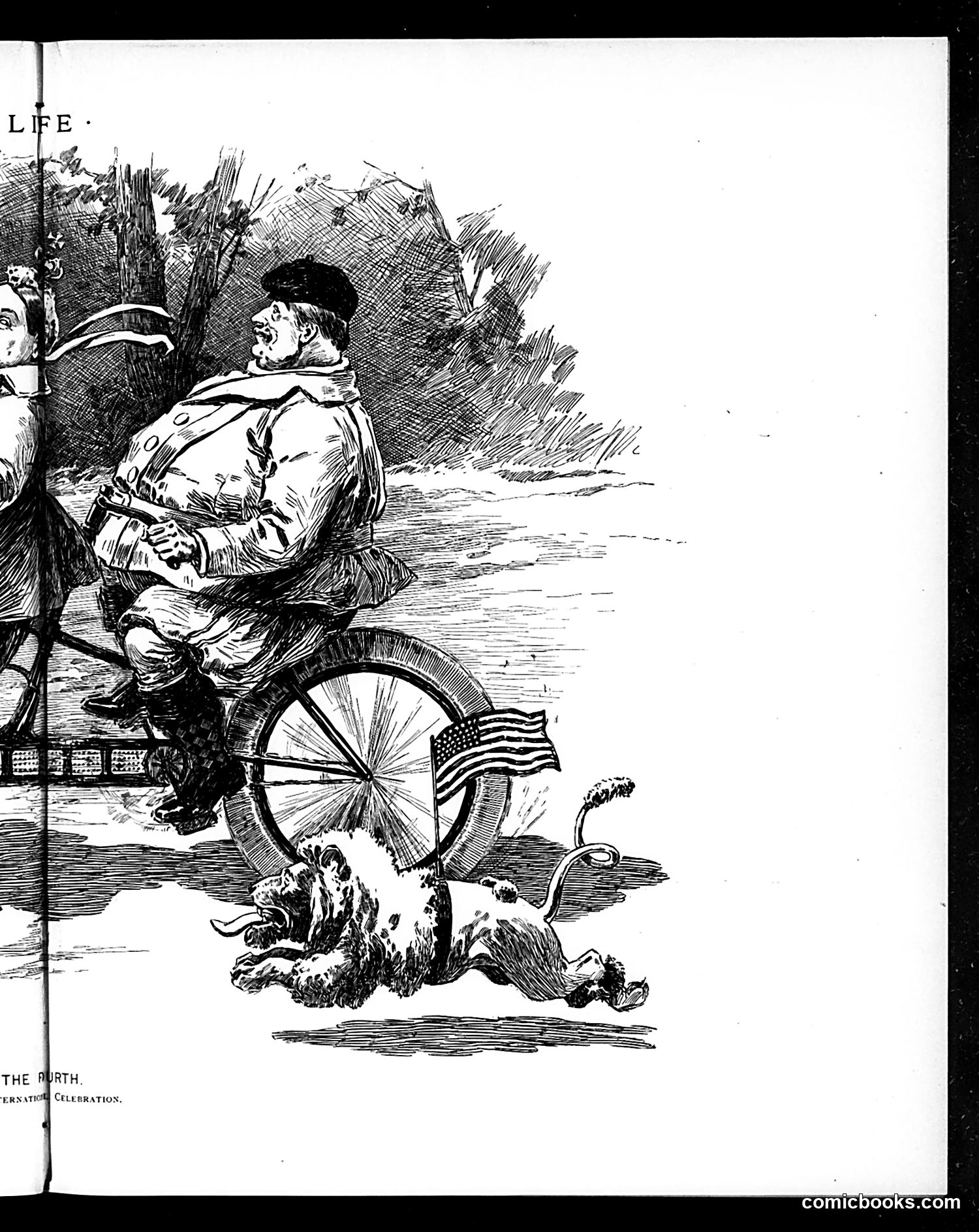
This appears to be a satirical cartoon titled "Life" (visible at top left), with text referencing "The Birth" and "Celebration" (bottom left). The image depicts a rotund, well-fed figure sitting contentedly by a bicycle bearing an American flag. A dog sits beneath the bicycle. The corpulent man's comfortable posture and satisfied expression contrast with the sparse landscape behind him. The satire likely critiques American prosperity or complacency during a specific historical period—possibly addressing wealth disparity, materialism, or the leisure enjoyed by privileged Americans. The bicycle with the flag suggests patriotic imagery being associated with indulgence. Without clearer dating or additional context, the specific political moment remains unclear, though the style suggests early-to-mid 20th century.
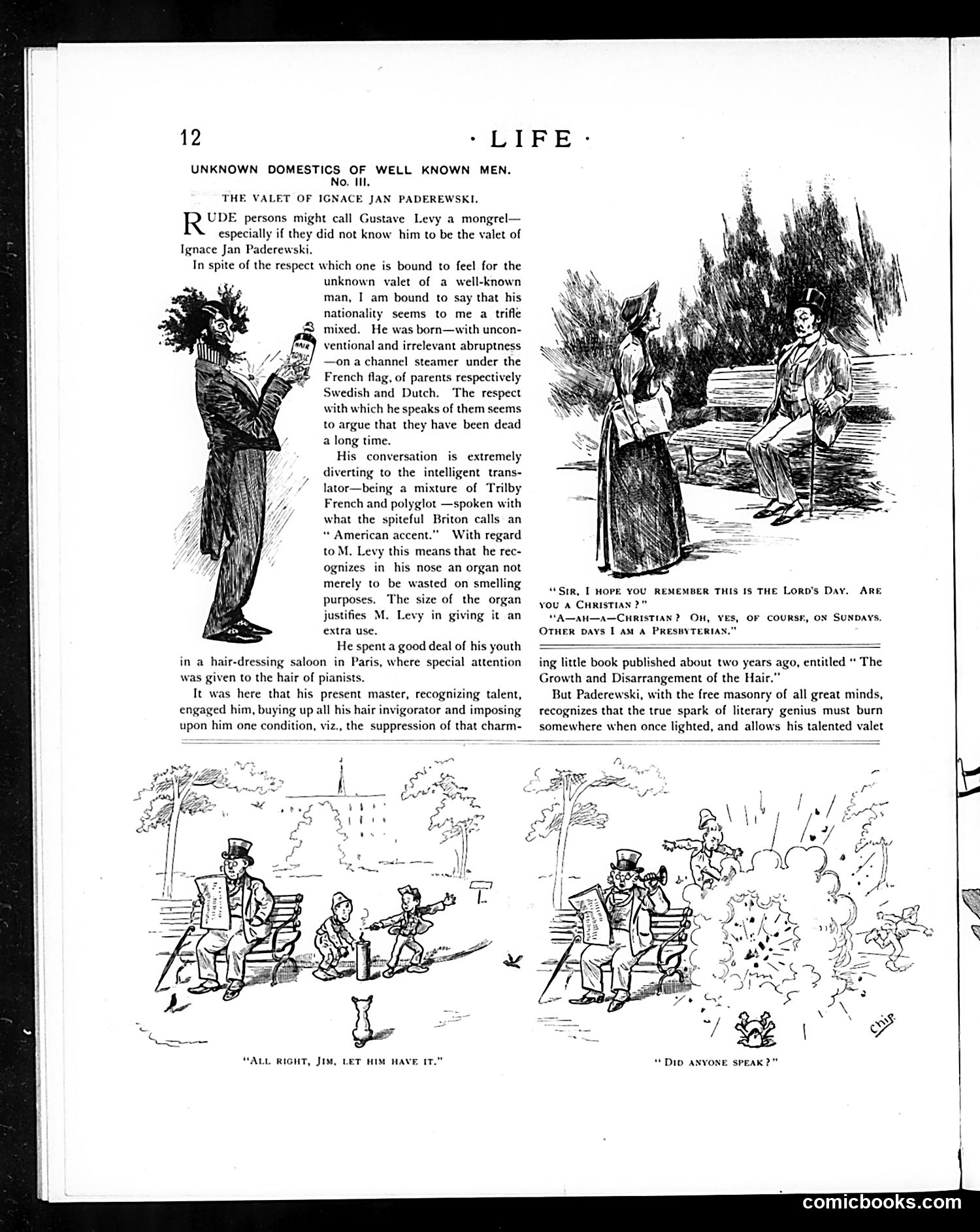
This satirical article mocks Gustave Levy, valet to the famous Polish pianist Ignace Jan Paderewski, by presenting his supposedly mixed heritage and comic personality as noteworthy precisely *because* he serves a celebrated man. The humor relies on: 1. **Class satire**: Life presents an obscure servant's biography as if he were notable—he's only interesting due to his employer's fame. 2. **Ethnic mockery**: Levy's mixed parentage (born on a channel steamer to Swedish-Dutch parents, speaks polyglot French with an "American accent") is treated as comically cosmopolitan and confused. 3. **The religious joke** (bottom cartoon): When asked if he's Christian, Levy replies he's Christian on Sundays but Presbyterian other days—mocking both religious hypocrisy and his muddled identity. 4. **The implicit point**: Paderewski's genius supposedly extends to recognizing literary talent in his valet's hair-care writing, further absurdly inflating Levy's importance. The cartoons show Levy as a well-meaning but buffoonish character, embodying turn-of-century American attitudes toward European immigrants and servants.
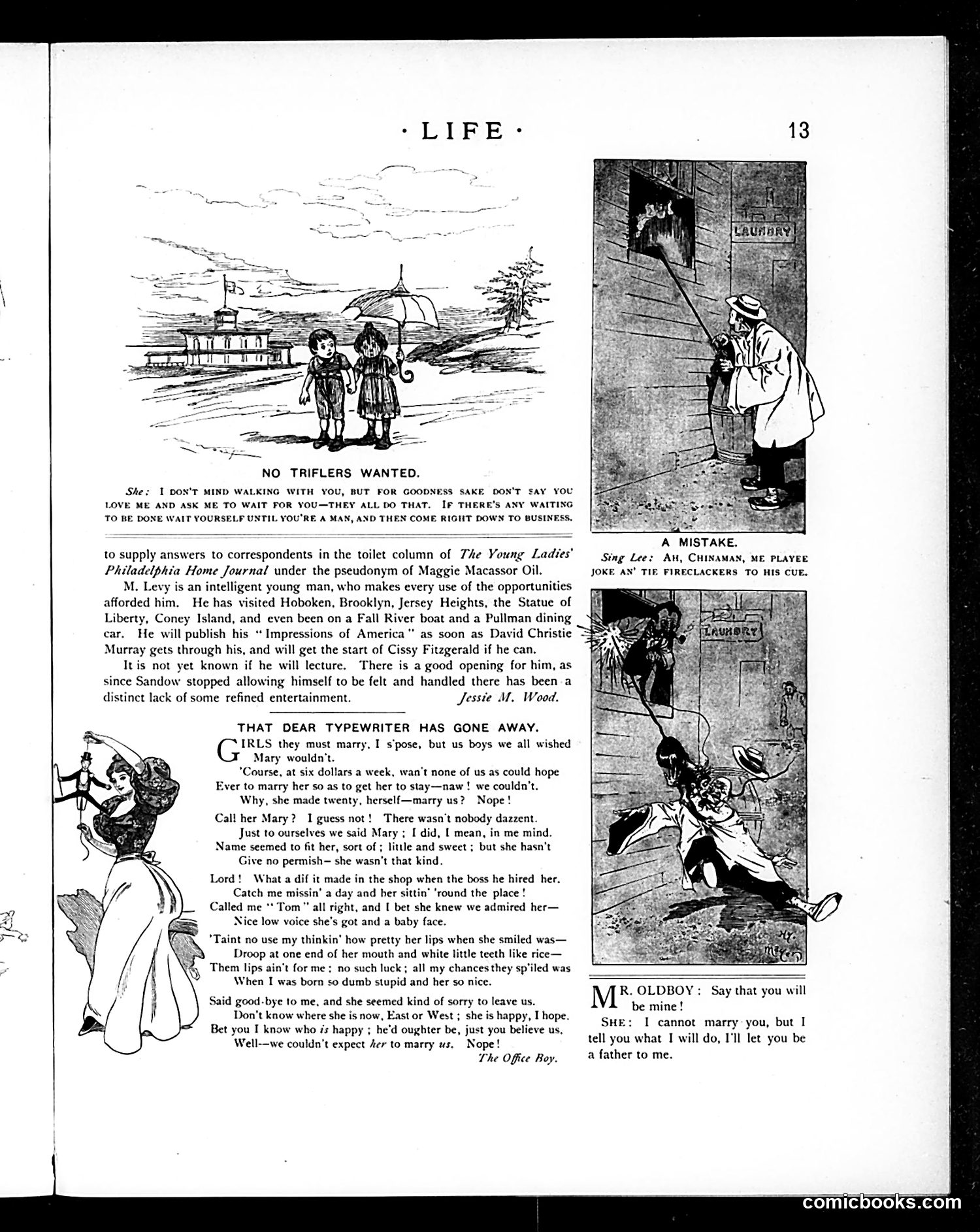
This page contains three separate pieces mocking courtship and romance conventions: **"No Triflers Wanted"** depicts a modern woman rejecting sentimental male posturing—she demands men stop pledging eternal love and instead "come right down to business" once they're financially established. This satirizes the clash between Victorian romance rhetoric and emerging female pragmatism. **"That Dear Typewriter Has Gone Away"** is a sentimental poem from an office boy mourning a female coworker ("Mary") who quit her $20/week job after marrying. The narrator romanticizes her unattainability while accepting her departure as inevitable—satire of working-class male sentimentality and the period's assumption that marriage meant women left employment. **"A Mistake"** shows a Chinese man (rendered in period-offensive dialect) tying firecrackers to a billiards player's cue as a "joke," while below, an elderly man proposes to a young woman who accepts his offer to be "a father" instead of a husband—dark humor about unsuitable age-gap relationships. All three pieces satirize contemporary romantic and gender dynamics of the early 1900s.
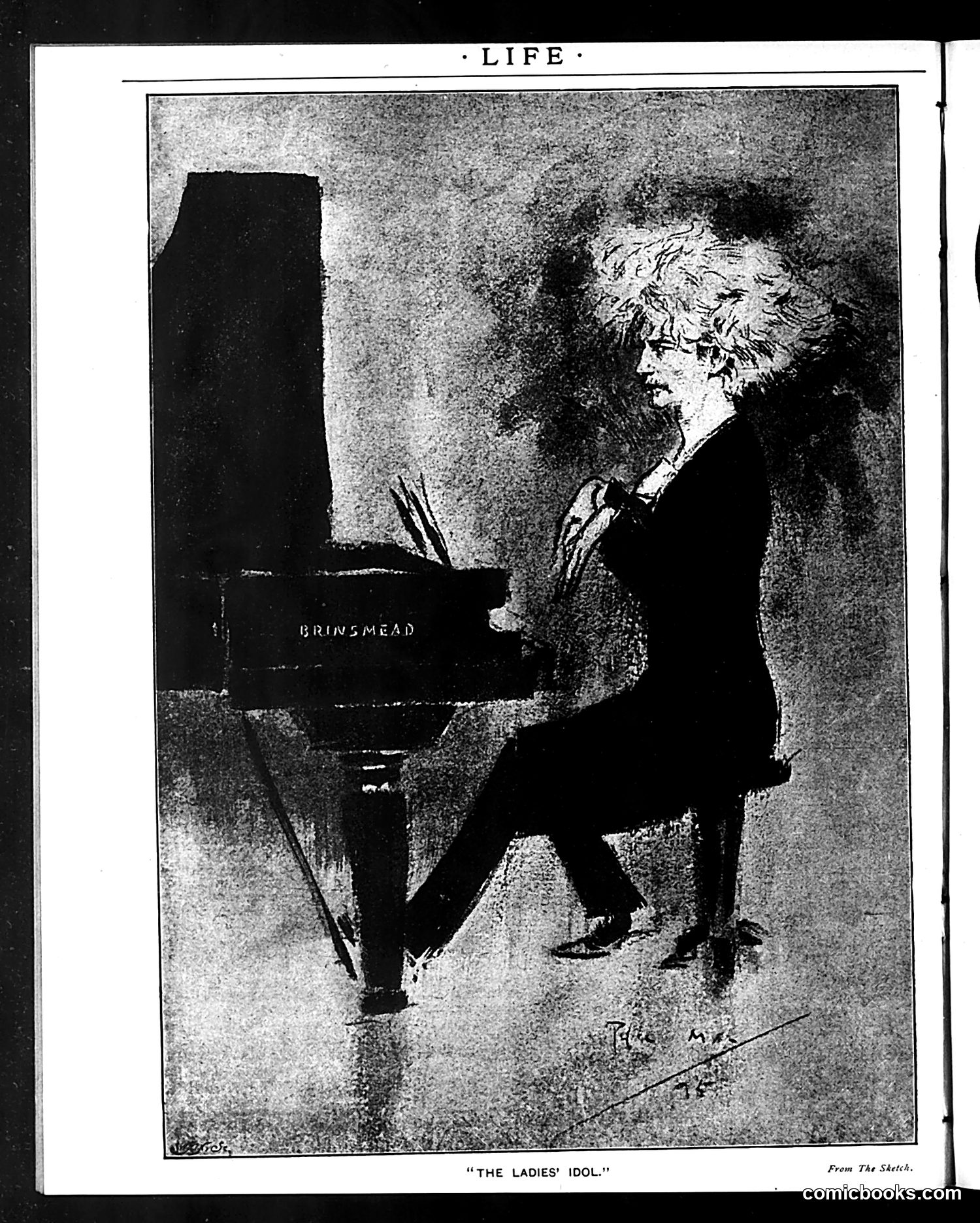
This satirical cartoon from *Life* magazine depicts a man at a piano labeled "BRINGSMEAD" (likely a piano manufacturer). The title "The Ladies' Idol" appears to mock the romanticization of male musicians or performers in popular culture. The sketch, credited as "From The Sketch" (another British publication), uses caricature to satirize how women were portrayed as infatuated with talented male artists. The well-dressed figure at the piano represents the "idol" — suggesting society's tendency to elevate musicians to celebrity status and attribute to them an almost irresistible appeal to female audiences. This reflects early 20th-century social satire about gender dynamics and cultural celebrity worship, poking fun at both the pretensions of musicians and the stereotype of female admirers.
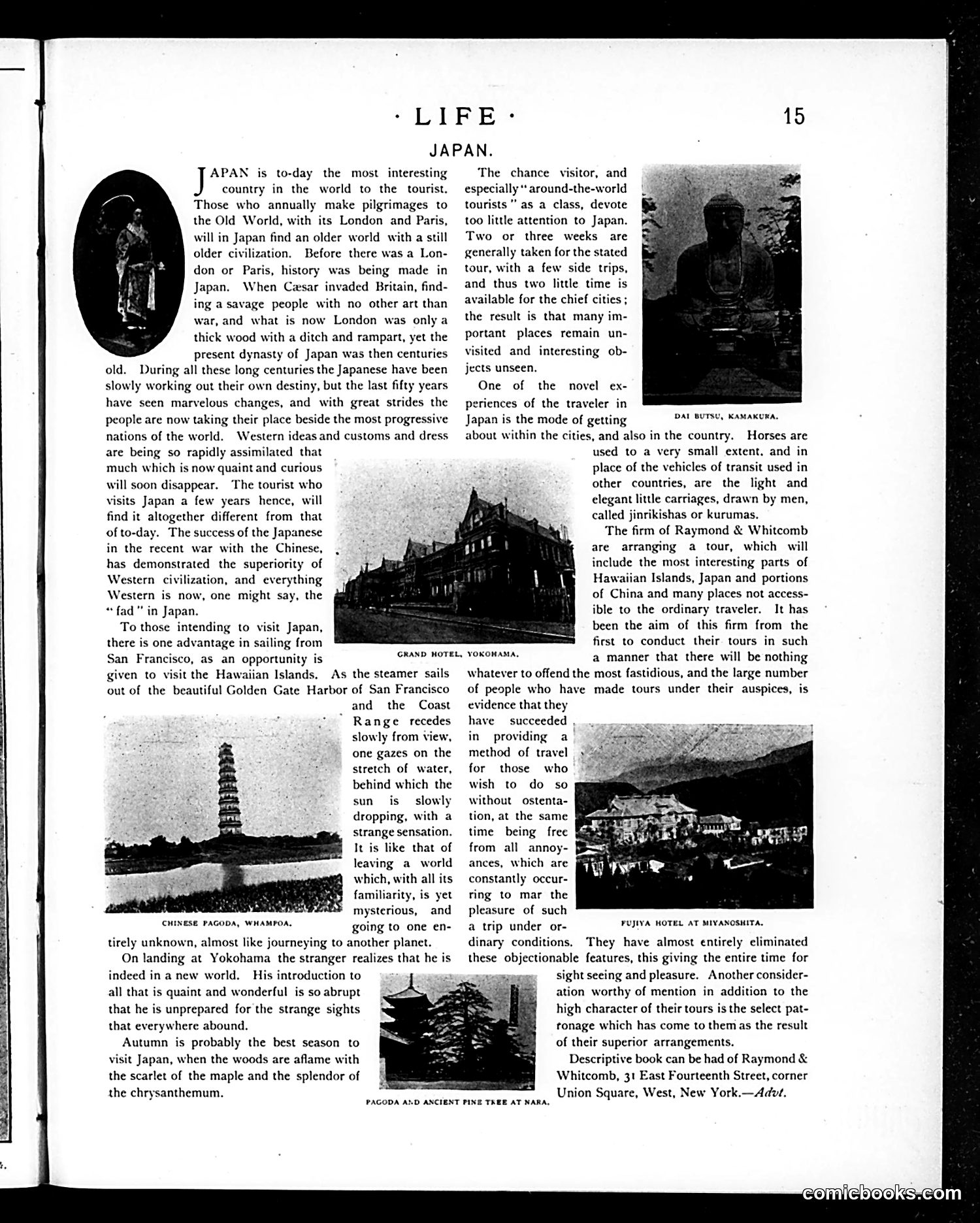
This is not a political cartoon but rather a travel advertisement disguised as editorial content. The page promotes tourism to Japan and specifically advertises Raymond & Whitcomb travel tours. The text presents Japan as an exotic, ancient civilization newly modernizing through Western influence—particularly after Japan's recent military victory over China (likely the First Sino-Japanese War, 1894-95). The article frames Japanese adoption of Western ways as inevitable progress. The accompanying photographs show Japanese landmarks (pagodas, hotels, ancient sites) to entice American tourists. The piece emphasizes Japan's accessibility via San Francisco steamship routes and Hawaii, while noting that typical tourists spend insufficient time there. Rather than satire, this represents genuine Period enthusiasm for "Oriental" tourism among wealthy Americans. The underlying message: Japan is becoming safe and civilized enough (through Westernization) for refined travelers to visit comfortably.
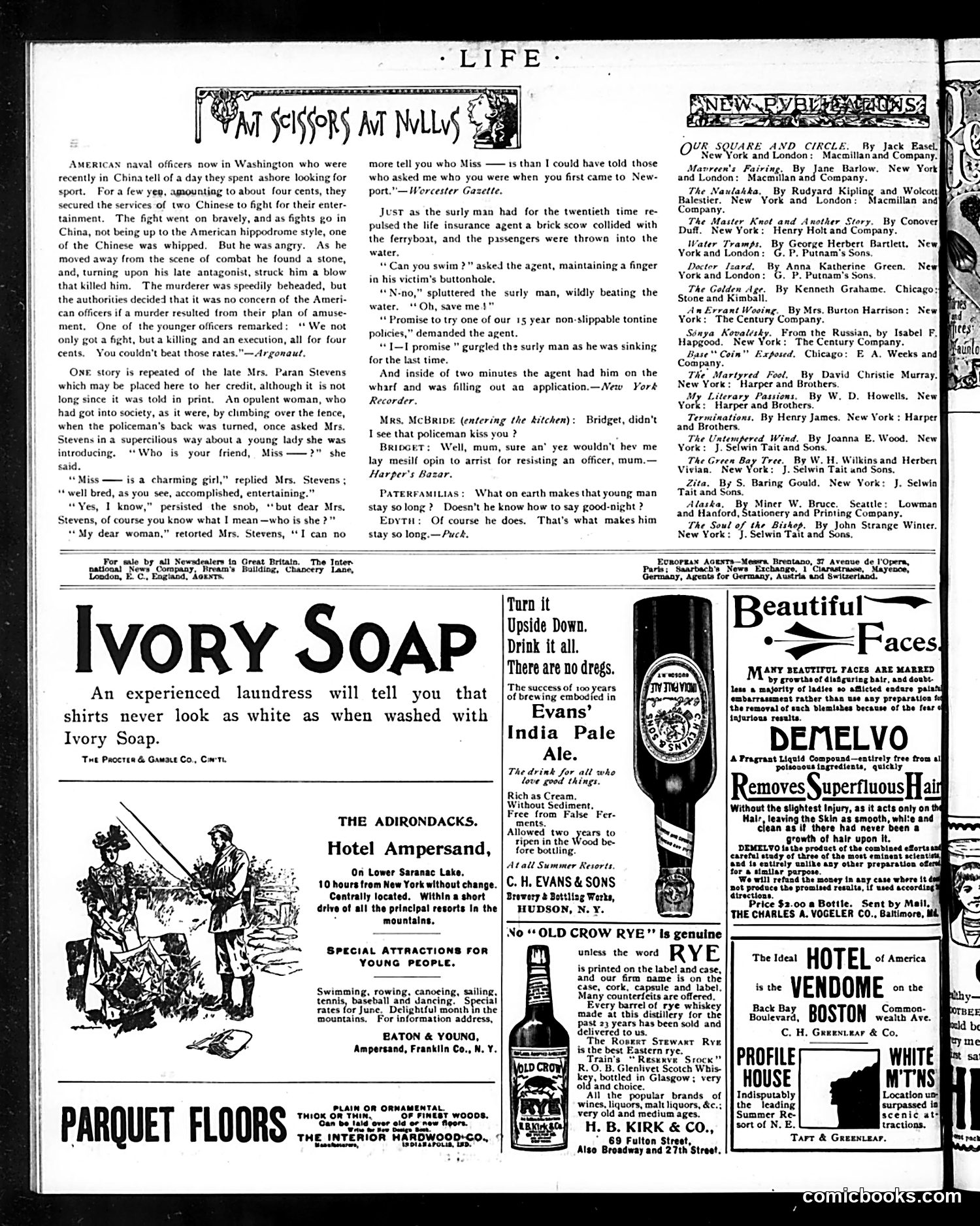
This page contains **primarily short humorous anecdotes and advertisements**, not political cartoons. The featured stories satirize **American social behavior and attitudes**: 1. **Naval officers in China**: American servicemen pay Chinese men to fight for entertainment; when one is killed, authorities dismiss it as irrelevant. The satire criticizes American indifference to non-Western lives and casual cruelty disguised as sport. 2. **Mrs. Paran Stevens anecdote**: A newly wealthy woman asks about another woman's social background. Stevens's cutting reply—essentially "I couldn't tell you who *you* were either when you arrived"—mocks social climbers and nouveau riche pretension. 3. **Insurance agent**: A desperate drowning man agrees to buy a life insurance policy to be saved. The joke targets aggressive salesmanship that exploits human vulnerability. 4. **Servant and policeman**: A maid accepts a kiss to avoid arrest for "resisting an officer"—dark satire on power imbalances and coercion. The page reflects turn-of-century American attitudes: condescension toward colonized peoples, class anxiety, and cynicism about commerce and authority.
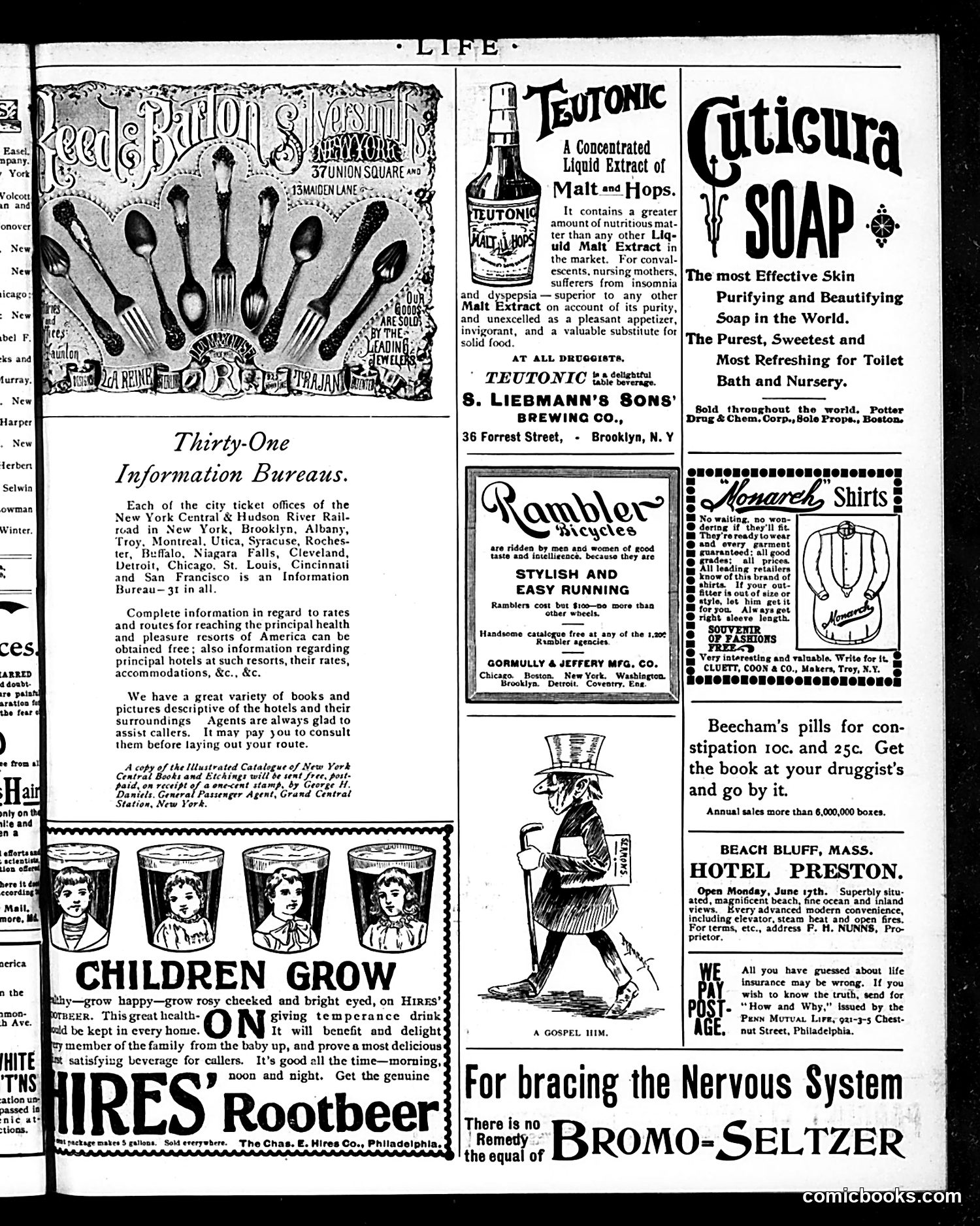
This page is primarily **advertising**, not satirical content or political cartoons. It features several product advertisements typical of an early 20th-century American magazine: Notable ads include: Hires' Rootbeer (a temperance beverage marketed to children), Teutonic malt extract (for invalids and nursing mothers), Rambler bicycles, Cuticura soap, Beecham's pills, and Bromo-Seltzer. There's also a notice about "Thirty-One Information Bureaus" operated by the New York Central & Hudson River Railroad. The page reflects contemporary attitudes: patent medicines marketed for ailments without regulation, gender-specific products (malt extract for mothers), and bicycles as modern consumer goods. The language emphasizes purity, health benefits, and scientific superiority—common marketing claims of the era when such products lacked FDA oversight. This is documentary primarily of advertising conventions and consumer culture, not satire.
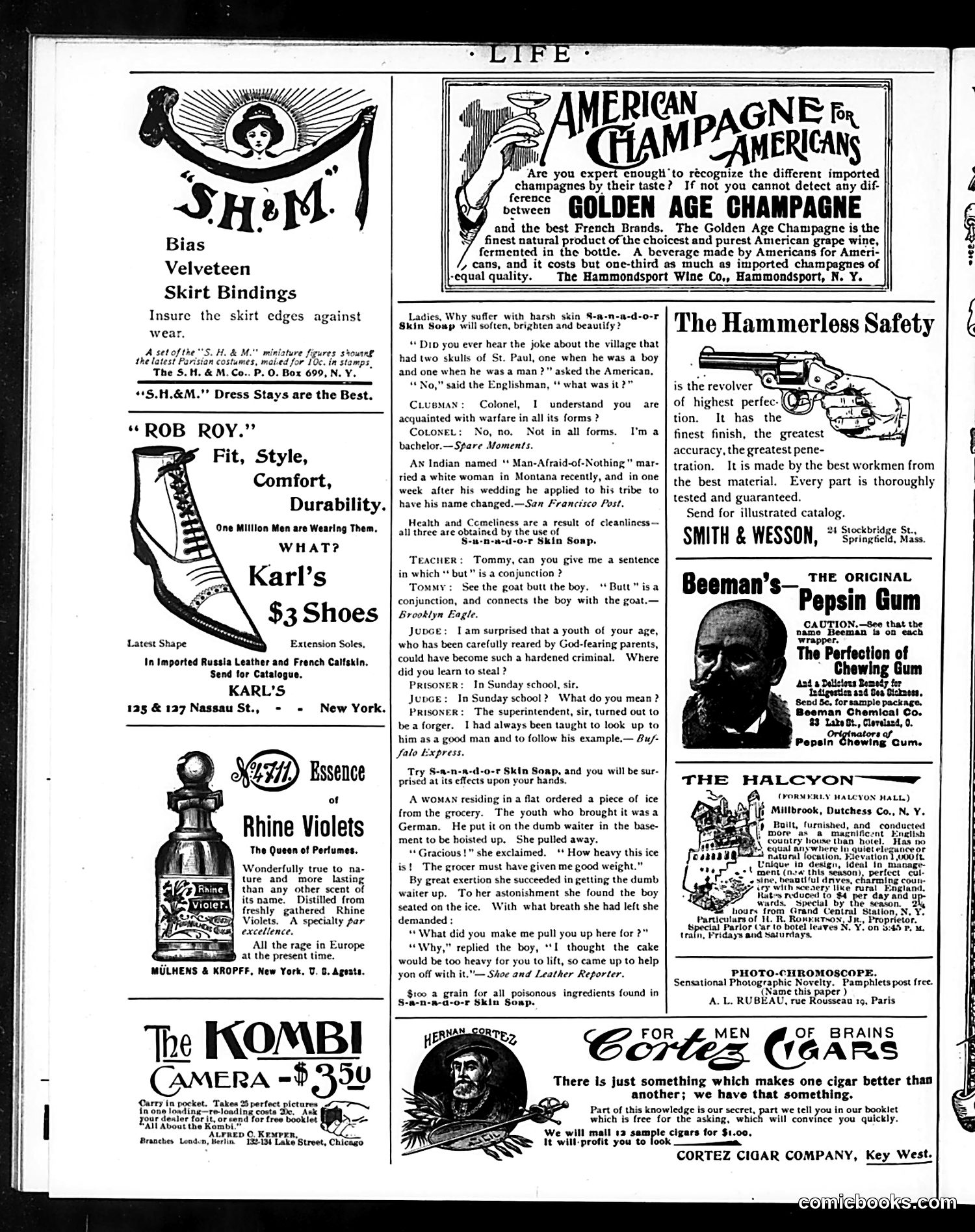
This is primarily an **advertising page** with minimal editorial content. The few jokes included are filler material typical of early 20th-century magazines: **Notable content:** - A brief anecdote mocking an American tourist's ignorance (the St. Paul skulls joke) - Ethnic humor about an Indian named "Man-Afraid-of-Nothing" who wants to change his name after marriage—playing on stereotypes - Classroom jokes about grammar and a prisoner crediting a forger superintendent for teaching him to steal - A slapstick story about a German delivery boy riding on ice up a dumbwaiter **The satire is mild**: mostly gentle wordplay and situational humor. The ethnic content reflects period attitudes without apparent deeper political intent. The page is dominated by **period product advertisements** (champagne, shoes, cameras, skin soap, perfume)—typical Life magazine revenue. No significant political cartoons or social commentary appear on this particular page.