
Life, 1895-07-04 · page 4 of 18
Life — July 4, 1895 — page 4: what you’re looking at
What you’re looking at
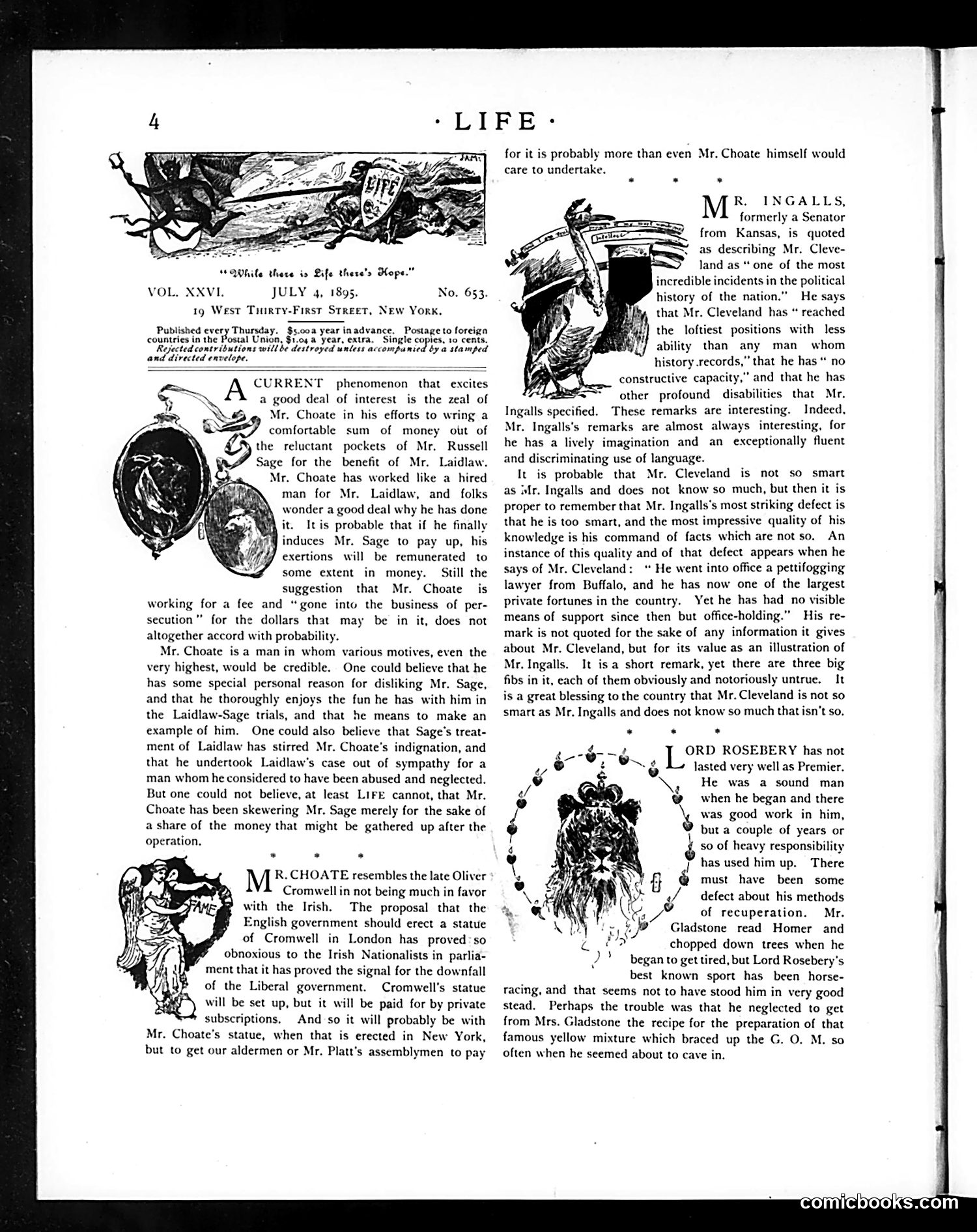
This page satirizes American political figures of the 1890s. The main text discusses **Mr. Choate** (likely Joseph H. Choate, a prominent lawyer/diplomat) working to extract money from **Russell Sage** (the wealthy financier) and **Mr. Laidlaw** for some unspecified "business of persecution." The satirist suggests Choate may be skewing facts against Sage out of personal animosity. The right column critiques **Mr. Cleveland** (President Grover Cleveland) through quotes from **Mr. Ingalls** (likely John James Ingalls, former Kansas Senator), mocking Cleveland's lack of constructive ability and his reliance on office-holding rather than genuine private wealth or accomplishment. The bottom discusses **Lord Rosebery**, Britain's recent Prime Minister, and his apparent inability to manage recovery efforts—possibly referencing his brief, unsuccessful 1894-1895 tenure.
📄 Transcribed text from this page (OCR, searchable)
Machine-transcribed from the original scan — historical spelling and the odd misread are preserved.
‘LIFE: “HQMMile there is Life there's Hope.” XXXVI. JULY 4, 1895. No. 653. 1g West Tiurty-First Street, New York, VOL. Published every Thursday. $s.00a year inadvance. Postage to foreiga countries in the Postal Union, $104 a Year, extra. Single copies, 10 cents, Rejected contributions will be destroyed unless accompanied by a stamped and directed envelope. phenomenon that excites a good deal of interest is the zeal of Mr. Choate in his efforts to wring a comfortable sum of money out of he reluctant pockets of Mr. Russell Sage for the benefit of Mr. Laidlaw. Mr. Choate has worked like a hired man for Mr. Laidlaw, and folks wonder a good deal why he has done it. It is probable that if he finally induces Mr. Sage to pay up, his exertions will be remunerated to some extent in money. Still the suggestion that Mr. Choate is working for a fee and “gone into the business of per- secution” for the dollars that may be in it, does not altogether accord with probability. Mr. Choate is a man in whom various motives, even the very highest, would be credible. One could believe that he has some special personal reason for disliking Mr. Sage, and that he thoroughly enjoys the fun he has with him in the Laidlaw-Sage trials, and that he means to make an example of him. One could also believe that Sage’s treat- ment of Laidlaw has stirred Mr. Choate’s indignation, and that he undertook Laidlaw’s case out of sympathy for a man whom he considered to have been abused and neglected. But one could not believe, at least LIFE cannot, that Mr. Choate has been skewering Mr. Sage merely for the sake of a share of the money that might be gathered up after the operation, . . * R. CHOATE resembles the late Oliver Cromwell in not being much in favor with the Irish. The proposal that the English government should erect a statue of Cromwell in London has proved: so obnoxious to the Irish Nationalists in parlia- ment that it has proved the signal for the downfall of the Liberal government. Cromwell's statue will be set up, but it will be paid for by private subscriptions, And so it will probably be with Mr. Choate’s statue, when that is erected in New York, but to get our aldermen or Mr. Platt’s assemblymen to pay for it is probably more than even Mr. Choate himself would care to undertake. . . R. INGALLS, formerly a Senator from Kansas, is quoted as describing Mr. Cleve- land as “ one of the most incredible incidents in the political history of the nation.” He says that Mr. Cleveland has “ reached the loftiest positions with less ability than any man whom history.records,” that he has “ no constructive capacity,” and that he has other profound disabilities that Mr. Ingalls specified. These remarks are interesting. Indeed, Mr. Ingalls's remarks are almost always interesting, for he has a lively imagination and an exceptionally fluent and discriminating use of language. It is probable that Mr. Cleveland is not so smart as Mr. Ingalls and does not know so much, but then it is proper to remember that Mr. Ingalls’s most striking defect is that he is too smart, and the most impressive quality of his knowledge is his command of facts which are not so. An instance of this quality and of that defect appears when he says of Mr. Cleveland: ‘ He went into office a pettifogging lawyer from Buffalo, and he has now one of the largest private fortunes in the country. Yet he has had no visible means of support since then but office-holding.” His re- mark is not quoted for the sake of any information it gives about Mr. Cleveland, but for its value as an illustration of Mr. Ingalls. It isa short remark, yet there are three big fibs in it, each of them obviously and notoriously untrue, It is a great blessing to the country that Mr. Cleveland is not so smart as Mr. Ingalls and does not know so much that isn’t so. * ORD ROSEBERY has not lasted very well as Premier. He was a sound man when he began and there was good work in him, but a couple of years or so of heavy responsibility } has used him up, There § @ must have been some defect about his methods of recuperation. Mr. Gladstone read Homer and chopped down trees when he began to get tired, but Lord Rosebery’s best known sport has been horse- racing, and that seems not to have stood him in very good stead. Perhaps the trouble was that he neglected to get from Mrs. Gladstone the recipe for the preparation of that famous yellow mixture which braced up the G. O. M. so often when he seemed about to cave in. \y ‘ a