
Life, 1895-07-04 · page 9 of 18
Life — July 4, 1895 — page 9: what you’re looking at
What you’re looking at
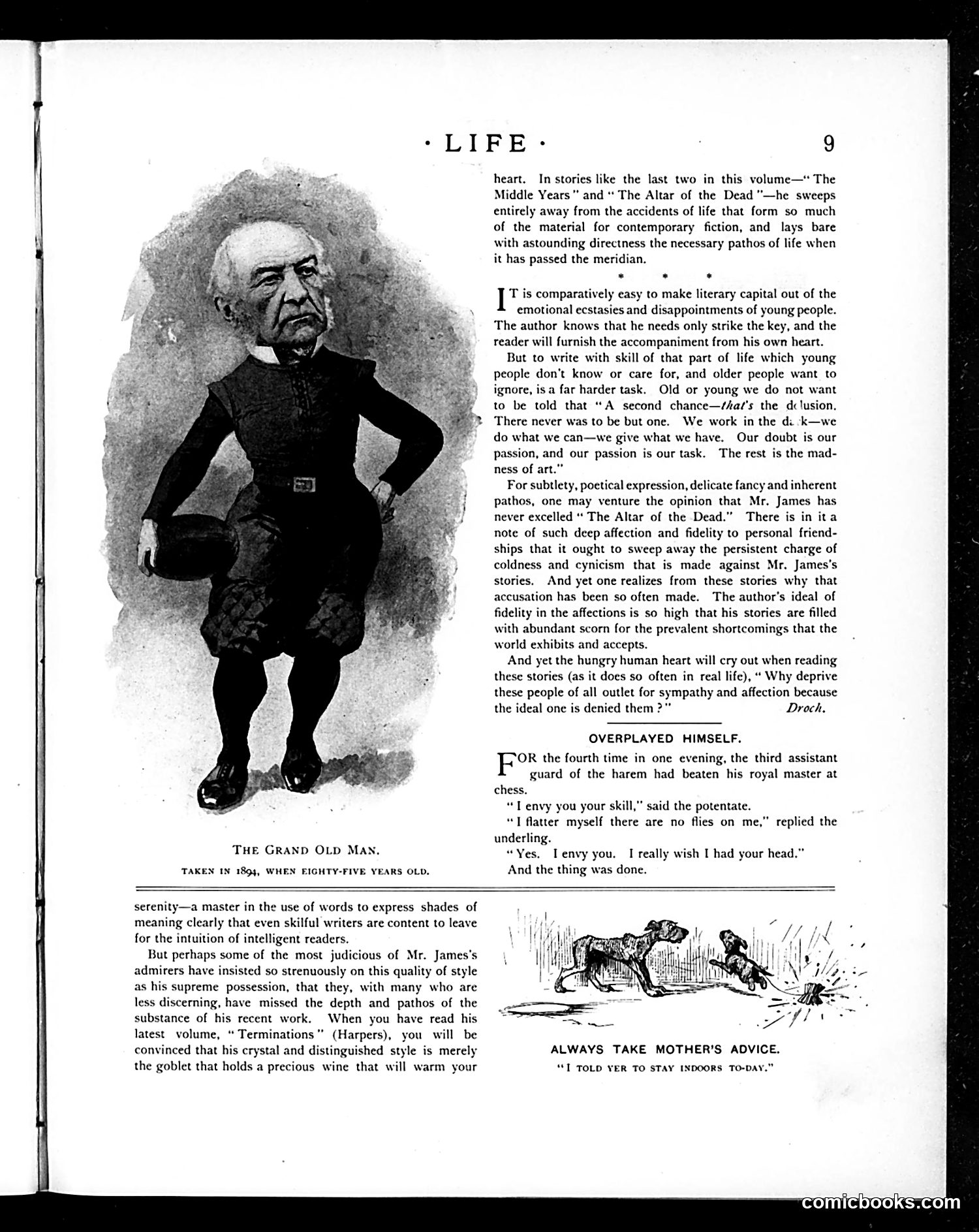
This page contains literary criticism about author Henry James, accompanied by two illustrations. **"The Grand Old Man"** portrait (left) depicts an elderly gentleman taken in 1894 at age eighty-five. The text praises James's subtle, sophisticated writing style while acknowledging criticism that his work lacks emotional warmth and accessibility. The reviewer defends James against charges of coldness, arguing his stories demonstrate deep affection and fidelity to human experience. **"Overplayed Himself"** (bottom right) is a brief comedic sketch about a harem guard who beats a royal master at chess, then boasts about it—resulting in swift punishment. The caption "Always Take Mother's Advice" suggests the moral: hubris leads to downfall. Both pieces exemplify Life magazine's blend of literary commentary and humorous social observation.
📄 Transcribed text from this page (OCR, searchable)
Machine-transcribed from the original scan — historical spelling and the odd misread are preserved.
-LIFE: 9 THE GRAND OLD Man, TAKEN IN 1894, WHEN EIGHTY-FIVE YEARS OLD. heart. In stories like the last two in this volume—* The Middle Years" and * The Altar of the Dead "—he sweeps entirely away from the accidents of life that form so much of the material for contemporary fiction, and lays bare with astounding directness the necessary pathos of life when it has passed the meridian. . * . I" is comparatively easy to make literary capital out of the emotional ecstasies and disappointments of young people. The author knows that he needs only strike the key, and the reader will furnish the accompaniment from his own heart. But to write with skill of that part of life which young people don't know or care for, and older people want to ignore, is a far harder task. Old or young we do not want to be told that “A second chance—/ha?'s the dclusion. There never was to be but one. We work in the di -k—we do what we can—we give what we have. Our doubt is our passion, and our passion is our task. The rest is the mad- ness of art.” For subtlety, poetical expression, delicate fancy and inherent pathos, one may venture the opinion that Mr. James has never excelled * The Altar of the Dead.” There is in ita note of such deep affection and fidelity to personal friend- ships that it ought to sweep away the persistent charge of coldness and cynicism that is made against Mr. James's stories. And yet one realizes from these stories why that accusation has been so often made. The author's ideal of fidelity in the affections is so high that his stories are filled with abundant scorn for the prevalent shortcomings that the world exhibits and accepts. And yet the hungry human heart will cry out when reading these stories (as it does so often in real life), “ Why deprive these people of all outlet for sympathy and affection because the ideal one is denied them ?"” Droch, OVERPLAYED HIMSELF. ‘OR the fourth time in one evening, the third assistant guard of the harem had beaten his royal master at chess. “T envy you your skill,” said the potentate. “T flatter myself there are no flies on me,’ underling. “Yes, Tenvy you. I really wish I had your head.” And the thing was done. replied the serenity—a master in the use of words to express shades of meaning clearly that even skilful writers are content to leave for the intuition of intelligent readers. But perhaps some of the most judicious of Mr. James's admirers have insisted so strenuously on this quality of style as his supreme possession, that they, with many who are less discerning, have missed the depth and pathos of the substance of his recent work. When you have read his latest’ volume, “ Terminations” (Harpers), you will be convinced that his crystal and distinguished style is merely the goblet that holds a precious wine that will warm your ALWAYS TAKE MOTHER'S ADVICE. ‘*] TOLD YER TO STAY INDOORS TO-DAY.”