
A complete issue · 18 pages · 1895
Life — May 16, 1895
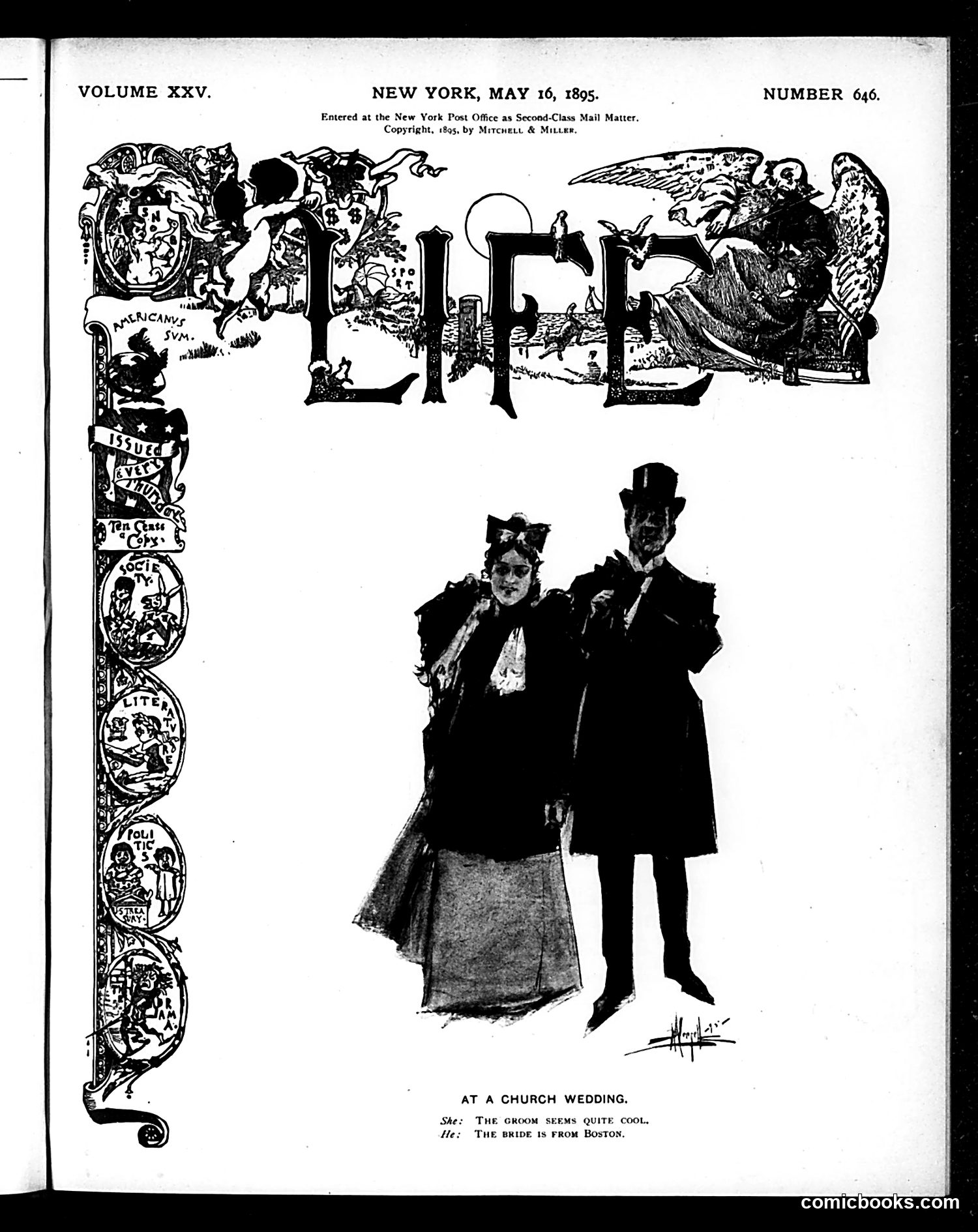
This cartoon satirizes class differences and regional attitudes in 1890s America. The illustration shows a wedding scene with two figures: a groom described as appearing "quite cool" and a bride identified as being "from Boston." The humor likely plays on stereotypes about Boston's upper-class society and New England propriety contrasted with the groom's demeanor. The ornate decorative border on the left suggests this is a satirical commentary on formal social occasions and their rigid conventions. The joke appears to hinge on social awkwardness or unexpected behavior at a formal wedding—a common subject for Life's satirical commentary on American society's class consciousness and regional pretensions during the Gilded Age.
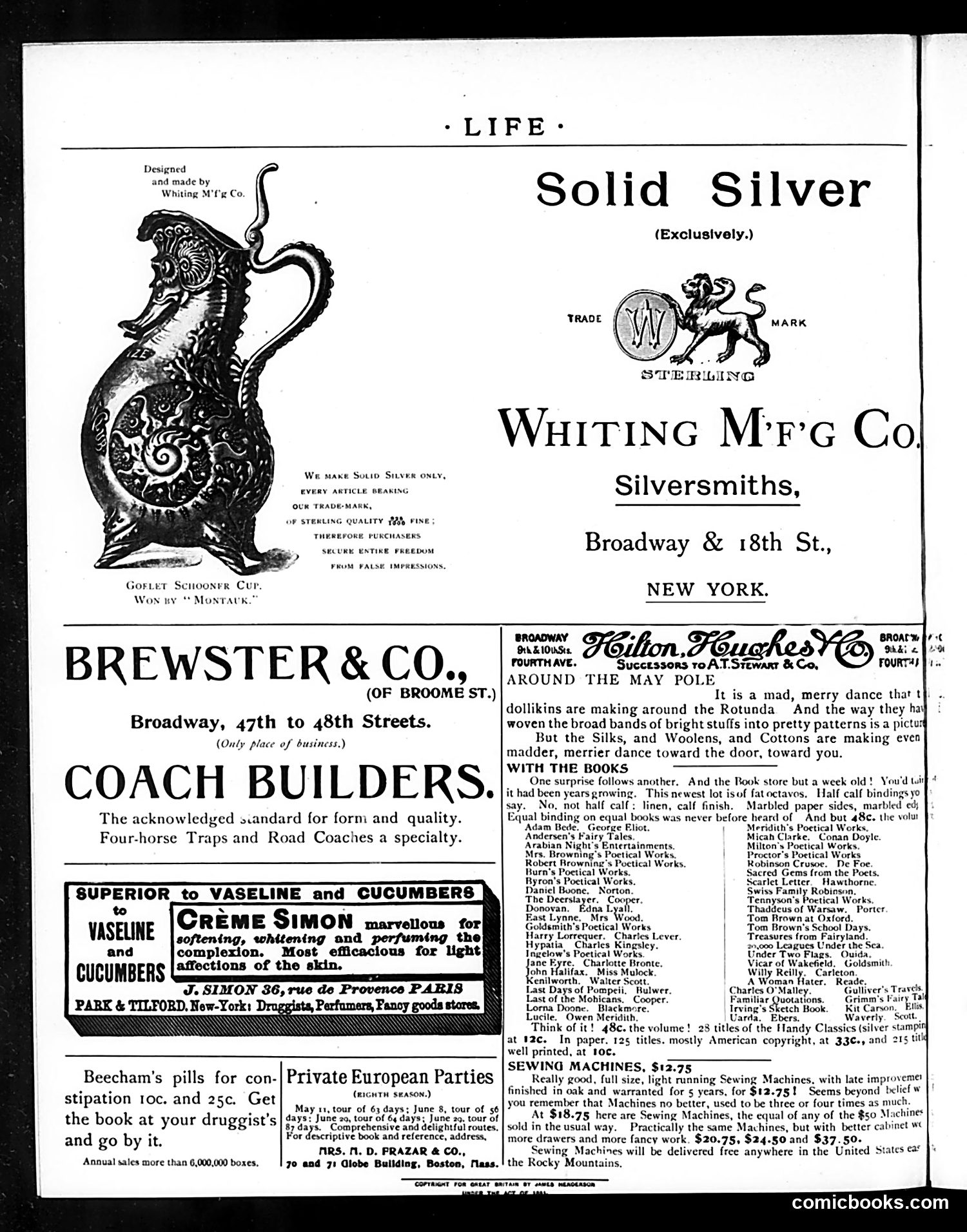
This page is predominantly **advertising**, not editorial content or cartoons. The main advertisements include: - **Whiting Mfg Co.** (silversmiths, Broadway & 18th St., NYC) featuring an ornate silver pitcher - **Brewster & Co.** (coach builders, Broadway 47th-48th Streets) - **Vaseline and Cucumbers** (cosmetics) - **Beecham's Pills** (patent medicine) - **Halton, Hughes & Co.** (dress goods) The only potentially satirical element is a brief text snippet titled "**Around the May Pole**" describing silk, woolen, and cotton fabrics "making even madder, merrier dance toward the door, toward you"—likely humorous promotional copy rather than political satire. This appears to be a standard Life magazine advertising page from the early 20th century with minimal editorial content.
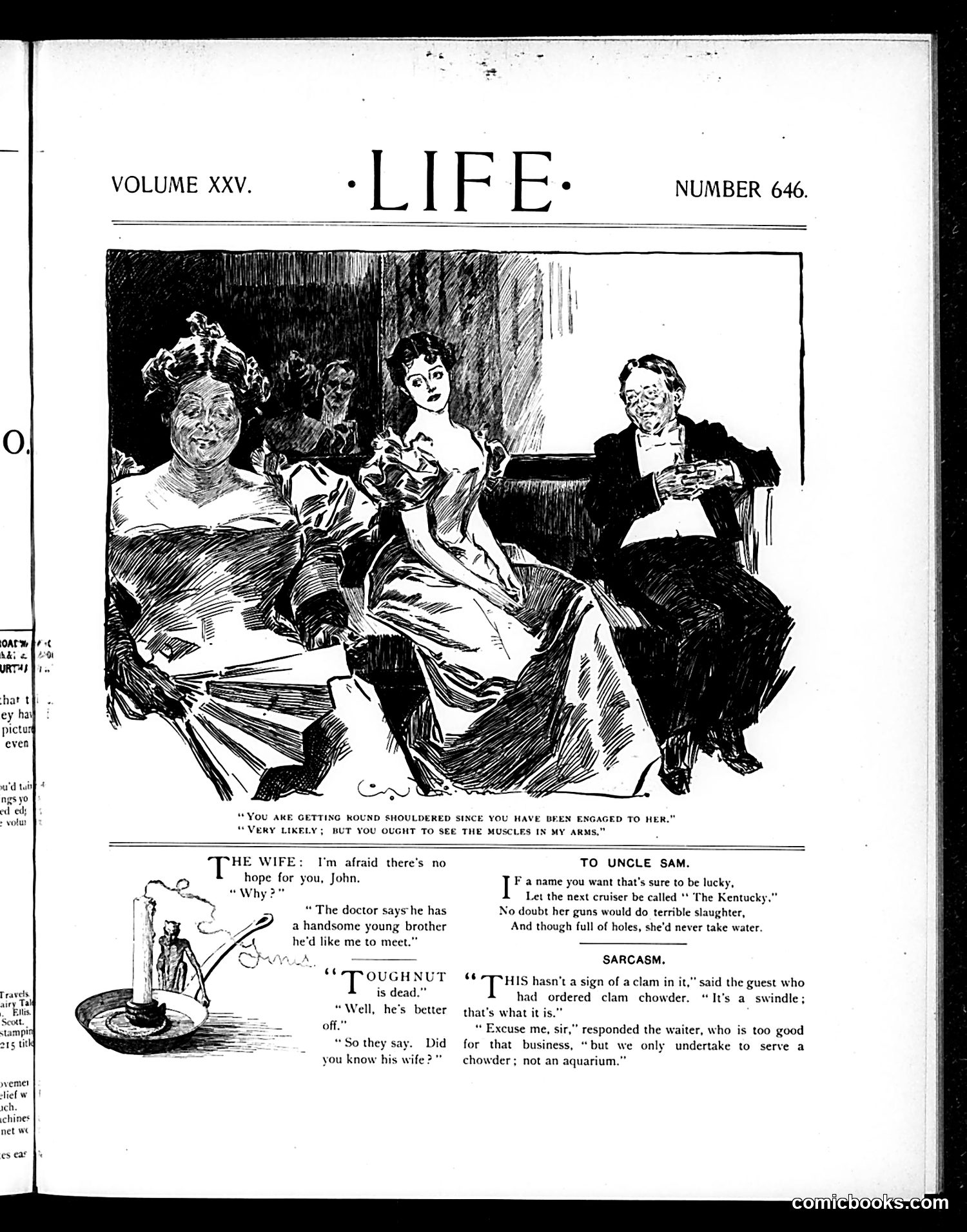
This page contains three separate humor pieces typical of early 20th-century Life magazine: **Top cartoon:** Shows a couple at a social gathering. The caption jokes about a man becoming "round-shouldered" since his engagement, suggesting his fiancée has made him physically weak or listless—a dig at how romantic relationships supposedly emasculate men. **Middle section ("The Wife"):** A domestic humor piece where a wife tells her husband John he's hopeless, referencing a doctor's comment about John's "handsome young brother." **Bottom sections:** Include unrelated satirical bits—one about naming a naval ship "The Kentucky," and another mocking a waiter's confusion between serving clam chowder and maintaining an aquarium. The humor relies on wordplay, marital stereotypes, and absurdist non-sequiturs common to the era.
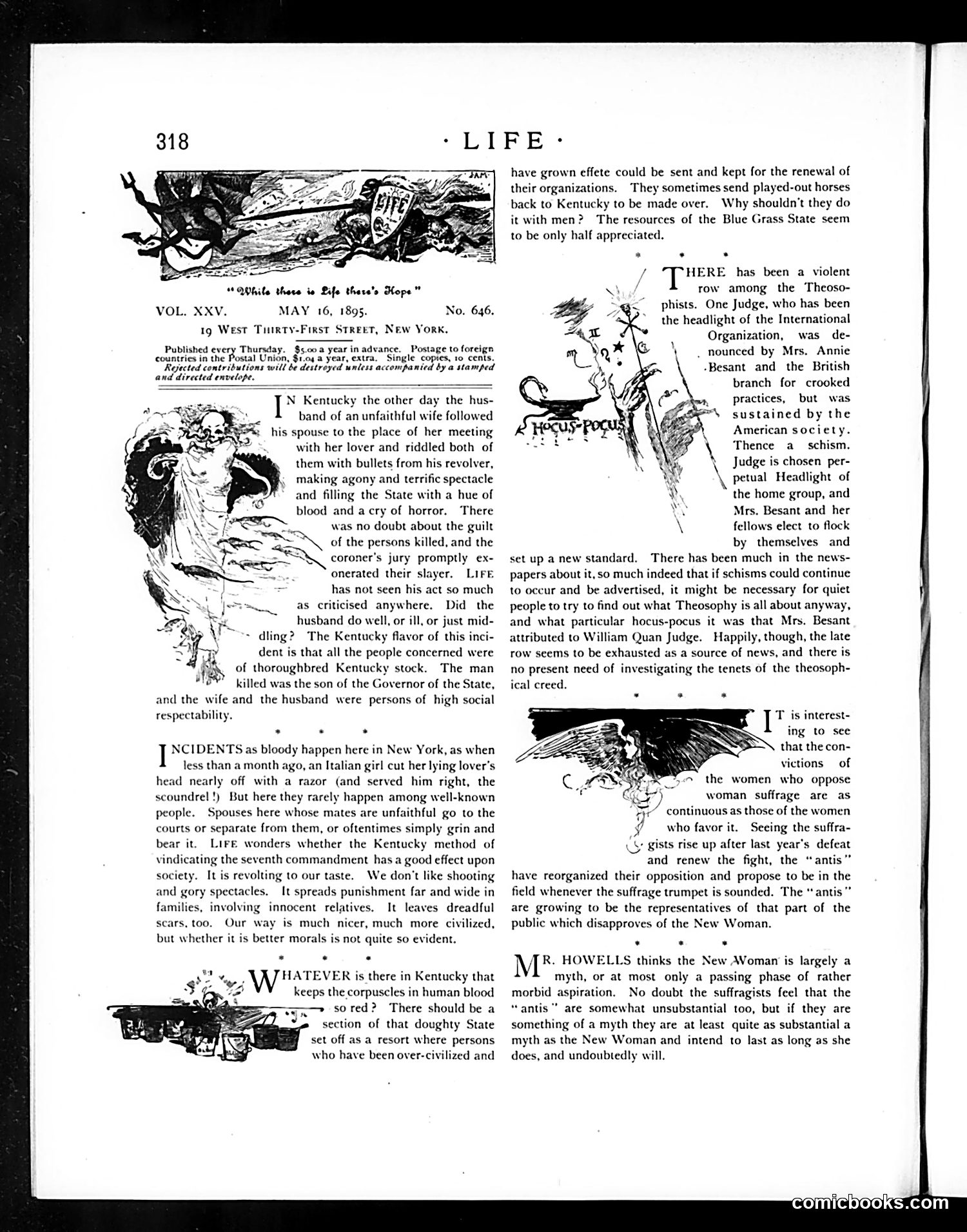
This page contains editorial commentary on violence and social issues rather than traditional political cartoons. The text criticizes a Kentucky incident where a governor's son killed his wife's lover—a case that made national headlines due to the high social status of those involved. The editorial contrasts this with violent incidents in New York, arguing Kentucky's "method of vindication" (vigilante killing) versus civilization's legal system reflects differing cultural standards. The page also discusses a row among Theosophists regarding Judge William Quan and accusations by Annie Besant about "crooked practices," and concludes with commentary on women's suffrage opposition, characterizing anti-suffragists as representing outdated views of "the New Woman."
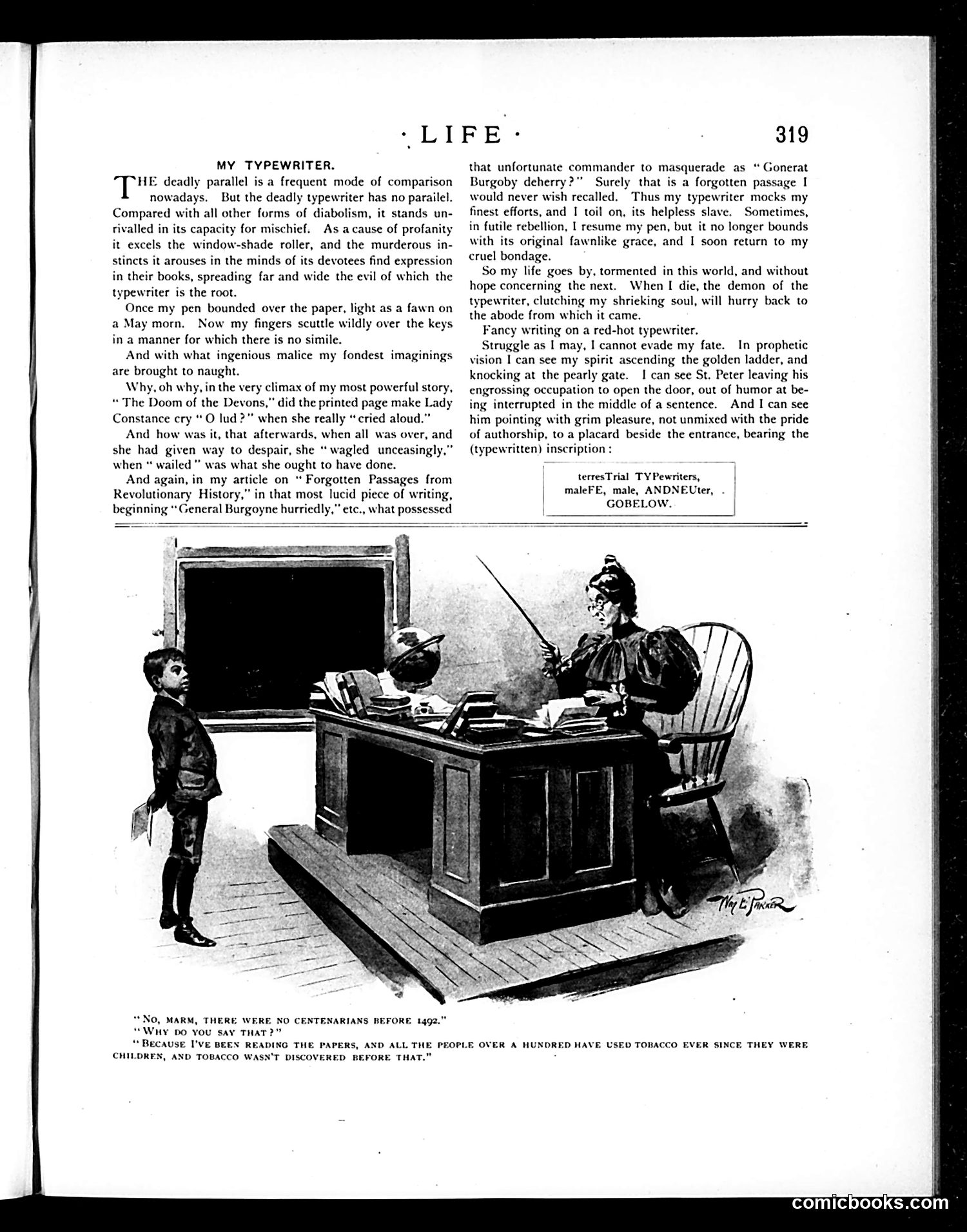
**Main Content: "My Typewriter" Essay** The page features a personal essay lamenting the author's troublesome typewriter, which they compare to other forms of mischief-making. The author describes how the typewriter has sabotaged their writing efforts, citing specific examples where printed text caused unintended reactions (Lady Constance crying at "The Doom of the Devons," for instance). **Cartoon Below:** The illustration shows a stern woman at a desk pointing at a boy, with a blackboard visible. The caption concerns tobacco use, referencing 1492 and arguing that centenarians predated tobacco's discovery—therefore tobacco didn't cause people to live long lives. This is a humorous logical fallacy used to defend smoking, likely reflecting early 20th-century tobacco industry arguments against health concerns.
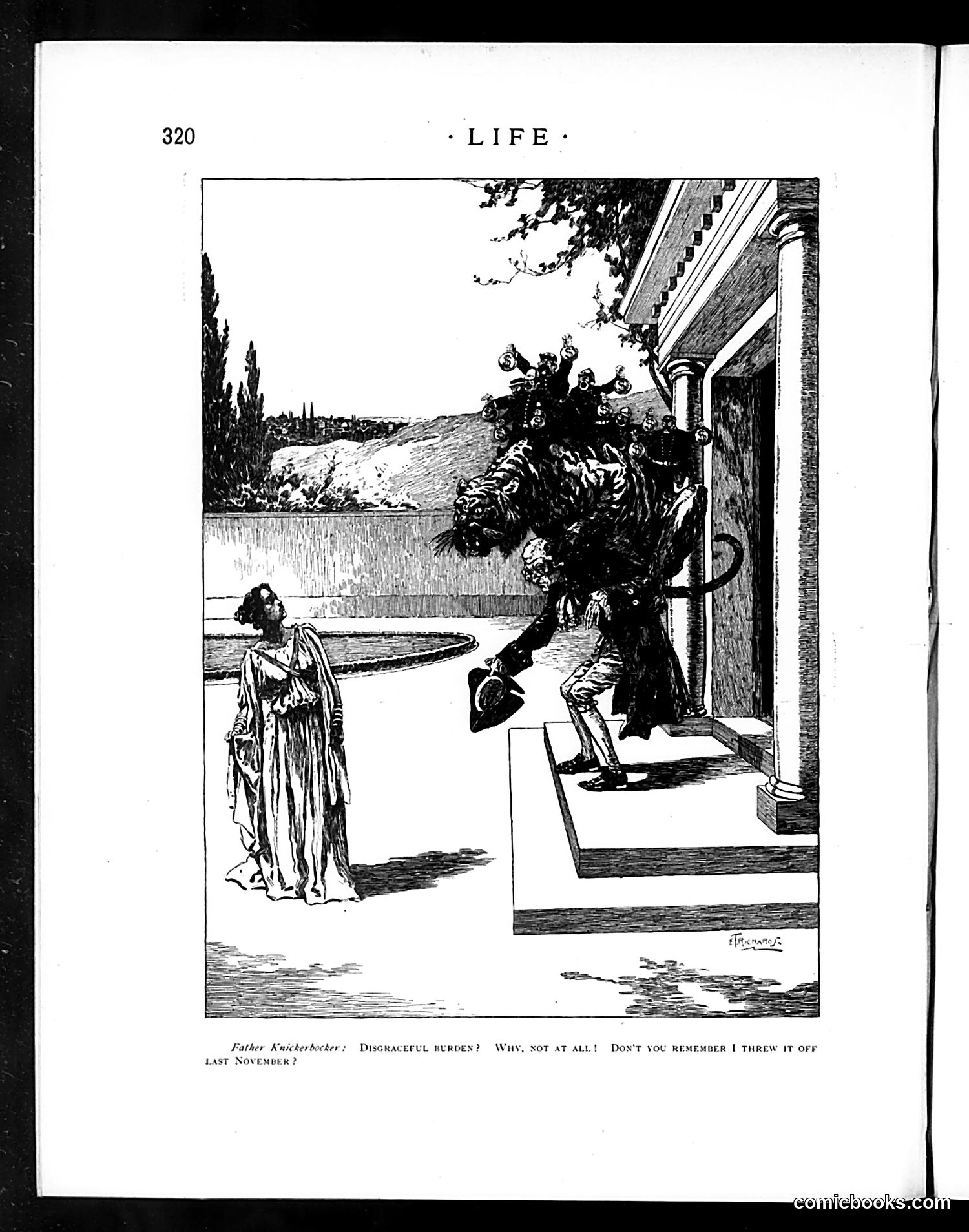
This appears to be a domestic comedy sketch from *Life* magazine. The caption reads: "Father Knickerbocker: 'Disgraceful burden! Why, not at all! Don't you remember I threw it off last November?'" The cartoon depicts a woman in classical dress (likely representing a virtue or civic ideal) confronting a grotesquely caricatured figure labeled "Father Knickerbocker" (a traditional personification of New York City). The man appears to be carrying or burdened by something ornate. The joke likely references a civic or political burden—possibly related to New York City governance—that was supposedly resolved the previous November (presumably through an election or policy change), yet persists. The satire mocks either the failure of promised reform or the hypocrisy of claiming problems were solved when they clearly weren't.
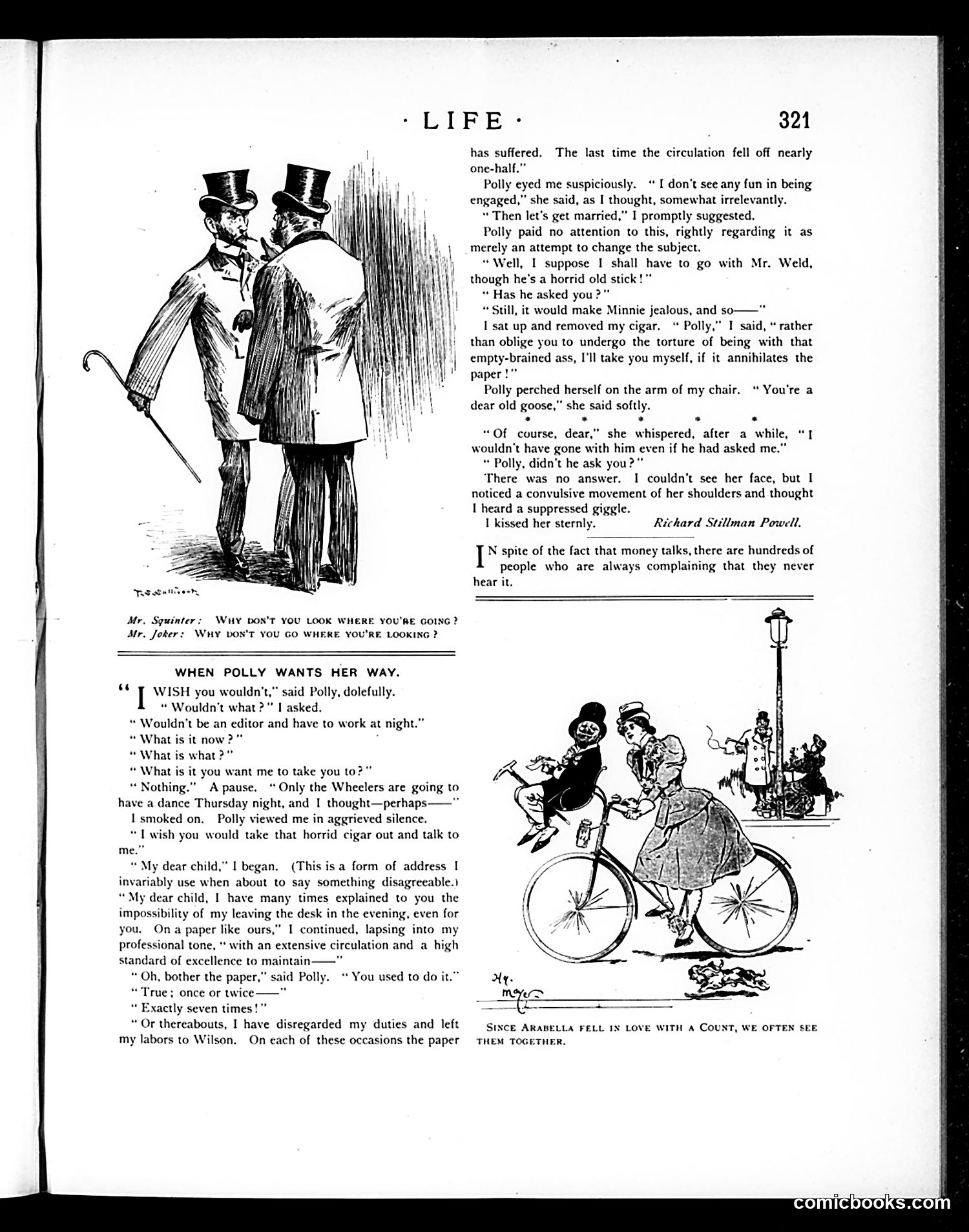
**Top Cartoon**: Two wealthy gentlemen in top hats and coats converse. The caption reads: "Mr. Squinter: Why don't you look where you're going? / Mr. Joker: Why don't you go where you're looking?" This is a simple visual gag about absent-minded pedestrians—likely satirizing distracted wealthy men of the era. **Main Story Section**: "When Polly Wants Her Way" depicts a domestic dispute where a woman (Polly) refuses her husband's request to attend a social event because the Wheelers are hosting. The husband complains about her selective obedience and circulation of the newspaper. This satirizes marital power dynamics and women's social independence in the early 20th century. **Bottom Illustration**: Shows a woman on a bicycle with admirers, captioned about courtship.
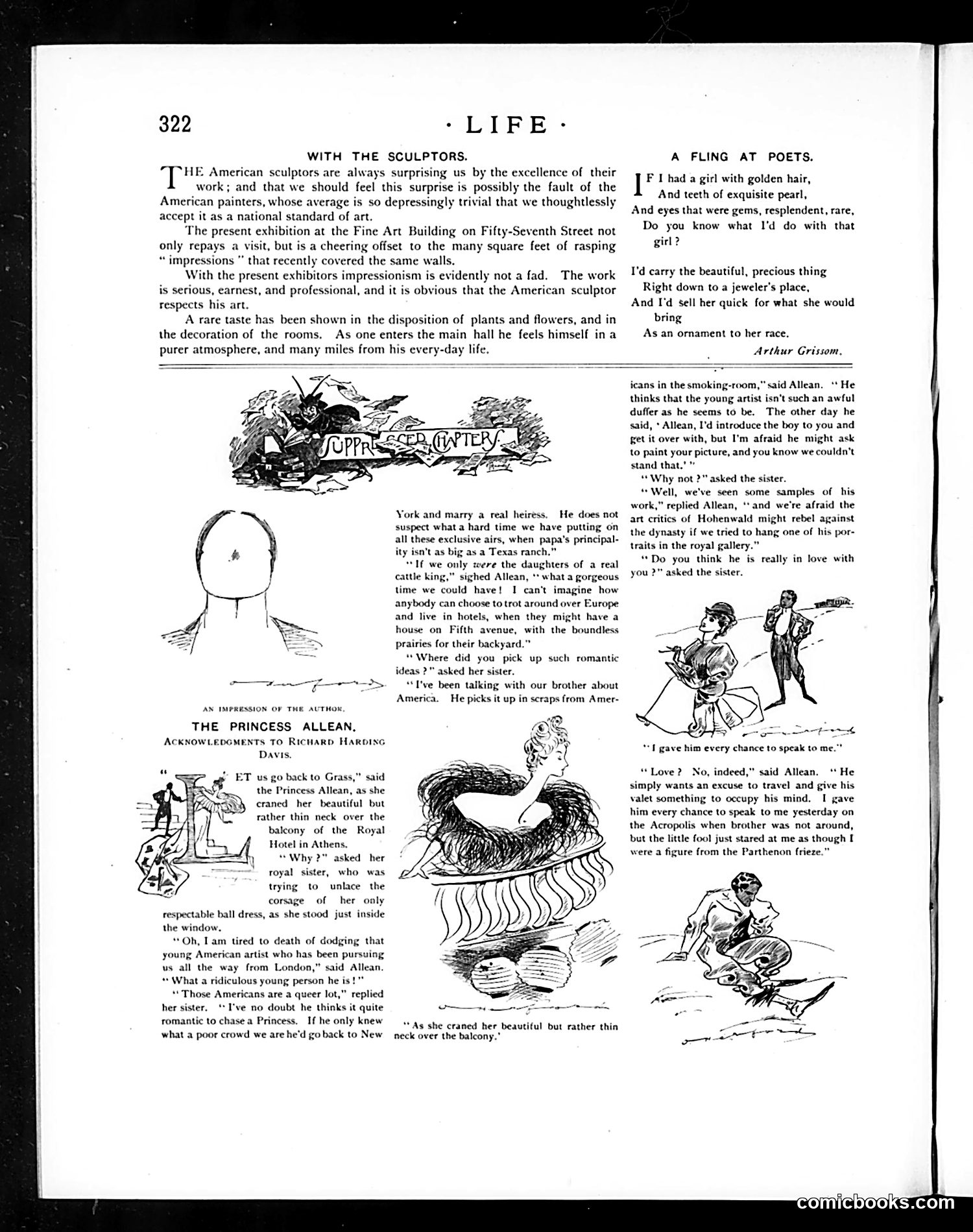
This page contains two sections: a serious arts review and a humorous poem with illustrations. **Left side:** A brief critique of American sculptors' work at a Fine Art Building exhibition, praising their professionalism and the tasteful display arrangements. **Right side:** "A Fling at Poets" is a satirical poem by Arthur Grissom mocking overly romantic young poets. The illustrations depict a poet attempting to impress a woman by proposing to sell her jewelry—presenting himself as grand and poetic while actually being impractical and self-absorbed. The humor targets the pretentiousness of artistic young men who adopt grandiose romantic poses without genuine substance, a common satirical theme in *Life* magazine during this era.
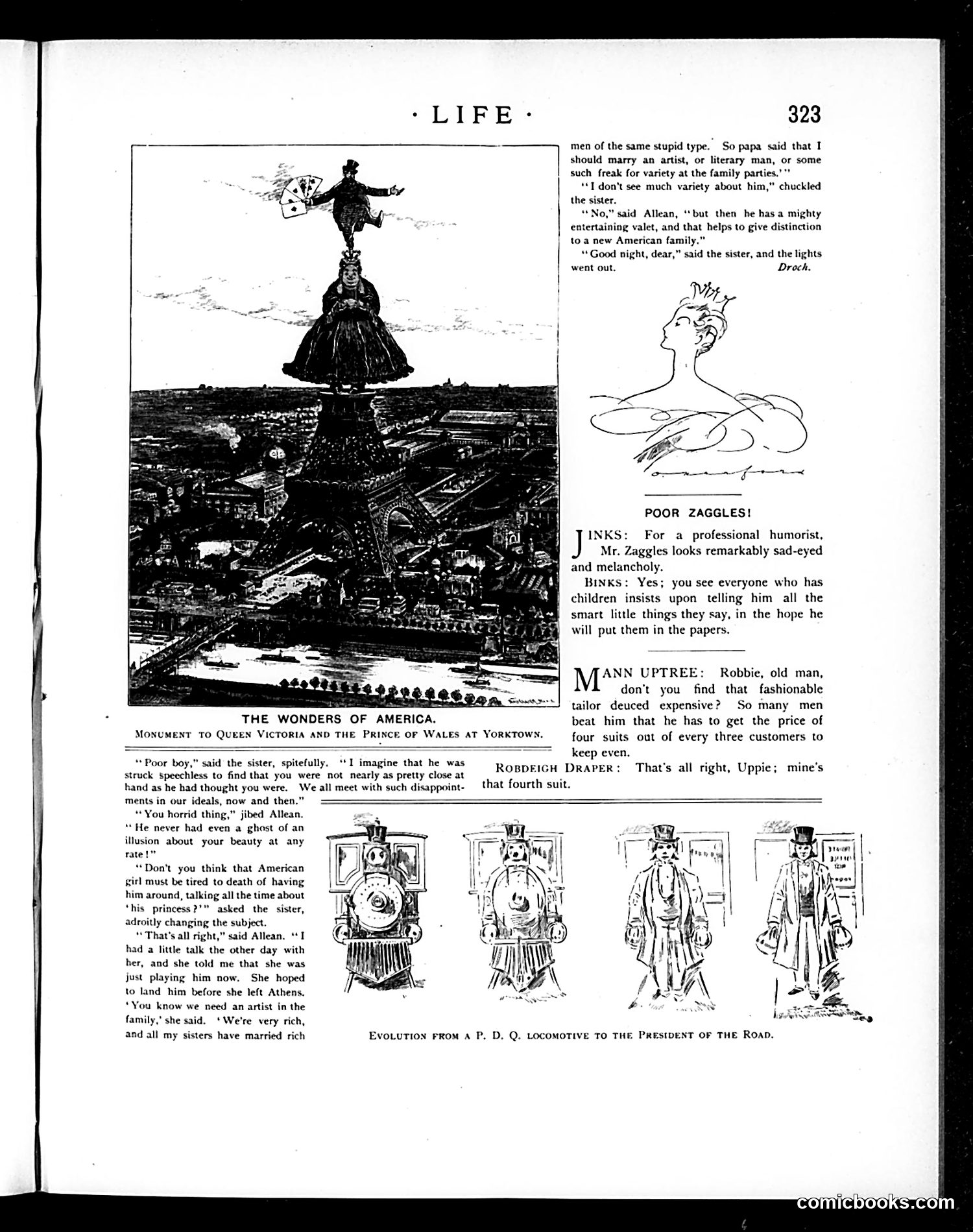
The main illustration depicts "The Wonders of America: Monument to Queen Victoria and the Prince of Wales at Yorktown," a satirical architectural fantasy showing a ornate monument rising impossibly high above a cityscape. The accompanying dialogue mocks American social pretensions: a sister scolds her brother Alikan for his lack of ambition, criticizing his "illusions about your beauty." The family discussion revolves around marriage prospects—whether he should marry an artist or "literary man" for variety. The satire targets American class consciousness and the expectation that marriage should secure social standing. Below, a humorous evolution chart shows transformation "From a P.D.Q. Locomotive to the President of the Road," satirizing American industrial advancement and social mobility through corporate hierarchy.
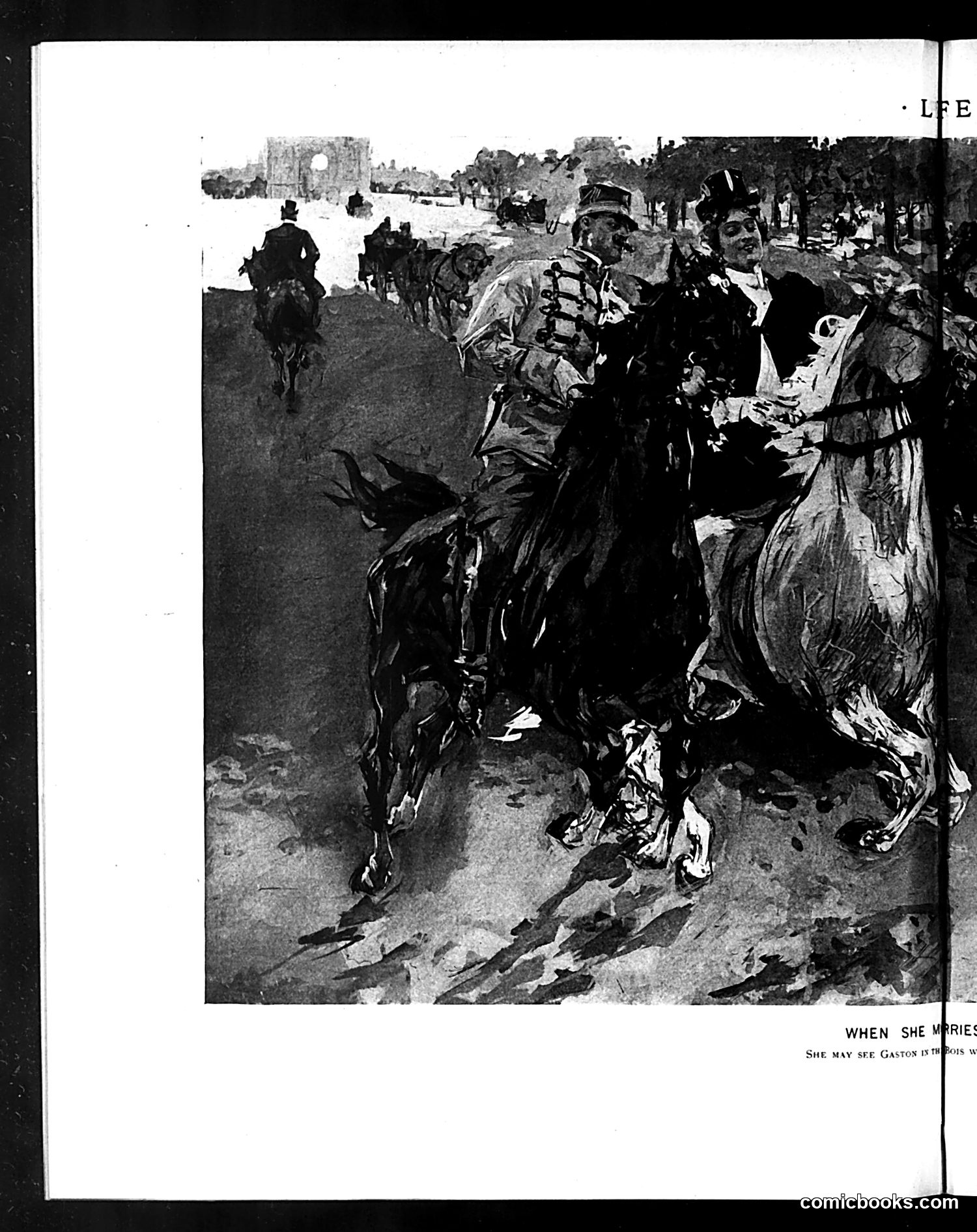
This appears to be an illustration from Life magazine titled "When She Marries" (visible at bottom). The image shows military or formal-dressed figures on horseback in what seems to be a satirical scene. The caption references "She may see Gaston it [text cuts off]." The cartoon likely satirizes a romantic or matrimonial scenario involving military figures, possibly from the early 20th century based on the style and uniforms visible. The humor appears to center on marriage prospects or romantic entanglements, though the exact historical figures or events referenced are unclear from the visible text alone. The formal military dress and outdoor setting suggest this may be commenting on courtship among military or aristocratic circles of the period. Without more legible caption text, the specific satirical target remains ambiguous.
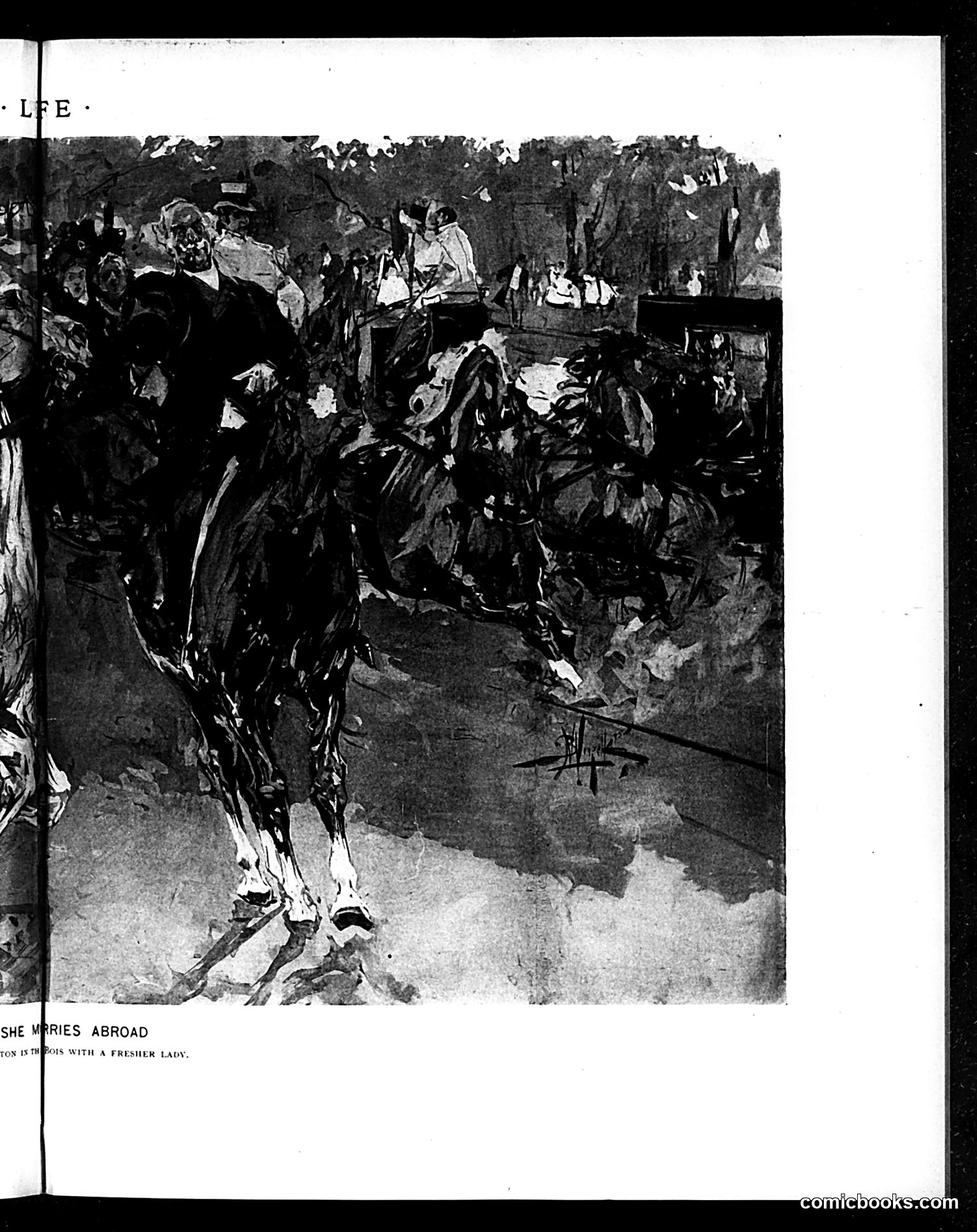
This appears to be a satirical illustration from *Life* magazine titled "SHE MARRIES ABROAD," with a subtitle mentioning "TON IS IN THIS WITH A FRESHER LADY." The image depicts a woman on horseback in what seems to be a European or aristocratic setting, with onlookers in the background. The satire likely targets American women marrying foreign nobleman or wealthy Europeans—a common social phenomenon and subject of ridicule in early 20th-century American humor. The "fresher lady" reference suggests commentary on social climbing or romantic entanglements abroad. The crude, expressive drawing style is characteristic of *Life*'s satirical approach. However, without the full caption or additional context, the specific individuals or events referenced remain unclear.
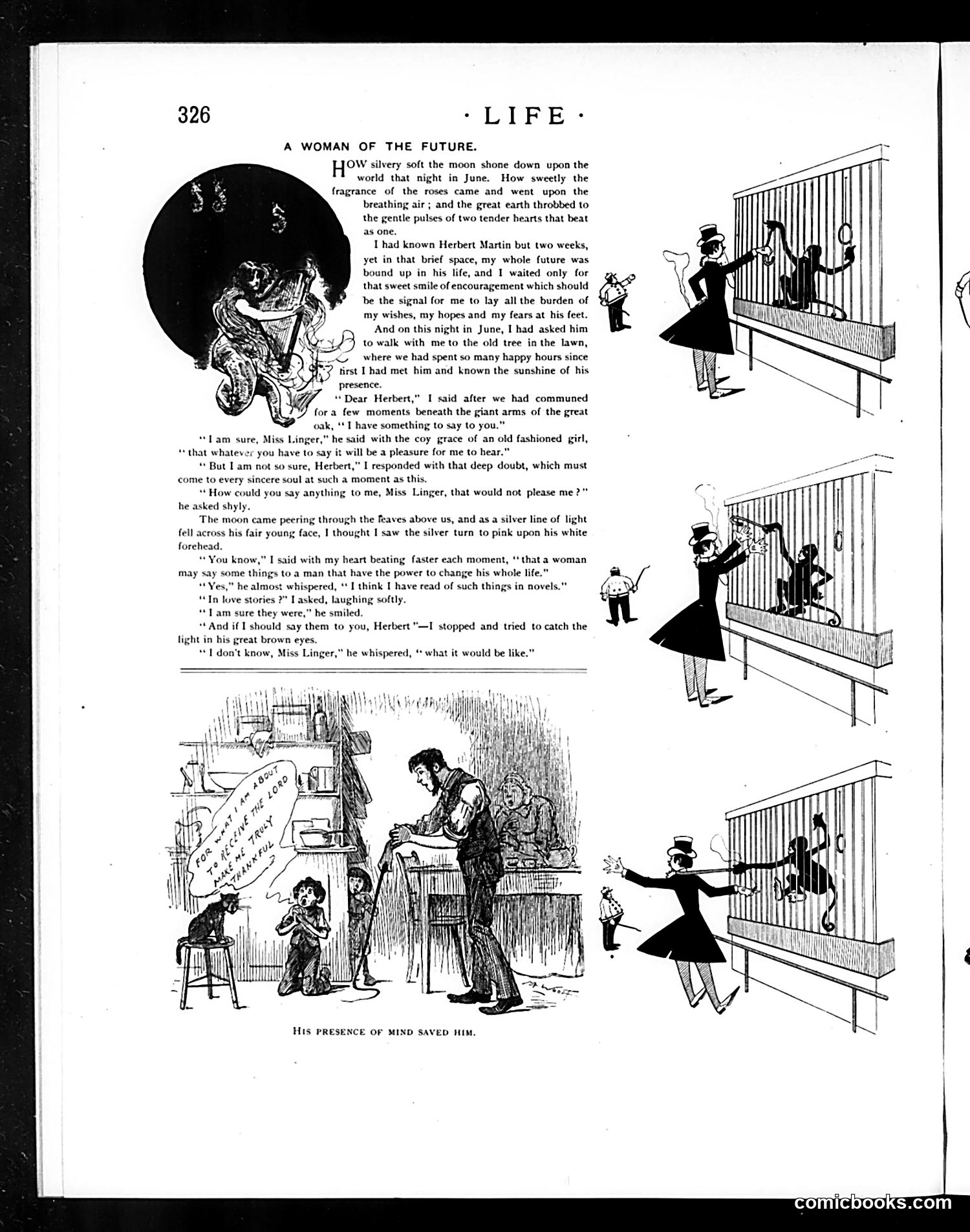
This page satirizes the "New Woman" of the early 20th century—the emerging independent female who challenges traditional gender roles. The story follows Miss Linger, who prepares to propose marriage to Herbert Martin, reversing the conventional male proposal. The accompanying illustrations on the right show a woman actively pursuing a man at what appears to be a zoo or animal enclosure, visually emphasizing the role reversal as comedic and absurd by contemporary standards. The satire's point: society found the prospect of women taking initiative in courtship deeply threatening and ridiculous. The caption "His Presence of Mind Saved Him" (referring to the lower illustration) suggests the man must cleverly evade or escape the woman's advances—treating female agency as something requiring defense against. The piece mocks both the anxiety men felt about changing gender dynamics and the sentimental romance language women were expected to use, even when breaking social conventions.
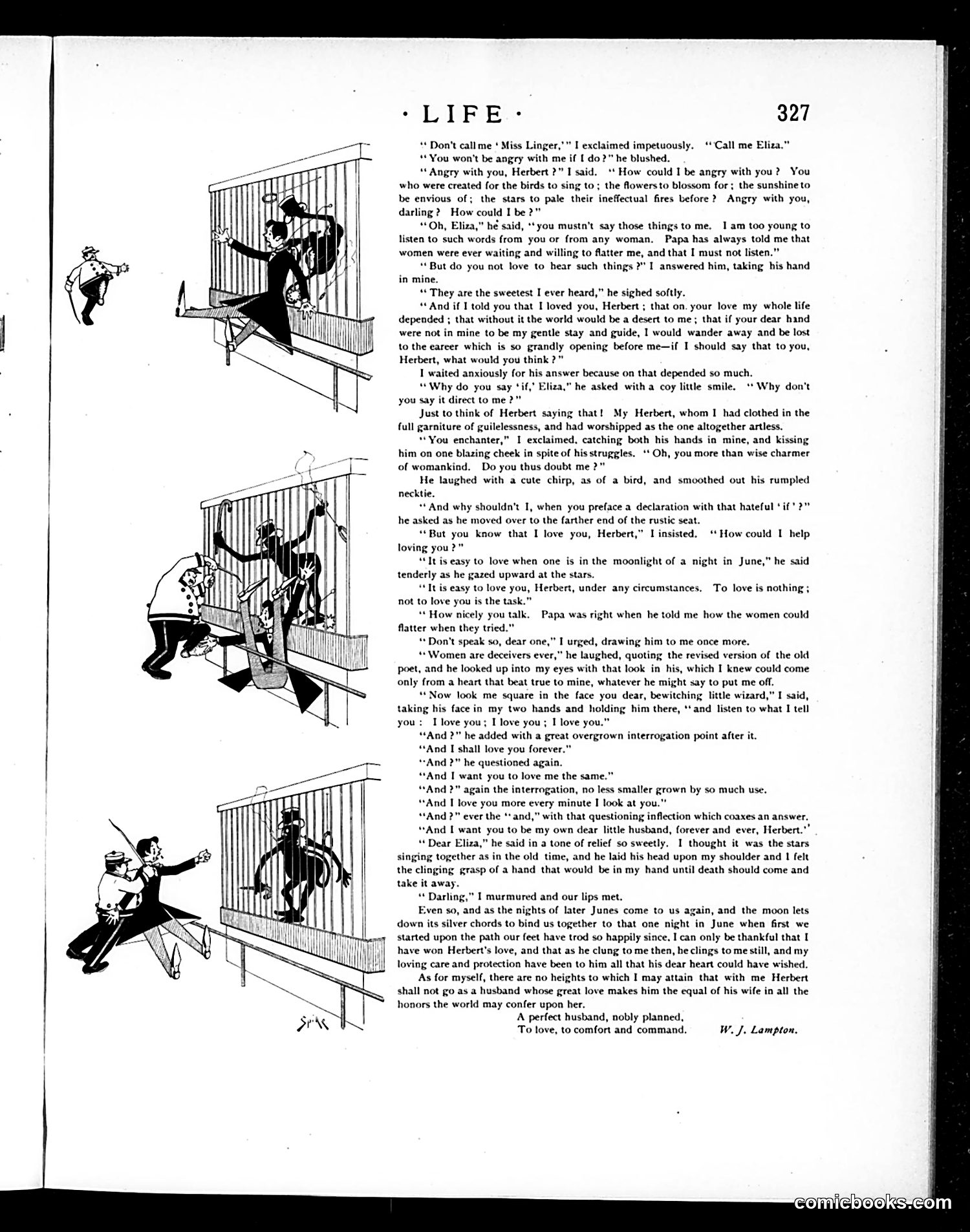
This page contains a romantic short story illustrated with three sketch panels, not political satire. The narrative depicts a sentimental courtship scene between two characters, Eliza and Herbert, exchanging declarations of love in a moonlit garden setting. The three illustrations show the couple at a fence or gate in increasingly intimate poses—from initial conversation to embracing. The text captures Victorian-era romantic dialogue with florid language ("moonlight of a night in June," "bewitching little wizard"). **The satire's target**: The piece appears to mock the excessive sentimentality and clichéd flattery of Victorian romantic conventions. Herbert's repeated skepticism about Eliza's sincerity, his quotation that "women are deceivers ever," and his strategic questioning ("And?") suggest the author is gently ridiculing both the overwrought declarations and the manipulative tactics embedded in period romance. The humor lies in exposing the performative nature of courtship rather than genuine feeling.
This page contains three comic sketches satirizing married life and miscommunication. In the main narrative, a wife asks her husband George to purchase ten yards of pink silk, specifying he should examine the exact shade. George, taking the instruction literally, buys expensive silk ($4/yard) when the wife actually wanted cheaper fabric (39 cents, reduced from 79 cents). The wife then reveals she's already given the expensive silk to the dressmaker to work with—a cutting remark about her husband's carelessness. The humor relies on mismatched expectations: the wife's implicit criticism versus George's literal but impractical obedience. This reflects Victorian-era marital dynamics where wives managed household budgets while husbands earned wages, often leading to tension over spending and domestic decision-making. The page also includes two brief newspaper item jokes mocking trivial "news," reflecting Life magazine's regular criticism of sensationalist journalism of the era.
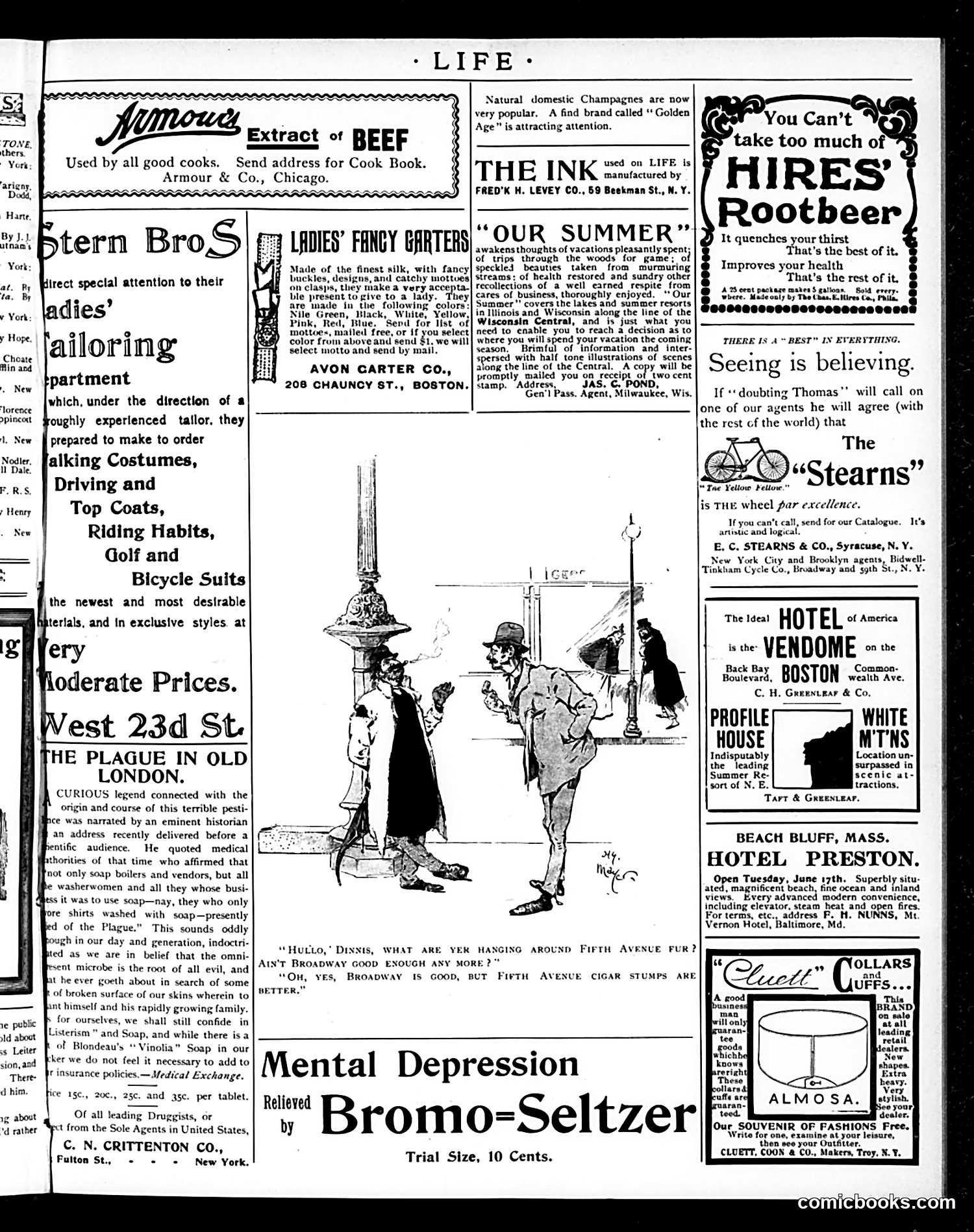
This is primarily an **advertising page** from Life magazine, not a political cartoon page. However, there is one small **cartoon illustration** depicting a street scene. ## The Cartoon The sketch shows two men on a city street near a lamppost, with the caption suggesting one is asking why the other is "hanging around Fifth Avenue" instead of staying on Broadway. The joke appears to be about **social class and neighborhood status**: Broadway was the entertainment/commercial district, while Fifth Avenue was becoming an exclusive wealthy residential area. The humor lies in the contrast—the man is apparently slumming or has pretensions of moving "up" socially by frequenting the fancier avenue, prompting the other's sarcastic question. ## The Advertisements The page is dominated by period ads for ladies' clothing (Stern Bros.), extract of beef, garters, root beer, hotels, bicycles, and patent medicines (notably Bromo-Seltzer for "mental depression")—typical early 20th-century commercial content reflecting contemporary consumer culture and medical attitudes.
This page contains three satirical pieces mocking social pretension and hypocrisy: 1. **"Sir Walter Raleigh" story**: A humorous dialogue where Queen Elizabeth I engages in witty repartee with Sir Walter Raleigh, trading puns about "wintry," "summary," and "raw-ly disposed." The satire suggests courtiers must laugh at the Queen's ancient, recycled jokes to maintain favor. 2. **Mr. Munn subscription story**: Satirizes wealthy men's charitable giving. Ladies solicit Mr. Munn, who generously pledges $1,000—then reveals he won't sign the check because he wishes his "benefactions known to the world" to remain anonymous. The contradiction is the joke: he wants credit for anonymous giving. 3. **Uncle Eben quote**: A brief, condescending dialect piece contrasting practical labor ("shovlin beautiful snow") with fancy accomplishments. The page is primarily advertisements otherwise (gloves, bicycles, suspenders, perfume, patent medicine).
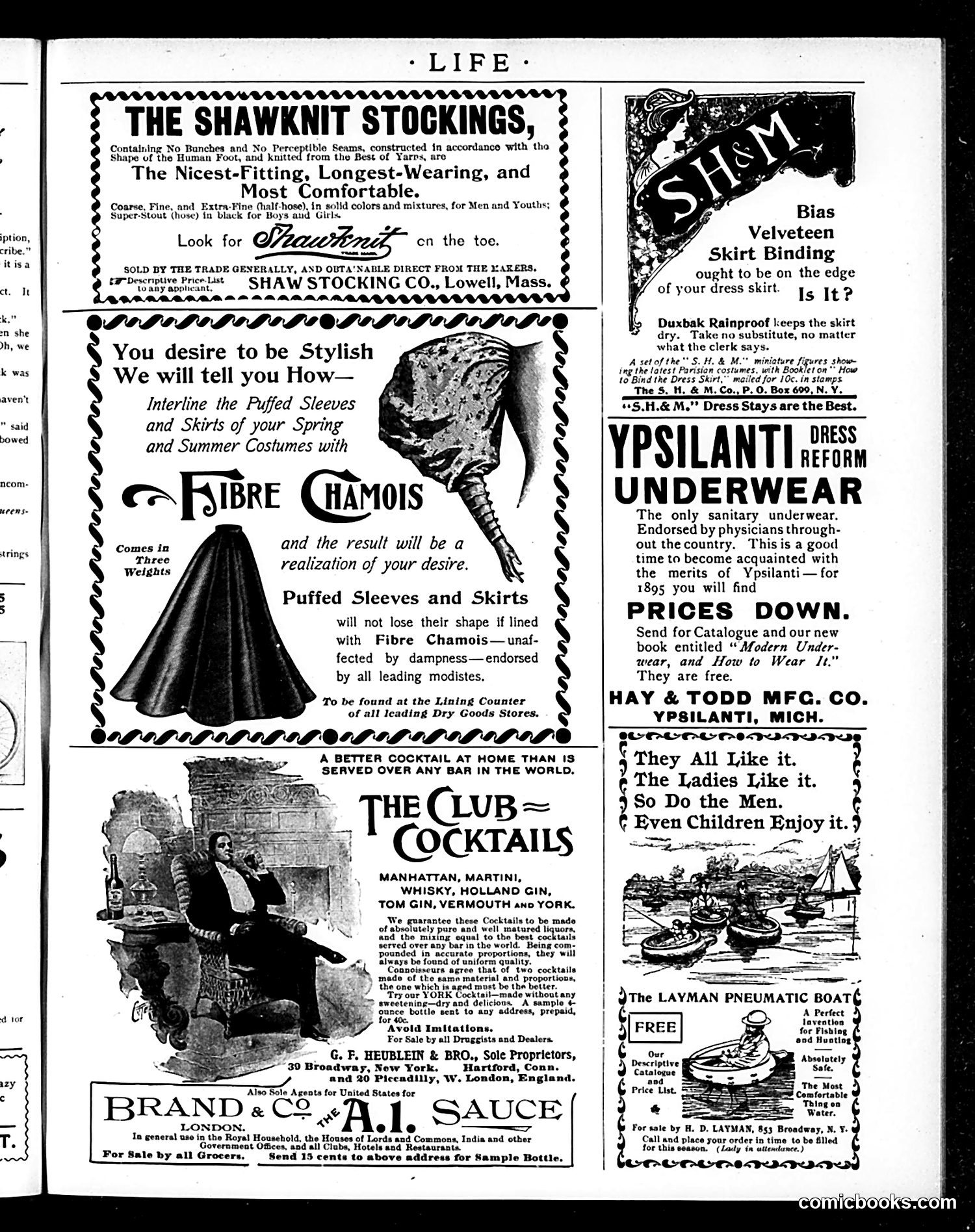
This is primarily an **advertising page**, not a satirical cartoon page. It contains roughly a dozen product advertisements from the 1890s, with no political content or satire. The ads showcase period consumer goods: Shawknit stockings, Fibre Chamois fabric lining, Ypsilanti underwear, Club cocktails (pre-Prohibition), Brand & Co. sauce, and the Layman Pneumatic Boat. One ad promotes "bias velveteen skirt binding" as essential fashion detail. The only quasi-humorous element appears in the cocktail ad's tagline: "A Better Cocktail at Home Than Is Served Over Any Bar in the World"—a competitive marketing claim rather than satire. The page reflects 1890s consumer culture, emphasizing genteel domesticity, fashion innovation, and emerging ready-made goods. There are no identifiable caricatures, political figures, or satirical commentary visible. This appears to be a standard revenue-generating advertiser page from Life magazine's early period.
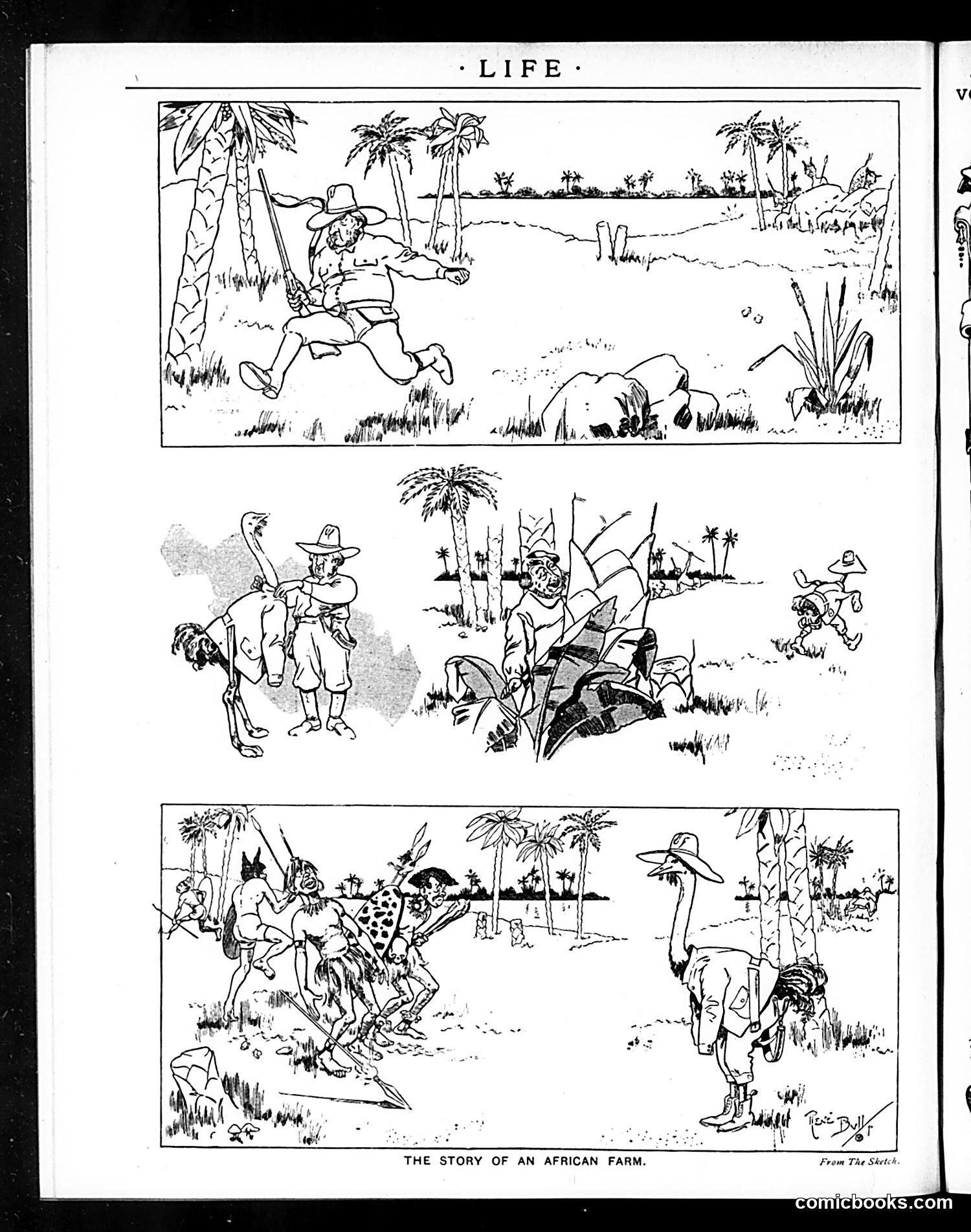
This page contains three comic panels illustrating a narrative titled "The Story of an African Farm." The comics depict a colonial-era figure (wearing a hat, appearing to be a European settler or administrator) in various scenes with African landscapes and people. The panels show: a man running through African terrain; interactions between the colonial figure and African inhabitants; and what appears to be a chaotic farm scene with multiple figures. Without more context about the specific date and publication details, the satire likely mocks either colonial farming ventures in Africa or the pretensions of European settlers attempting agriculture in unfamiliar terrain. The cartoonist's signature appears to read "Rea Irvin" or similar. The comedic tone suggests mockery of colonial enterprise rather than serious commentary.