
Life, 1895-05-16 · page 7 of 18
Life — May 16, 1895 — page 7: what you’re looking at
What you’re looking at
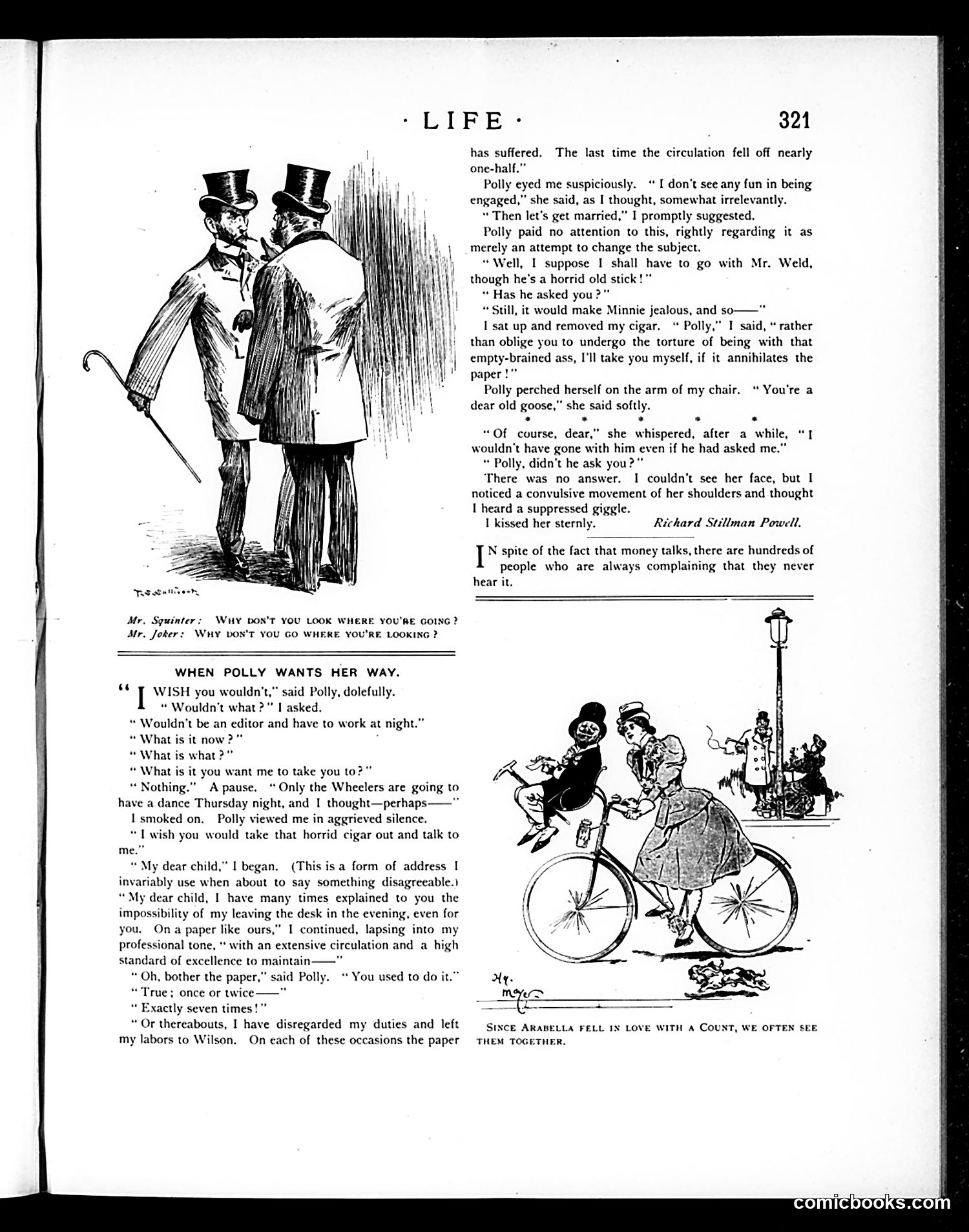
**Top Cartoon**: Two wealthy gentlemen in top hats and coats converse. The caption reads: "Mr. Squinter: Why don't you look where you're going? / Mr. Joker: Why don't you go where you're looking?" This is a simple visual gag about absent-minded pedestrians—likely satirizing distracted wealthy men of the era. **Main Story Section**: "When Polly Wants Her Way" depicts a domestic dispute where a woman (Polly) refuses her husband's request to attend a social event because the Wheelers are hosting. The husband complains about her selective obedience and circulation of the newspaper. This satirizes marital power dynamics and women's social independence in the early 20th century. **Bottom Illustration**: Shows a woman on a bicycle with admirers, captioned about courtship.
📄 Transcribed text from this page (OCR, searchable)
Machine-transcribed from the original scan — historical spelling and the odd misread are preserved.
LIFE RSS Mr, Sguinter: WY vOS'T YOU LOOK WHERE YOU'RE GOING ? Mr, Joker: WY DON'T YOU GO WHERE YOU'RE LOOKING ? WHEN POLLY WANTS HER WAY. WISH you wouldn't,” said Polly, dolefully. “ Wouldn't what?” I asked. “ce I * Wouldn't be an editor and have to work at night.” “ What is it now?” “ What is what ?” “ What is it you want me to take you to?” “ Nothing.” A pause. ‘Only the Wheelers are going to have a dance Thursday night, and I thought—perhaps——" I smoked on. Polly viewed me in aggrieved silence. “Twish you would take that horrid cigar out and talk to me.” “ My dear child,” I began. (This is a form of address I inva ably use when about to say something disagreeable.) “My dear child, I have many times explained to you the impossibility of my leaving the desk in the evening, even for you, Ona paper like ours,” I continued, lapsing into my professional tone, “ with an extensive circulation and a high standard of excellence to maintain——" “Oh, bother the paper,” said Polly.‘ You used to do it.” “True; once or twice—”" =xactly seven times! “ Or thereabouts, I have disregarded my duties and left my labors to Wilson. On each of these occasions the paper 321 has suffered. The last time the circulation fell off nearly one-half.” Polly eyed me suspiciously.“ I don’t see any fun in being engaged,” she said, as I thought, somewhat irrelevantly. “ Then let's get married,” I promptly suggested. Polly paid no attention to this, rightly regarding it as merely an attempt to change the subject. “Well, I suppose I shall have to go with Mr. Weld, though he’s a horrid old stick!" “Has he asked you ?" “ Still, it would make Minnie jealous, and so—” I sat up and removed my cigar. “ Polly,” I said, “ rather than oblige you to undergo the torture of being with that empty-brained ass, I'll take you myself, if it annihilates the paper!" Polly perched herself on the arm of my chair. dear old goose,” she said softly. . . . . . “You're a “Of course, dear,” she whispered, after a while, “ wouldn’t have gone with him even if he had asked me.” “ Polly, didn’t he ask you?” There was no answer. I couldn't see her face, but I noticed a convulsive movement of her shoulders and thought I heard a suppressed giggle. 1 kissed her sternly. Richard Stillman Powell. I N spite of the fact that money talks, ‘there are hundreds of people who are always complaining that they never hear it. SINCE ARABELLA FELL IN LOVE WITH A COUNT, WE OFTEN SEE THEM TOGETHER,