
Life, 1895-05-16 · page 4 of 18
Life — May 16, 1895 — page 4: what you’re looking at
What you’re looking at
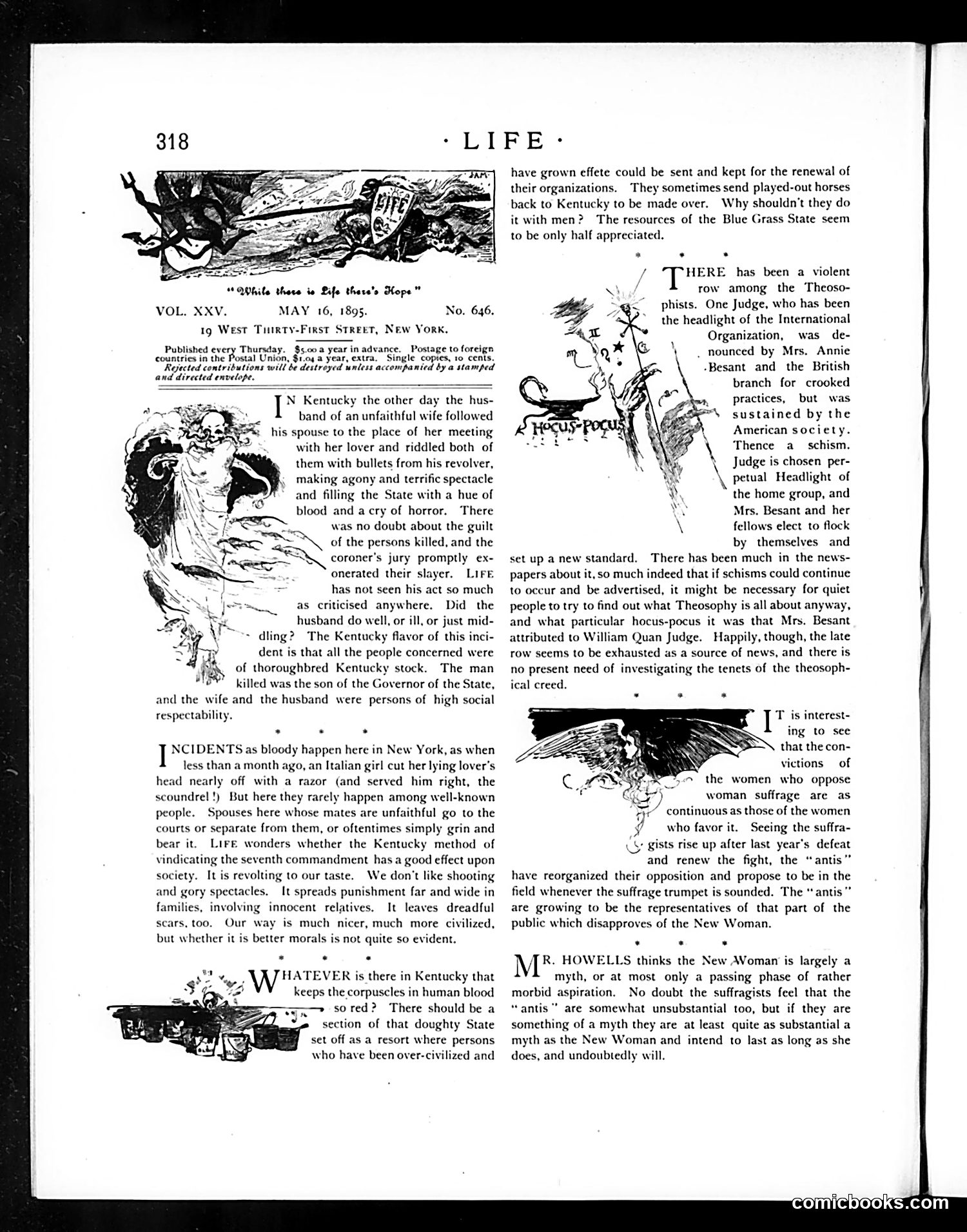
This page contains editorial commentary on violence and social issues rather than traditional political cartoons. The text criticizes a Kentucky incident where a governor's son killed his wife's lover—a case that made national headlines due to the high social status of those involved. The editorial contrasts this with violent incidents in New York, arguing Kentucky's "method of vindication" (vigilante killing) versus civilization's legal system reflects differing cultural standards. The page also discusses a row among Theosophists regarding Judge William Quan and accusations by Annie Besant about "crooked practices," and concludes with commentary on women's suffrage opposition, characterizing anti-suffragists as representing outdated views of "the New Woman."
📄 Transcribed text from this page (OCR, searchable)
Machine-transcribed from the original scan — historical spelling and the odd misread are preserved.
-LIFE: “ADhile there ie Life there's Hope” MAY 16, 1895. No. 646. 1g West Tuirty-First STREET, New York, VOL. Published every Thursday. $5.00 year in advance. Postage to foreign countries in the Postal Union, $1.04 a year, extra, Single copies, 10 cents. Rejected contributions will be destréyed unless accompanied by a stamped and directed envelope. Kentucky the other day the hus- band of an unfaithful wife followed spouse to the place of her meeting with her lover and riddled both of them with bullets from his revolver, making agony and terrific spectacle and filling the State with a hue of blood and a cry of horror. There was no doubt about the guilt of the persons killed, and the “coroner's jury promptly ex- onerated their slayer. LIFE has not seen his act so much as criticised anywhere, Did the husband do well, or ill, or just mid- > dling? The Kentucky flavor of this inci- dent is that all the people concerned were of thoroughbred Kentucky stock. The man killed was the son of the Governor of the State, and the wife and the husband were persons of high s respectability. NCIDENTS as bloody happen here in New York, as when less than a month ago, an Italian girl cut her lying lover's head nearly off with a razor (and served him right, the scoundrel!) But here they rarely happen among well-known people. Spouses here whose mates are unfaithful go to the courts or separate from them, or oftentimes simply grin and bear it. Lire wonders whether the Kentucky method of vindicating the seventh commandment has a good effect upon society. It is revolting to our taste. We don’t like shooting and gory spectacles. It spreads punishment far and wide in families, involving innocent relatives. It leaves dreadful scars, too. Our way is much nicer, much more civilized, but whether it is better morals is not quite so evident. , HATEVER is there in Kentucky that keeps the corpuscles in human blood wan sored? There should be a ~2 section of that doughty State set off as a resort where persons who have been over-: zed and have grown effete could be sent and kept for the renewal of They sometimes send played-out horses Why shouldn’t they do State seem their organizations. back to Kentucky to be made over. it with men? The resources of the Blue Gra: to be only half appreciated, * . . / HERE has been a violent row among the Theoso- phists. One Judge, who has been the headlight of the International Organization, was de- nounced by Mrs. Annie -Besant and the British branch for crooked practices, but was sustained by the American society. Thence a_ schism. Judge is chosen per- petual Headlight of the home group, and Mrs. Besant and her fellows elect to flock by themselves and set up a new standard. There has been much in the news- papers about it, so much indeed that if schisms could continue to occur and be advertised, it might be necessary for quiet people to try to find out what Theosophy is all about any: and what particular hocus-pocus it was that Mrs. Besant attributed to William Quan Judge. Happily, though, the late row seems to be exhausted as a source of news, and there is no present need of investigating the tenets of the theosoph- ical creed. T is interest- ing to see that the con- victions of the women who oppose woman suffrage are as ar Z continuous as those of the women {who favor it. Seeing the suffra- gists rise up after last year's defeat and renew the fight, the “antis” have reorganized their opposition and propose to be in the field whenever the suffrage trumpet is sounded. The “ antis” are growing to be the representatives of that part of the public which disapproves of the New Woman. M R. HOWELLS thinks the New AVoman is largely a myth, or at most only a passing phase of rather morbid aspiration. No doubt the suffragists feel that the “antis ” are somewhat unsubstantial too, but if they are something of a myth they are at least quite as substantial a myth as the New Woman and intend to last as long as she does, and undoubtedly will. S . . .