
A complete issue · 18 pages · 1895
Life — May 9, 1895
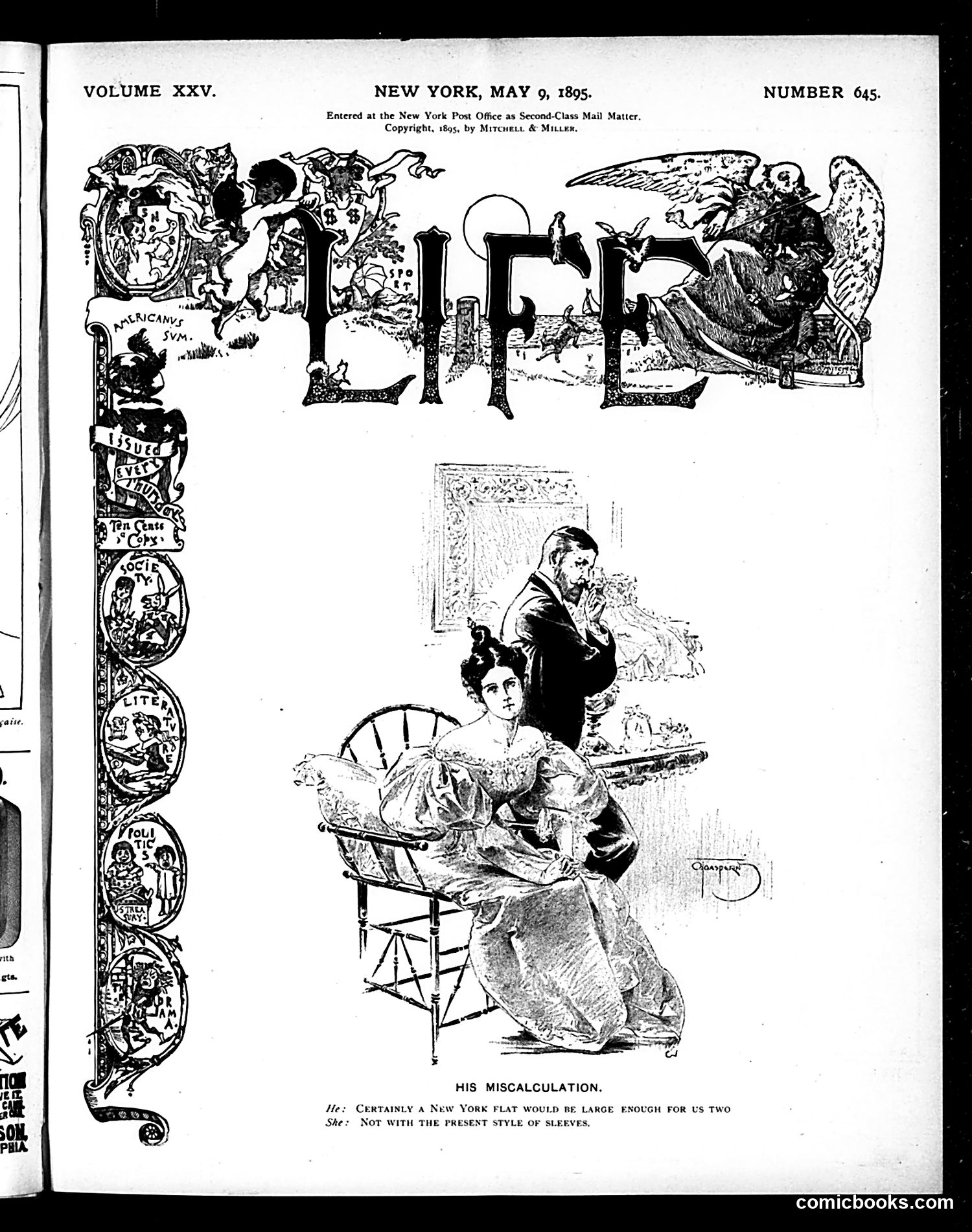
This page contains a single cartoon titled "His Miscalculation," depicting a fashionably dressed woman seated while a man stands behind her chair, both appearing concerned or frustrated. The caption reads: "He: Certainly a New York flat would be large enough for us two. She: Not with the present style of sleeves." This is **social satire about women's fashion**. The joke targets the exaggerated "leg of mutton" or puffy sleeves that were fashionable in the 1900s—garments so voluminous they required substantial space. The woman humorously suggests her sleeves alone make a standard apartment too cramped for two people, mocking both the impracticality of contemporary women's fashion and the absurdity of these oversized sleeves dominating domestic space.
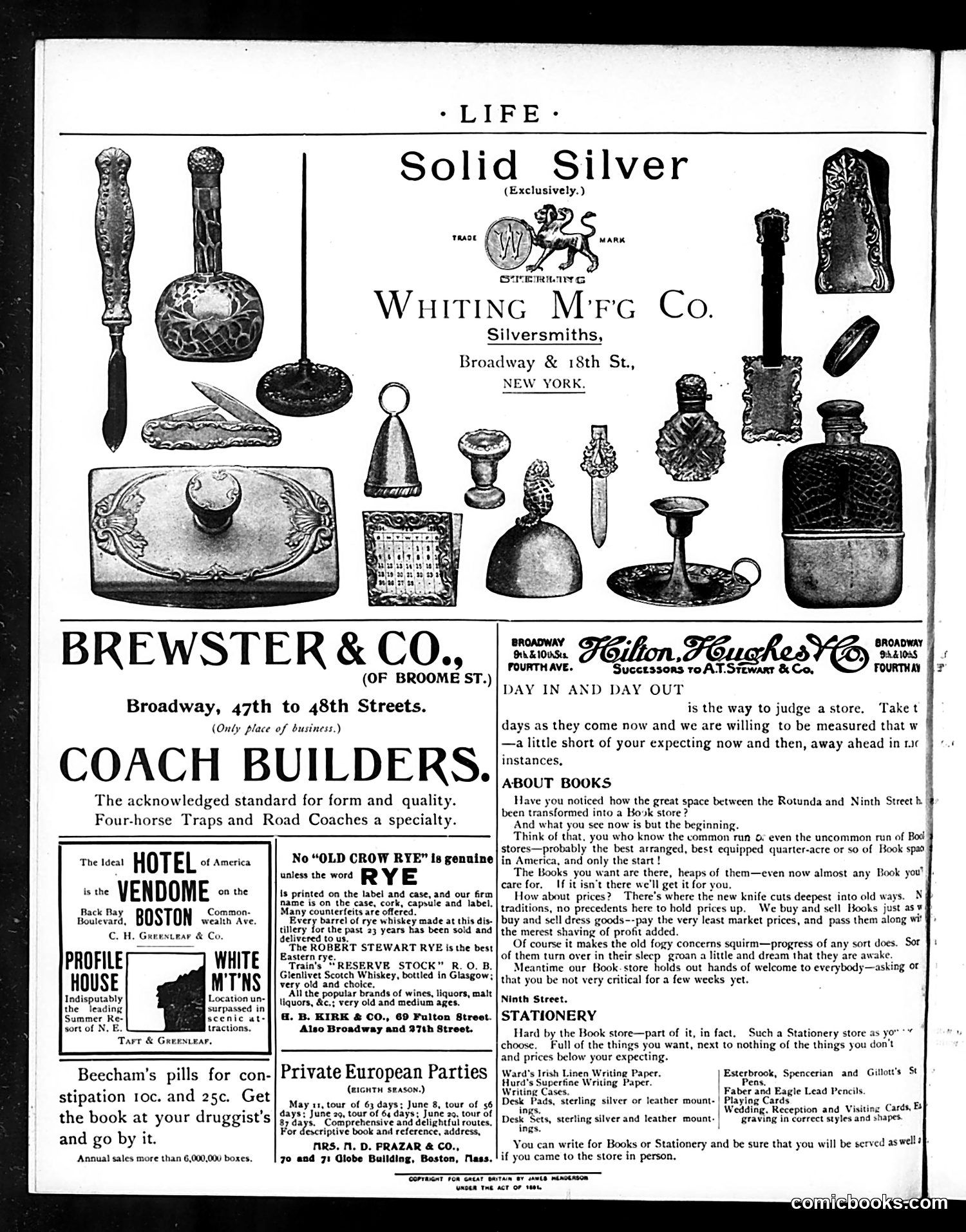
This page is **primarily advertising**, not satirical content. It contains multiple commercial advertisements for luxury goods and services aimed at wealthy Americans: - **Whiting Mfg Co.** advertises solid silver tableware and accessories - **Brewster & Co.** promotes high-end coach building and horse-drawn carriages - **Hilton, Hunches & Co.** offers "day in and day out" services - Additional ads feature hotels, stationery, pills, and European travel The only editorial content is a brief section titled "ABOUT BOOKS" discussing New York bookstores and merchandise. This reflects *Life* magazine's dual nature in this era: primarily a vehicle for upscale advertising alongside satirical commentary. There are no political cartoons or social satire visible on this particular page.
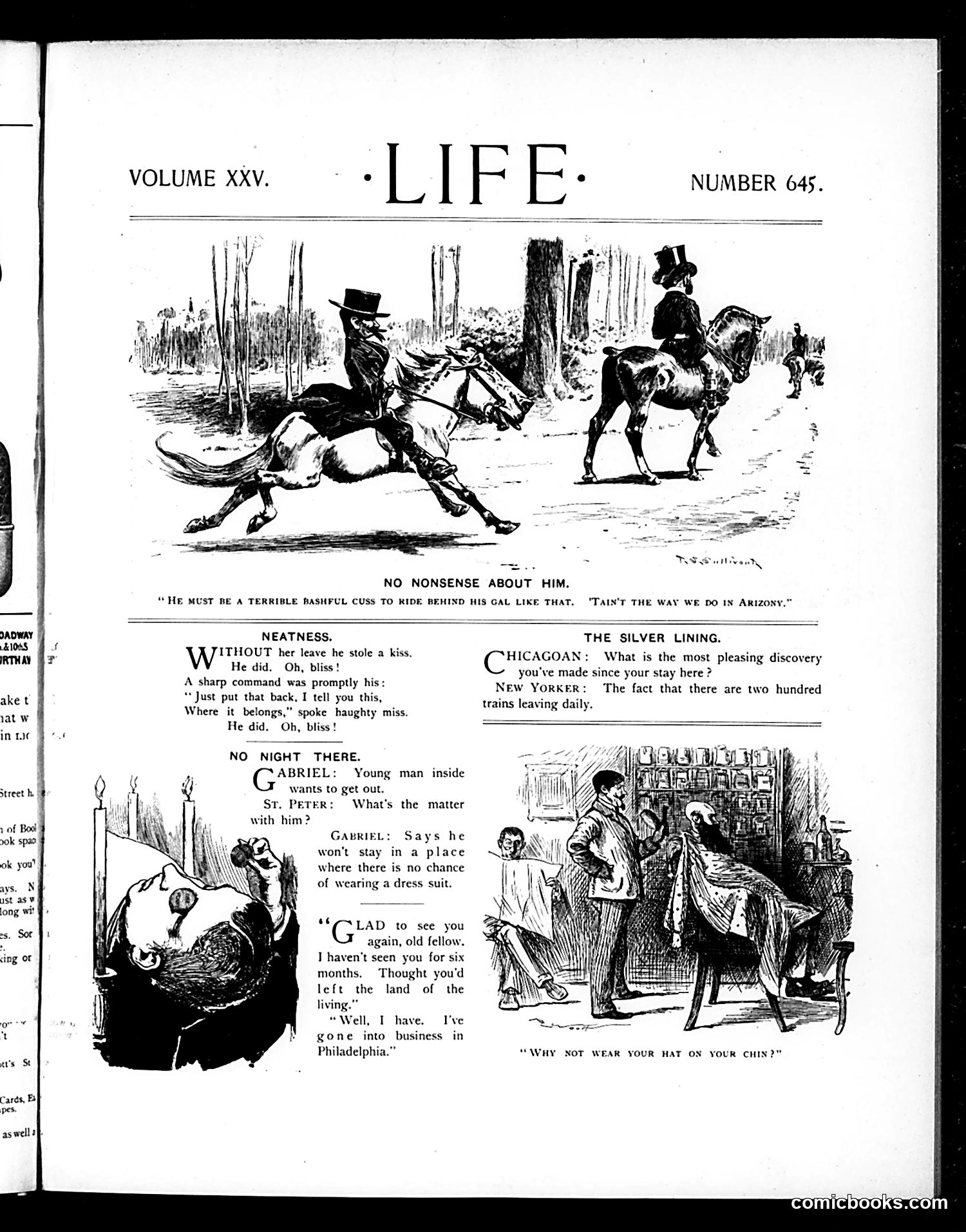
This page contains three unrelated humorous sketches typical of LIFE's satirical format: 1. **"No Nonsense About Him"** (top): A Western scene mocking rigid gender roles. A man on horseback criticizes another rider for letting his female companion ride "behind his gal like that," calling it improper for Arizona. The joke satirizes inconsistent social propriety—the critic's own casual attitude contradicts his rigid moralism. 2. **"Neatness"** (lower left): A domestic comedy where a woman leaves without kissing her husband, then he's ordered to retrieve her for the forgotten kiss—humor derives from role reversals and household dynamics. 3. **"The Silver Lining"** (lower right): A conversation joke contrasting Chicago and New York, with a separate illustration showing an awkward social interaction about hat-wearing etiquette, likely poking fun at urban fashion pretensions.
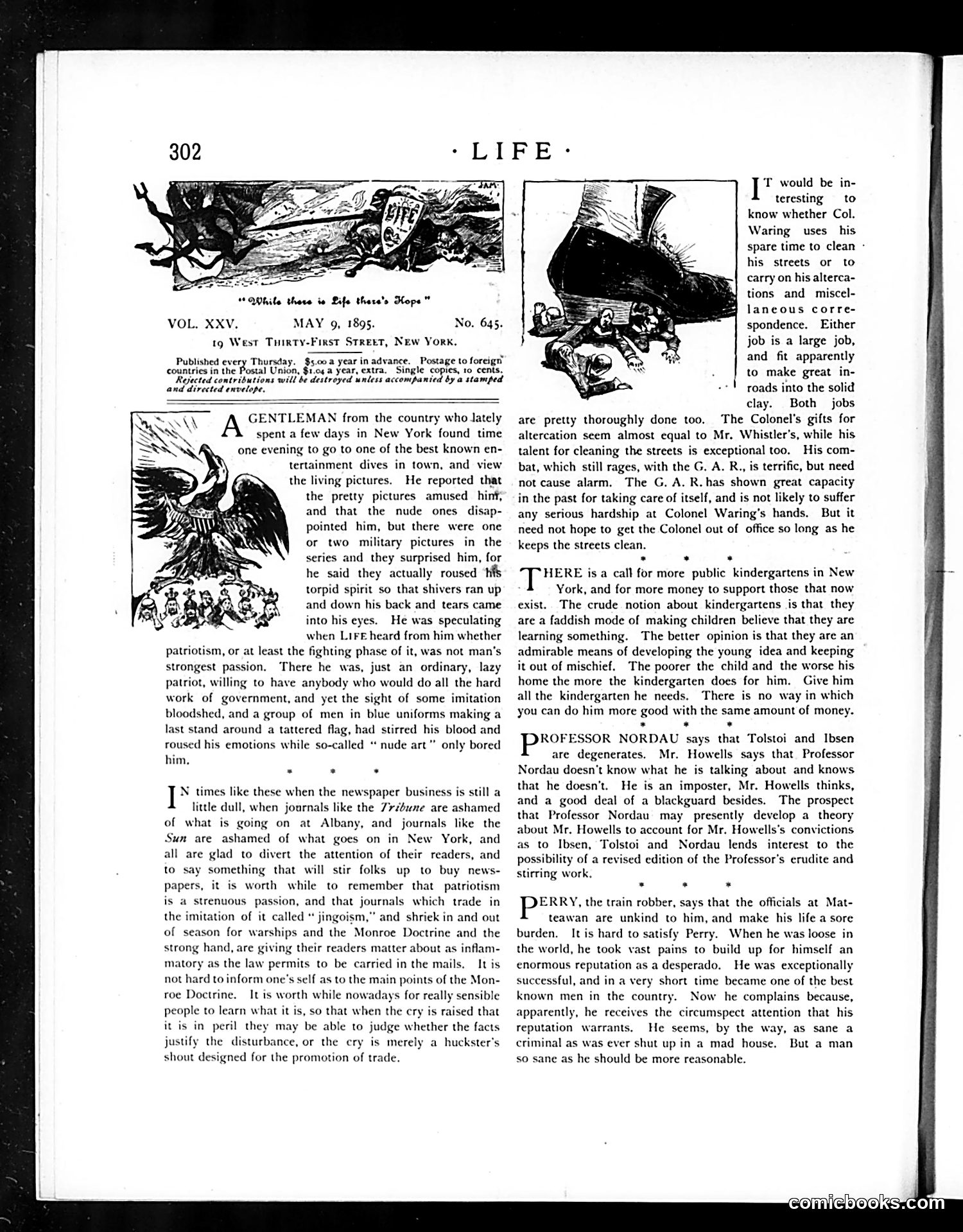
This page contains editorial commentary rather than a political cartoon. The main illustrated elements are decorative vignettes (an eagle, a hat). The text discusses several topics: 1. **Colonel Waring's street cleaning**: Praises the Colonel's exceptional talent for cleaning New York's streets, comparing it favorably to his alleged military abilities. The satire suggests his real strength lies in municipal sanitation rather than military prowess. 2. **Kindergarten funding**: Argues for increased public funding for kindergartens as superior to private charitable models. 3. **Literary criticism**: Comments on Tolstoy, Ibsen, and Nordau as "degenerates," referencing contemporary debates about naturalist literature. 4. **Train robber "Perry"**: A brief note about a criminal who built a reputation as a "desperado" but may be less dangerous than his legend suggests. The page exemplifies *Life*'s satirical approach to urban politics and cultural criticism of the 1890s.
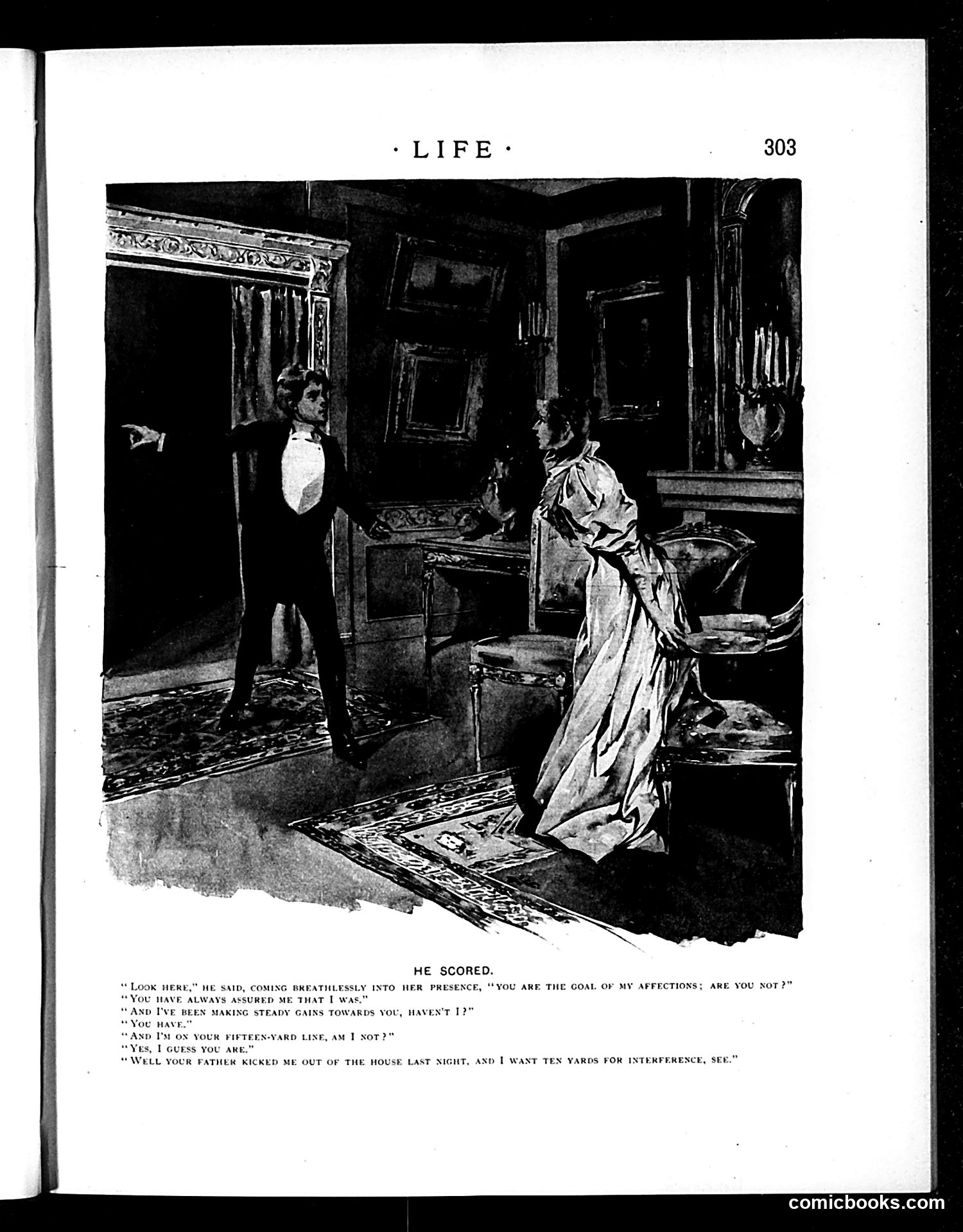
This cartoon illustrates a domestic dispute between a man and woman, likely depicting marital conflict over infidelity or interference. The man, dressed formally in evening wear, confronts the woman in an ornate interior. The dialogue reveals the satirical point: the man claims he's "making steady gains" toward the woman's affections, and when she mentions her father kicked him out, he demands "ten yards for interference"—a football reference. The humor satirizes masculine bravado and courtship as a "game" with quantifiable progress. The title "He Scored" plays on athletic terminology for romantic/sexual conquest. This reflects early 20th-century attitudes about gender relations, framing seduction as competitive sport rather than mutual emotion.
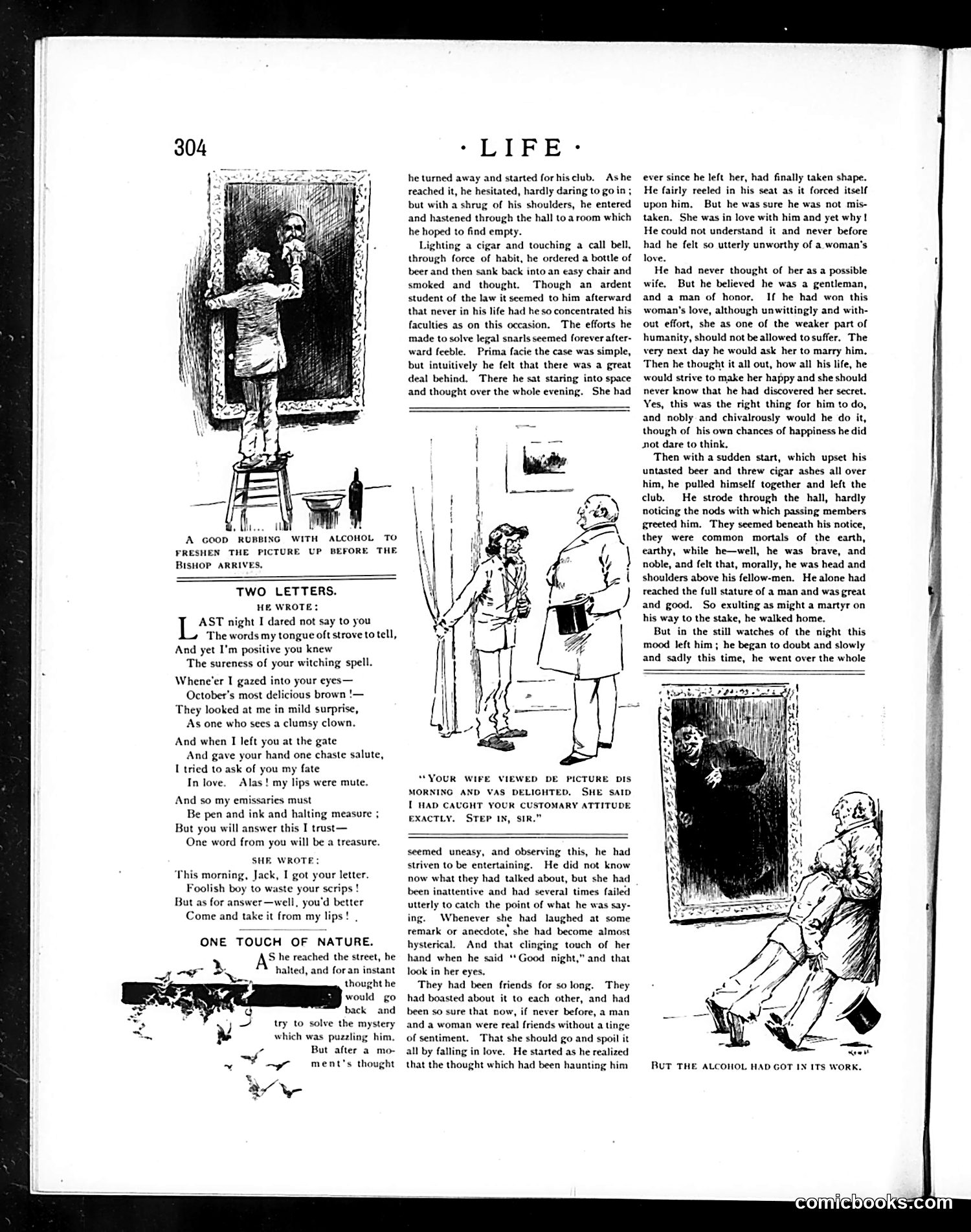
This page contains serialized fiction rather than political satire. The main narrative describes a man's internal conflict about his feelings for a woman, exploring themes of love, honor, and social propriety typical of early 20th-century literature. The section titled "Two Letters" appears to be romantic poetry or correspondence. The illustrations depict domestic scenes: a man in a club contemplating a woman's portrait, and figures in an interior setting discussing the woman's reaction to the portrait. The bottom illustration, captioned "But the alcohol had got in its work," suggests the narrative involves alcohol's influence on judgment or behavior—a common literary theme of the period. This is primarily **literary content**, not political commentary or satirical cartooning.
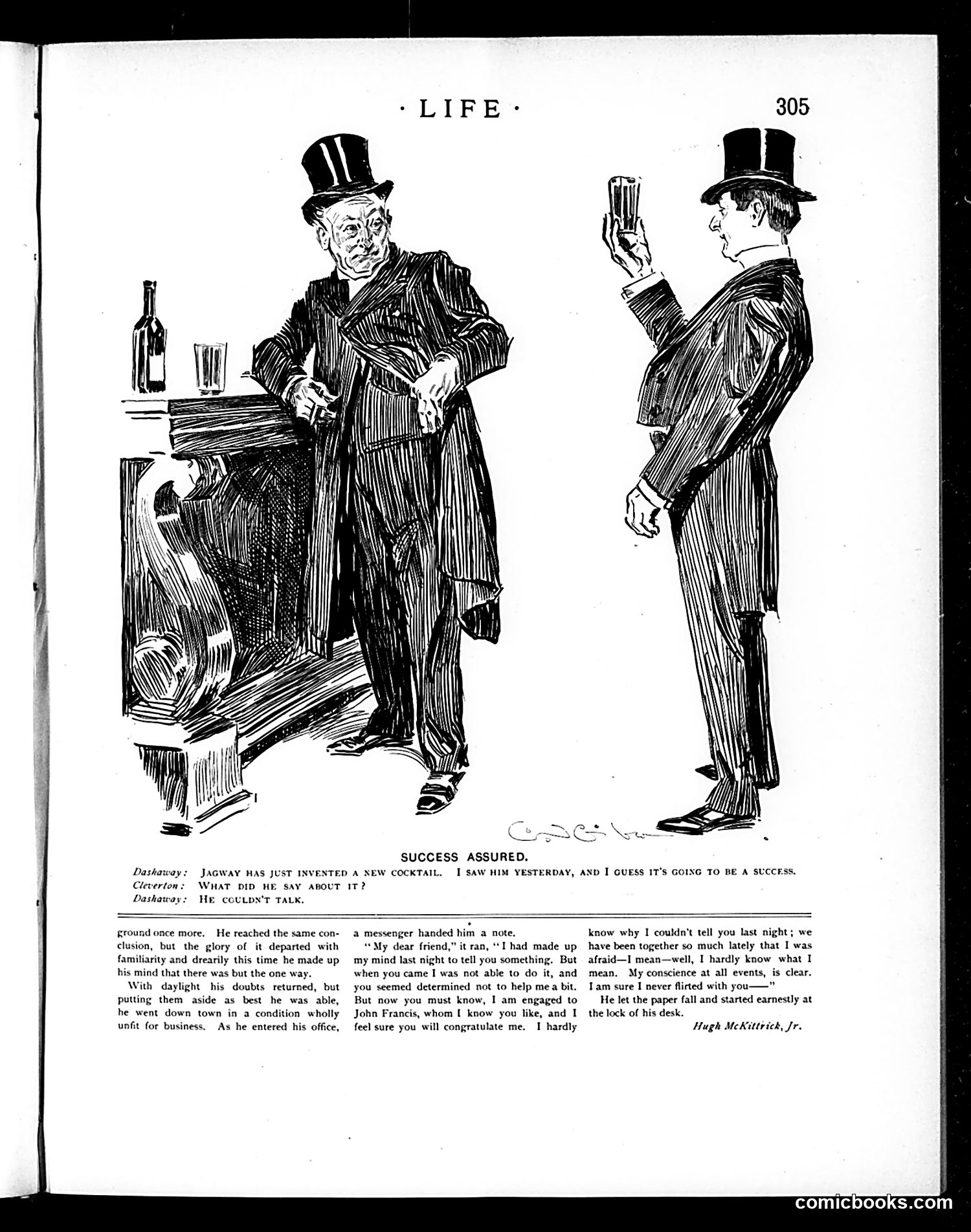
This cartoon satirizes a business deal involving a new cocktail invention. The left figure (labeled "Dashawayt") has invented a cocktail and is pitching it to a well-dressed businessman on the right ("Crierton"). The humor relies on Dashawayt's confidence that success is "assured" despite his inability to describe the drink coherently—he can only say "What did he say about it?" when pressed for details. The accompanying text reveals Crierton engaged someone named John Francis to manufacture it, though Dashawayt apparently couldn't articulate the product's merits. The satire mocks both hype-driven business ventures and the absurdity of selling something one cannot adequately explain—a timeless commentary on questionable entrepreneurship and empty marketing promises.
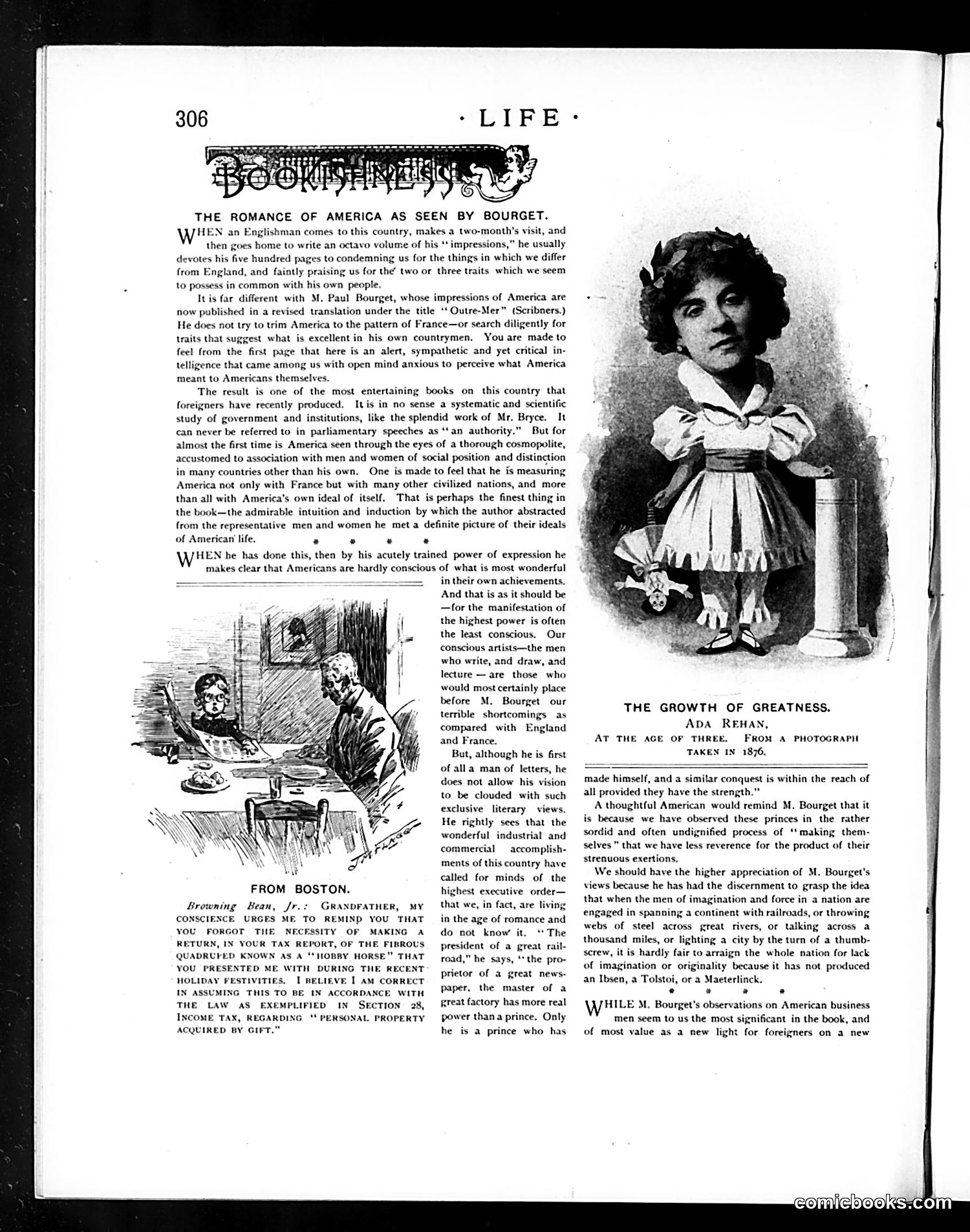
This page discusses **Paul Bourget**, a French author whose book "Outre-Mer" (translated as "The Romance of America") offered a European critique of American society. The article praises Bourget's ability to observe American life with sophistication—measuring the country not just against France but other civilized nations. The sketch labeled **"From Boston"** appears to show a domestic scene, likely satirizing American home life or social customs that Bourget observed. The photograph titled **"The Growth of Greatness"** shows a child at age three, illustrating the article's broader point about American potential and achievement—that ordinary Americans accomplish what would require aristocratic privilege elsewhere. The piece celebrates Bourget's outsider perspective as revealing something Americans themselves overlook about their nation's accomplishments.
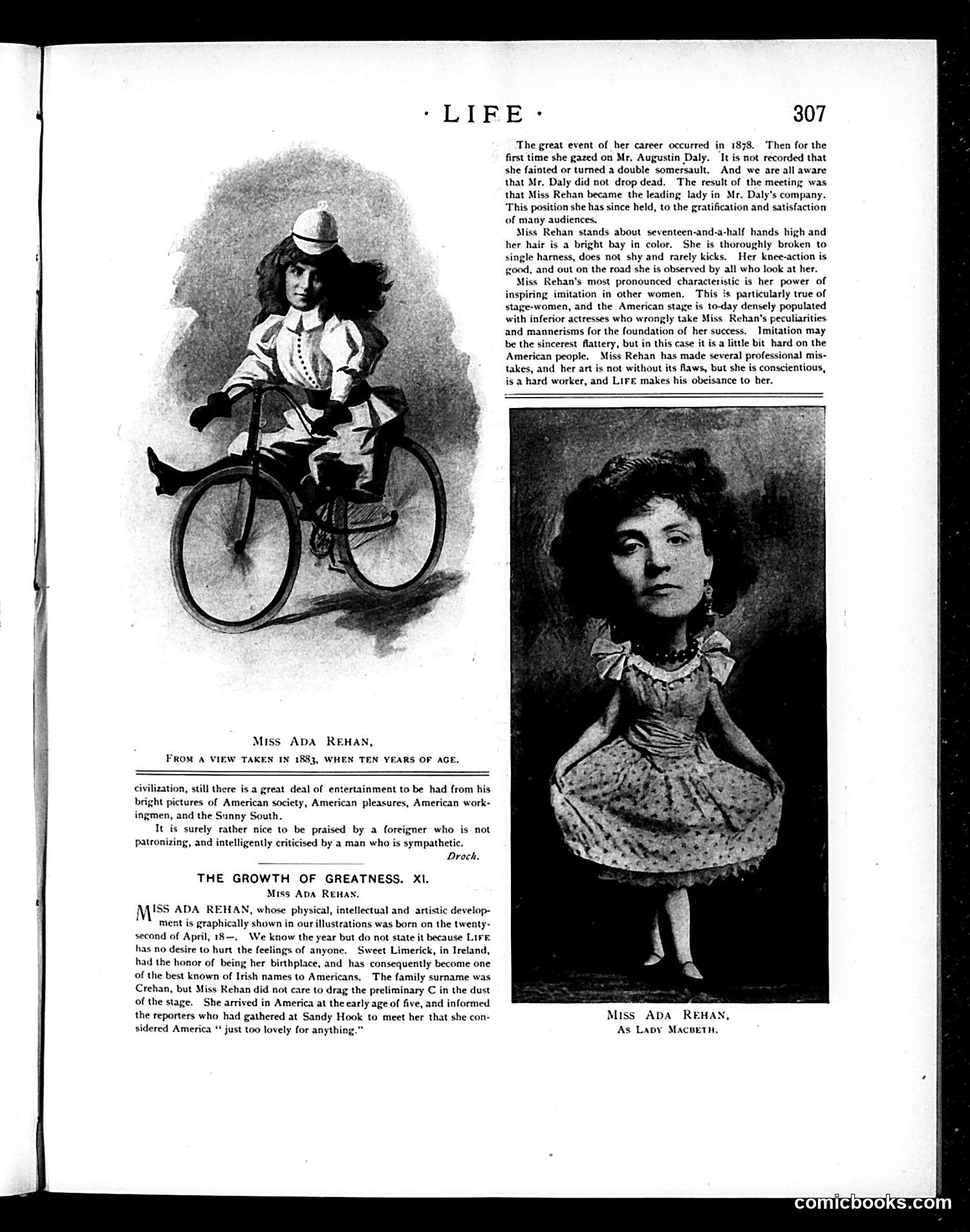
This page from *Life* magazine celebrates actress **Miss Ada Rehan**, a prominent stage performer of the era. The left illustration shows her riding a bicycle—a contemporary leisure activity that symbolized modern independence, particularly for women. The right photographs document her career: a childhood portrait from 1883 (age ten) and an image of her in costume as Lady Macbeth, demonstrating her transition from child to accomplished Shakespearean actress. The accompanying text praises her physical development, artistic talent, and professional success, while noting she arrived in America at age five and became a leading lady in Mr. Daly's theatrical company. The page essentially documents her transformation from unknown child to celebrated performer—"the growth of greatness."
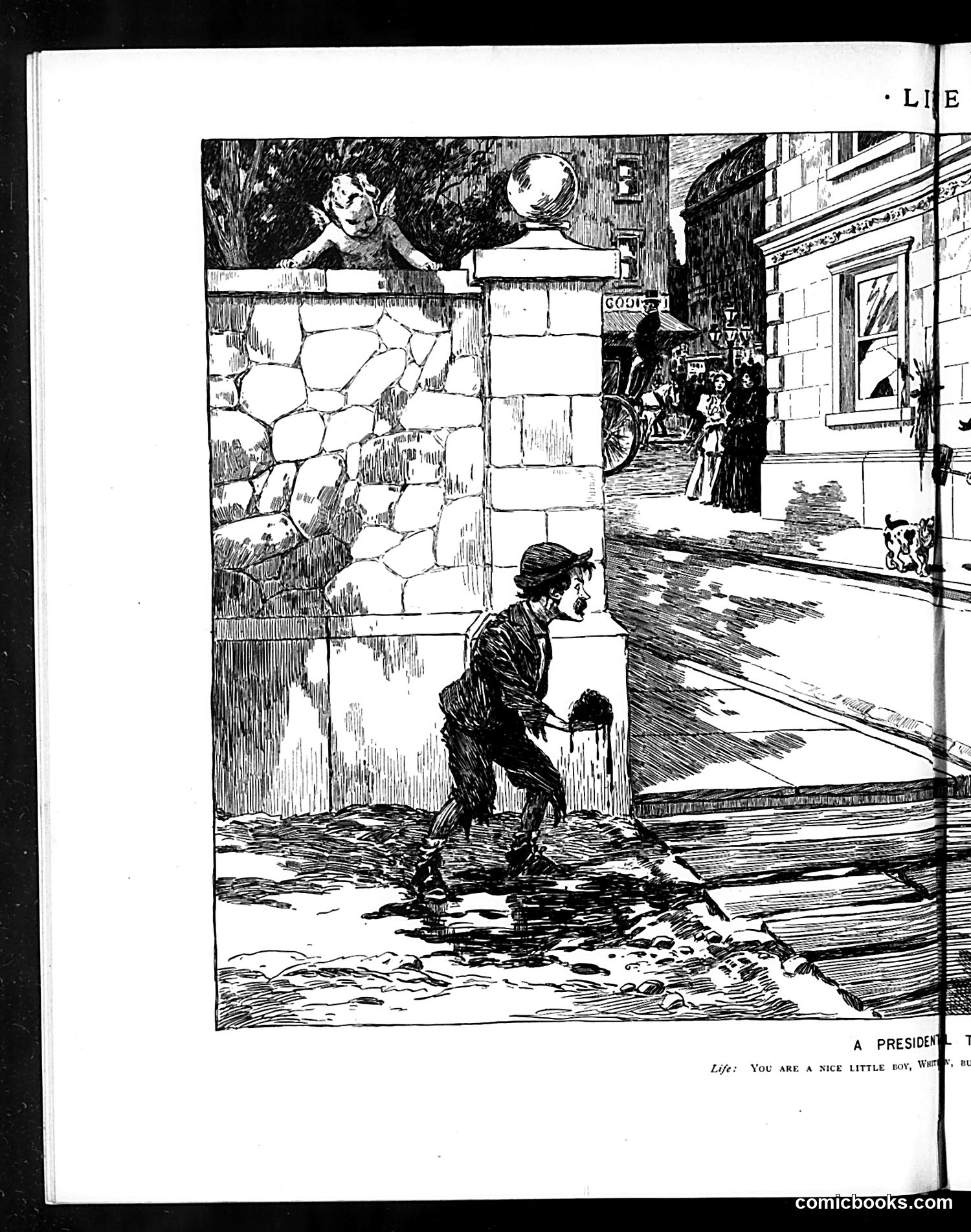
This is a satirical illustration from *Life* magazine depicting a street scene. A young boy in dark clothing stands in the foreground near a stone wall, appearing to observe or interact with his surroundings. In the background, there's a European-style street with buildings, pedestrians, and what appears to be a bicycle. The caption begins "You are a nice little boy, Willi, bu..." (text cuts off), suggesting the cartoon references a character named Willi, likely a German child. Given the European architecture and the incomplete caption, this appears to be political satire related to international relations or German affairs, possibly from the early-to-mid 20th century. The specific historical context—whether this comments on German youth, politics, or diplomacy—remains unclear without the complete caption text.
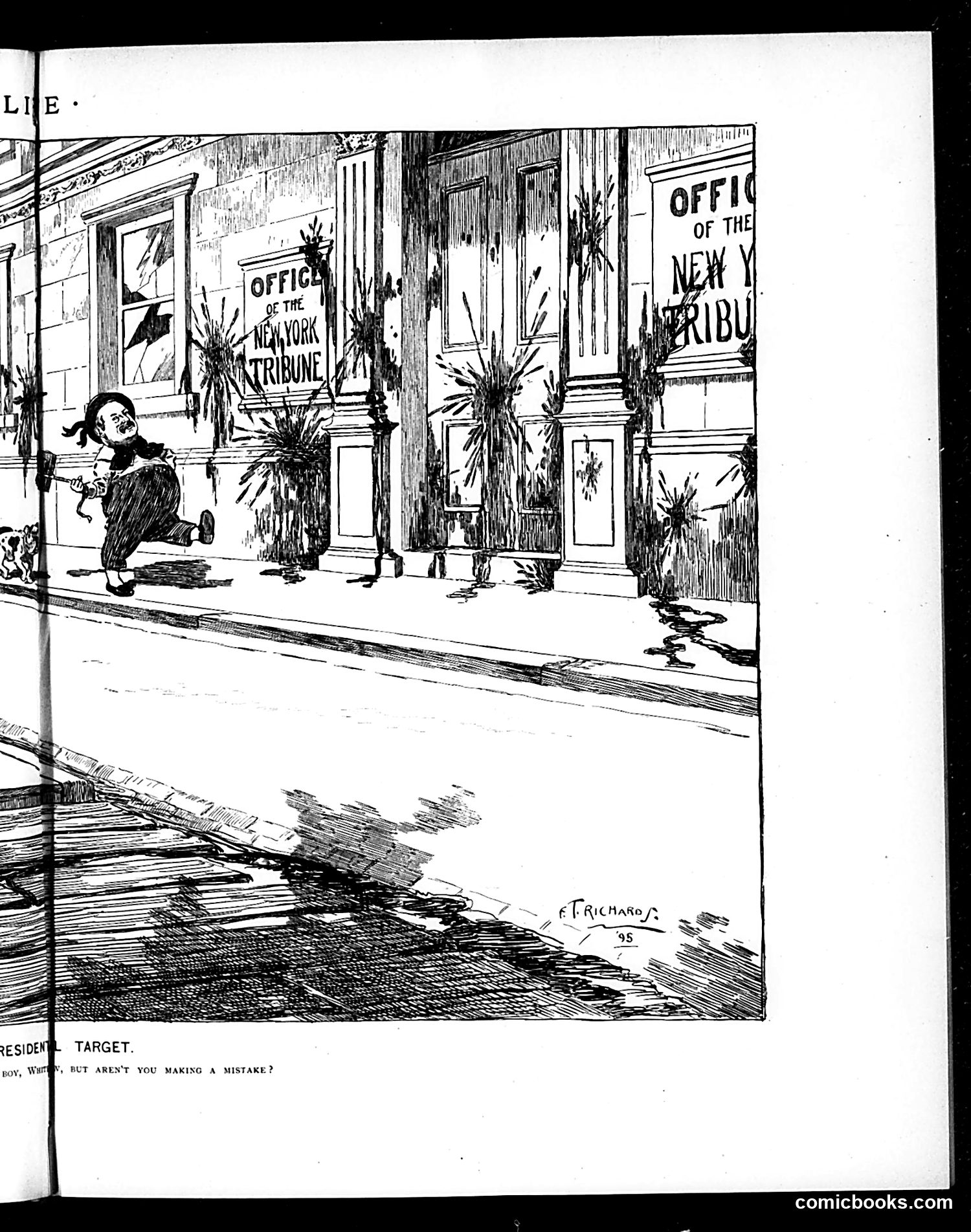
This is a satirical cartoon by F. Frichard (signed, dated '95) from Life magazine titled "President Target." The image shows a figure hurling what appears to be a bomb or explosive at the office of the New York Tribune building. The partial caption reads: "Boy, Why, but aren't you making a mistake?" The cartoon appears to criticize violent attacks or threats directed at the presidency or presidential institutions. The "target" metaphor suggests the president was under literal or figurative attack. The Tribune, a major newspaper, may represent either a target of violence or a commentator on violent threats. Without additional context about specific 1895 events, the exact political situation remains unclear, though it likely references anarchist violence or anti-government sentiment of that era.
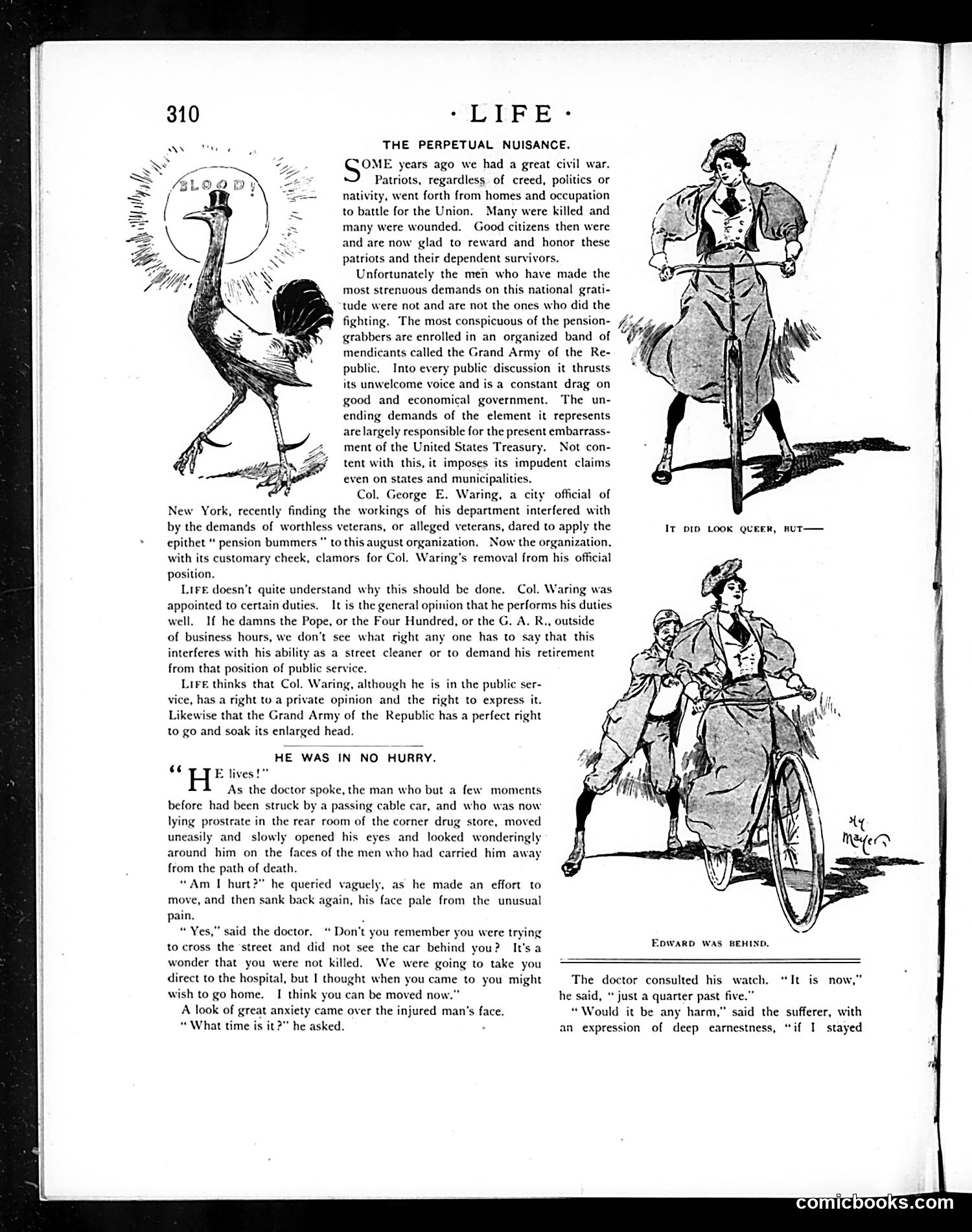
This page critiques the **Grand Army of the Republic (G.A.R.)**, a powerful veterans' organization formed after the Civil War. Life argues that while honoring actual war sacrifices is proper, the G.A.R. had become a self-serving "pension-grabbing" lobby constantly demanding government benefits and interfering in politics—draining the Treasury and state budgets. The specific case: **Colonel George E. Waring**, a New York city official (street cleaner), called G.A.R. members "pension bummers." The organization demanded his removal. Life defends Waring's right to private opinion and ridicules the G.A.R. for abusing its political leverage. The cartoons mock this entitled behavior: a rooster (pompous symbol) and women on bicycles represent the organization's self-important meddling. The secondary story, "He Was in No Hurry," appears unrelated—a street accident victim asking the time, concerned about staying somewhere late.
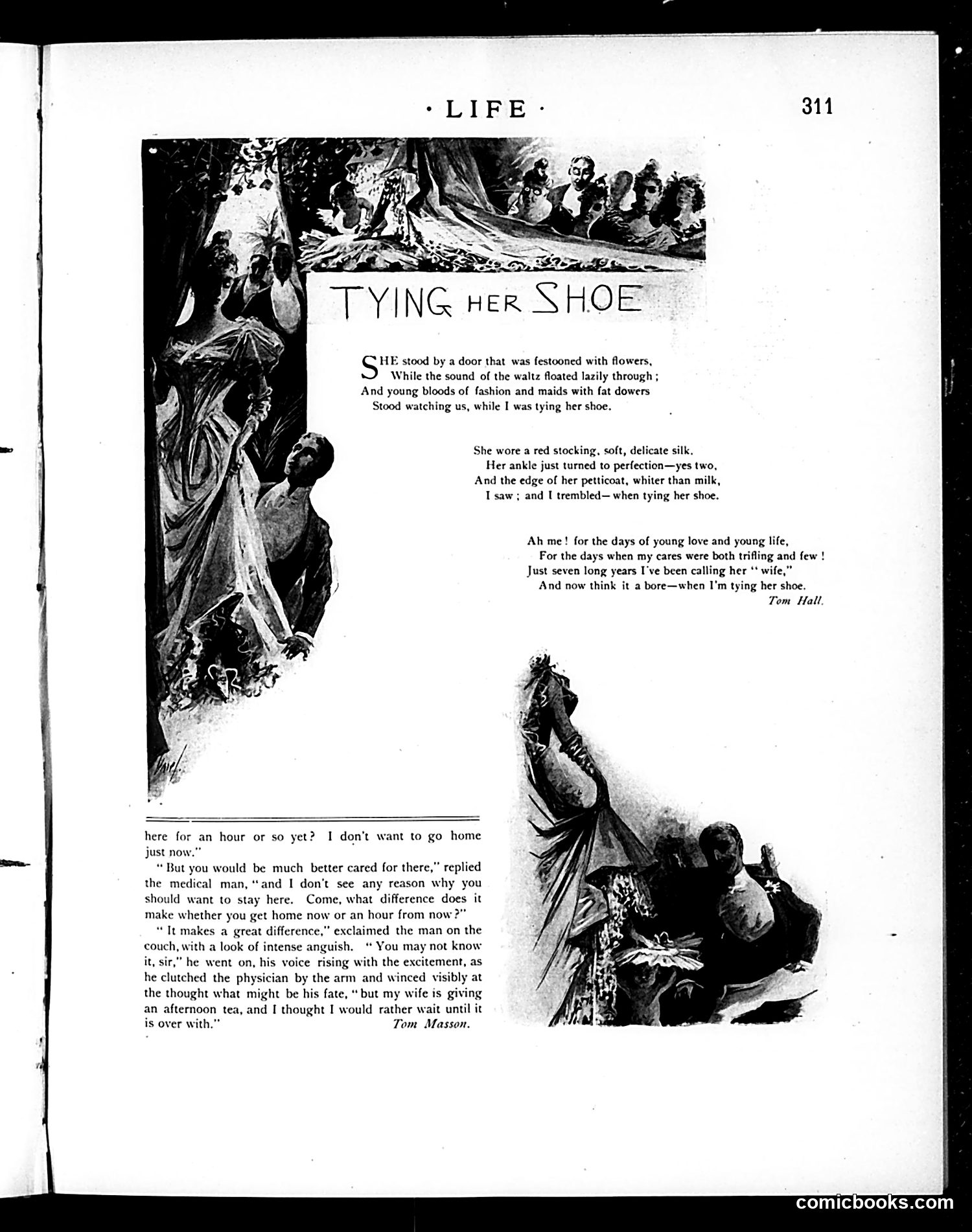
This page presents two contrasting poems about marriage, both attributed to real writers (Tom Hall and Tom Masson). The top poem romantically recalls a man tying his beloved's shoe at a dance—a tender moment of courtship filled with passion and longing. The bottom section inverts this sentiment: a medical anecdote where a sick man refuses to leave his doctor's office because his wife is hosting an afternoon tea at home. He'd rather endure his illness than face her social event, suggesting marital tedium has replaced romance. The satire targets the disillusionment of married life: what was once an intimate, thrilling gesture (tying a shoe) becomes mere domestic routine after seven years. The contrast between youthful romance and jaded domesticity—particularly the husband actively avoiding returning home—reflects early 20th-century anxieties about marriage's loss of excitement and the constraints of domestic obligation.
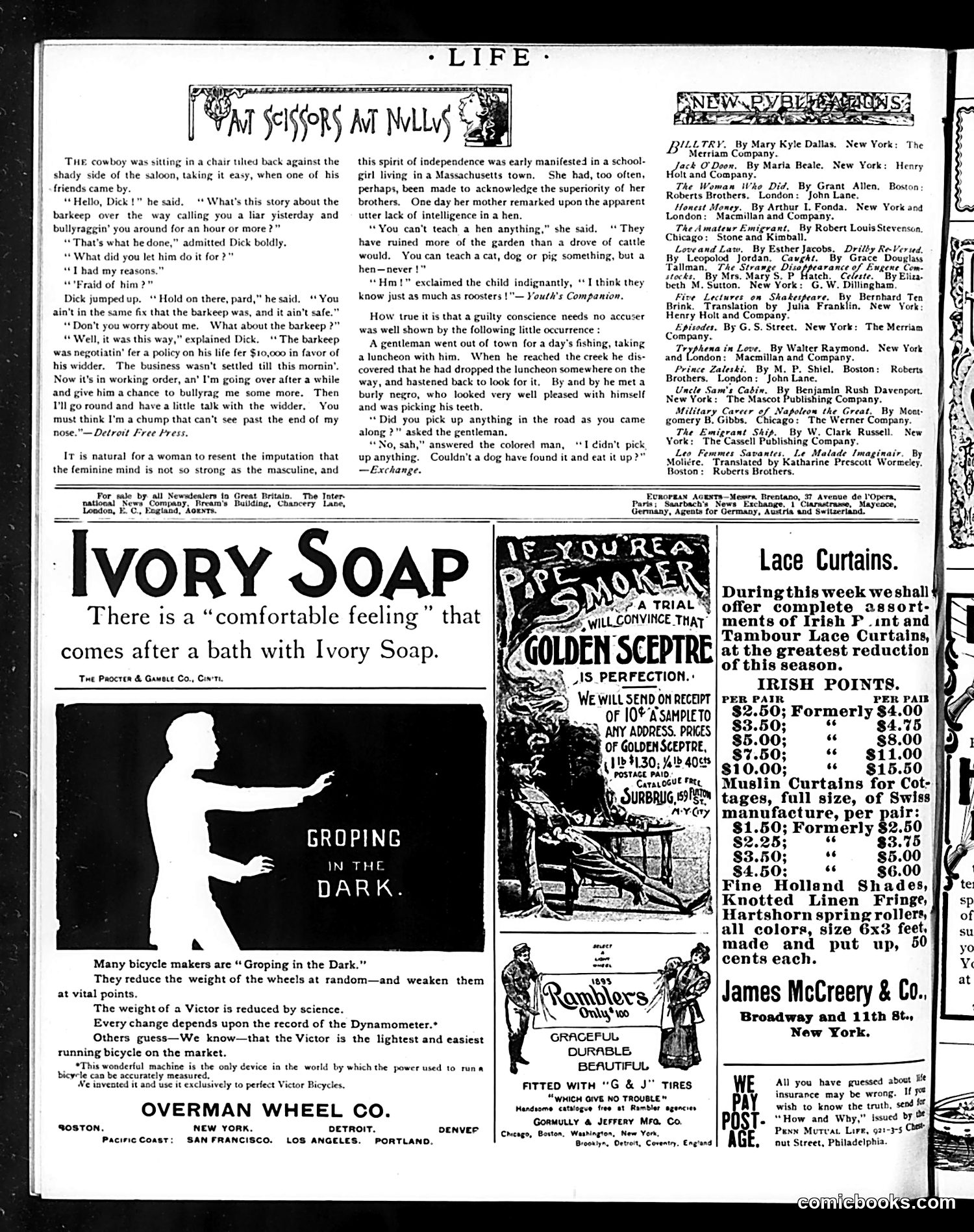
This page contains **three separate humorous anecdotes** rather than political cartoons: 1. **"The Barkeep" story**: A cowboy allows a saloon bartender to bully him, revealing he's actually waiting until the bartender's life insurance policy is finalized—then he'll fight back. The joke satirizes **masculine honor codes and life insurance**, suggesting men will tolerate insults if financial gain is involved. 2. **The hen anecdote**: A young girl defends hens' intelligence against her mother's dismissal, asserting they're as smart as roosters. This is **light satire on gender attitudes**—the girl's independent spirit mirrors period debates about women's capabilities. 3. **The fishing story**: A man suspects a Black man ("burly negro") of stealing his lunch, but the man denies it, suggesting a dog ate it. The humor relies on racial stereotypes typical of the era. The page is primarily **literary advertising** listing new books, with unrelated commercial ads (Ivory Soap, bicycles, curtains) interspersed. The satire is mild and domestic rather than political.
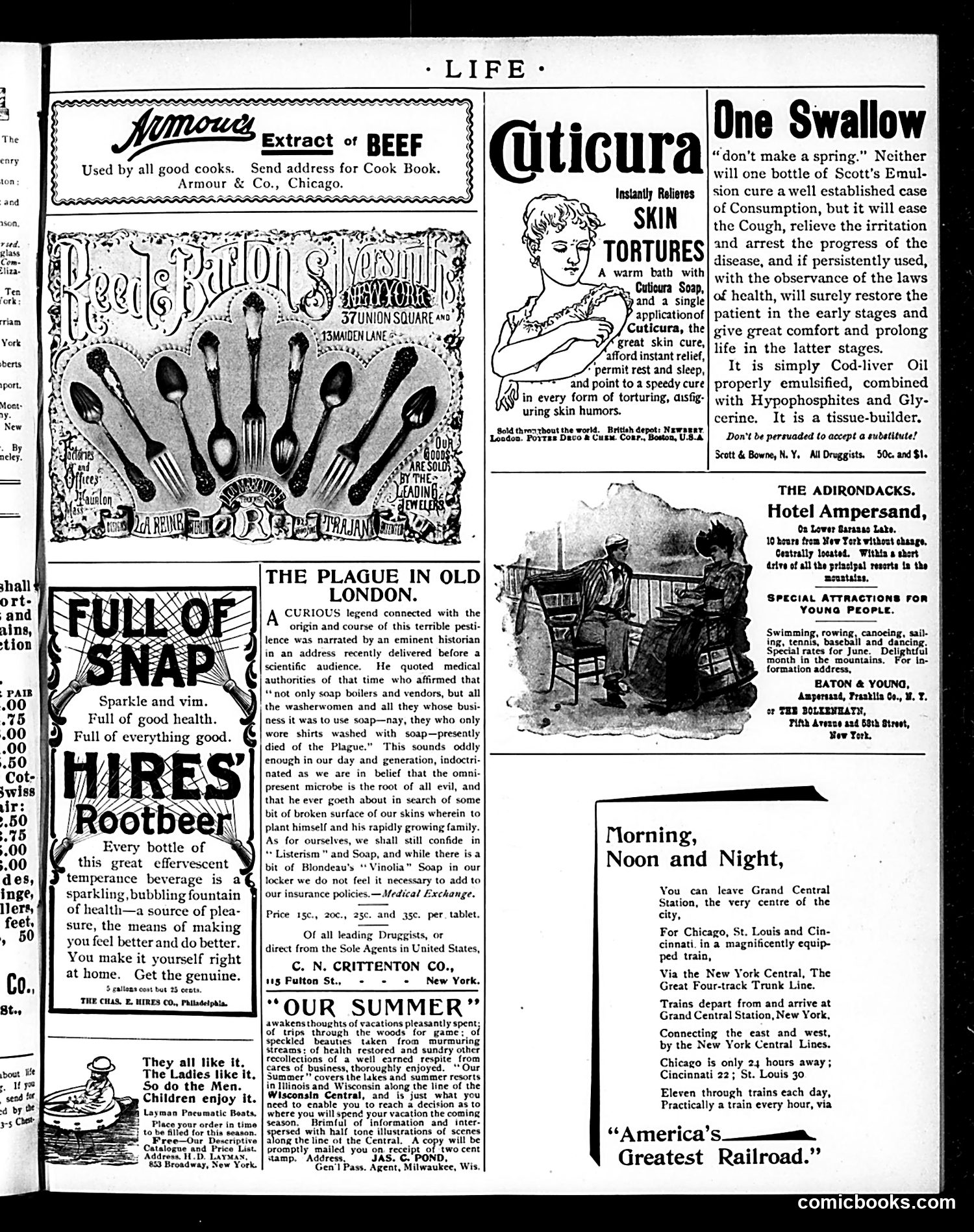
This page is primarily **advertisements and promotional content** rather than political satire or editorial cartoons. The main visual element—a decorative illustration of ornate spoons and forks—advertises Pairpoint Manufacturing's tableware from Union Square, New York. Below it, "The Plague in Old London" presents a historical anecdote (rather than satire) about how 17th-century Londoners blamed soap use for plague deaths, contrasting folk superstition with modern germ theory. The piece uses this curiosity to promote Vinolia soap and Listerine products. The remaining content consists of advertisements for consumer goods: Armour beef extract, Hires rootbeer, Scott's Emulsion (for consumption/tuberculosis), Cuticura skin products, and travel promotions for railroads and Adirondack hotels. **There is no identifiable political cartoon or satirical commentary** on this page. It represents typical Life magazine advertising revenue alongside light educational/historical filler content.
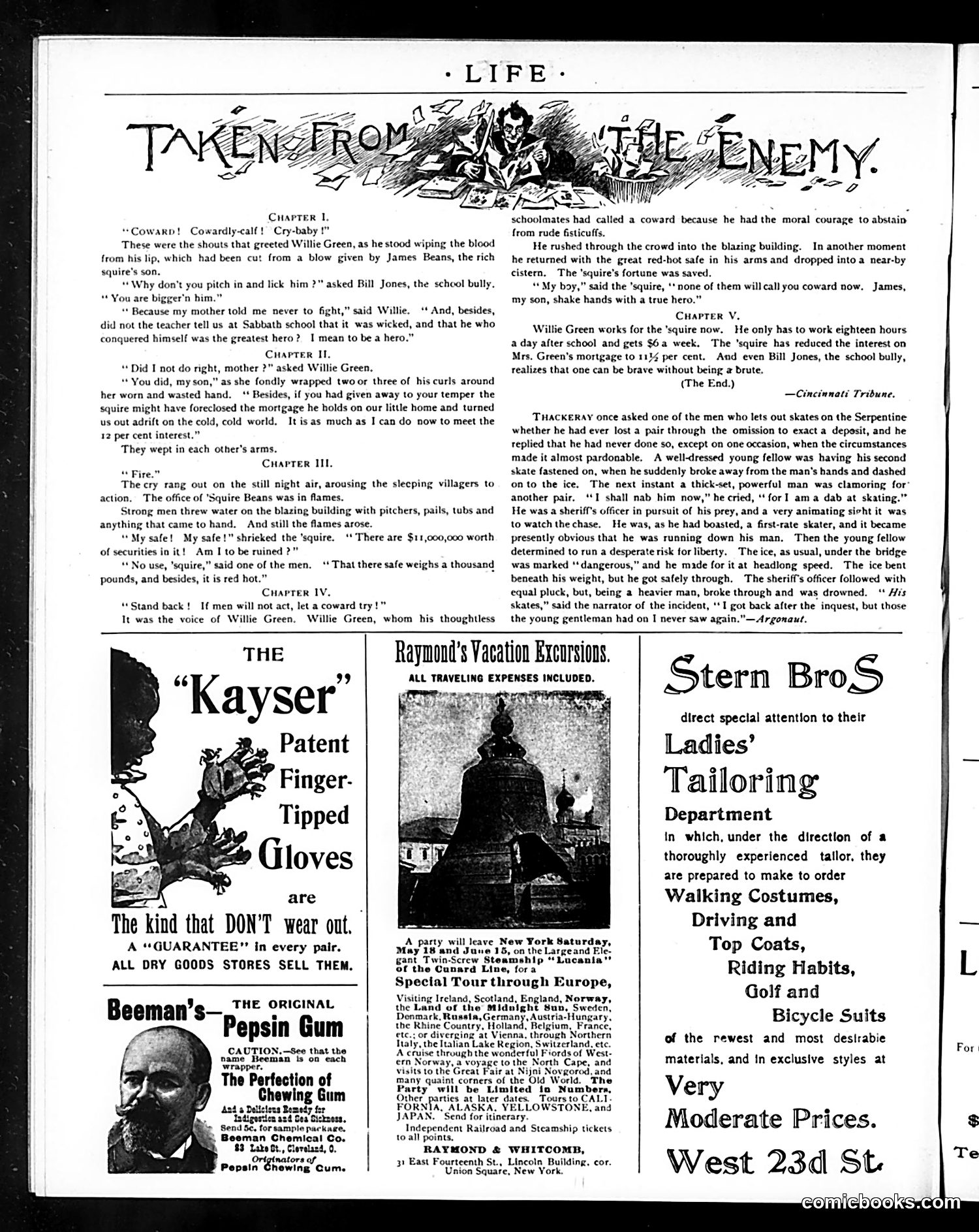
This page contains a serialized morality tale from *Life* magazine about Willie Green, a poor boy who refuses to fight the rich squire's son despite schoolyard taunts calling him a coward. His mother reinforces that self-control is true heroism, noting that fighting could cause the squire to foreclose their mortgage. The story's ironic twist: when the squire's office burns, Willie—the supposed "coward"—heroically rescues the $11,000,000 safe from the flames, earning vindication and employment. The finale is gently satirical: Willie now works eighteen-hour days for $6/week while the squire raises his mother's mortgage interest to 11¾ percent—suggesting that moral virtue brings exploitation rather than genuine reward. The narrative critiques both class exploitation and sentimental Victorian morality tales that instructed poor children to accept their suffering as noble.
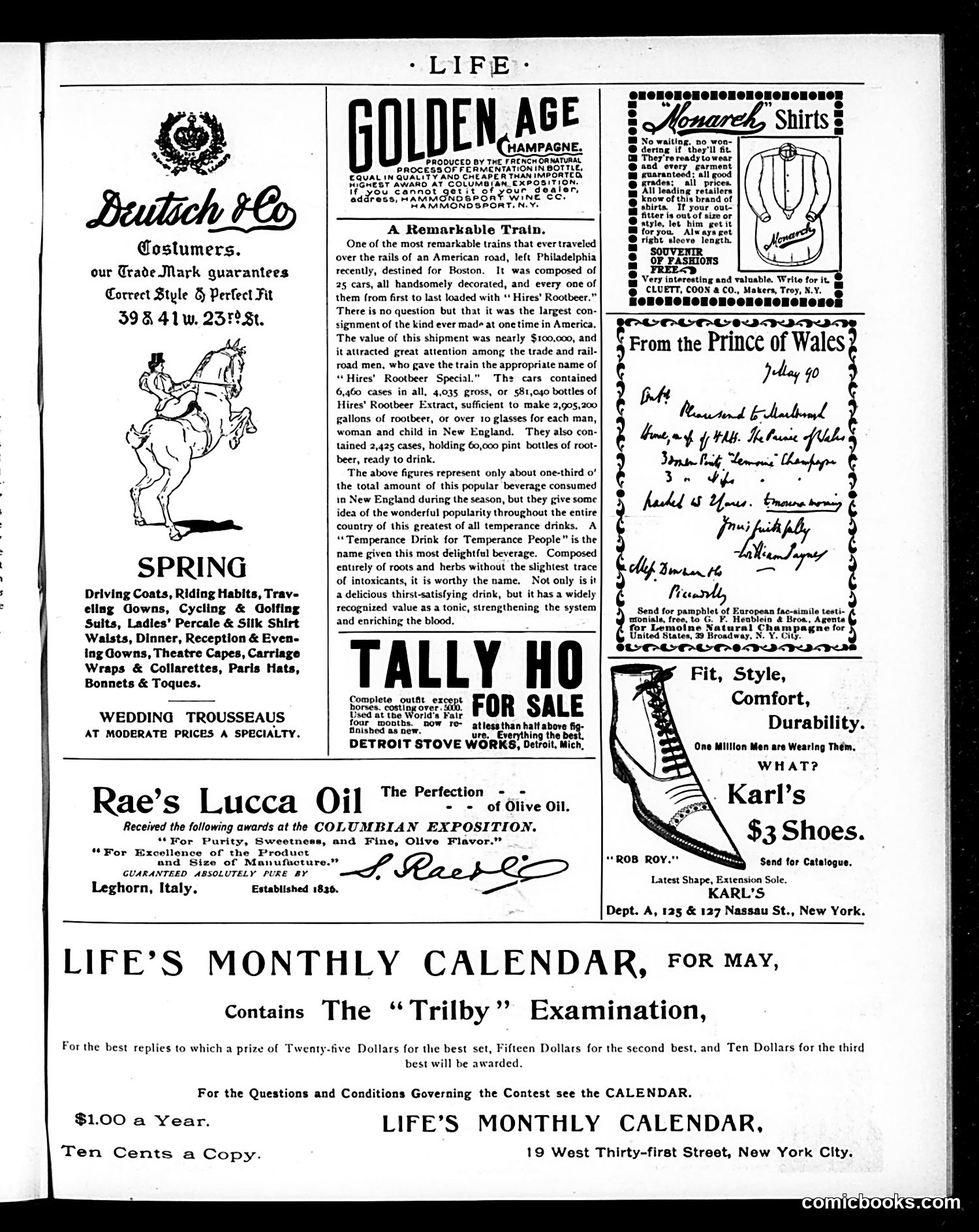
This is primarily an **advertising page** from *Life* magazine, not a political cartoon. The page contains multiple commercial ads typical of the era: **Notable content includes:** - **Deutsch & Co.** costume advertisement featuring a equestrian illustration - **Golden Age Champagne** ad promoting French wine - **Hires Rootbeer** article describing a remarkable promotional train from Philadelphia to Boston carrying 581,040 bottles—presented as a commercial novelty/achievement - **Rae's Lucca Oil** promoting Italian olive oil with Columbian Exposition awards - **Karl's $3 Shoes** and other fashion/luxury goods **The "Prince of Wales" handwritten note** appears to be an endorsement or testimonial, likely referencing the future King Edward VII's approval of a product. The page reflects **Gilded Age consumer culture**, emphasizing imported European luxury goods (Italian oil, French champagne) and American industrial capacity (the massive rootbeer shipment). There is **no political satire** visible—this is straightforward period advertising.
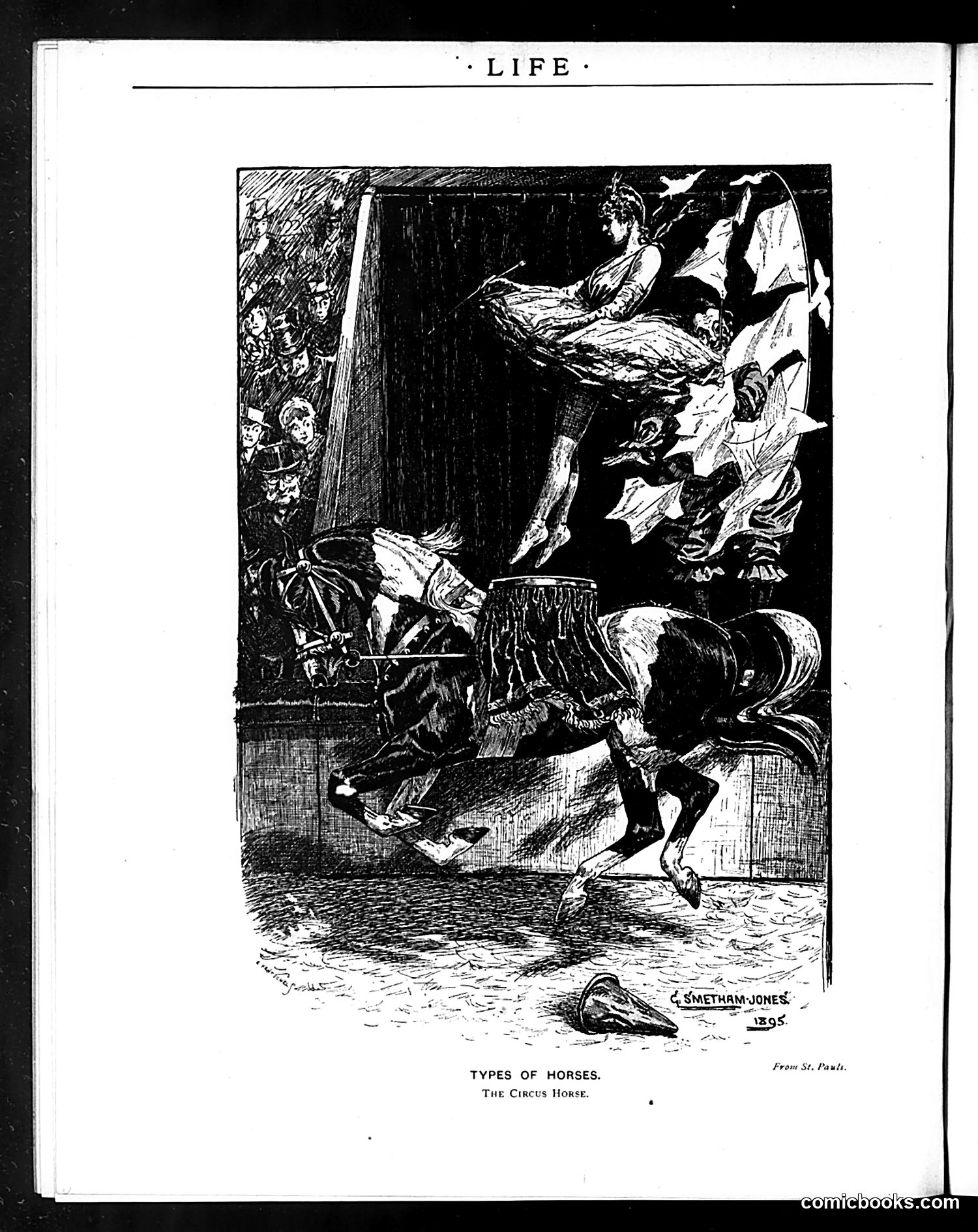
This is a satirical illustration titled "Types of Horses: The Circus Horse," credited to G. Smetham Jones and adapted from *St. Paul's* magazine (dated 1895). The image depicts a circus scene with a rearing horse and acrobatic performers in mid-act above. The satire likely plays on the phrase "types of horses" — rather than depicting actual horse breeds, it shows a horse defined by its *function* in circus entertainment. The chaotic, dynamic composition with flying performers and the struggling horse suggests satire about either circus animal treatment or the absurdity of categorizing horses by their trained performance rather than biological characteristics. The *Life* magazine context indicates this is lighthearted social commentary on Victorian-era circus culture and entertainment conventions.