
Life, 1895-05-09 · page 4 of 18
Life — May 9, 1895 — page 4: what you’re looking at
What you’re looking at
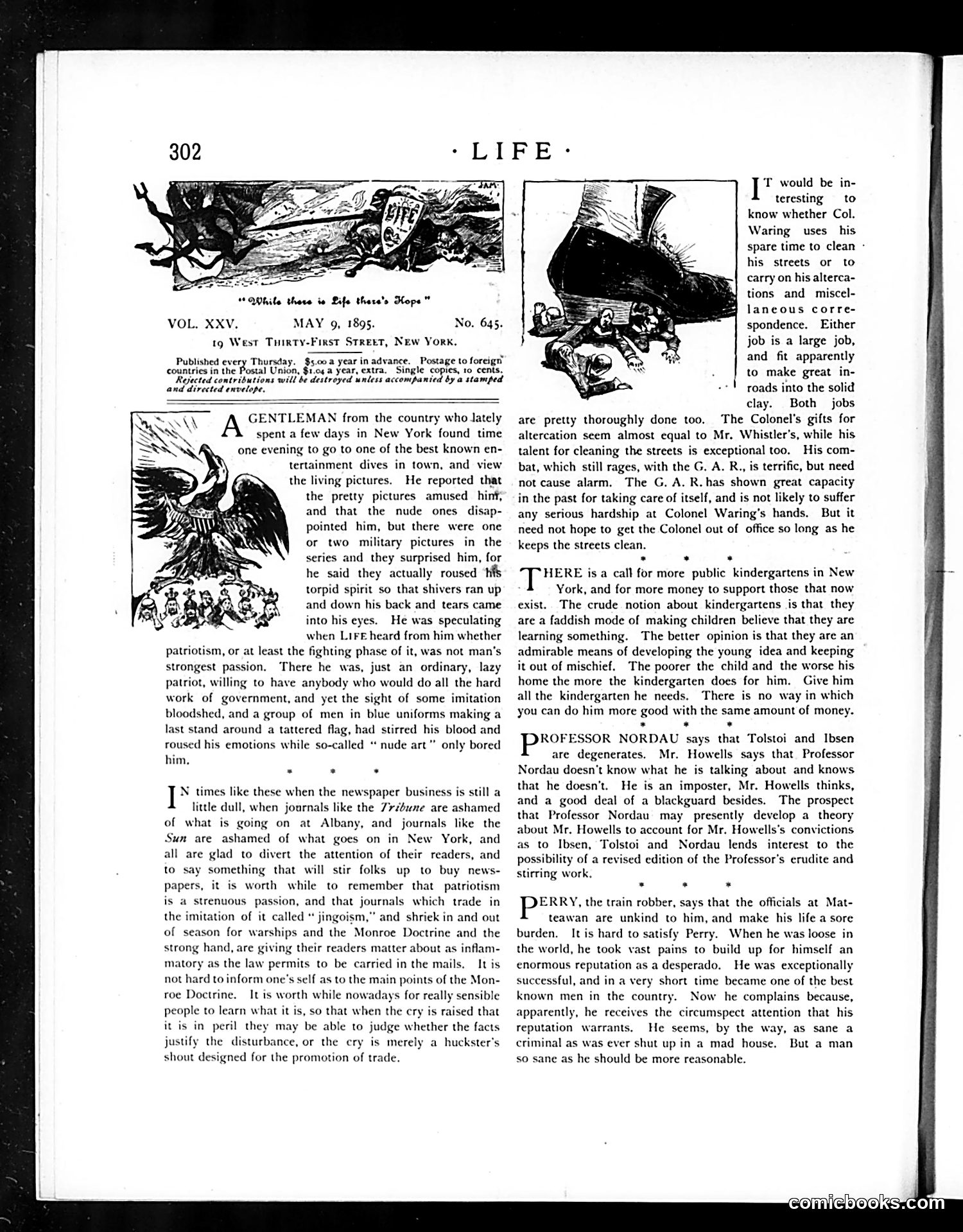
This page contains editorial commentary rather than a political cartoon. The main illustrated elements are decorative vignettes (an eagle, a hat). The text discusses several topics: 1. **Colonel Waring's street cleaning**: Praises the Colonel's exceptional talent for cleaning New York's streets, comparing it favorably to his alleged military abilities. The satire suggests his real strength lies in municipal sanitation rather than military prowess. 2. **Kindergarten funding**: Argues for increased public funding for kindergartens as superior to private charitable models. 3. **Literary criticism**: Comments on Tolstoy, Ibsen, and Nordau as "degenerates," referencing contemporary debates about naturalist literature. 4. **Train robber "Perry"**: A brief note about a criminal who built a reputation as a "desperado" but may be less dangerous than his legend suggests. The page exemplifies *Life*'s satirical approach to urban politics and cultural criticism of the 1890s.
📄 Transcribed text from this page (OCR, searchable)
Machine-transcribed from the original scan — historical spelling and the odd misread are preserved.
“While these io Life there's Hope” VOL. XXV. MAY 9, 1895. tg West Tuirty-First STREET, NEw York. Published every Thursday, $5.00 year inadvance. Postage to foreign countries in the Postal Union, $1.04 a year, extra, Single copies, 10 cents. Rejected contributions will be destroyed unless accompanied by a stamped and directed envelope. GENTLEMAN from the country who lately spent a few days in New York found time one evening to go to one of the best known en- tertainment dives in town, and view the living pictures. He reported that the pretty pictures amused _hinf, and that the nude ones disap- pointed him, but there were one or two military pictures in the series and they surprised him, for he said they actually roused ‘this torpid spirit so that shivers ran up and down his back and tears came into his eyes. He was speculating when LiFe heard from him whether patriotism, or at least the fighting phase of it, was not man’s strongest passion, There he was, just an ordinary, lazy patriot, willing to have anybody who would do all the hard work of government, and yet the sight of some imitation bloodshed, and a group of men in blue uniforms making a last stand around a tattered flag, had stirred his blood and roused his emotions while so-called “ nude art” only bored him, . . . N times like these when the newspaper business is still a little dull, when joarnals like the 7yzéune are ashamed of what is going on at Albany, and journals like the Sun are ashamed of what goes on in New York, and all are glad to divert the attention of their readers, and to say something that will stir folks up to buy news- papers, it is worth while to remember that patriotism is a strenuous passion, and that journals which trade in the imitation of it called * jingoism,” and shriek in and out of season for warships and the Monroe Doctrine and the strong hand, are giving their readers matter about as inflam- matory as the law permits to be carried in the mails, It is not hard to inform one's self as to the main points of the Mon- roe Doctrine. It is worth while nowadays for really sensible people to learn what it is, so that when the cry is raised that it is in peril they may be able to judge whether the facts justify the disturbance, or the cry is merely a huckster’s shout designed for the promotion of trade. I" would be in- teresting to know whether Col. Waring uses his spare time to clean - his streets or to carry on his alterca- tions and miscel- laneous corre- spondence. Either job is a large job, and fit apparently to make great in- roads into the solid clay. Both jobs are pretty thoroughly done too. The Colonel's gifts for altercation seem almost equal to Mr. Whistler's, while his talent for cleaning the streets is exceptional too. His com- bat, which still rages, with the G. A. R., is terrific, but need not cause alarm. The G. A. R.has shown great capacity in the past for taking care of itself, and is not likely to suffer any serious hardship at Colonel Waring’s hands. But it need not hope to get the Colonel out of office so long as he keeps the streets clean. . . . HERE isa call for more public kindergartens in New York, and for more money to support those that now exist. The crude notion about kindergartens is that they are a faddish mode of making children believe that they are learning something. The better opinion is that they are an admirable means of developing the young idea and keeping it out of mischief. The poorer the child and the worse his home the more the kindergarten does for him. Give him all the kindergarten he needs. There is no way in which you can do him more good with the same amount of money. . * . ROFESSOR NORDAU says that Tolstoi and Ibsen are degenerates. Mr. Howells says that Professor Nordau doesn’t know what he is talking about and knows that he doesn’t. He is an imposter, Mr. Howells thinks, and a good deal of a blackguard besides. The prospect that Professor Nordau may presently develop a theory about Mr. Howells to account for Mr. Howells’s convictions as to Ibsen, Tolstoi and Nordau lends interest to the possibility of a revised edition of the Professor's erudite and stirring work. . . * ERRY, the train robber, says that the officials at Mat- teawan are unkind to him, and make his life a sore burden. It is hard to satisfy Perry. When he was loose in the world, he took vast pains to build up for himself an enormous reputation as a desperado. He was exceptionally successful, and in a very short time became one of the best known men in the country. Now he complains because, apparently, he receives the circumspect attention that his reputation warrants. He seems, by the way, as sane a criminal as was ever shut up in a mad house. But a man so sane as he should be more reasonable.