
Life, 1895-05-09 · page 8 of 18
Life — May 9, 1895 — page 8: what you’re looking at
What you’re looking at
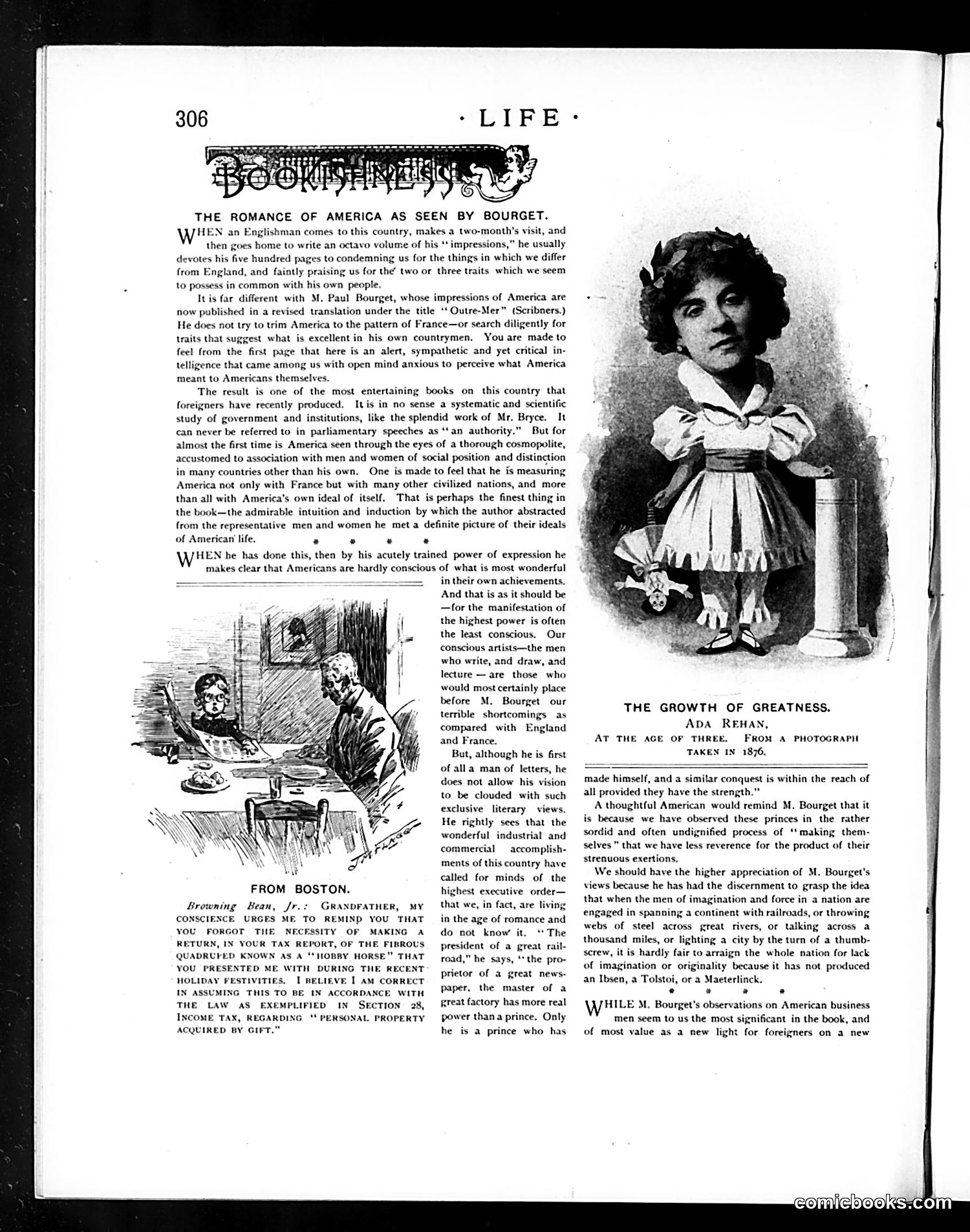
This page discusses **Paul Bourget**, a French author whose book "Outre-Mer" (translated as "The Romance of America") offered a European critique of American society. The article praises Bourget's ability to observe American life with sophistication—measuring the country not just against France but other civilized nations. The sketch labeled **"From Boston"** appears to show a domestic scene, likely satirizing American home life or social customs that Bourget observed. The photograph titled **"The Growth of Greatness"** shows a child at age three, illustrating the article's broader point about American potential and achievement—that ordinary Americans accomplish what would require aristocratic privilege elsewhere. The piece celebrates Bourget's outsider perspective as revealing something Americans themselves overlook about their nation's accomplishments.
📄 Transcribed text from this page (OCR, searchable)
Machine-transcribed from the original scan — historical spelling and the odd misread are preserved.
THE ROMANCE OF AMERICA AS SEEN BY BOURGET. 1EN an Englishman comes to this country, makes a two-month’s visit, and then goes home to write an octavo volume of bis “ impressions,” he usually devotes his five hundred pages to condemning us for the things in which we differ from England, and faintly praising us for the’ two or three traits which we seem to possess in common with his own people. It is far different with M. Paul Bourget, whose impressions of America are now published in a revised translation under the title ** Outre-Mer” (Scribners.) He does not try to trim America to the pattern of France—or search diligently for traits that suggest what is excellent in his own countrymen. You are made to feel from the first page that here is an alert, sympathetic and yet critical in- telligence that came among us with open mind anxious to perceive what America meant to Americans themselves. The result is one of the most entertaining books on this country that foreigners have recently produced. It is in no sense a systematic and scientific study of government and institutions, like the splendid work of Mr. Bryce. It can never be referred to in parliamentary speeches as ‘an authority.” But for almost the first time is America seen through the eyes of a thorough cosmopolite, accustomed to association with men and women of social position and distinction in many countries other than his own. One is made to feel that he is measuring America not only with France but with many other civilized nations, and more than all with America’s own ideal of itself, That is perhaps the finest thing in the book—the admirable intuition and induction by which the author abstracted from the representative men and women he met a definite picture of their ideals of American life. * ° . * HEN he has done this, then by his acutely trained power of expression he makes clear that Americans are hardly conscious of what is most wonderful in their own achievements. And that is as it should be —for the manifestation of the highest power is often the least conscious. Our conscious artists—the men who write, and draw, and lecture — are those who would most certainly place before M. Bourget our terrible shortcomings as compared with England and France. But, although he is first of alla man of letters, he does not allow his vision to be clouded with such exclusive literary views. He rightly sees that the wonderful industrial and commercial _accomplish- ments of this country have called for minds of the highest executive order— that we, in fact, are living in the age of romance and do not know it. “The president of a great rail- road,” he says, ‘the pro- prietor of a great news- paper, the master of a great factory has more real power thana prince. Only he is a prince who has FROM BOSTON. Browning Bean, Jr.: GRANDFATHER, MY URGES ME TO REMIND YOU THAT YOU FORGOT THE NECESSITY OF MAKING A RETURN, IN YOUR TAX REPORT, OF THE FIBROUS QUADRUFED KNOWN AS A “HOBBY HORSE” THAT YOU PRESENTED ME WITH DURING THE RECENT HOLIDAY FESTIVITIES. [RELIEVE TAM CORRECT IN ASSUMING THIS TO BE IN ACCORDANCE WITH THE LAW AS EXEMPLIFIED IN SECTION 28, INCOME TAX, REGARDING ‘* PERSONAL PROPERTY ACQUIRED BY GIFT.” CONSCIENCE 6 THE GROWTH OF GREATNESS. ADA REHAN, AT THE AGE OF THREE, FROM A TAKEN IN 1876. PHOTOGRAPH made himself, and a similar conquest is within the reach of all provided they have the strength.” A thoughtful American would remind M. Bourget that it is because we have observed these princes in the rather sordid and often undignified process of ‘making them- selves " that we have less reverence for the product of their strenuous exertions. We should have the higher appreciation of M. Bourget's views because he has had the discernment to grasp the idea that when the men of imagination and force in a nation are engaged in spanning a continent with railroads, or throwing webs of steel across great rivers, or talking across a thousand miles, or lighting a city by the turn of a thumb- screw, it is hardly fair to arraign the whole nation for lack of imagination or originality because it has not produced an Ibsen, a Tolstoi, or a Maeterlinck. * * * . WHILE M. Bourget’s observations on American business men seem to us the most significant in the book, and of most value as a new light for foreigners on a new