
Life, 1895-05-09 · page 12 of 18
Life — May 9, 1895 — page 12: what you’re looking at
What you’re looking at
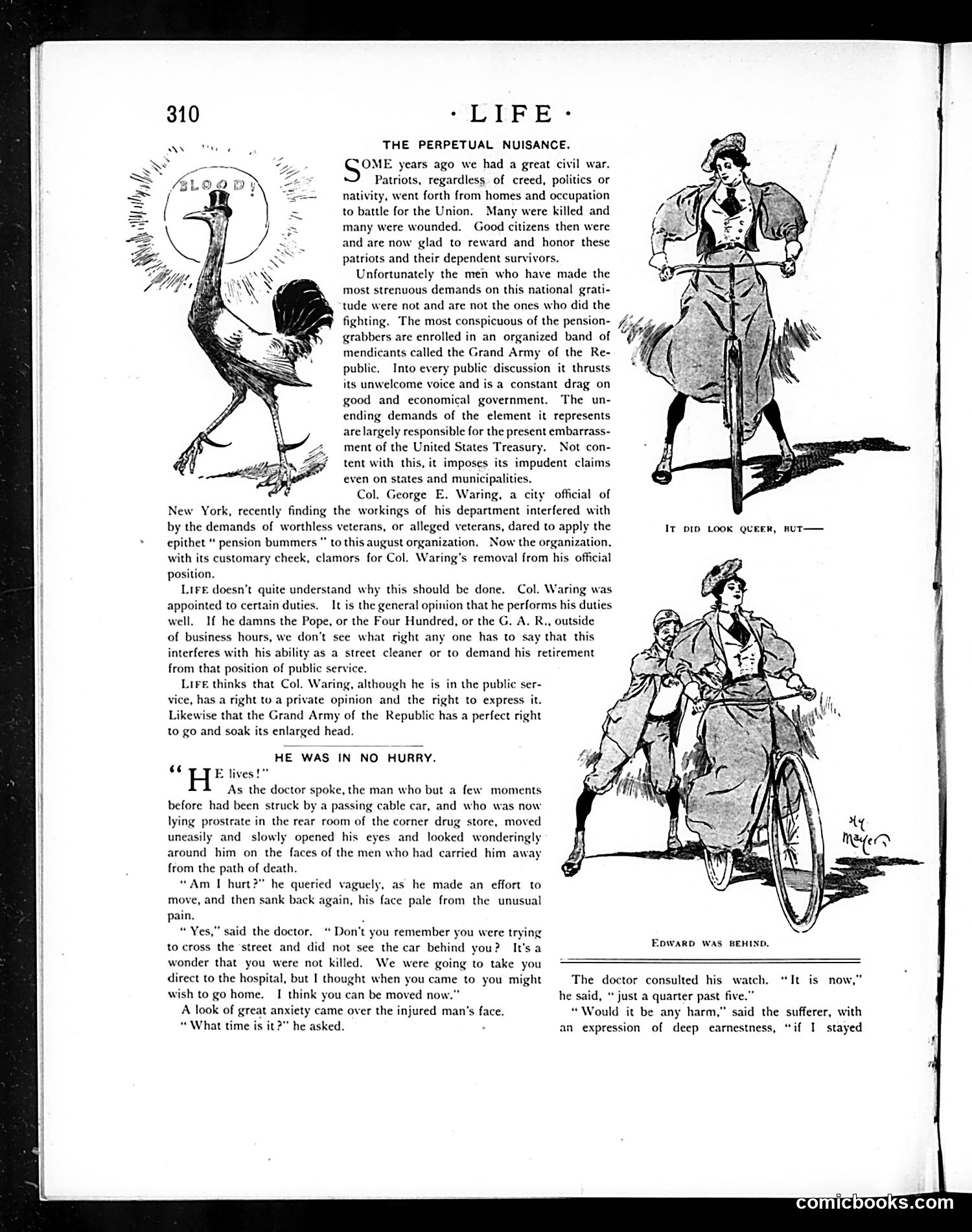
This page critiques the **Grand Army of the Republic (G.A.R.)**, a powerful veterans' organization formed after the Civil War. Life argues that while honoring actual war sacrifices is proper, the G.A.R. had become a self-serving "pension-grabbing" lobby constantly demanding government benefits and interfering in politics—draining the Treasury and state budgets. The specific case: **Colonel George E. Waring**, a New York city official (street cleaner), called G.A.R. members "pension bummers." The organization demanded his removal. Life defends Waring's right to private opinion and ridicules the G.A.R. for abusing its political leverage. The cartoons mock this entitled behavior: a rooster (pompous symbol) and women on bicycles represent the organization's self-important meddling. The secondary story, "He Was in No Hurry," appears unrelated—a street accident victim asking the time, concerned about staying somewhere late.
📄 Transcribed text from this page (OCR, searchable)
Machine-transcribed from the original scan — historical spelling and the odd misread are preserved.
- LIFE: THE PERPETUAL NUISANCE. OME years ago we had a great civil war. Patriots, regardless of creed, politics or nativity, went forth from homes and occupation to battle for the Union, Many were killed and many were wounded. Good citizens then were and are now glad to reward and honor these patriots and their dependent survivors. Unfortunately the men who have made the most strenuous demands on this national grati- tude were not and are not the ones who did the fighting. The most conspicuous of the pension- grabbers are enrolled in an organized band of mendicants called the Grand Army of the Re- public. Into every public discussion it thrusts its unwelcome voice and is a constant drag on good and economical government. The un- ending demands of the element it represents are largely responsible for the present embarrass- ment of the United States Treasury. Not con- tent with this, it imposes its impudent claims even on states and municipalities. Col. George E. Waring, a city official of New York, recently finding the workings of his department interfered with by the demands of worthless veterans, or alleged veterans, dared to apply the epithet “ pension bummers " to this august organization. Now the organization, with its customary cheek, clamors for Col. Waring's removal from his official position. LiFe doesn’t quite understand why this should be done. Col. Waring was appointed to certain duties. It is the general opinion that he performs his duties well. If he damns the Pope, or the Four Hundred, or the G. A. R., outside of business hours, we don’t sce what right any one has to say that this interferes with his ability as a street cleaner or to demand his retirement from that position of public service. Lire thinks that Col. Waring, although he is in the public s vice, has a right to a private opinion and the right to expres: Likewise that the Grand Army of the Republic has a perfect right to go and soak its enlarged head. HE WAS IN NO HURRY. ss HE live As the doctor spoke, the man who but a few moments before had been struck by a passing cable car, and who was now lying prostrate in the rear room of the corner drug store, moved uneasily and slowly opened his eyes and looked wonderingly around him on the faces of the men who had carried him away from the path of death. “Am I hurt?" he queried vaguely, as he made an effort to move, and then sank back again, his face pale from the unusual pain, . “ Yes," said the doctor. “Don't you remember you were trying to cross the street and did not see the car behind you? It’sa EDWARD: WAS JBEHIND. wonder that you were not killed. We were going to take you direct to the hospital, but I thought when you came to you might The doctor consulted his watch. “It is now,” wish to go home. I think you can be moved now.” he said, “ just a quarter past fiv A look of great anxiety came over the injured man’s face. “Would it be any harm,” said the sufferer, with “ What time is it?” he asked. . an expression of deep earnestness, “if I stayed comicbooks.com