
A complete issue · 18 pages · 1895
Life — February 21, 1895
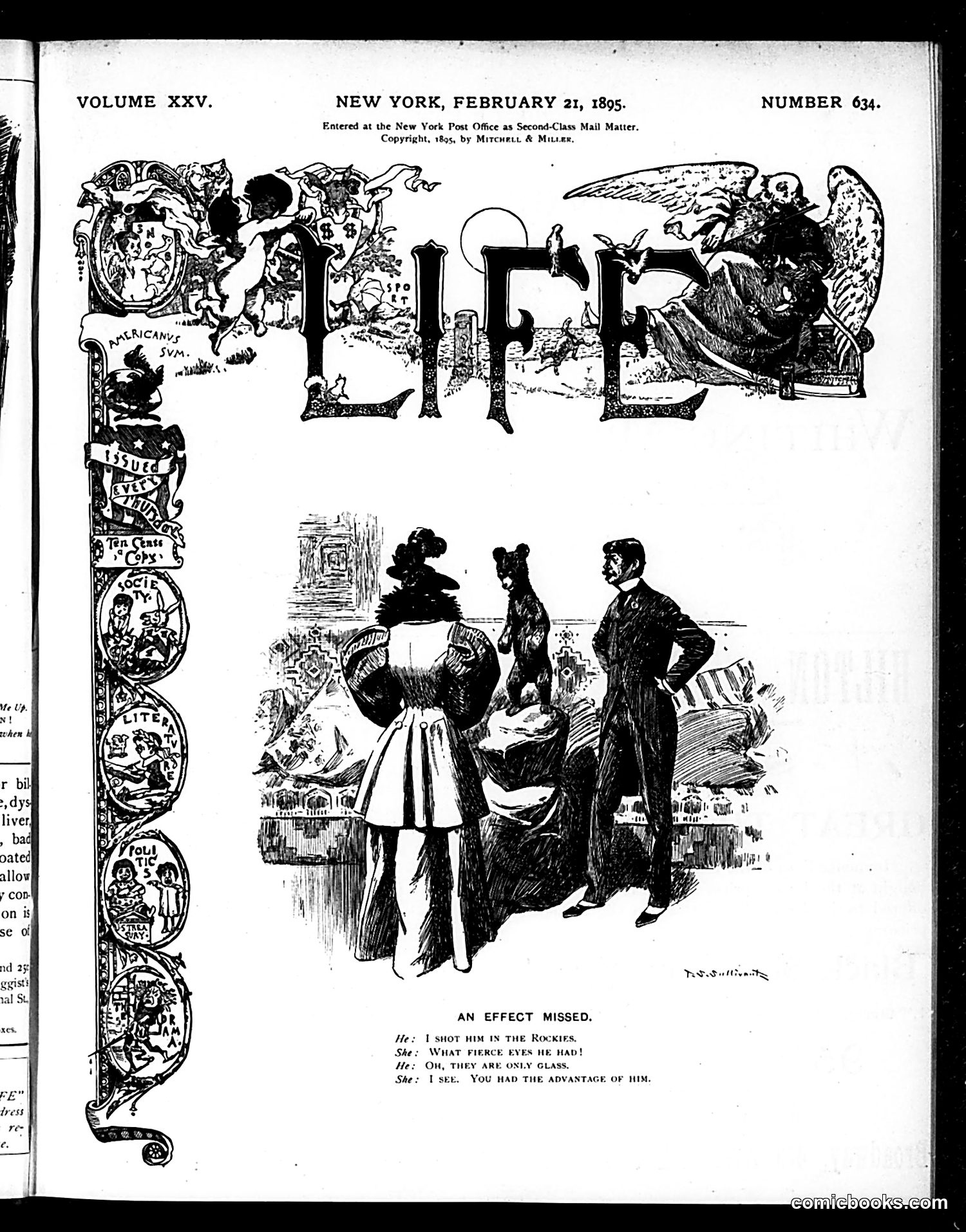
This cartoon depicts a social embarrassment scenario. A woman confronts a man about shooting him "in the Rockies," expecting him to have fierce, frightened eyes. However, he replies his eyes are "only glass"—meaning he's wearing a glass eye or prosthetic. The woman's intended insult (that she'd wounded him emotionally or physically) falls flat because the man is revealing a physical disability or injury. The joke satirizes Victorian-era social posturing and the gap between intended insults and reality. The "advantage" she thought she had—wounding his pride or person—becomes meaningless when confronted with actual physical difference. It's a satirical commentary on both performative masculinity and how disability unexpectedly undercuts social hierarchies.
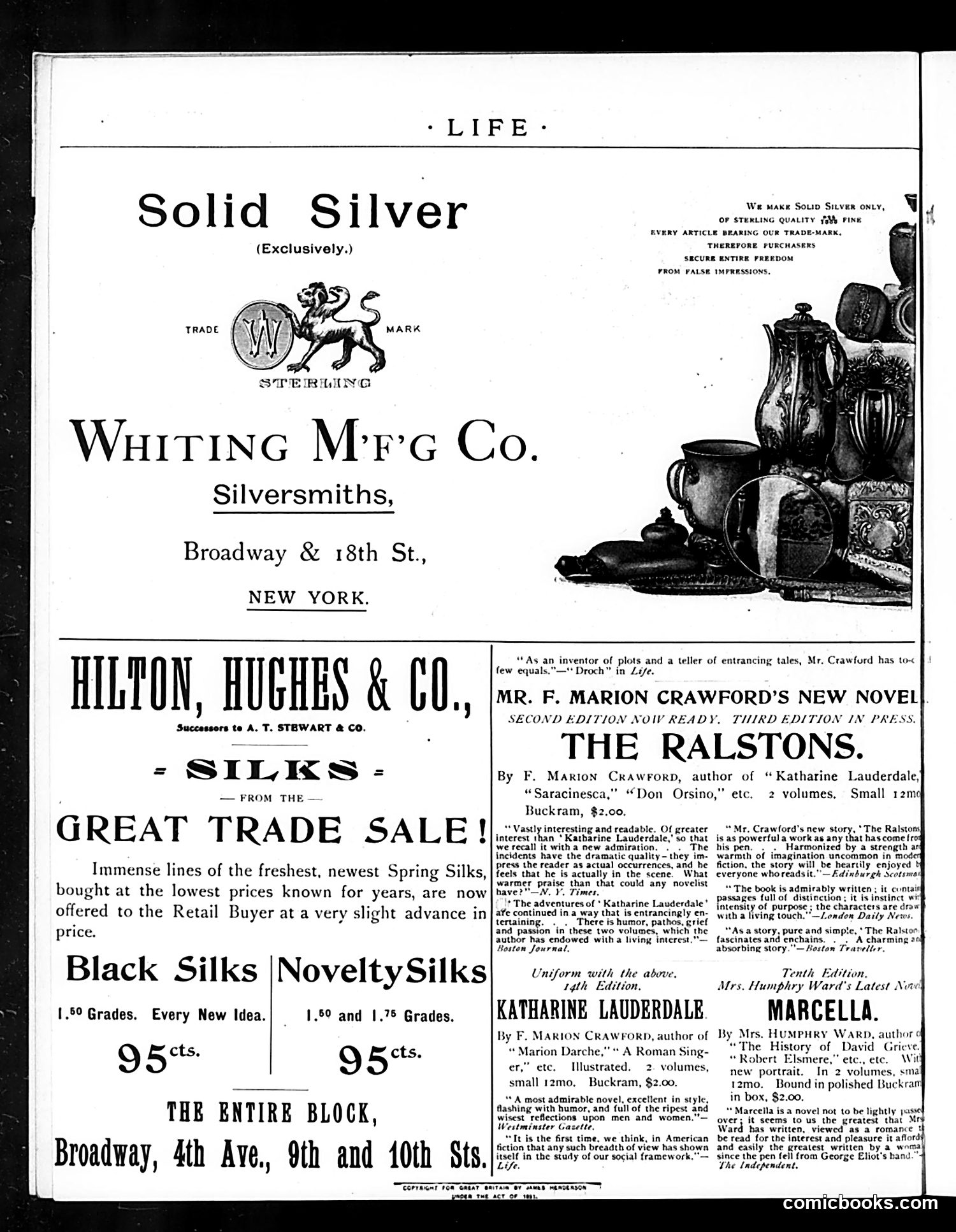
This page is primarily **advertising**, not satirical content. It contains: 1. **Whiting Mfg Co.** advertisement for solid sterling silver goods (Broadway & 18th St., New York) 2. **Hilton, Hughes & Co.** advertising a silk sale—"immense lines of freshest, newest Spring Silks" at low prices, located at "The Entire Block, Broadway, 4th Ave., 9th and 10th Sts." 3. **Book advertisements** for F. Marion Crawford novels (*The Ralstons*, *Katharine Lauderdale*, *Marcella*) The page header says "LIFE," but this particular page lacks political cartoons or satirical commentary. It's a commercial advertising section typical of periodicals from this era (appears to be late 19th century based on typography and product types). No identifiable caricatures or political references are present.
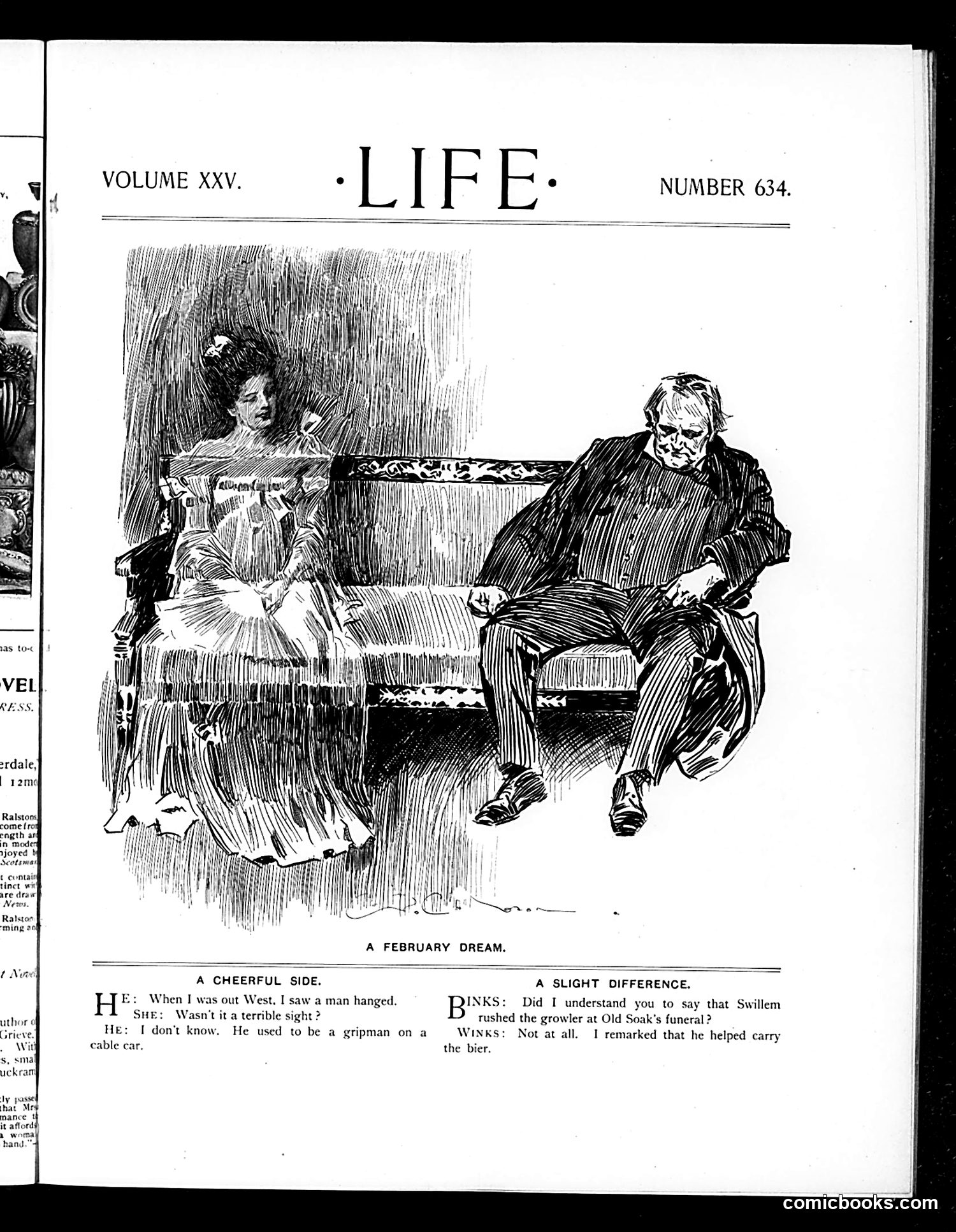
This page features a cartoon titled "A February Dream" depicting two figures on a sofa: a woman reading a newspaper and a man in a suit appearing to doze or daydream. The accompanying jokes below play on a slight miscommunication. One character mentions a man who was hanged out West and worked as a cable car gripman. The punchline hinges on the other character misunderstanding "he helped carry the bier" (coffin) at a funeral, thinking instead the man "rushed the growler" (slang for fetching beer) at the funeral—a humorous conflation of death-related vocabulary with drinking slang. The satire appears to be gentle domestic humor rather than political commentary, using wordplay and misheard phrases for comedic effect. The "February Dream" title suggests wistful thinking during winter.
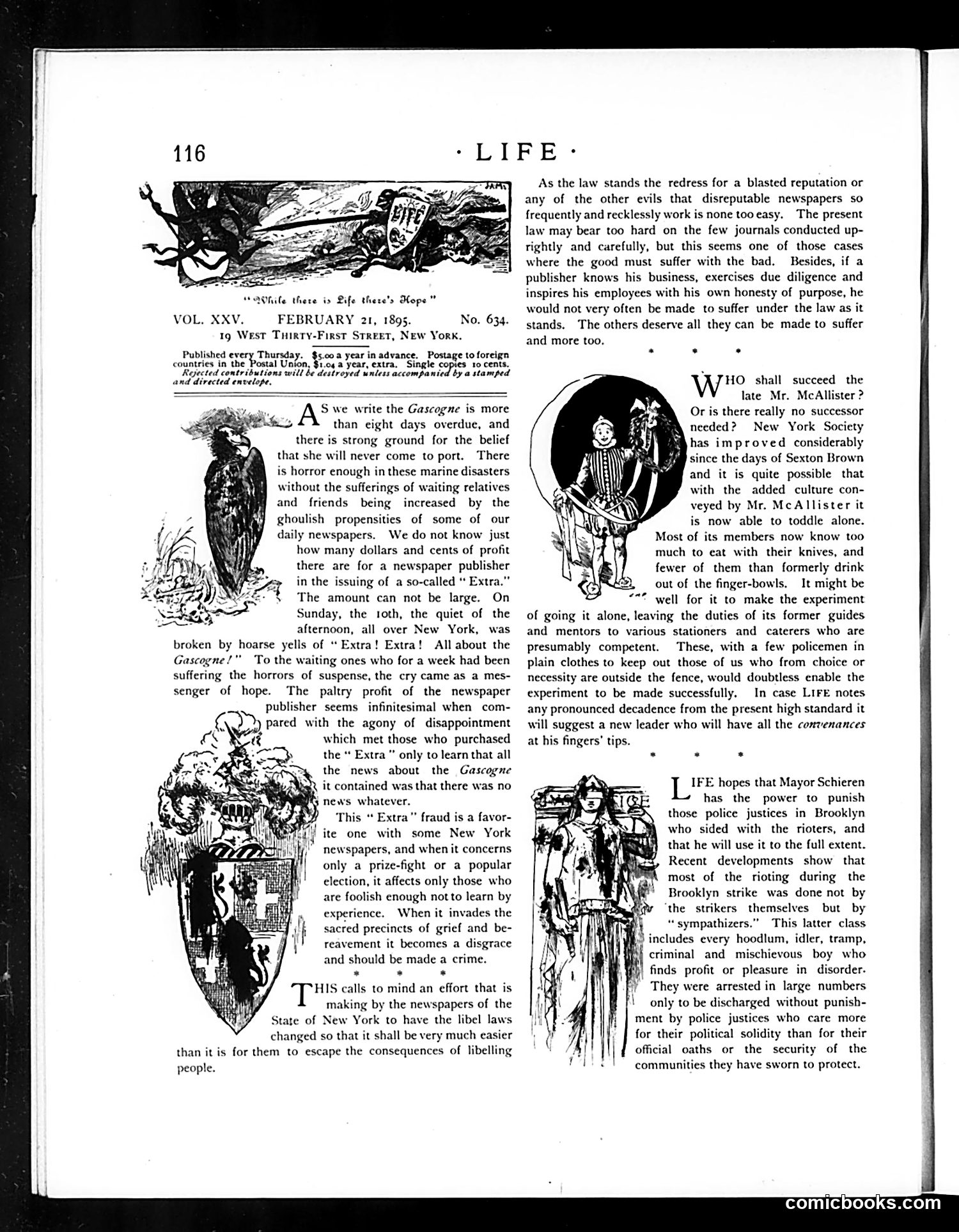
This page critiques newspaper sensationalism, specifically the *Gascoyne* ship disaster. The text condemns newspapers for publishing worthless "Extra" editions that profit from public anxiety about the delayed vessel while adding no genuine news—a deliberate fraud on readers seeking information. The cartoons depict vultures and skeleton figures representing the press, visualizing how newspapers prey on human suffering for profit. The accompanying editorial argues for stronger libel laws to hold publishers accountable for reckless falsehoods. A secondary item praises Mayor Schieren's potential to punish Brooklyn police justices who sided with rioters during recent labor strikes, suggesting selective enforcement by officials loyal to political allies rather than public safety.
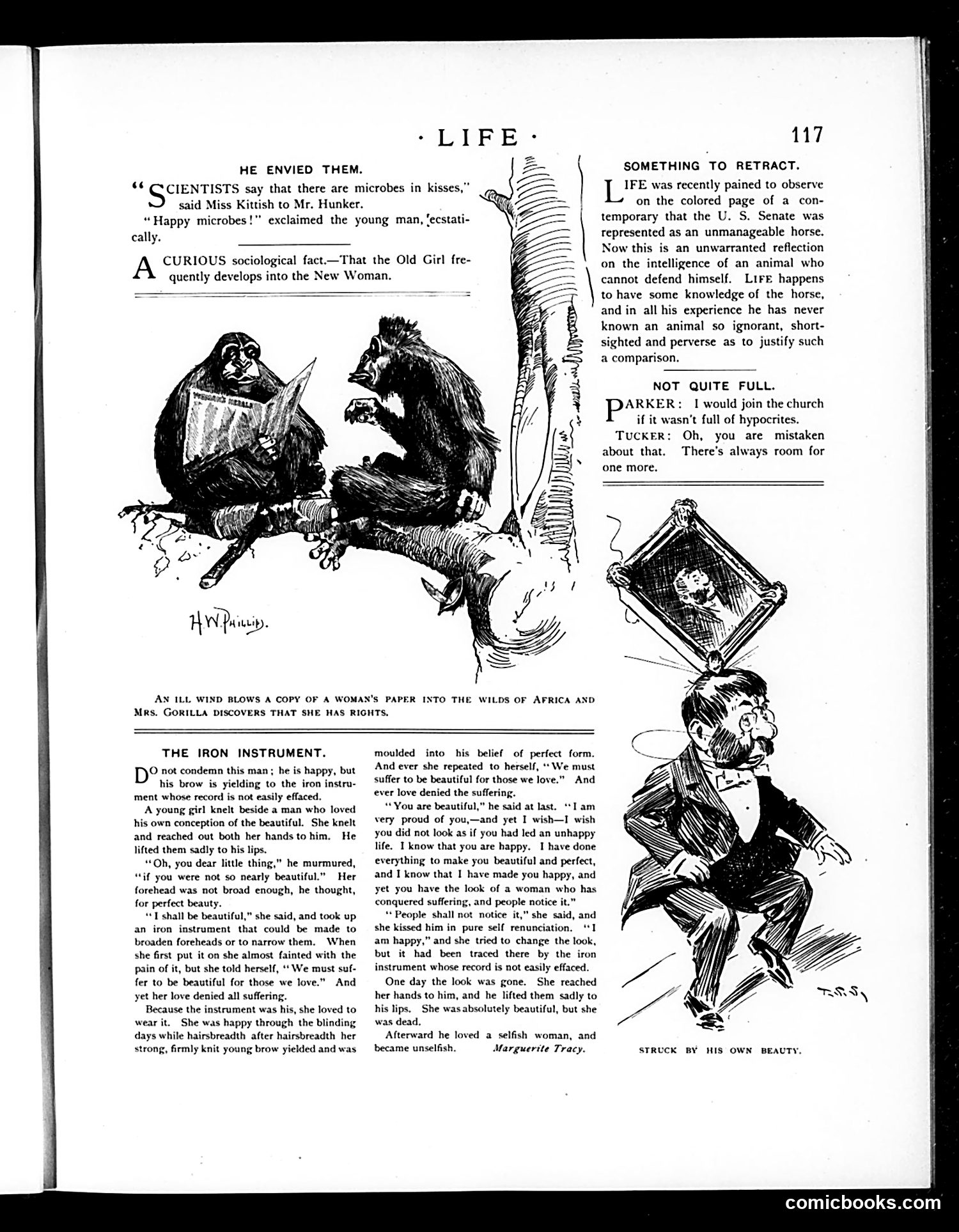
This page contains three distinct satirical pieces: 1. **"He Envied Them"** (top left): A cartoon showing two apes reading, with dialogue about microbes in kisses. This satirizes pseudo-scientific claims about hygiene and romance, mocking both scientific pretension and romantic anxiety of the era. 2. **"Something to Retract"** (top right): Critiques a U.S. Senate cartoon depicting a horse as unintelligent—Life argues the comparison is unfairly harsh, as horses possess more intelligence than senators demonstrated. Political satire on congressional incompetence. 3. **"The Iron Instrument"** (bottom): A darker story about a man using an "iron instrument" to "perfect" his beautiful wife's appearance, ultimately destroying her. This appears to critique obsessive beauty standards and possessive male control disguised as love.
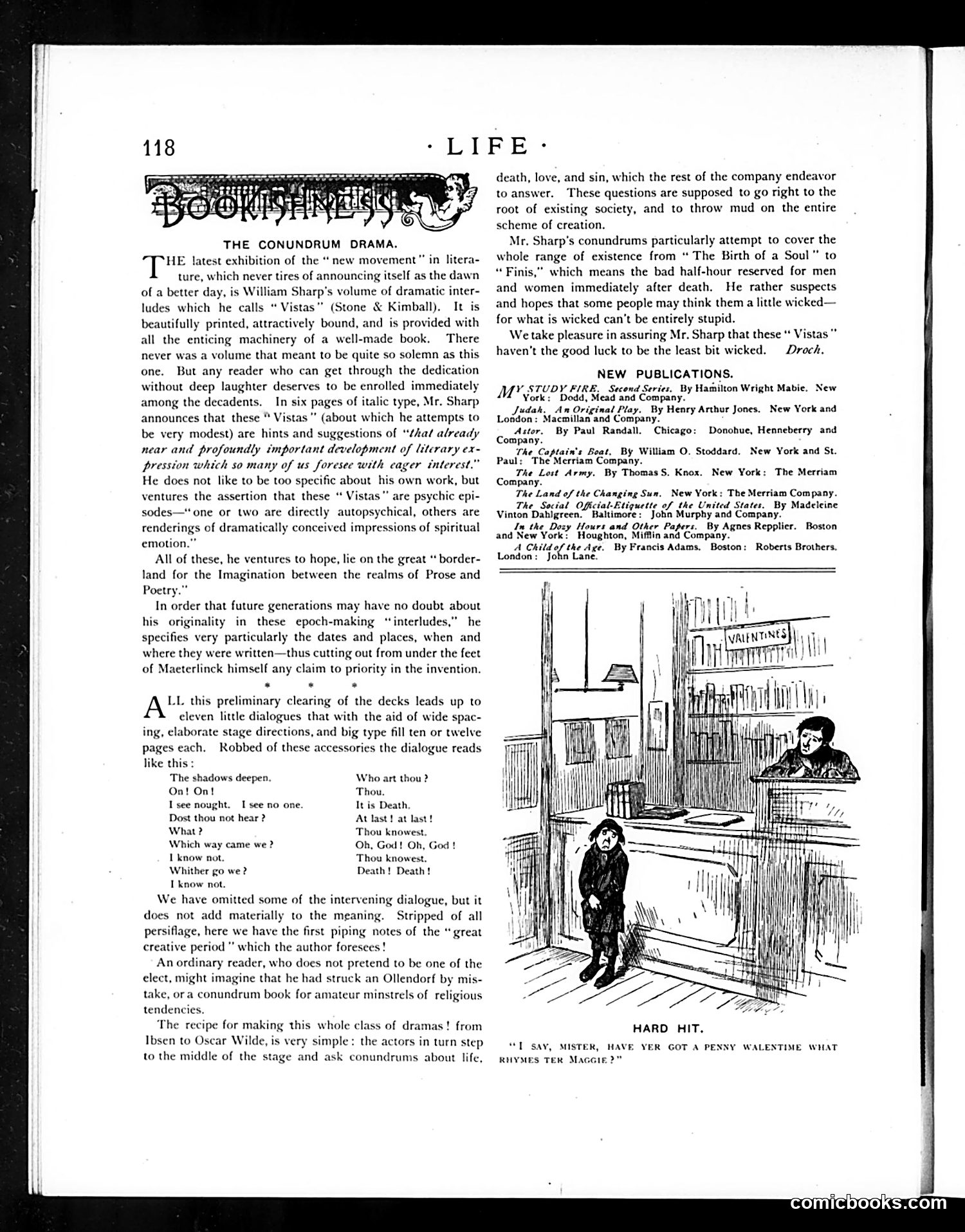
This cartoon illustrates a street encounter between two figures. The caption reads: "I say, mister, have yer got a penny waistime what rhymes ter maggie?" The humor appears to be a play on working-class London speech patterns and street beggar culture. One figure (possibly a street urchin or beggar) is asking another for money, using deliberately fractured grammar and slang ("yer," "waistime"). The request references "rhymes ter maggie," likely a reference to Cockney rhyming slang—a distinctly working-class London linguistic tradition where words are replaced by rhyming phrases. The cartoon satirizes both poverty and the colorful speech of London's lower classes during this period, presenting their dialect as amusing to middle and upper-class readers of *Life* magazine.
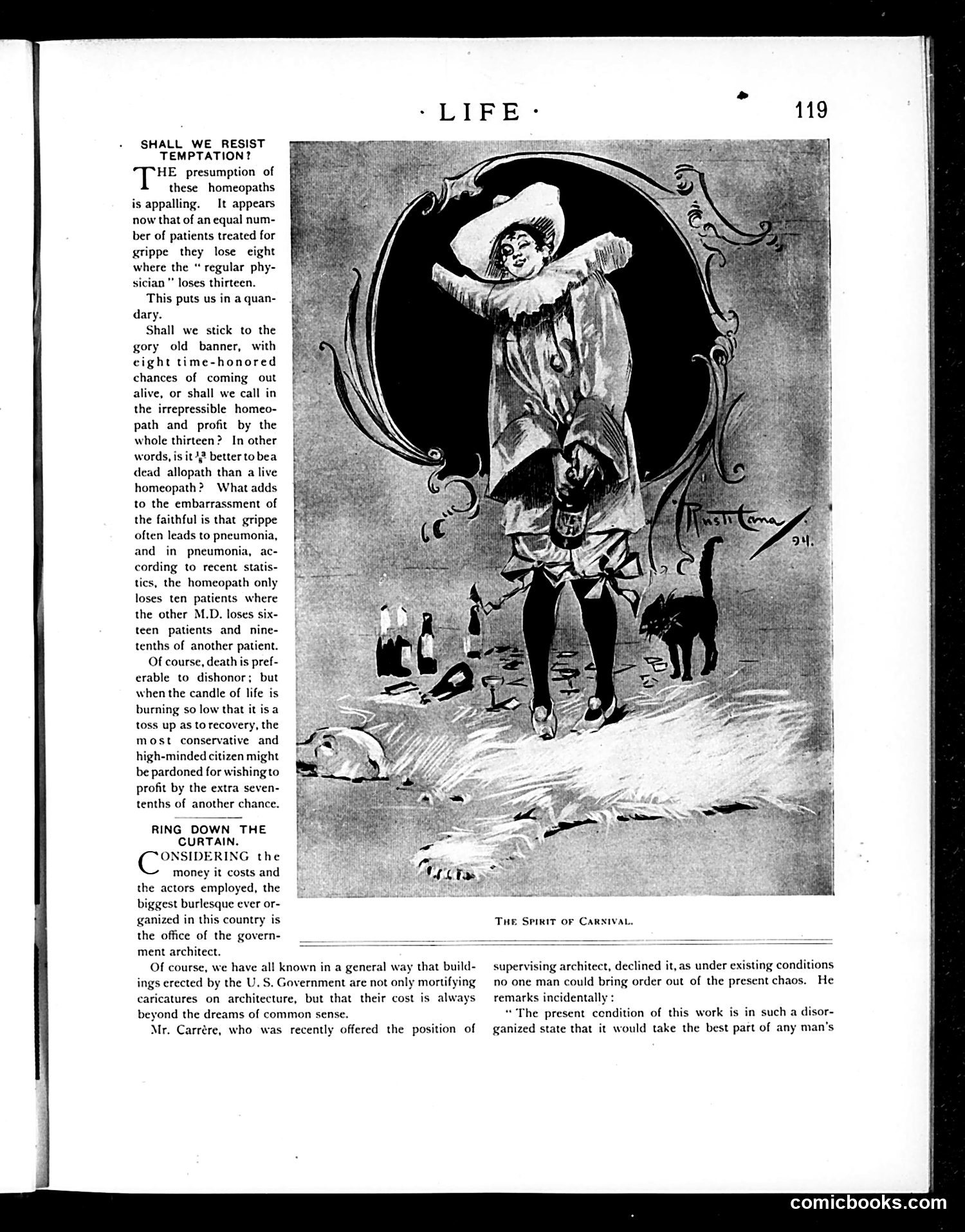
The main illustration, titled "The Spirit of Carnival," depicts a jester or carnival figure in elaborate costume striking a theatrical pose. The cartoon critiques American government spending on architecture and public buildings. The left column discusses homeopathy versus conventional medicine, questioning whether homeopathic treatments' survival rates justify their continued use. The text cites statistics comparing patient outcomes. The right column, "Ring Down the Curtain," attacks wasteful government spending on the Capitol building's construction. It references Mr. Carrère (a supervising architect) who declined the position, noting the project's chaotic, over-budget state. The cartoon satirizes the government's architectural extravagance and poor project management—suggesting the "spirit of carnival" (wasteful frivolity) governs public construction.
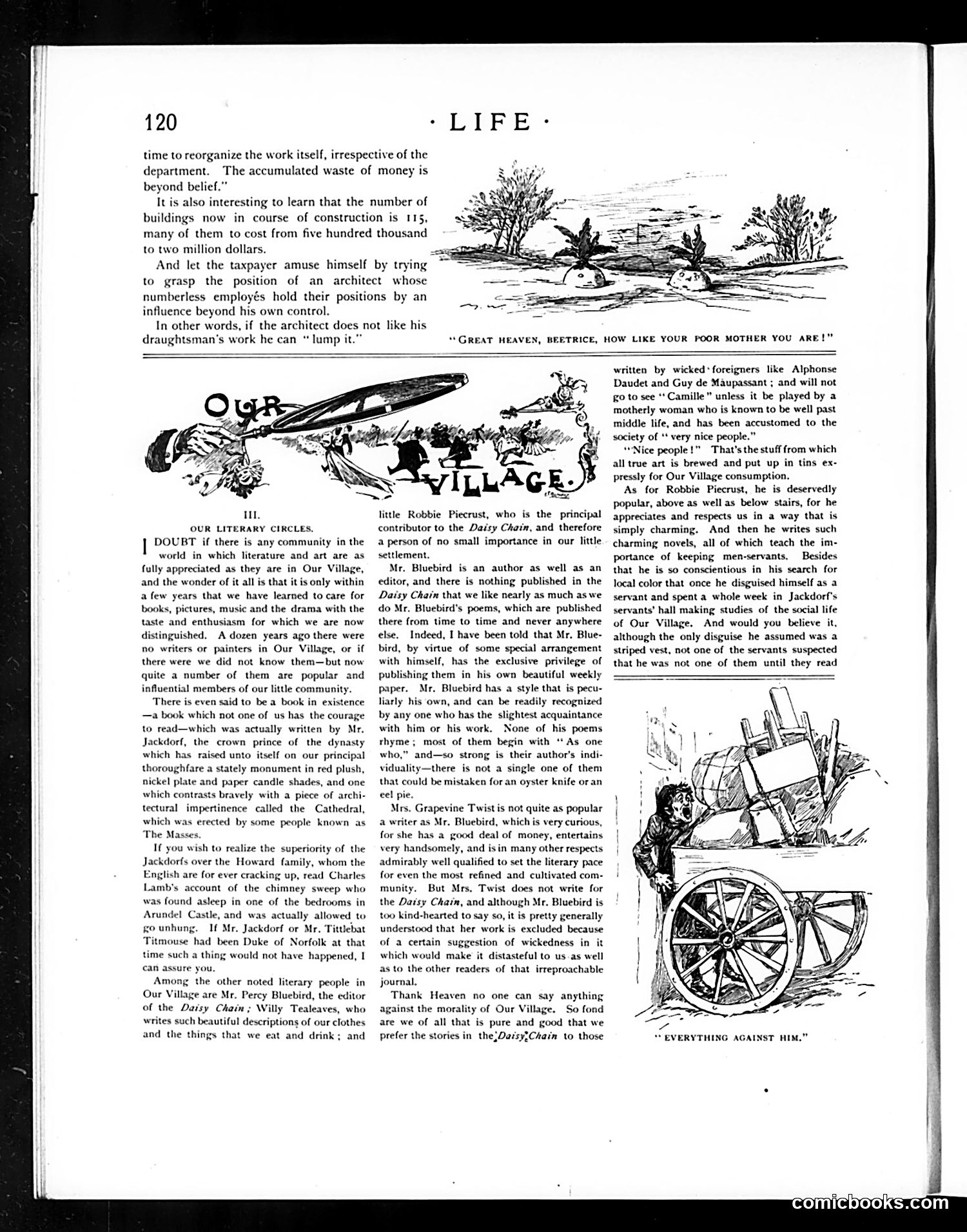
This page from *Life* magazine's "Our Village" section discusses the magazine's literary contributors, including Mr. Bluebird (editor of the *Daisy Chain*), Robbie Pierrust, Mrs. Twist, and Mr. Percy Bluebird. The two illustrations appear to be humorous sketches rather than political cartoons. The top image shows rural landscape elements with the caption "Great heavens, Beetrice, how like your poor mother you are!" — a domestic joke about family resemblance. The bottom illustration depicts a chaotic pile of household items/debris with the caption "Everything against him" — likely satirizing domestic chaos or marital discord through visual humor. The text emphasizes *Life's* literary quality and the respectability of its contributors, positioning the magazine as sophisticated and morally sound — a claim the domestic humor gently undercuts.
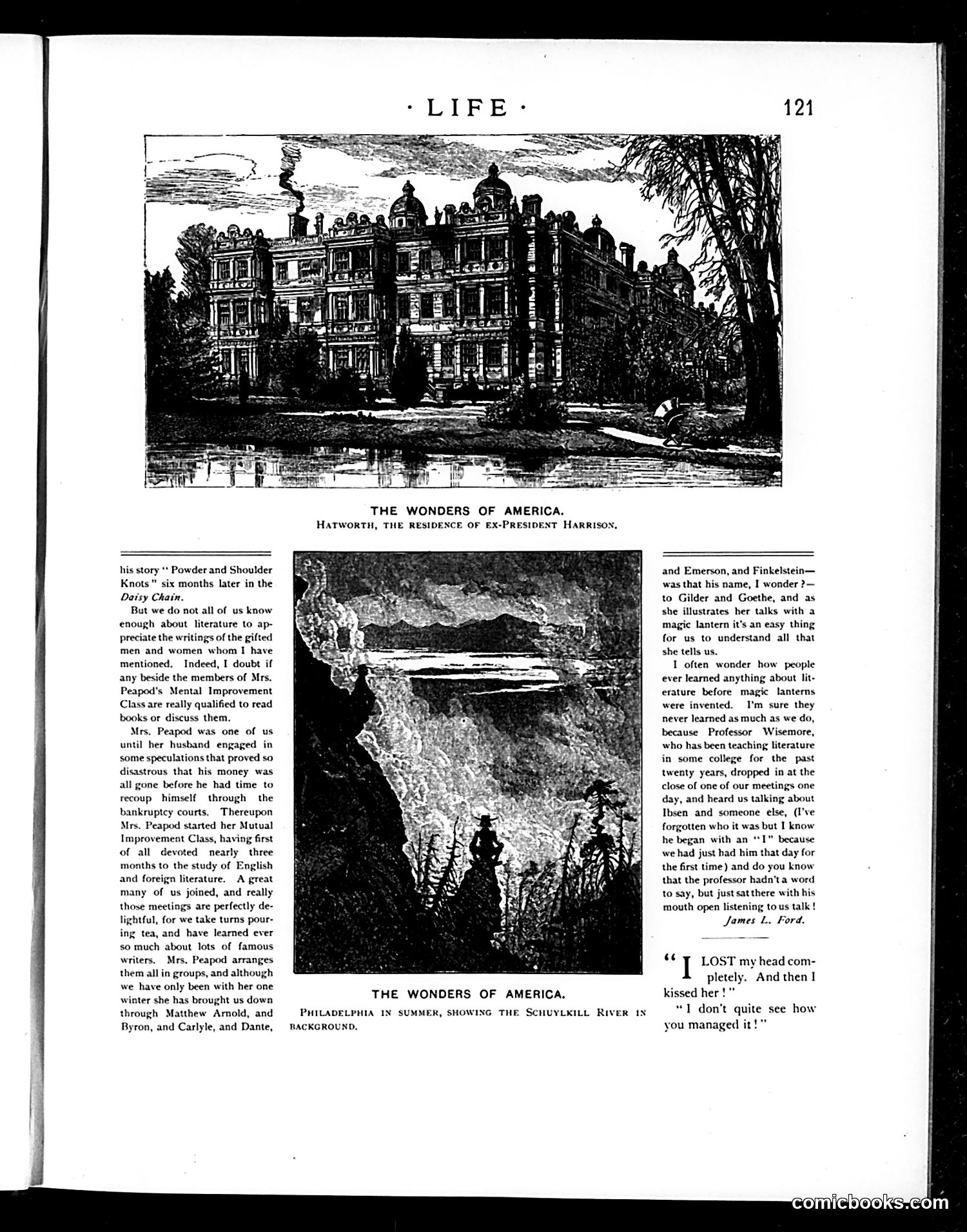
This page features "The Wonders of America" — two architectural engravings: **Hatworth, the residence of ex-President Harrison** (top) and **Philadelphia in summer, showing the Schuylkill River in background** (bottom). The accompanying text discusses a **literary discussion group led by Mrs. Peapod**, apparently focused on famous writers. The narrative humorously suggests that while members discuss Ibsen, Goethe, and Emerson, they lack serious literary education. A Professor Wisemore is mentioned as having taught literature for twenty years. The page concludes with a dialogue joke: "I lost my head completely. And then I kissed her!" / "I don't quite see how you managed it!" This appears to be satirical commentary on American cultural pretensions and intellectual affectation among amateur literary enthusiasts.
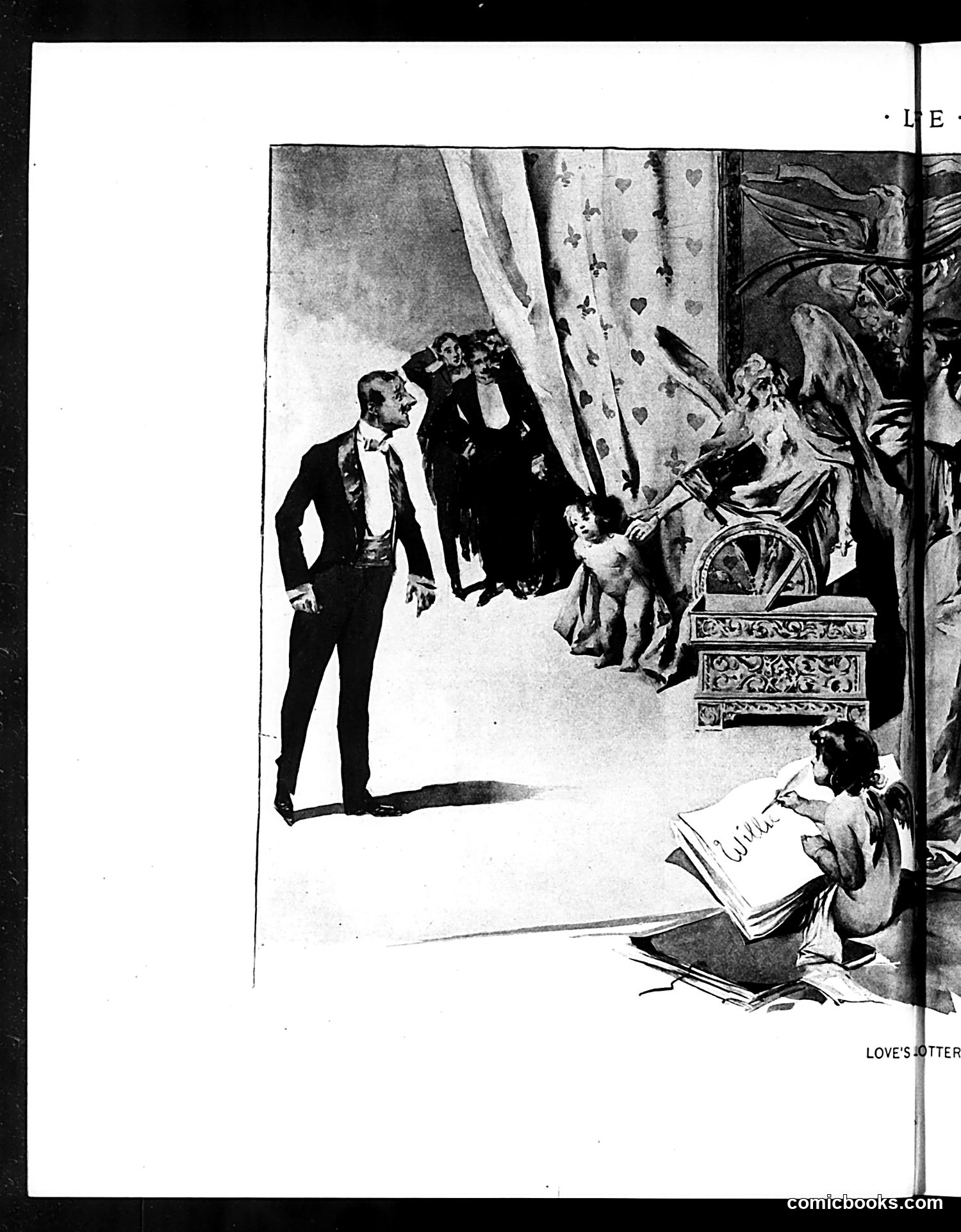
This illustration depicts a romantic comedic scenario titled "Love's Letter." A well-dressed man in formal attire stands conversing with other gentlemen in what appears to be an ornate interior space. Meanwhile, a cherub or cupid figure (bottom right) holds what is labeled a "letter," suggesting this is about romantic correspondence. The satire likely plays on Victorian-era conventions around courtship and love letters—perhaps mocking the earnestness or formality of romantic communication among the upper classes. The cherub's presence invokes classical imagery of Cupid, creating humorous contrast with the modern, formally-dressed men conducting what should be a matter of the heart in a stiff, businesslike manner. The specific satirical point remains somewhat unclear without additional context.
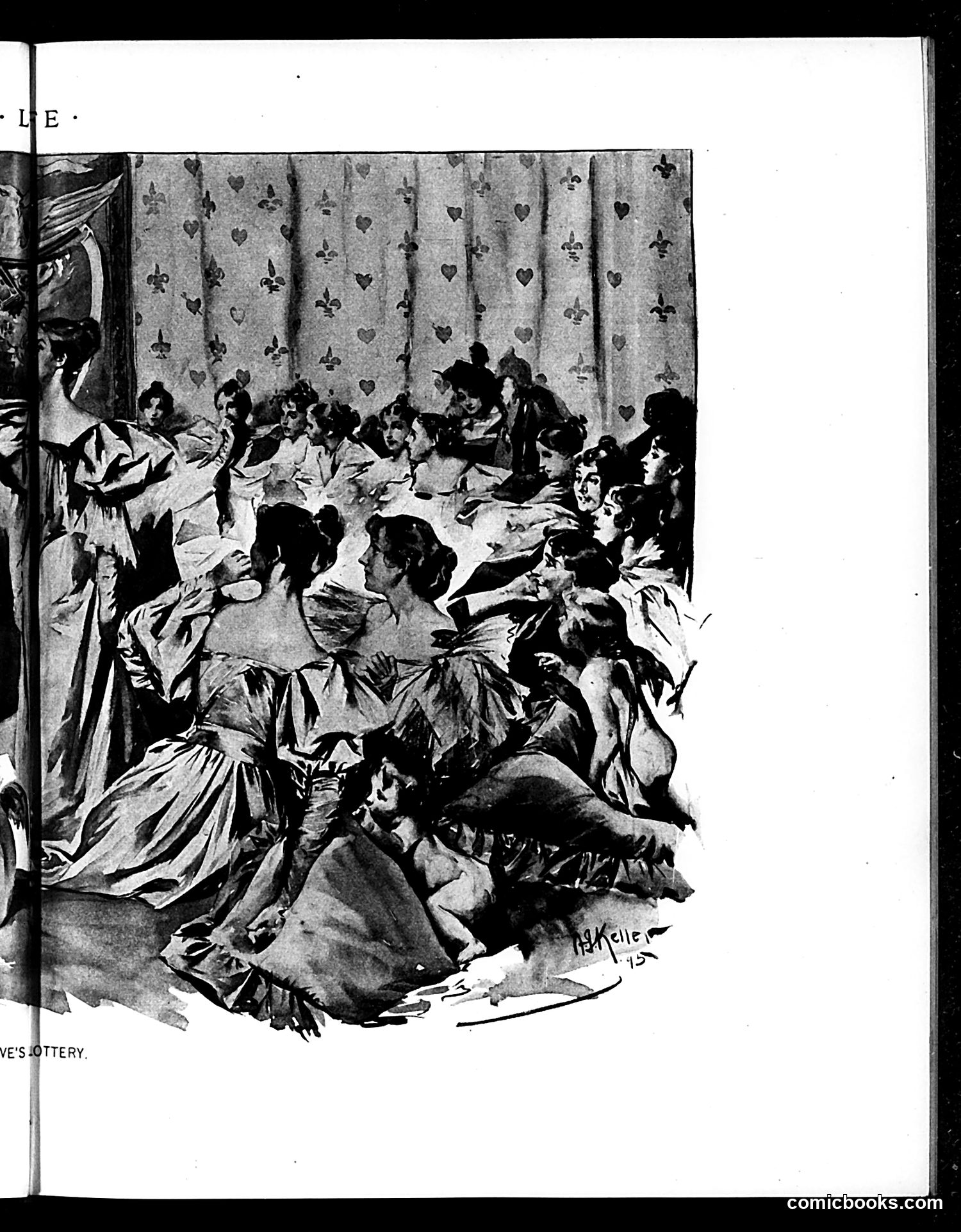
This appears to be a satirical illustration from Life magazine depicting a social gathering of women in elaborate early 20th-century dress. The scene shows multiple figures reclining and conversing in an ornate interior with decorative curtains featuring hearts and fleur-de-lis patterns. The partial text visible at bottom ("VE'S POTTERY") is unclear in context. Without the full caption or article text, the specific satirical target is uncertain. However, given Life's tradition of social satire, this likely mocks either: - Upper-class women's leisure activities and fashion - A specific social event or institution - Women's behavior or conversation The artist's signature appears to read "H. Aselier" or similar. The illustration's style and subject matter suggest commentary on Gilded Age or Progressive Era society, but the exact social or political critique requires the missing caption text.
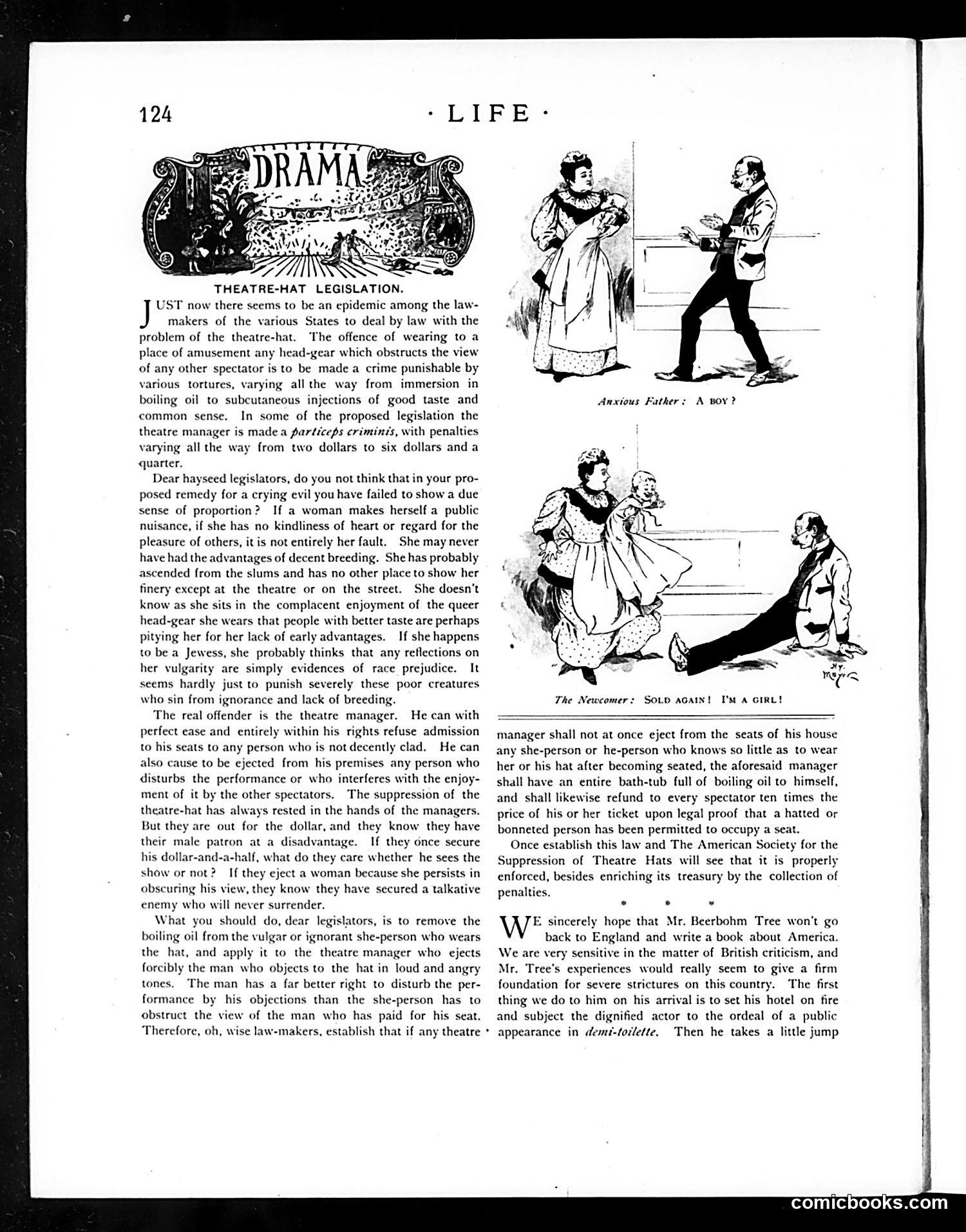
This page satirizes state lawmakers proposing laws to criminalize wearing large hats to theaters—a genuine early 20th-century problem where women's elaborate, wide-brimmed hats obstructed other patrons' views. The article mocks the legislators' disproportionate response, arguing they've targeted the wrong culprit. Rather than punishing (mostly lower-class and immigrant) women for wearing fashionable hats out of ignorance or lack of breeding, the satirist says theater *managers* are the real offenders. Managers deliberately ignore the problem because they've already collected admission fees and fear losing male patrons' future business if they eject disruptive women. The accompanying cartoons illustrate the social absurdity: an anxious father hopes for a boy; a woman announces she's a girl instead—suggesting the "problem" of difficult women in society. The satire ultimately argues managers should use existing authority to maintain order, rather than legislators passing excessive punishments against society's poorest members.
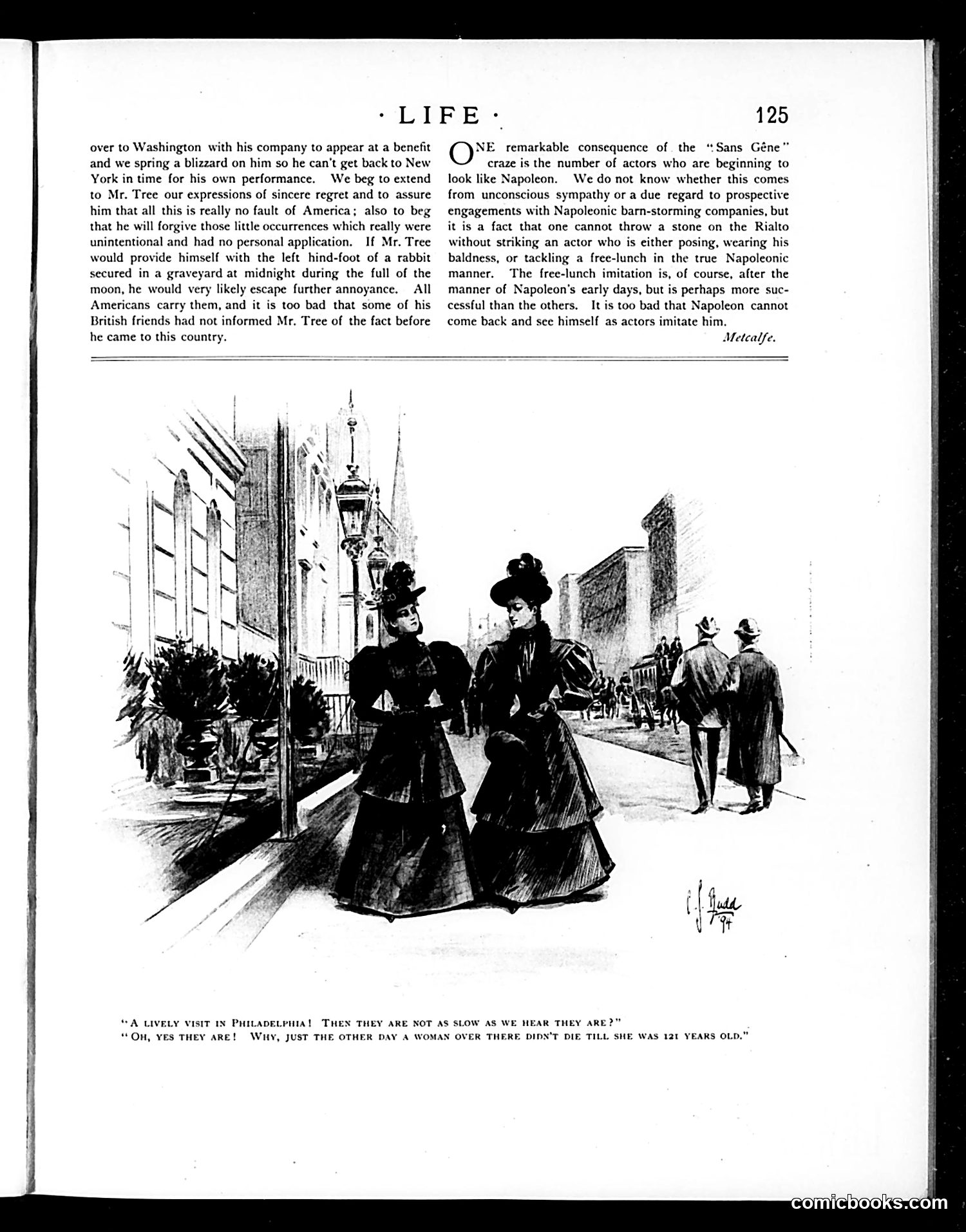
This Life magazine page (page 125) contains two separate pieces of satire: **Upper text**: A humorous complaint about actor Herbert Tree being stranded by a blizzard while traveling to Washington for a benefit performance. The writer mockingly suggests Tree arm himself with a rabbit's foot (a folk superstition charm) to avoid further "annoyance"—sarcastically implying Americans deliberately sabotage British visitors. **Illustration and caption below**: A sketch of two fashionably dressed women on a Philadelphia street, with dialogue mocking Philadelphia's reputation for being slow and dull. One woman boasts of Philadelphia's "lively" social scene; the other deadpans that it's actually quite slow, citing as "evidence" that a woman there recently died at age 121—implying life moves so slowly that people live extraordinarily long lives there. The humor relies on period stereotypes about regional American character (Philadelphia as staid and slow-paced) and British-American cultural friction.
This page contains three humorous short stories typical of Life's satirical content: 1. **"An Obliging Parent"**: A young man nervously approaches a wealthy father to court his daughter, but the father eagerly facilitates the romance—inverting the expected parental resistance trope. 2. **Scottish Gravedigger Story**: A minister's assistant describes properly burying his predecessor "among the hindmost," a dark joke about ensuring the deceased stays buried and doesn't resurface. 3. **Country Farmer Satire**: The main piece mocks a paranoid rural man who enters a city business entrance. Convinced he'll be swindled by urban con artists (gold brick schemes, shell games, confidence men), he lectures the proprietor about reading newspapers and knowing all the dodges. The proprietor simply wants him to stop loitering. **The satire**: The farmer's defensive, elaborate distrust of city sophistication—despite (or because of) his self-education through papers—marks him as the actual fool. His verbose suspicion of being "euchered" becomes absurdly performative, and he physically attacks an innocent man based on paranoia. The humor targets rural anxiety about urban deception and class difference.
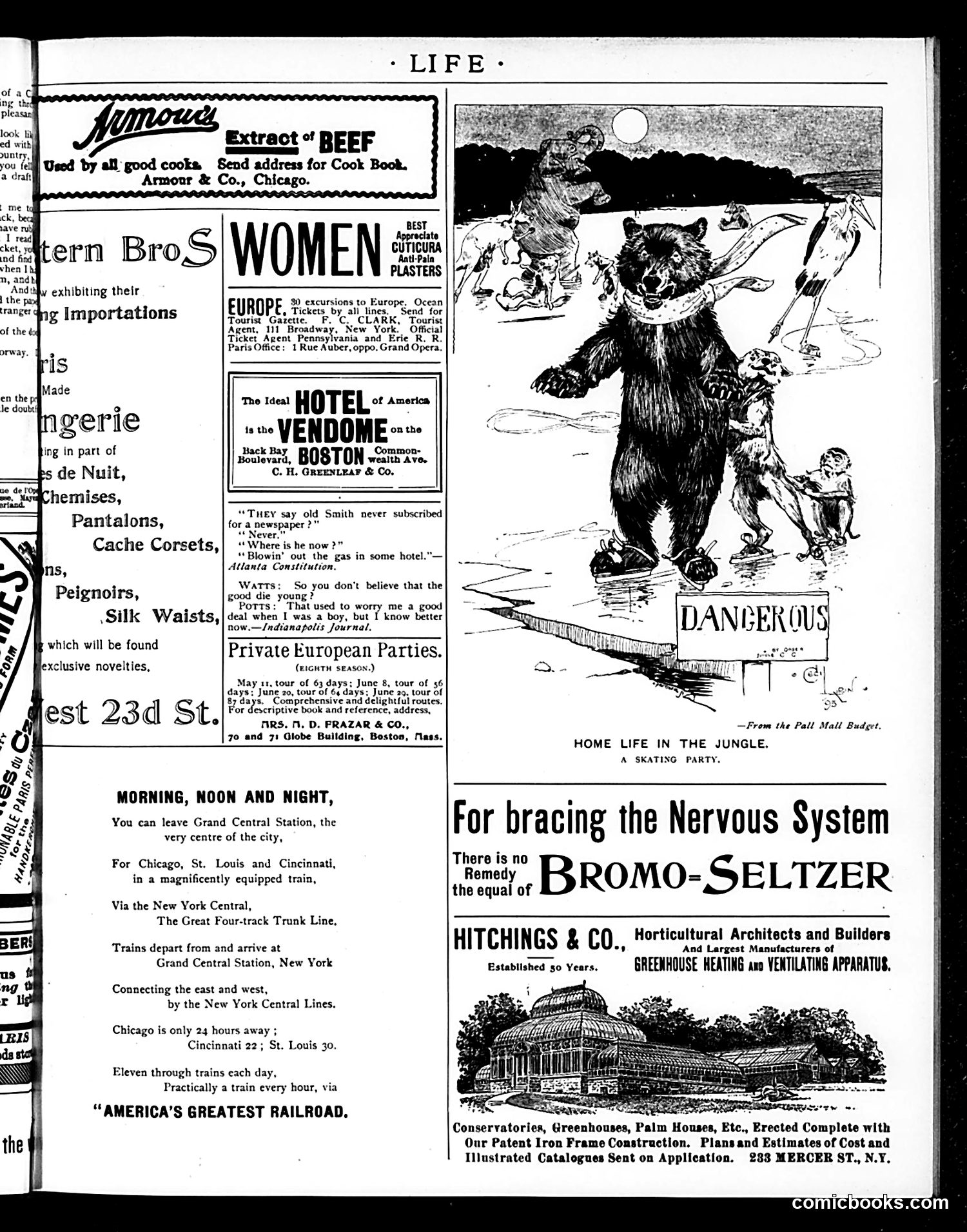
This page is primarily **advertising and filler content** with one notable cartoon titled "Home Life in the Jungle: A Skating Party." The cartoon depicts **anthropomorphized bears ice-skating**—a mother bear instructing or supervising young bears on frozen water, with what appears to be a dangerous situation developing. The title's irony is the joke: calling animal behavior "home life" and giving it a genteel Victorian activity (skating) creates humor through incongruity. The caption labels one bear "DANGEROUS," suggesting the scene plays on anxieties about wild nature intruding on civilized leisure. The rest of the page contains period advertisements (beef extract, hotels, railroad services, Bromo-Seltzer patent medicine) and two short newspaper humor snippets about suicide ("blowin' out the gas in some hotel") and mortality—typical turn-of-the-century dark comedy. **No clear political satire is evident.** This appears to be a standard magazine page mixing light entertainment with commercial content.
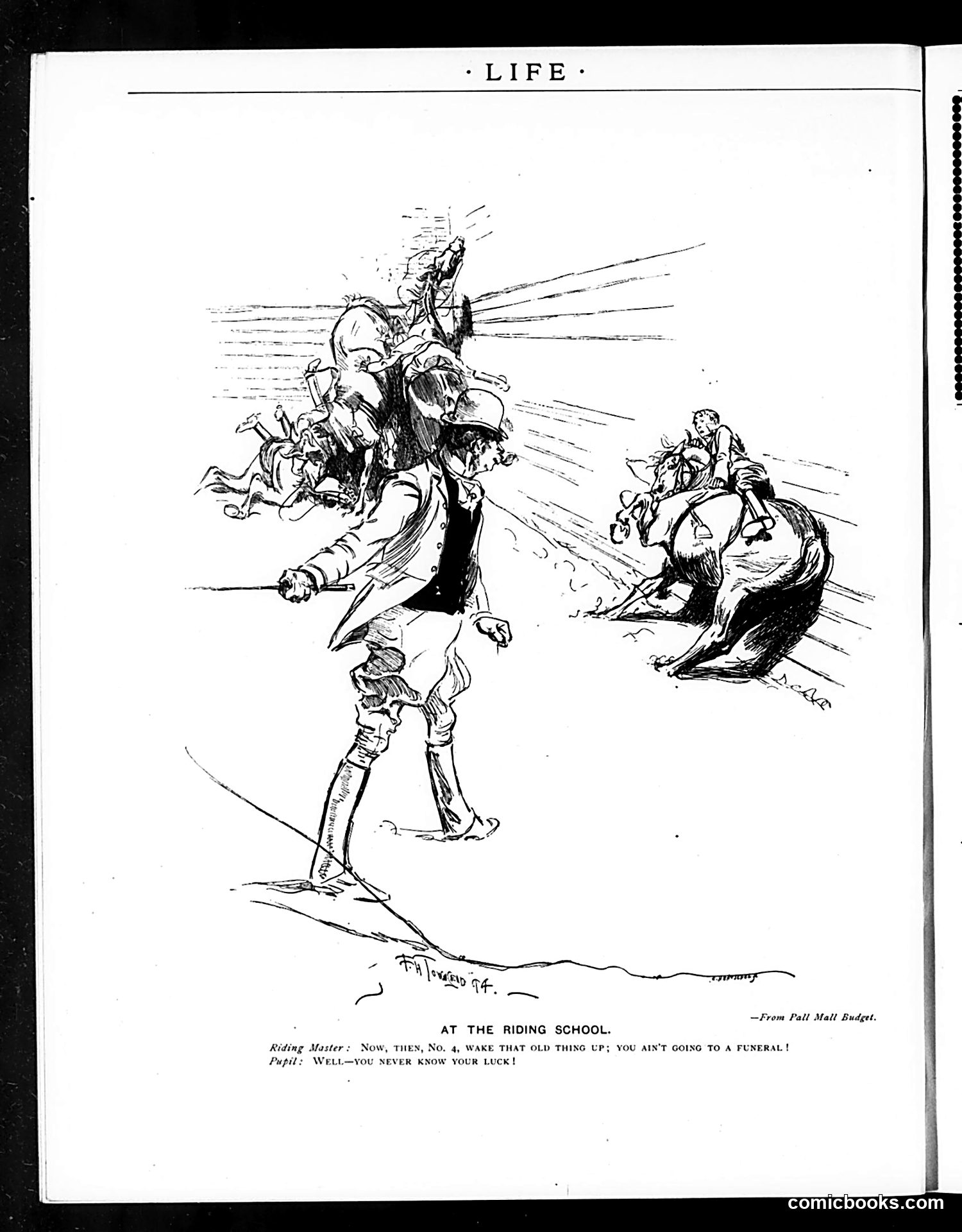
This satirical cartoon depicts a riding instructor berating an inept pupil mounted on a sluggish horse. The instructor barks at the student to energize the elderly horse, sarcastically remarking they're not headed to a funeral. The pupil's deadpan response—"Well, you never know your luck!"—suggests pessimistic resignation about the horse's condition or their riding prospects. The humor relies on the contrast between the instructor's aggressive exhortation and the pupil's fatalistic acceptance. The visual exaggeration of the horse's poor condition and the student's uncertain seat emphasizes the comedic incompetence. The joke appears to mock both overconfident instructors and hapless, doom-expecting pupils at equestrian schools. The source attribution to "Pall Mall Budget" indicates this is from British satirical humor.
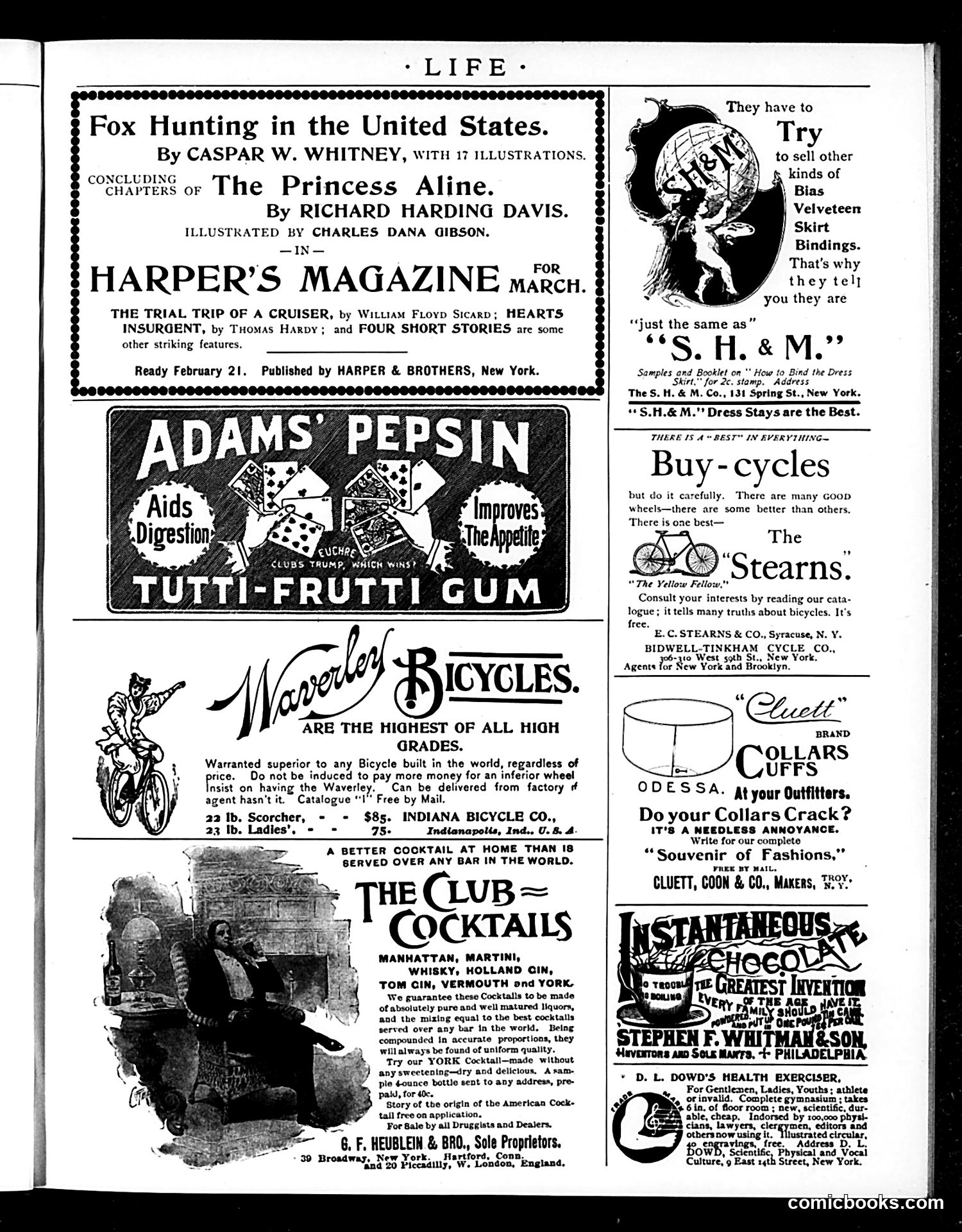
This is primarily an **advertising page** from Life's March issue (ready February 21), with a header promoting Harper's Magazine content. The actual magazine content is minimal—just a boxed announcement of articles including "Fox Hunting in the United States" by Caspar W. Whitney and serialized fiction. The page is dominated by commercial advertisements typical of the era: bicycles (Waverley, Stearns, Indiana models), patent medicines (Adams' Pepsin Tutti-Frutti Gum), cocktail kits (The Club brand), dress accessories (S.H. & M. skirt bindings, Cluett collar cuffs), and health equipment (D.L. Dowd's gymnasium apparatus). One small **cartoon** appears in the Pepsin Gum ad: playing cards labeled "Clubs Trump, Which Wins?"—a visual pun suggesting the gum aids digestion and improves appetite through card-game imagery. There is **no significant political satire** on this page. It represents Life's commercial function as a vehicles for product marketing in the early 20th century.
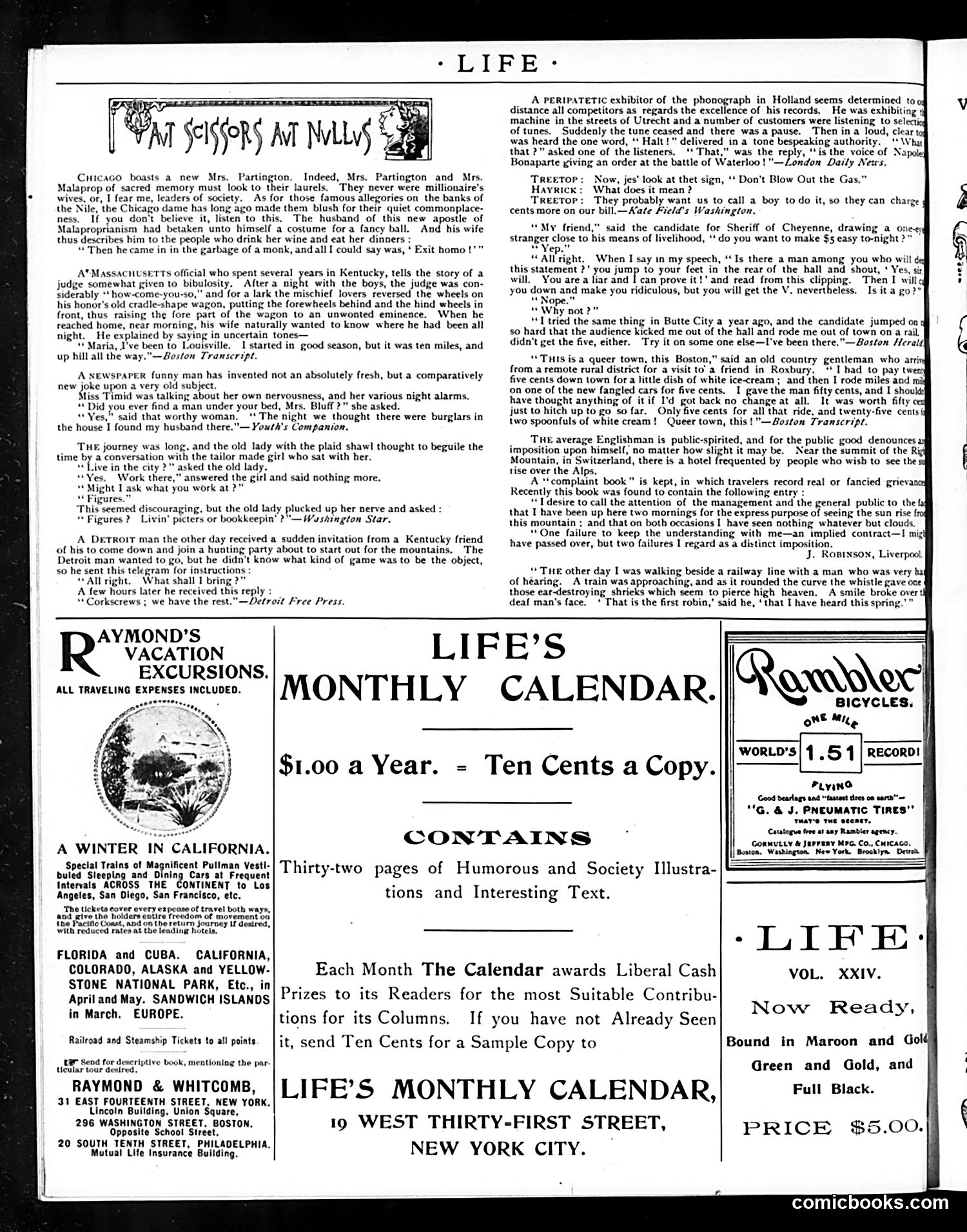
This Life magazine page consists primarily of **humorous anecdotes** rather than political cartoons. The title "Scissors at Nulls" references the magazine's practice of reprinting funny stories from newspapers and publications. The jokes satirize **everyday absurdities and social pretension**: - A wealthy Chicago woman misuses language ("garbage of a monk" instead of "garb"), mocking malapropism and nouveau-riche society - A drunk judge's confused explanation to his wife, poking fun at masculine excess and foolishness - A nervous woman finding her husband hiding under the bed, satirizing domestic comedy - A city girl's evasive responses, gently mocking urban working-class attitudes The page reflects **turn-of-century American humor** centered on character types: wealthy pretenders, drunken judges, nervous wives, and city workers. There's no single political message—rather, it's gentle social satire targeting human folly across class lines through relatable domestic and everyday scenarios.