
Life, 1895-02-21 · page 6 of 18
Life — February 21, 1895 — page 6: what you’re looking at
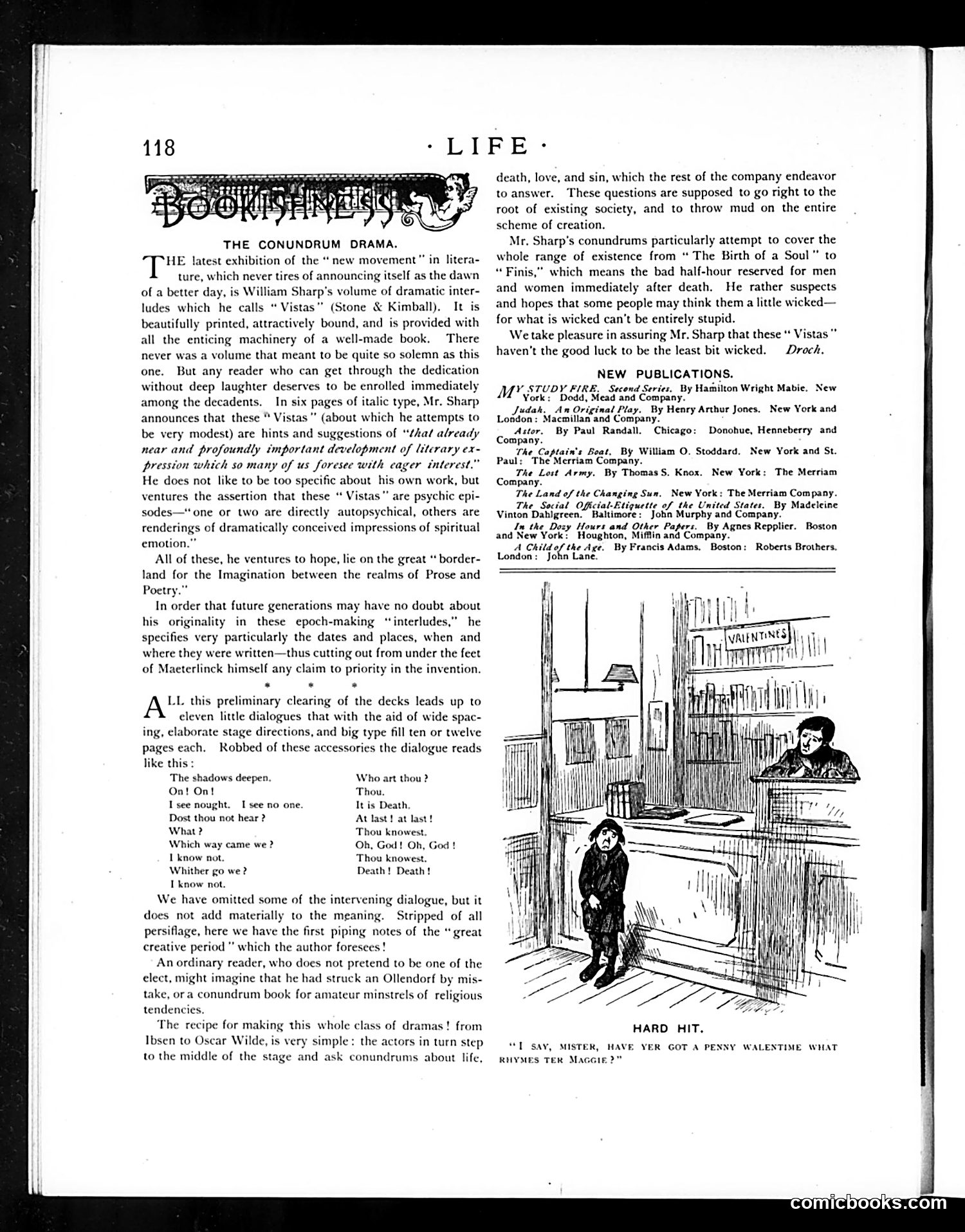
What you’re looking at
This cartoon illustrates a street encounter between two figures. The caption reads: "I say, mister, have yer got a penny waistime what rhymes ter maggie?" The humor appears to be a play on working-class London speech patterns and street beggar culture. One figure (possibly a street urchin or beggar) is asking another for money, using deliberately fractured grammar and slang ("yer," "waistime"). The request references "rhymes ter maggie," likely a reference to Cockney rhyming slang—a distinctly working-class London linguistic tradition where words are replaced by rhyming phrases. The cartoon satirizes both poverty and the colorful speech of London's lower classes during this period, presenting their dialect as amusing to middle and upper-class readers of *Life* magazine.
📄 Transcribed text from this page (OCR, searchable)
Machine-transcribed from the original scan — historical spelling and the odd misread are preserved.
LIFE THE CONUNDRUM DRAMA. HE latest exhibition of the “ new movement” in litera- ture, which never tires of announcing itself as the dawn of a better day, is William Sharp's volume of dramatic inter- ludes which he calls “ Vistas" (Stone & Kimball). It is beautifully printed, attractively bound, and is provided with all the enticing machinery of a well-made book. There never was a volume that meant to be quite so solemn as this one. But any reader who can get through the dedicati without deep laughter deserves to be enrolled immediately among the decadents. In six pages of italic type, Mr. Sharp announces that these “ Vistas” (about which he attempts to be very modest) are hints and suggestions of “¢hat already near and profoundly important development of literary ex- pression which so many of us foresee with eager interest.” He does not like to be too specific about his own work, but ventures the assertion that these * as" are psychic epi- sodes—one or two are directly autopsychical, others are renderings of dramatically conceived impressions of spiritual emotion.” All of these, he ventures to hope, lie on the great “ border- land for the Imagination between the realms of Prose and Poetry In order that future generations may have no doubt about his originality in these epoch-making “interludes,” he specifies very particularly the dates and places, when and where they were written—thus cutting out from under the feet of Maeterlinck himself any claim to priority in the invention. LL this preliminary clearing of the decks leads up to eleven little dialogues that with the aid of wide spac- ing, elaborate stage directions, and big type fill ten or twelve pages each. Robbed of these accessories the dialogue reads like this : ‘The shadows deepen. On! Ont I see nought. I see no one. Dost thou not hear ? What? Which way came we ? I know not. Whither go we? I know not. Who art thou ? Thou. It is Death, At last! at last! Thou knowest. Oh, God! Oh, God t Thou knowest, Death! Death! We have omitted some of the intervening dialogue, but it does not add materially to the meaning. Stripped of all persiflage, here we have the first piping notes of the “great creative period " which the author fore: : An ordinary reader, who does not eta to be one of the elect, might imagine that he had struck an Ollendorf by mis- take, ora conundrum book for amateur minstrels of religious tendencies. The recipe for making this whole class of dramas! from Ibsen to Oscar Wilde, is very simple: the actors in turn step to the middle of the stage and ask conundrums about life, death, love, and sin, which the rest of the company endeavor to answer. These questions are supposed to go right to the root of existing society, and to throw mud on the entire scheme of creation. Mr. Sharp's conundrums particularly attempt to cover the whole range of existence from “ The Birth of a Soul” to “ Finis,” which means the bad half-hour reserved for men and women immediately after death. He rather suspects and hopes that some people may think them a little wicked— for what is wicked can’t be entirely stupid. We take pleasure in assuring Mr. Sharp that these “ Vistas” haven't the good luck to be the least bit wicked. — Droch. NEW PUBLICATIONS. MY STUOV FIRE, Second Series. By Hamilton Wright Mabie, New York: Dodd, Mead and Company. Judak. An Original Play. By Henry Arthur Jones. New York and Losdon: Macmillan and Company. Astor, By Paul Randall. Chicago: Company. The Captain's Beat, By William O. Stoddard. New York and St. Paul: The Merriam Company. The Lost Army. By Thomas S. Knox. Company. The Land of the Changing Sun. New York: The Merriam Company. The Social Official-Etiquette of the United States, By Madeleine Vinton Dahigreen. Baltimore: John Murphy and Company. In the Dory Hours and Other Papers. By Agnes Repplicr. and New York: Houghton, Mifflin and Company. A Child of the Age. By Francis Adams. Boston: Roberts Brothers. London: John Lane. Donohue, Henneberry and New York: The Merriam Boston HARD HIT. “TL SAY, MISTER, HAVE YER GOT A PENN RHYMES TER MAGGIE ? y WALENTIME WHAT