
A complete issue · 14 pages · 1894
Life — December 20, 1894
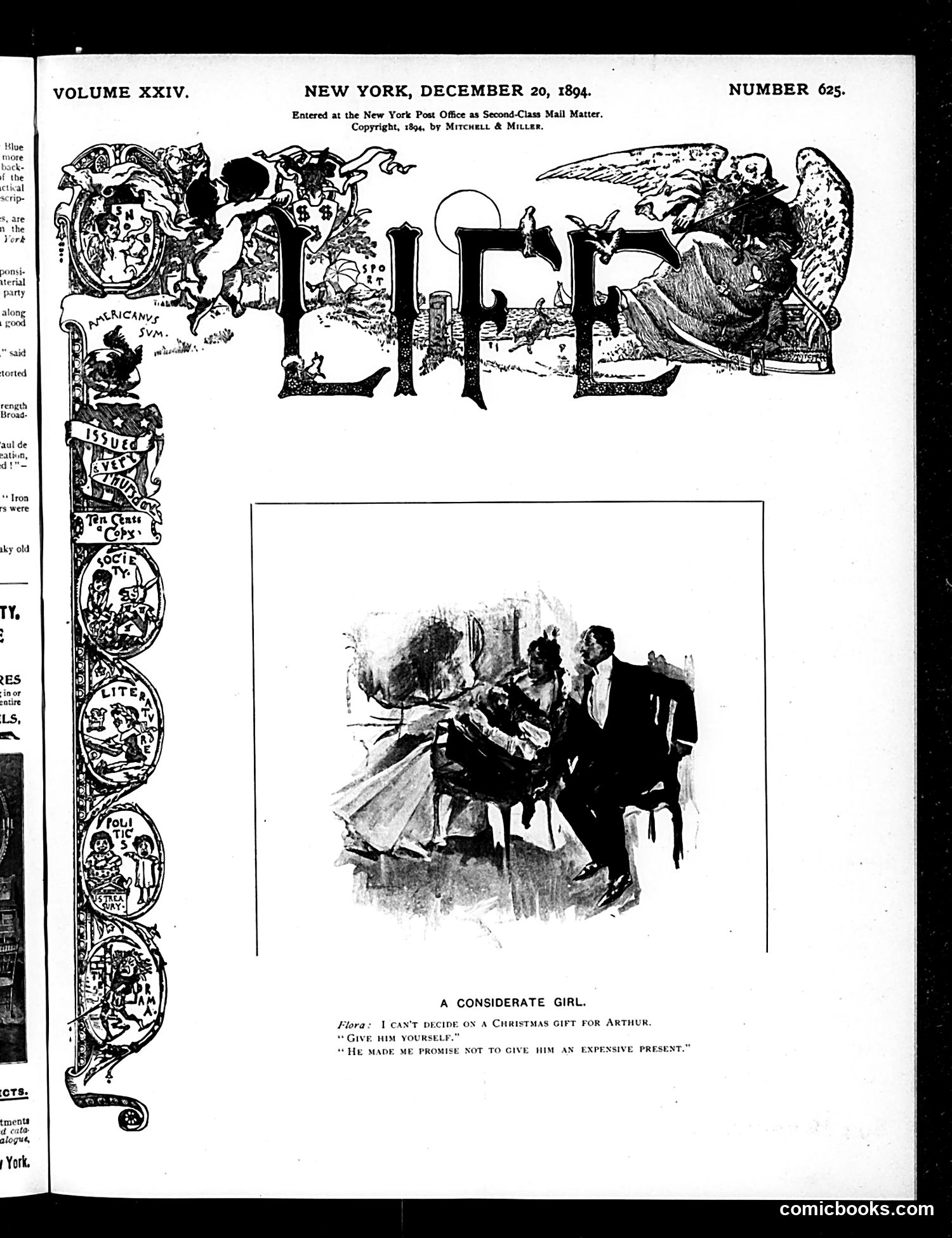
This cartoon illustrates a domestic humor scenario common to 1890s Life magazine. The caption indicates Flora faces a dilemma: she cannot decide what Christmas gift to buy for "Arthur," her presumed suitor or husband. The joke pivots on Flora's resolution: rather than purchase an expensive present (which Arthur forbade), she offers **herself** as the gift—a self-deprecating reference to marriage or romantic commitment as woman's ultimate offering. The ornate decorative border on the left, typical of Life's design, frames this genteel domestic comedy. The sketch-style illustration shows the couple in an intimate conversation, capturing the sentimental tone of period romance literature. The humor relies on Victorian courtship conventions where a woman's primary value lay in companionship and domestic partnership rather than material possessions.
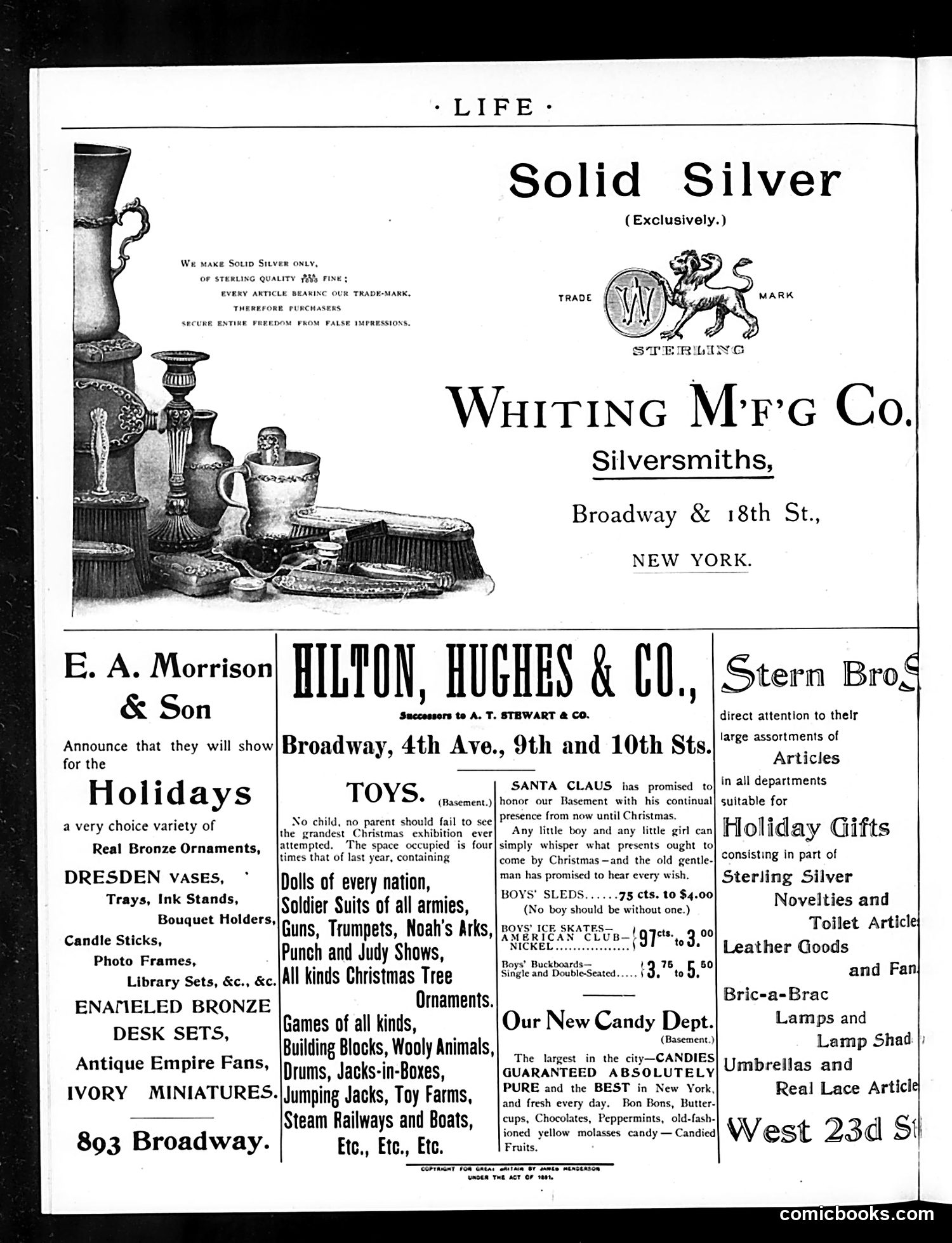
This page is **primarily advertising**, not satire or political commentary. It contains multiple holiday shopping advertisements from New York retailers, circa early 1900s. The main content includes: - **Whiting M'f'g Co.** advertisement for solid sterling silver goods - **E.A. Morrison & Son** promoting bronze ornaments and desk sets - **Hilton, Hughes & Co.** advertising toys, dolls, and Christmas items - **Stern Bros.** offering holiday gifts in sterling silver and leather goods The only noteworthy editorial element is a **Santa Claus mention** promising children presents—standard holiday marketing rhetoric. There are no political cartoons, caricatures requiring interpretation, or satirical commentary visible. This is a straightforward commercial page targeting wealthy holiday shoppers in Manhattan.
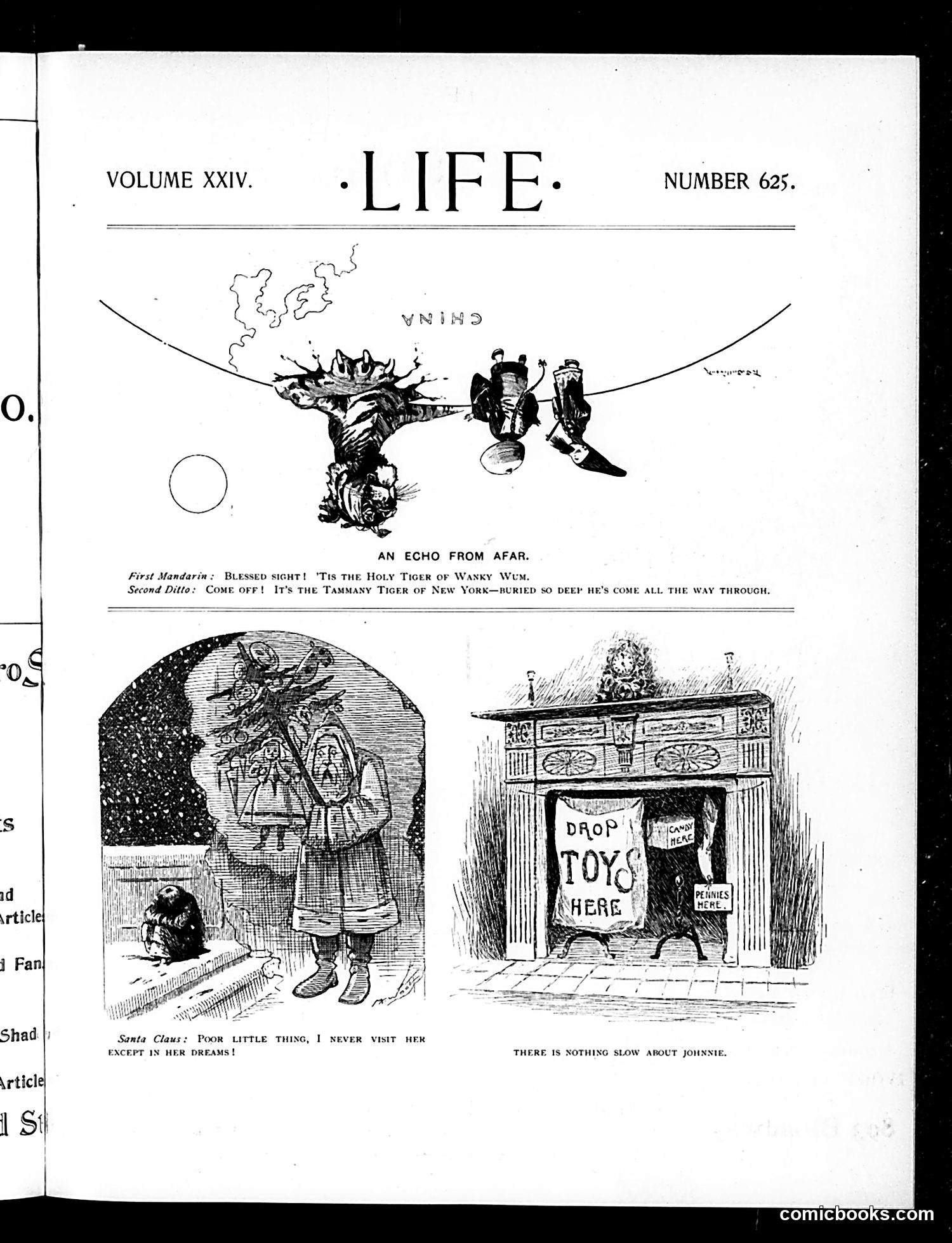
This page contains three separate satirical cartoons typical of early 20th-century Life magazine humor: 1. **"An Echo from Afar"** (top): A dialogue joke about tigers—one character references the "Holy Tiger of Wanky Wum" while another mentions a "Tammany Tiger of New York," likely satirizing Tammany Hall political corruption through animal metaphor. 2. **"Santa Claus" (bottom left)**: Shows Santa telling a child he "never visits her except in her dreams"—social satire about poverty or neglect. 3. **"There is Nothing Slow About Johnnie"** (bottom right): Depicts a toy shop storefront, apparently making a joke about a character named Johnnie, though the specific reference is unclear from the image alone. The cartoons use exaggerated linework typical of the era's satirical style.
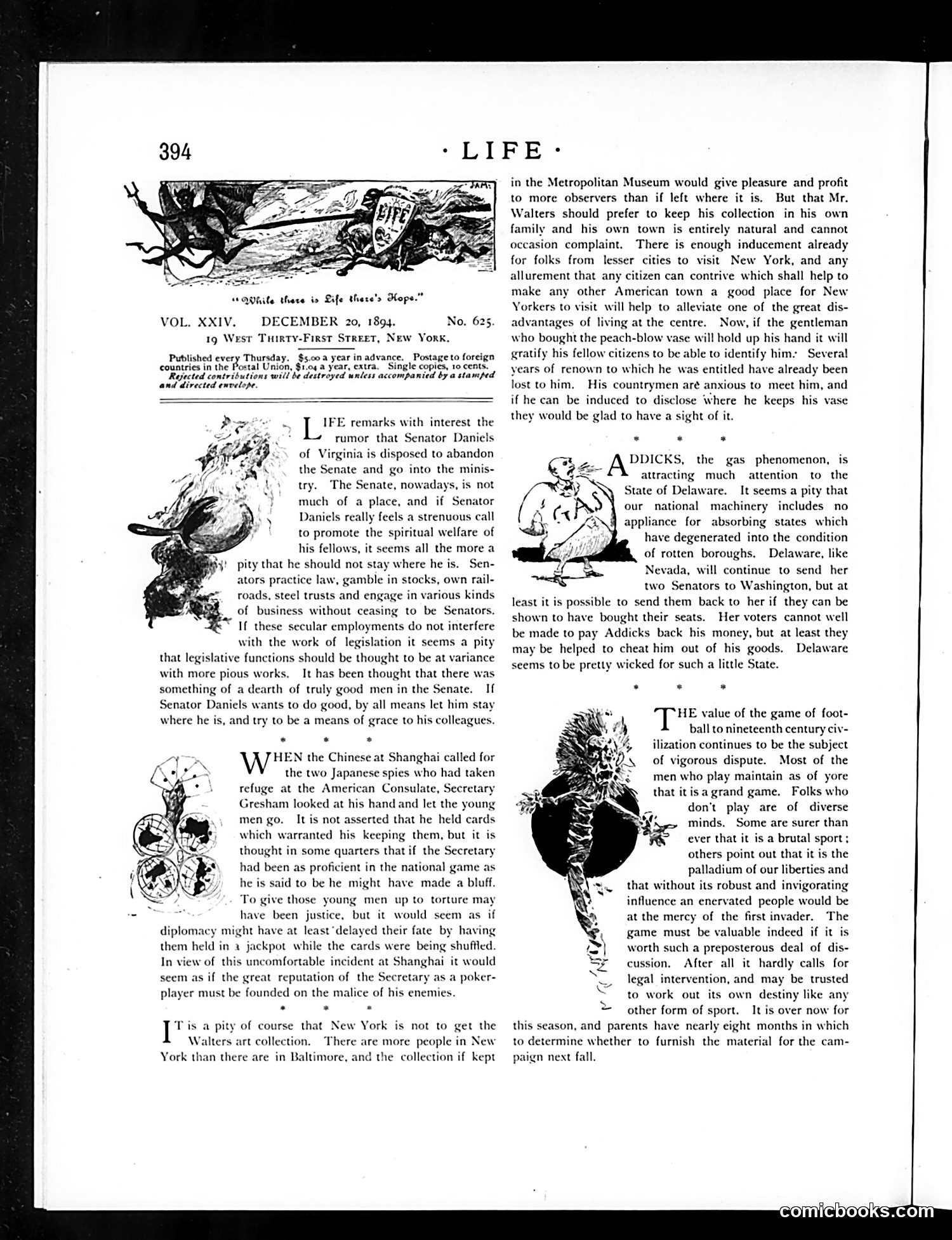
This page contains four satirical pieces addressing contemporary issues: 1. **Senator Daniels of Virginia**: The text criticizes his rumored plan to leave the Senate, arguing he should stay and use his business experience for legislative good rather than private enterprise. 2. **Shanghai Incident**: A satirical account of Secretary Gresham's poker skills during a diplomatic crisis. The joke suggests that while the Secretary held cards at the American Consulate during the Chinese conflict, his reputation as a poker player may have been overstated—implying his diplomatic abilities are similarly questionable. 3. **Walters Art Collection**: Commentary on keeping valuable art collections in their home cities rather than moving them to New York's Metropolitan Museum. 4. **Football Debate**: Discussion of football's social value as a "vigorous dispute" continues among nineteenth-century observers about whether it's noble or brutal sport.
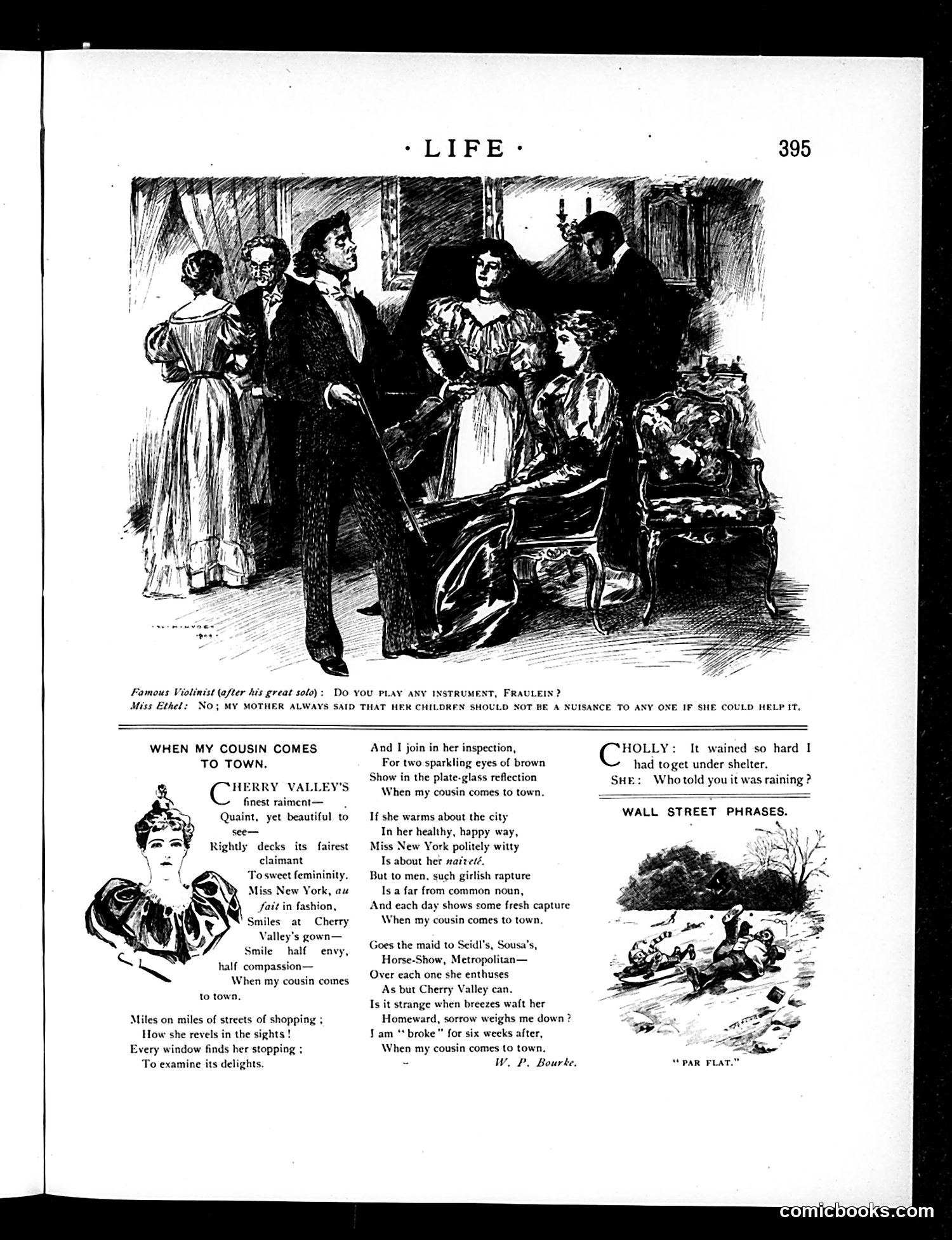
**Top Cartoon:** A social scene showing a "Famous Violinist" being asked by Miss Ethel if he plays any instrument. His response—that her mother said children shouldn't be a nuisance if they could help it—is a cutting insult disguised as agreement. The joke satirizes social rudeness masked by false politeness. **Lower Content:** - A poem titled "When My Cousin Comes to Town" mocks a visiting cousin from New York, satirizing her pretentious shopping habits and fashionable airs on "Cherry Valley's" streets. - "Wall Street Phrases" and "Par Flat" appear to be additional humorous sections. The overall tone targets urban affectation and social pretension common to Gilded Age satire.
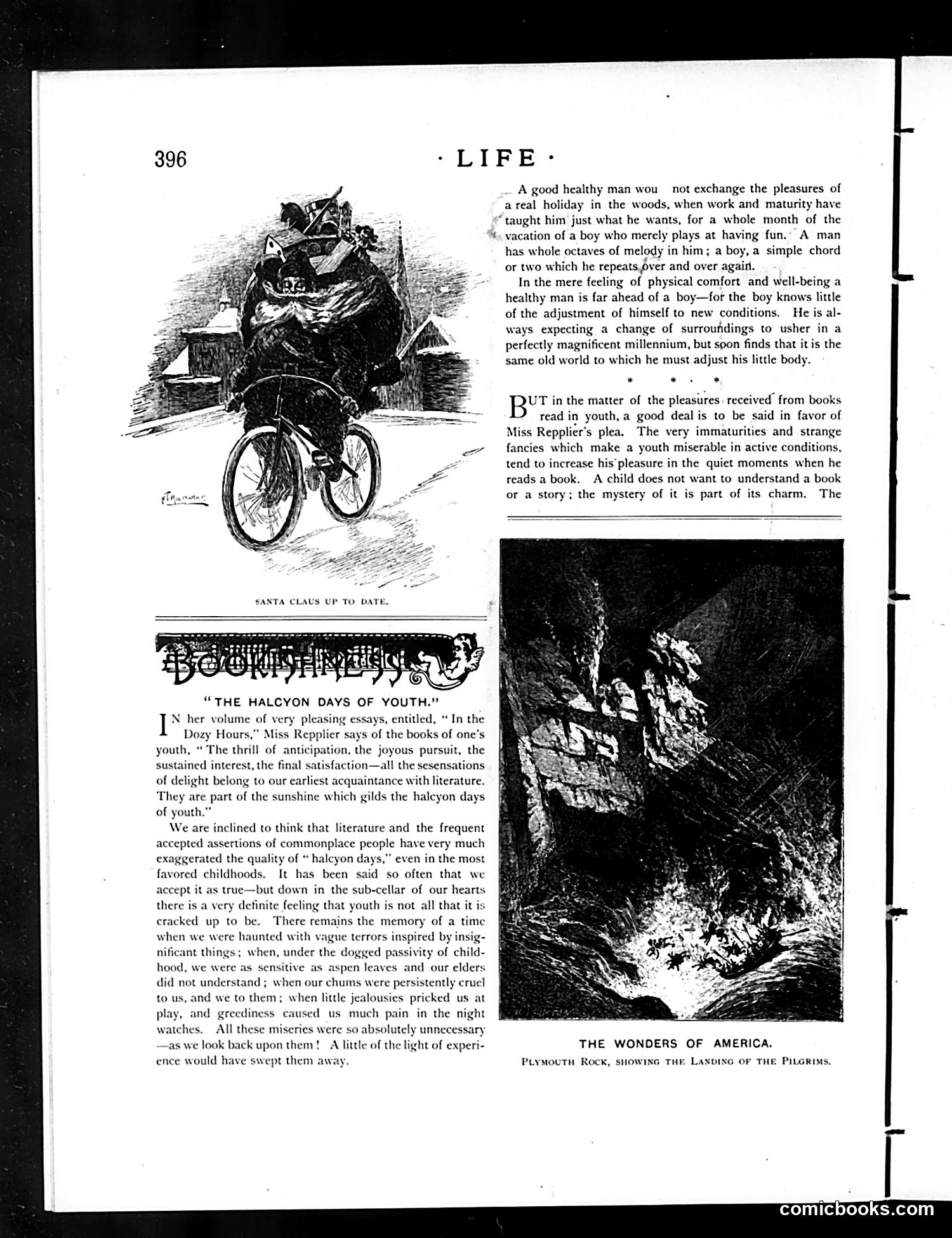
The main illustration, "Santa Claus Up to Date," shows Santa riding a bicycle rather than in his traditional sleigh. This reflects early 20th-century technological optimism—the bicycle was a modern marvel of the era, symbolizing progress and up-to-date modernity. The joke is that even Santa has adopted contemporary transportation. The text below discusses "The Halcyon Days of Youth," quoting Miss Repplier on nostalgia and literature's role in childhood. It argues against romanticizing the past, suggesting that youth wasn't actually as idyllic as memory suggests, and that good books provide genuine pleasure superior to mere play. The photograph shows Plymouth Rock and references American history rather than satire. This page balances humor with reflective cultural commentary.
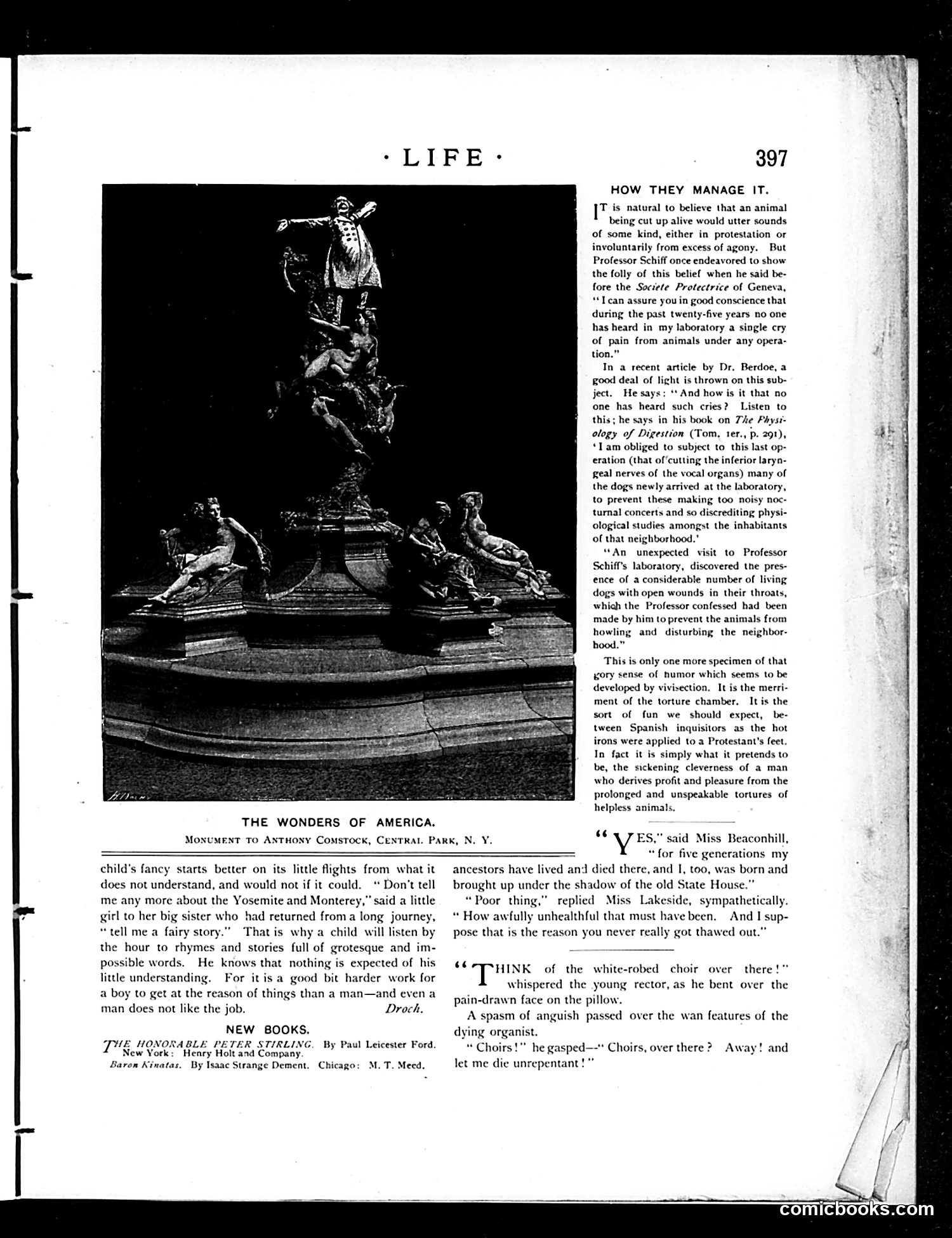
This page features a monument sculpture titled "The Wonders of America: Monument to Anthony Comstock, Central Park, N.Y." **The Satire:** The cartoon mocks **Anthony Comstock**, a real historical figure who was a crusading moral reformer and anti-obscenity activist. The monument depicts him standing triumphantly over figures he opposed—likely representing free speech, artistic expression, and progressive causes. **The Point:** *Life* magazine (known for satirizing moral censorship) ridicules Comstock's aggressive suppression campaigns. By presenting him as if he deserved a grand monument, the cartoonist sarcastically critiques his self-righteous zealotry and the collateral damage his moral crusades caused to legitimate art and literature. The accompanying text about animal vivisection and Professor Schiff continues this theme of satirizing excessive moral policing.
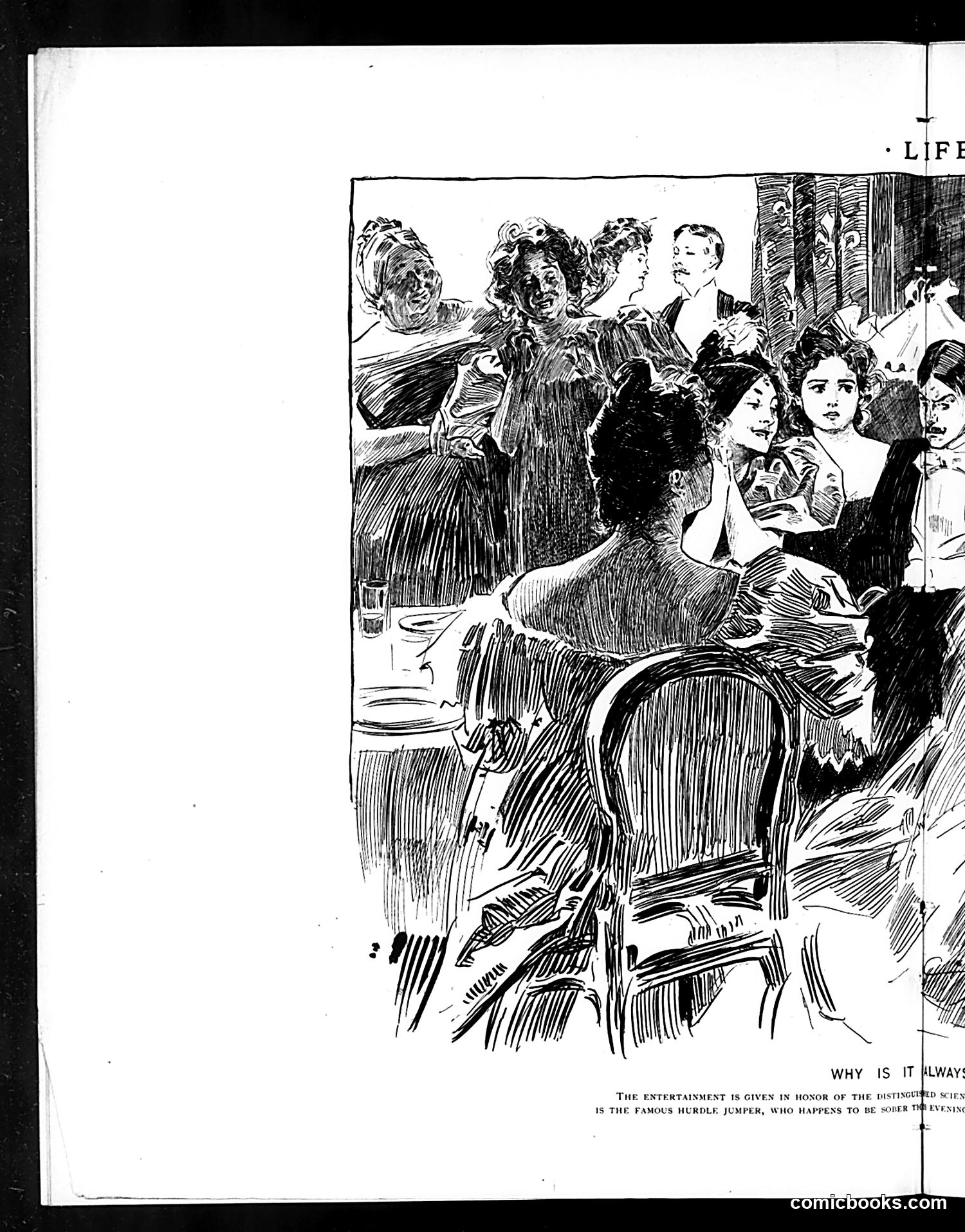
This is a satirical illustration from *Life* magazine depicting an evening social gathering. The caption reads: "The entertainment is given in honor of the distinguished scion [of] the famous hurdle jumper, who happens to be sober this evening." The satire targets a wealthy family whose patriarch is known for being a habitual drunk (the "famous hurdle jumper" who regularly navigates obstacles, presumably while intoxicated). The joke is that his son's social event is noteworthy specifically because the father managed to stay sober for once—suggesting this is rare enough to warrant celebration. The illustration shows well-dressed guests at what appears to be an indoor soirée, with the satirical humor playing on class pretense and the open acknowledgment of aristocratic alcoholism as an expected character trait.
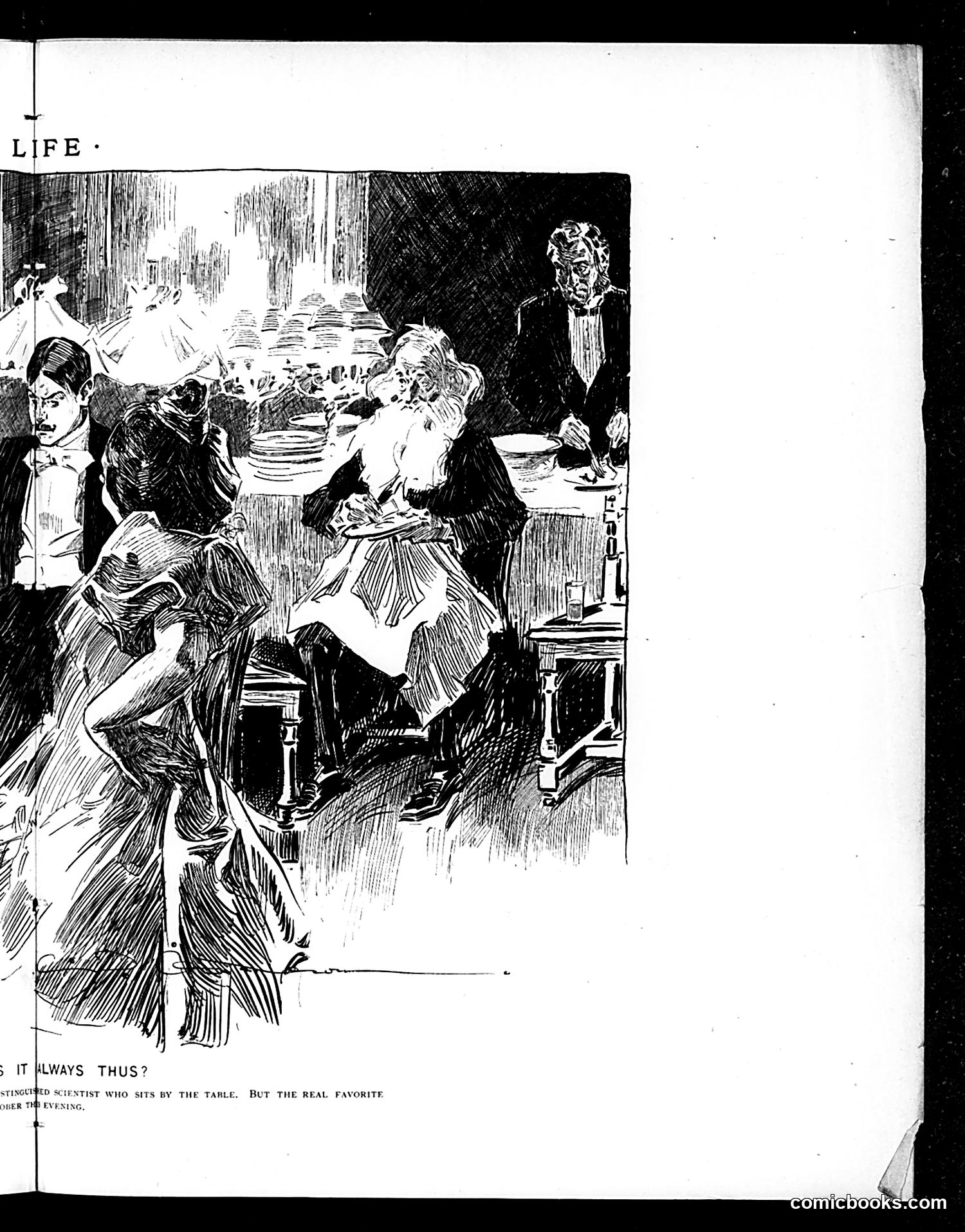
This illustration depicts a formal dinner scene with well-dressed figures seated at a table. The caption reads "IS IT ALWAYS THUS?" with additional text mentioning "A DISTINGUISHED SCIENTIST WHO SITS BY THE TABLE. BUT THE REAL FAVORITE [OF THE EVENING]." The satire appears to target social pretension at formal dinners. It suggests that an accomplished scientist—presumably seated formally but overlooked—is less valued socially than someone else at the gathering (likely a woman or entertainer, given the figure in the foreground). The joke critiques how high society prioritizes charm or entertainment over genuine intellectual achievement. The "always thus" implies this is a recurring social pattern: genuine merit takes a backseat to more superficial appeal at gatherings.
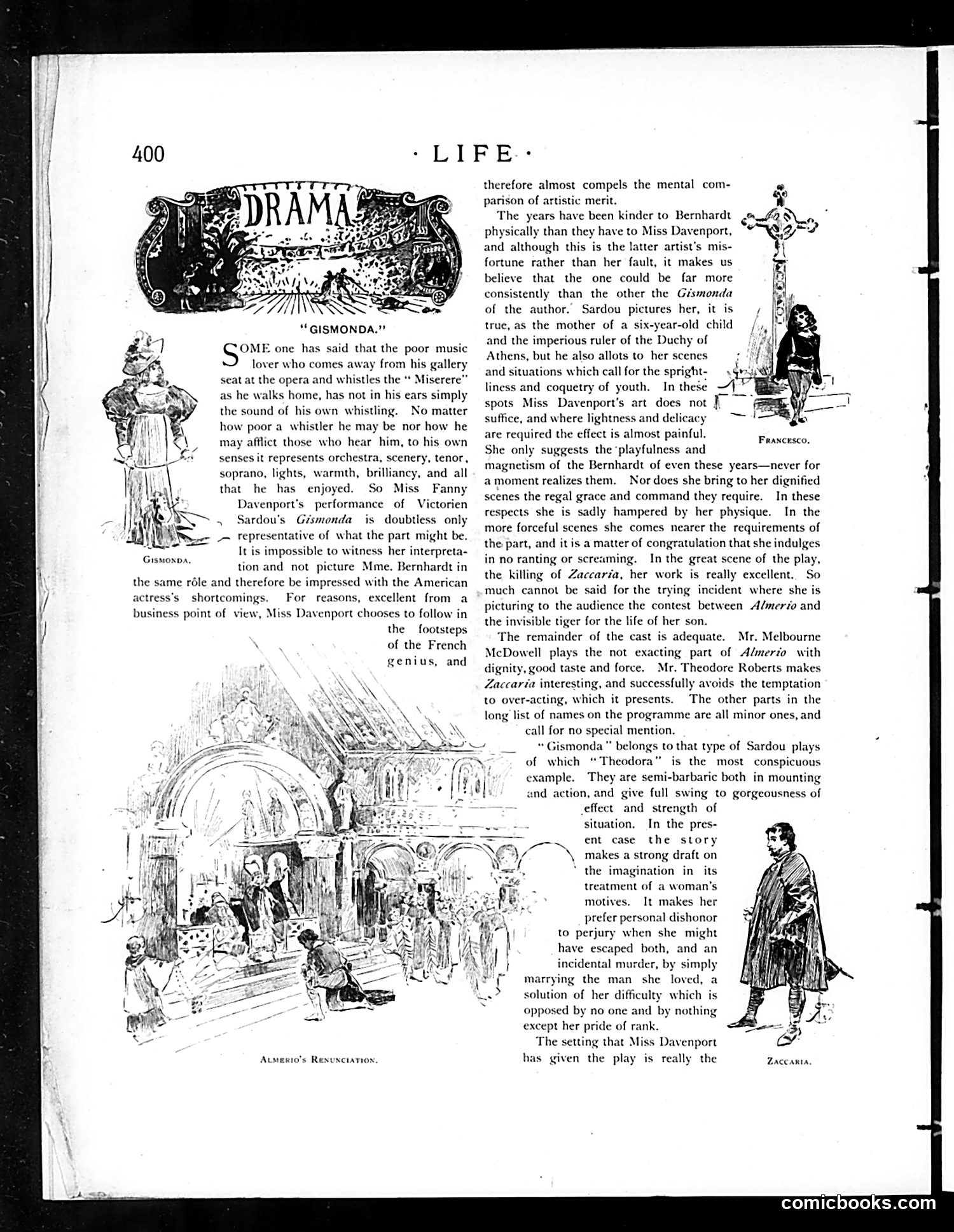
This page reviews a theatrical production of "Gismonda," a play featuring actress Fanny Davenport. The text praises her performance while acknowledging her physical limitations for certain demanding scenes. The illustrations show theatrical scenes—one depicting a religious or classical interior ("Almerio's Renunciation") and another showing a robed figure labeled "Zacaria." The review notes that Davenport's interpretation is dignified but sometimes physically insufficient for the role's requirements. It mentions other cast members, particularly Melbourne McDowell as Almerio and Theodore Roberts as Zacaria, performing adequately. The play itself is described as semi-barbaric, featuring dramatic action and a plot involving a woman's moral dilemma around murder and marriage.
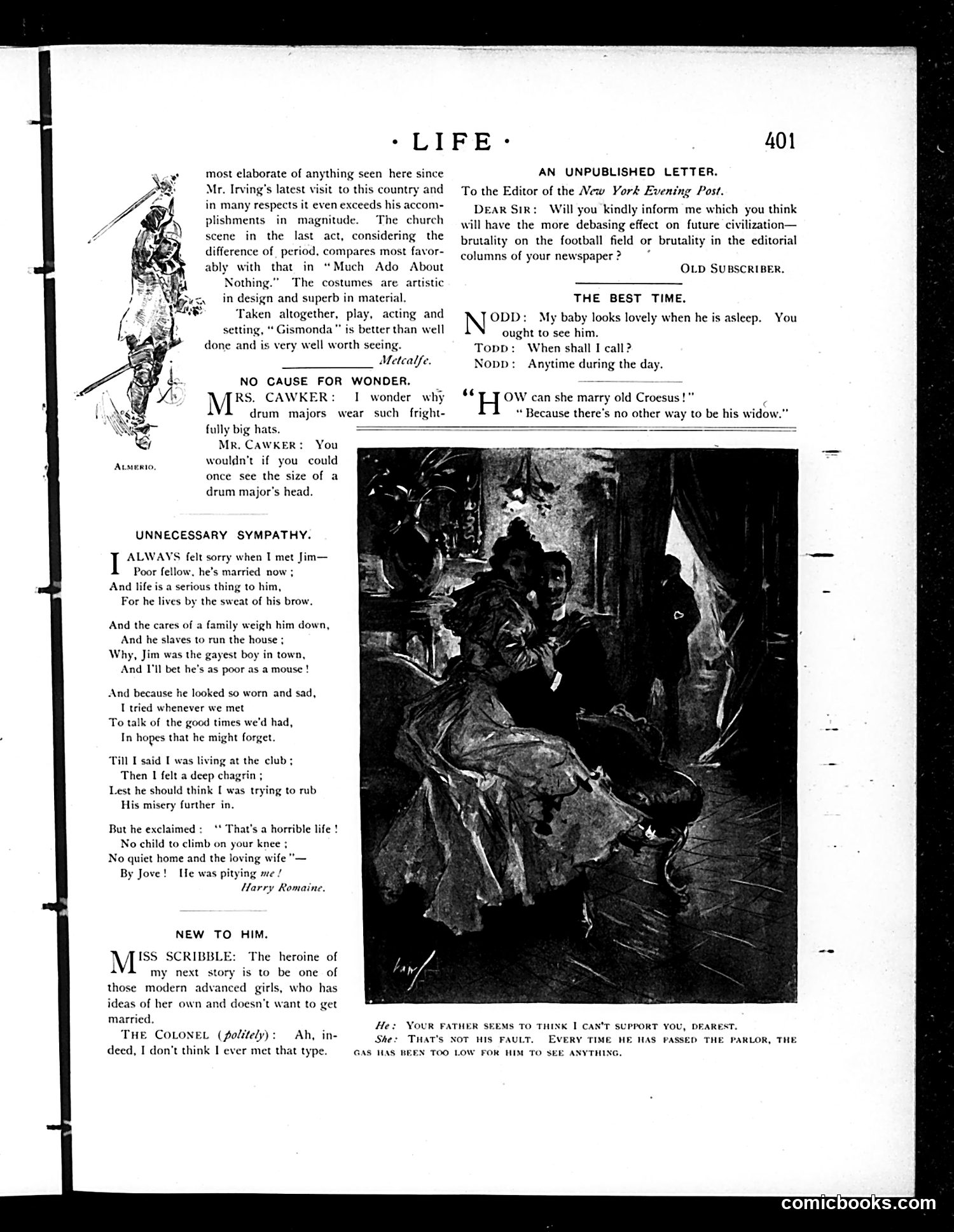
This page contains several humorous short pieces and a dramatic illustration rather than political cartoons. **The content includes:** - **"An Unpublished Letter"**: A satirical letter asking whether football or editorial brutality damages civilization more - **"The Best Time"**: A brief comedic dialogue about when a baby looks best - **"How Can She Marry Old Croseus?"**: A joke playing on the saying "because there's no other way to be his widow" - **Dramatic illustration**: Shows figures in what appears to be a domestic crisis scene, with a caption about a father unable to support his daughter and the gas remaining too low for him to see anything—likely satirizing poverty or financial desperation The page reflects early 20th-century satirical humor targeting contemporary social issues: marriage economics, family hardship, and class anxieties. The tone is characteristic of *Life* magazine's blend of gentle mockery and social commentary.
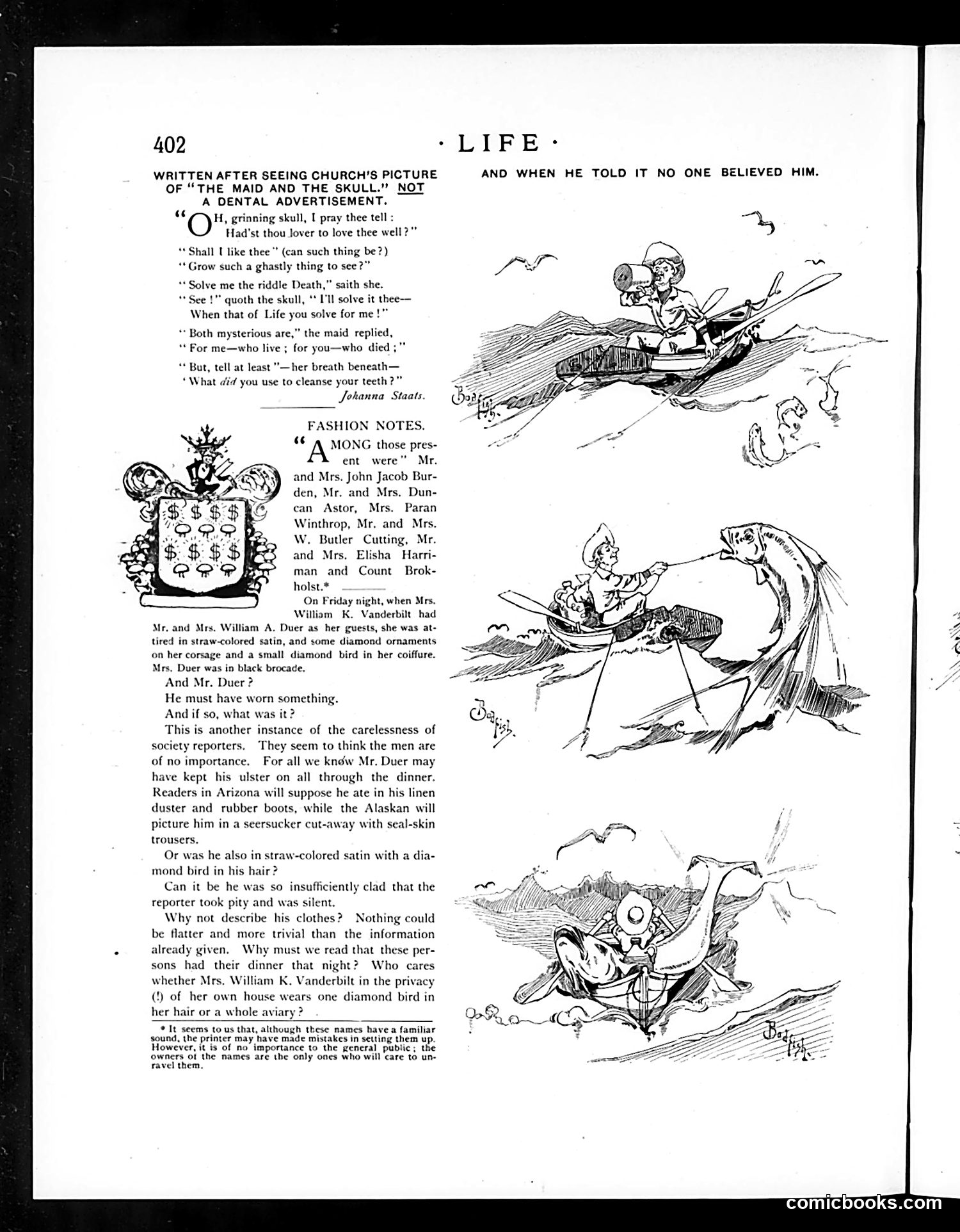
This page contains two distinct pieces of social satire: **Upper section:** A poem mocking a painting ("Church's Picture of 'The Maid and the Skull'"). The verse humorously reimagines a romantic/Gothic encounter between a maiden and a skull, with the skull posing philosophical riddles about life and death—then abruptly asking what toothpaste she used. The satire targets overly serious Romantic artwork by injecting mundane dental humor. **Lower section ("Fashion Notes"):** Satirizes society reporters' superficial coverage of high-society dinners. The writer mocks that Mrs. Vanderbilt's outfit was meticulously described (straw-colored satin, diamond ornaments, diamond bird), while her husband Mr. Duer received no description—he "must have worn something." The satire skewers both the reporters' triviality and readers' obsession with wealthy socialites' clothing while ignoring men entirely. A footnote suggests some listed names may be printer errors, implying even society reporters don't verify facts carefully.
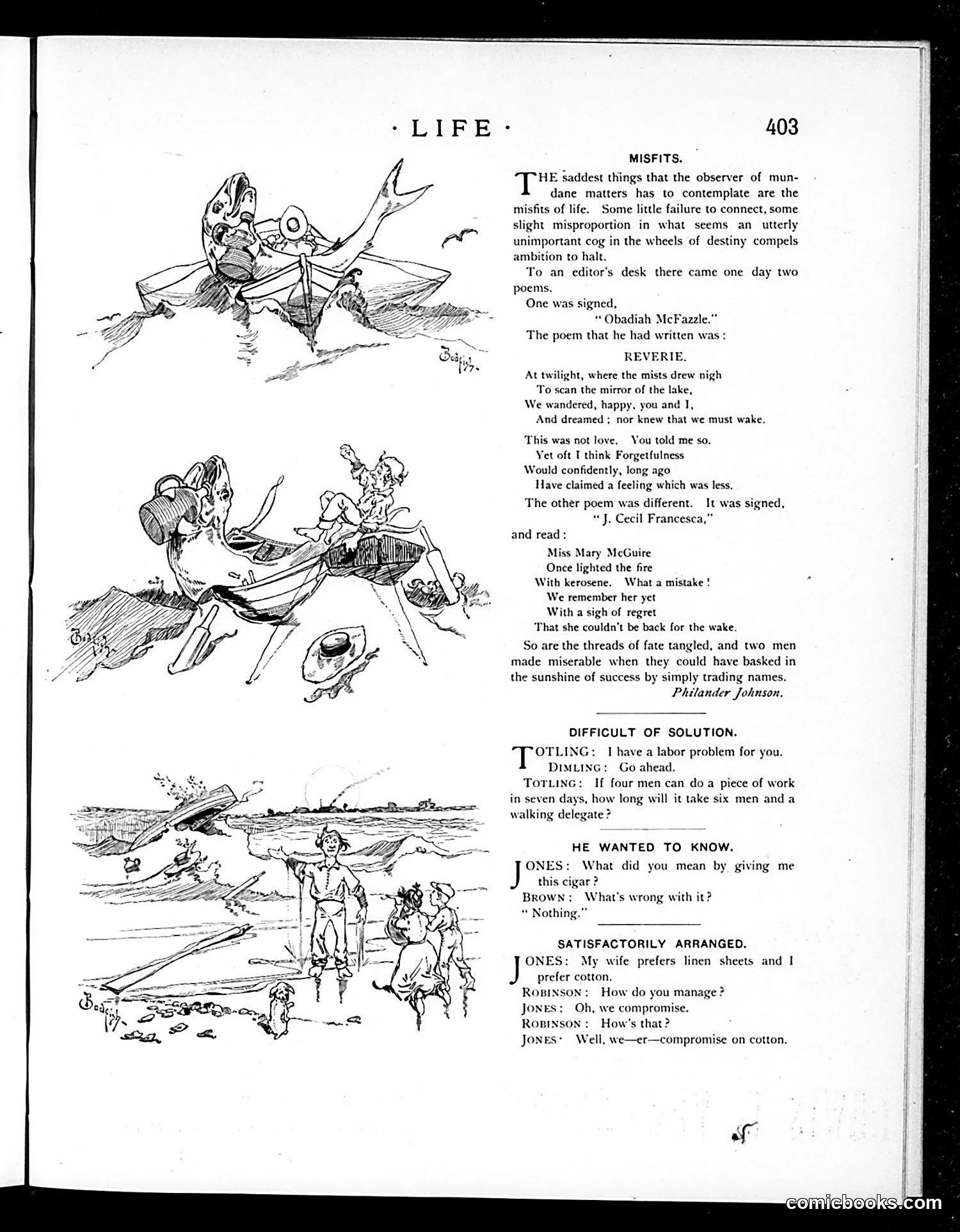
This page presents several short humorous pieces satirizing everyday life's ironies. **Main feature "Misfits"**: Two aspiring poets submit work to an editor on the same day. One signs as "Obadiah McFazzle" and writes a serious, romantic poem about love and forgetfulness. The other signs as "J. Cecil Francesca" and writes a crude, comedic poem about Miss Mary McGuire lighting a fire with kerosene and dying. The satire's point: the serious romantic poet has a ridiculous name (McFazzle), while the humorous poet has a feminine-sounding name (Cecil Francesca). The caption notes they could have "basked in success by simply trading names"—their apparent misfits are their names, not their talents. **Supporting jokes** mock workplace absurdity (the labor problem with a "walking delegate"), and marital "compromise" where one party gets their way entirely. The illustrations show whimsical creatures and beach scenes, reinforcing the lighthearted tone of these observations about life's small failures and coincidences.
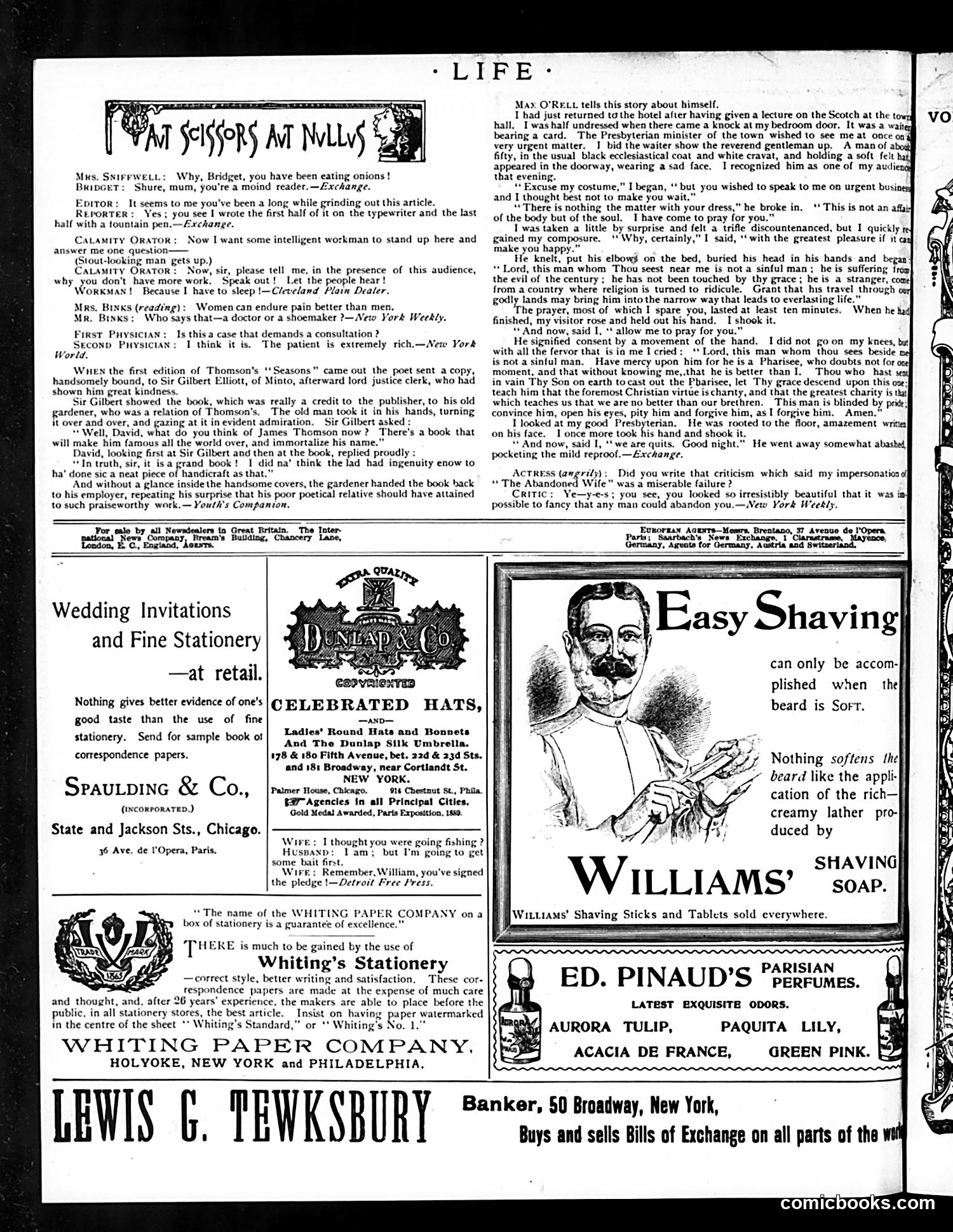
This Life magazine page contains several brief comic anecdotes rather than political cartoons: **Main Story (Max O'Rell):** A French lecturer returns to his hotel partially undressed when a stern Presbyterian minister arrives to "pray for" him—viewing the Frenchman as spiritually lost due to coming from a country where "religion is turned to ridicule." The humor lies in the minister's presumption and the cultural clash between French secularism and Scottish religious earnestness. **Other Jokes:** Brief quips about onion-eating Irish servants, typewriter vs. fountain pen writing speed, and a worker's honest answer that he can't work more because he needs sleep. The page is primarily **advertising** (Spaulding stationery, Williams' shaving soap, Whiting paper) with satirical content targeting Victorian pieties and Irish/Scottish stereotypes common to 1890s American humor.