
Life, 1894-12-20 · page 7 of 14
Life — December 20, 1894 — page 7: what you’re looking at
What you’re looking at
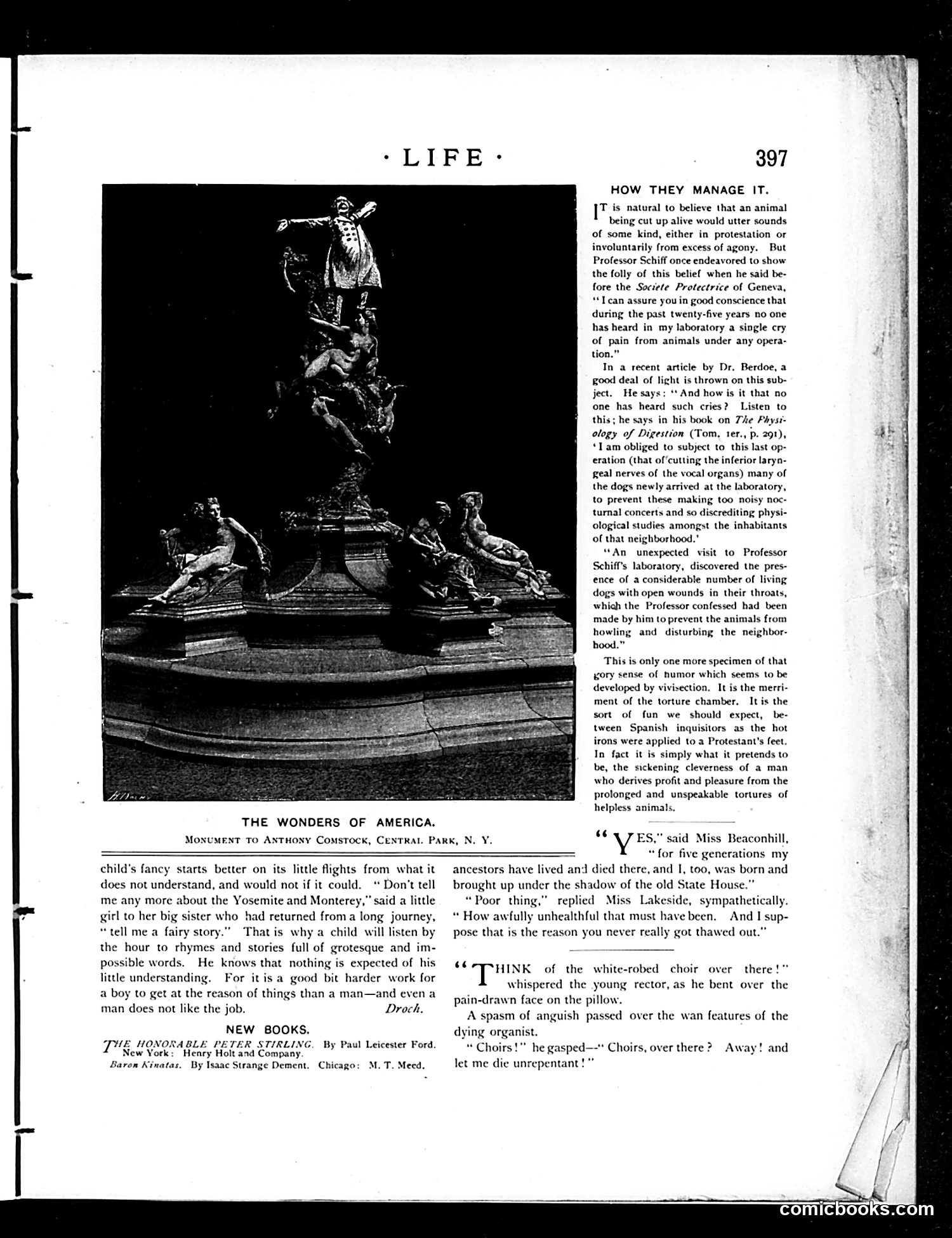
This page features a monument sculpture titled "The Wonders of America: Monument to Anthony Comstock, Central Park, N.Y." **The Satire:** The cartoon mocks **Anthony Comstock**, a real historical figure who was a crusading moral reformer and anti-obscenity activist. The monument depicts him standing triumphantly over figures he opposed—likely representing free speech, artistic expression, and progressive causes. **The Point:** *Life* magazine (known for satirizing moral censorship) ridicules Comstock's aggressive suppression campaigns. By presenting him as if he deserved a grand monument, the cartoonist sarcastically critiques his self-righteous zealotry and the collateral damage his moral crusades caused to legitimate art and literature. The accompanying text about animal vivisection and Professor Schiff continues this theme of satirizing excessive moral policing.
📄 Transcribed text from this page (OCR, searchable)
Machine-transcribed from the original scan — historical spelling and the odd misread are preserved.
THE WONDERS OF AMERICA, MONUMENT TO ANTHONY ComsTock, CENTRAL PARK, 397 HOW THEY MANAGE IT. T is natural to believe that an animal being cut up alive would utter sounds of some kind, either in protestation or involuntarily from excess of agony. But Professor Schiff once endeavored to show the folly of this belief when he said be- fore the Societe Protectrice of Geneva, “‘Tcan assure you in good conscience that during the past twenty-five years no one has heard in my laboratory a single cry of pain from animals under any opera- tion.” In a recent article by Dr, Berdoe, a good deal of light is thrown on this sub- ject. He says: * And how is it that no one has heard such cries? Listen to this; he says in his book on The Physi ology of Digestion (Tom, ter., p. 291), ‘Lam obliged to subject to this last op- eration (that of’cutting the inferior laryn- geal nerves of the vocal organs) many of the dogs newly arrived at the laboratory, to prevent these making too noisy noc- turnal concerts and so discrediting physi- ological studies amongst the inhabitants of that neighborhood.’ “An unexpected visit to Professor Schiff’s laboratory, discovered the pres- ence of a considerable number of living dogs with open wounds in their throats, which the Professor confessed had been made by him to prevent the animals from howling and disturbing the neighbor- This is only one more specimen of that xory sense of humor which seems to be developed by vivisection. It is the merri- ment of the torture chamber, It is the sort of fun we should expect, be- tween Spanish inquisitors as the hot irons were applied to a Protestant’s feet. In fact it is simply what it pretends to be, the sickening cleverness of a man who derives profit and pleasure from the prolonged and unspeakable tortures of helpless animals, 6©\ 7 ES,” said Miss Beaconbill, child's fancy starts better on its little flights from what it does not understand, and would not if it could.“ Don’t tell me any more about the Yosemite and Monterey,” said a little girl to her big sister who had returned froma long journey, “tell mea fairy story.” Thatis why a child will listen by the hour to rhymes and stories full of grotesque and im- possible words. He knows that nothing is expected of his little understanding. For it is a good bit harder work for a boy to get at the reason of things than a man—and even a man does not like the job. Droch. NEW BOOKS. THE HONORABLE PETER STIRLING. By Paul Leicester Ford. New York: Henry Holt and Company. Baron Kinatas. By Isaac Strange Dement. Chicago: M.T. Meed. “for five generations my ancestors have lived and died there, and I, too, was born and brought up under the shadow of the old State House.” “Poor thing,” replied Miss Lakeside, sympathetically. “ How awfully unhealthful that must have been. And I sup- pose that is the reason you never really got thawed out.” S©HINK of the white-robed choir over there!” whispered the young rector, as he bent over the pain-drawn face on the pillow. A spasm of anguish passed over the wan features of the dying organist. “ Choirs!" he gasped—" Choirs, over there ? let me die unrepentant! \ i | | | | / posit