
Life, 1894-12-20 · page 10 of 14
Life — December 20, 1894 — page 10: what you’re looking at
What you’re looking at
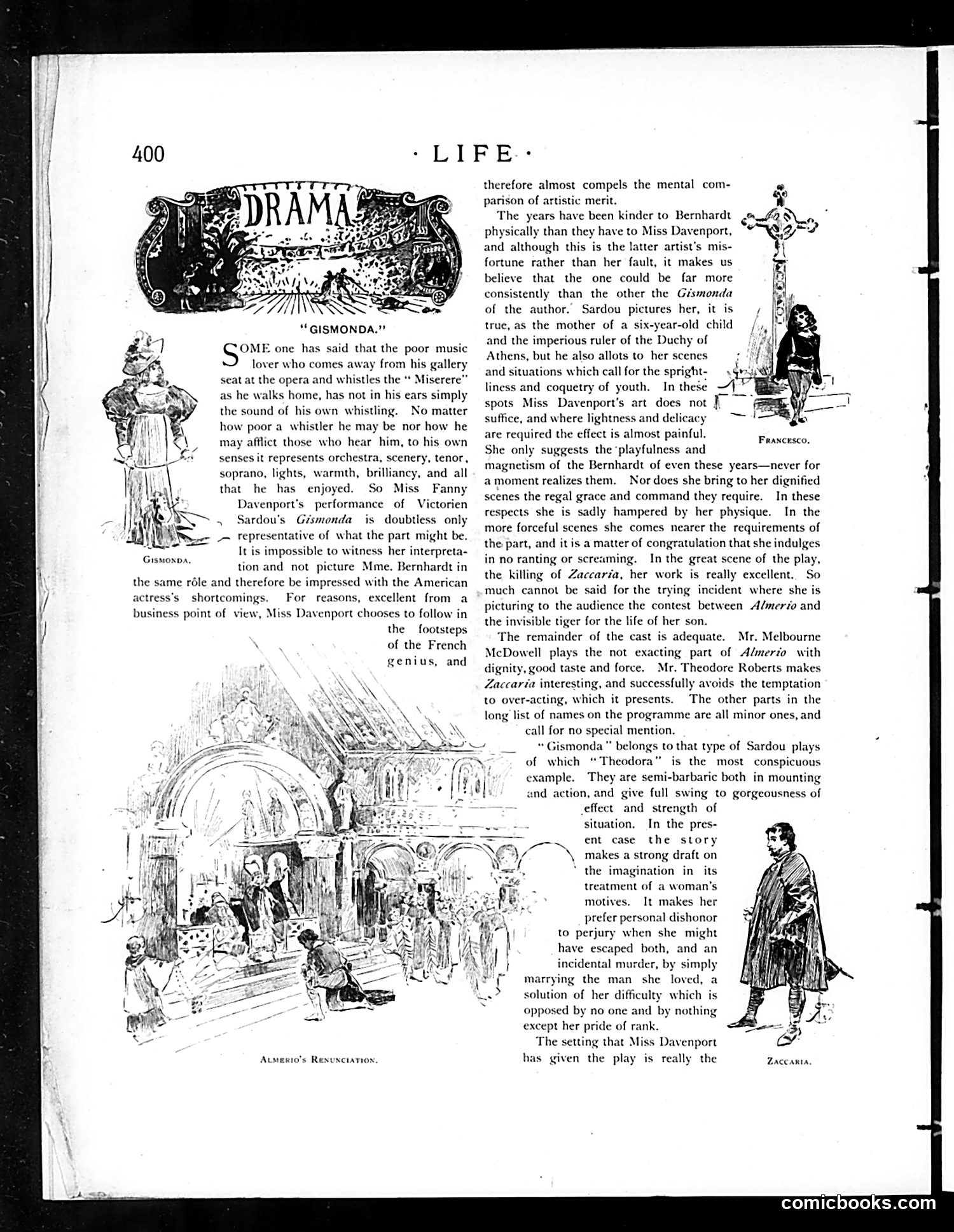
This page reviews a theatrical production of "Gismonda," a play featuring actress Fanny Davenport. The text praises her performance while acknowledging her physical limitations for certain demanding scenes. The illustrations show theatrical scenes—one depicting a religious or classical interior ("Almerio's Renunciation") and another showing a robed figure labeled "Zacaria." The review notes that Davenport's interpretation is dignified but sometimes physically insufficient for the role's requirements. It mentions other cast members, particularly Melbourne McDowell as Almerio and Theodore Roberts as Zacaria, performing adequately. The play itself is described as semi-barbaric, featuring dramatic action and a plot involving a woman's moral dilemma around murder and marriage.
📄 Transcribed text from this page (OCR, searchable)
Machine-transcribed from the original scan — historical spelling and the odd misread are preserved.
- LIFE-.: x Sart ““GISMONDA.”” OME one has said that the poor music lover who comes away from his gallery seat at the opera and whistles the “* Miserere” as he walks home, has not in his ears simply the sound of his own whistling. No matter how poor a whistler he may be nor how he afflict those who hi him, to his own ses it represents orchestra, scenery, tenor, soprano, lights, warmth, brilliancy, and all that he has enjoyed. So Miss Fanny Davenport's performance of Victorien Sardou’s Gsmonda is doubtless only entative of what the part might be. It is impossible to witness her interpri tion and not picture Mme. Bernhardt in the same réle and therefore be impressed with the American actress’s shortcomings. For reasons, excellent from a business point of view, Miss Davenport chooses to follow in the footsteps of the French genius, and Gismoxpa. therefore almost compels the mental com- parison of artistic merit. he years have been kinder to Bernhardt physically than they have to Miss Davenport, and although this is the latter artist’s mis- fortune rather than her fault, it makes us believe that the one could be far more consistently than the other the Grsmonda of the author. Sardou pictures her, it is true, as the mother of a six-year-old child and the imperious ruler of the Duchy of Athens, but he also allots to her scenes and situations which call for the spright- liness and coquetry of youth. In these spots Miss Davenport's art does not | suffice, and where lightness and delicacy are required the effect is almost painful. She only suggests the ‘playfulness and magnetism of the Bernhardt of even these years—never for a moment realizes them. Nor does she bring to her dignified scenes the regal grace and command they require. In these respects she is sadly hampered by her physique. In the more forceful scenes she comes nearer the requirements of the part, and itis a matter of congratulation that she indulges in no ranting or screaming. In the great scene of the play, the killing of Zaccarfa, her work is really excellent. So much cannot be said for the trying incident where she is picturing to the audience the contest between A/merso and the invisible tiger for the life of her son. The remainder of the cast is adequate. Mr. Melbourne McDowell plays the not exacting part of Admeréo with dignity, good taste and force. Mr. Theodore Roberts makes Zaccaria imeresting, and successfully avoids the temptation to over-acting, which it presents. The other parts in the long’ list of names on the programme are all minor ones, and Francesco. call for no special mention. * Gismonda " belongs to that type of Sardou plays of which “ Theodo is the most conspicuous example. They are semi-barbaric both in mounting and action, and give full swing to gorgeousness of effect. and strength of situation, In the pres- Auserio's Rexuxctation ent case the story makes a strong draft on * the imagination in its treatment of a woman's motives. It makes her prefer personal dishonor to perjury when she might have escaped both, and an incidental murder, by simply marrying the man she loved, a solution of her difficulty which is opposed by no one and by nothing except her pride of rank. The setting that Miss Davenport has given the play is really the Deccan: comicbooks.com