
A complete issue · 16 pages · 1894
Life — November 29, 1894
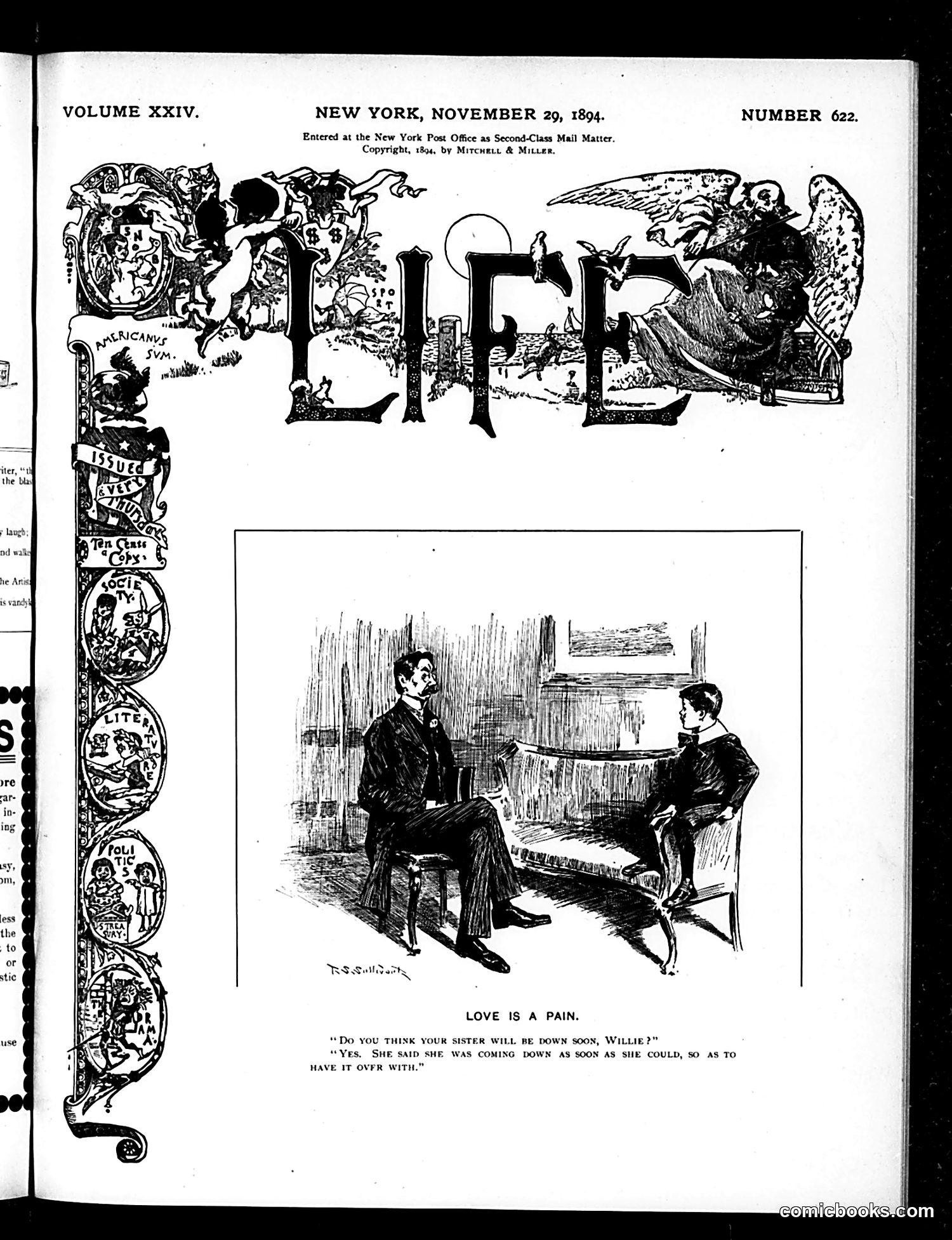
This page contains a single-panel cartoon titled "Love is a Pain," depicting two men in conversation. One asks: "Do you think your sister will be down soon, Willie?" The other replies: "Yes. She said she was coming down as soon as she could, so as to have it over with." The joke appears to satirize courtship customs of the 1890s, suggesting the sister views an impending romantic encounter as an unpleasant duty to "get over with" rather than something pleasurable. The cartoon mocks both the formality of Victorian-era dating rituals and the reluctance some women expressed toward romance and marriage, treating what society deemed a desirable social obligation as burdensome. The title reinforces this ironic sentiment about romantic love.
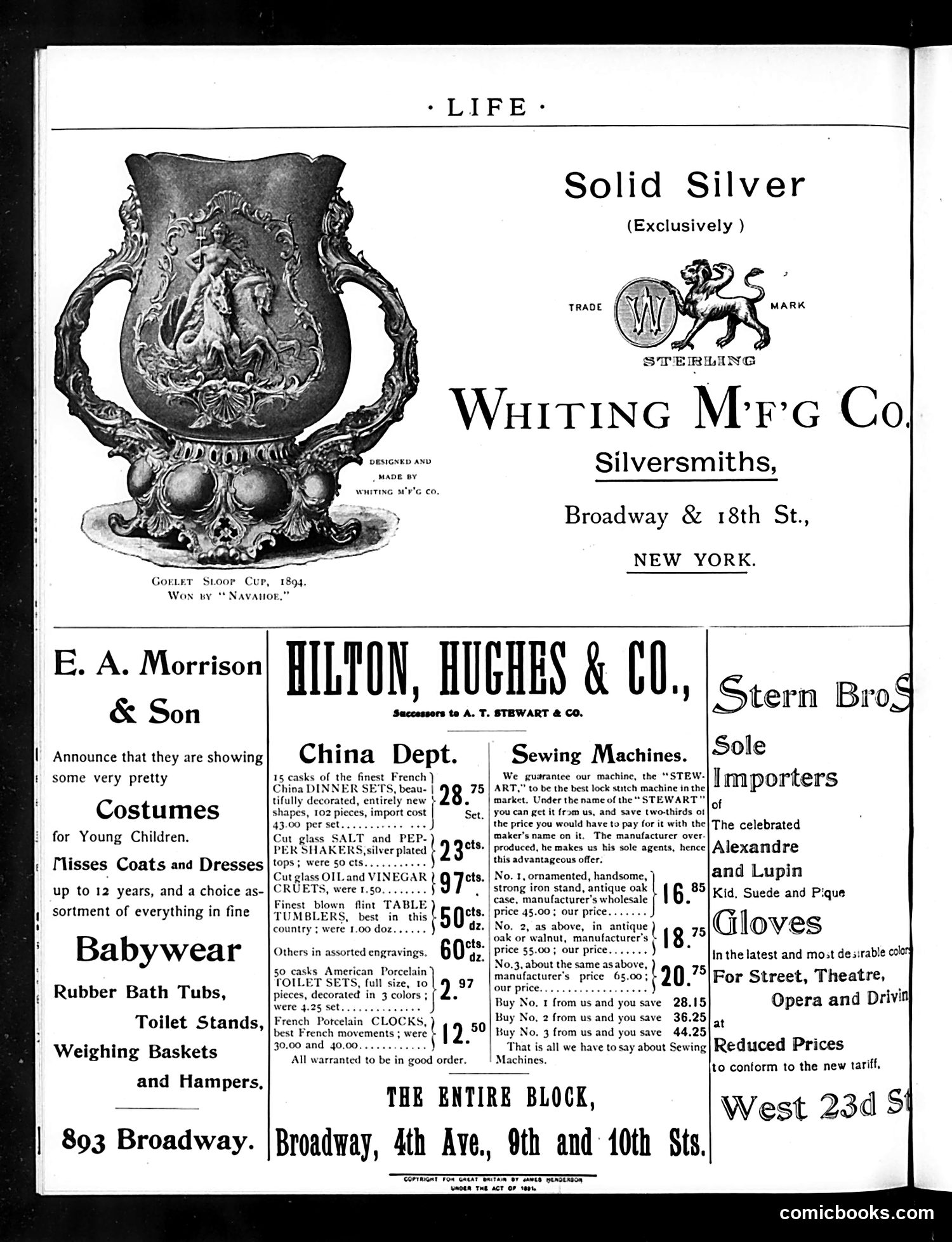
This page is **primarily advertising**, not satirical content. It features vintage commercial advertisements from late 19th-century New York businesses, including: - **Whiting Manufacturing Company** (silversmiths) advertising a "Goblet Sloop Cup" from 1894 - **E.A. Morrison & Son** promoting children's clothing and babywear - **Hilton, Hughes & Co.** selling china dinnerware and sewing machines - **Stern Bros** advertising gloves and clothing at reduced prices The decorative silver cup image is a product showcase, not political commentary. The page represents typical *Life* magazine content from this era—a mix of satirical articles with commercial advertisements supporting publication costs. No cartoons or political satire appear on this particular page.
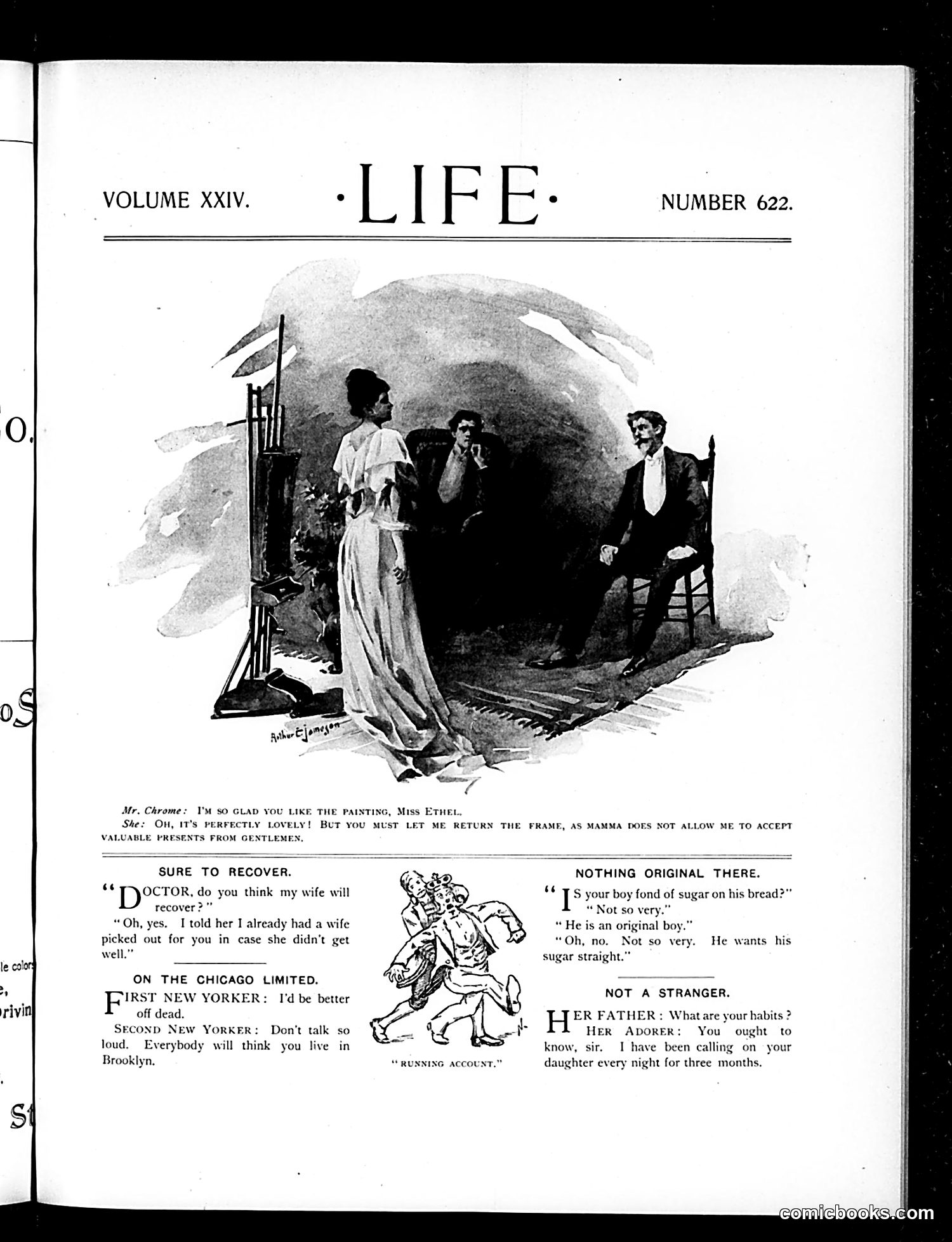
This page from *Life* magazine (Volume XXIV, Number 622) contains a dramatic illustration and several brief comic sketches satirizing early 20th-century social situations. The main illustration depicts a woman in classical dress presenting a painting to three men in formal attire, with dialogue about returning the frame because "mama does not allow me to accept valuable presents from gentlemen." Below are four separate comic vignettes mocking different scenarios: a doctor's overconfidence about his wife's recovery, Brooklyn versus New York pretensions, a boy's unoriginal taste in sugar, and an awkward courtship situation where a persistent suitor claims three months of nightly visits. The humor targets Victorian-era social conventions, marital assumptions, regional rivalries, and courtship etiquette. Without additional context, the specific individuals depicted remain unclear.
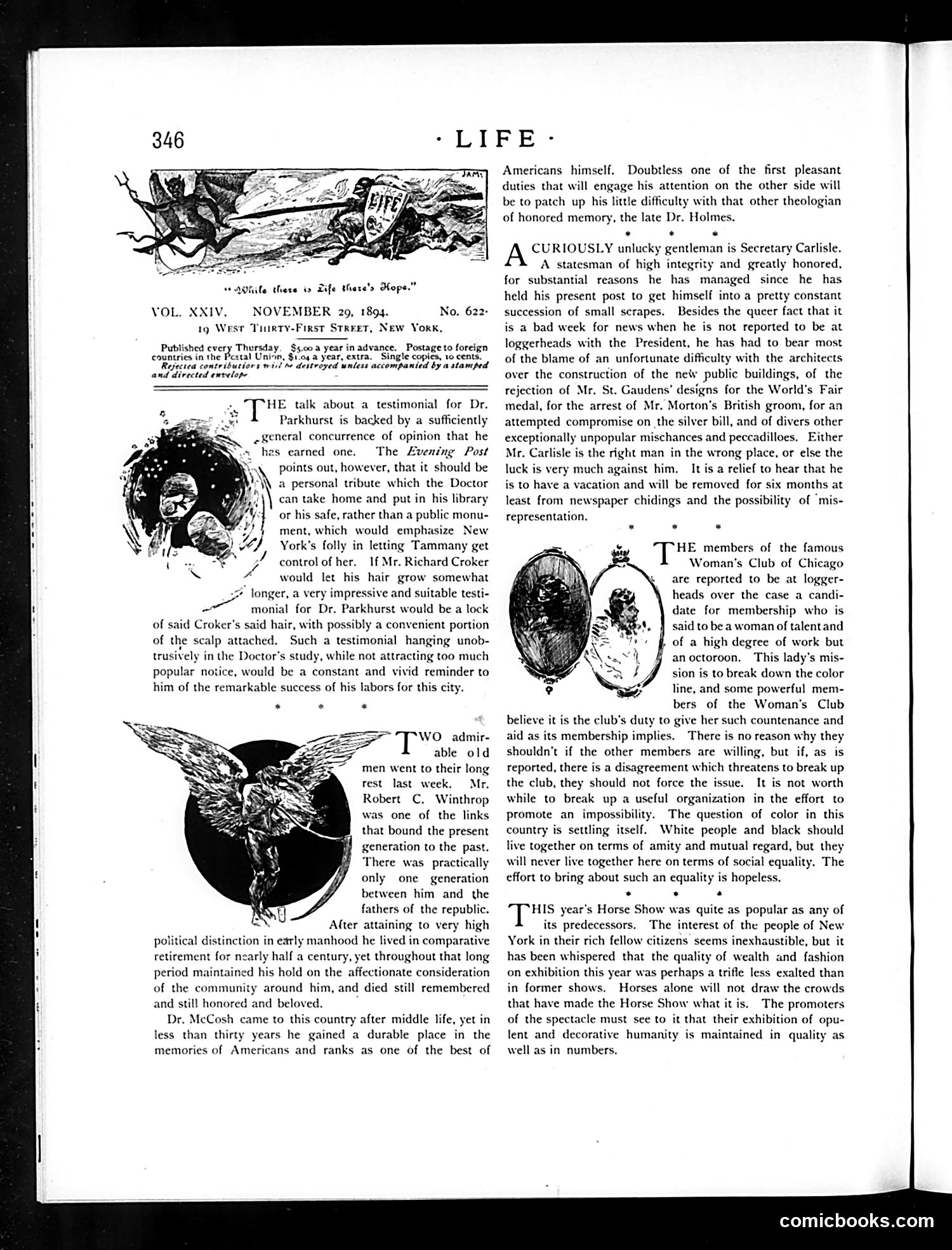
This page contains three satirical pieces about contemporary figures and events: 1. **Dr. Parkhurst testimonial**: The text discusses a proposed public tribute to Dr. Parkhurst, suggesting a personal memorial (like his hair) would be more fitting than a public monument, given his role in New York reform efforts. 2. **Robert C. Winthrop obituary**: A circular vignette celebrates an elderly statesman who maintained high political distinction across generations, dying after nearly 50 years of respected public service. 3. **Woman's Club membership dispute**: The text sarcastically critiques a Chicago women's club debating whether to admit a talented but "octoroon" (mixed-race) member, arguing that forcing such "social equality" is futile and unnecessary. The page reflects 1890s Progressive Era debates around reform, social hierarchy, and race.
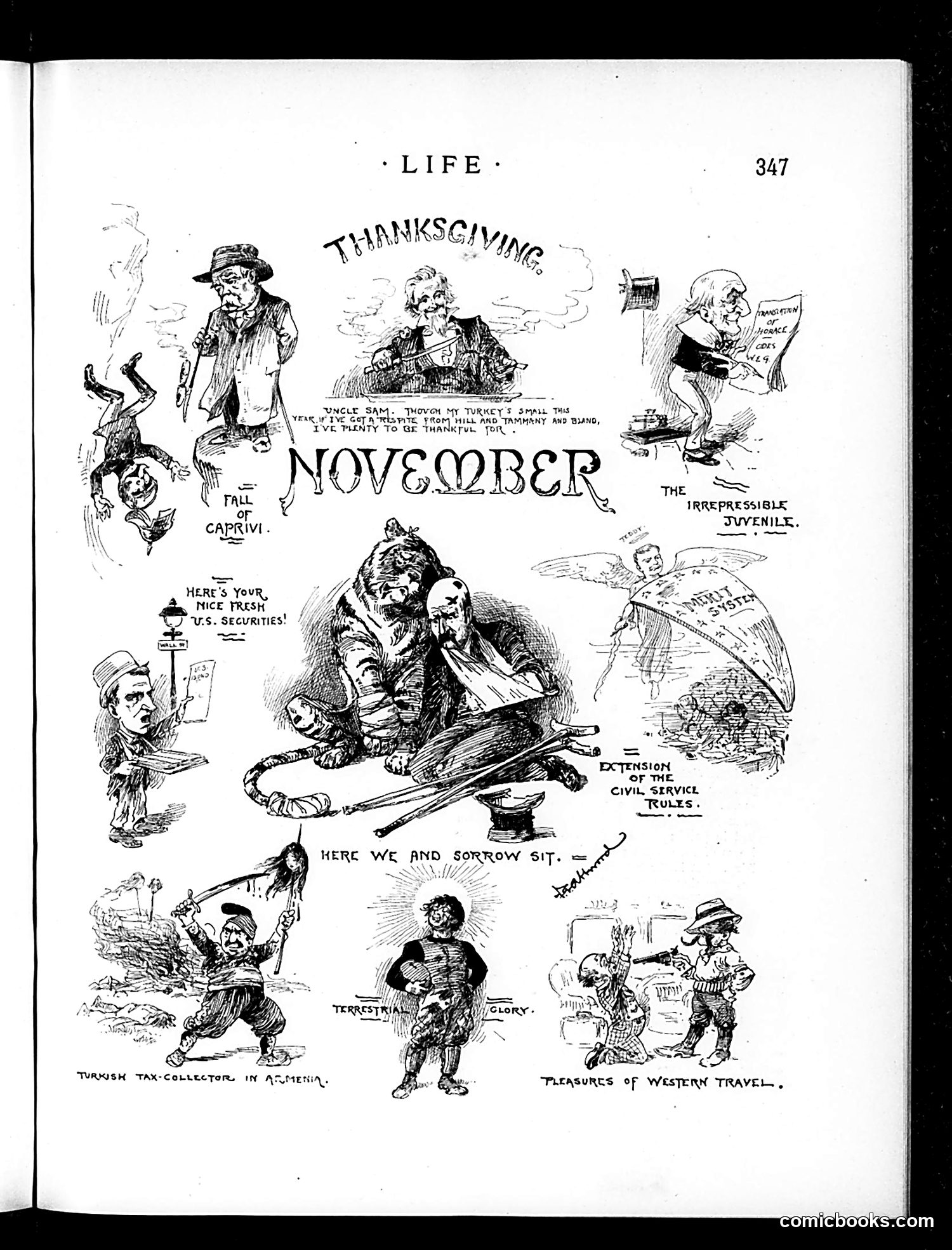
This page from *Life* magazine satirizes various November events and figures. "Thanksgiving" anchors the theme, with "Uncle Sam" depicted pondering his turkey amid national troubles. The central image shows a tiger (likely representing a foreign power or threat) menacing a figure, captioned "Here We and Sorrow Sit." Other vignettes mock: - "The Irrepressible Juvenile" (upper right) - "Extension of Civil Service Rules" (depicted with an angel) - "Turkish Tax Collector in Armenia" (showing violence/brutality) - "Terrestrial Glory" (skeleton figure) - "Pleasures of Western Travel" The cartoons suggest contemporary anxieties about foreign threats, governmental expansion, taxation issues, and social instability during this November period, though the specific year isn't visible here.
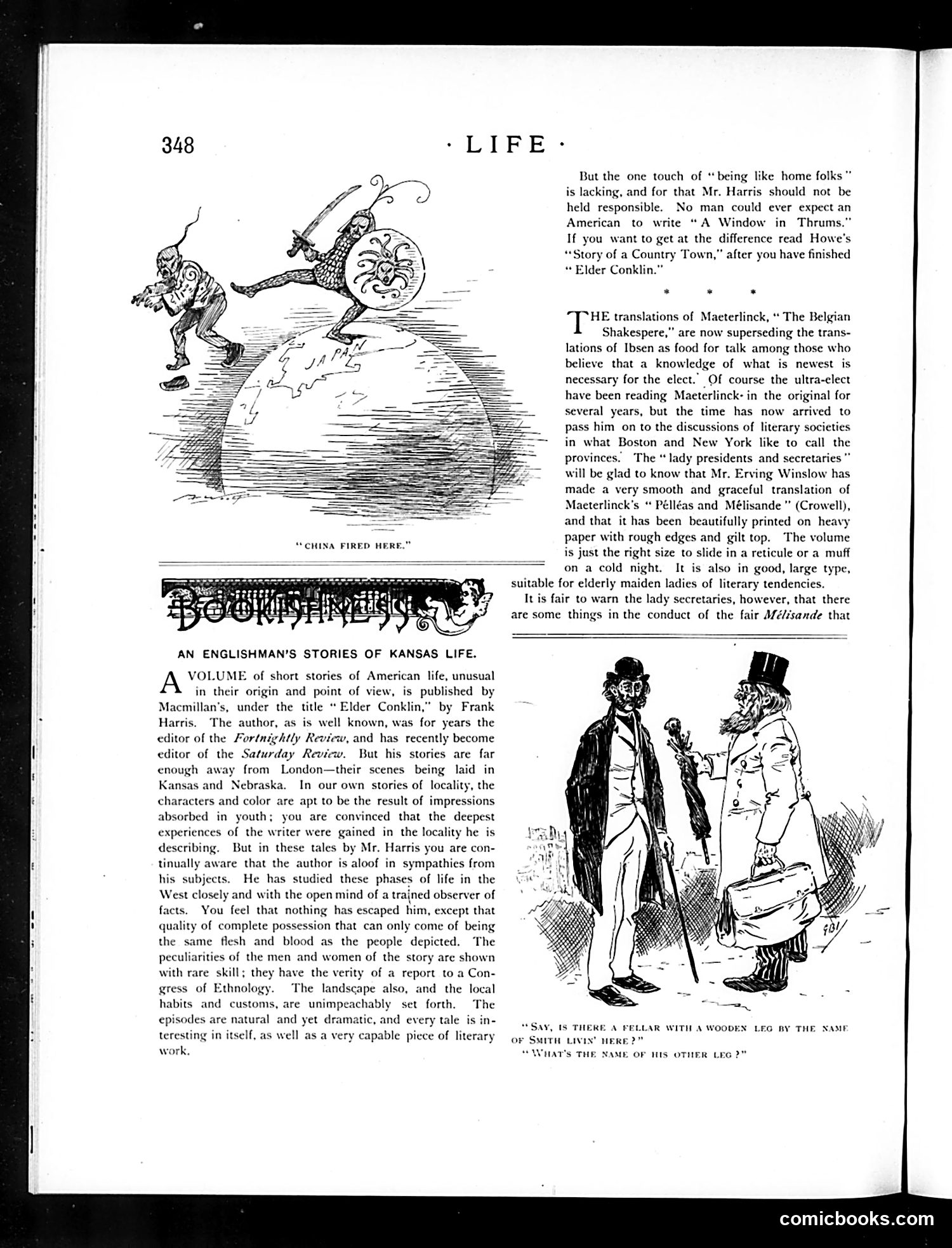
The top illustration labeled "CHINA FIRED HERE" depicts a figure being launched from a cannon in a chaotic manner. This appears to be satirical commentary on Chinese immigration or labor issues, common subjects of late 19th-century American satire. The grotesque caricature suggests prejudiced attitudes of the era. The lower illustration shows two well-dressed gentlemen in conversation. The caption reads: "SAY, IS THERE A PILLAR WITH A WOODEN LEG BY THE NAME OF SMITH LIVIN' HERE?" / "WHAT'S THE NAME OF HIS OTHER LEG?" This wordplay joke plays on the absurdity of asking directions using nonsensical descriptions—a typical humor format of the period, relying on puns and confusion rather than social commentary.
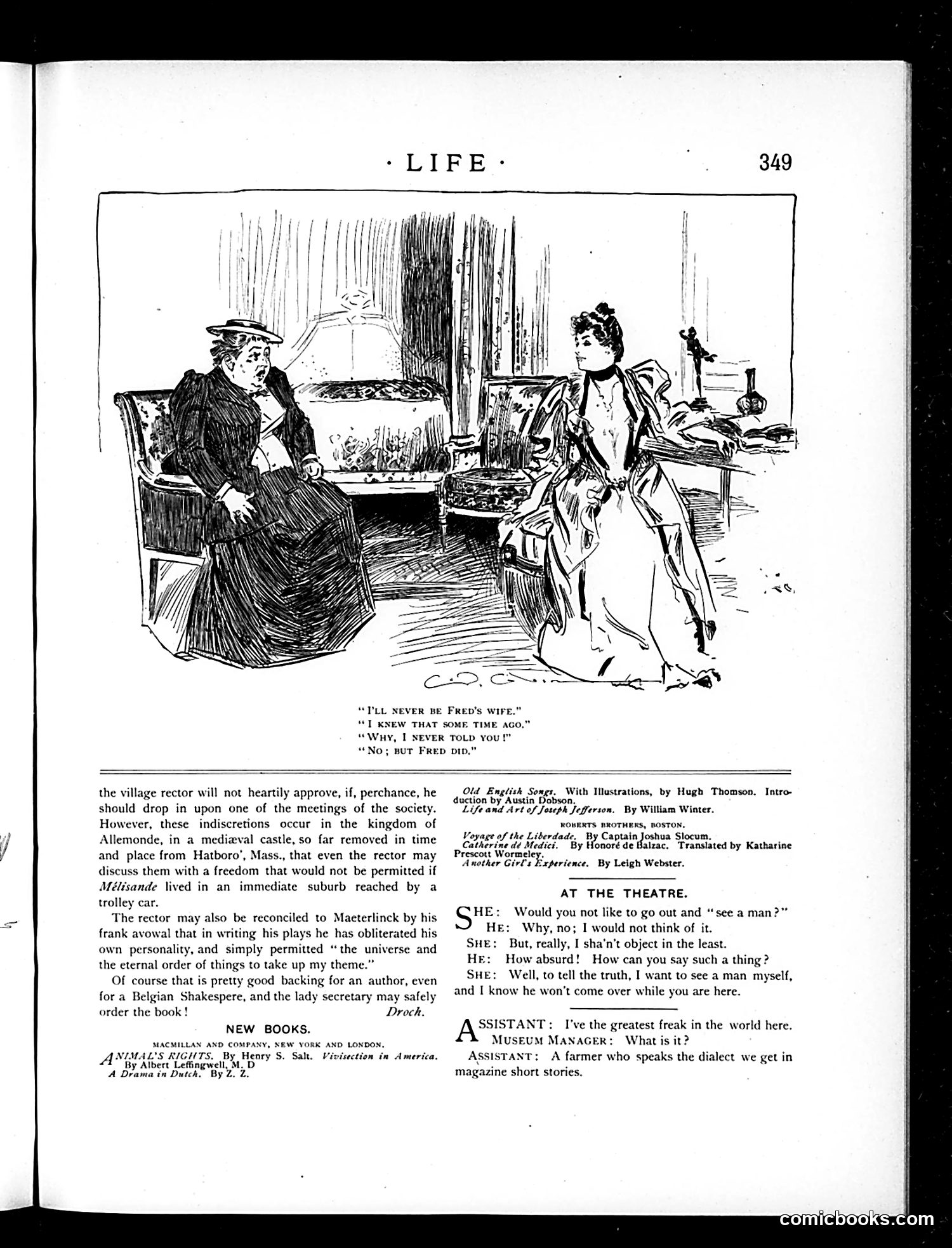
This satirical cartoon depicts a domestic dispute between a man and woman in an interior setting. The dialogue reveals the woman refusing marriage to someone named Fred, claiming she was never told of his intentions. The man responds that Fred himself must have communicated this. The humor targets Victorian-era courtship conventions, where formal marriage proposals followed specific social protocols. The woman's indignation suggests Fred violated these unwritten rules by proposing or declaring intentions without proper notification through intermediaries or direct conversation with her family. The cartoon satirizes the rigid, often absurd formality of upper-class courtship rituals and the miscommunications that could result from their complexity.
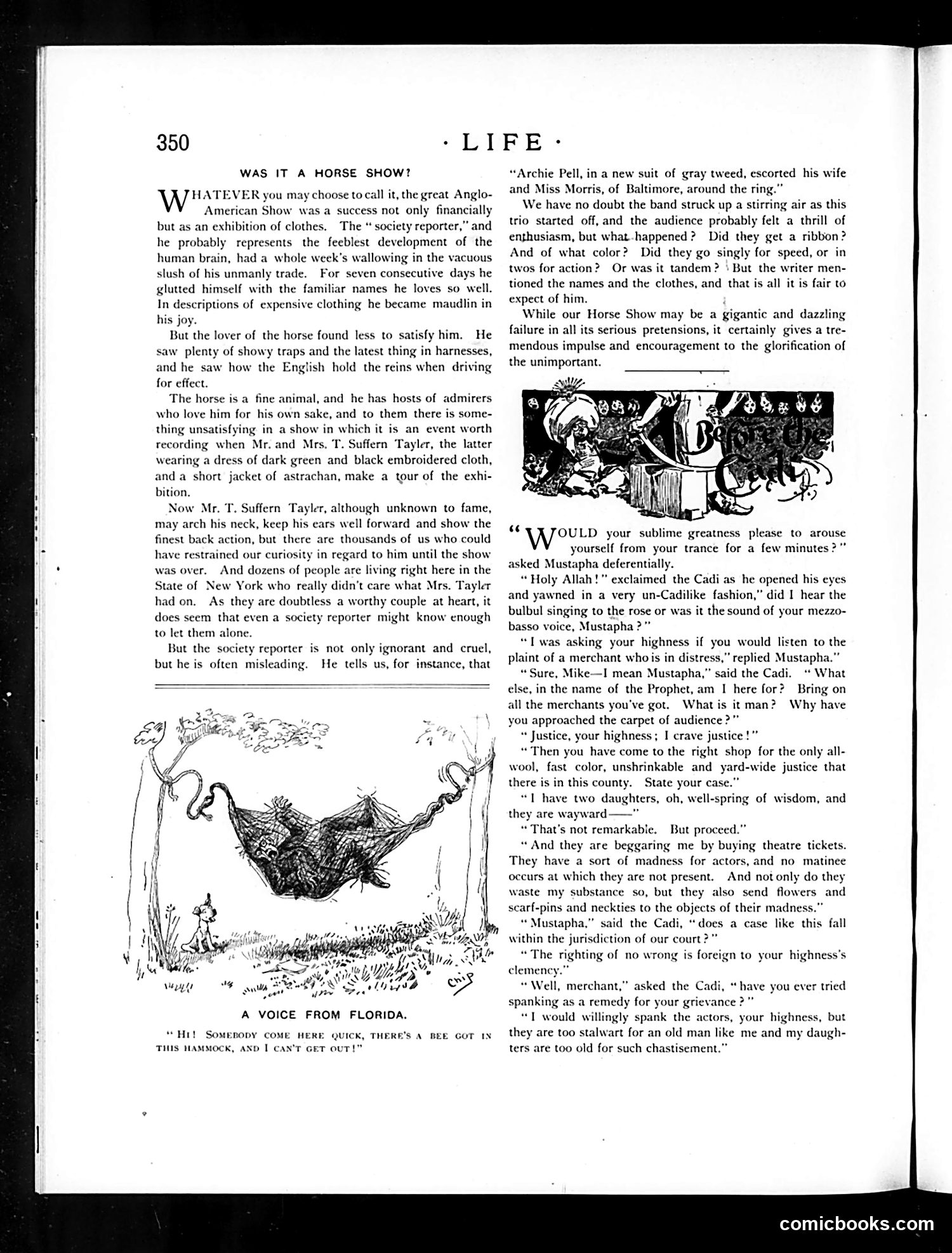
This page satirizes the Anglo-American Horse Show as a shallow social spectacle focused on clothing rather than horsemanship. The main article mocks society reporters who obsess over attendees' expensive outfits while ignoring actual equestrian skill. The cartoon "A Voice from Florida" depicts a man stuck in a hammock with a bee, crying for help—a humorous illustration unrelated to the horse show content, likely a separate comic piece. The second section presents a dialogue between a Cadi (Islamic judge) and "Mustapha" about justice, where the merchant seeks legal remedy for his daughters' theater-ticket-buying madness. The satire targets both theatrical excess and the absurdity of appealing to traditional authority for modern social problems. The tone is lighthearted mockery of contemporary behavior.
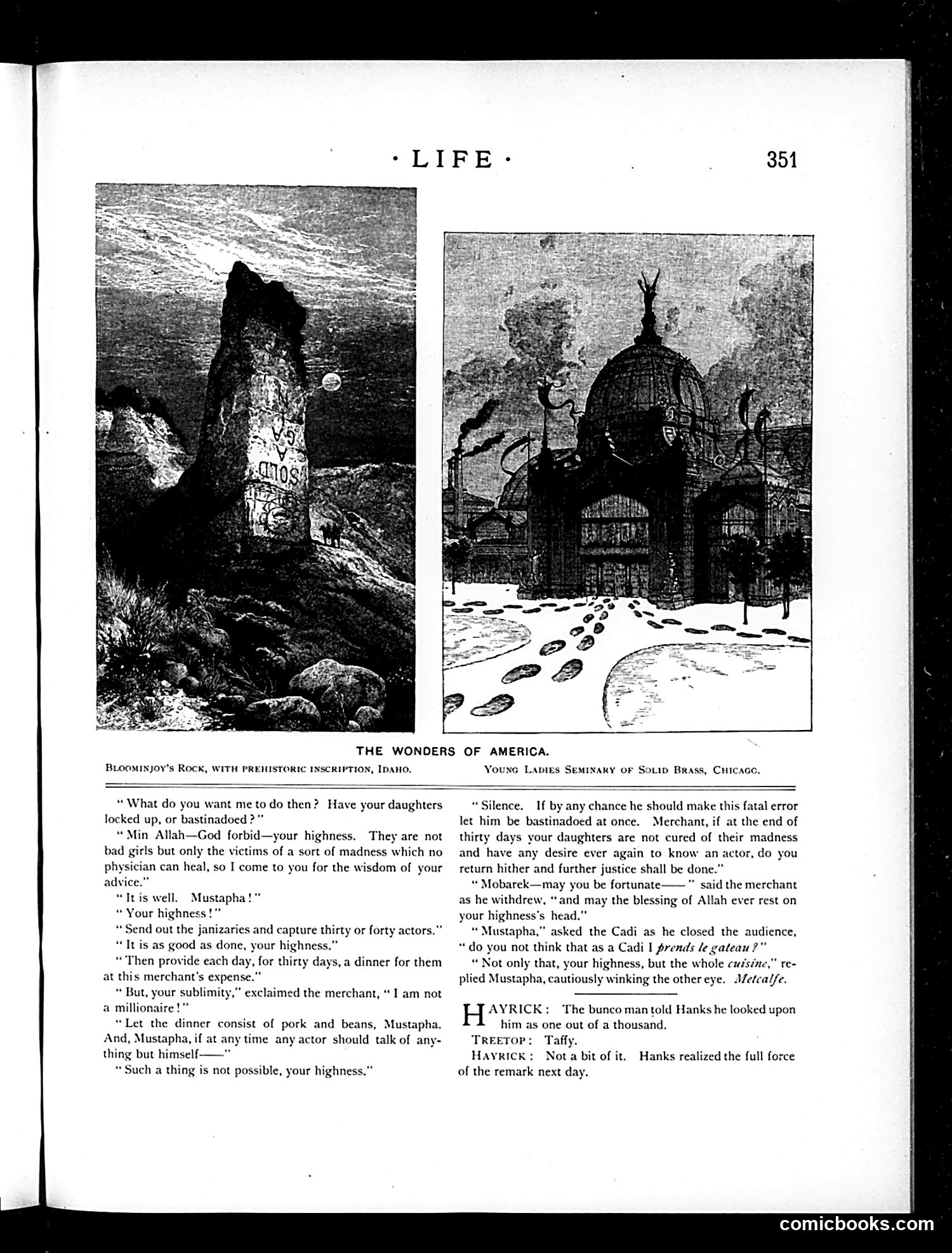
This page from *Life* magazine presents two illustrated panels labeled "The Wonders of America": **Left panel:** Shows Bloominjoy's Rock in Idaho with a prehistoric inscription—likely a genuine natural landmark the magazine treats as noteworthy Americana. **Right panel:** Depicts the Young Ladies Seminary of Solid Brass in Chicago—a satirical architectural fantasia with an ornate domed building and decorative pathway. The accompanying dialogue is a comedic sketch about a merchant negotiating with someone (possibly a Cadi, suggesting Middle Eastern context) regarding disciplining daughters. The humor centers on absurd proposals: locking up girls, bastinading, hiring actors to entertain them at expense. The satire appears to mock both exaggerated parental discipline and the pretentious nature of women's educational institutions. The "solid brass" seminary likely ridicules affected, overly-ornamental architecture and institutions.
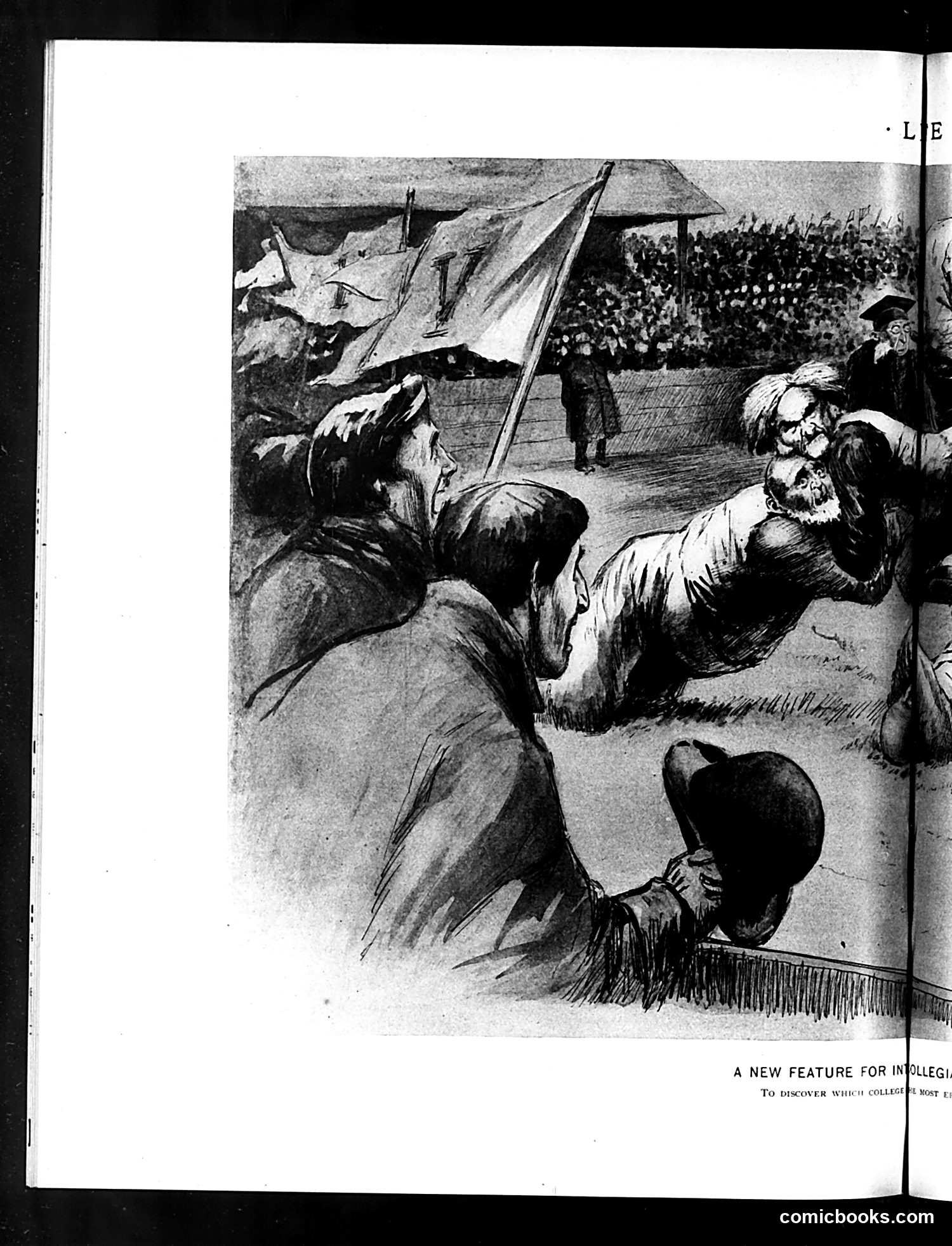
This appears to be a satirical illustration from *Life* magazine depicting a circus or carnival scene. The image shows figures in period clothing (possibly late 19th or early 20th century) at what looks like a circus tent, with crowds visible in the background. The caption reads "A NEW FEATURE FOR IN[COLLEGE]" and references discovering "WHICH COLLEGE[S]...MOST E[...]" — the text is partially cut off, making the specific satirical target unclear. The sketch style and composition suggest commentary on college-related activities or trends, possibly mocking the addition of circus performances or entertainment at educational institutions. However, without the complete caption text visible, the exact nature of the satire cannot be definitively determined from the image alone.
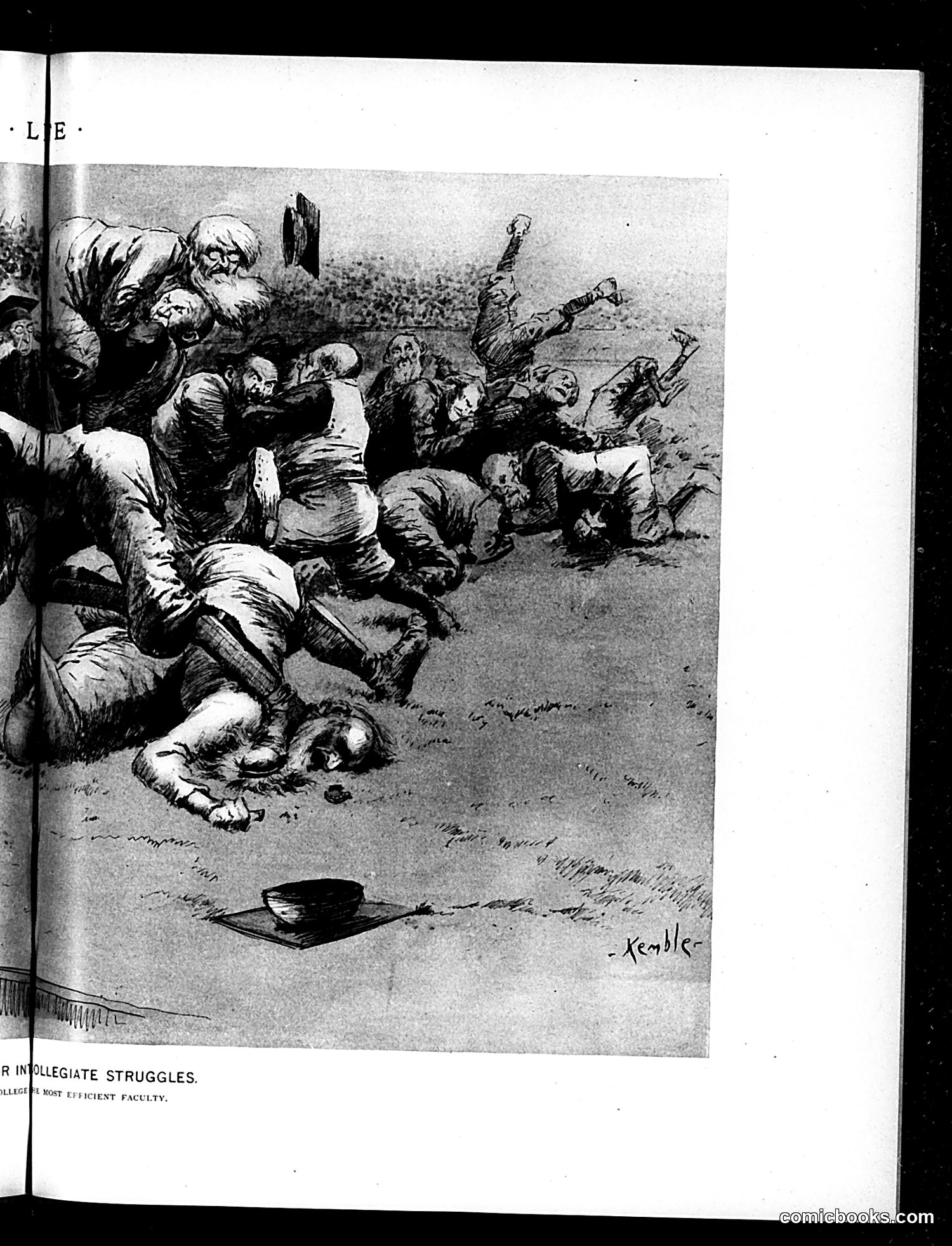
This Kemble-signed cartoon satirizes collegiate life, specifically academic struggles. The image depicts students engaged in what appears to be a chaotic, physical "struggle"—likely representing the difficulty of academic work or competition among students. The caption references "collegiate struggles" and mentions "college's most efficient faculty," suggesting satire about either: - The demanding nature of college curricula - Student competition and hazing rituals - The gap between institutional claims of educational excellence and actual student experience The exaggerated, violent physicality of the figures—some wielding implements, others sprawled on the ground—presents academic pursuits as almost comically brutal. This reflects early 20th-century satirical commentary on the intensely competitive nature of American college education and institutional practices.
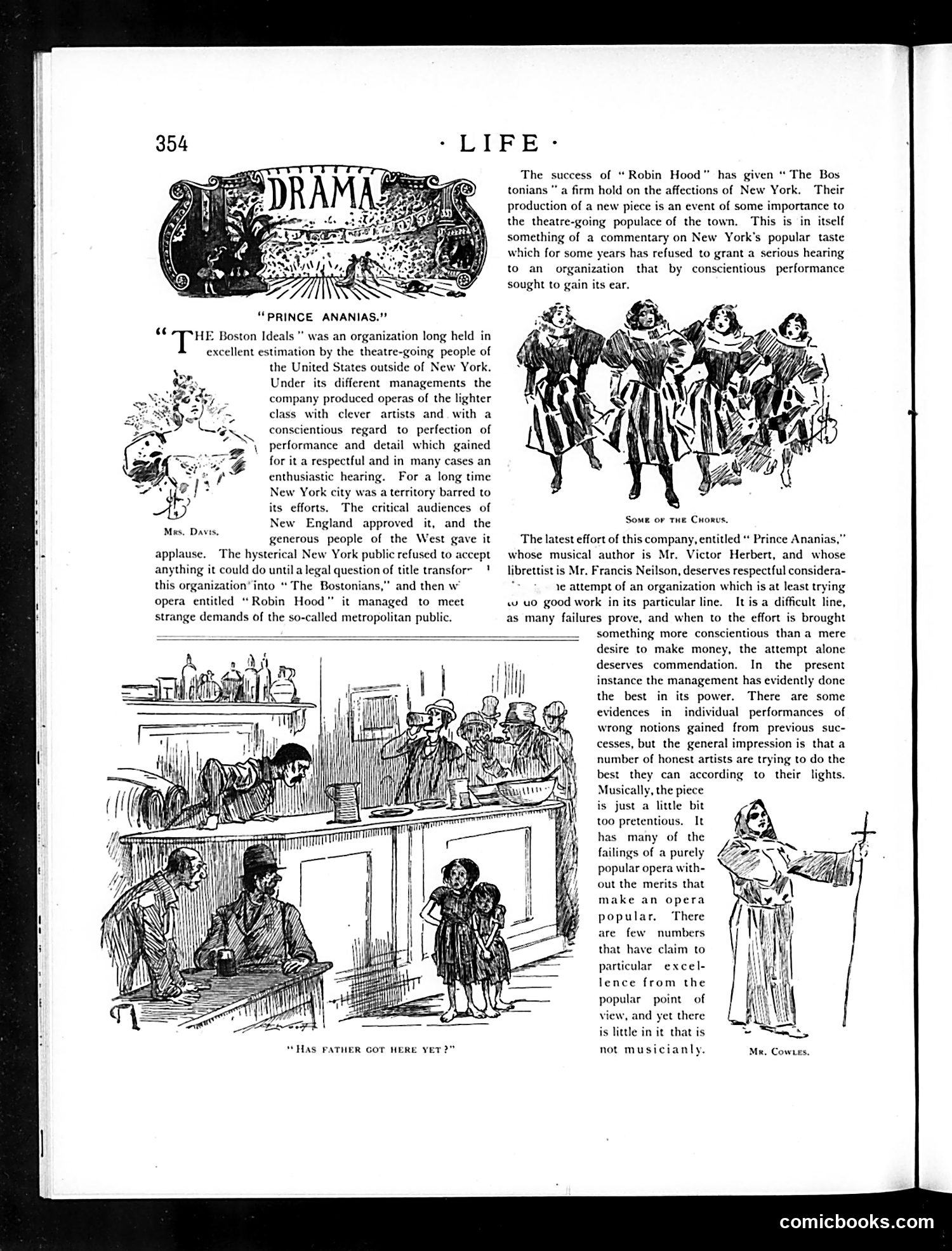
This page reviews a theatrical production by The Boston Ideals opera company. The text explains that this respected regional theater group was long excluded from New York City's critical audiences, who rejected their work until the company legally became "The Bostonians" and achieved success with "Robin Hood." The new production "Prince Ananias" (with music by Victor Herbert and libretto by Francis Neilson) receives qualified praise. Life acknowledges the company's earnest effort and artistic integrity, but critiques the work itself as "too pretentious"—it attempts serious opera while lacking the popular appeal that makes opera successful. The review suggests talented performers are doing their best, but the musical composition itself fails to excel. The accompanying sketches show chorus members and a scene labeled "Has Father Got Here Yet?"—likely illustrating the plot. The satire targets not the performers but the gap between artistic ambition and actual execution in popular theater.
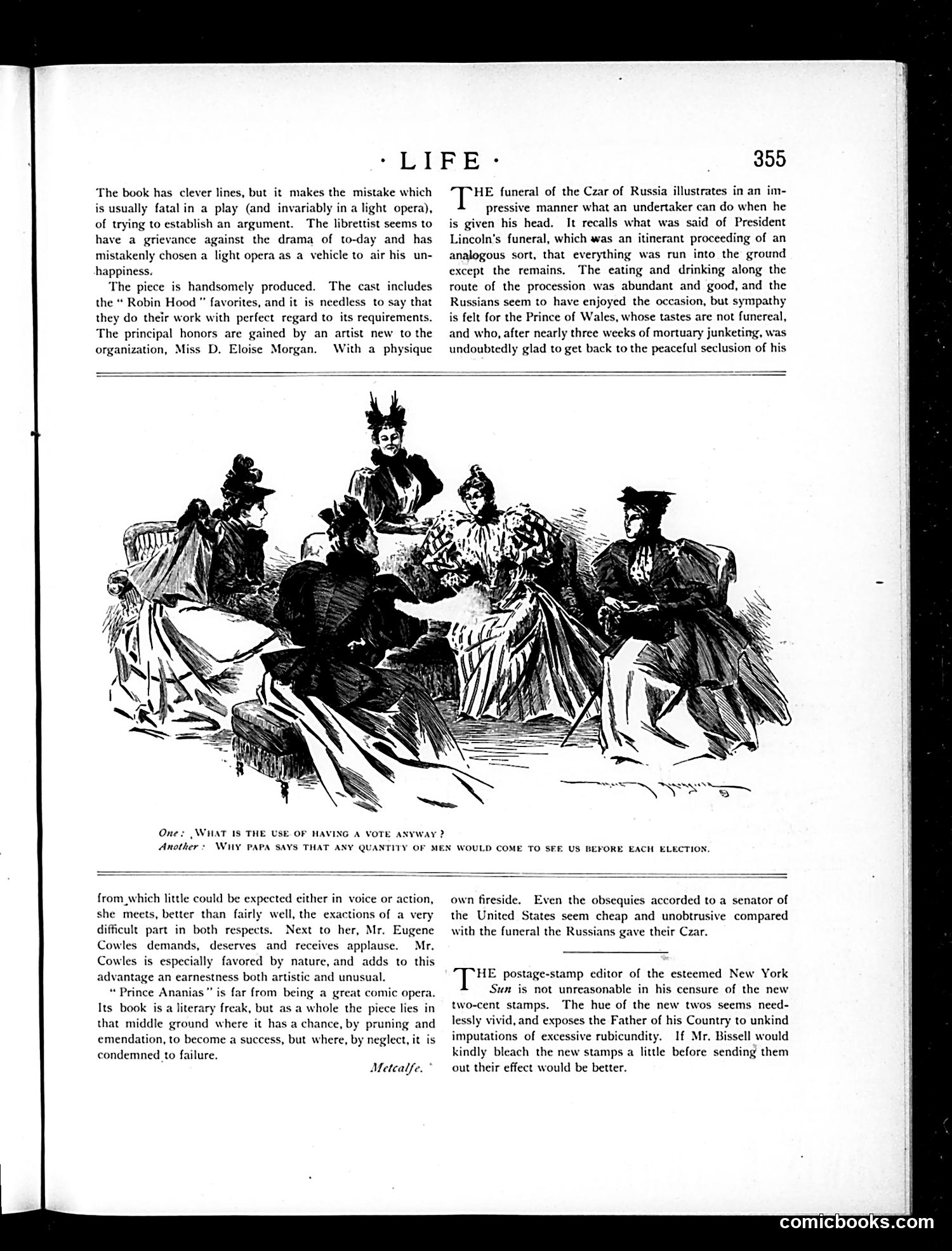
This page contains two separate satirical pieces: **The Czar's Funeral Commentary:** The main article mocks the elaborate Russian state funeral of the Czar, comparing it unfavorably to President Lincoln's funeral. The satire suggests that Russian officials have turned the funeral into an excessive spectacle—with abundant eating and drinking along the procession route—while expressing sympathy for the Prince of Wales, who had to endure nearly three weeks of "mortuary junketing" before escaping to peace. **The Cartoon:** The sketch depicts women in conversation, with captions addressing voting rights. "One" asks about the usefulness of voting, while "Another" cynically notes that "Papa says that any quantity of men would come to see us before each election"—satirizing how politicians court women voters before elections, then ignore them afterward. This likely references early-20th-century women's suffrage debates, mocking politicians' opportunistic attention to female voters. The page combines political commentary on international affairs with domestic critique of electoral hypocrisy.
This page contains several humorous anecdotes satirizing American social hierarchies and pretension: **"Jack-leg Carpenter"**: A Black witness in court deflates a lawyer's pomposity by comparing him to a second-rate carpenter—implying the lawyer is as inferior as the "jack-leg" tradesman, just in a different field. **"The Editor's Insurance Policy"**: A man threatens violence against a newspaper editor but becomes docile when shown the editor's life insurance policy—satirizing how financial documents inspire more fear than actual confrontation. **"The Welsh Tailor vs. Rector"**: A poor tailor sued for unpaid church tithes countersues the rector for tailoring services, using the rector's own logic (you can come whenever you want) against him—mocking institutional hypocrisy. **"The Silk Hat in Church"**: A young man's hat is crushed when a woman sits on it in his pew—a slapstick moment satirizing vanity and romantic distraction during worship. These are typical *Life* magazine humor: class commentary, mockery of authority figures, and social embarrassment.
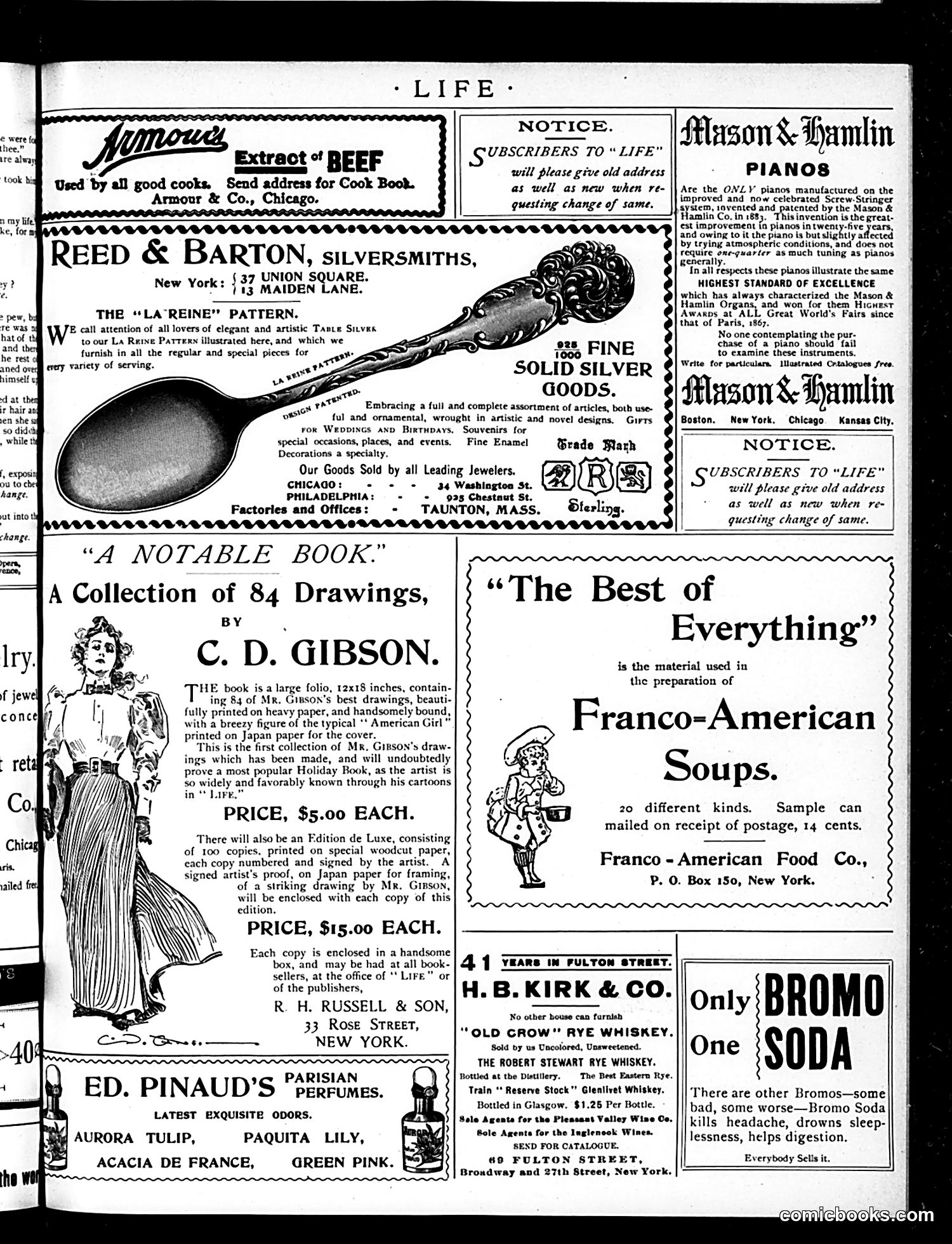
This page is predominantly **advertisements**, not political or satirical content. It's a typical page from *Life* magazine featuring commercial promotions for various products: beef extract, silverware, pianos, perfumes, soups, whiskey, and soda. The only notable visual content is **C.D. Gibson's book advertisement**—featuring his famous illustration style of an idealized young woman ("the Gibson Girl"). This was wildly popular at the time and represents Gibson's influence on American visual culture through his cartoons in *Life* itself. The text repeatedly includes notices reminding subscribers to provide both old and new addresses when requesting address changes—a practical administrative detail reflecting the magazine's circulation management. **No political satire or caricature is present on this page.** It's a commercial document typical of early 1900s magazine publishing.
This page contains several brief humorous anecdotes typical of *Life* magazine's satirical style: 1. **"Moses in the Bulrushes"** — A countryman asks an artist to paint his dead father without a photograph, reasoning the artist painted Moses without one either. The joke mocks folk logic and the absurdity of treating artistic imagination as equivalent to portraiture. 2. **"Jennie's Reading"** — A child misreading double letters as "double up" and "double Lucy" instead of "up, up, Lucy." This jokes about childhood literacy struggles. 3. **"Pat's Pills"** — An Irishman complains medicine isn't working because the box lid hasn't come off. The humor relies on ethnic stereotyping common to the era. 4. **"The Barber"** — A barber claims he only nipped "a small piece" of a customer's ear during a haircut, assuring it won't affect hearing. Dark humor about incompetence. 5. **"Texas Rifle Practice"** — A military lieutenant demonstrates shooting incompetence while claiming to teach proper technique, finally hitting the target by accident. Satirizes military inefficiency. The remaining content is advertising.