
Life, 1894-11-29 · page 6 of 16
Life — November 29, 1894 — page 6: what you’re looking at
What you’re looking at
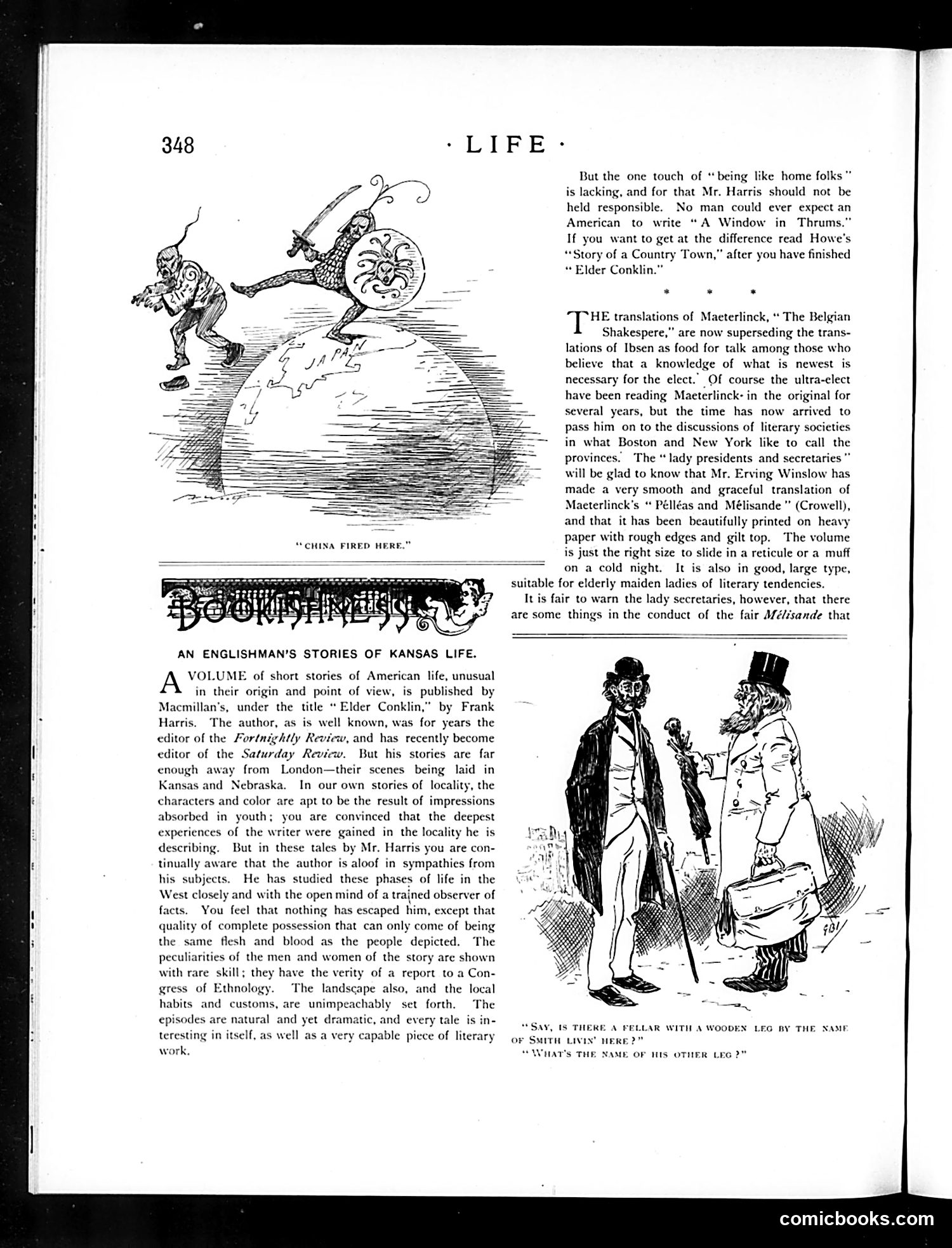
The top illustration labeled "CHINA FIRED HERE" depicts a figure being launched from a cannon in a chaotic manner. This appears to be satirical commentary on Chinese immigration or labor issues, common subjects of late 19th-century American satire. The grotesque caricature suggests prejudiced attitudes of the era. The lower illustration shows two well-dressed gentlemen in conversation. The caption reads: "SAY, IS THERE A PILLAR WITH A WOODEN LEG BY THE NAME OF SMITH LIVIN' HERE?" / "WHAT'S THE NAME OF HIS OTHER LEG?" This wordplay joke plays on the absurdity of asking directions using nonsensical descriptions—a typical humor format of the period, relying on puns and confusion rather than social commentary.
📄 Transcribed text from this page (OCR, searchable)
Machine-transcribed from the original scan — historical spelling and the odd misread are preserved.
But the one touch of “being like home folks” is lacking, and for that Mr. Harris should not be held responsible. No man could ever expect an American to write “A Window in Thrums.” If you want to get at the difference read Howe's “Story of a Country Town,” after you have finished * Elder Conklin.” * * * HE translations of Maeterlinck, * The Belgian Shakespere,” are now superseding the trans- lations of Ibsen as food for talk among those who believe that a knowledge of what is newest is necessary for the elect. Of course the ultra-clect have been reading Maeterlinck- in the original for several years, but the time has now arrived to pass him on to the discussions of literary societies in what Boston and New York like to call the provinces. The “lady presidents and secretaries” will be glad to know that Mr. Erving Winslow has made a very smooth and graceful translation of Maeterlinck’s “ Pélléas and Mélisande " (Crowell), and that it has been beautifully printed on heavy paper with rough edges and gilt top. The volume is just the right size to slide in a reticule or a muff on a cold night. It is also in good, large type, suitable for elderly maiden ladies of literary tendencies. It is fair to warn the lady secretaries, however, that there are some things in the conduct of the fair Mfé/‘sande that AN ENGLISHMAN’S STORIES OF KANSAS LIFE. VOLUME of short stories of American life, unusual in their origin and point of view, is published by Macmillan’s, under the title “ Elder Conklin,” by Frank Harris. The author, as is well known, was for years the editor of the Fortnightly Review, and has recently become editor of the Saturday Review. But his stories are far enough away from London—their scenes being laid in Kansas and Nebraska. In our own stories of locality, the characters and color are apt to be the result of impressions rbed in youth; you are convinced that the deepest ces of the writer were gained in the locality he is describing. But in these tales by Mr. Harris you are con- tinually aware that the author is aloof in sympathies from his subjects. He has studied these phases of life in the West closely and with the open mind of a trained observer of facts. You feel that nothing has escaped him, except that quality of complete possession that can only come of being the same flesh and blood as the people depicted. The peculiarities of the men and women of the story are shown with rare skill; they have the verity of a report to a Con- gress of Ethnology. The landscape also, and the local habits and customs, are unimpeachably set forth. The episodes are natural and yet drama and every tale is in- . ) SAY, IS THERE A FELLAR WITH A WOODEN LEG BY THE NAMF OF SMITH LIVIN’ HERE work, WHAT'S THE NAME OF HIS OTHER LEG?” teresting in itself, as well as a very capable piece of literary comicbooks.com