
A complete issue · 16 pages · 1894
Life — November 15, 1894
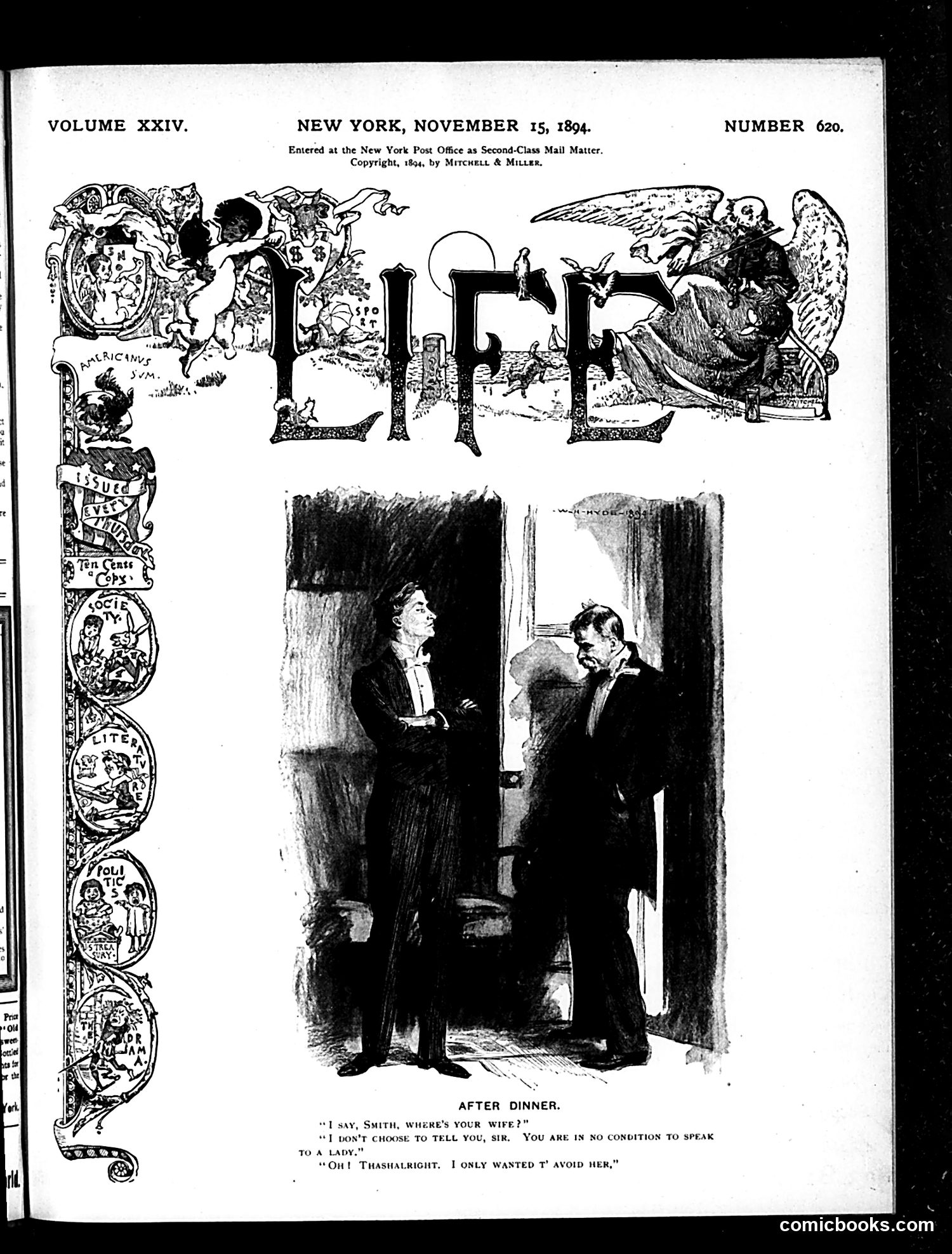
This cartoon depicts a domestic scene between two men in formal evening wear, apparently after dinner. The dialogue reveals a social awkwardness: one man asks "Where's your wife?" The other responds that he's "in no condition to speak to a lady," then clarifies he "only wanted t' avoid her." The humor targets Victorian-era marital dynamics and male behavior. The implication is that the man is intoxicated or otherwise socially compromised after dinner—a common satirical subject of the period. The cartoon mocks both male excess (drinking, poor conduct) and the social pretense required to navigate polite company and spousal relationships among the affluent classes. It's gentle domestic satire typical of Life's social commentary.
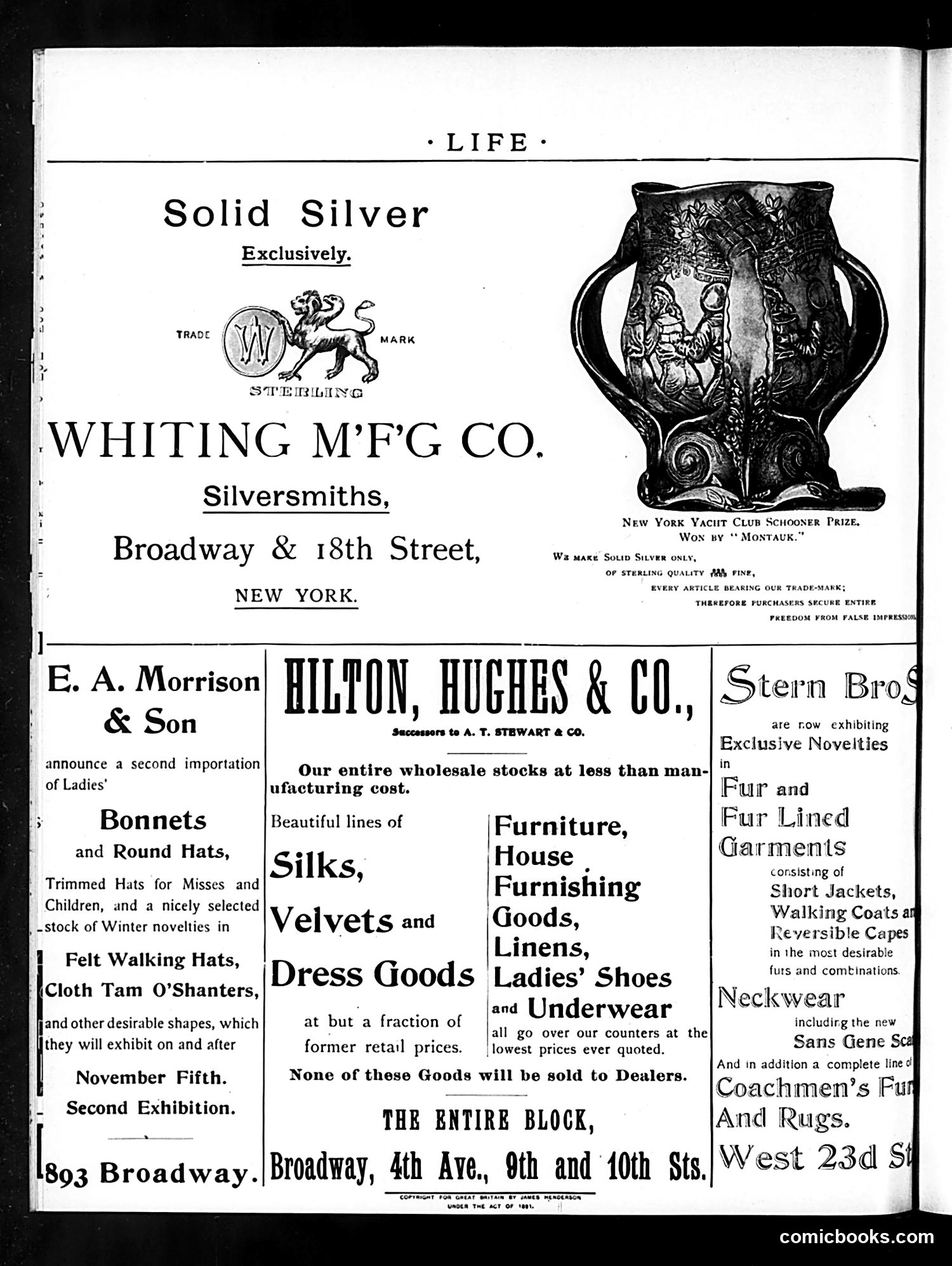
This page is **primarily advertising**, not satirical content. It contains four separate advertisements from late 19th-century New York merchants: 1. **Whiting M'fg Co.** - A silversmith featuring a decorative silver vessel (the "New York Yacht Club Schooner Prize, Won by 'Montauk'") 2. **E.A. Morrison & Son** - Announcing imported bonnets and hats for women and children 3. **Hilton, Hughes & Co.** - Wholesale clothing, silks, velvets, dress goods, furniture, and housewares at below manufacturing cost 4. **Stern Bros.** - Fur garments, coats, and accessories There are no political cartoons or satirical commentary visible. The page represents typical commercial advertising from *Life* magazine's early period, when it mixed advertisements with editorial content.
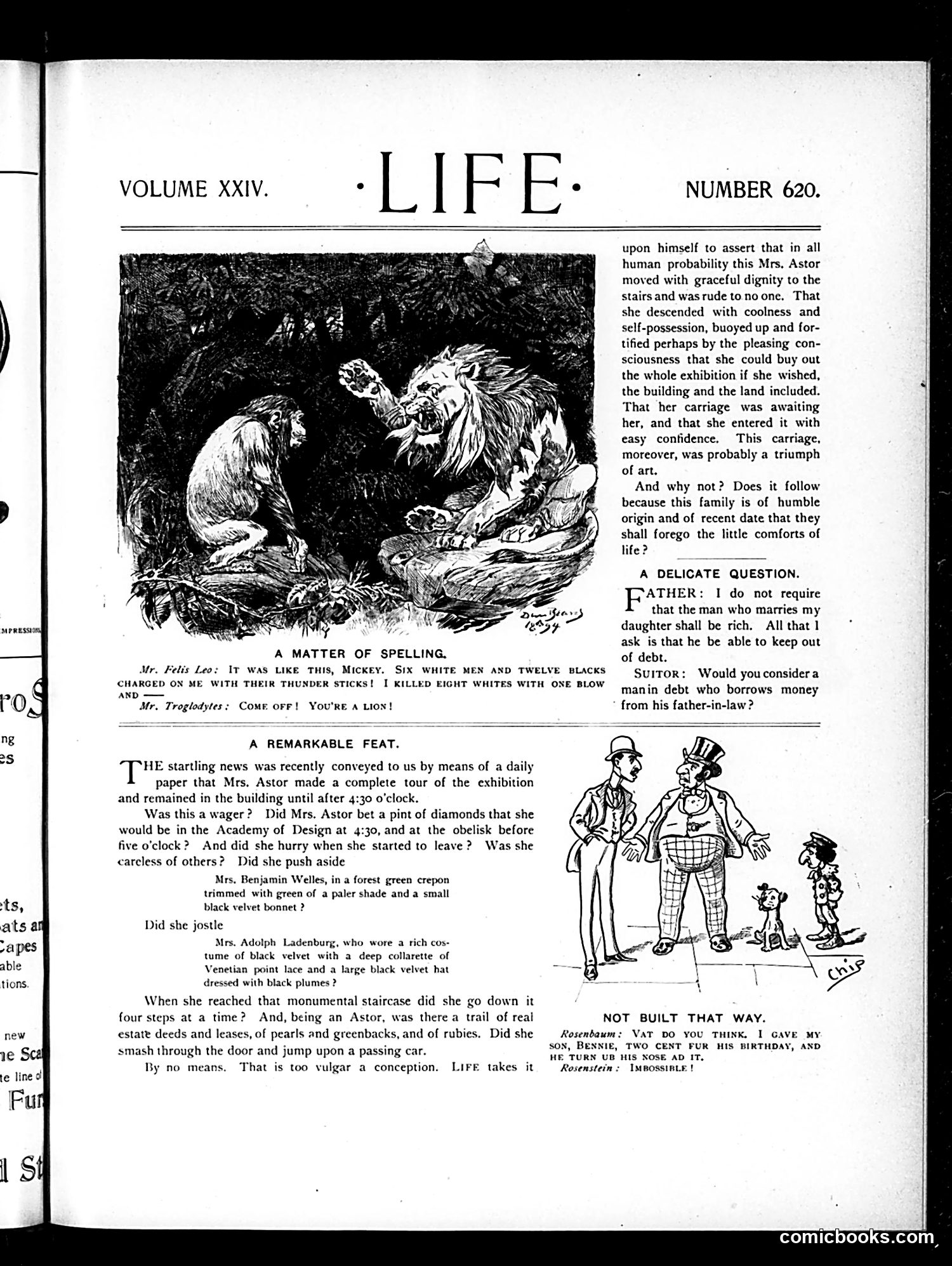
This page contains three distinct satirical pieces about wealthy society figures, likely from the early 1900s: 1. **"A Matter of Spelling"**: A cartoon mocking someone's boast about defeating multiple opponents, playing on the word "lion." 2. **"A Remarkable Feat"**: Text describing Mrs. Astor (a prominent wealthy society matriarch) completing a tour of an exhibition in under two hours. The satire questions whether she noticed specific details—mocking the superficiality of high-society attendance at cultural events. 3. **"Not Built That Way"**: A cartoon about class differences, where a wealthy father refuses to give his son money for a toy, claiming poverty while clearly being affluent—satirizing hypocrisy among the rich. The page ridicules Gilded Age wealthy elites through their pretensions and contradictions.
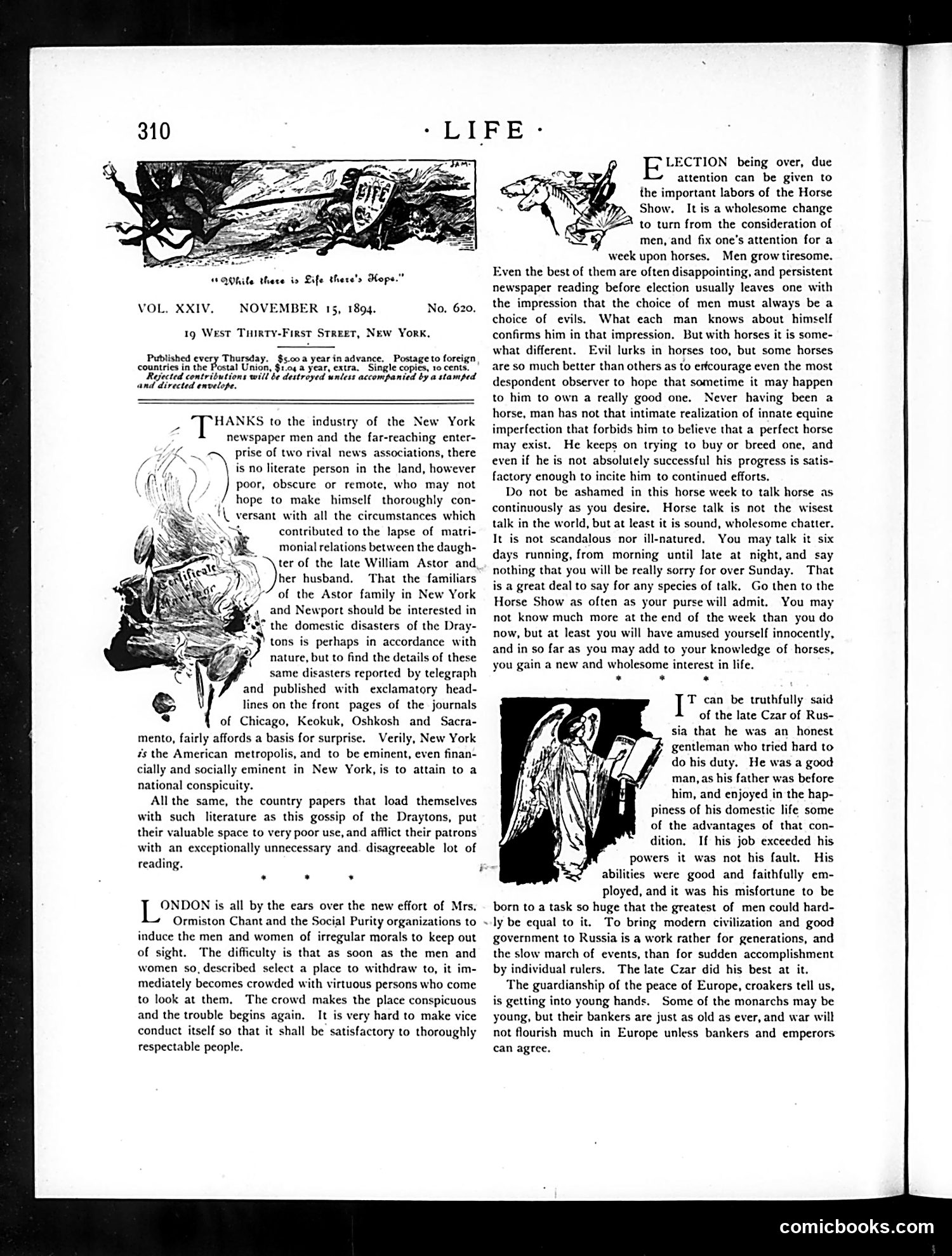
The page contains two main editorial pieces rather than political cartoons. The **first section** discusses the recent William Astor and Drayton family domestic scandal reported in newspapers. The editor criticizes how New York papers sensationalized these wealthy families' personal troubles, contrasting this with country papers that avoid such gossip. The **second section** comments on London's efforts to remove "irregular" poor people from public view before social events. The editor notes this creates temporary cosmetic solutions—crowds still develop vice problems once enforcement relaxes—and suggests respectability requires genuine moral improvement, not just managing appearances. Neither section contains caricatures. Both use satire to critique social hypocrisy among the wealthy and governmental superficiality in addressing poverty.
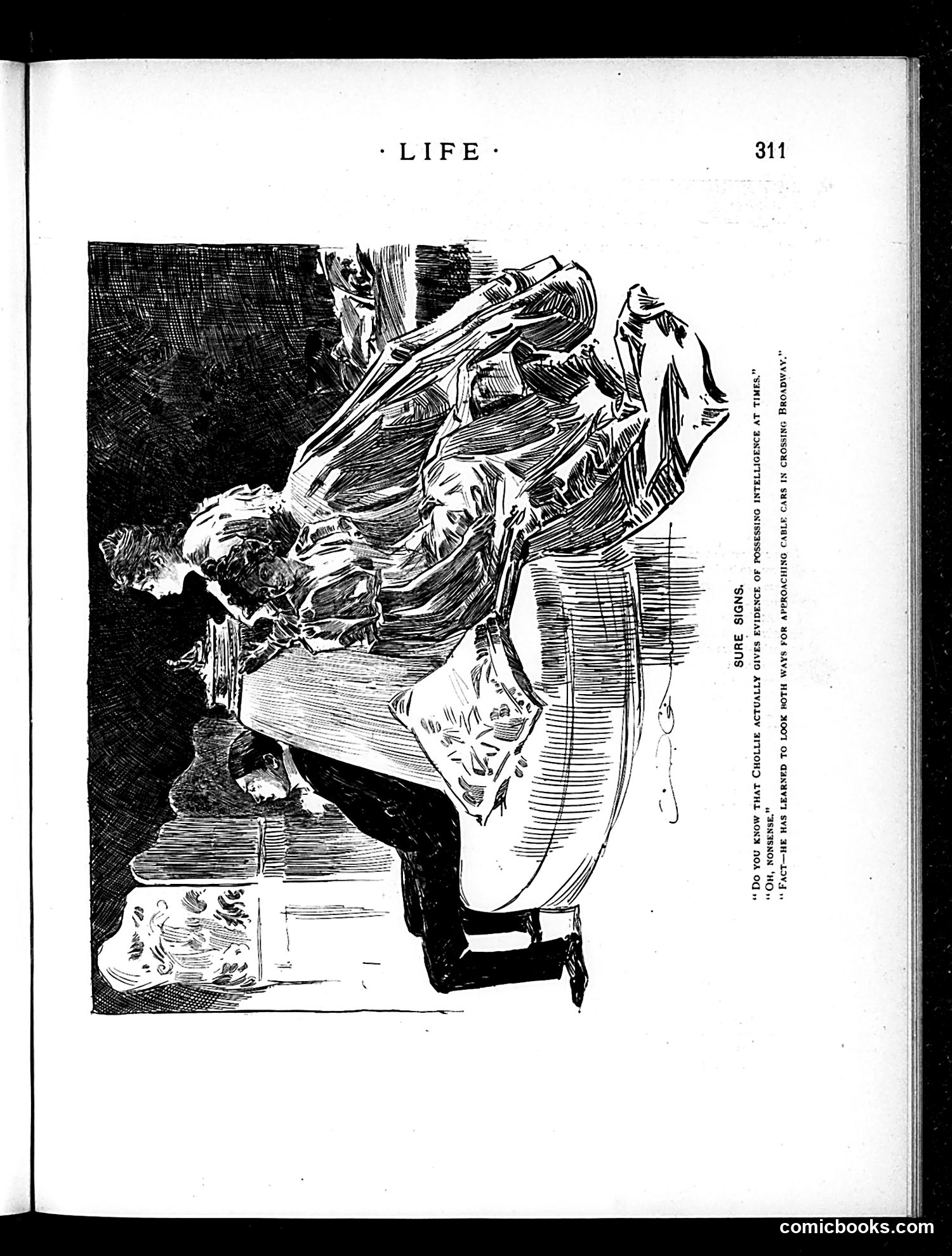
This page from *Life* magazine (page 311) contains a political cartoon satirizing what appears to be a wealthy or privileged figure engaged in artistic pursuits—likely playing a musical instrument (possibly a cello or similar string instrument based on the shape). The figure is drawn in an exaggerated style typical of early 20th-century caricature. The satire seems to target the contrast between artistic pretension and actual skill or substance—a common *Life* magazine theme mocking the affectations of the upper classes or newly wealthy. The caption text is partially visible but difficult to read clearly in this reproduction. Without legible OCR text confirming the specific political or social reference, I cannot definitively identify which public figure or event this lampoons.
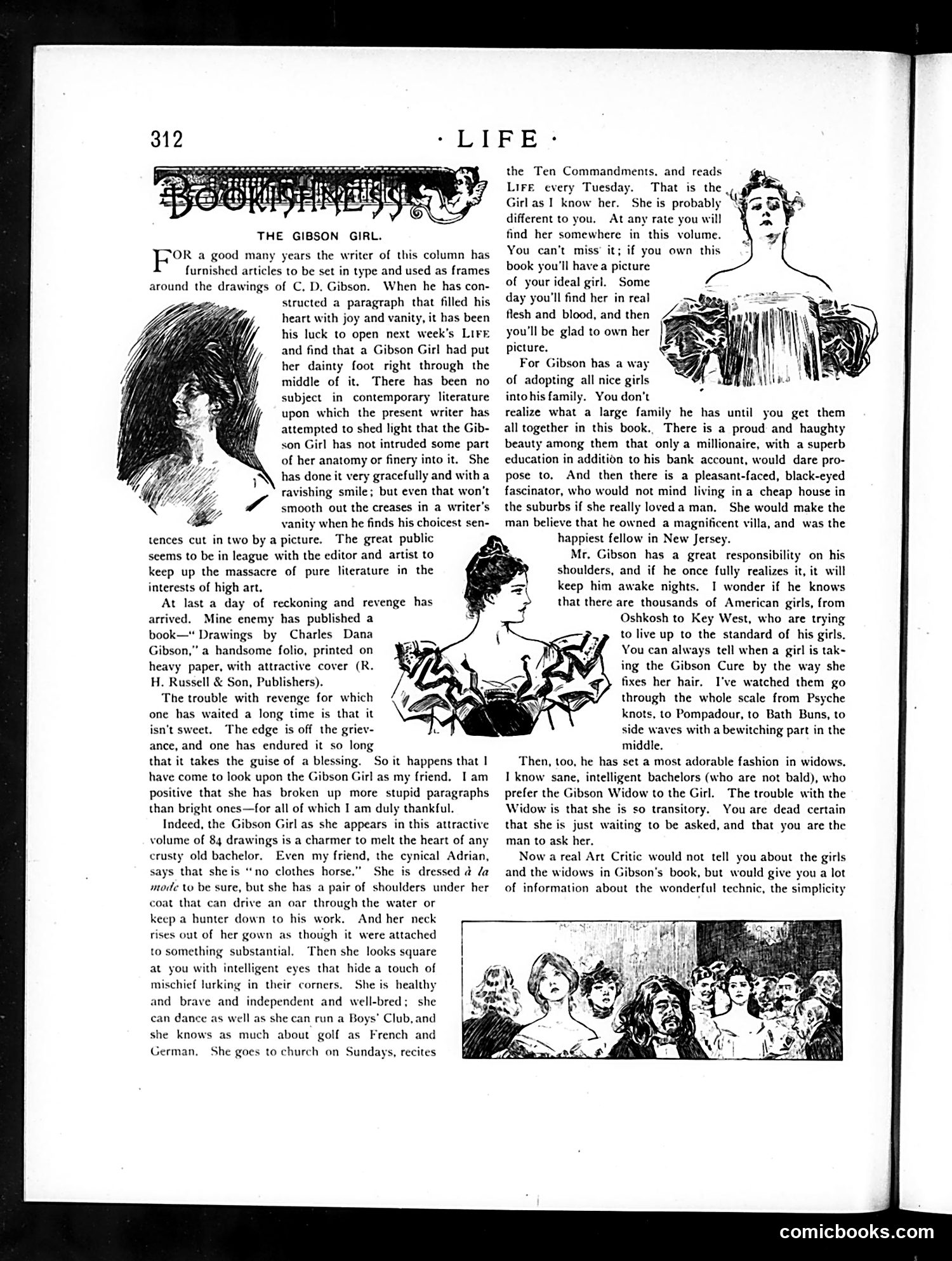
This page celebrates C. D. Gibson's illustrated "ideal woman" — the Gibson Girl — through a column discussing Gibson's new book of 84 drawings. The text describes Gibson's creation as representing an aspirational feminine standard: independent, athletic, fashionable, and socially accomplished. The illustrations show Gibson's distinctive drawing style: elegant women with particular hairstyles (the "Gibson Curl"), clothing, and bearing that defined early 1900s beauty ideals for American women. The column notes Gibson's influence across American culture, from "Oshkosh to Key West." The satire is gentle: the writer acknowledges Gibson's commercial success while slightly mocking how thoroughly this illustrated standard has shaped women's behavior and self-image — they're compared to following a strict "cure" or standard. It's commentary on media's power to create and enforce beauty ideals.
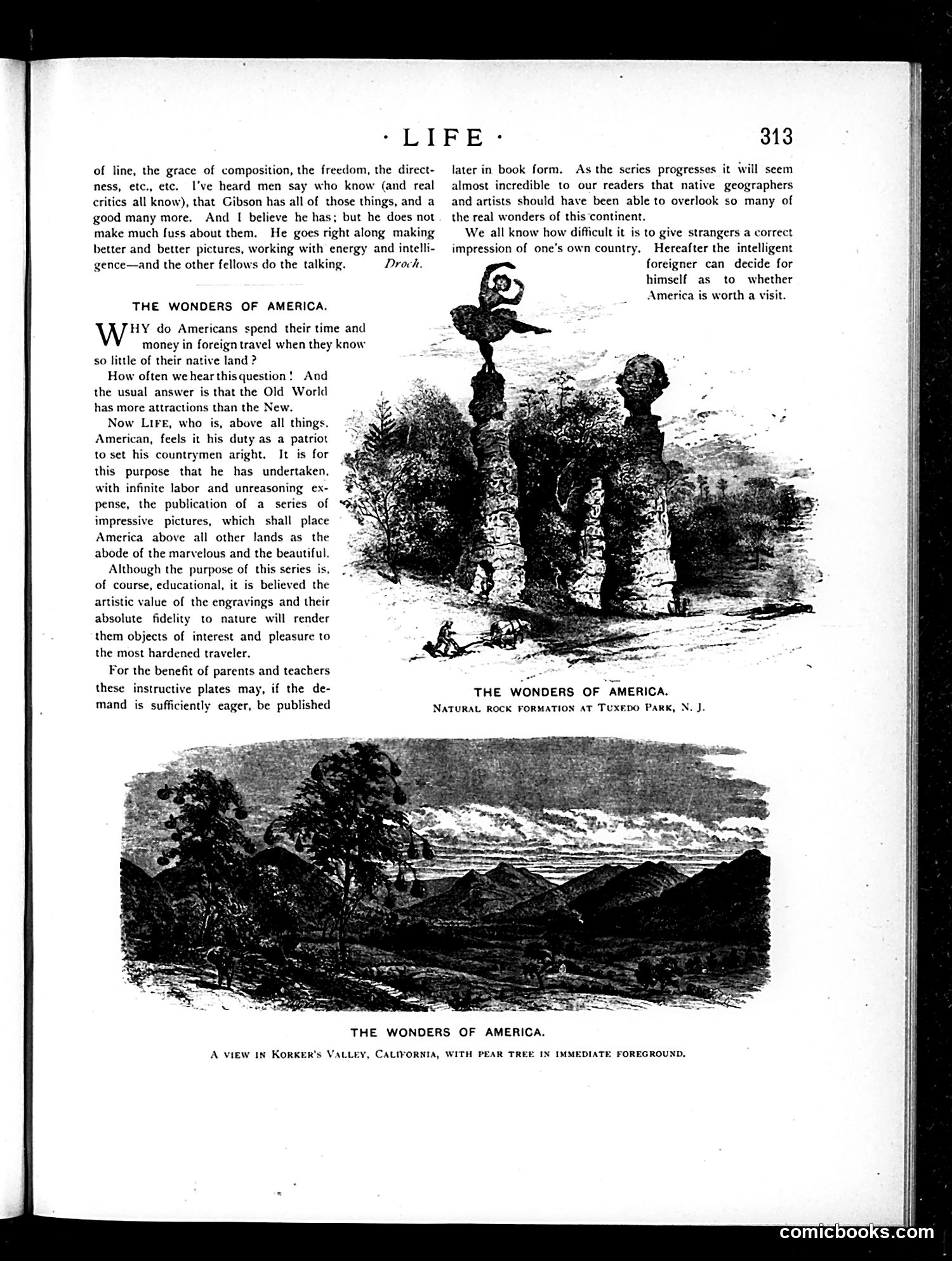
This page promotes a series of engravings depicting American natural landmarks. The text argues that Americans should explore their own country rather than traveling abroad to Europe. The author (signing as "Drab") contends that America's natural wonders—represented here by Tuxedo Park, New Jersey rock formations and Korker's Valley, California with its pear trees—rival European attractions and deserve appreciation. The satire targets American snobbery: wealthy travelers routinely dismissed domestic scenery as inferior to Old World attractions. Life advocates for patriotic appreciation of American landscape, positioning these engravings as educational tools for "parents and teachers," making national beauty accessible while countering European cultural superiority claims popular among the American elite.
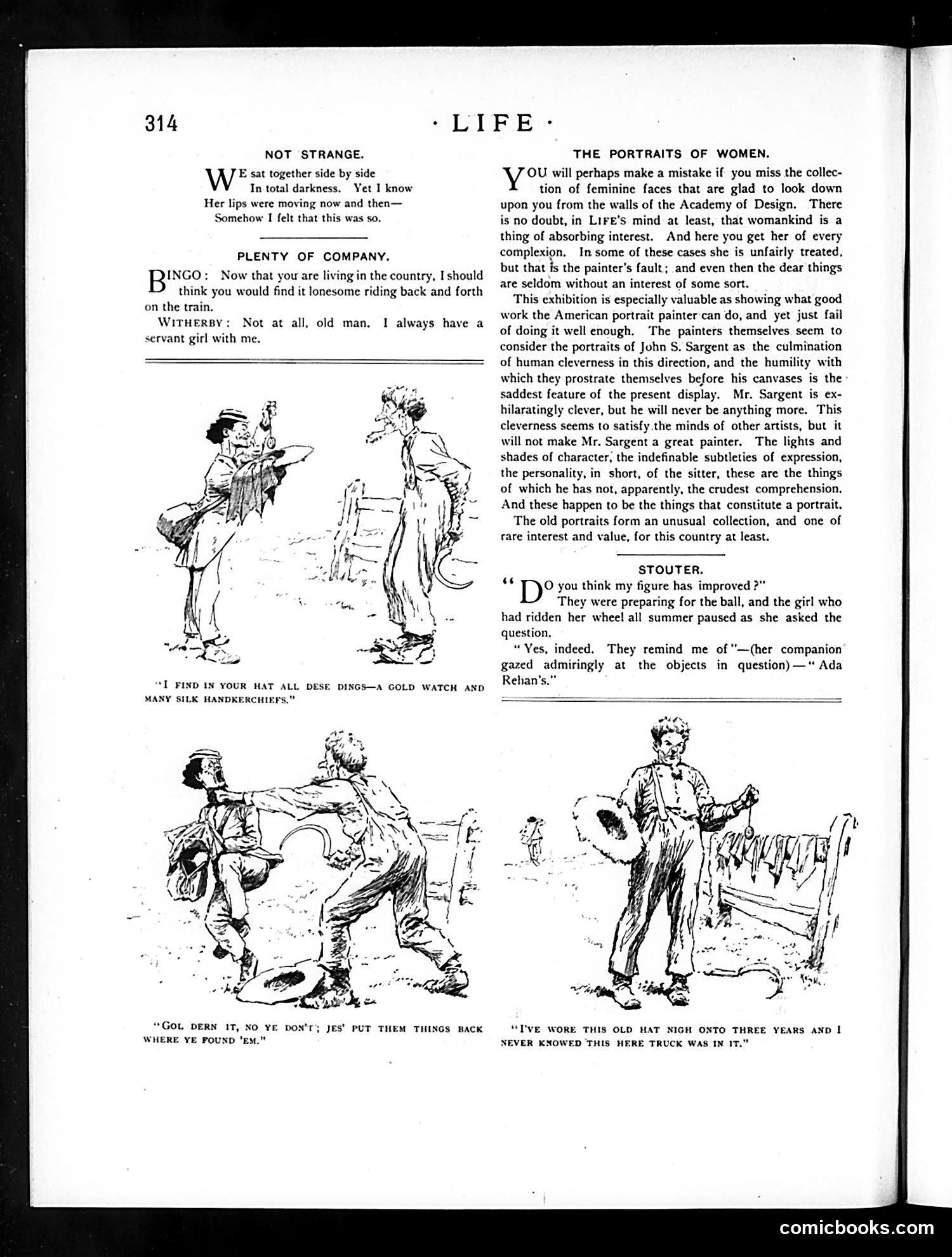
This page contains humorous sketches about everyday life rather than political commentary. The left column features two brief dialogues: "Not Strange" depicts a couple in darkness, and "Plenty of Company" shows a man and woman discussing train travel and a servant girl. The right column discusses an exhibition of women's portraits at the Academy of Design, critiquing American portrait painters. It specifically praises John Singer Sargent's superior skill while noting other painters' inability to capture personality and character—the essential elements of portraiture beyond mere technical cleverness. The sketches illustrate rural or working-class scenes with dialogue about found objects and worn clothing, reflecting period humor about ordinary people's lives and domestic situations rather than specific political targets.
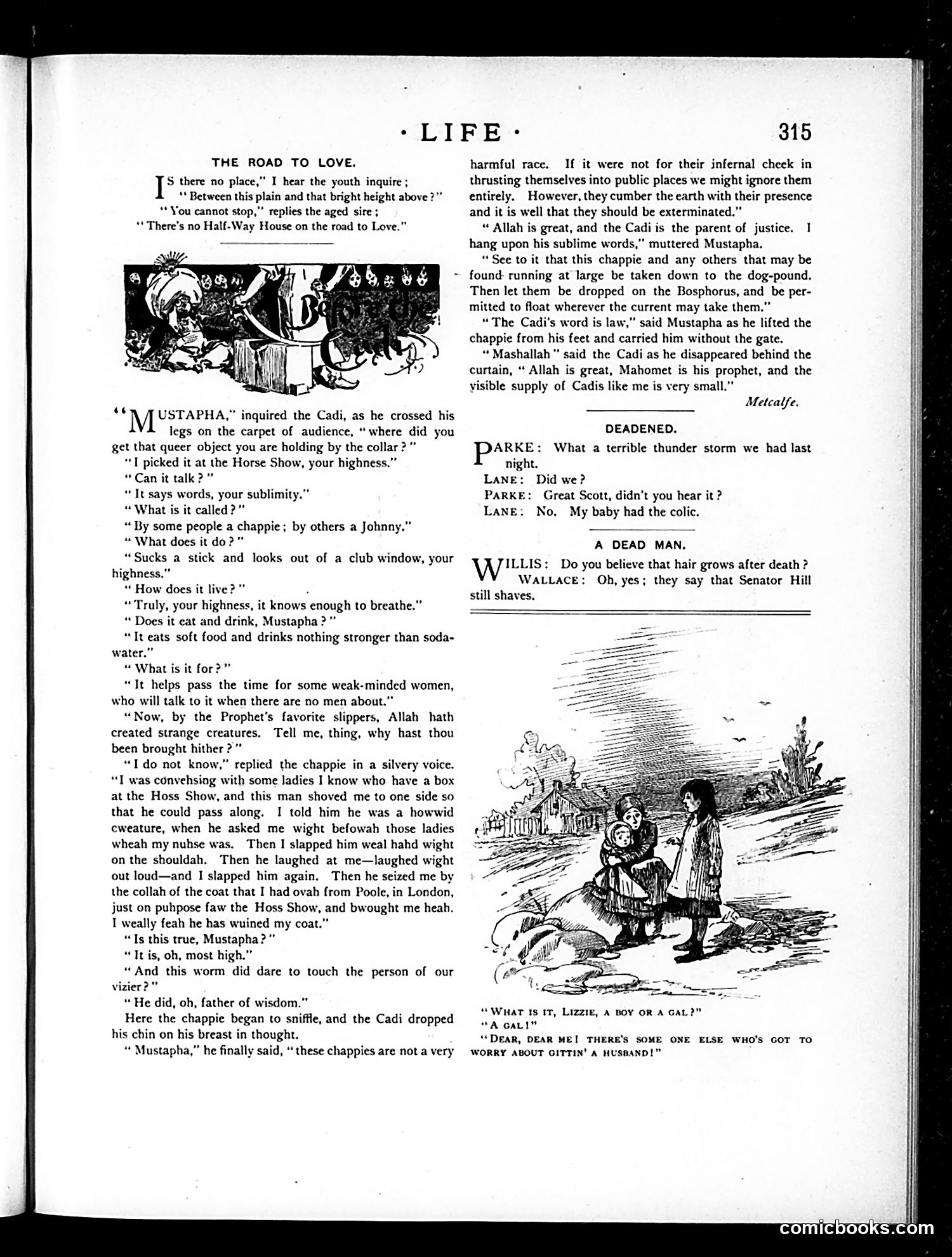
This page contains three separate satirical pieces: **"The Road to Love"** features a dialogue between a Cadi (Islamic judge) and a "chappie" (British slang for a fellow) who brings a strange animal to a public gathering. The satire mocks both the Cadi's pompous religious pronouncements and the chappie's absurd explanations for the creature—apparently acquired at a "Hoss Show" in London. The humor plays on cultural misunderstanding and the chappie's questionable animal husbandry. **"Deadened"** is a brief joke about a thunderstorm and colic. **"A Dead Man"** presents a ribald exchange about whether hair grows after death, with a crude punchline about a senator's shaving habits. The page exemplifies *Life*'s early 20th-century blend of social observation and bawdy humor.
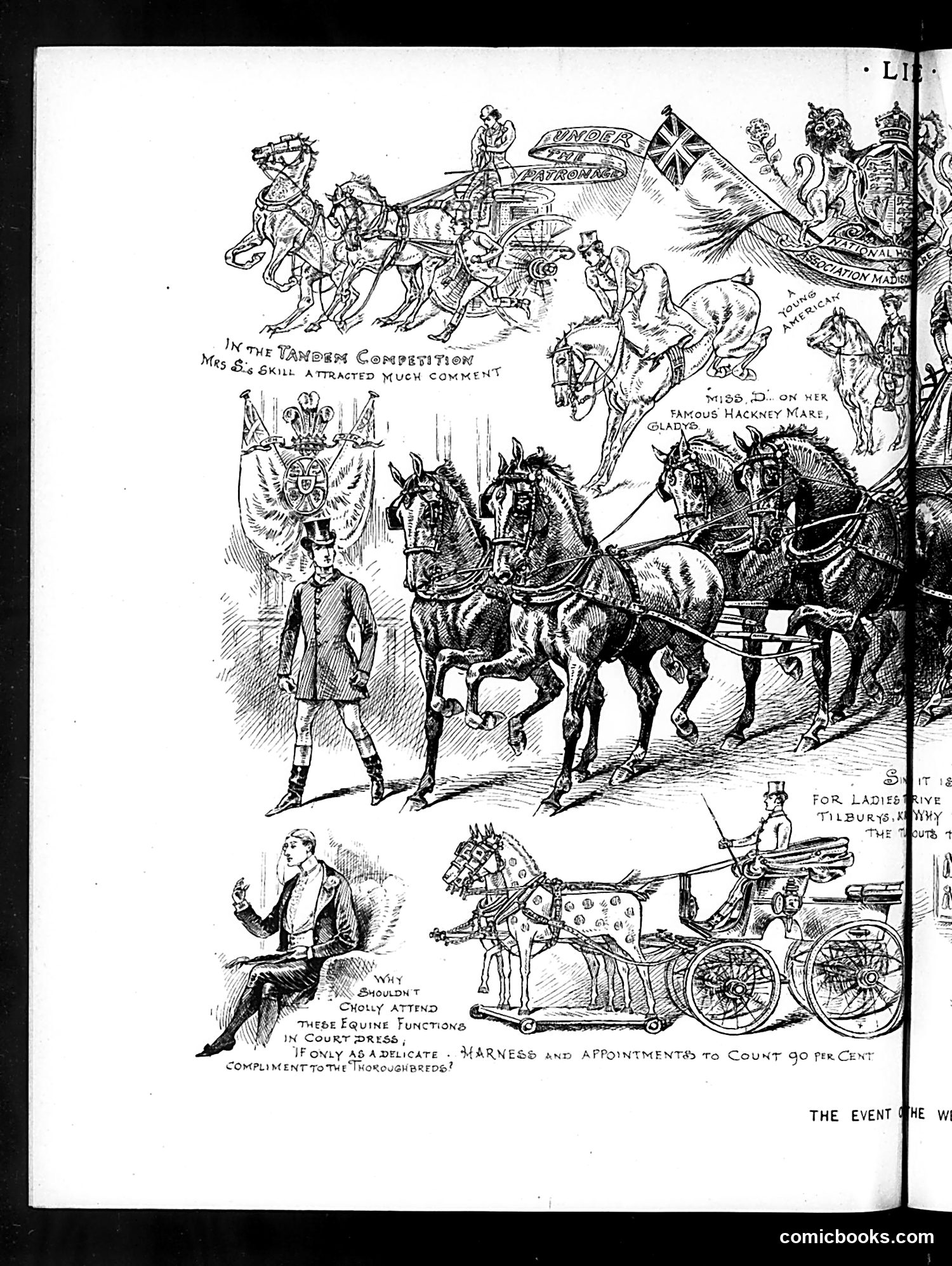
This page contains multiple horse-related satirical vignettes, likely from the Edwardian era based on the style and dress. The top panel mocks "Mrs. B. Skill" for attracting attention at the Tanden Competition, suggesting she drew notice through questionable riding skill rather than merit. The middle section shows Miss D. on her "famous Hackney Mare, Gladys," apparently at a prestigious equestrian event, with commentary questioning why someone should attend such elite functions merely as "a delicate, harness and appointments" rather than demonstrating genuine horsemanship. The bottom vignette sarcastically asks why a gentleman ("Cicely") attends formal equestrian events if only decorum and expensive appointments matter—mocking the social performance aspect of upper-class horse shows over actual riding ability. The satire targets pretentious society participation without genuine skill.
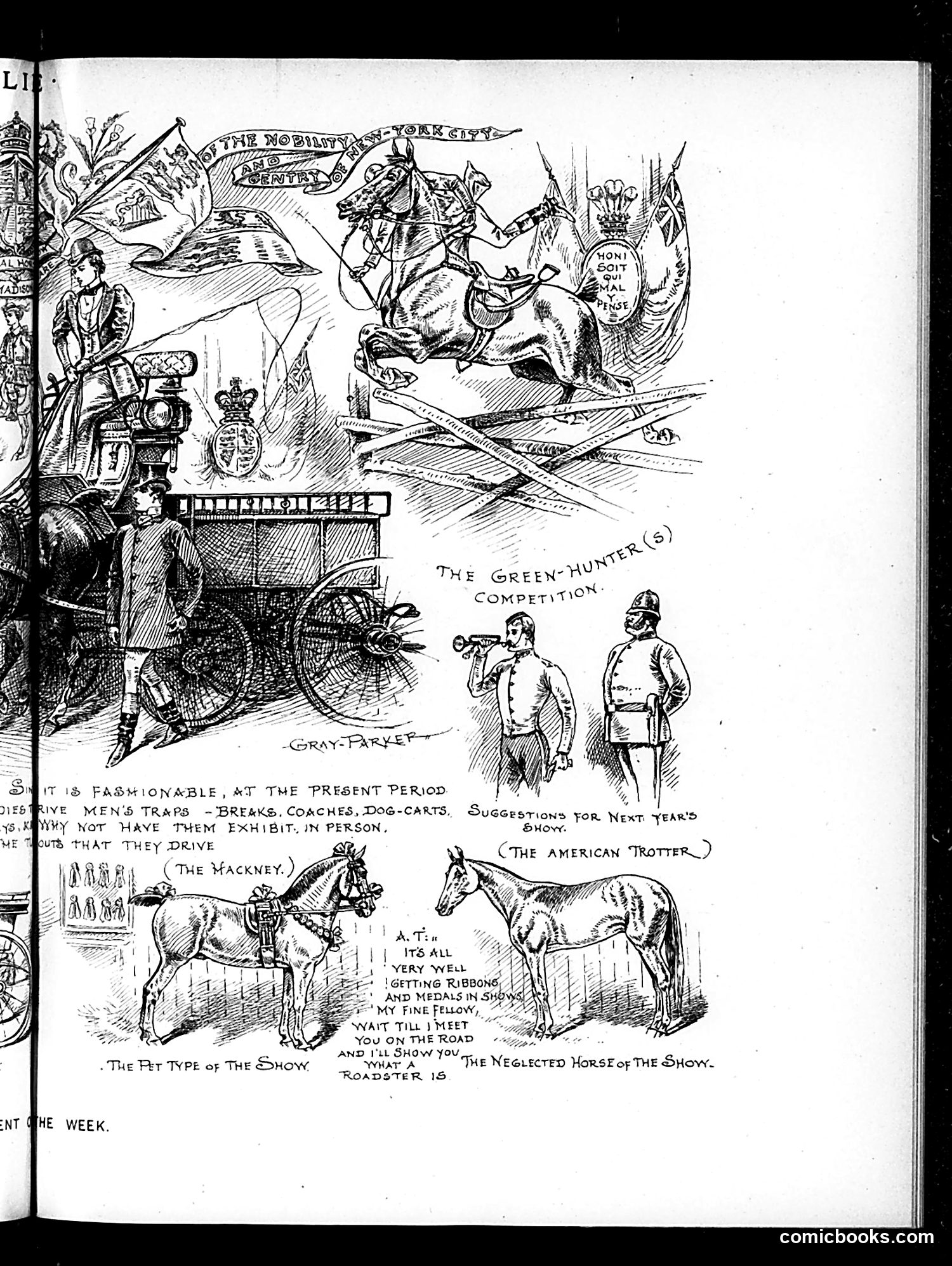
This page satirizes fashionable leisure activities among wealthy men of the period. The top cartoon, "The Green-Hunter(s) Competition," mocks competitive hunting culture among the nobility and gentry, showing an elaborately dressed horseman with hunting flags and aristocratic pretension. Below, the text criticizes how fashionable men display their traps, coaches, and dog-carts, suggesting they prioritize showing off equipment rather than actual skill or accomplishment. The lower section features horse types: "The Hackney," "The Pet Type of the Show," "The American Trotter," and "The Neglected Horse of the Show." This appears to mock the superficiality of horse shows, where decorative breeds and ribbons receive attention while practical working horses are overlooked—satirizing how wealthy society values appearance over substance. The cartoonist is Gray-Parker.
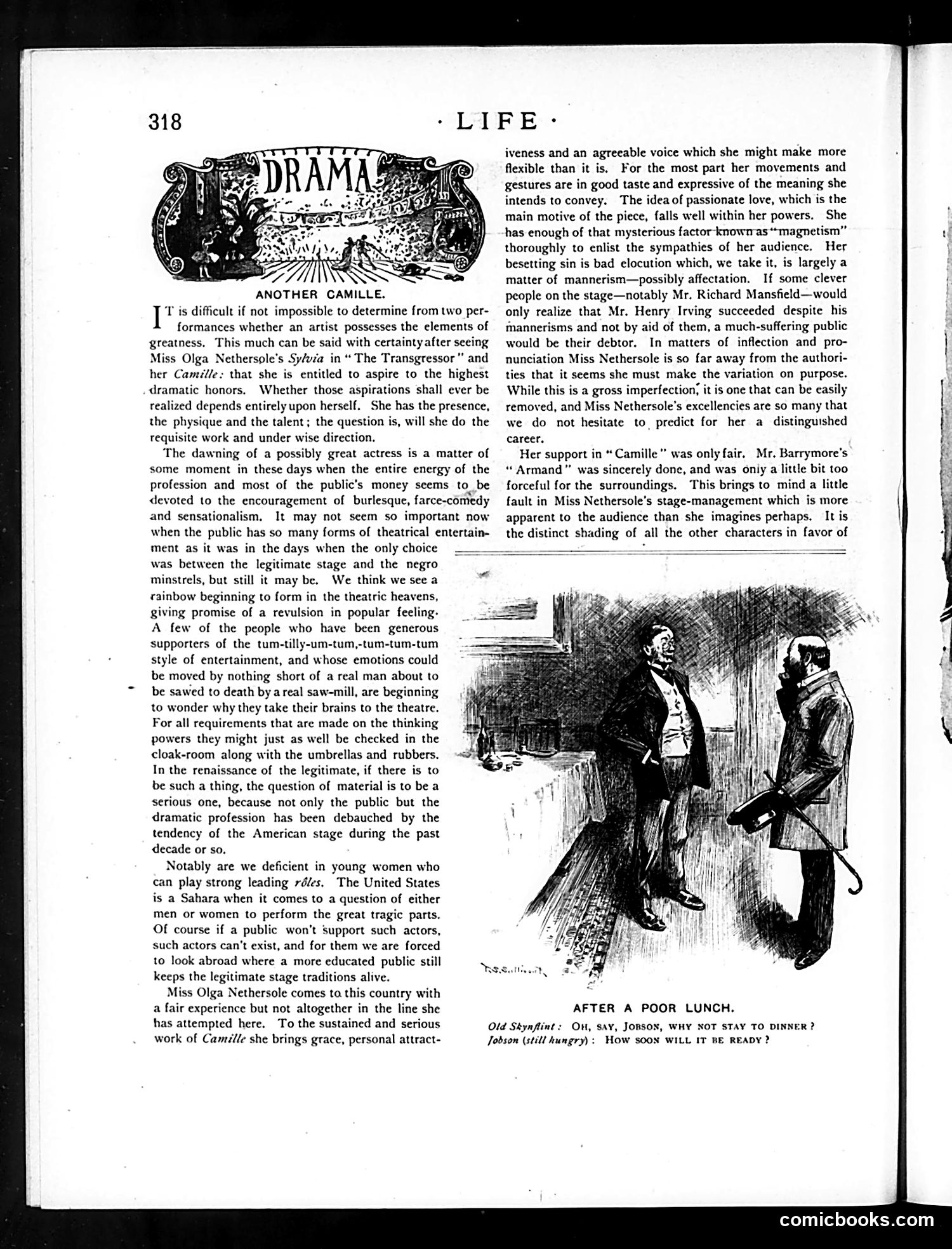
This page reviews actress Olga Nethersole's performance in *Camille*, praising her potential while critiquing American theater's degradation. The text argues that legitimate drama is dying, replaced by sensational entertainment that requires no intellectual engagement from audiences. The accompanying sketch—captioned "After a Poor Lunch"—shows two figures in conversation. The dialogue reads: "Oh, say, Jimson, why not stay to dinner?" / "How soon will it be ready?" This appears to be satirical commentary on the shallow, superficial social interactions depicted in contemporary theater, contrasting with the serious dramatic work Nethersole represents. The cartoon reinforces the article's broader complaint: American audiences have become so accustomed to mindless entertainment that genuine theatrical artistry—like Nethersole's *Camille*—represents a rare "rainbow" of cultural hope amid widespread theatrical mediocrity.
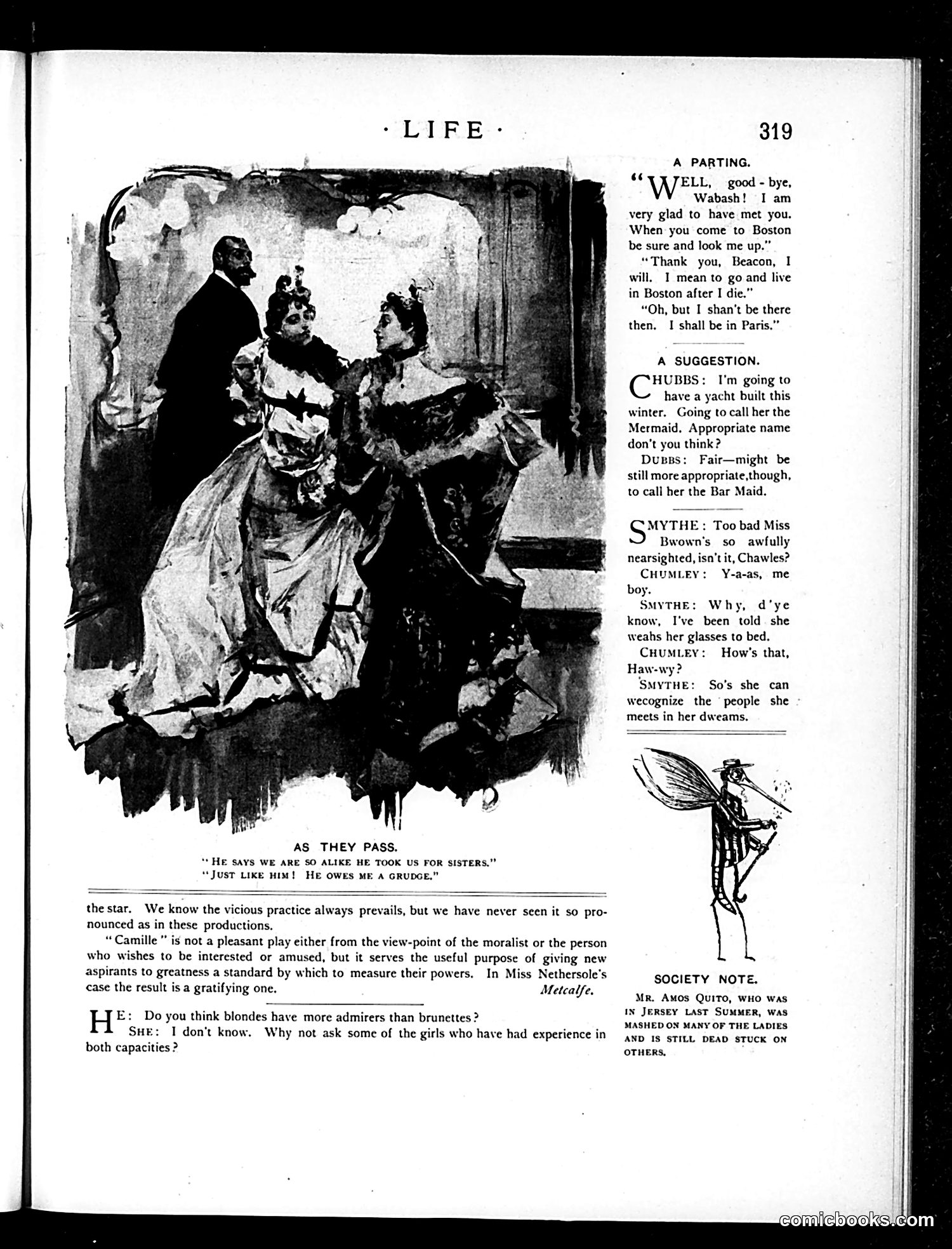
This page contains several unrelated humor pieces typical of early-20th-century *Life* magazine's satirical format. **Main illustration ("As They Pass"):** Shows two women who resemble each other. The caption mocks a man's poor judgment—he mistook them for sisters, and one quips he "owes me a grudge," suggesting he previously wronged her. The joke plays on the idea of indistinguishable women or his general incompetence. **Other sketches:** - "A Parting" satirizes pretentious social types ("Wabash," "Beacon") with arch dialogue about Boston and Paris—poking fun at affected upper-class mannerisms. - "A Suggestion" makes crude wordplay about yachts and "Bar Maid" (prostitutes). - The final sketches mock upper-class affectation and nearsightedness with exaggerated upper-class dialect. - "Society Note" is gossip-column satire about a forgettable man. The page reflects *Life's* focus on mocking American social pretension and gender stereotypes through quick, caustic humor.
This page from *Life* magazine contains three humorous anecdotes told by "Colonel Kaintuck," a dialectal storyteller character. The jokes rely on wordplay and misunderstandings: 1. **The vanishing water trick**: A man makes water disappear from a glass under a tablecloth—the punchline suggests he simply drank it, mocking the Colonel's credulity. 2. **Expensive beans**: A traveler overpays for beans at a railway station, then sends a telegram asking if the price was too high—the proprietor must pay the same amount to receive it, creating ironic comeuppance. 3. **Geese in the drum**: Civil War soldiers hide stolen geese in a drummer's instrument; when discovered, the Colonel permits the boy to rest, unknowingly allowing the theft to continue. These are straightforward comic anecdotes typical of *Life*'s humor—gentle satire relying on confusion, irony, and folk wisdom rather than political commentary. The rest of the page contains period advertisements and notices.
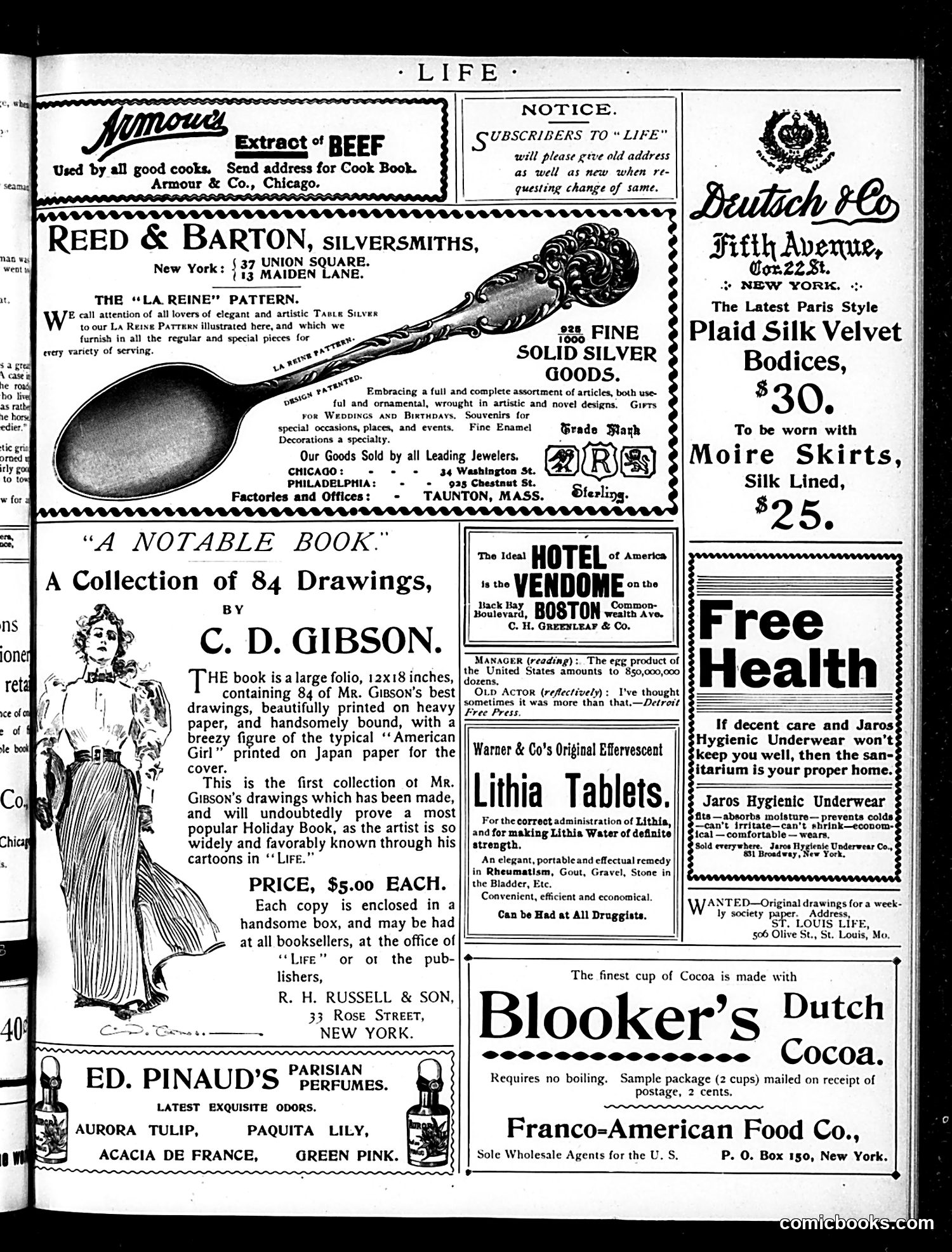
This page is primarily **advertisements and publisher notices** with one small cartoon. There is no significant political satire here. The single cartoon appears in the middle-right section, showing a **hotel manager reading statistics about egg production** to an **old actor**. The actor responds that he thought egg production was even higher than the reported 850 million dozen. This is mild humor about the actor's apparently large appetite or gluttony—a simple joke rather than political commentary. The rest of the page consists of period advertisements for luxury goods (silverware by Reed & Barton, perfume, cocoa, silk clothing) and a book advertisement for C.D. Gibson's drawing collection. Gibson was famous for illustrating the idealized "Gibson Girl" aesthetic. There are no identifiable political figures, no social commentary beyond consumerism, and no satirical commentary visible. This appears to be a standard magazine page from the early 1900s focused on commerce and lifestyle advertising.
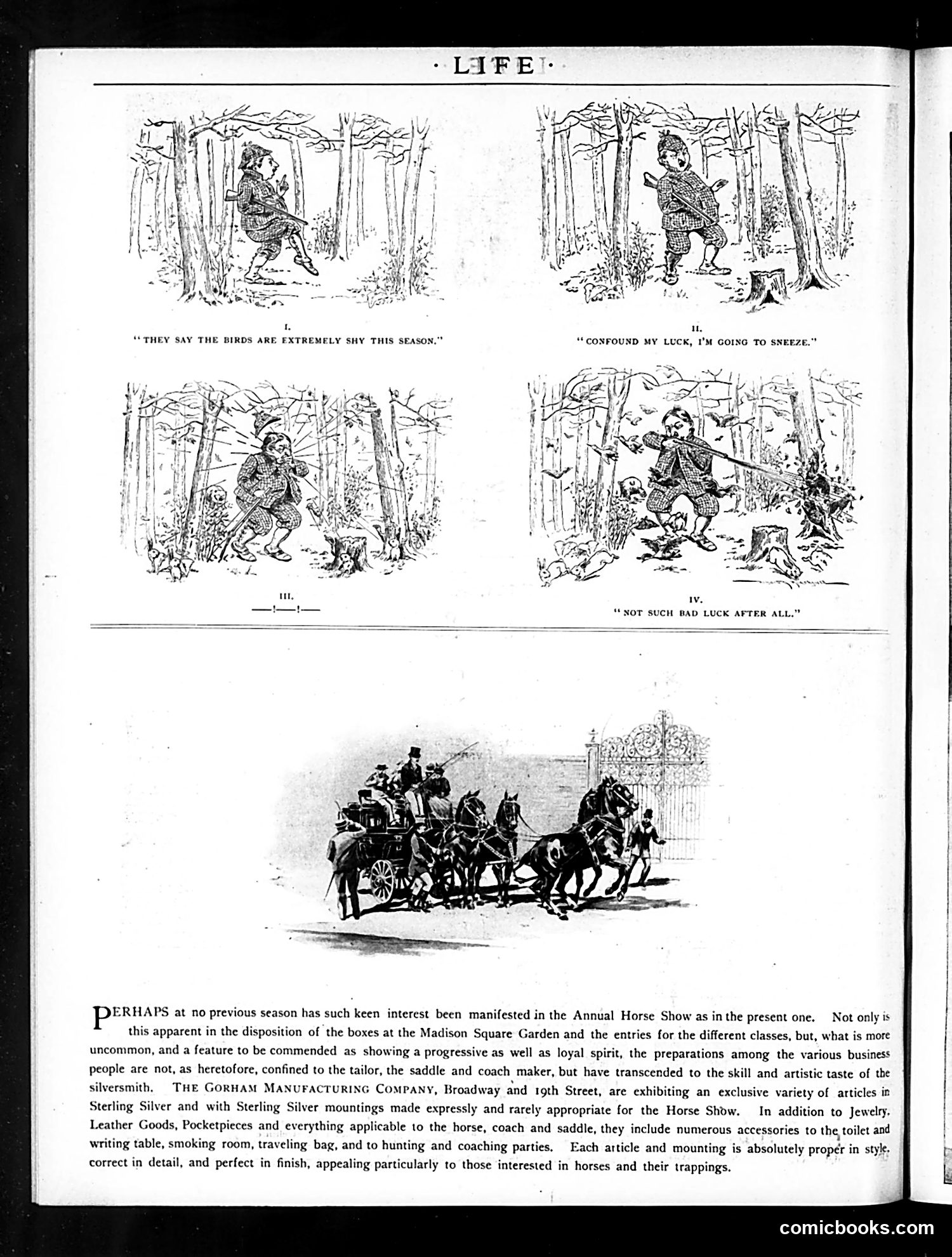
This page combines a four-panel comic strip with advertising. The comic shows a hunter in a winter forest attempting to catch birds for food. The sequence progresses from his initial attempt ("They say the birds are extremely shy this season") through his sneeze that frightens away his quarry, to him finally shooting a bird, concluding "Not such bad luck after all." The humor relies on the hunter's misfortune—his body betraying his hunting efforts—ultimately yielding modest success anyway. It's genteel, lighthearted satire about field sports. The lower half advertises the Gorham Manufacturing Company's sterling silver products designed for the Madison Square Garden Horse Show. The ad emphasizes that wealthy patrons of equestrian events now purchase luxury silver goods alongside traditional coach-maker supplies, suggesting growing sophistication and commercial expansion among the elite sporting class.