
Life, 1894-11-15 · page 12 of 16
Life — November 15, 1894 — page 12: what you’re looking at
What you’re looking at
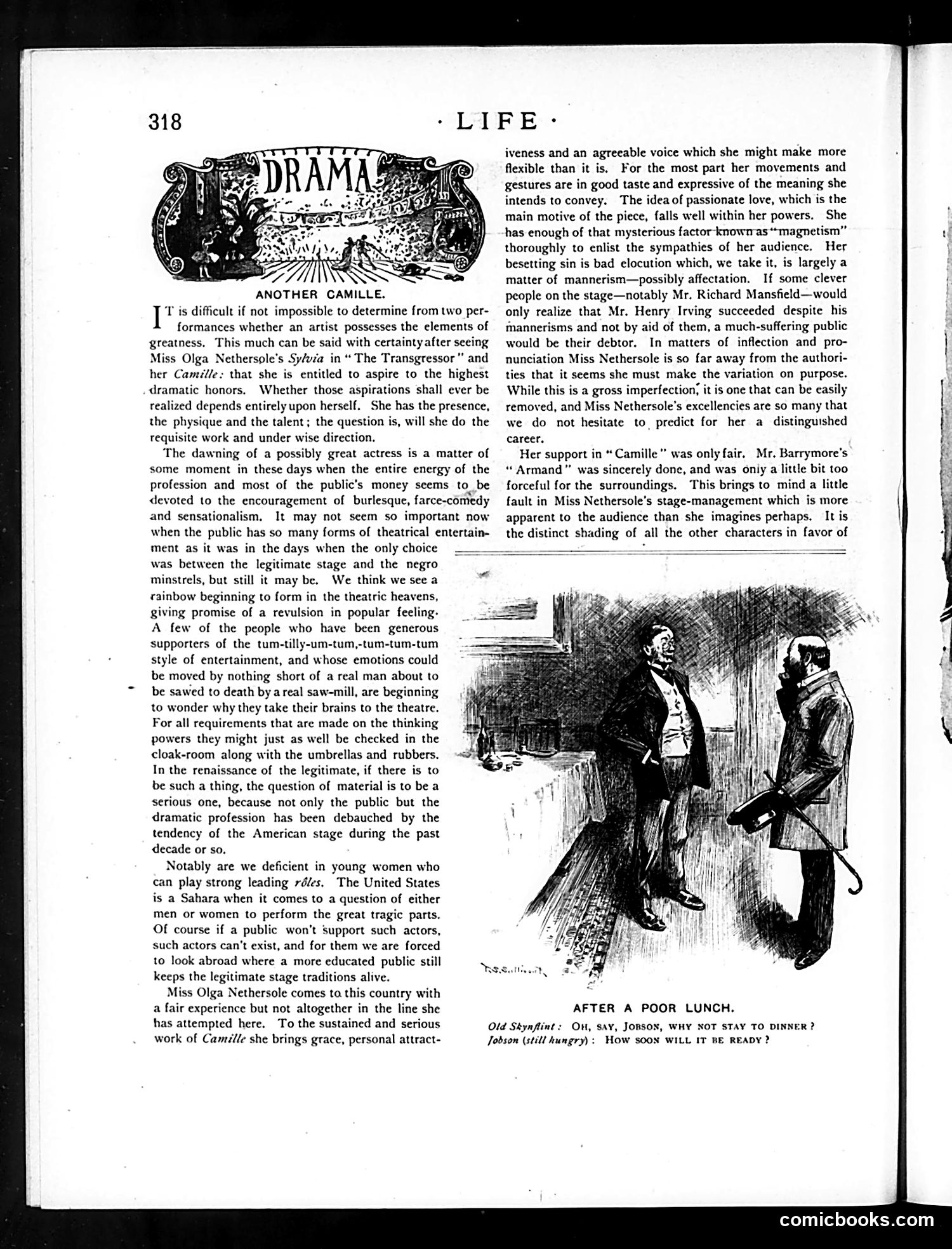
This page reviews actress Olga Nethersole's performance in *Camille*, praising her potential while critiquing American theater's degradation. The text argues that legitimate drama is dying, replaced by sensational entertainment that requires no intellectual engagement from audiences. The accompanying sketch—captioned "After a Poor Lunch"—shows two figures in conversation. The dialogue reads: "Oh, say, Jimson, why not stay to dinner?" / "How soon will it be ready?" This appears to be satirical commentary on the shallow, superficial social interactions depicted in contemporary theater, contrasting with the serious dramatic work Nethersole represents. The cartoon reinforces the article's broader complaint: American audiences have become so accustomed to mindless entertainment that genuine theatrical artistry—like Nethersole's *Camille*—represents a rare "rainbow" of cultural hope amid widespread theatrical mediocrity.
📄 Transcribed text from this page (OCR, searchable)
Machine-transcribed from the original scan — historical spelling and the odd misread are preserved.
LIFE: ANOTHER CAMILLE. I’ is difficult if not impossible to determine from two per- formances whether an artist possesses the elements of greatness. This much can be said with certainty after seeing Miss Olga Nethersole’s Sy/vza in “ The Transgressor” and her Camille: that she is entitled to aspire to the highest dramatic honors. Whether those aspirations shall ever be realized depends entirely upon herself. She has the presence, the physique and the talent; the question is, will she do the requisite work and under wise direction. The dawning of a possibly great actress is a matter of some moment in these days when the entire energy of the profession and most of the public’s money seems to_be devoted to the encouragement of burlesque, farce-comedy and sensationalism, It may not seem so important now when the public has so many forms of theatrical entertain- ment as it was in the days when the only choice was between the legitimate stage and the negro minstrels, but still it may be. We think we see a rainbow beginning to form in the theatric heavens, giving promise of a revulsion in popular feeling: A few of the people who have been generous supporters of the tum-tilly-um-tum,-tum-tum-tum style of entertainment, and whose emotions could be moved by nothing short of a real man about to be sawed to death by areal saw-mill, are beginning to wonder why they take their brains to the theatre. For all requirements that are made on the thinking powers they might just as well be checked in the cloak-room along with the umbrellas and rubbers. In the renaissance of the legitimate, if there is to be such a thing, the question of material is to be a serious one, because not only the public but the dramatic profession has been debauched by the tendency of the American stage during the past decade or so, Notably are we deficient in young women who can play strong leading ré/es. The United States is a Sahara when it comes to a question of either men or women to perform the great tragic parts. Of course if a public won't support such actors, such actors can't exist, and for them we are forced to look abroad where a more educated public still keeps the legitimate stage traditions alive. Miss Olga Nethersole comes ta this country with a fair experience but not altogether in the line she has attempted here. To the sustained and serious work of Camille she brings grace, personal attract- iveness and an agreeable voice which she might make more flexible than it is. For the most part her movements and gestures are in good taste and expressive of the meaning she intends to convey. The idea of passionate love, which is the main motive of the piece, falls well within her powers. She has enough of that mysterious factor-knowrras “magnetism” thoroughly to enlist the sympathies of her audience. Her besetting sin is bad elocution which, we take it, is largely a matter of mannerism—possibly affectation. If some clever people on the stage—notably Mr. Richard Mansfield—would only realize that Mr. Henry Irving succeeded despite his mannerisms and not by aid of them, a much-suffering public would be their debtor, In matters of inflection and pro- nunciation Miss Nethersole is so far away from the authori- ties that it seems she must make the variation on purpose. While this is a gross imperfection; it is one that can be easily removed, and Miss Nethersole’s excellencies are so many that we do not hesitate to, predict for her a distinguished career, Her support in “ Camille” was only fair. Mr. Barrymore's “Armand” was sincerely done, and was oniy a little bit too forceful for the surroundings. This brings to mind a little fault in Miss Nethersole’s stage-management which is more apparent to the audience than she imagines perhaps. It is the distinct shading of all the other characters in favor of AFTER A POOR LUNCH. Old Shynflint : OU, Sav, JoRSOS, WHY NOT STAY TO DINNER? Jobson (still hungry); HOW SOON WILL IT BE READY ? comicbooks.com ——_— A\N