
A complete issue · 16 pages · 1894
Life — August 30, 1894
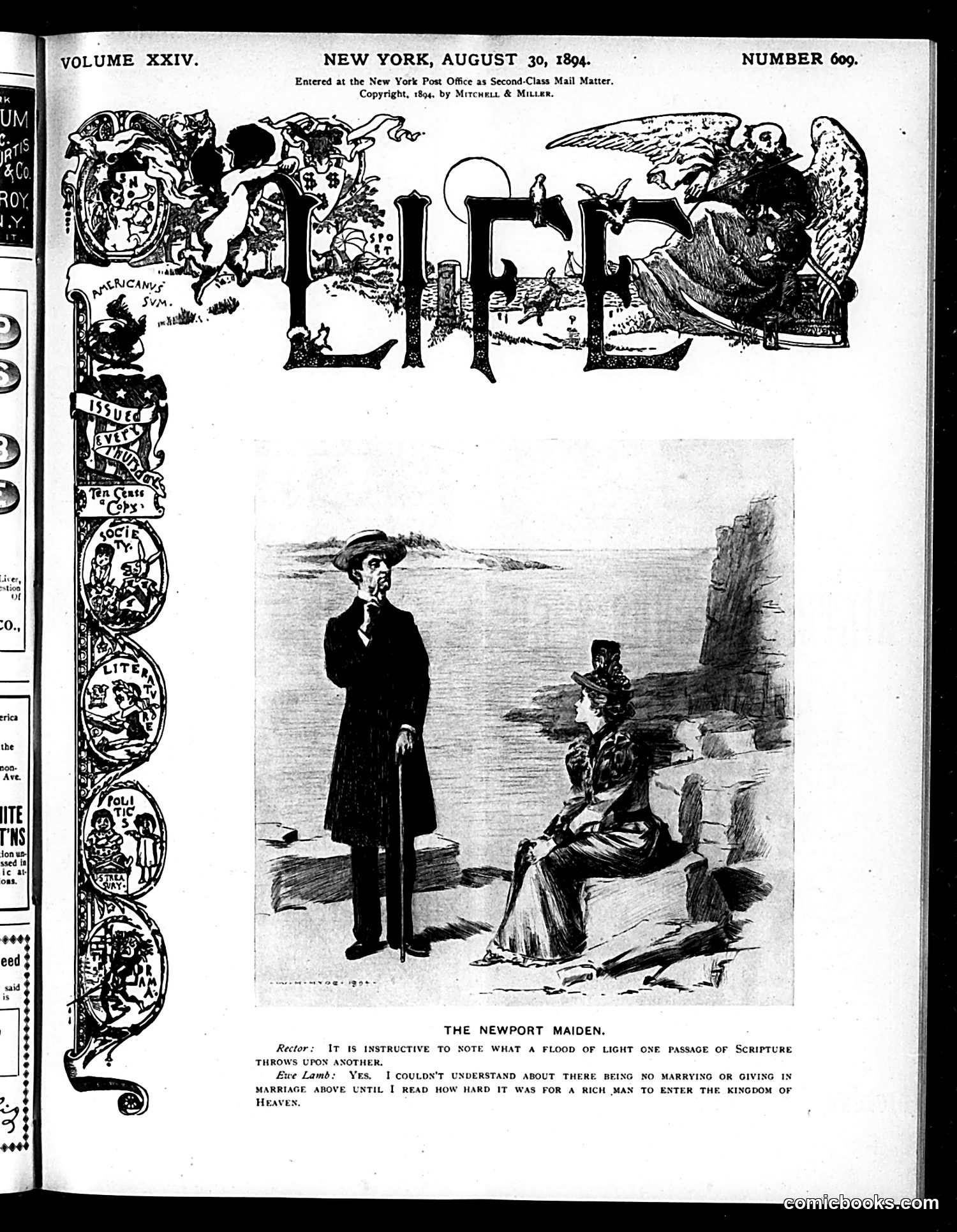
This cartoon satirizes class attitudes toward wealth and marriage among America's wealthy elite. The scene depicts two figures at Newport, Rhode Island—then the premier resort destination for the affluent. The dialogue mocks the hypocrisy of the wealthy regarding spiritual values. The rector (clergyman) lectures about Scripture's teaching that wealth hinders salvation. The "Gay Lamb" (the young woman) responds that she couldn't understand this doctrine until reading how difficult it is for the rich to enter Heaven—implying the wealthy deliberately ignore such teachings. The satire targets the contradiction between the ostensibly pious Newport society and their actual pursuit of material luxury and advantageous marriages. The joke exposes how the rich rationalize their worldly ambitions despite Christian moral teachings.
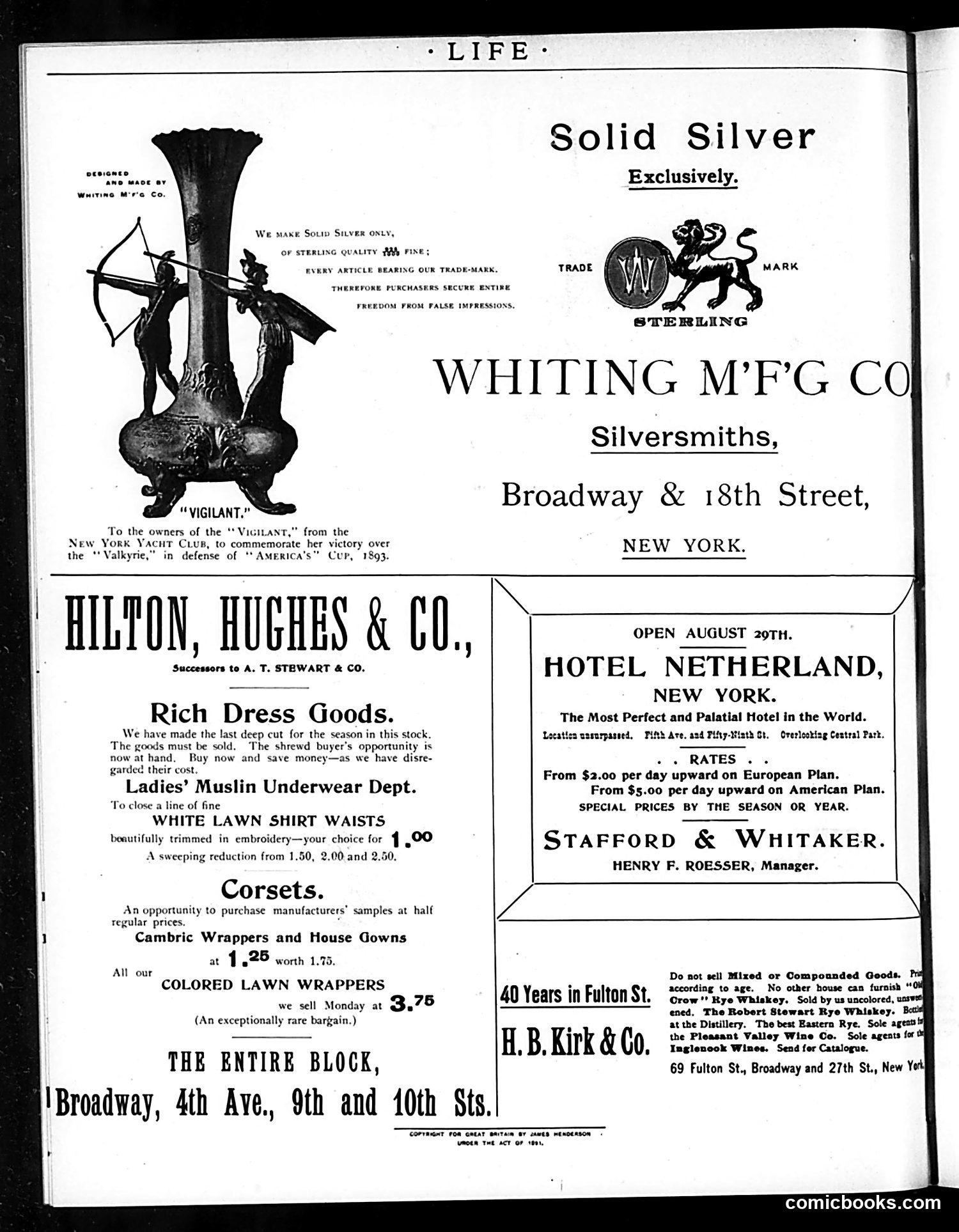
This page is primarily **advertising**, not political satire. The main content features: 1. **Whiting M'fg Co.** (top right): A sterling silver manufacturer showcasing their "Vigilant" vessel design, commissioned by the New York Yacht Club to commemorate a victory over the "Valkyrie" in 1893—likely referencing the America's Cup yacht racing competition. 2. **Hilton, Hughes & Co.** (left): Dress goods advertisements targeting women, including muslin underwear, corsets, and lawn wrappers. 3. **Hotel Netherland** (center): A luxury hotel opening announcement on August 29th. 4. **H.B. Kirk & Co.** (bottom right): A whiskey advertisement. The page reflects 1890s consumer culture with upscale products aimed at wealthy New Yorkers, with minimal satirical content.
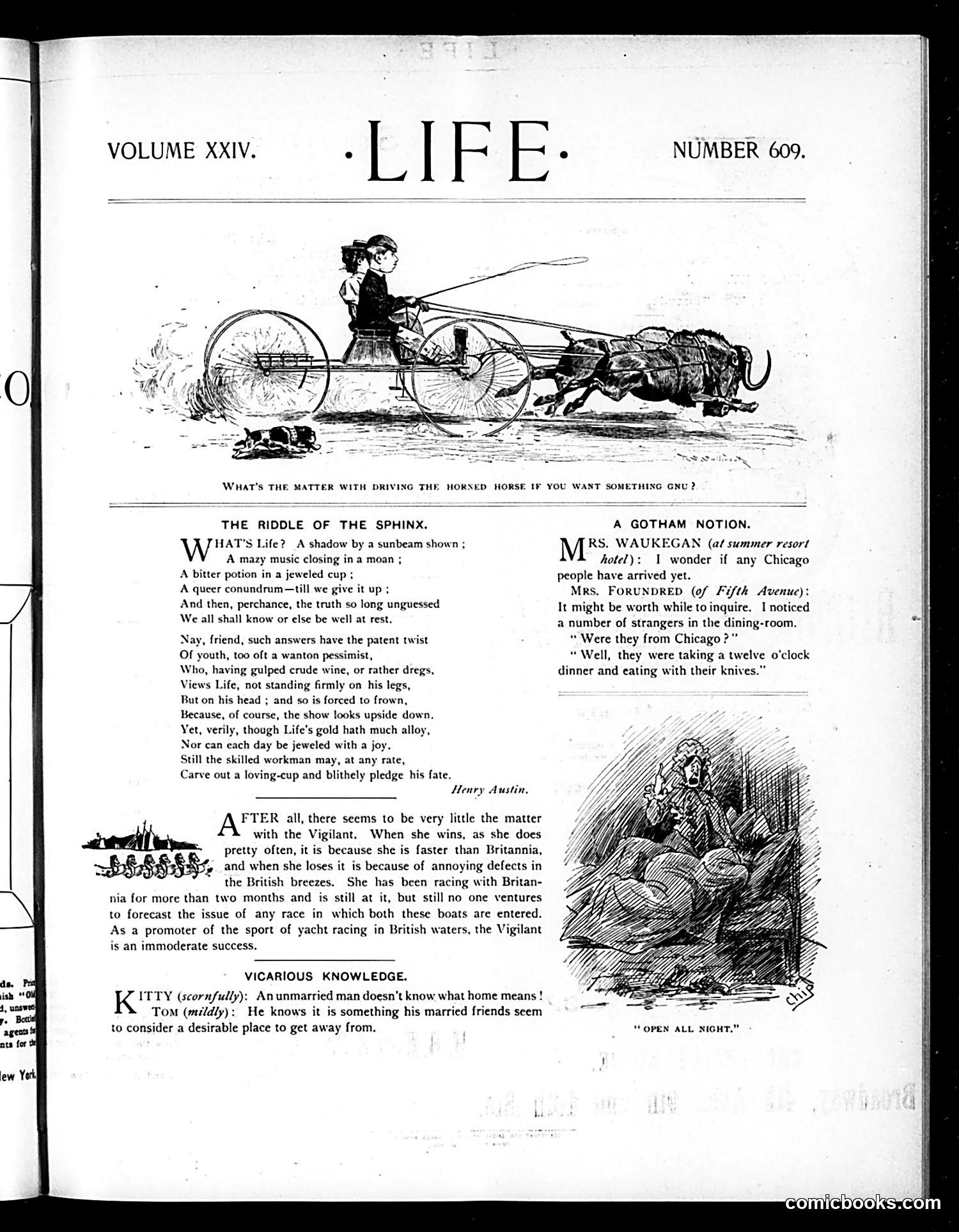
**Top Cartoon**: A humorous illustration showing a person driving a cart pulled by a horned horse (or goat) that's clearly difficult to control. The caption "What's the matter with driving the horned horse if you want something gnu?" is a pun—"gnu" (the African antelope) sounds like "new." The joke appears to be about the impracticality of using an exotic animal for transportation. **"The Riddle of the Sphinx"**: A poem by Henry Austin about life's nature—philosophical rather than political satire. **"A Gotham Notion"**: A brief comedic dialogue between two women discussing strangers eating with knives at a hotel dining room, likely poking fun at uncouth manners or newly wealthy people's lack of refinement. **"Vicarious Knowledge"**: A two-line joke about unmarried versus married men and their understanding of "home."
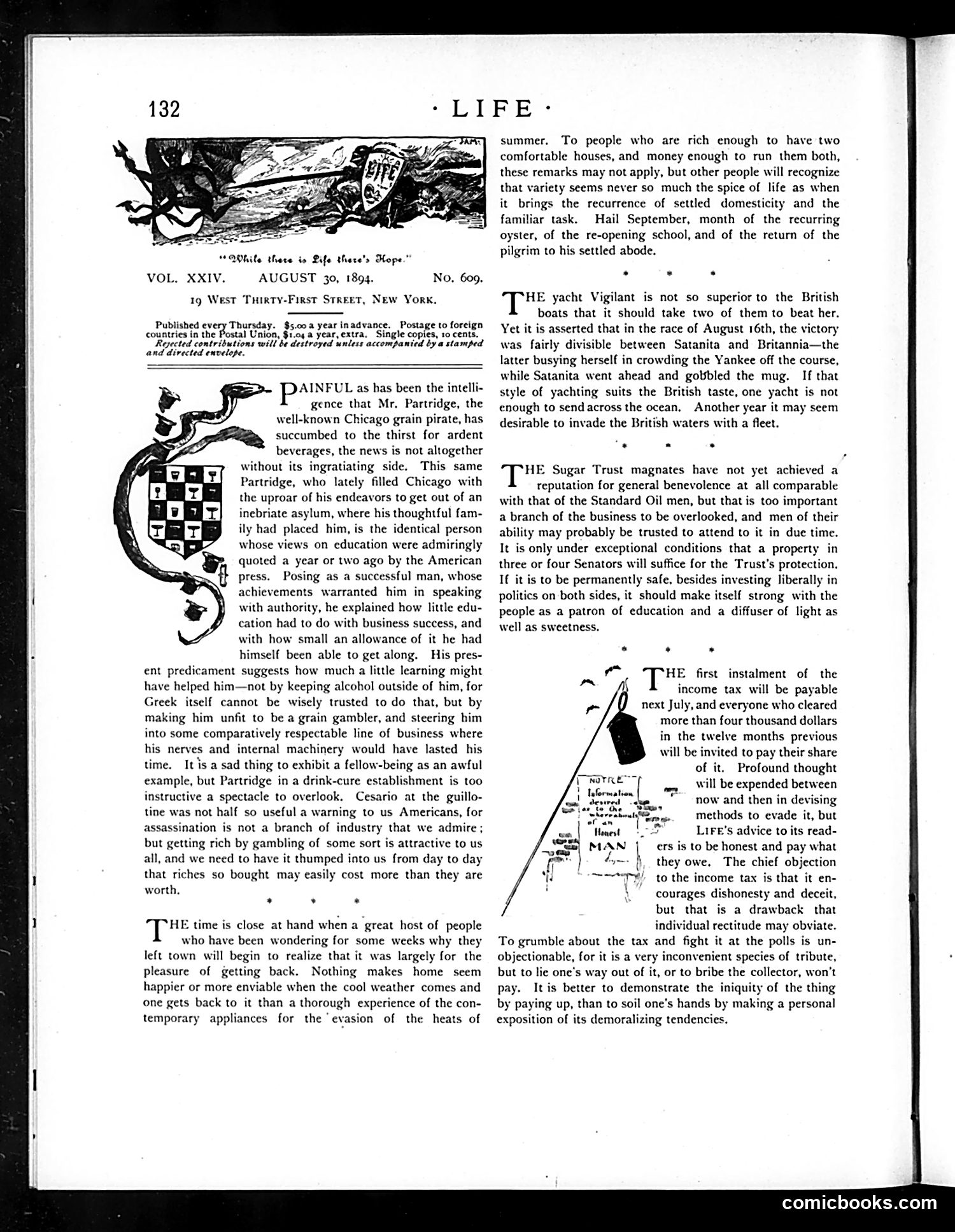
The page contains three separate satirical commentaries rather than illustrated cartoons: 1. **Partridge the Grain Pirate**: Critiques a Chicago businessman who allegedly filled an asylum with poor relatives, then became successful. The satire mocks how little education aided his success, suggesting he succeeded through ruthless business tactics rather than merit—a commentary on Gilded Age capitalism's moral bankruptcy. 2. **Yacht Racing**: Brief commentary on the yacht *Vigilant* racing British boats, asserting American superiority. This reflects 1890s Anglo-American competition and national pride. 3. **Sugar Trust & Income Tax**: Discusses the newly-established income tax (effective July 1894) and the Sugar Trust's political influence, questioning whether a few senators can adequately regulate such powerful monopolies—reflecting Progressive Era anxieties about corporate power and taxation.
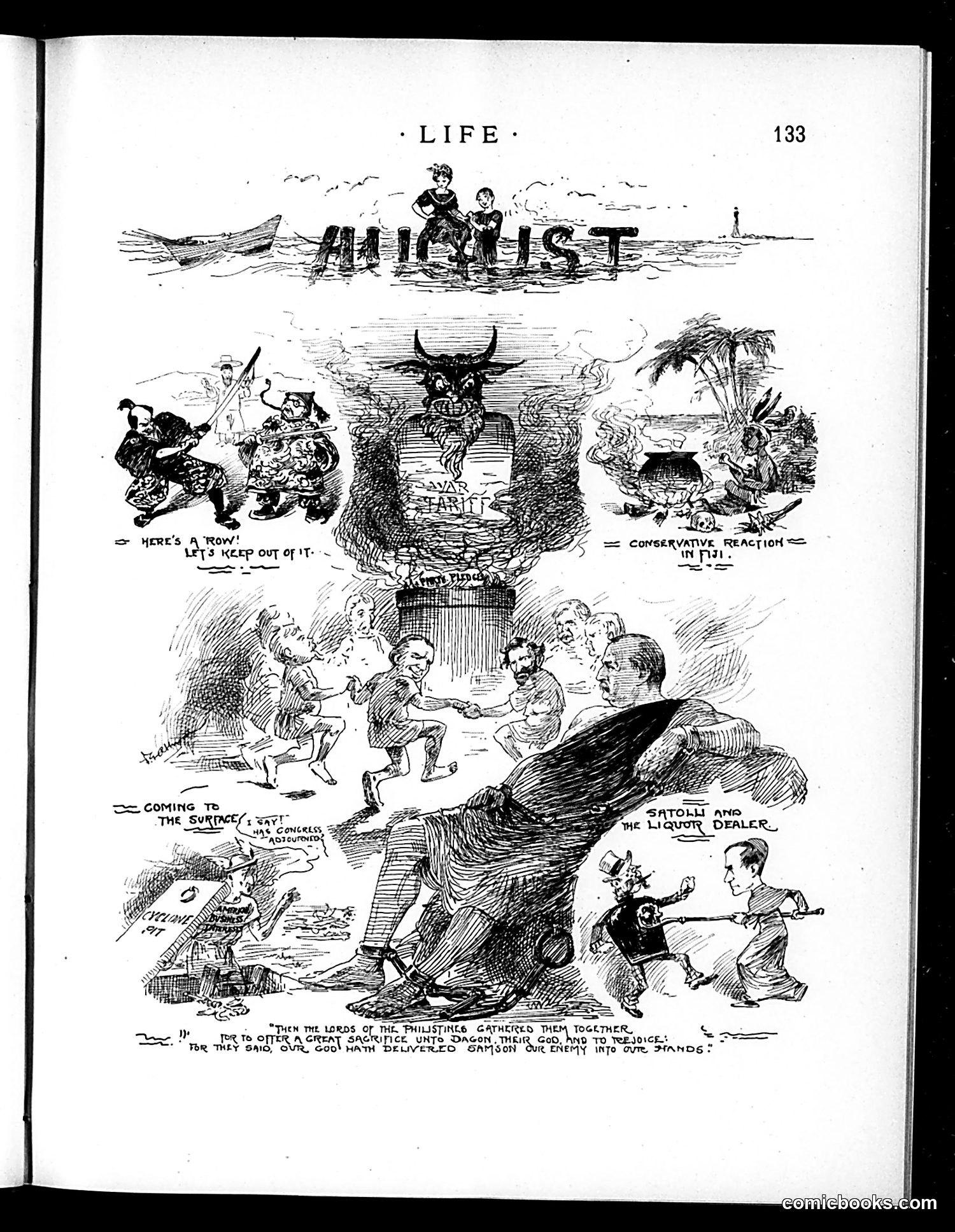
This page uses the month "August" as a framework for satirizing contemporary political and social issues. The central figure is a horned demon labeled "Avar Parii" (likely referencing a political figure or party), surrounded by vignettes depicting: - "Here's a row! Let's keep out of it" (left) - suggests avoiding involvement in a conflict - "Conservative Reaction in 1911" (right) - critiques conservative political responses - "Coming to the Surface" - depicts scandal or corruption emerging - "Satoli and the Liquor Dealer" - references political corruption involving alcohol - Bottom panel shows figures making a "great sacrifice unto Dagon" - a biblical reference implying immoral political dealings The overall message condemns August 1911 political controversies and hypocrisy, using supernatural/demonic imagery to express moral outrage at political corruption.
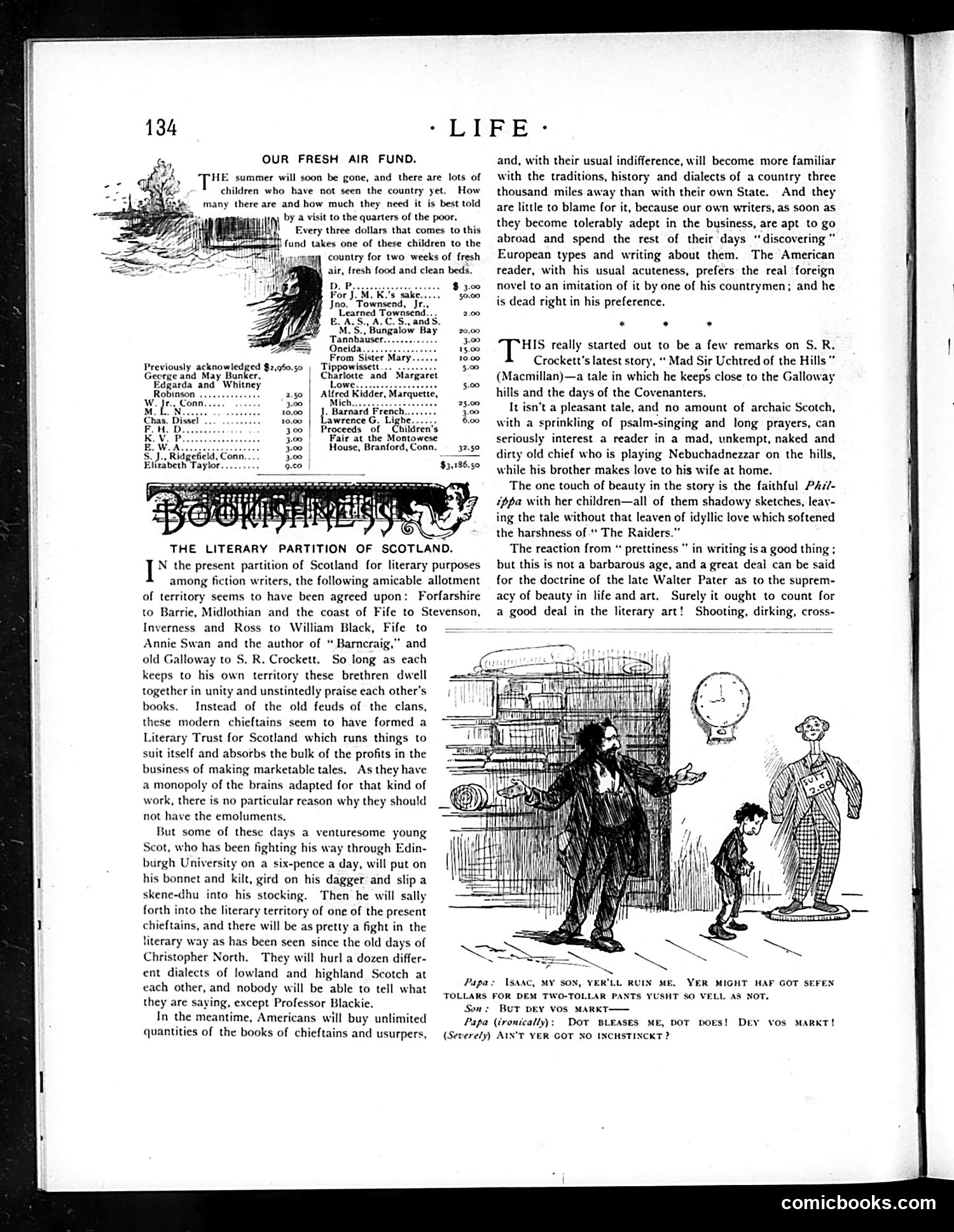
This page contains two distinct sections: **Top section ("Our Fresh Air Fund"):** A charitable fundraising appeal listing donor contributions for sending poor urban children to the countryside for two weeks. The accompanying sketches illustrate the program's purpose—giving underprivileged kids healthier conditions. **Bottom section ("The Literary Partition of Scotland"):** A satirical commentary on Scottish literary territories, where major authors (Stevenson, Barrie, Crockett, etc.) have claimed exclusive regional dominions. The text mocks this territorial division while praising a story by S.R. Crockett. **The cartoon** shows a father scolding his son over ruined expensive pants, with the child protesting. It's a humorous domestic scene illustrating parental frustration—likely commenting on childhood mischief and clothing costs, a relatable everyday situation rather than political satire.
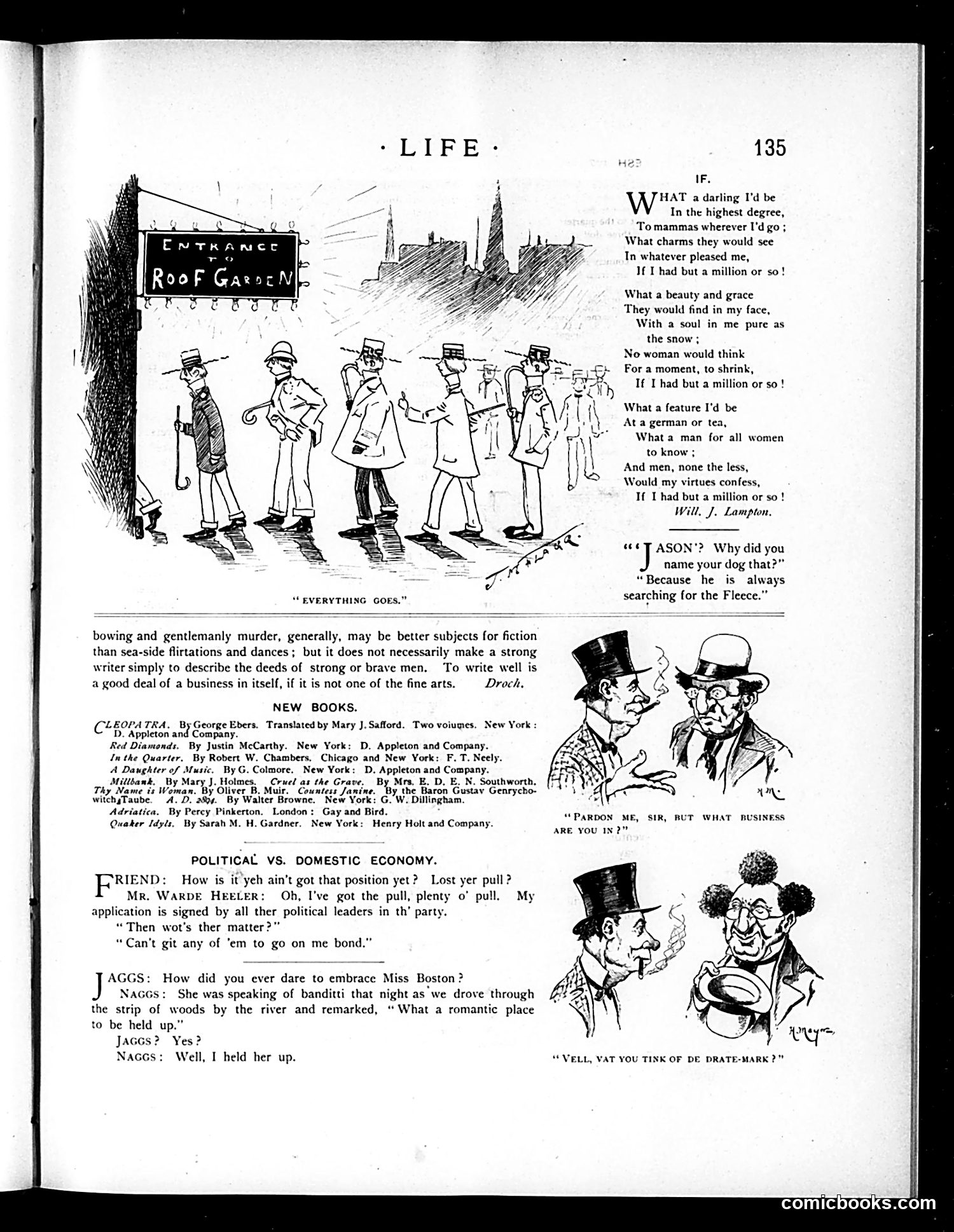
This page contains three separate satirical pieces: 1. **"Entrance to Roof Garden"** - A cartoon mocking fashionable Manhattan society visitors, depicted as identical, interchangeable figures in formal dress. The caption "Everything Goes" suggests satirical commentary on wealthy socialites' behavior at popular nightspots. 2. **"If" - A poem** by Will J. Lampson expressing fantasies about wealth and its transformative social power, mocking the vanity and materialism of the era. 3. **Two dialogue jokes** about politics and romance, using exaggerated caricatures to poke fun at political ambition and gentlemen's flirtation. The overall theme mocks American upper-class pretension, social climbing, and romantic posturing—typical subjects for *Life* magazine's satirical humor of this era.
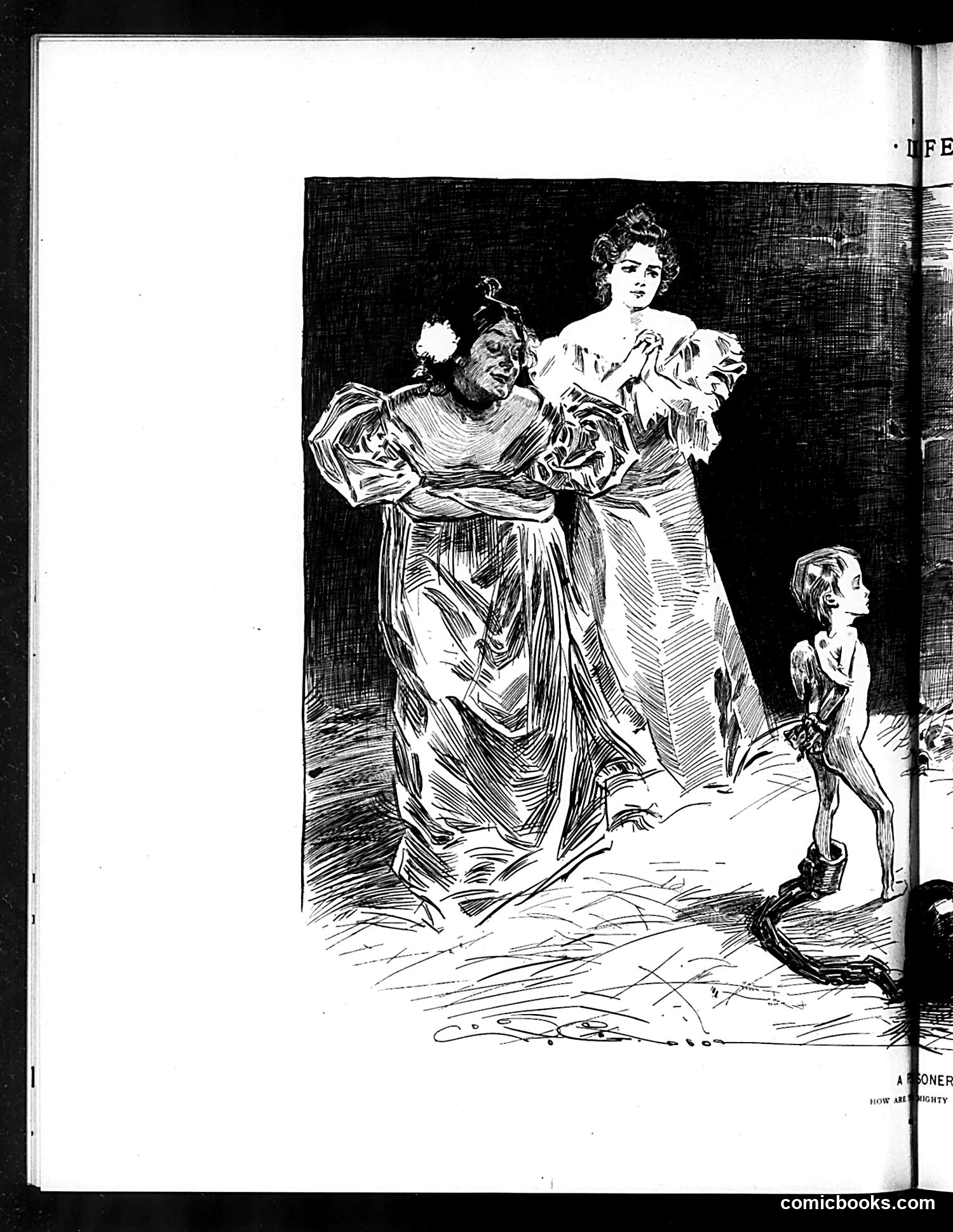
This appears to be an illustration titled "A CORNER" (visible at bottom) with subtitle "HOW ARE MIGHTY" (likely "HOW ARE THE MIGHTY [FALLEN]"). The image depicts three figures in an interior scene rendered in ink. On the left stands a figure with an exaggerated, grotesque face wearing elaborate draped clothing. To the right is a young woman in fashionable dress with puffed sleeves, and a small child stands apart on the right side. The grotesque facial features and theatrical costume of the left figure suggest this is satirical caricature, though the specific identity remains unclear from the visible text alone. The artistic style is consistent with early 20th-century American satirical illustration. The compositional arrangement and title suggest commentary on social pretension or decline in status, but without additional context, the precise political or social target cannot be definitively determined.
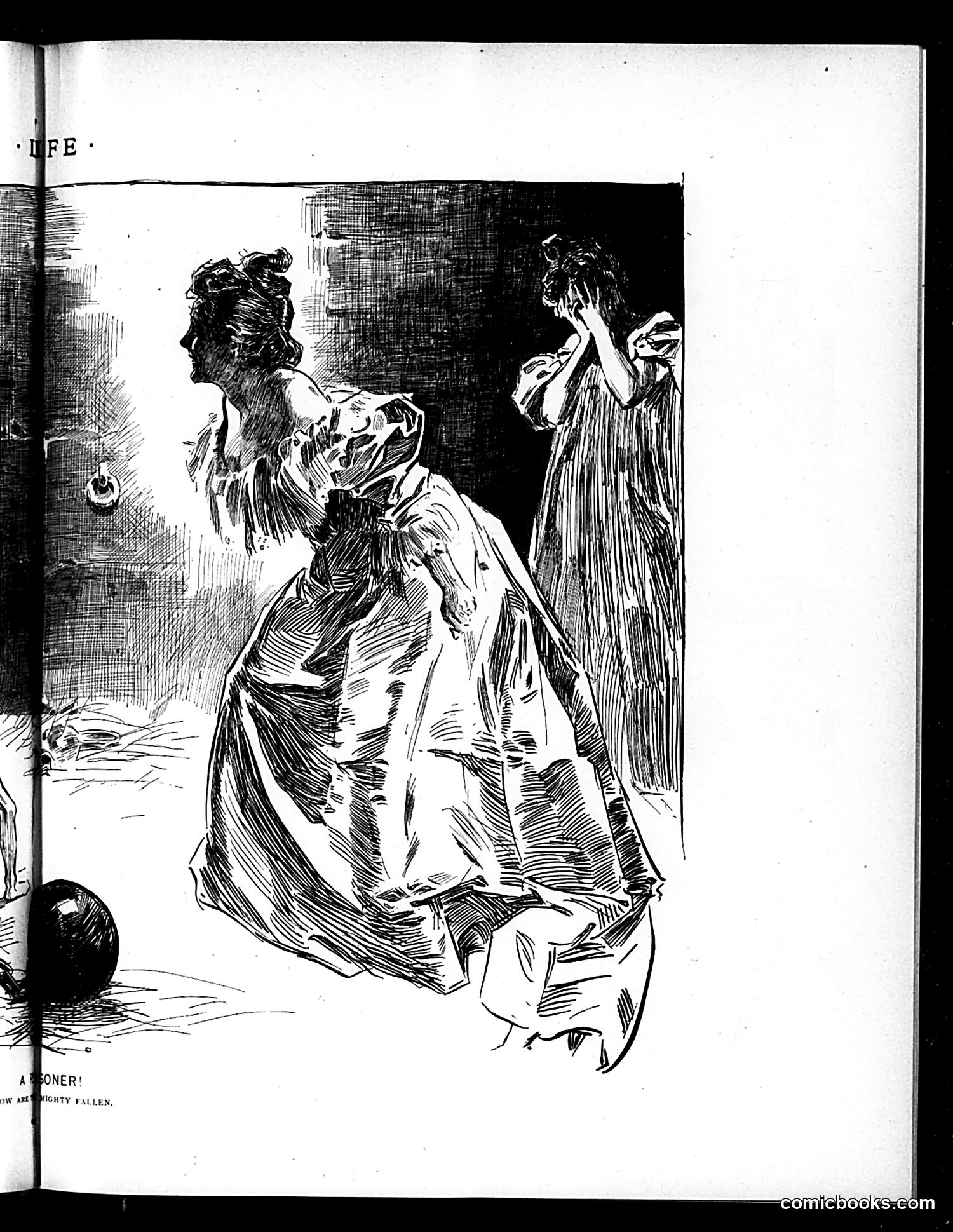
This appears to be a satirical illustration from *Life* magazine showing two figures in an interior scene. The figure on the left, viewed from behind, wears period dress and has an elaborate hairstyle. The figure on the right stands near a doorway or dark opening, also in period costume. The partial caption visible reads "A SOONER!" with additional text mentioning "HOW ART MIGHTY FALLEN" — suggesting this depicts a fall from grace or social decline. However, without the complete caption or date visible, I cannot identify the specific individuals being caricatured or the precise political or social event being referenced. The style and technique suggest late 19th or early 20th-century satire, but the specific target remains unclear from the image alone.
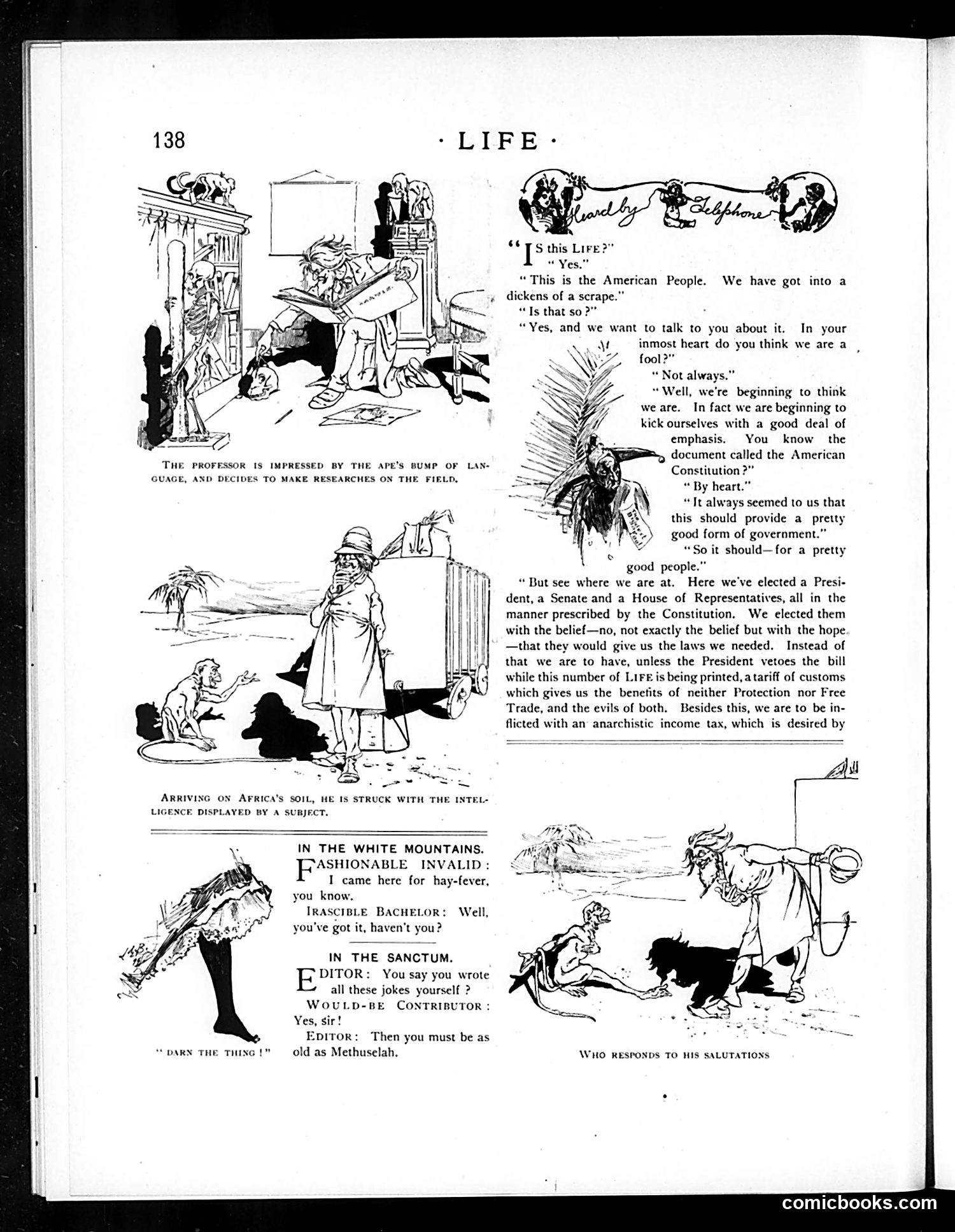
This page satirizes American political dysfunction through dialogue between unnamed speakers debating the Constitution and government effectiveness. The central argument critiques how elected officials fail to deliver promised reform: despite electing a President, Senate, and House "in the manner prescribed by the Constitution," these representatives ignore voters' wishes. Instead of providing needed laws, the President vetoes bills while Congress imposes tariffs benefiting special interests. The cartoon panels mock various incompetencies: a professor studying an ape's language; a colonial figure discovering "intelligence" in Africa; and disputes between editors and contributors. The satire suggests American democratic institutions—celebrated as "pretty good government"—have become corrupted by partisan gridlock and special-interest politics, betraying constitutional ideals.
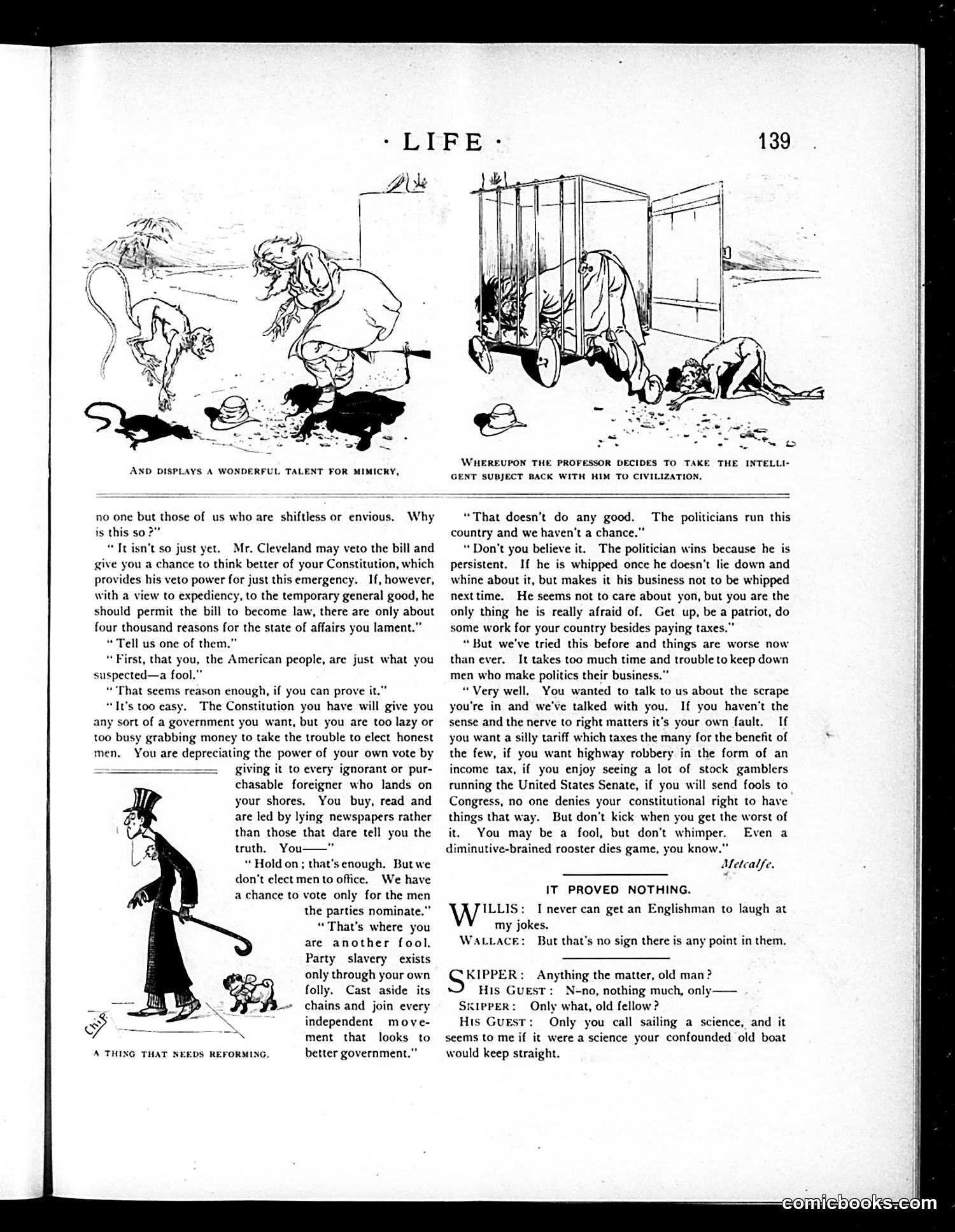
The page contains a debate about American politics and voting. The upper cartoon shows a "Professor" attempting to civilize an "intelligent subject"—a satirical commentary on the difficulty of improving civic engagement. Below, the dialogue mocks voter apathy and political cynicism. A character argues that politicians control the country regardless of public effort, that voting for honest candidates is futile, and that Americans are "too lazy" to reform government. The left cartoon depicts Uncle Sam as "A THING THAT NEEDS REFORMING"—suggesting the American political system itself requires fundamental change. The satire targets both voter cynicism and systemic corruption, arguing that Americans' passivity enables politicians to perpetuate dishonesty and self-interest rather than serve the public good. The piece advocates for active civic participation despite perceived futility.
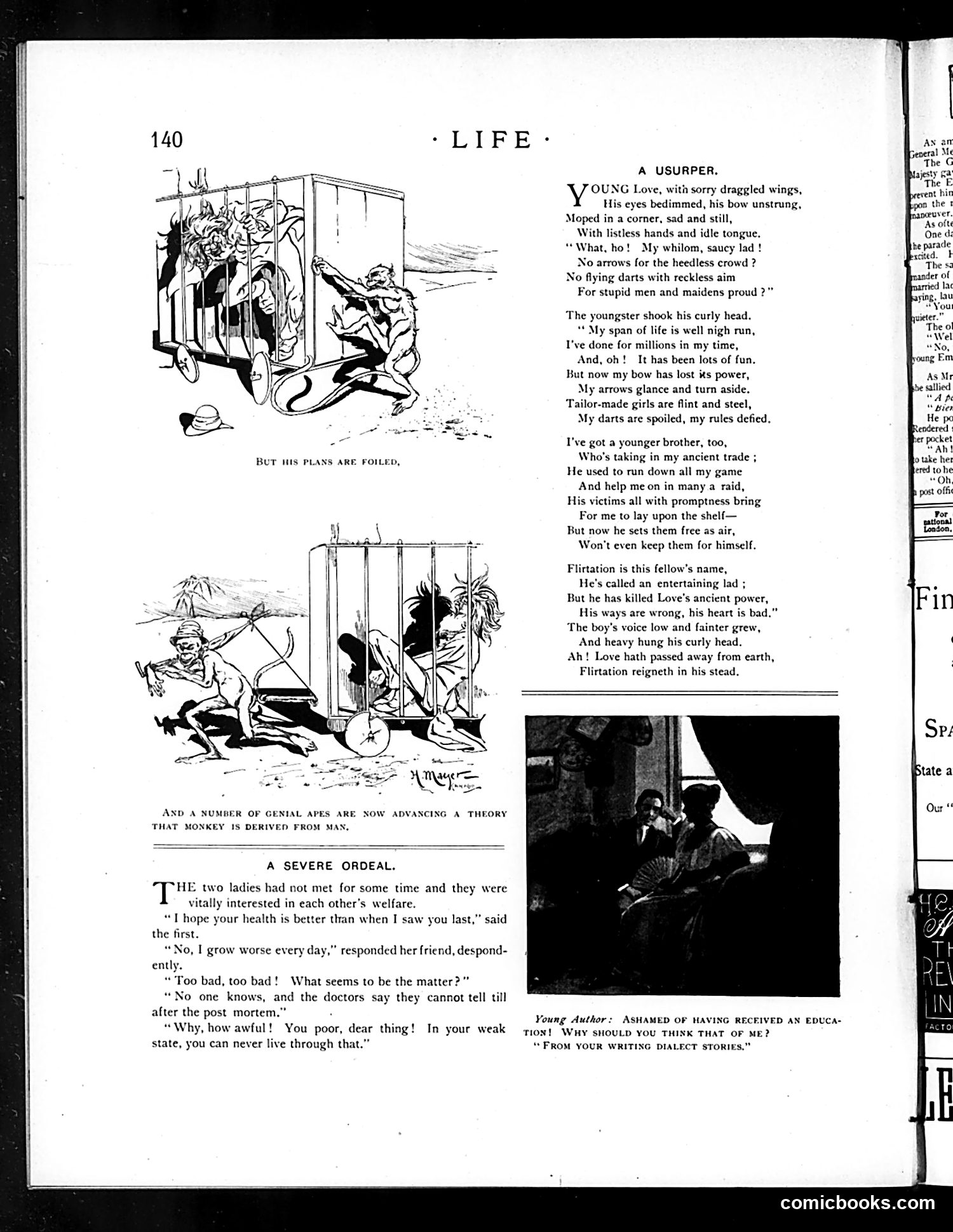
This two-part satirical cartoon critiques changes in courtship and romance in early 20th-century America. **The main poem**: Personified "Love" (depicted as Cupid) complains that his power has diminished. Young women are now "tailor-made girls" who are "flint and steel"—resistant to romantic advances. Worse, a rival force called "Flirtation" has replaced Love's traditional role. Flirtation is "entertaining" but shallow, treating romance as casual amusement rather than genuine emotion. The satire suggests that modern courtship—characterized by superficial flirtation rather than sincere romantic feeling—represents cultural decline. Love has "passed away from earth." **The secondary cartoon** (lower left, with apes): Mocks evolutionary theory by suggesting that if monkeys derive from humans, humans must be degenerating into apes, appearing alongside commentary about changing social behavior. **The "Severe Ordeal" dialogue**: A separate joke about a woman's worsening health, with dark humor about medical futility. The satire reflects anxieties about modernization and the perceived loss of authentic emotion in social interactions.
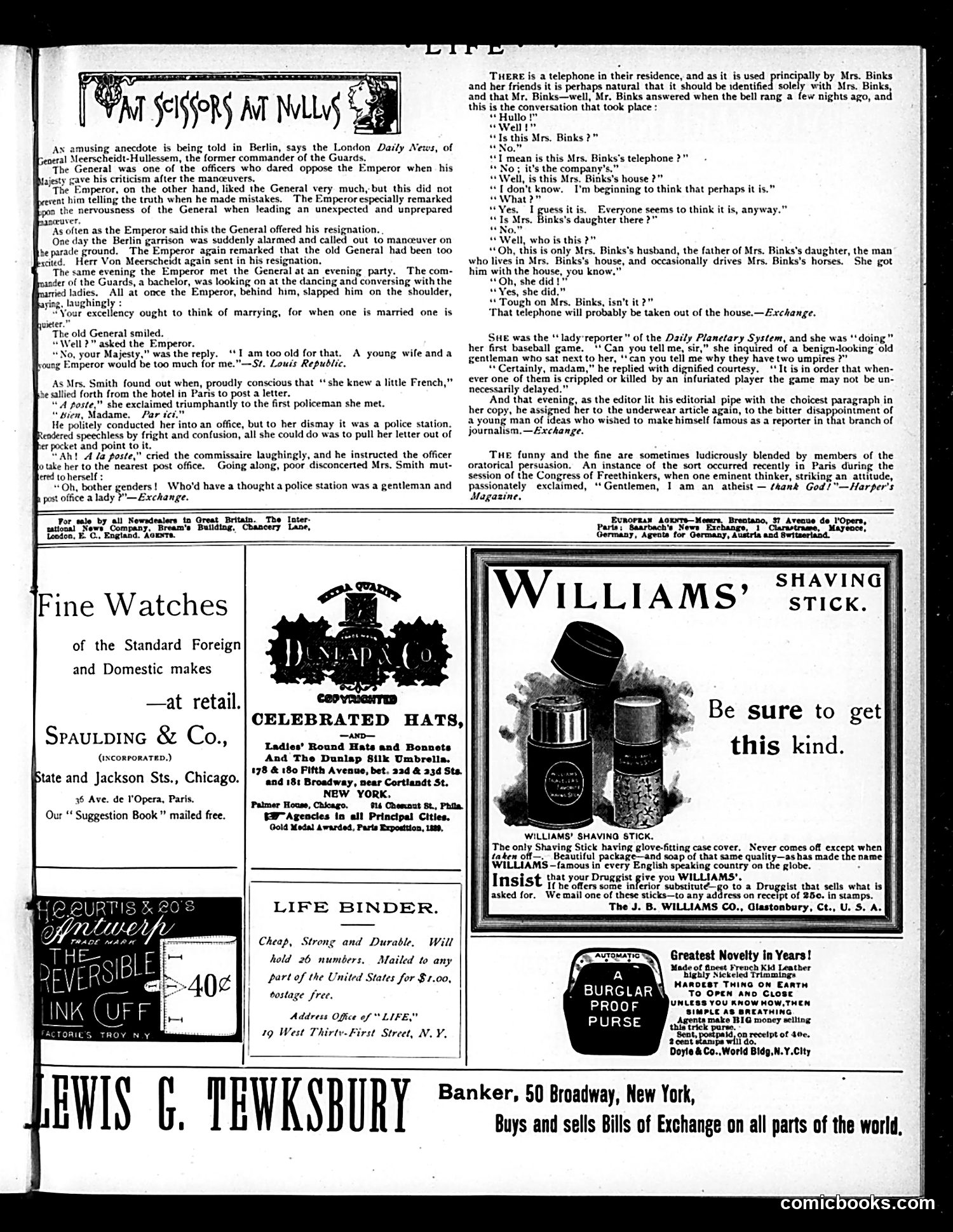
This page contains three separate humorous anecdotes typical of Life magazine's satirical humor: 1. **The General and the Emperor**: A Berlin story mocking German military hierarchy. An aging General repeatedly offers resignation after the Emperor's criticism, eventually leading to a joke about marriage making one "quieter"—satirizing rigid military protocol and the Emperor's peculiar management style. 2. **The French Language Mix-up**: An American tourist ("Mrs. Smith") confidently uses her limited French phrase "à la poste" (to the post office) but is directed to a police station instead. The humor derives from her embarrassment and her murmured complaint that "genders" fooled her—likely referencing that "poste" (feminine) and the imagined "gentleman" versus "lady" confusion. 3. **The Telephone Conversation**: A domestic comedy where Mr. Binks answers his own phone, only to be repeatedly asked for "Mrs. Binks," suggesting the telephone is considered her property. Mr. Binks sardonically describes himself as something the house came with. The page also contains period advertisements for watches, shaving sticks, and financial services.
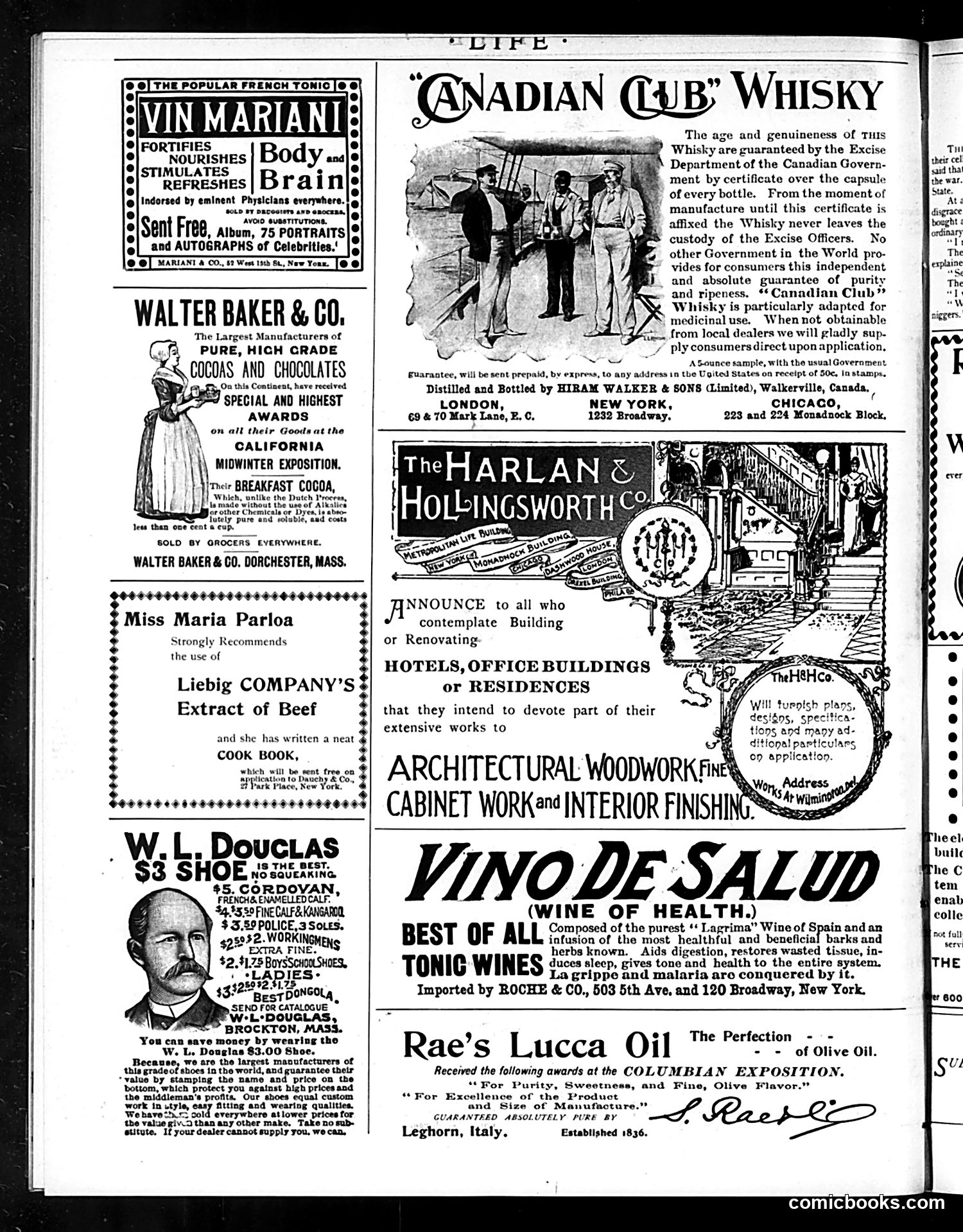
This is primarily a **advertisements page** with no political cartoons or satire. It consists entirely of commercial promotions typical of late 19th-century American magazines. The ads promote various products marketed as health remedies and consumer goods: - **Vin Mariani**: A French "tonic" wine claiming to fortify the body and brain, endorsed by physicians - **Walter Baker & Co.**: Cocoa and chocolate products - **Liebig Company**: Beef extract with cookbook - **W.L. Douglas**: $3 shoes advertised as quality footwear - **Canadian Club Whisky**: Emphasized government certification of purity and age; marketed for "medicinal use" - **Harlan & Hollingsworth Co.**: Architectural woodwork services - **Vino de Salud**: Spanish wine marketed as tonic medicine - **Rae's Lucca Oil**: Olive oil with awards from the Columbian Exposition These reflect an era when patent medicines, fortified wines, and dubious health products were heavily advertised without modern FDA regulation.
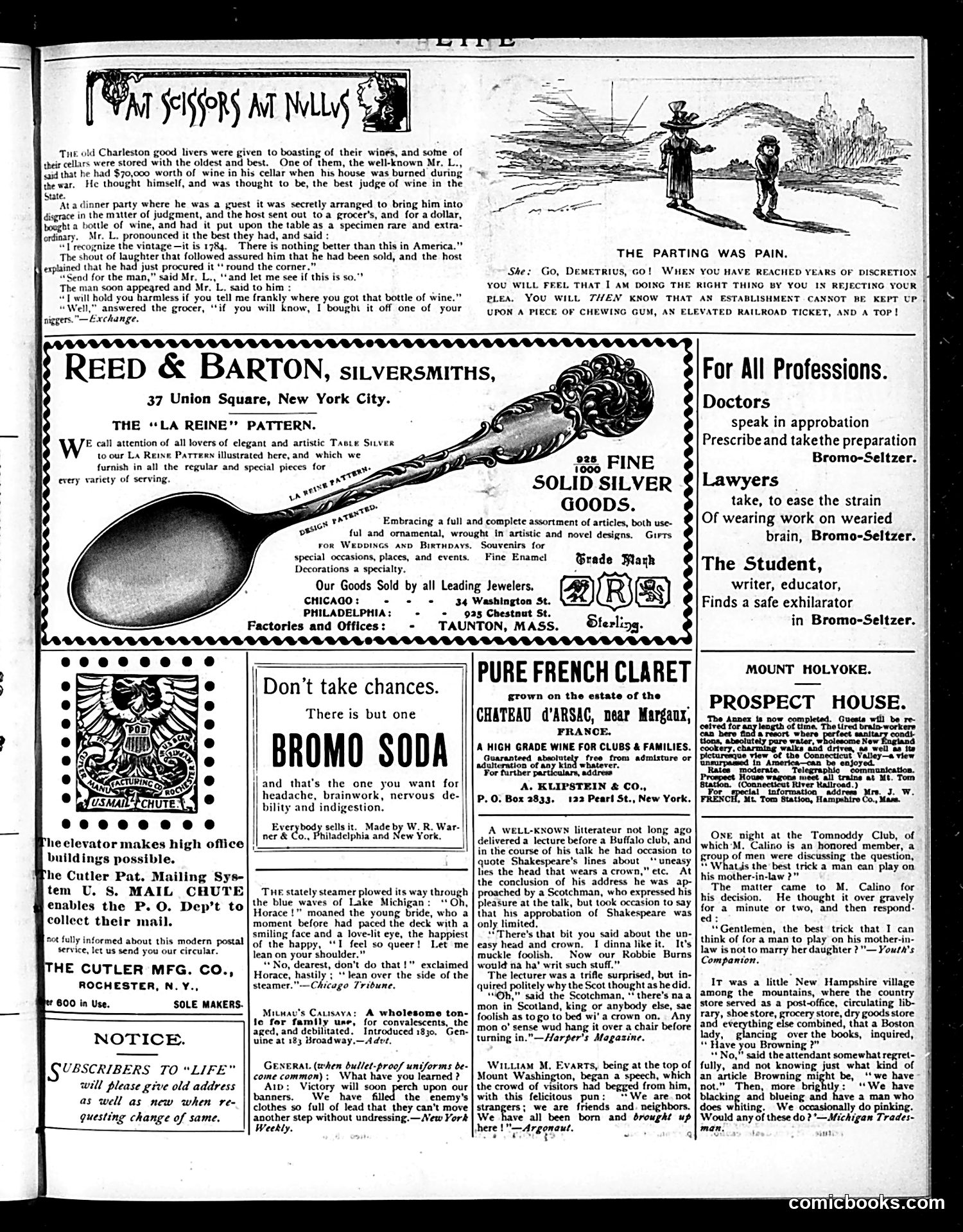
**"Fat Scissors at Nelly's"** (top left): This is a humorous anecdote mocking a Charleston wine connoisseur. Mr. L., famous for claiming expertise in rare wines, is tricked at a dinner party into praising a cheap grocery-store bottle as an 1784 vintage. When exposed as a fraud, he demands to know the wine's origin. The grocer's revelation that he bought it from "one of your niggers" (enslaved people) is the punchline—suggesting the wine came from a slave's theft or that Mr. L.'s own enslaved workers duped him. The satire ridicules his pretension and gullibility. **"The Parting Was Pain"** (top right): A cartoon showing a figure dismissing someone, lecturing about "discretion" and proper behavior. The caption suggests domestic discipline or employer-worker conflict, though context is unclear. The page is primarily **advertisements** for silverware (Reed & Barton), Bromo Soda, and other products, interspersed with brief humorous anecdotes typical of Life magazine's satirical format.
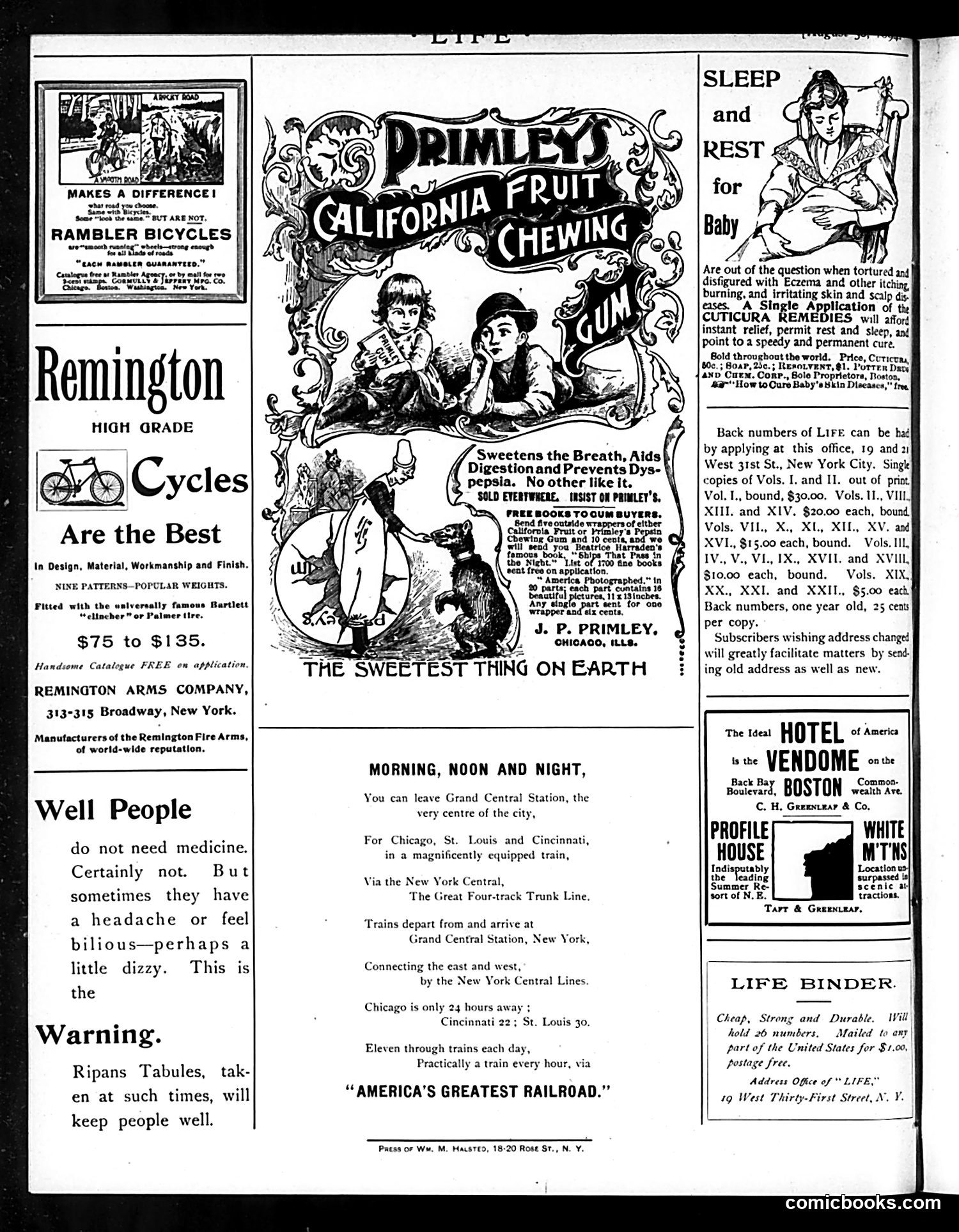
This page is primarily **advertising**, not political satire. It contains multiple product advertisements typical of early 20th-century American magazines: **Main Advertisement:** Primley's California Fruit Chewing Gum dominates the center, featuring illustrated children and promotional copy emphasizing digestive benefits—reflecting period claims that chewing gum aided digestion and prevented dyspepsia. **Other Notable Ads:** - Rambler and Remington bicycles (popular consumer goods) - Ripans Tabules (patent medicine) - Cuticura Remedies (for skin conditions) - New York Central Railroad ("America's Greatest Railroad") - Hotel Vendome in Boston - Life magazine back issues and binders **Context for Modern Readers:** These ads showcase **patent medicine culture** and **unregulated health claims** common before FDA regulations (1906 onwards). Companies freely advertised remedies for vague ailments like "biliousness" without scientific evidence. The gum advertisement offering free books as purchase incentives was standard promotional practice. The page reflects **commercialized mass media** and the advertising-dependent magazine business model of the era.