
Life, 1894-08-30 · page 6 of 16
Life — August 30, 1894 — page 6: what you’re looking at
What you’re looking at
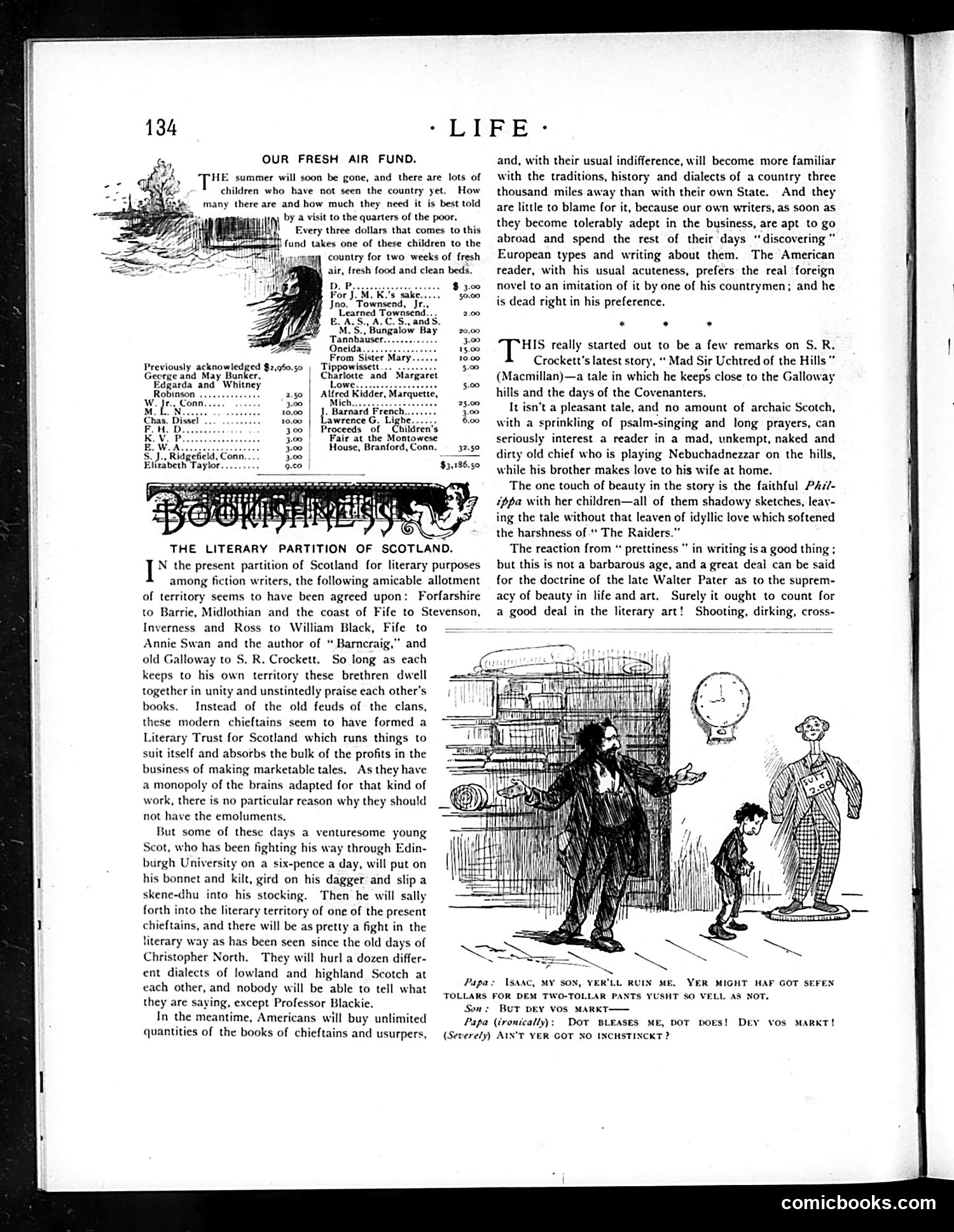
This page contains two distinct sections: **Top section ("Our Fresh Air Fund"):** A charitable fundraising appeal listing donor contributions for sending poor urban children to the countryside for two weeks. The accompanying sketches illustrate the program's purpose—giving underprivileged kids healthier conditions. **Bottom section ("The Literary Partition of Scotland"):** A satirical commentary on Scottish literary territories, where major authors (Stevenson, Barrie, Crockett, etc.) have claimed exclusive regional dominions. The text mocks this territorial division while praising a story by S.R. Crockett. **The cartoon** shows a father scolding his son over ruined expensive pants, with the child protesting. It's a humorous domestic scene illustrating parental frustration—likely commenting on childhood mischief and clothing costs, a relatable everyday situation rather than political satire.
📄 Transcribed text from this page (OCR, searchable)
Machine-transcribed from the original scan — historical spelling and the odd misread are preserved.
LIFE OUR FRESH AIR FUND. HE summer will soon be gone, and there are lots of children who have not seen the country yet. How many there are and how much they need it is best told by a visit to the quarters of the poor. Every three dollars that comes to this fund takes one of these children to the omg country for two weeks of fresh air, fresh food and clean beds. D..P: 2 Bungalow Bay Tanabauser, Oneida From Sister Mary. Tippowissett Previously acknowledged $2,960.50 é Charlotte and Gecrge and May Bunker, Edgarda and Whitney Robiswa: . | Lor Alfred Ridder, Marquette, w. Conn. Mich... |. Barnard French. wrence G. Ligh Proceeds of Children’s Fair at the Montowese House, Branford, Conn. we boNe Chas. Dissel - F.H. D..... THE LITERARY PARTITION OF SCOTLAND. N the present partition of Scotland for literary purposes among fiction writers, the following amicable allotment of territory seems to have been agreed upon: Forfarshire to Barrie, Midlothian and the coast of Fife to Stevenson, Inverness and Ross to William Black, Fife to — Annie Swan and the author of “ Barncraig,” and old Galloway to S. R. Crockett. So long as each keeps to his own territory these brethren dwell together in unity and unstintedly praise each other's books. Instead of the old feuds of the clans, these modern chieftains seem to have formed a Literary Trust for Scotland which runs things to suit itself and absorbs the bulk of the profits in the business of making marketable tales. As they have a monopoly of the brains adapted for that kind of work, there is no particular reason why they should not have the emoluments. But some of these days a venturesome young Scot, who has been fighting his way through Edin- burgh University on a six-pence a day, will put on his bonnet and kilt, gird on his dagger and slip a skene-dhu into his stocking. Then he will sally forth into the literary territory of one of the present chieftains, and there will be as pretty a fight in the literary way as has been seen since the old days of Christopher North. They will hurl a dozen differ- ent dialects of lowland and highland Scotch at each other, and nobody will be able to tell what they are saying, except Professor Blackie. In the meantime, Americans will buy unlimited quantities of the books of chieftains and usurpers, Son: Papa: TOLLARS FOR DEM TWO-TOLLAR PANTS YUSHT SO VE! Papa (éronicalty) : (Severely) AIN'T YER GOT NO INCHSTINCKT ? and, with their usual indifference, will become more familiar with the traditions, history and dialects of a country three thousand miles away than with their own State. And they are little to blame for it, because our own writers, as soon as they become tolerably adept in the business, are apt to go abroad and spend the rest of their days ‘ discovering” European types and writing about them. The American reader, with his usual acuteness, prefers the real foreign novel to an imitation of it by one of his countrymen; and he is dead right in his preference. * . . HIS really started out to be a few remarks on S. R. Crockett’s latest story, “ Mad Sir Uchtred of the Hills (Macmillan)—a tale in which he keeps close to the Galloway hills and the days of the Covenanters. It isn’t a pleasant tale, and no amount of archaic Scotch, with a sprinkling of psalm-singing and long prayers, can seriously interest a reader in a mad, unkempt, naked and dirty old chief who is playing Nebuchadnezzar on the hills, while his brother makes love to his wife at home. The one touch of beauty in the story is the faithful PAd/- ippa with her children—all of them shadowy sketches, leav- ing the tale without that leaven of idyllic love which softened the harshness of * The Raiders.” The reaction from “ prettiness " in writing isa good thing ; but this is not a barbarous age, and a great deal can be said for the doctrine of the late Walter Pater as to the suprem- acy of beauty in life and art. Surely it ought to count for a good deal in the literary art! Shooting, dirking, cross- YER MIGHT HAF GOT SE! AS NOT. Isaac, MY SON, YER'LL RUIN ME. But Dey vos MARKT—— Dot BLEASES ME, DOT DOES! Dey vos MARKT! comicbooks.com