
A complete issue · 14 pages · 1894
Life — August 23, 1894
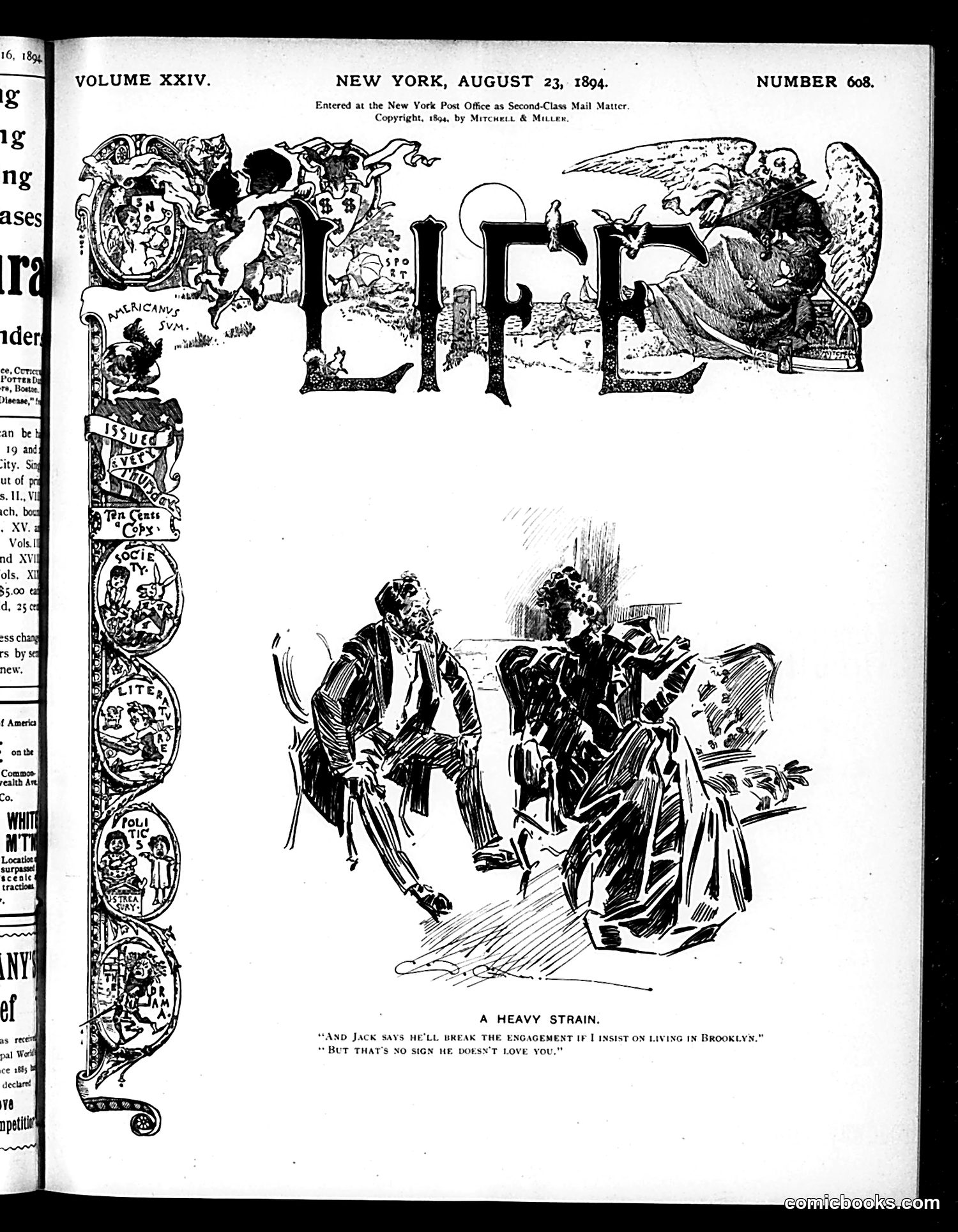
This cartoon depicts a domestic dispute centered on a disagreement about residence. The caption reads: "And Jack says he'll break the engagement if I insist on living in Brooklyn. But that's no sign he doesn't love you!" The humor targets the class tensions of 1890s New York. Brooklyn, though technically part of the greater metropolitan area, was considered less prestigious than Manhattan by wealthy New Yorkers. The joke satirizes the absurdity of a suitor claiming love while refusing to live in Brooklyn—suggesting his "love" is conditional on social status rather than genuine affection. The woman's companion attempts to rationalize this contradiction, highlighting the shallow materialism of Gilded Age courtship and the anxieties surrounding geographic and social positioning in the rapidly developing city.
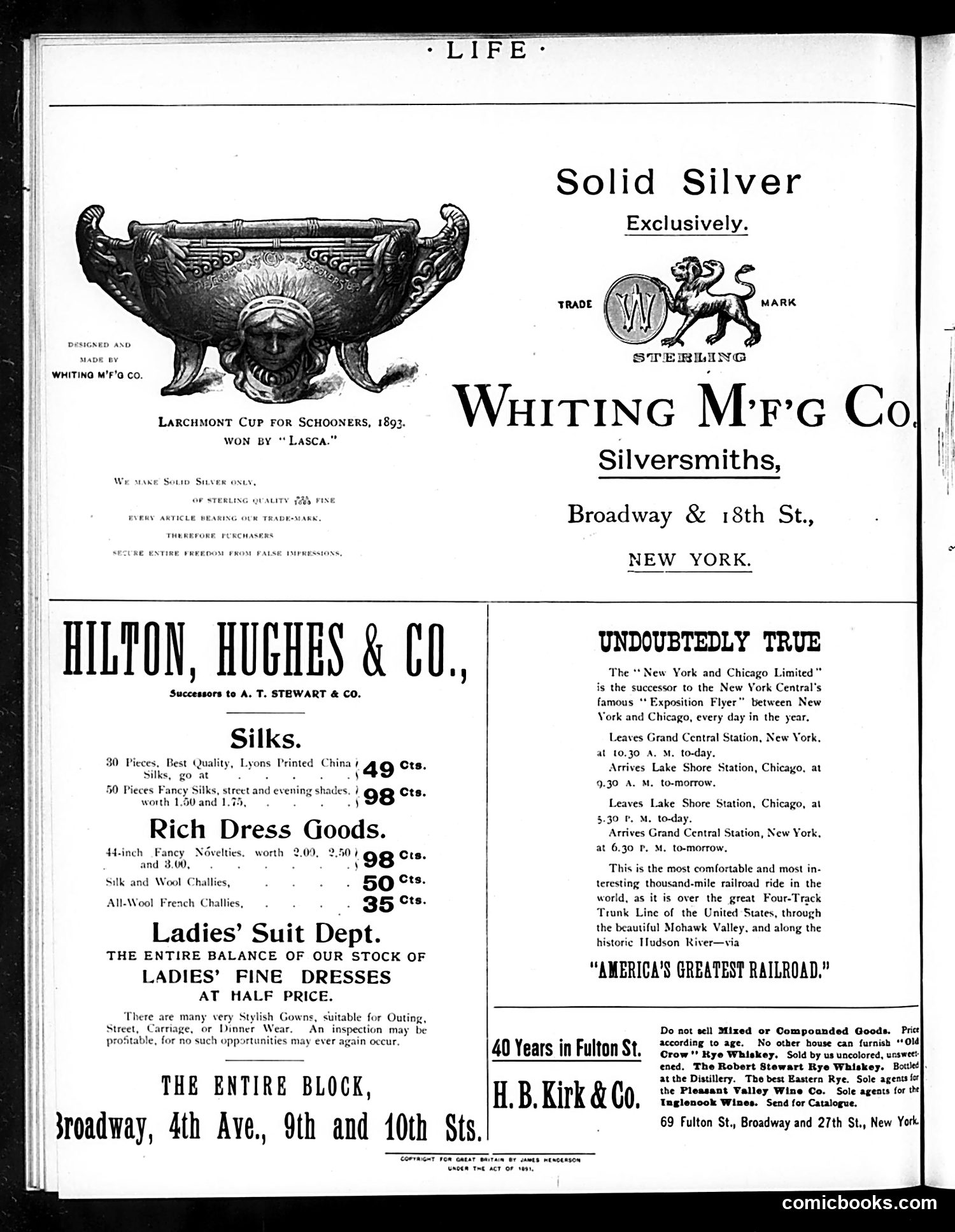
This page is **primarily advertising** rather than satirical content. The upper half features an ornate silver cup (the "Larchmont Cup for Schooners, 1893") promoting Whiting Mfg Co's sterling silver goods. Below are advertisements for Hilton, Hughes & Co. (silks and dress goods), H.B. Kirk & Co. (whiskey), and a railroad service ("America's Greatest Railroad"). The only potentially editorial content is a brief advertisement for the New York and Chicago Limited train, described with some promotional hyperbole as the "most comfortable and most interesting thousand-mile railroad ride in the world." The page reflects **late 19th-century magazine economics**, where advertising revenue subsidized publication. No clear political satire or social commentary is evident in the visible content.
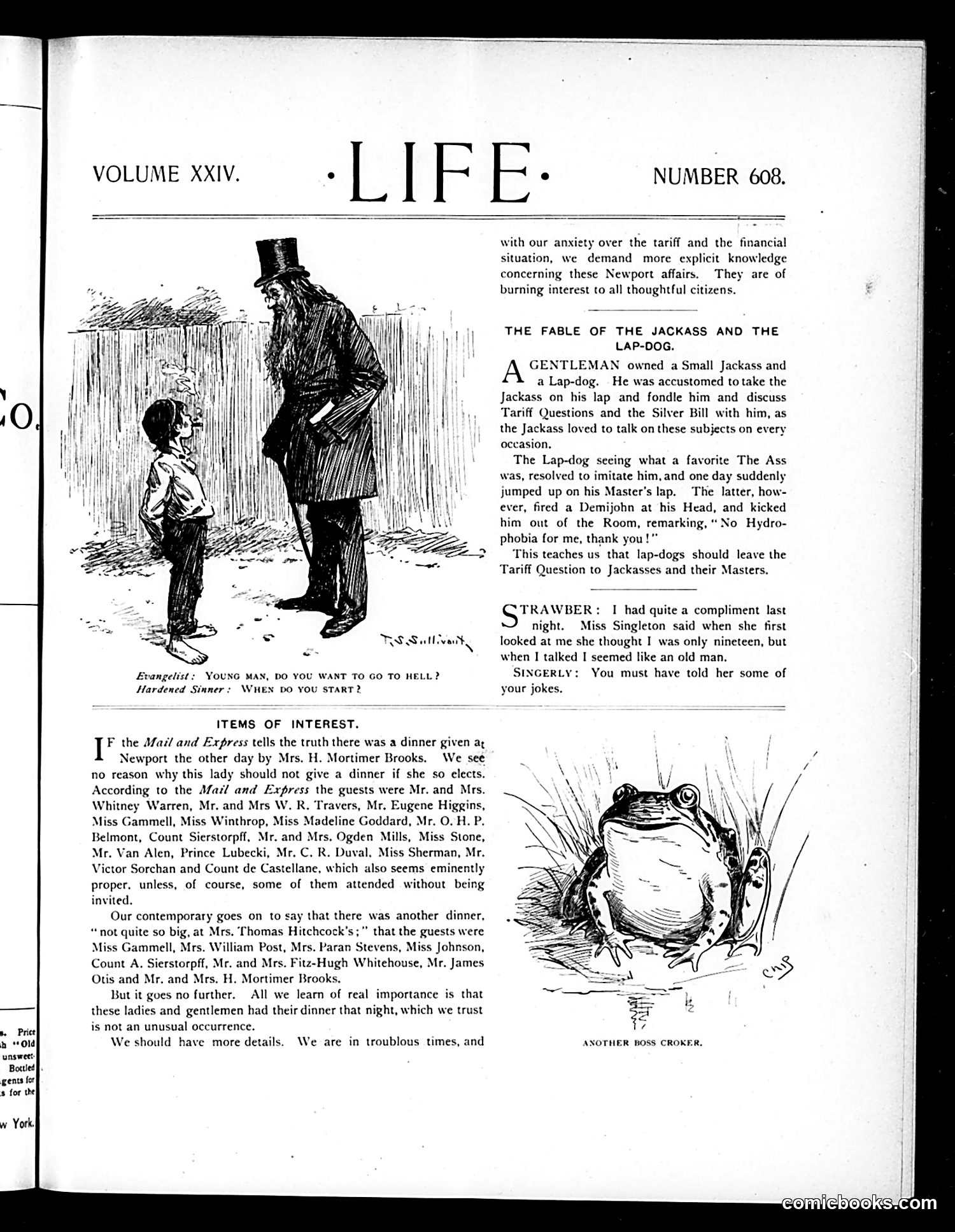
The page contains two distinct elements: **Top Cartoon:** Shows a tall gentleman in a top hat addressing a young boy, with the caption "Evangelist: Young man, do you want to go to hell? Hardened Sinner: When do you start?" This is straightforward satirical humor mocking both evangelical preachers and irreverent youth culture—poking fun at the clash between religious fervor and modern skepticism. **"The Fable of the Jackass and the Lap-Dog":** A moral fable where a lap-dog foolishly imitates a jackass (which then kicks him), teaching that lap-dogs should leave tariff debates to jackasses and their masters. This appears to be political satire about the tariff question, with animals representing different classes or groups, though the specific contemporary reference is unclear. The lower section discusses Newport dinner parties among society figures.
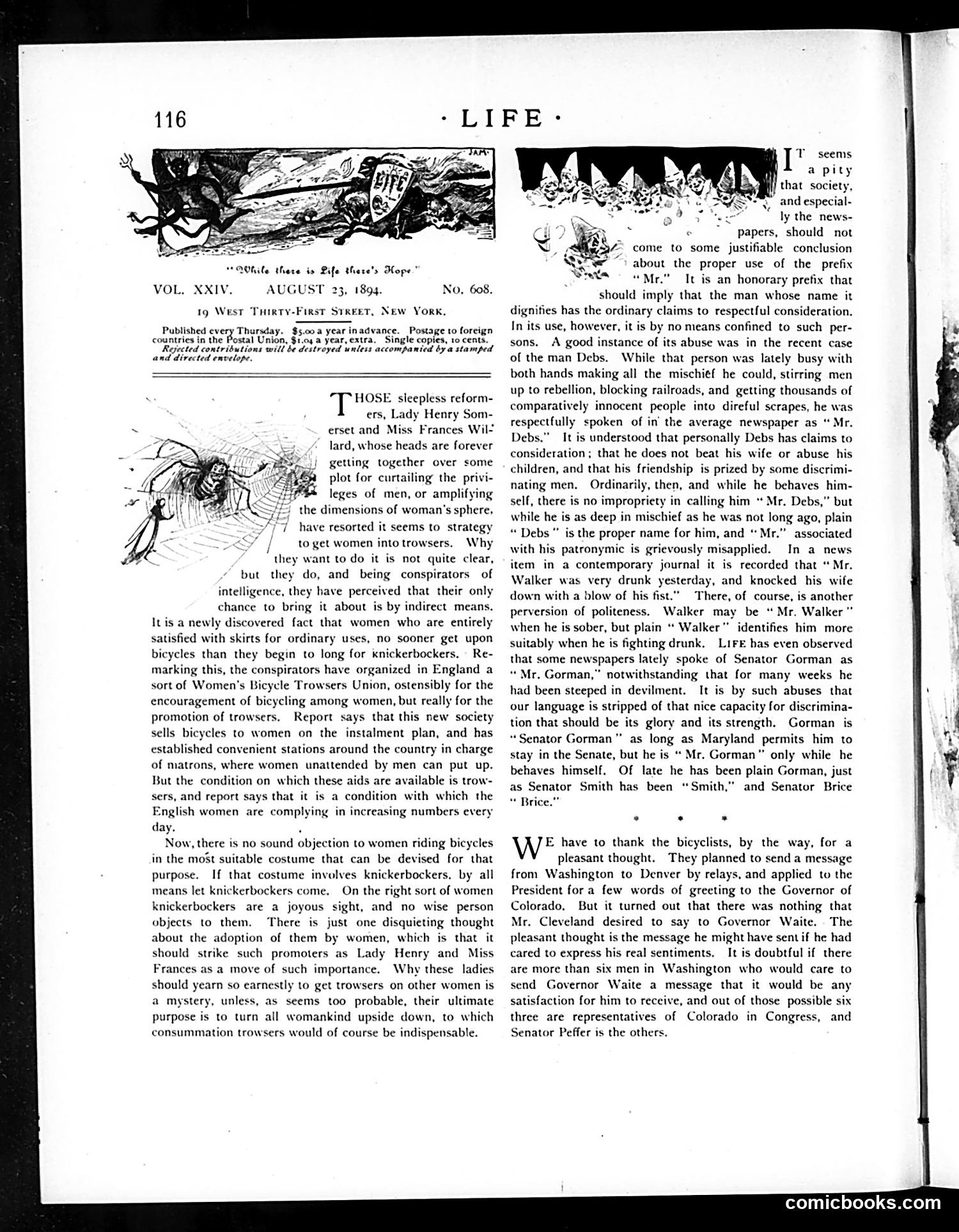
This page contains political commentary rather than cartoons. The text satirizes the misuse of honorary titles, particularly the prefix "Mr." used before surnames like "Debs" and "Gorman." The article criticizes how newspapers apply "Mr." selectively to legitimize certain figures while denying them to others—particularly senators and politicians. It appears to mock the inconsistent application of this respectful designation as a form of social control or editorial bias. The piece references Senator Gorman and Senator Smith by name, suggesting contemporary political figures were subject to this editorial treatment. The satire suggests that withholding or granting the courtesy title "Mr." was weaponized to either elevate or diminish public figures' respectability in the eyes of readers.
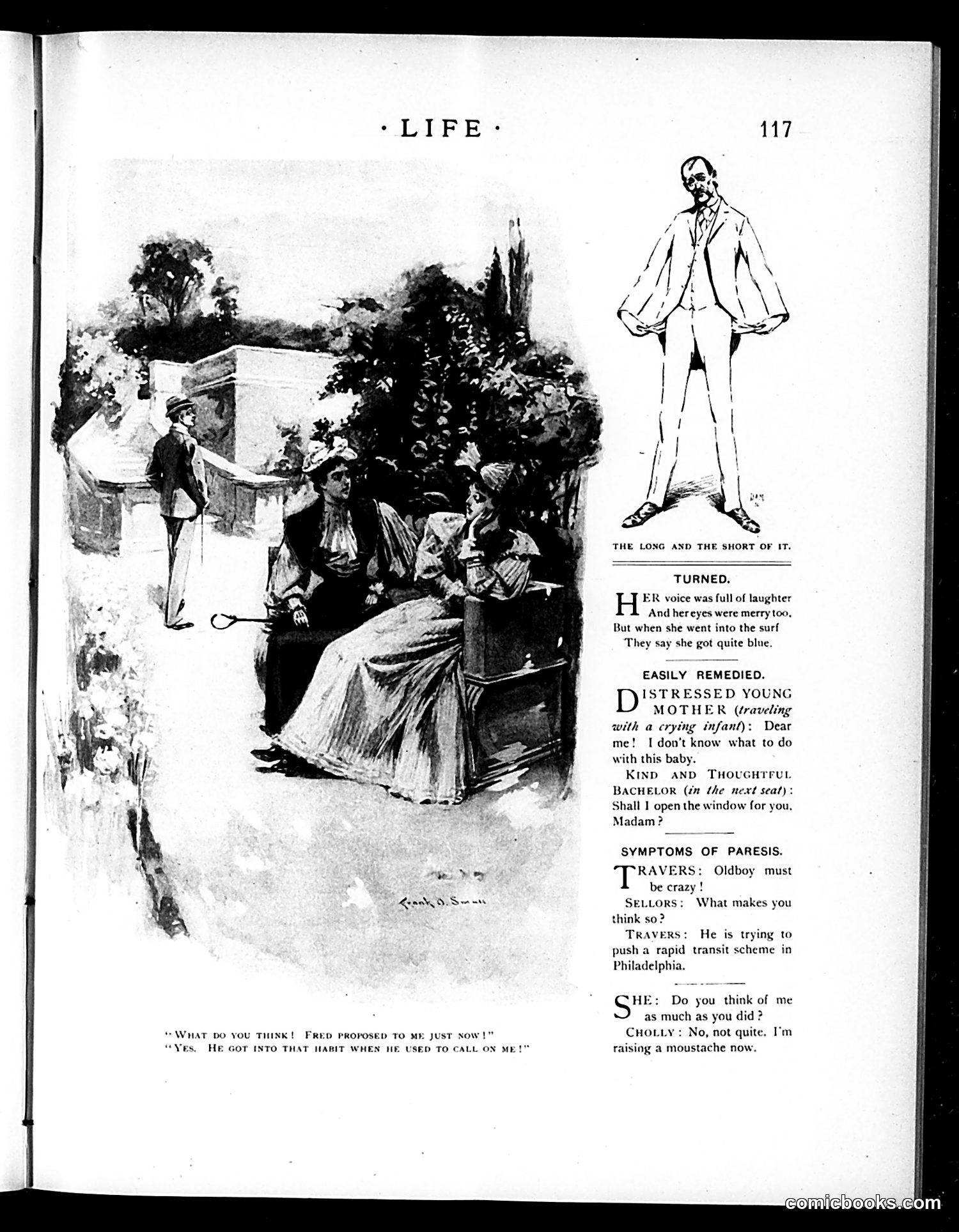
This page contains several short satirical pieces rather than a single cartoon. **Left illustration**: Shows a social scene with the caption "What do you think? Fred proposed to me just now!" / "Yes. He got into that habit when he used to call on me!" This jokes about a man's recurring proposal habit—suggesting he's chronically unsuccessful at matrimony, having proposed to multiple women. **Right side sketches and text**: Include pieces titled "Turned," "Easily Remedied," and "Symptoms of Paresis." These appear to be brief comedic dialogues poking fun at romantic misunderstandings, distressed mothers, bachelors, and marital anxieties—typical early 20th-century Life magazine humor targeting middle-class courtship and marriage customs. The overall theme: satirizing courtship rituals and relationship awkwardness among the genteel classes.
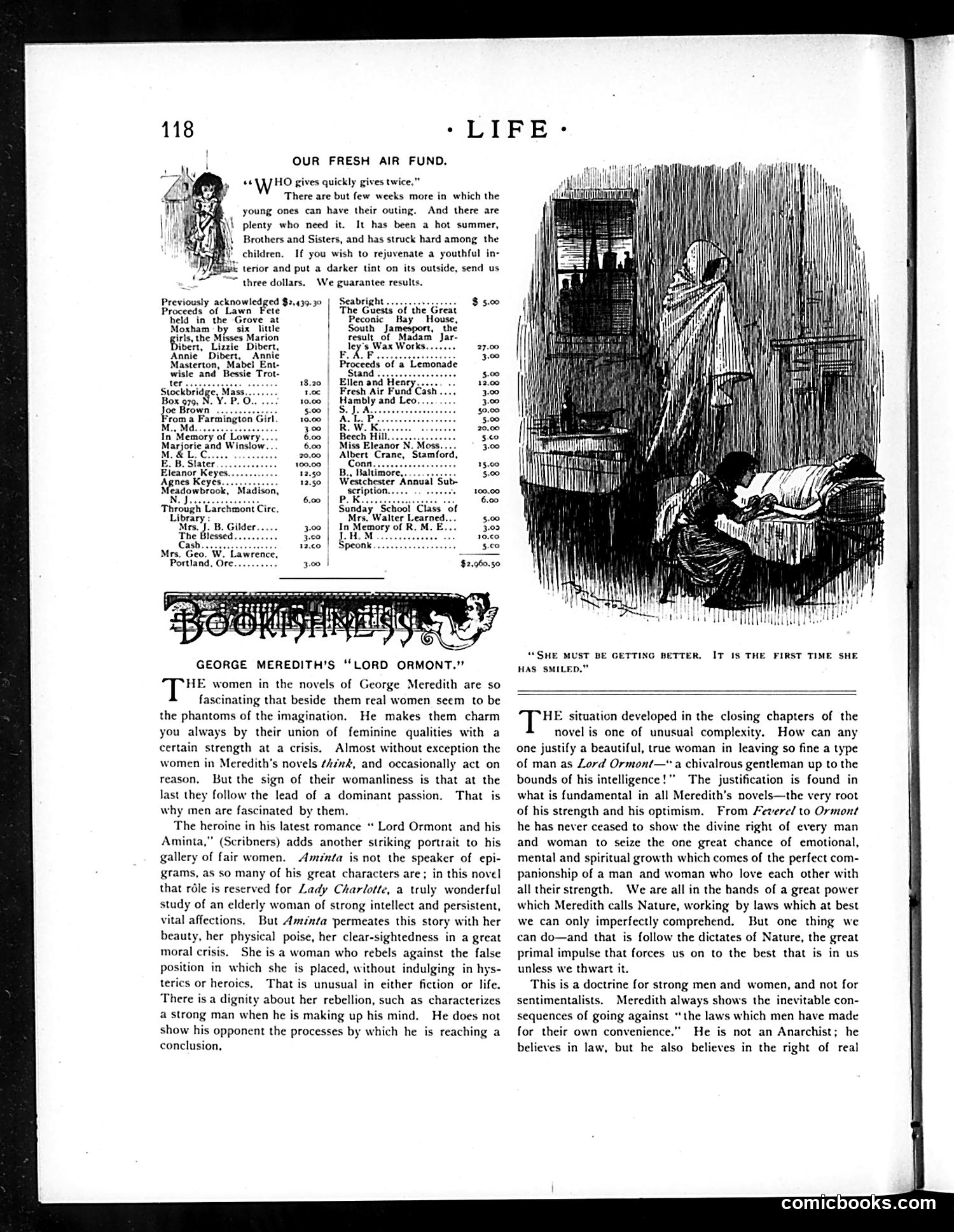
This page contains two distinct sections: **Upper half:** "Our Fresh Air Fund" — a charitable appeal soliciting donations (minimum $3) to send poor urban children to the countryside for summer recuperation. The accompanying illustration shows a sickly child near a tenement window, emphasizing the health benefits of fresh air for impoverished youth. This reflects early 20th-century Progressive Era concerns about child welfare and urban poverty. **Lower half:** A book review of George Meredith's novel *Lord Ormont*, praising Meredith's female characters as psychologically complex and morally independent. The reviewer emphasizes that Meredith depicts women with intellectual strength and agency, particularly the character Lady Charlotte, who "rebels against false position" without theatrical heroics. The page reflects contemporary cultural and social reform interests rather than political satire.
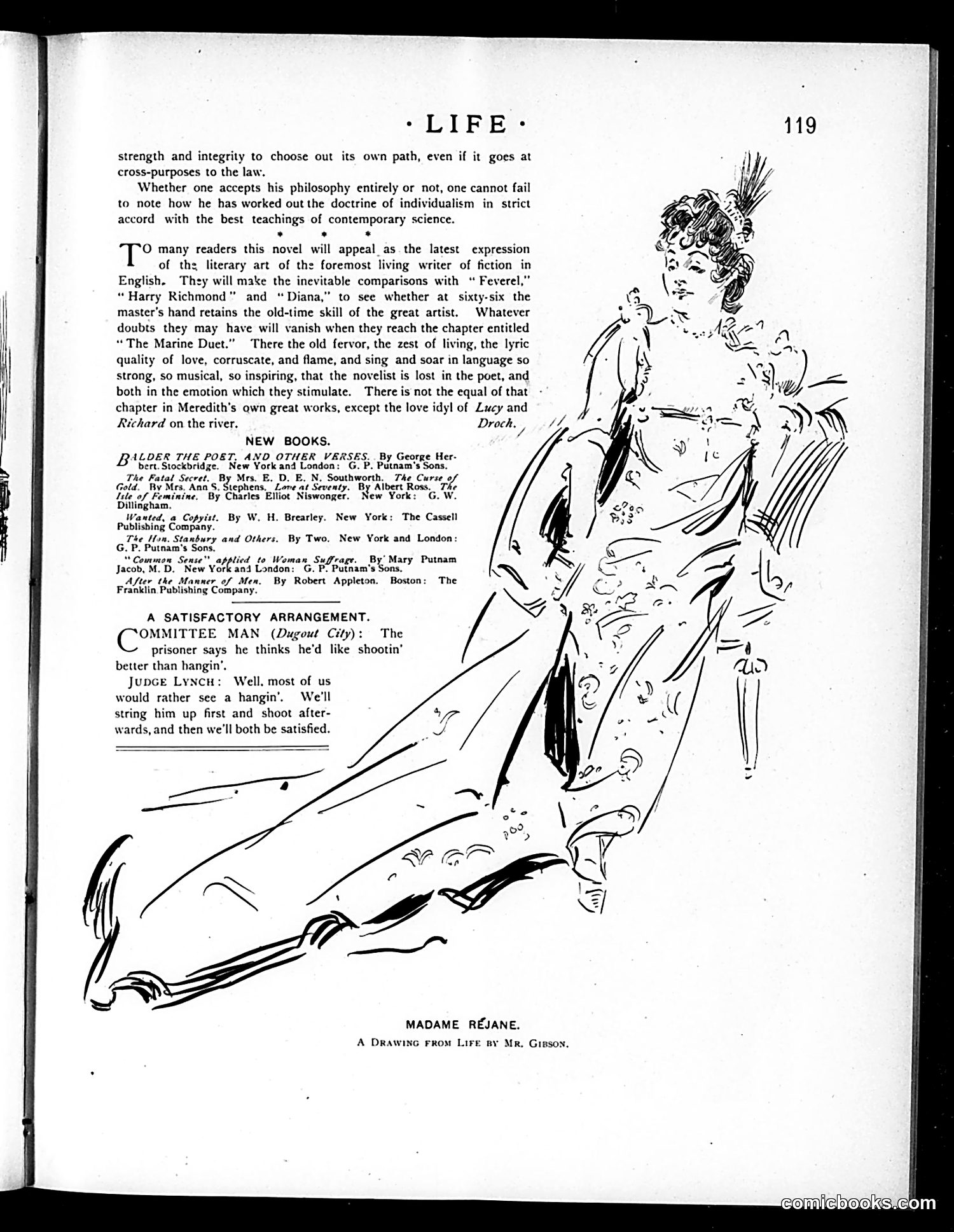
This page contains a literary review section and a satirical sketch titled "Madame Réjane" (drawn by Mr. Gibson). The sketch depicts a fashionable woman in an elaborate, flowing gown with ornate styling—typical Gibson Girl aesthetic from the early 1900s. Below the illustration is a brief comedic dialogue titled "A Satisfactory Arrangement" between a Committee Man and a prisoner debating execution methods (shooting versus hanging). The joke relies on dark humor about capital punishment. The upper text reviews contemporary novels, praising one author's mastery of literary form and comparing works to established classics like "Feverel" and "Harry Richmond." Without additional context, the specific satirical targets of "Madame Réjane" remain unclear, though the Gibson illustration likely caricatures contemporary fashion or society figures.
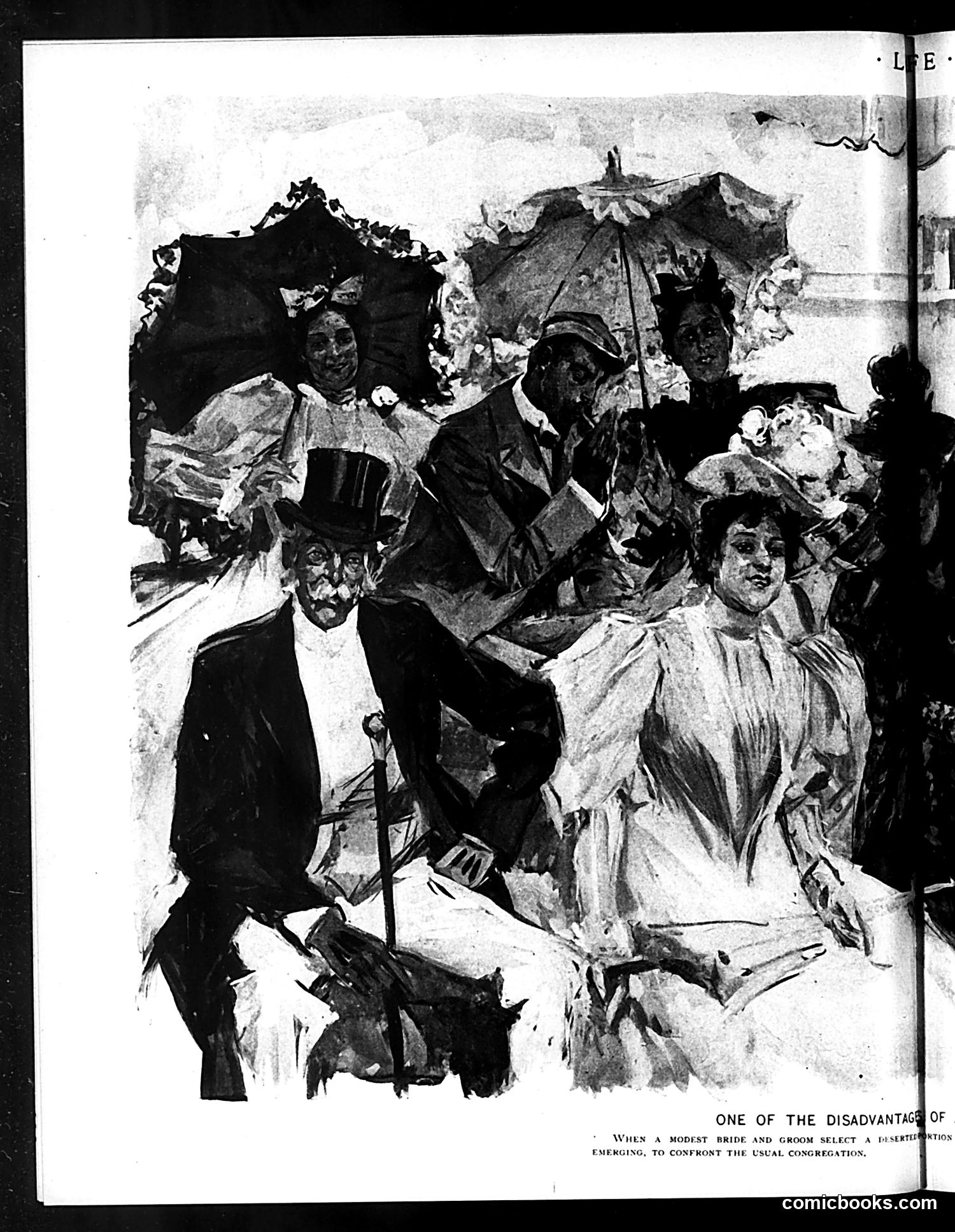
This satirical illustration depicts a wedding scene with the caption "ONE OF THE DISADVANTAGES OF WHEN A MODEST BRIDE AND GROOM SELECT A DESCRIPTION EMERGING, TO CONFRONT THE USUAL CONGREGATION." The cartoon mocks a couple who chose an unconventional or modest wedding ceremony. The image shows formally dressed guests (in top hats and formal wear) appearing startled or uncomfortable as what appears to be an unusual or unexpected wedding procession emerges. The figures in the background seem chaotic or unconventional compared to the dignified guests in front. The satire targets the social awkwardness that results when a bride and groom reject traditional wedding conventions. Their modest, non-conformist choice clashes with guests' expectations of formality and proper etiquette. Life magazine is poking fun at the couple's attempt at individuality and the resulting social discomfort it creates among the conventional attendees.
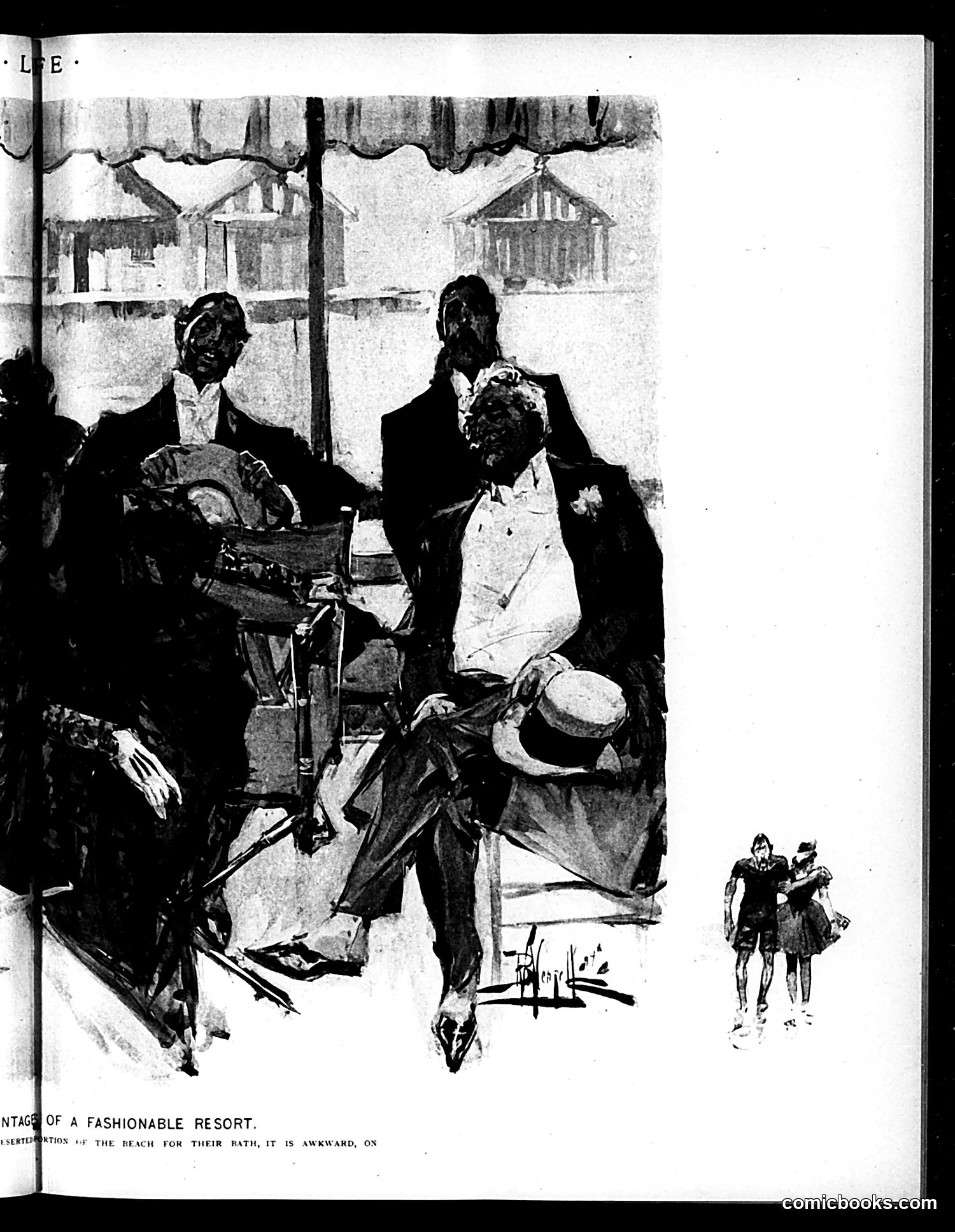
This page from *Life* magazine shows a satirical illustration titled "Vintage of a Fashionable Resort." The caption references "the Beach for Their Bath, It is Awkward, On" (text partially obscured). The image depicts well-dressed men in formal attire at what appears to be a seaside resort, with a woman in the center. The satire likely mocks the social awkwardness or pretension of fashionable beach resorts—specifically how formal-dressed gentlemen appear uncomfortable or out of place in a beach setting meant for bathing and leisure. The smaller figure sketch in the lower right may show beachgoers in more appropriate resort wear, creating contrast with the overdressed figures in the main scene. The humor appears directed at Victorian/Edwardian era social conventions that clashed with recreational activities.
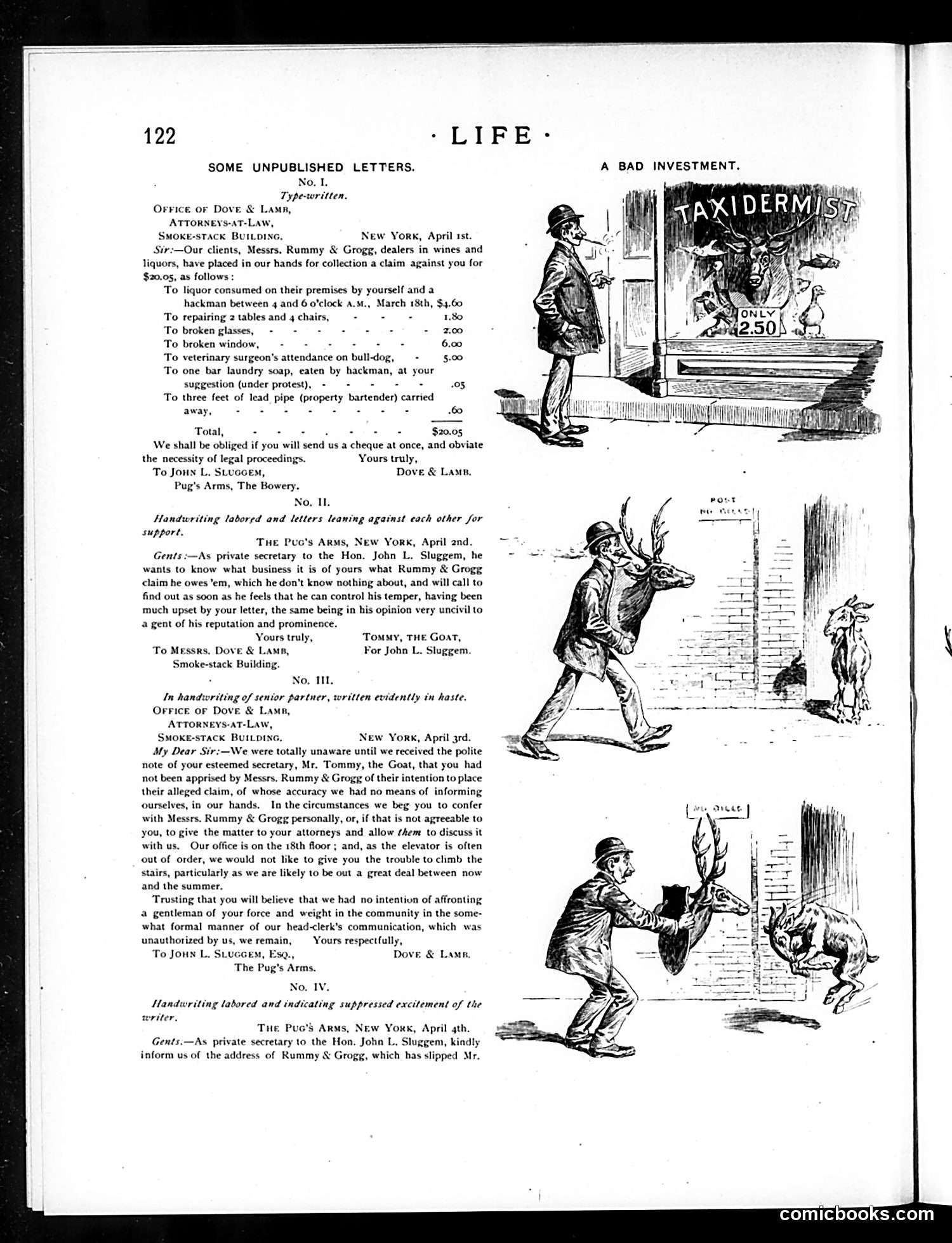
This cartoon satirizes a man visiting a taxidermist shop advertising "$2.50" service. The sequential panels show the man progressively transforming into various mounted animal poses—first like a deer, then in increasingly contorted positions mimicking taxidermied specimens. The joke appears to be a dark pun: the man is literally becoming a taxidermy exhibit, suggesting he's made a "bad investment" by patronizing this business. The cartoon mocks either the taxidermist's suspicious practices or the absurdity of paying for such cheap taxidermy work. The visual humor relies on the surreal transformation and the double meaning of "investment"—financial and physical.
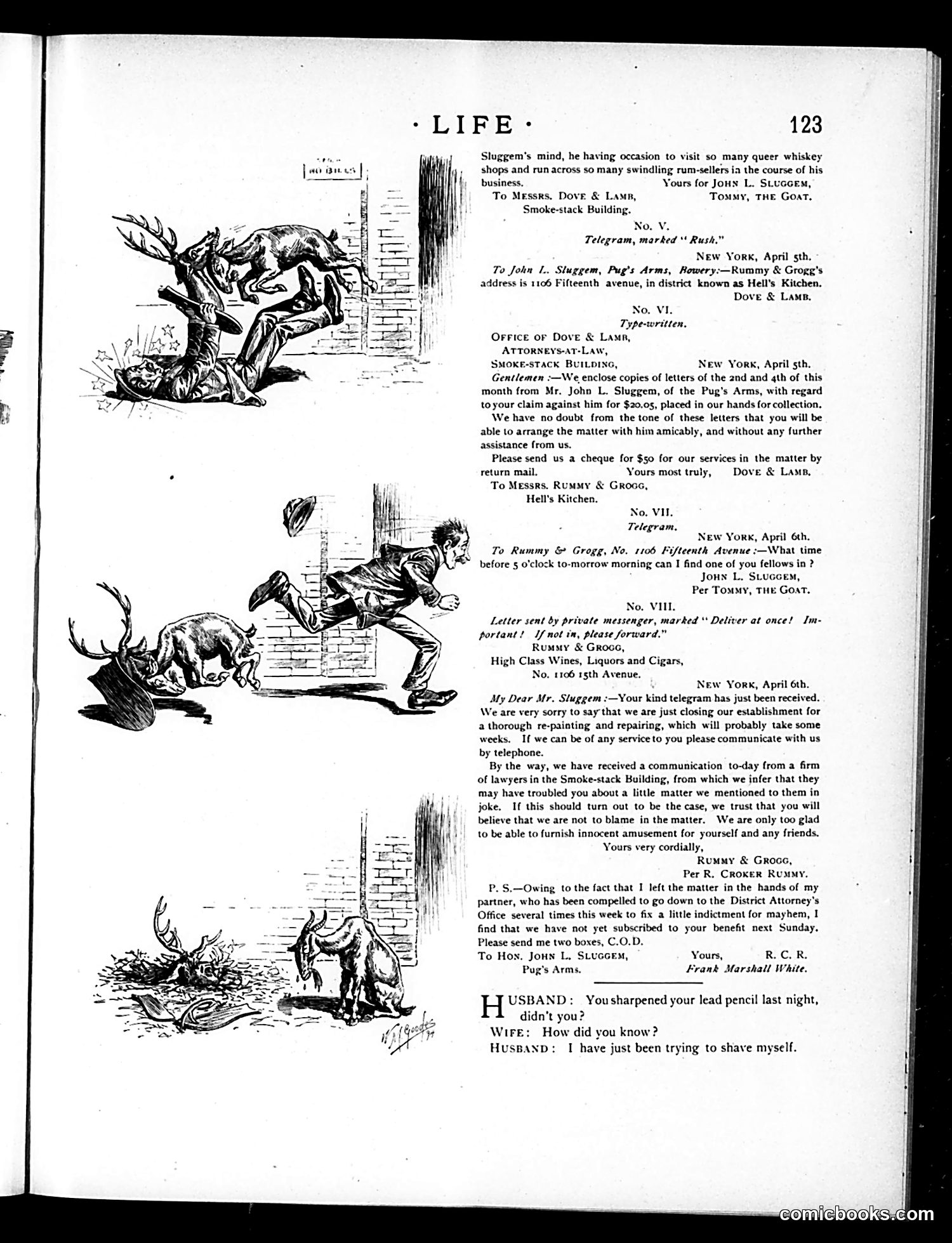
This page contains satirical correspondence addressing John L. Sluggem regarding various business disputes and collection matters. The left side features cartoon illustrations of animals (deer, goats, and other creatures) in exaggerated poses, likely satirizing human behavior through anthropomorphism—a common Life magazine technique. The letters mock Sluggem's involvement in questionable business dealings, including disputes with lawyers in the "Smoke-stack Building" and implied debt collection issues. References to "Hell's Kitchen" (a rough Manhattan neighborhood) and telegram exchanges suggest urban commercial disputes of the era. The bottom includes a brief domestic joke about sharpening a pencil versus shaving—typical period humor about marital misunderstandings. The overall satire targets business fraud, debt evasion, and urban commercial dishonesty through mockingly formal correspondence.
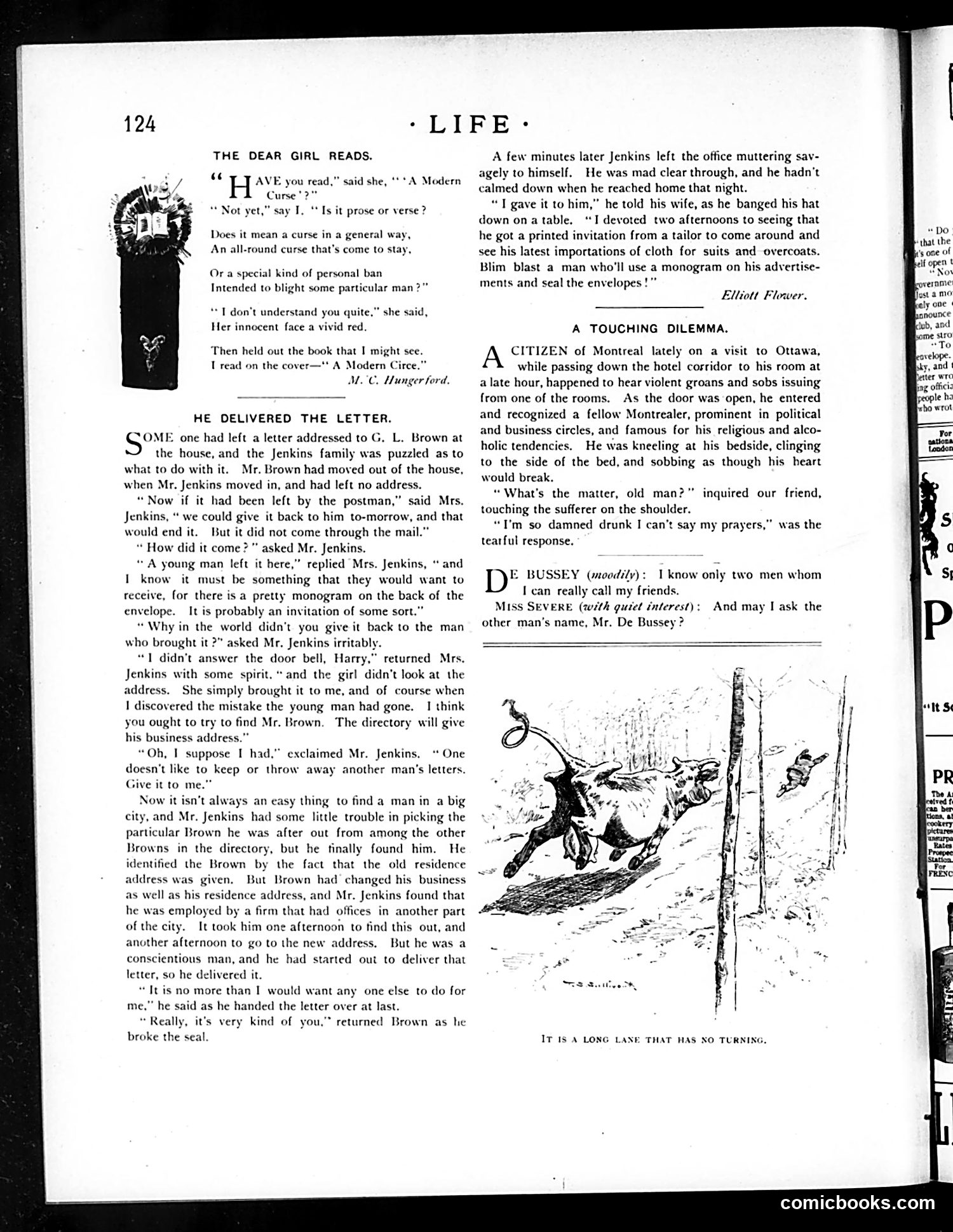
This page contains two humorous short stories satirizing everyday social situations and human folly. **"The Dear Girl Reads"** mocks pretentious literary discussion. A woman asks if the man has read *"A Modern Curse,"* and he comically over-interprets the title as either a general societal problem or a targeted curse against a specific man—when it's simply a book title. The joke targets affected intellectual conversation. **"He Delivered the Letter"** satirizes misplaced conscientiousness. Mr. Jenkins spends two afternoons locating and delivering a letter to Mr. Brown, only to discover it's a tailor's advertisement wearing a fancy monogram to appear important. Jenkins is furious at being manipulated by deceptive marketing disguised as personal correspondence. The satire targets both the tailor's dishonest advertising tactics and Jenkins's wasted effort in being "conscientious." The cartoon at bottom (captioned "It is a long lane that has no turning") appears unrelated to the text stories—a visual gag about a horse or rider on a winding road.
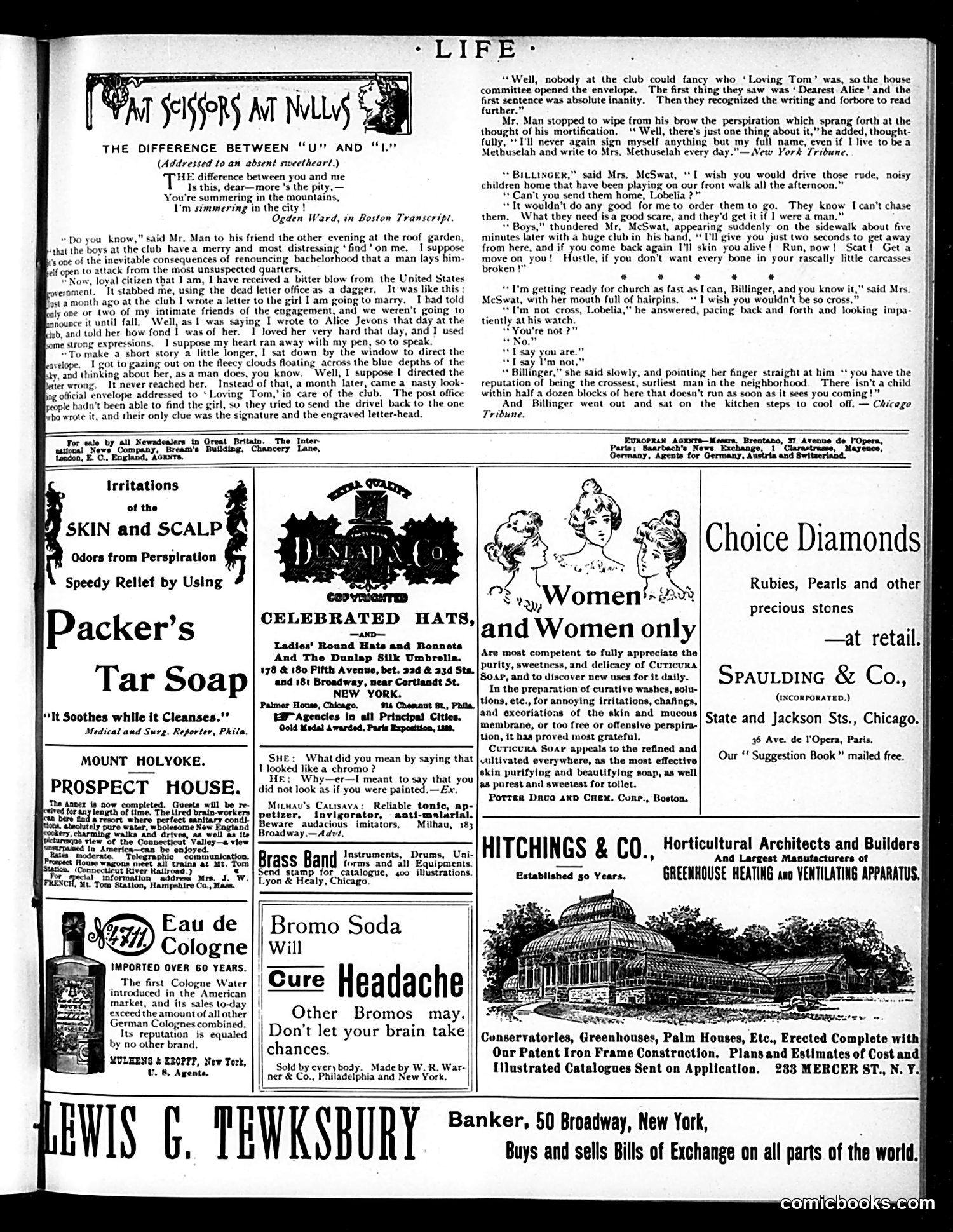
This page contains two humorous short stories satirizing romantic miscommunication and domestic life. The title piece tells of "Loving Tom," a man whose passionate love letter to his fiancée Alice gets lost and opened by his club's house committee, exposing his flowery sentiments to public embarrassment—the joke being that his signature created confusion about his identity, leading to mortification. The second story, "The McSwat Problem," depicts domestic hypocrisy: Mrs. McSwat complains she cannot discipline neighborhood children because she's a woman, but when her husband Mr. Billinger intervenes with threats, she then criticizes *his* supposedly terrible temper—catching him in a contradiction. The satire targets both gender expectations of the era and marital bickering. Both pieces use situational comedy to mock human folly rather than target specific political figures.
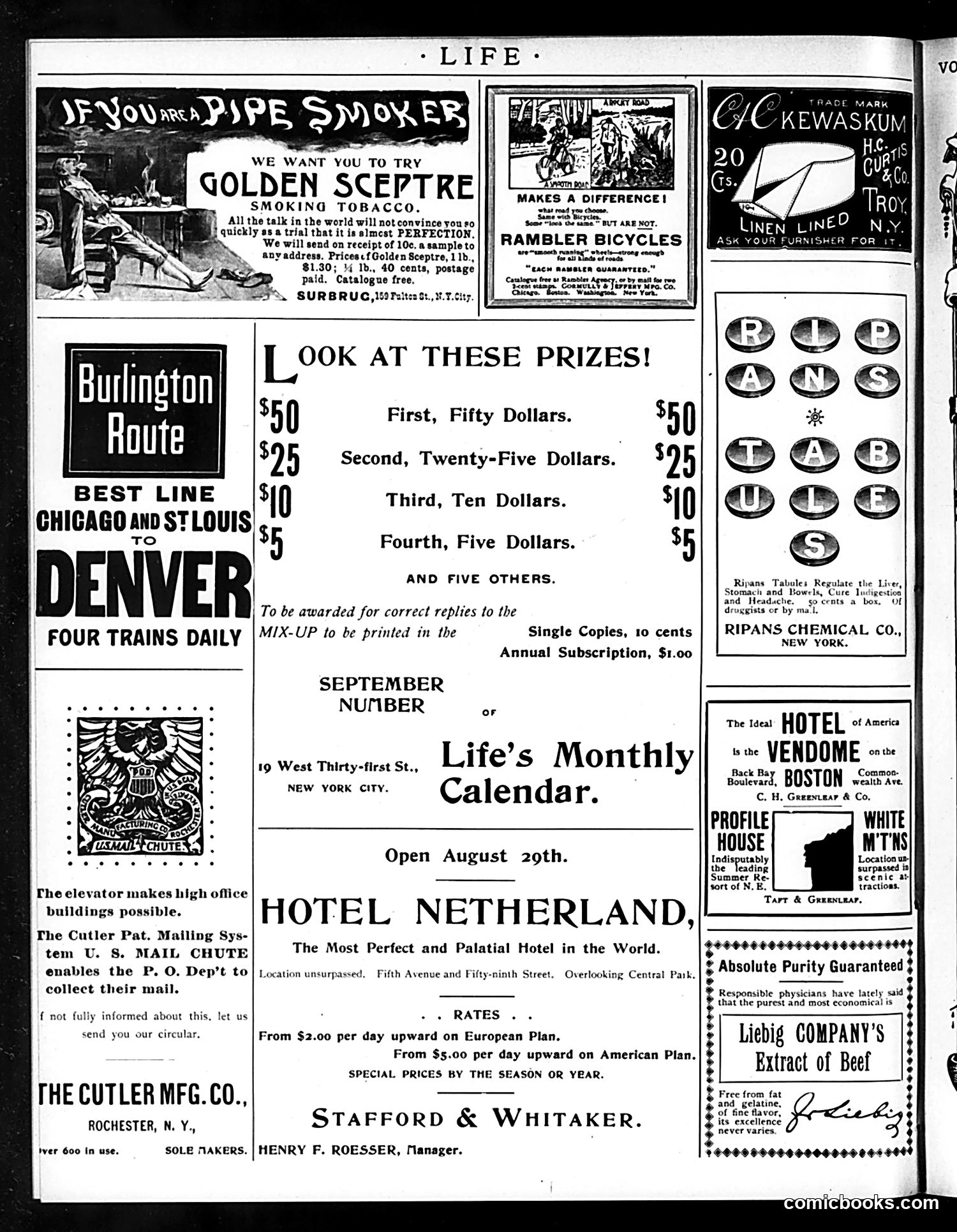
This is predominantly an advertisement page from *Life* magazine, not a political cartoon. The page contains multiple advertisements for period products and services: **Notable ads include:** - **Golden Sceptre Smoking Tobacco**: promotes its quality by offering free samples - **Burlington Route**: advertises train service from Chicago/St. Louis to Denver (four trains daily) - **Rambler Bicycles**: claims superiority over competitors - **Hotel Netherland**: a luxury New York hotel opening August 29th, located at Fifth Avenue and 59th Street overlooking Central Park - **Ripans Tabules**: patent medicine promising to regulate liver, stomach, and bowels - **Liebig Company's Extract of Beef**: promoted as pure and economical The page also advertises *Life's* September issue with a puzzle contest offering cash prizes ($50, $25, $10, $5) for correct answers. There are no visible political cartoons or satirical commentary on this particular page—it functions as a commercial advertisement section typical of period magazines.