
Life, 1894-08-23 · page 6 of 14
Life — August 23, 1894 — page 6: what you’re looking at
What you’re looking at
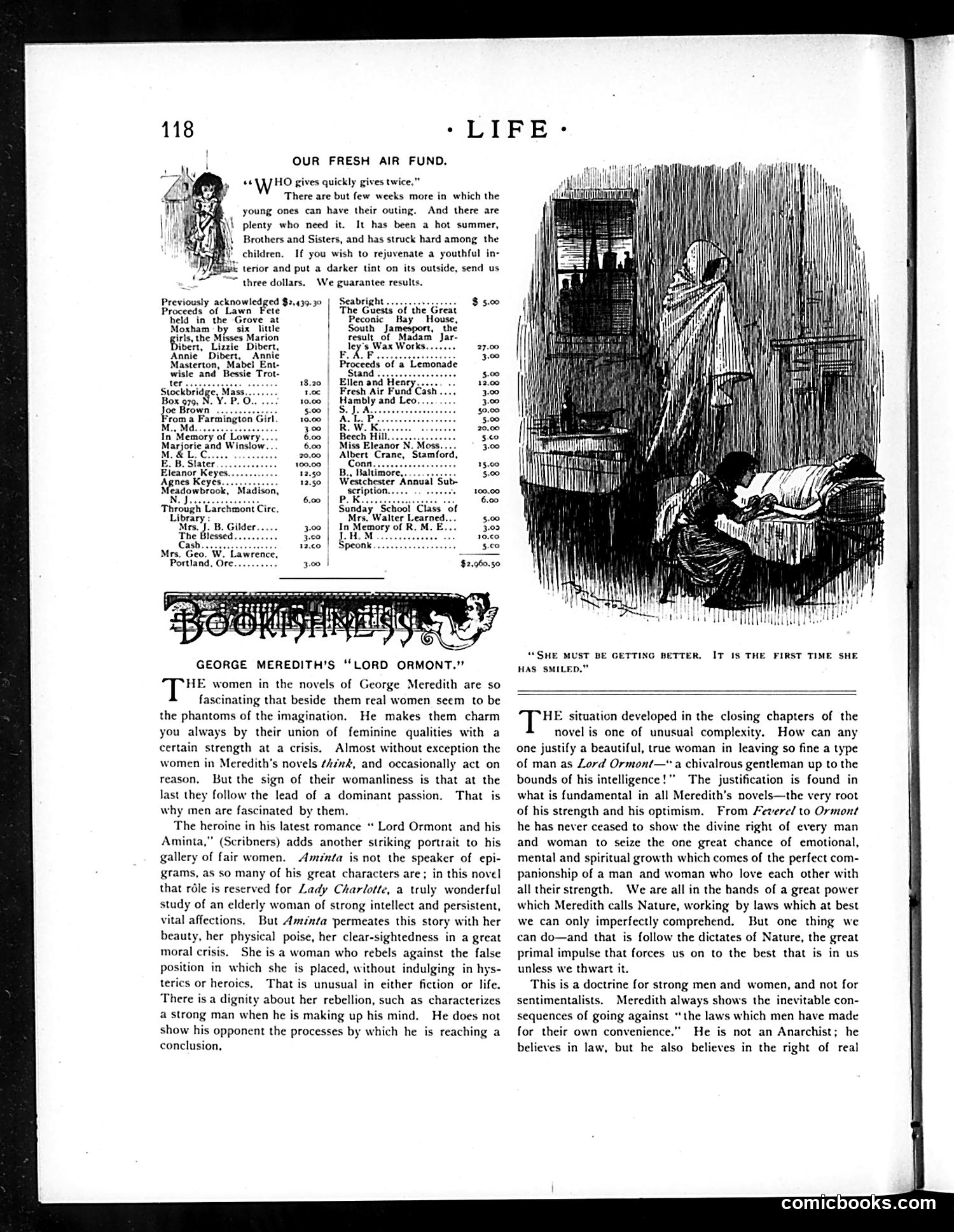
This page contains two distinct sections: **Upper half:** "Our Fresh Air Fund" — a charitable appeal soliciting donations (minimum $3) to send poor urban children to the countryside for summer recuperation. The accompanying illustration shows a sickly child near a tenement window, emphasizing the health benefits of fresh air for impoverished youth. This reflects early 20th-century Progressive Era concerns about child welfare and urban poverty. **Lower half:** A book review of George Meredith's novel *Lord Ormont*, praising Meredith's female characters as psychologically complex and morally independent. The reviewer emphasizes that Meredith depicts women with intellectual strength and agency, particularly the character Lady Charlotte, who "rebels against false position" without theatrical heroics. The page reflects contemporary cultural and social reform interests rather than political satire.
📄 Transcribed text from this page (OCR, searchable)
Machine-transcribed from the original scan — historical spelling and the odd misread are preserved.
* LIFE: OUR FRESH AIR FUND. yp YP HO gives quichly gives twice.” There are but few weeks more in which the young ones can have their outing. And there are N\\ plenty who need it. It has been a hot summer, Brothers and Sisters, and has struck hard among the children. If you wish to rejuvenate a youthful in- iv terior and put a darker tint on its outside, send us ~ three dollars. We guarantee results, Seabright . The Guests of the Great Bay House, the Previously acknowledged $2,439.39 | Proceeds of Lawn Fete held in the Grove at Moxham by six. little irls, the Misses Marion Bivert, “Lizzie Dibert, Annie’ Dibert, Annie Masterton, Mabel Ent- wisle and’ Bessie Trot- | | Stand 3 Ellen and Henry... ‘ Fresh Air Fund Cash Hambly and Leo Peconic | South In “Memory y Marjorie and Winslow E L. C. ‘Stamford, ‘onn. B,, Baltimore, * Westchester Annual Sub- scription, se P.K y, Schoo s Mrs, Walter Learned. In Memory of R. M. He M sss Through Larchmont Circ, Library : Mrs. J. B. Gilder... The Biessed ‘ash. ‘ Mrs. Geo. W. Lawrence, Portland, Ore. GEORGE MEREDITH’S ‘‘LORD ORMONT.” HE women in the novels of George Meredith are so fascinating that beside them real women seem to be the phantoms of the imagination. He makes them charm you always by their union of feminine qualities with a certain strength at a crisis. Almost without exception the women in Meredith's novels ¢/zn&, and occasionally act on reason, But the sign of their womanliness is that at the last they follow the lead of a dominant passion. That is why men are fascinated by them. The heroine in his latest romance ‘* Lord Ormont and his Aminta,” (Scribners) adds another striking portrait to his gallery of fair women. Amznta is not the speaker of epi- grams, as so many of his great characters are; in this novel that rdle is reserved for Lady Charlotte, a truly wonderful study of an elderly woman of strong intellect and persistent, vital affections. But Aménta permeates this story with her beauty, her physical poise, her clear-sightedness in a great moral crisis. She is a woman who rebels against the false position in which she is placed, without indulging in hys- terics or heroics, That is unusual in either fiction or life. There is a dignity about her rebellion, such as characterizes a strong man when he is making up his mind. He does not show his opponent the processes by which he is reaching a conclusion, ita } “SHE MUST BE GETTING BETTER, HAS SMILED.” IT Is THE FIRST TIME SHE HE situation developed in the closing chapters of the novel is one of unusual complexity. How can any one justify a beautiful, true woman in leaving so fine a type of man as Lord Ormont—" a chivalrous gentleman up to the bounds of his intelligence!" The justification is found in what is fundamental in all Meredith’s novels—the very root of his strength and his optimism. From Fevere/ to Ormont he has never ceased to show the divine right of every man and woman to seize the one great chance of emotional, mental and spiritual growth which comes of the perfect com- panionship of a man and woman who love each other with all their strength. We are all in the hands of a great power which Meredith calls Nature, working by laws which at best we can only imperfectly comprehend. But one thing we can do—and that is follow the dictates of Nature, the great primal impulse that forces us on to the best that is in us unless we thwart it. This is a doctrine for strong men and women, and not for sentimentalists. Meredith always shows the inevitable con- sequences of going against “the laws which men have made for their own convenience.” He is not an Anarchist; he believes in law, but he also believes in the right of real ! i Hi i comicbooks.com