
Life, 1894-08-23 · page 12 of 14
Life — August 23, 1894 — page 12: what you’re looking at
What you’re looking at
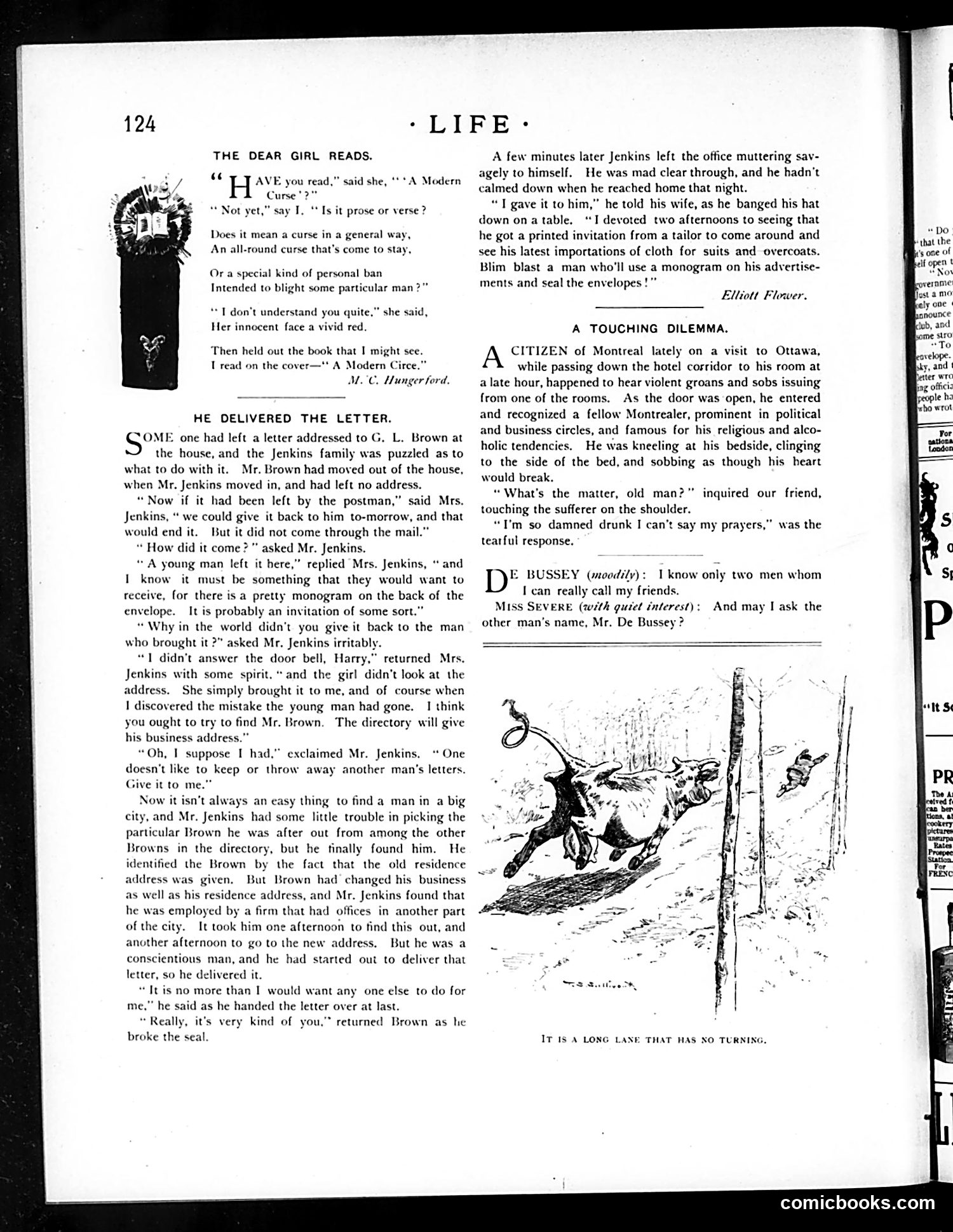
This page contains two humorous short stories satirizing everyday social situations and human folly. **"The Dear Girl Reads"** mocks pretentious literary discussion. A woman asks if the man has read *"A Modern Curse,"* and he comically over-interprets the title as either a general societal problem or a targeted curse against a specific man—when it's simply a book title. The joke targets affected intellectual conversation. **"He Delivered the Letter"** satirizes misplaced conscientiousness. Mr. Jenkins spends two afternoons locating and delivering a letter to Mr. Brown, only to discover it's a tailor's advertisement wearing a fancy monogram to appear important. Jenkins is furious at being manipulated by deceptive marketing disguised as personal correspondence. The satire targets both the tailor's dishonest advertising tactics and Jenkins's wasted effort in being "conscientious." The cartoon at bottom (captioned "It is a long lane that has no turning") appears unrelated to the text stories—a visual gag about a horse or rider on a winding road.
📄 Transcribed text from this page (OCR, searchable)
Machine-transcribed from the original scan — historical spelling and the odd misread are preserved.
- LIFE: THE DEAR GIRL READS. ss H AVE you read,” said she, ‘* ‘A Modern Curse "2" “Not yet,” say I,‘ Is it prose or verse? Does it mean a curse in a general way, An all-round curse that’s come to stay, Or a special kind of personal ban Intended to blight some particular man?” ** T don't understand you quit Her innocent face a vivid red. .”" she said, Then held out the book that I might see. T read on the cover—'* A Modern Ci MOC. Hunger ford. HE DELIVERED THE LETTER. S 2 one had left a letter addressed to G. L. Brown at the house, and the Jenkins family was puzzled as to what to do with it. Mr. Brown had moved out of the house, when Mr. Jenkins moved in, and had left no address. Now if it had been left by the postman,” said Mrs. Jenkins, “ we could give it back to him to-morrow, and that would end it. But it did not come through the mail.” “ How did it come?” asked Mr. Jenkins. “A young man left it bere,” replied Mrs. Jenkins, * and I know it must be something that they would want to receive, for there is a pretty monogram on the back of the envelope. It is probably an invitation of some sort.” “Why in the world didn't you give it back to the man who brought it ?” asked Mr. Jenkins irritabl: “1 didn’t answer the door bell, Harry,” returned Mrs, Jenkins with some spirit.“ and the girl didn’t look at the address. She simply brought it to me, and of course when I discovered the mistake the young man had gone. I think you ought to try to find Mr. Brown. The directory will give his business address “Oh, I suppose I had.” exclaimed Mr. Jenkins. “ One doesn't like to keep or throw away another man’s letters. Give it to me.” Now it isn’t always an easy thing to find a man in a big city, and Mr. Jenkins had some little trouble in picking the particular Brown he was after out from among the other Browns in the directory, but he finally found him. He identified the Brown by the fact that the old residence address was given, But Brown had changed his business as well as his residence address, and Mr. Jenkins found that he was employed by a firm that had offices in another part of the city. It took him one afternoon to find this out, and another afternoon to go to the new address. But he was a conscientious man, and he had started out to deliver that letter, so he delivered it. “It is no more than I would want any one else to do for he said as he handed the letter over at last. * Really, it’s very kind of you,” returned Brown as he broke the seal. A few minutes later Jenkins left the office muttering sav- agely to himself. He was mad clear through, and he hadn't calmed down when he reached home that night. “ T gave it to him,” he told his wife, as he banged his hat down ona table, ‘I devoted two afternoons to seeing that he got a printed invitation from a tailor to come around and see his latest importations of cloth for suits and overcoat: Blim blast a man who'll use a monogram on his advertise- ments and seal the envelopes !" Elliott Flower, A TOUCHING DILEMMA. CITIZEN of Montreal lately on a visit to Ottawa, while passing down the hotel cosridor to his room at a late hour, happened to hear violent groans and sobs issuing {rom one of the rooms. As the door was open, he entered and recognized a fellow Montrealer, prominent in political and business circles, and famous for religious and alco- holic tendencies. He was kneeling at his bedside, clinging to the side of the bed, and sobbing as though his heart would break. “What's the matter, old man?” inquired our friend, touching the sufferer on the shoulder. “T'm so damned drunk I can’t say my prayers,” was the tearful response. D BUSSEY (moodily): 1 know only two men whom I can really call my friends. MISS SEVERE (with quiet interest): other man’s name, Mr. De Bussey ? And may I ask the IT 1S A LONG LANE THAT HAS NO TURNID comicbooks.com