
A complete issue · 16 pages · 1894
Life — July 19, 1894
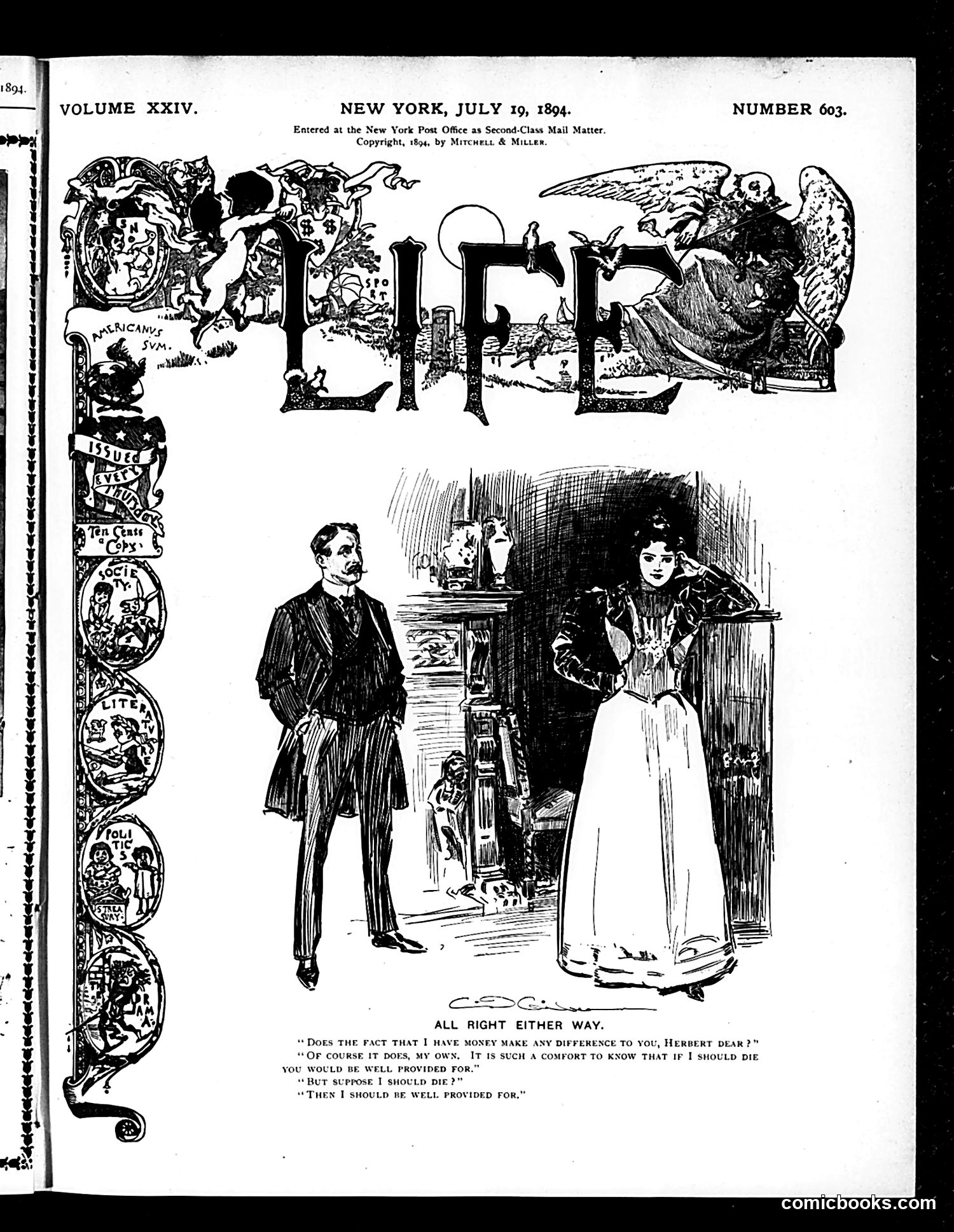
This page contains a single cartoon titled "All Right Either Way," depicting a domestic scene between a man and woman. The dialogue concerns financial security in marriage: the man (Herbert) assures the woman that her lack of wealth doesn't matter to him, and that he would provide for her if he died. She responds that if *she* should die, she would also be well provided for. The satire appears to target marital attitudes toward money and financial dependence, likely mocking either the pretense of romantic indifference to wealth or the calculating nature of matrimonial agreements among the middle or upper classes. The woman's phrasing suggests ironic commentary on the asymmetrical economic vulnerabilities spouses faced during this era.
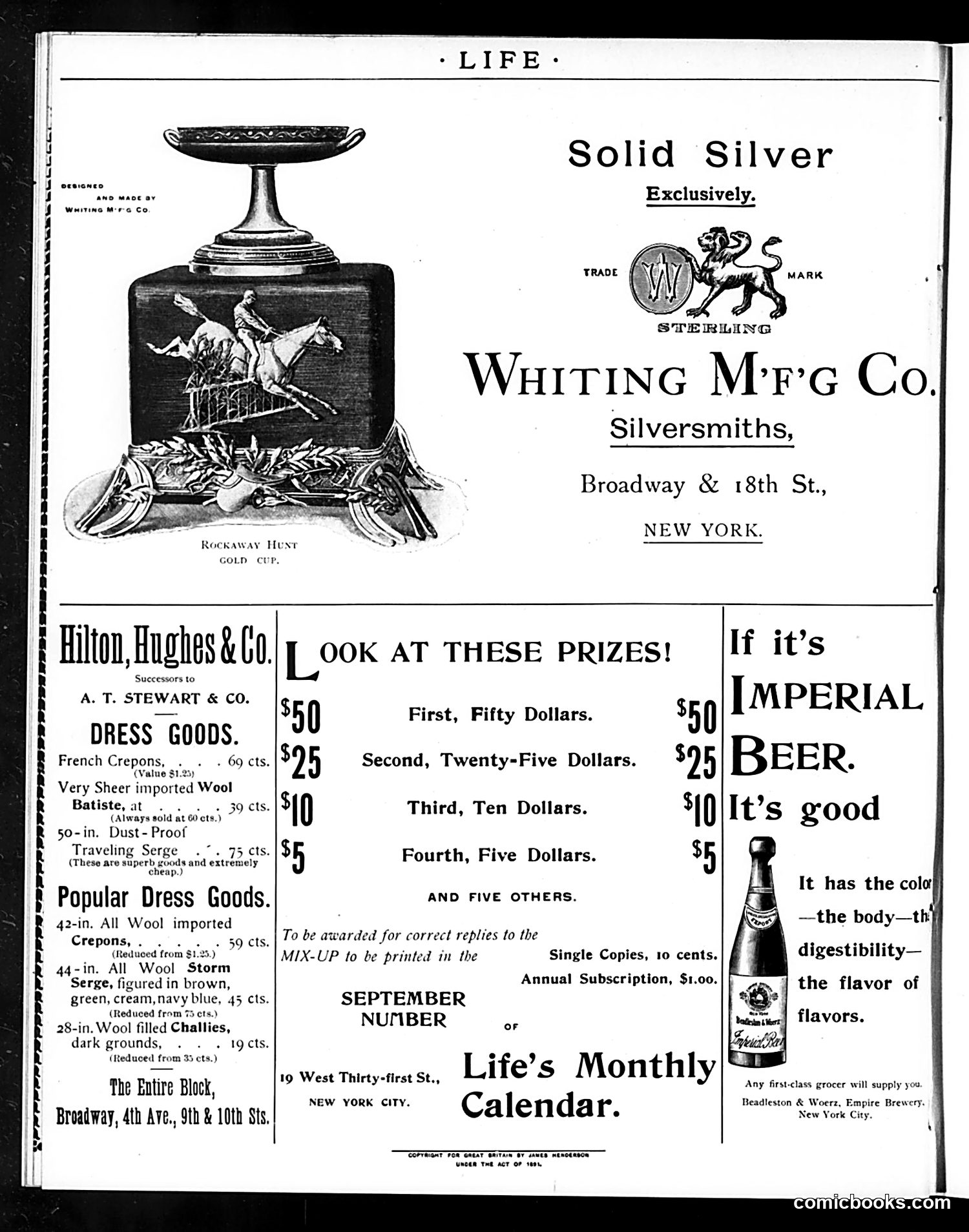
This page is primarily **advertisements** rather than satirical content. The main image shows a decorative silver trophy cup labeled "Rockaway Hunt Gold Cup," made by Whiting Mfg Co., a New York silversmith specializing in solid silver goods. The surrounding ads include: - **Hilton, Hughes & Co.** advertising dress goods (fabrics) - **Life magazine** promoting a contest with cash prizes ($50, $25, $10, $5) for the September issue, with entries to their "Mix-Up" puzzle feature - **Imperial Beer** advertisement There is **no political satire** visible on this page. It represents typical turn-of-the-century magazine content: luxury goods advertising, subscription promotion, and consumer products aimed at affluent readers.
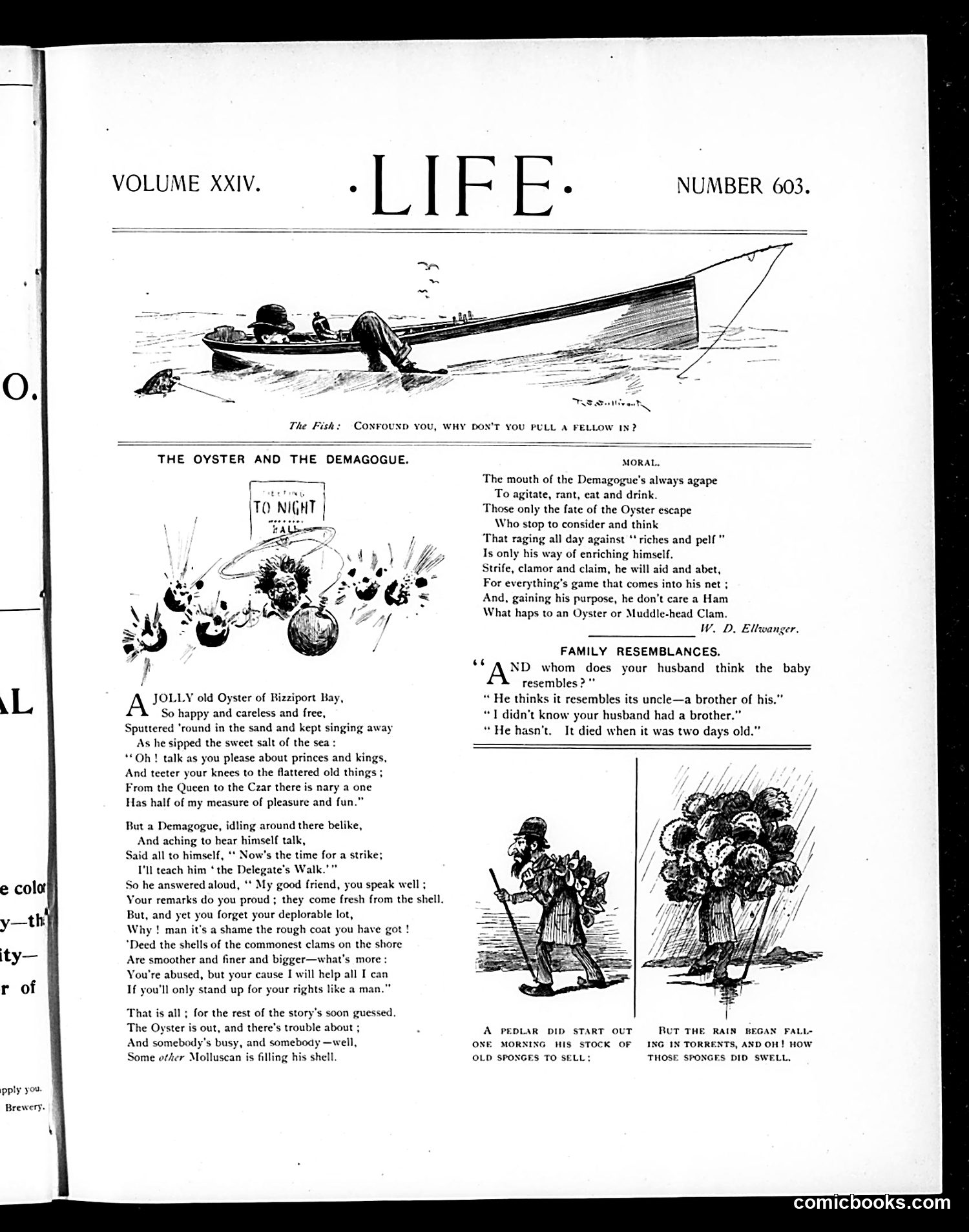
This page contains three satirical pieces: 1. **"The Fish" cartoon** (top): A man in a boat asks a fish why it won't pull a fellow in—likely a general humorous comment about nature's indifference. 2. **"The Oyster and the Demagogue"**: A poem satirizing a demagogue (a rabble-rousing politician) who agitates against "riches and pelf" while enriching himself, contrasted with an honest oyster. The moral criticizes hypocritical politicians who claim to champion common people while pursuing personal gain. 3. **"Family Resemblances"**: A brief humorous exchange where a woman notes her baby resembles her husband's uncle, who "died when it was two days old"—dark humor about family genetics and infant mortality. The illustrations show period-appropriate clothing and reflect turn-of-the-century satirical magazine conventions.
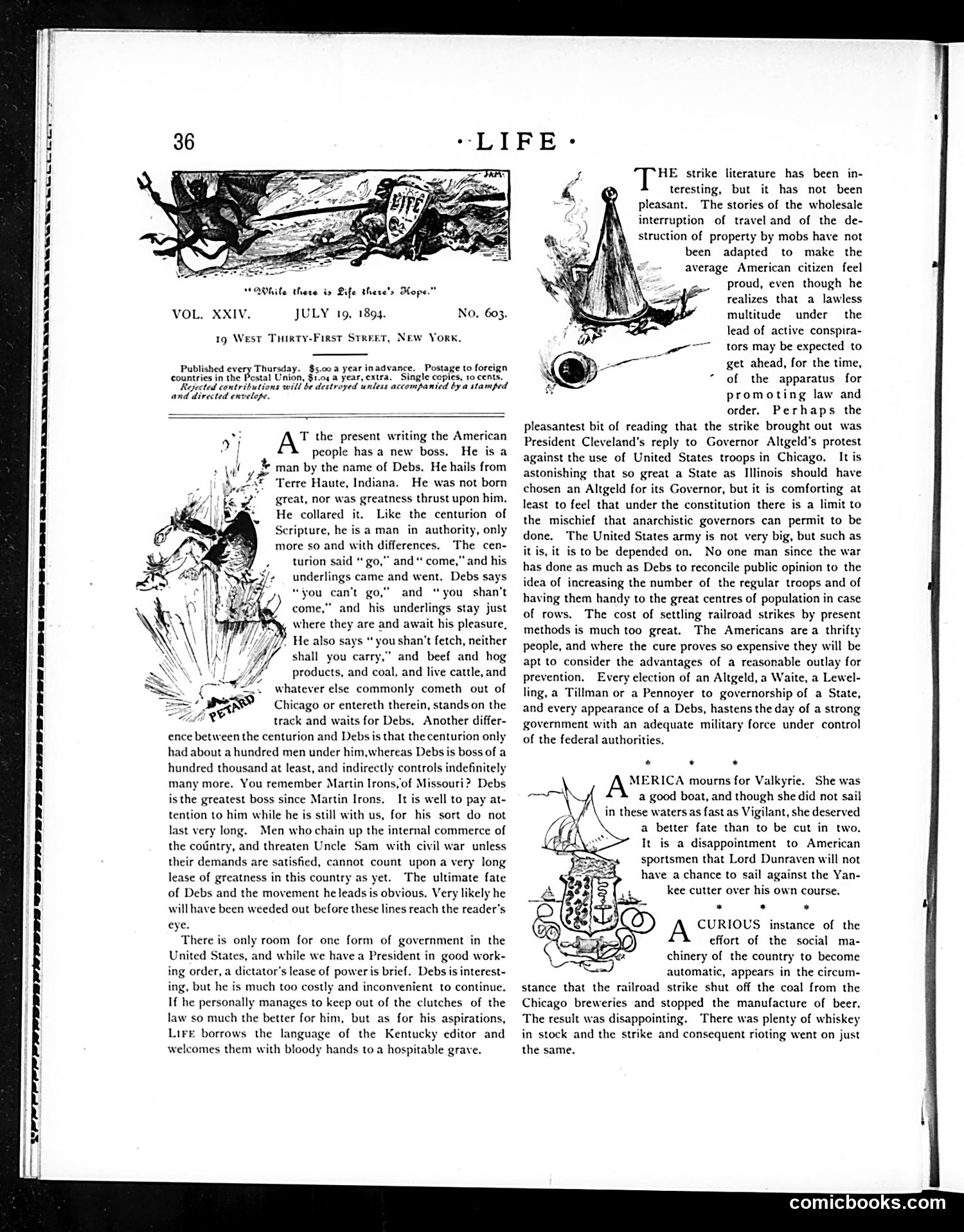
This page critiques Eugene V. Debs and the Pullman Strike, a major labor conflict that occurred just weeks before this publication. **The Main Cartoon** (top left): Shows a figure labeled "LIFE" being struck down, with the caption "While there is life there's hope"—sarcastically suggesting the strike threatens American optimism. **The Political Commentary**: The article attacks Debs as a new "boss" controlling the American people, comparing him unfavorably to President Cleveland. It criticizes the strike's disruption of commerce and rails against the "anarchistic" labor movement. The text expresses concern that Debs wields dangerous influence over "many" people, positioning strikers as lawless threats to order and commerce rather than workers with legitimate grievances.
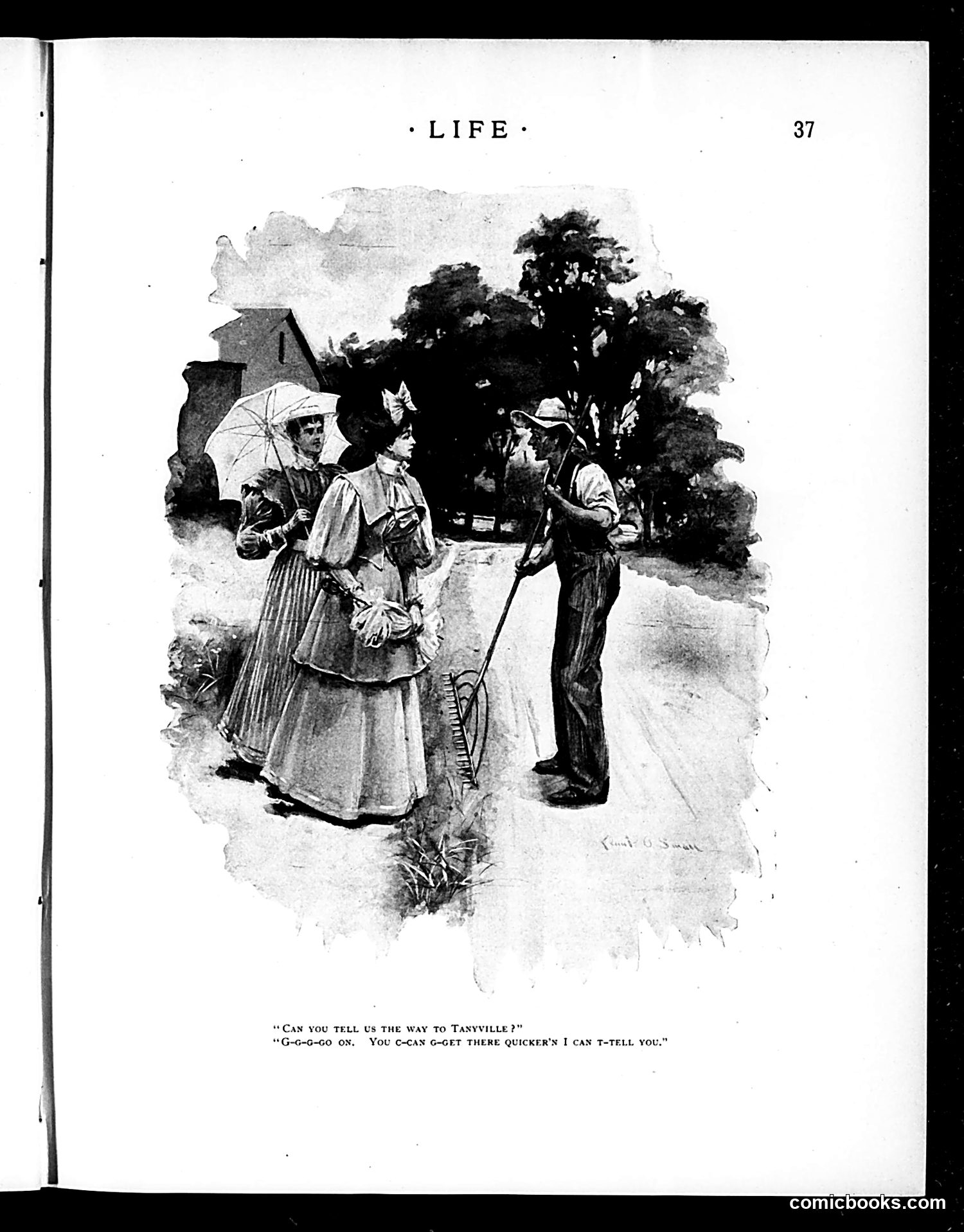
This illustration depicts a social encounter on a country road. A well-dressed woman with a parasol and a man in military uniform appear to be asking directions from rural figures—a man in work clothes and another person on horseback in the background. The caption reads: "CAN YOU TELL US THE WAY TO TANSVILLE?" with the response "G-G-GO ON. YOU C-CAN G-GET THERE QUICKER'S I CAN T-TELL YOU." The humor relies on class satire: refined urban travelers seeking directions from country folk who speak in exaggerated rural dialect with stammering speech patterns. This reflects early-20th-century satirical stereotypes contrasting educated city dwellers with working-class rural Americans, portraying country people as inarticulate and uncouth despite their practical knowledge.
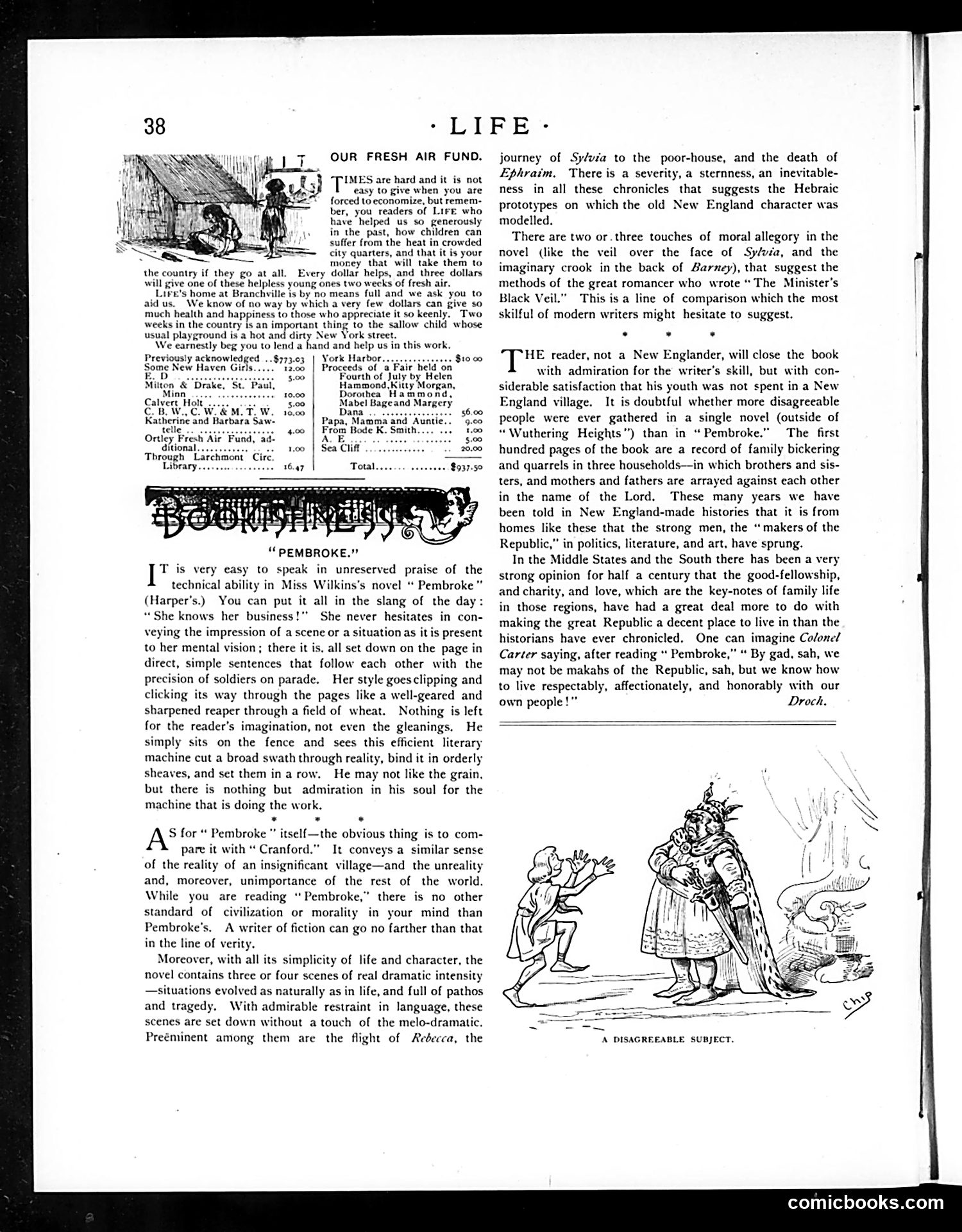
This page primarily contains a literary review of the novel "Pembroke" by Miss Wilkins (Mary E. Wilkins Freeman), comparing it favorably to her earlier work "Cranford." The reviewer praises Wilkins's ability to capture New England village life with precision and restraint, depicting domestic drama without sentimentality. The single cartoon at bottom right, captioned "A DISAGREEABLE SUBJECT," shows a woman being confronted by what appears to be a beggar or poor person. The illustration suggests social commentary on class encounters or public discomfort with poverty—a theme consistent with the page's upper section about "Our Fresh Air Fund," which solicited donations to send poor city children to the countryside for health benefits. The cartoon likely satirizes the awkwardness or distaste wealthy people displayed when encountering the poor directly.
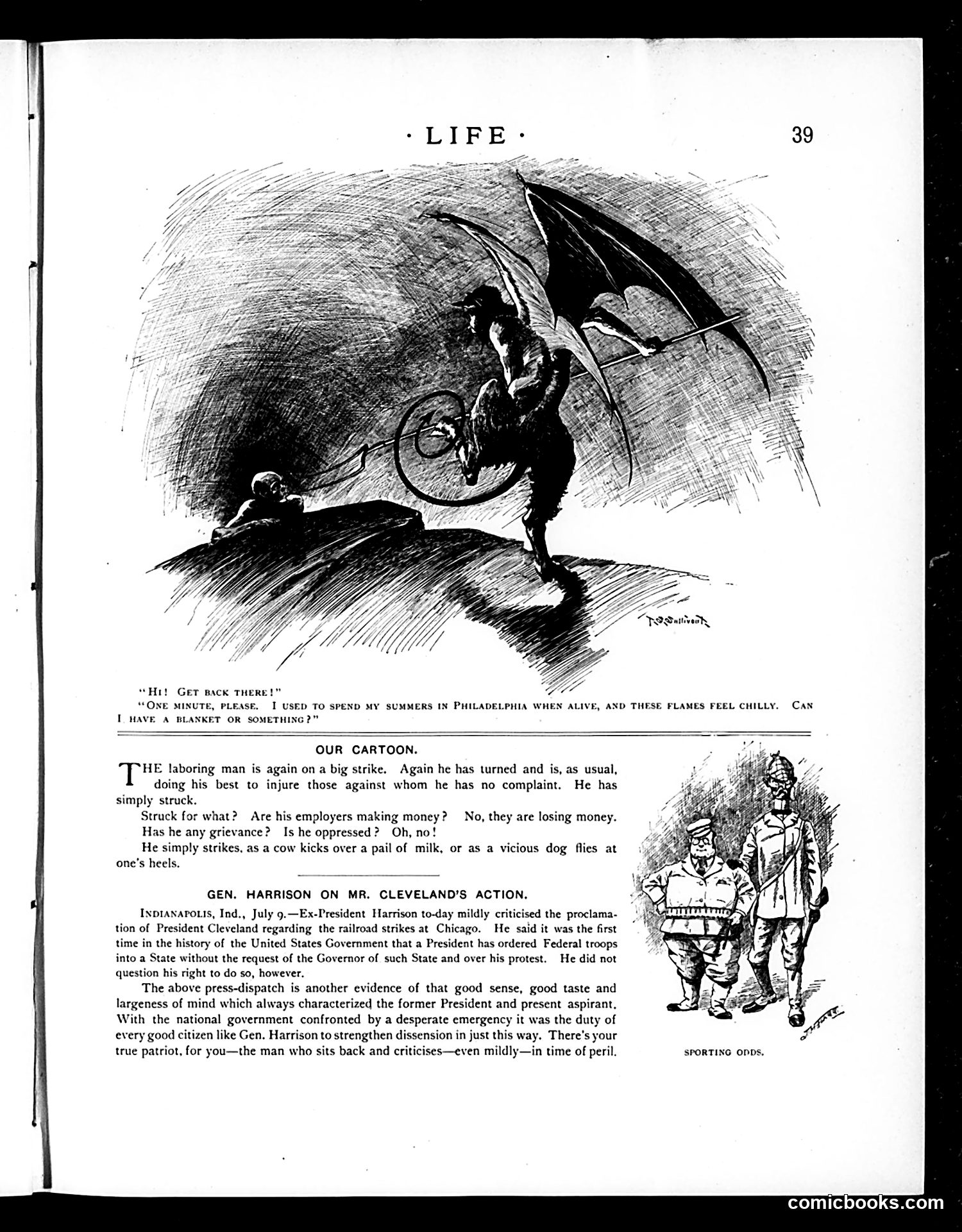
**Top Cartoon:** A demon or devil figure holds an umbrella while a person shivers below, saying "Get back there!" The caption references spending summers in Philadelphia and feeling chilly from "flames"—this is satirical commentary on strikes and labor unrest, suggesting violent or heated conflict. **"Our Cartoon" Editorial Section:** Criticizes a laboring man on strike, comparing his actions to a cow kicking over milk or a vicious dog—crude animal metaphors dismissing striker agency. The piece defends President Cleveland's use of Federal troops against railroad strikers (likely the 1894 Pullman Strike), praising General Harrison for supporting government action over state autonomy. **Right Cartoon ("Sporting Odds"):** Appears to show betting odds on unidentified figures, likely political commentary. The page overall defends strikebreaking and federal intervention against labor organizing.
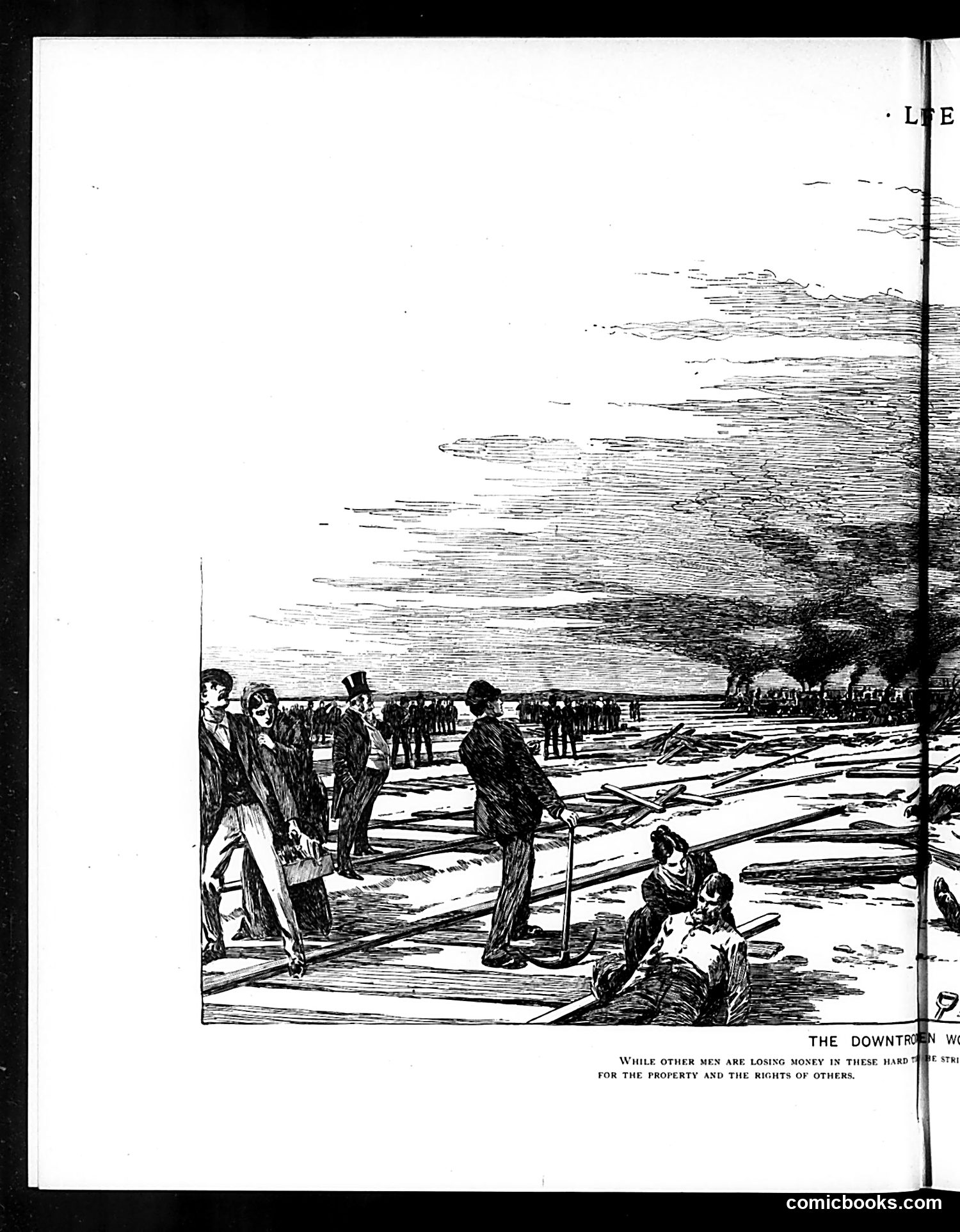
This appears to be a political cartoon from Life magazine depicting a scene at a waterfront or dock. The caption reads: "THE DOWNTOWN WORKERS... WHILE OTHER MEN ARE LOSING MONEY IN THESE HARD TIMES, THEY ARE FIGHTING FOR THE PROPERTY AND THE RIGHTS OF OTHERS." The image shows well-dressed gentlemen in top hats observing laborers or workers on the ground, apparently engaged in some form of struggle or conflict. The satire appears to critique class disparities during economic hardship—suggesting that while wealthy men ("the downtown") lose money, working-class men literally fight to protect property and defend the rights of others, implying an unfair burden on laborers. The contrast between the gentlemen's formal dress and the workers' physical struggle emphasizes this social commentary about labor and privilege during difficult economic times.
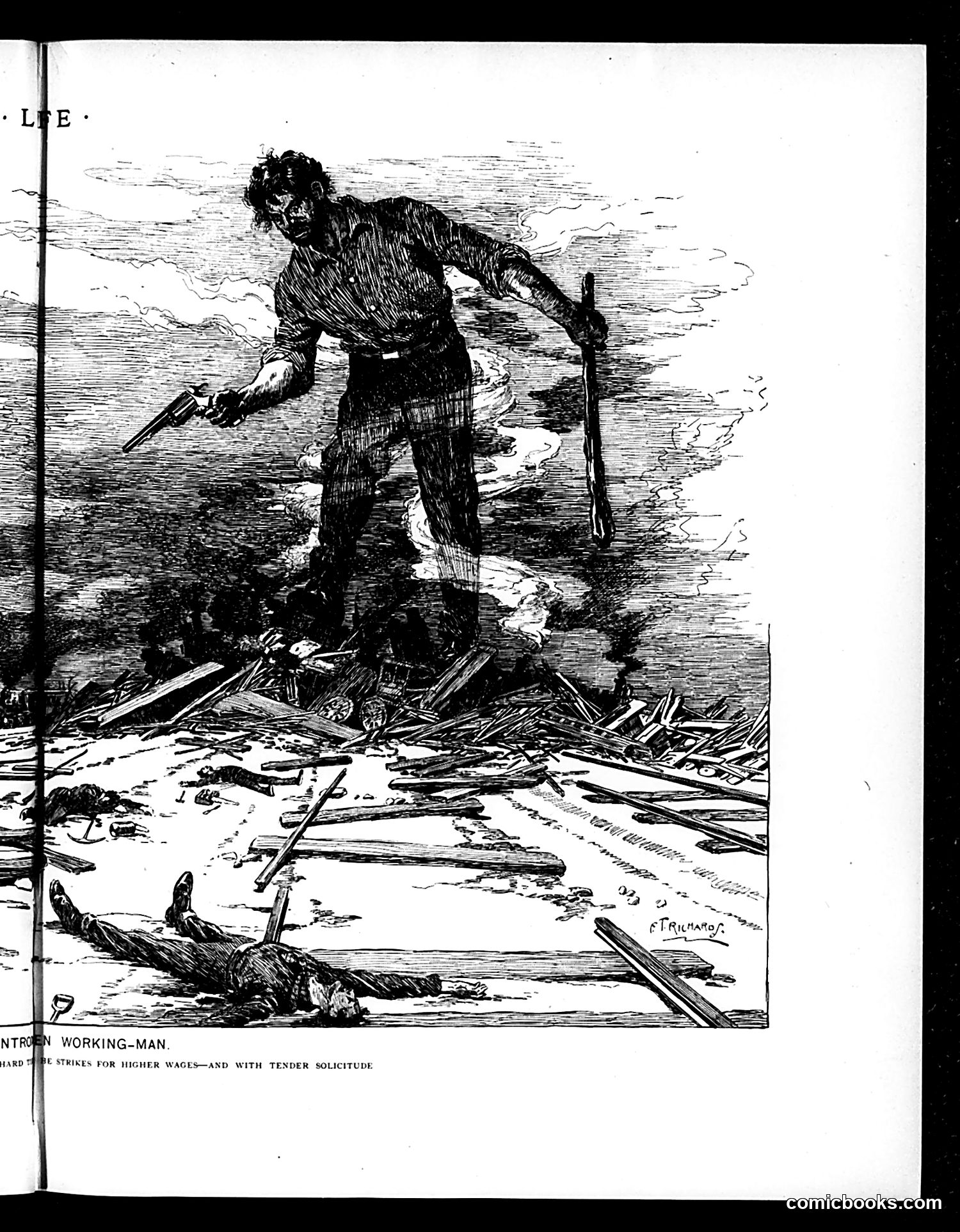
This is a political cartoon titled "INTRON WORKING-MAN" with the subtitle "HARD AT STRIKES FOR HIGHER WAGES—AND WITH TENDER SOLICITUDE." The image depicts a gaunt, aggressive figure wielding a club or bat, standing amid scattered debris and wreckage. Below him lies what appears to be an injured or dead body. The cartoon uses dark, violent imagery to satirize labor strikes. The satire appears to criticize workers striking for higher wages, portraying them as destructive and brutal rather than sympathetic. The phrase "tender solicitude" is ironic—suggesting the cartoon's creator views striking workers as hypocritical, claiming to seek reasonable improvements while actually causing harm and violence. The specific historical context (which strike, which decade) remains unclear from the visible text, but this reflects broader anti-labor sentiment common in American satirical publications of the early 20th century.
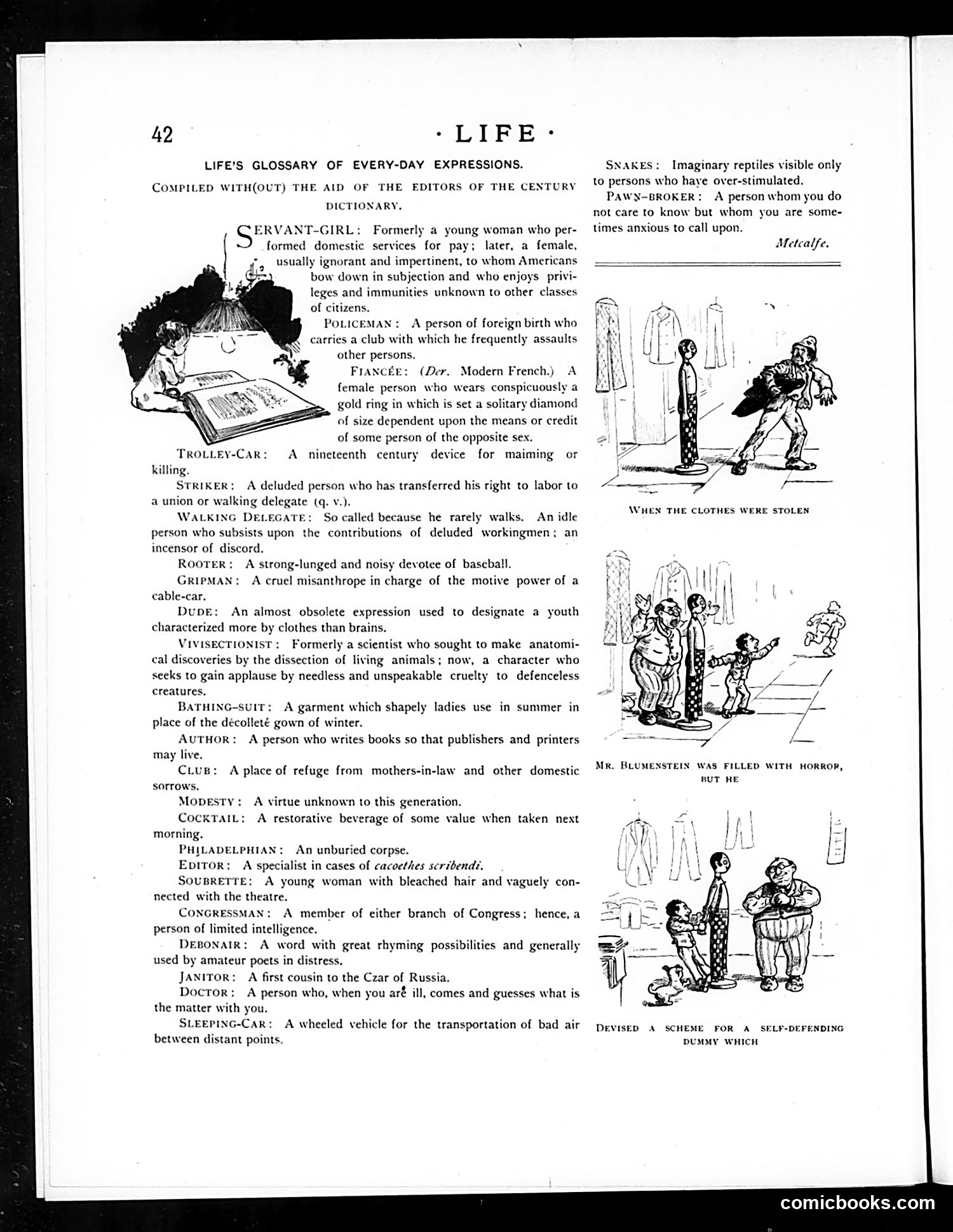
This page from *Life* magazine presents a glossary of contemporary social stereotypes and character types, accompanied by three cartoon vignettes illustrating the absurdities of modern life. The cartoons mock early 20th-century urban society: the first shows theft of hanging laundry; the second depicts "Mr. Blumenstein" horrified by domestic chaos; the third illustrates a satirical "self-defending dummy"—a mechanical contraption designed to protect against intrusion. The glossary entries define period-specific social types (servant-girls, fiancées, strikers, dandies) with biting commentary. The satire targets class distinctions, pretension, and social hypocrisy characteristic of the era. The cartoons use visual humor to reinforce these textual jabs at contemporary manners and social expectations.
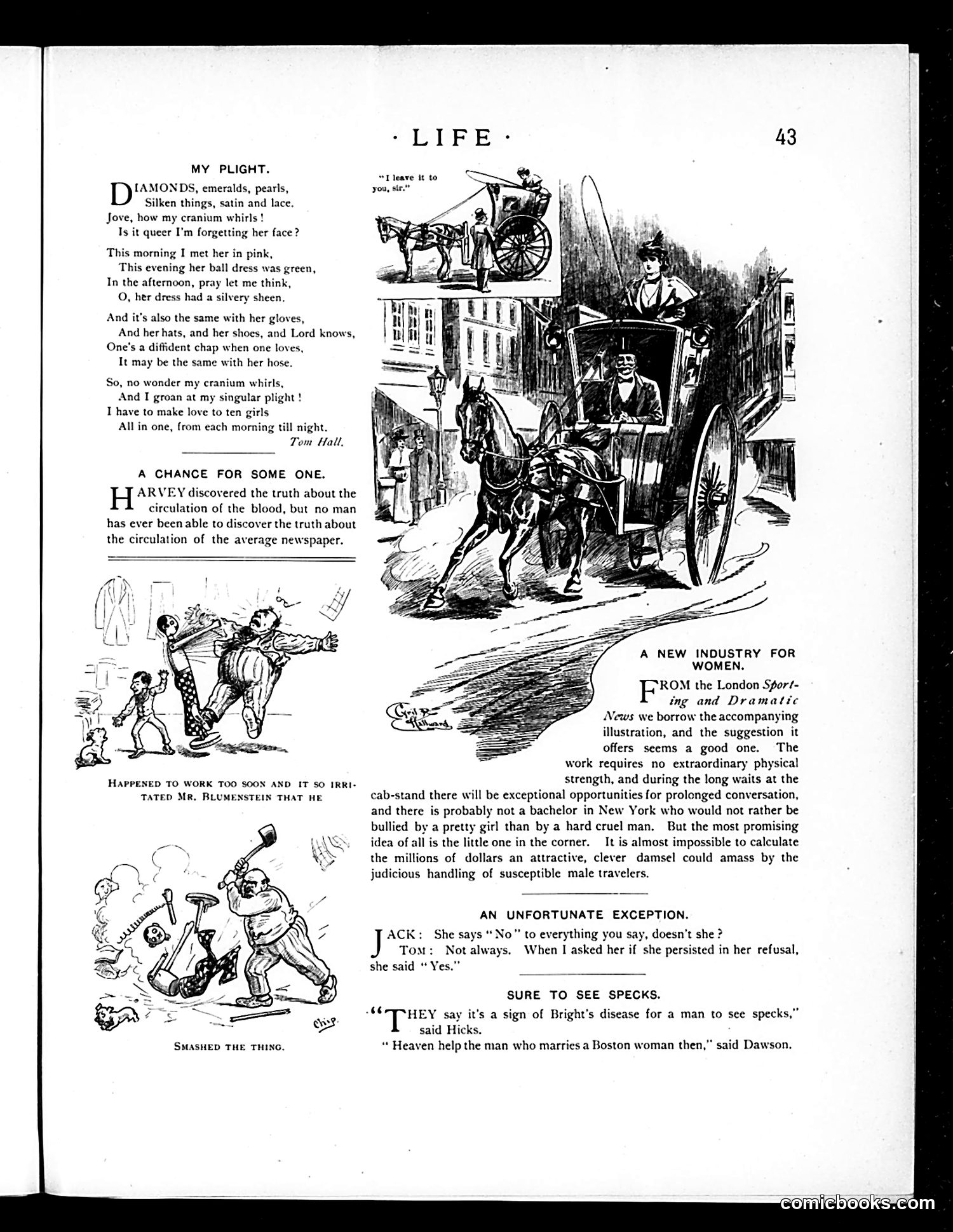
This page contains several satirical pieces on romance and gender relations: **"My Plight"** is a poem about a man unable to remember a woman's face despite seeing her regularly—poking fun at romantic forgetfulness. **"A Chance for Some One"** satirizes newspaper work, with an illustration showing slapstick workplace chaos. The joke appears to be about the hectic, physically demanding nature of newspaper circulation. **"A New Industry for Women"** discusses women working as cab-stand conversationalists to entertain male travelers—satirizing both emerging female employment and male susceptibility to flirtation. The remaining short jokes mock romantic rejection and Boston women, reflecting period attitudes toward courtship and regional stereotypes. The illustrations use exaggerated physical comedy typical of early 20th-century humor magazines.
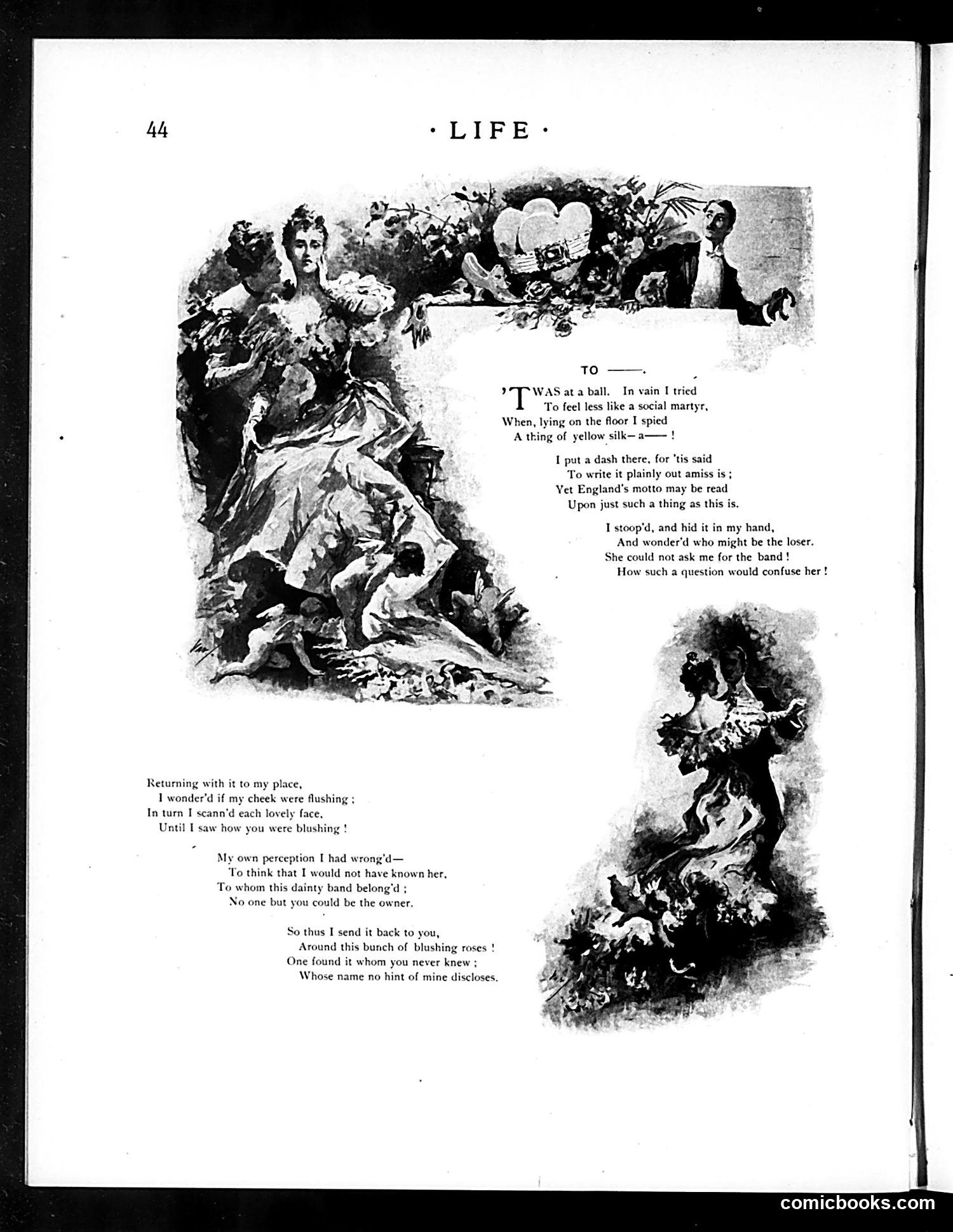
This page contains a romantic poem titled "To ——" from *Life* magazine, illustrated with period sketches of fashionable figures at a social gathering. The poem describes a gentleman finding a yellow silk item (likely a garter or hair ribbon—the dash obscures the word) at a ball. He's amused that English propriety prevents him from naming it directly, then returns it anonymously with roses to the woman he deduces it belongs to, having watched her blush when she realized the loss. The satire targets **Victorian sexual prudishness**—the elaborate euphemism and coyness required to discuss even innocent intimate accessories. The joke is that the unnamed object's identity is obvious to readers despite the narrator's delicate evasion ("England's motto" may reference discretion as a national trait). The accompanying illustrations show the fashionable world where such incidents occur, reinforcing the mockery of upper-class social conventions and the performative modesty that governs courtship.
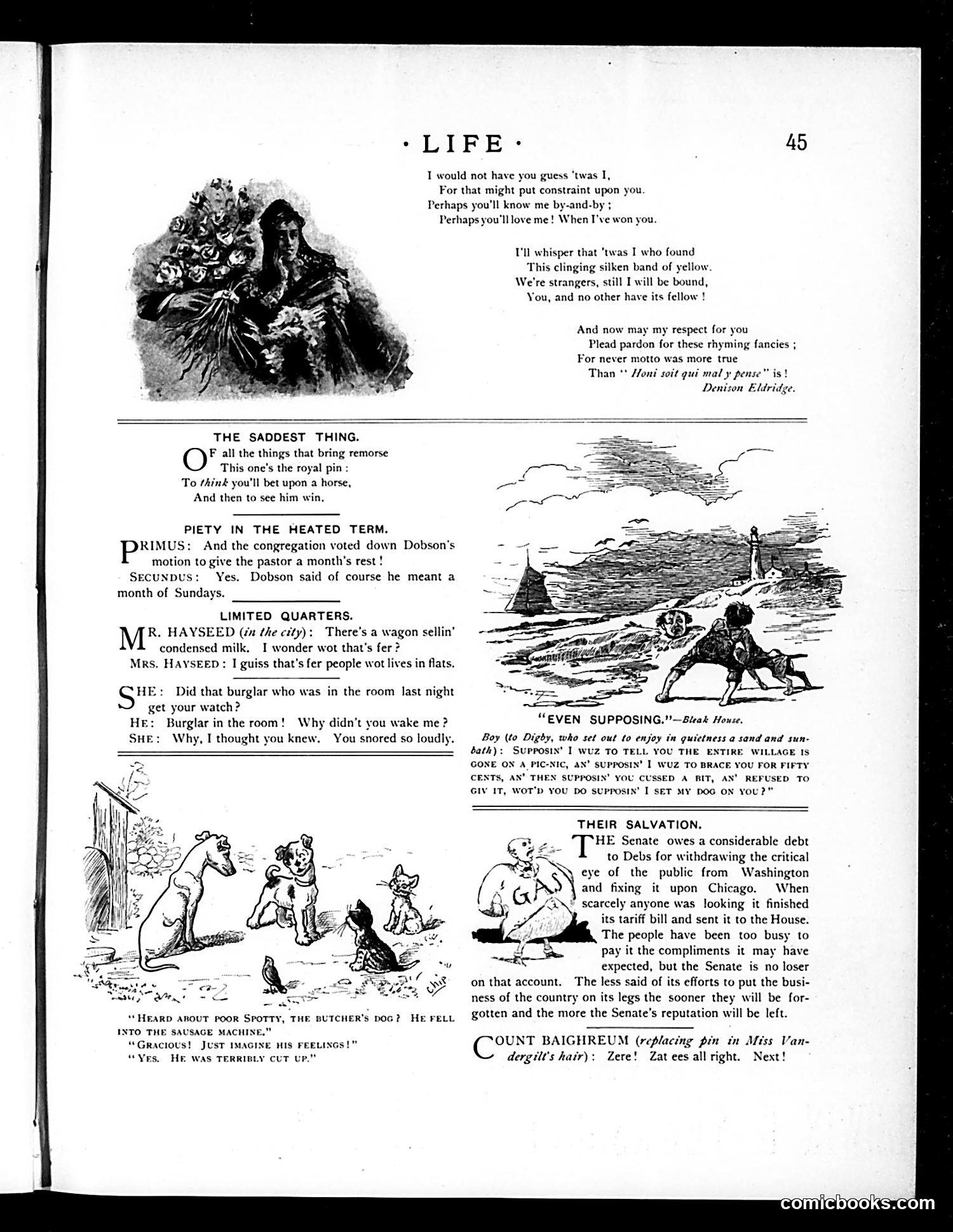
This page collects satirical humor pieces typical of early Life magazine's style. **"The Saddest Thing"** jokes about betting on horses—the irony being that winning a bet causes regret (perhaps due to guilt or unforeseen consequences). **"Piety in the Heated Term"** mocks clergy and congregations: a pastor requests a month's rest, but the congregation votes him down. His clarification that he meant "a month of Sundays" (i.e., just regular Sundays off) suggests minimal actual relief—satirizing both stingy congregations and the pastor's meek compromise. **"Limited Quarters"** uses a country couple's confusion about city life: condensed milk is for "people wot lives in flats" (apartments)—joking that urban dwellers have cramped living spaces. **Other brief jokes** include marital humor (a burglar and snoring husband), wordplay about a dog in a sausage machine, and a scene of a count pinning hair—routine domestic satire. The page's final item references Senator **Debs** diverting public attention from the Senate's tariff bill to Chicago matters, allowing unpopular legislation to pass quietly—political satire on legislative maneuvering.
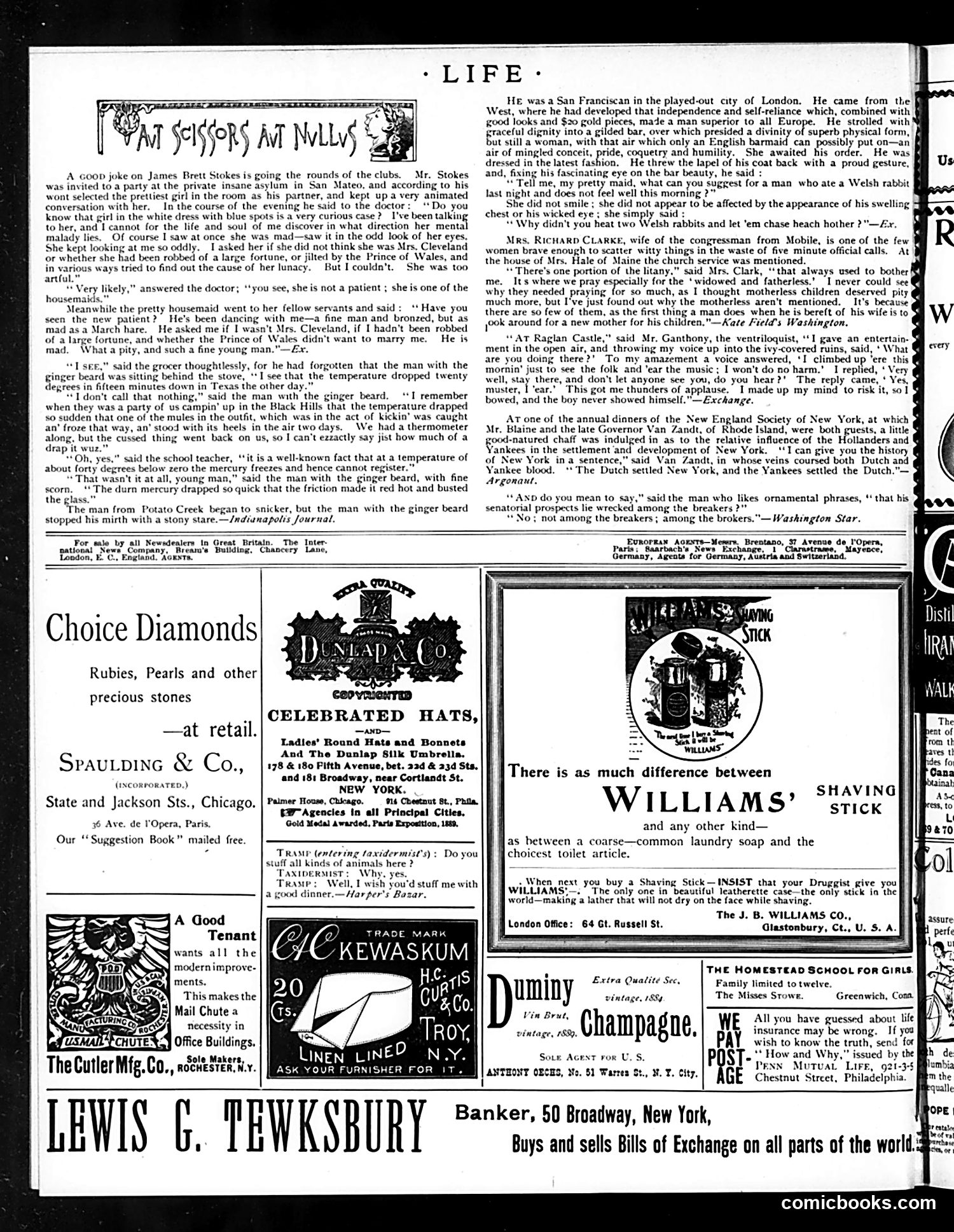
This page from *Life* magazine contains primarily **text-based humor and satirical anecdotes** rather than political cartoons. The main content includes: **"Sam Scissors at Nullus"** - A series of humorous stories mocking American types: 1. A San Francisco businessman in London proposes to a barmaid (a working-class woman) after eating Welsh rabbit, displaying arrogant superiority. She deflates his pretension with a witty insult about digestive issues. 2. Stories about a man with a ginger beard telling absurdly exaggerated tall tales (a frozen mule, temperature drops) to establish masculine authority through lies—satirizing frontier mythology and bluster. 3. A joke about mistaking an asylum maid for a patient, mocking shallow male judgment. **The satire targets:** American pretension, masculinity performance, and the era's class consciousness. The humor relies on working-class women outwitting pompous men through quick wit. The page is otherwise dominated by **period advertisements** for diamonds, hats, and grooming products.
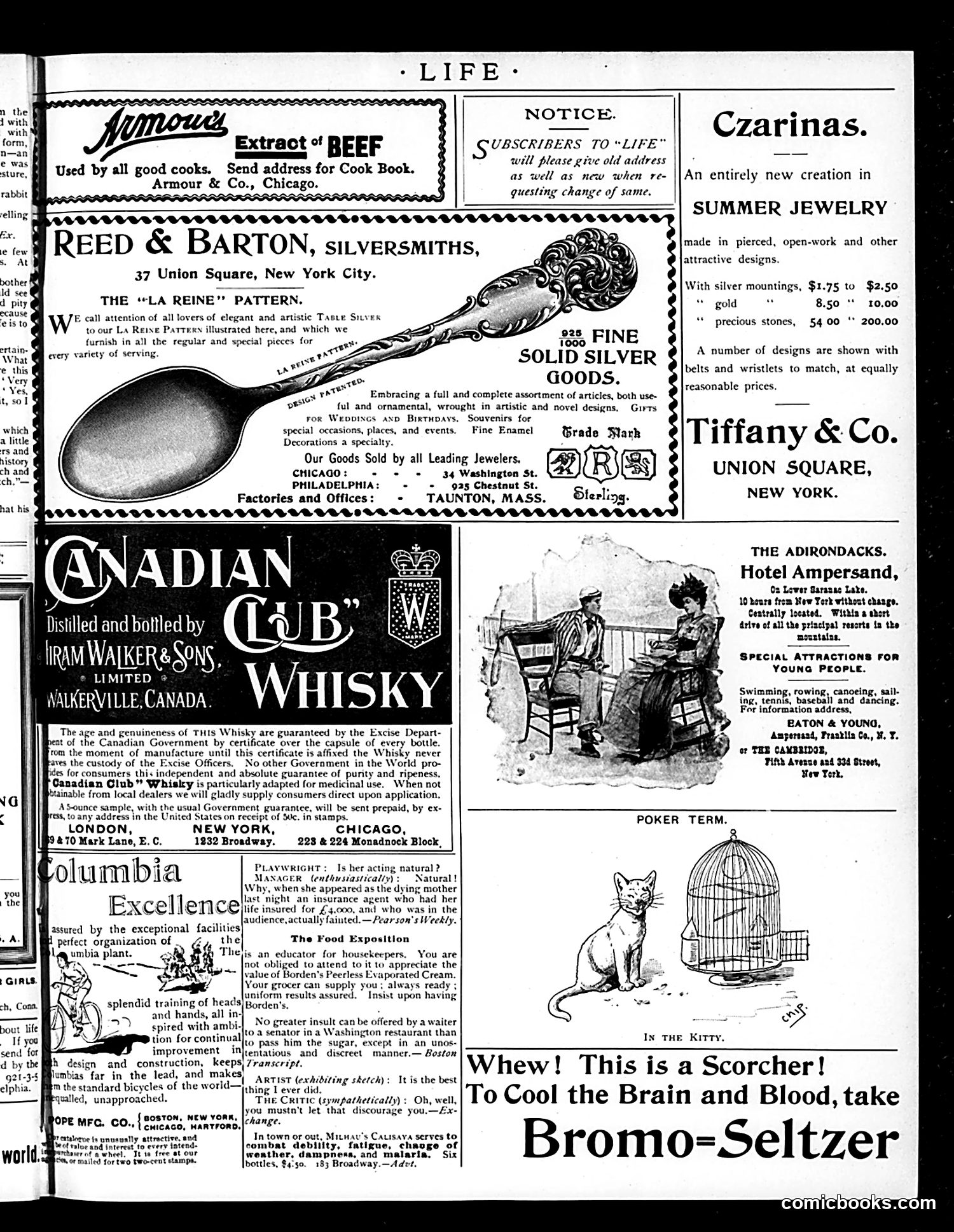
This page is primarily **advertising**, not political satire. It contains commercial advertisements for luxury goods and services typical of early 20th-century American publications: silverware (Reed & Barton), summer jewelry (Tiffany & Co.), Canadian whisky, a hotel in the Adirondacks, and food products. The only humor appears in small **satirical vignettes** embedded within ads. Most notably, "Poker Term" shows a cat eyeing a birdcage—a visual pun suggesting the cat is "caged" or trapped by temptation. Below it, a mock medical advertisement for "Bromo-Seltzer" uses exaggerated language ("Whew! This is a Scorcher!") typical of period patent medicine marketing, humorously suggesting the product cures overheated brains. The page also includes brief comedic observations about theater, restaurants, and social etiquette, formatted as witty commentary rather than political cartoons. These reflect upper-class concerns of the era rather than substantive satire.
This page is primarily **advertising**, not satire or editorial content. It contains luxury product advertisements typical of early 1900s Life magazine. The ads promote: - **Halcyon Hall** (Millbrook, Duchess County): A high-end hotel advertised as so desirable that wealthy private homeowners copy its furnishings and cuisine—a status marker for the ultra-wealthy. - **W.L. Douglas shoes ($3)**: Mass-produced shoes positioned as equal to custom work, emphasizing the manufacturer's size and direct-to-consumer pricing to undercut middlemen. - **Higgins and Seiter**: Fine china and cut glass at discounted prices. - **Rae's Lucca Oil, Vino de Salud, Vin Mariani**: Patent medicines and tonics (common in this era) claiming health benefits—digestion aid, malaria cure, brain tonic. Two brief humorous anecdotes appear at bottom (a condemned man wanting piano lessons; a man dodging a lightning bug). The page reflects Gilded Age consumer culture: luxury goods marketed to affluent readers alongside patent medicines that would later be regulated.