
Life, 1894-07-19 · page 6 of 16
Life — July 19, 1894 — page 6: what you’re looking at
What you’re looking at
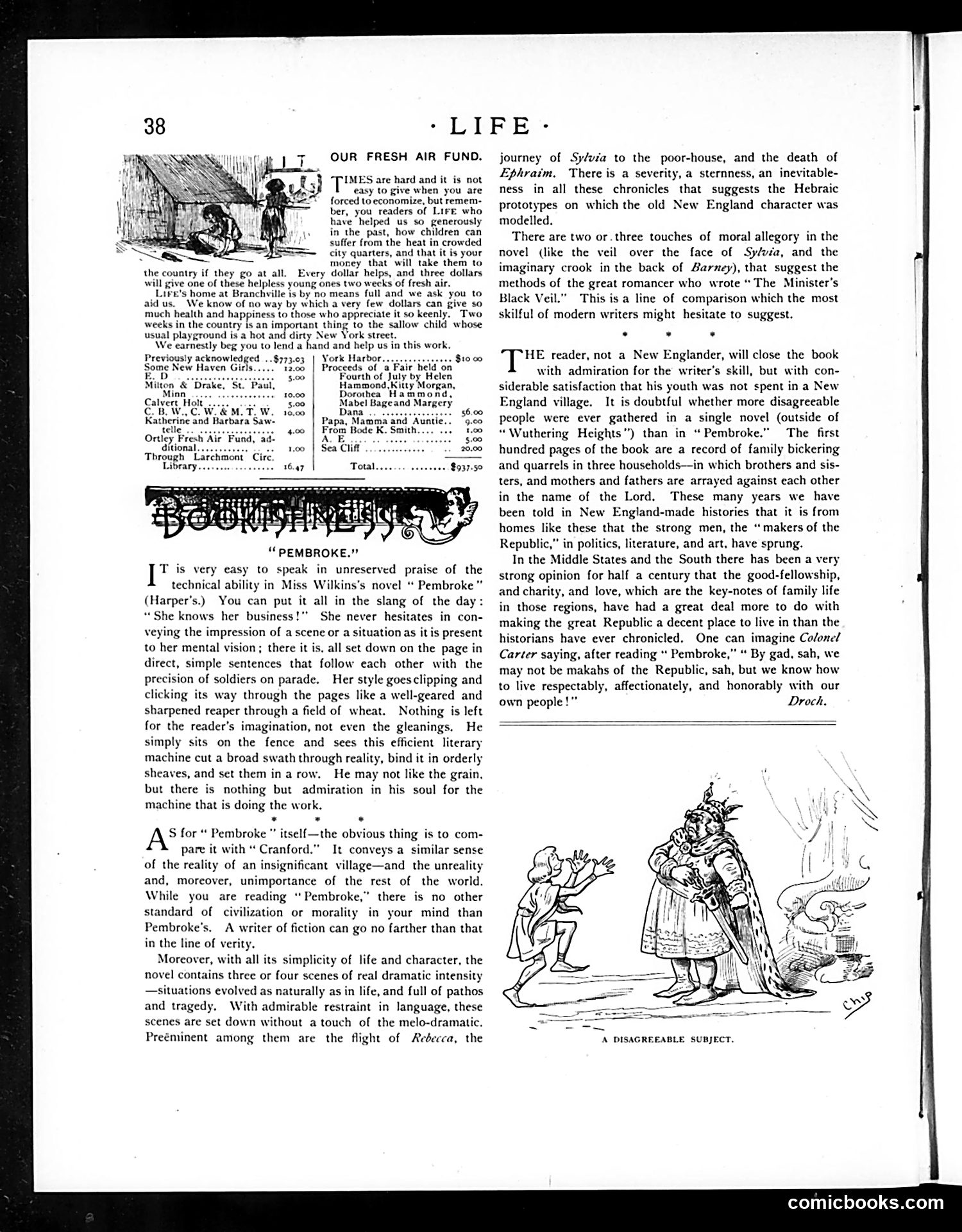
This page primarily contains a literary review of the novel "Pembroke" by Miss Wilkins (Mary E. Wilkins Freeman), comparing it favorably to her earlier work "Cranford." The reviewer praises Wilkins's ability to capture New England village life with precision and restraint, depicting domestic drama without sentimentality. The single cartoon at bottom right, captioned "A DISAGREEABLE SUBJECT," shows a woman being confronted by what appears to be a beggar or poor person. The illustration suggests social commentary on class encounters or public discomfort with poverty—a theme consistent with the page's upper section about "Our Fresh Air Fund," which solicited donations to send poor city children to the countryside for health benefits. The cartoon likely satirizes the awkwardness or distaste wealthy people displayed when encountering the poor directly.
📄 Transcribed text from this page (OCR, searchable)
Machine-transcribed from the original scan — historical spelling and the odd misread are preserved.
-LIFE- OUR FRESH AIR FUND. IMES are hard and it is not easy to give when you are forced to economize, but remem- ber, you readers of Lire who have helped us so generously in the past, how children can suffer from the heat in crowded city quarters, and that it is your money that’ will take them to the country if they go at all. Every dollar helps, and three dollars will give one of these helpless young ones two weeks of fresh air. Life's home at Branchville is by no means full and we ask you to aidus. We know of no way by which a very few dollars can give so much health and happiness to those who appreciate it so keenly. Two weeks in the country is an important thing to the sallow child whose usual playground is a hot and dirty New York street. We earnestly beg you to lend a hand and help us in this work. $10 Previously acknowledged ..$773.03 | York Harbor... Some New Haven Girl 12.00 | Proceeds of ‘a Fair held on s.co | Fourth of July by Helen | Hammond, Kitty Morgan, 10,00 Dorothea Hammond, 5.00 Mabel Bageand Margery 10,00 Dana $6.00 Papa, Mamm: ‘9.00 From Bode K. Smit! 1.00 A. E sees $.00 20.00 4:00 Sea Cliff “ PEMBROKE.” is very easy to speak in unreserved praise of the technical ability in Miss Wilkins's novel “ Pembroke” (Harper’s.) You can put it all in the slang of the day: “She knows her business!"’ She never hesitates in con- veying the impression of a scene or a situation as itis present to her mental vision; there it is. all set down on the page in direct, simple sentences that follow each other with the precision of soldiers on parade. Her style goesclipping and clicking its way through the pages like a well-geared and sharpened reaper through a field of wheat. Nothing is left for the reader's imagination, not even the gleanings, He simply sits on the fence and sees this efficient literary machine cut a broad swath through reality, bind it in orderly sheaves, and set them in a row. He may not like the grain, but there is nothing but admiration in his soul for the machine that is doing the work, . . . 5 for “ Pembroke ” itself—the obvious thing is to com- pare it with “ Cranford.” It conveys a similar sense of the reality of an insignificant village—and the unreality and, moreover, unimportance of the rest of the world. While you are reading “Pembroke,” there is no other standard of civilization or morality in your mind than Pembroke’s. A writer of fiction can go no farther than that in the line of verity. Moreover, with all its simplicity of life and character, the novel contains three or four scenes of real dramatic intensity —situations evolved as naturally as in life, and full of pathos and tragedy. With admirable restraint in language, these scenes are set down without a touch of the melo-dramatic. Preéminent among them are the flight of Redecca, the journey of Sy/véa to the poor-house, and the death of Ephraim. There is a severity, a sternness, an inevitable- ness in all these chronicles that suggests the Hebraic prototypes on which the old New England character was modelled, There are two or.three touches of moral allegory in the novel (like the veil over the face of Sy/véa, and the imaginary crook in the back of Barney), that suggest the methods of the great romancer who wrote “ The Minister's Black Veil.” This is a line of comparison which the most skilful of modern writers might hesitate to suggest. HE reader, not a New Englander, will close the book with admiration for the writer's skill, but with con- siderable satisfaction that his youth was not spent ina New England village. It is doubtful whether more disagreeable people were ever gathered in a single novel (outside of “Wuthering Heights”) than in “Pembroke.” The first hundred pages of the book are a record of family bickering and quarrels in three houscholds—in which brothers and s' ters, and mothers and fathers are arrayed against each other in the name of the Lord. These many years we have been told in New England-made histories that it is from homes like these that the strong men, the “makers of the Republic,” in politics, literature, and art, have sprung. In the Middle States and the South there has been a very strong opinion for half a century that the good-fellowship, and charity, and love, which are the key-notes of family life in those regions, have had a great deal more to do with making the great Republic a decent place to live in than the historians have ever chronicled. One can imagine Colonel Carter saying, after reading * Pembroke,” “ By gad, sah, we may not be makahs of the Republic, sah, but we know how to live respectably, affectionately, and honorably with our own people!" Droch. A DISAGREEABLE SUBJECT. comicbooks.com