
A complete issue · 20 pages · 1894
Life — July 12, 1894
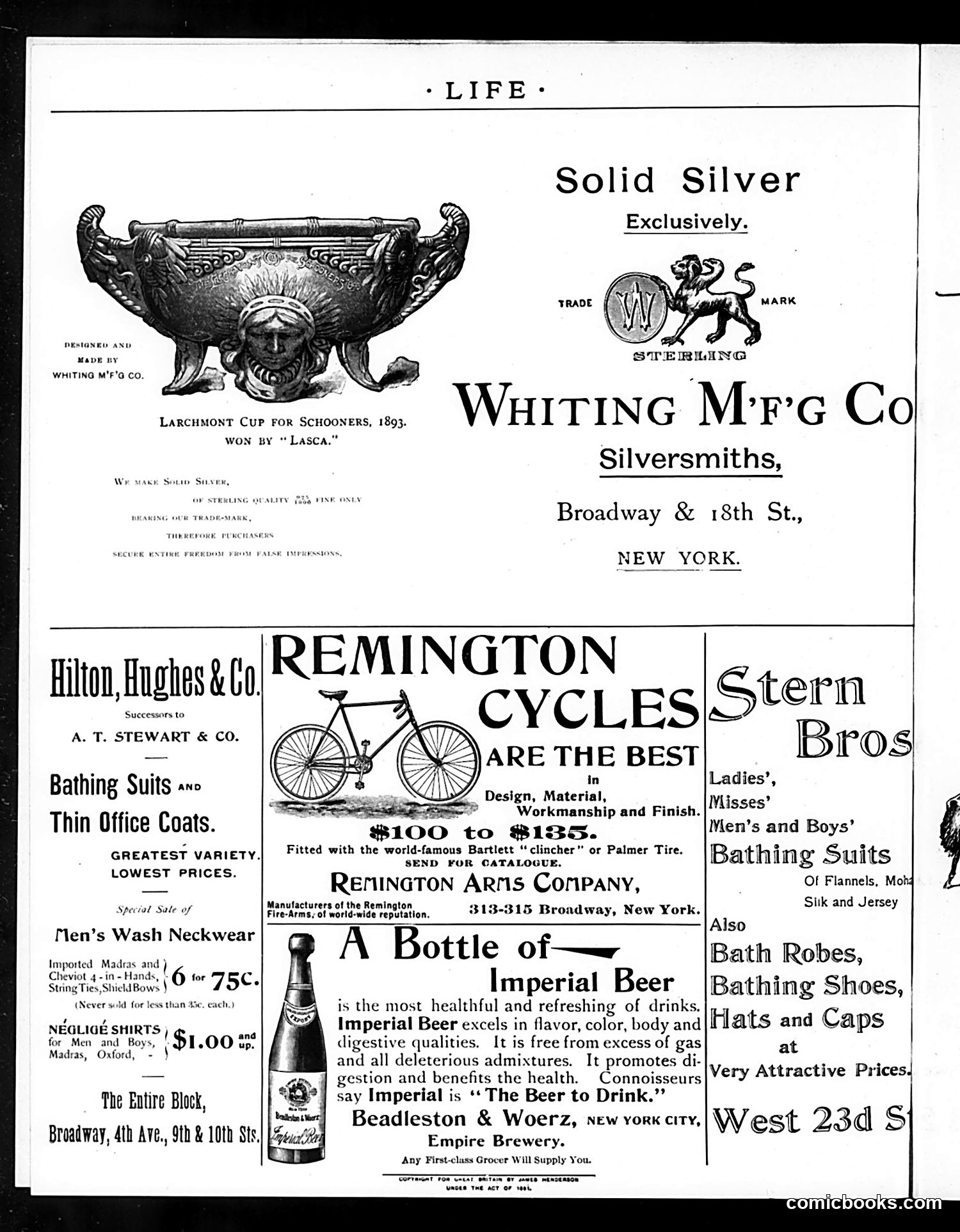
This page is primarily **advertising**, not satirical content. It contains five distinct advertisements: 1. **Whiting M'fg Co.** — Sterling silver goods, featuring the ornate Larchmont Cup won by a horse named "Lasca" in 1893. 2. **Hilton, Hughes & Co.** — Bathing suits and office coats. 3. **Remington Cycles** — Bicycles priced $100–$135, emphasizing design and quality. 4. **Imperial Beer by Beadleston & Woerz** — Marketed as healthful and digestive. 5. **Stern Bros.** — Bathing suits, robes, shoes, and hats. There are no political cartoons or satirical commentary on this page. It's a straightforward commercial layout typical of *Life* magazine's revenue model during the 1890s, showcasing consumer goods and services available in New York City.
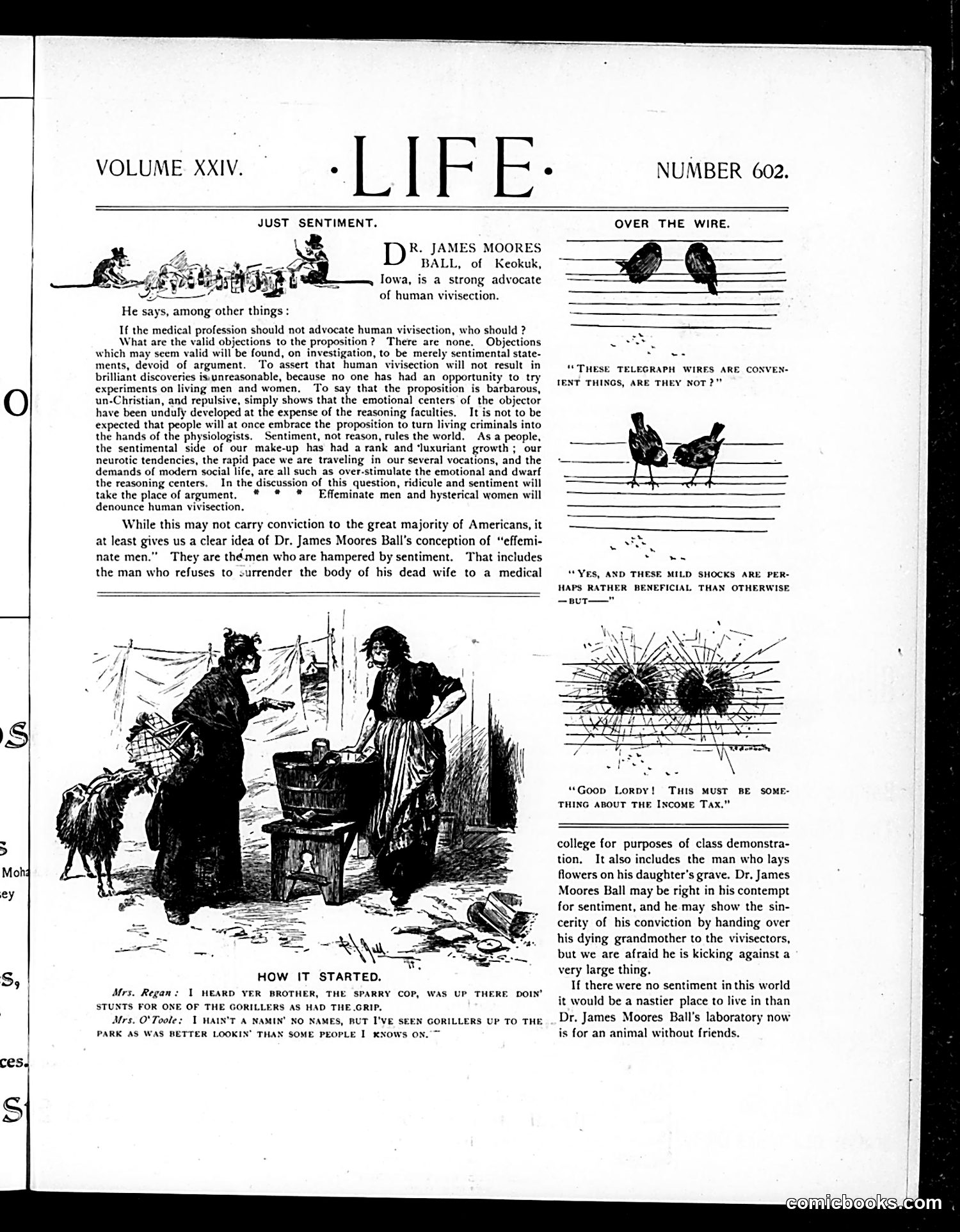
This page critiques **Dr. James Moores Ball of Keokuk, Iowa**, an advocate for human vivisection (animal testing). The left column argues that sentiment and emotion—not reason—govern human society, and that Ball's push to eliminate sentiment would create a harsh world. The lower cartoon titled "How It Started" depicts a domestic dispute, satirizing Ball's worldview through everyday life: a woman confronts a man about his behavior, suggesting that without sentiment (compassion, morality), human relationships would become transactional and cold. The right-side "Over the Wire" illustrations show birds and spiny creatures with captions mocking Ball's logic—if we eliminated sentiment, even mild shocks might seem justified for "progress." The satire argues that sentiment and human values are essential, not obstacles to progress.
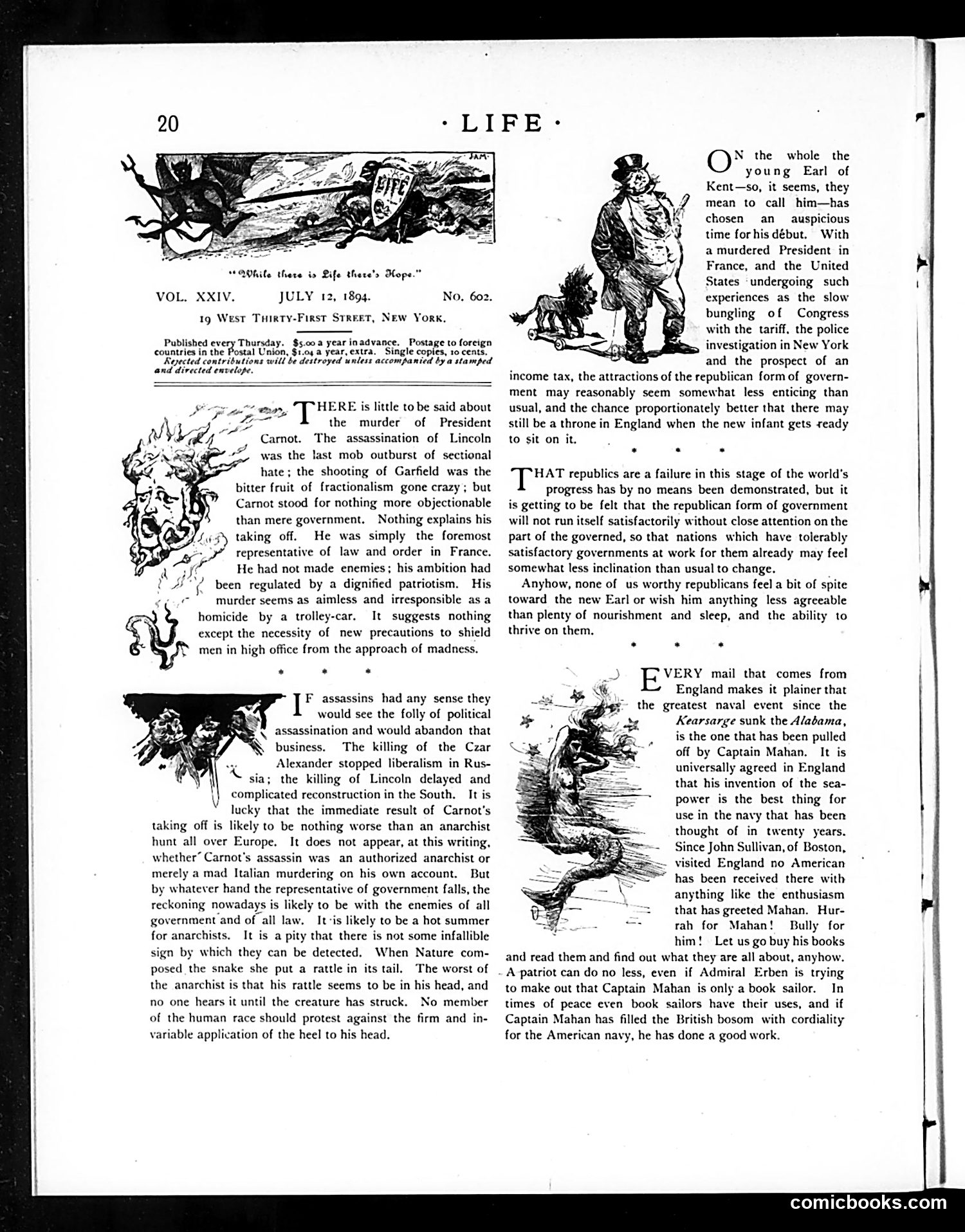
This page discusses the assassination of French President Carnot (murdered June 24, 1894) and its political implications. The text argues that while Carnot's killer was merely a madman rather than an anarchist conspirator, the incident raises concerns about anarchist violence across Europe. The cartoons illustrate anarchist threats: one depicts an anarchist as a wild, chaotic figure; another shows what appears to be a bomb or explosive device. The page also praises Captain Mahan's naval innovations, celebrating his advocacy for sea-power as beneficial to American naval strength. The overall message reflects contemporary anxiety about political violence and anarchism spreading internationally, while promoting American naval superiority as a stabilizing force.
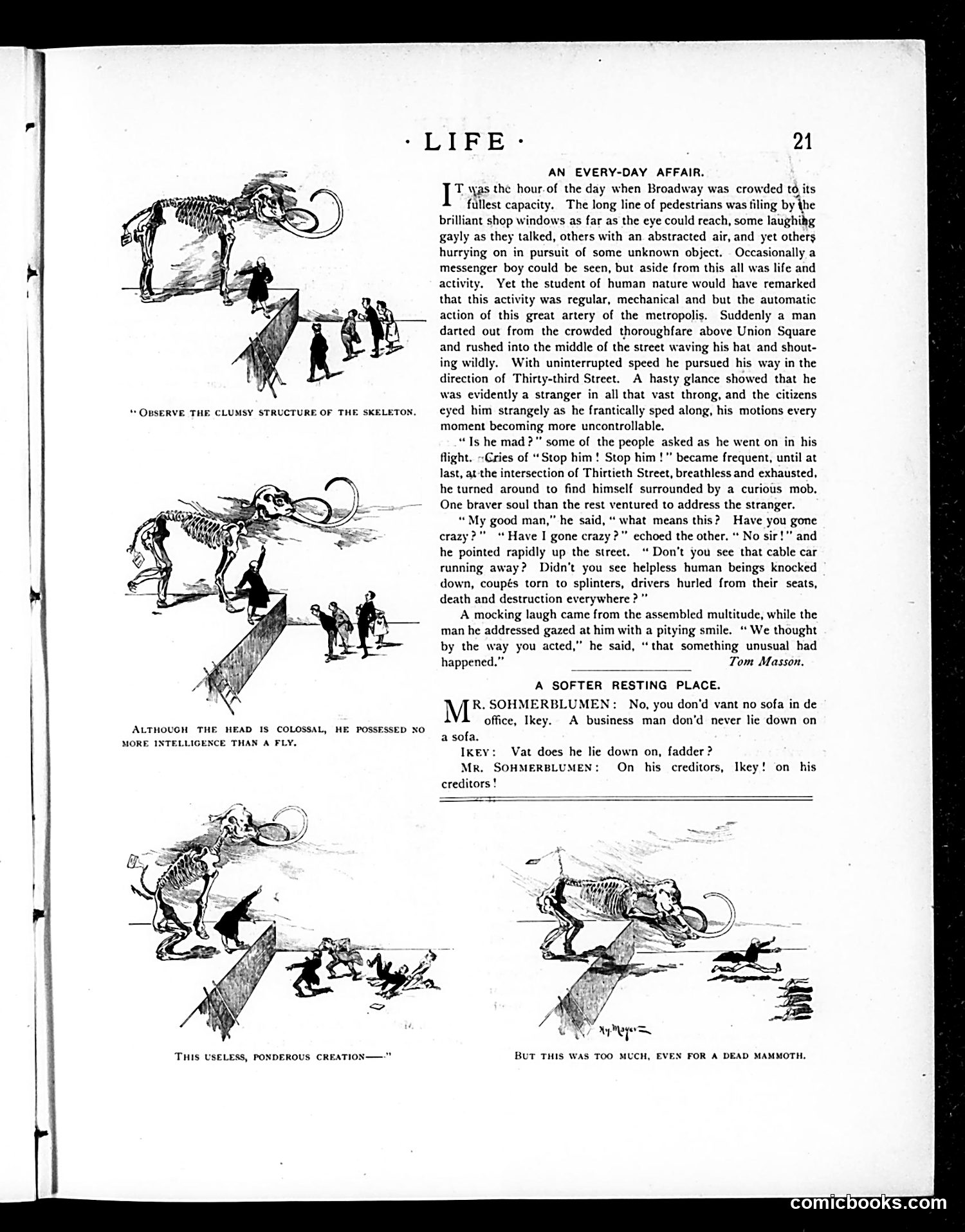
This page contains two satirical sections: **"An Every-Day Affair"** depicts a man frantically running through crowded Broadway streets, causing public alarm. Citizens mistake his erratic behavior for madness or danger. The satire critiques how urban crowds respond to unusual individual behavior with suspicion and panic, even when the person may simply be distressed or in a hurry. It mocks both the frenzied nature of city life and society's tendency toward mob mentality. **"A Softer Resting Place"** is a brief dialogue between Mr. Sommerblumen and Ikey about furniture. The joke plays on the phrase "lying down on the job"—Mr. Sommerblumen claims he doesn't rest on sofas because he prefers lying on his creditors (meaning avoiding financial obligations). It's wordplay satirizing financial irresponsibility disguised as wit.
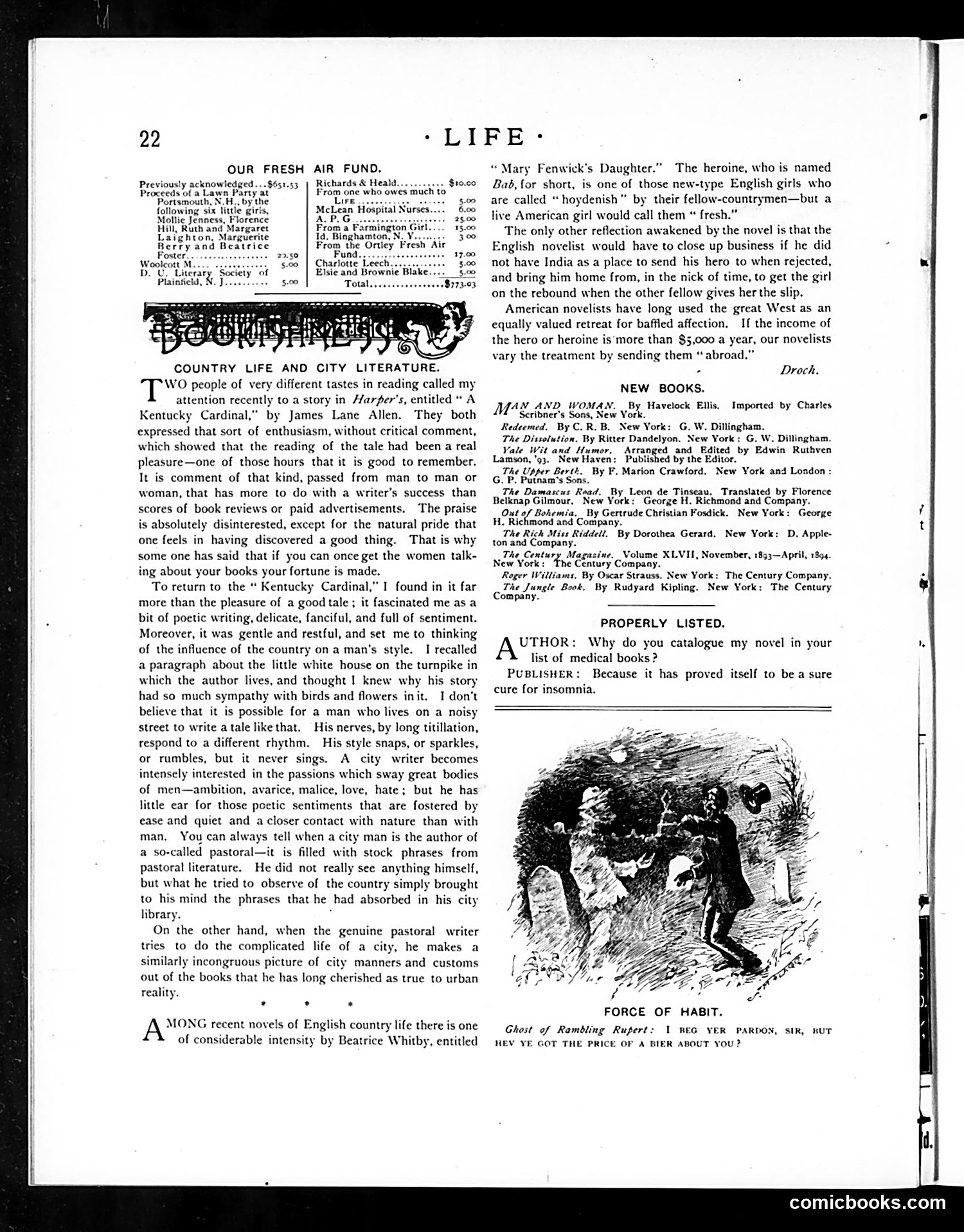
This page contains a literary discussion and book review section rather than political cartoons. The main content discusses country versus city literature, analyzing how authors capture rural versus urban settings authentically. The single illustration titled "FORCE OF HABIT" shows a sketch of what appears to be a rural or working-class figure, accompanied by text reading: "Ghost of Rambling Robert: I BEG VER PARDON, SIR, BUT HEV YE GOT THE PRICE OF A BIER ABOUT YOU?" This is a gentle satirical sketch depicting an apparition asking for money in dialect-heavy speech, likely poking fun at either rural character types or the persistence of poverty-stricken figures even in the afterlife. The humor relies on period stereotypes about rural speech patterns and persistent vice.
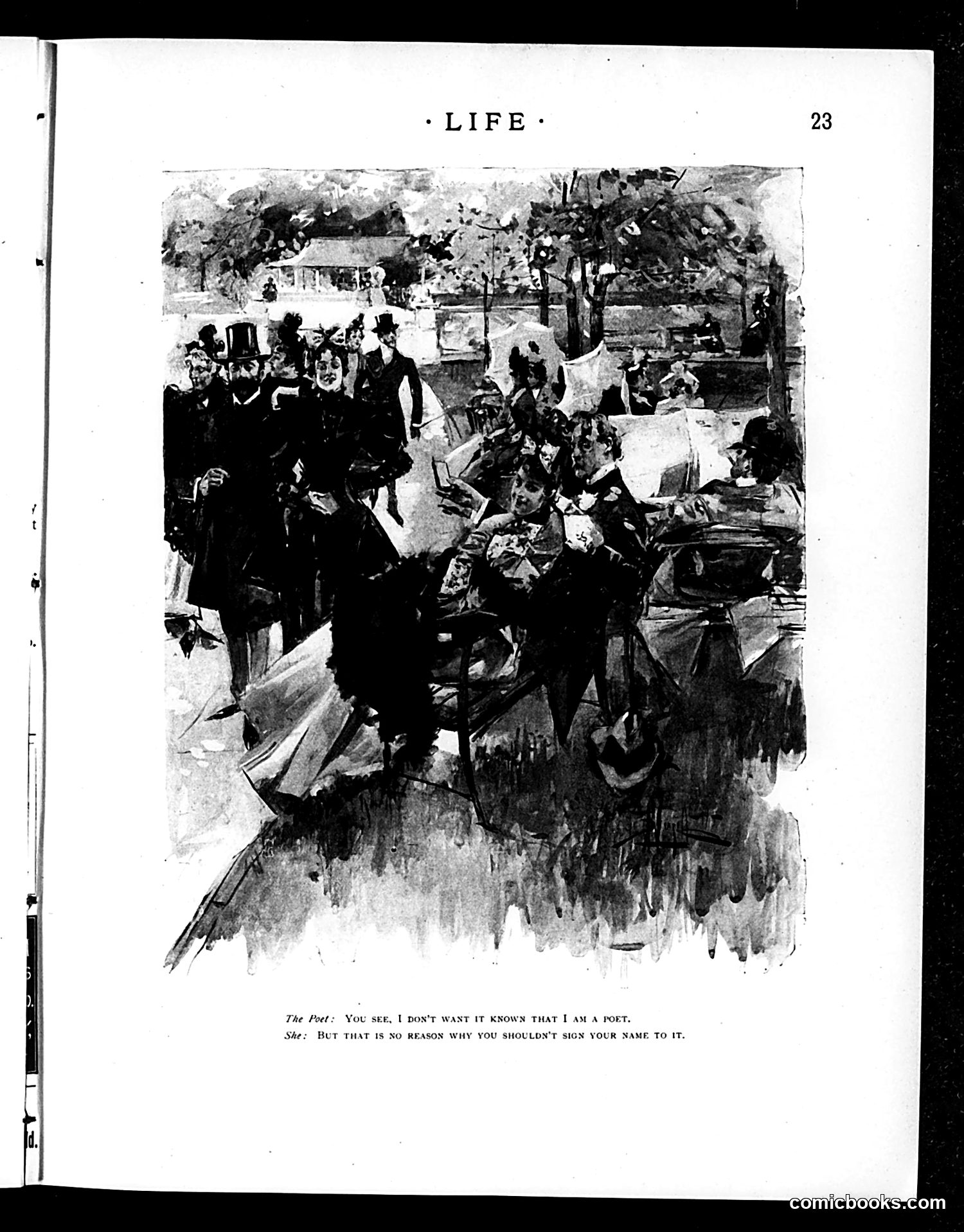
This page contains a satirical illustration depicting what appears to be a social gathering or public event, likely from the late 19th or early 20th century based on the clothing styles and artistic technique. The caption presents a dialogue between "The Poet" and "She": - **The Poet** claims he doesn't want it known that he is a poet - **She** responds that this is no reason he shouldn't sign his name to his work The satire appears to mock poets or artists who are either ashamed of their identity or reluctant to claim credit for their work. The joke suggests hypocrisy: if one produces creative work, one should openly acknowledge authorship rather than hide behind anonymity or false modesty.
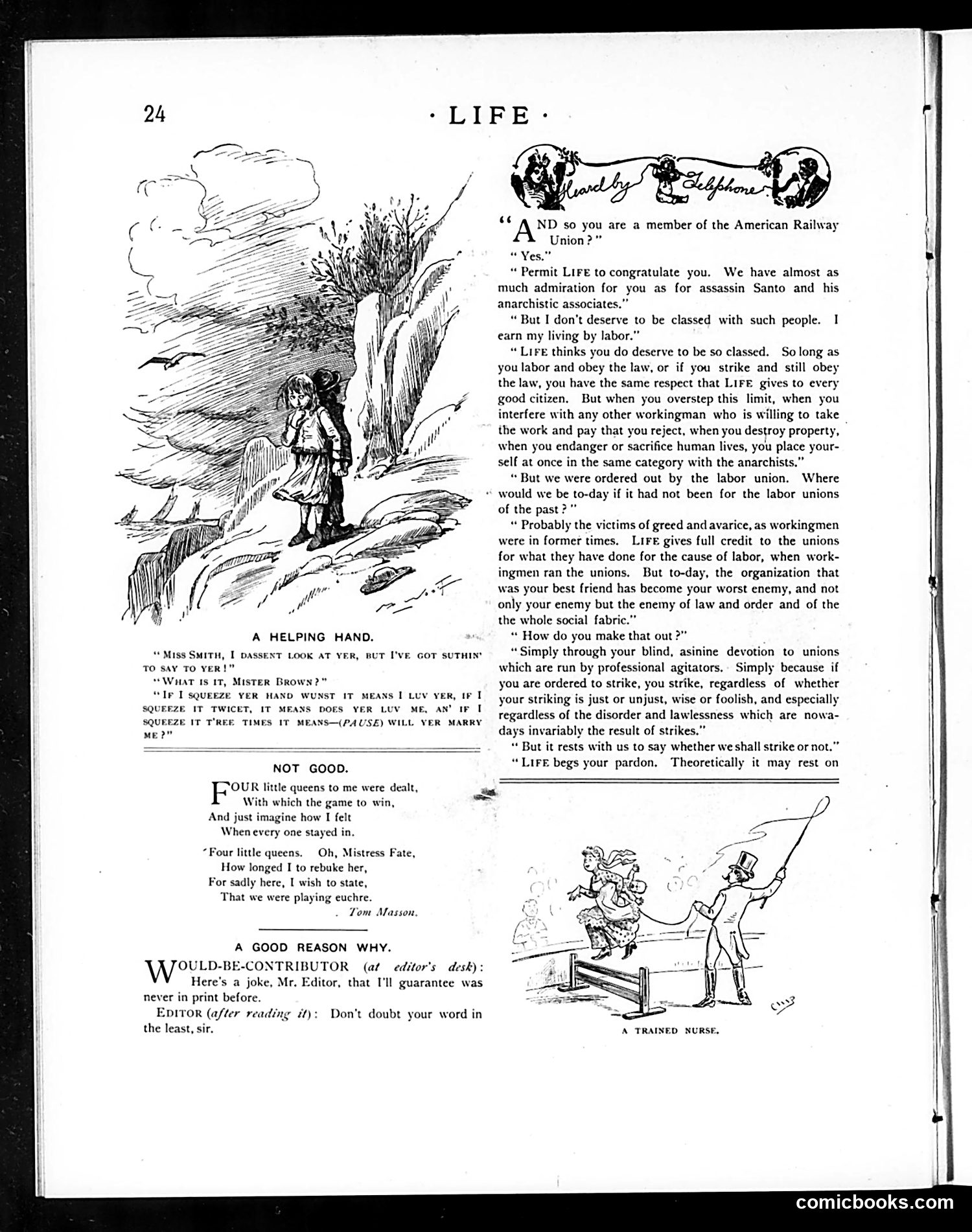
This page critiques labor union activism through satirical dialogue. A person identifies themselves as an American Railway Union member. Life's editors respond that while they admire labor organizing, unions cross an ethical line when members strike indiscriminately, destroy property, or endanger lives—placing strikers in the same category as anarchists like Santo (likely referencing contemporary anarchist violence). The debate centers on whether unions serve workers' interests or become tyrannical organizations forcing compliance regardless of strike justification. Life argues unions have become "blind, asinine devotion" rather than defenders of workers' rights. The accompanying illustrations—"A Helping Hand" and "A Trained Nurse"—use visual metaphor to mock union leadership and activism, though their specific meaning requires additional context.
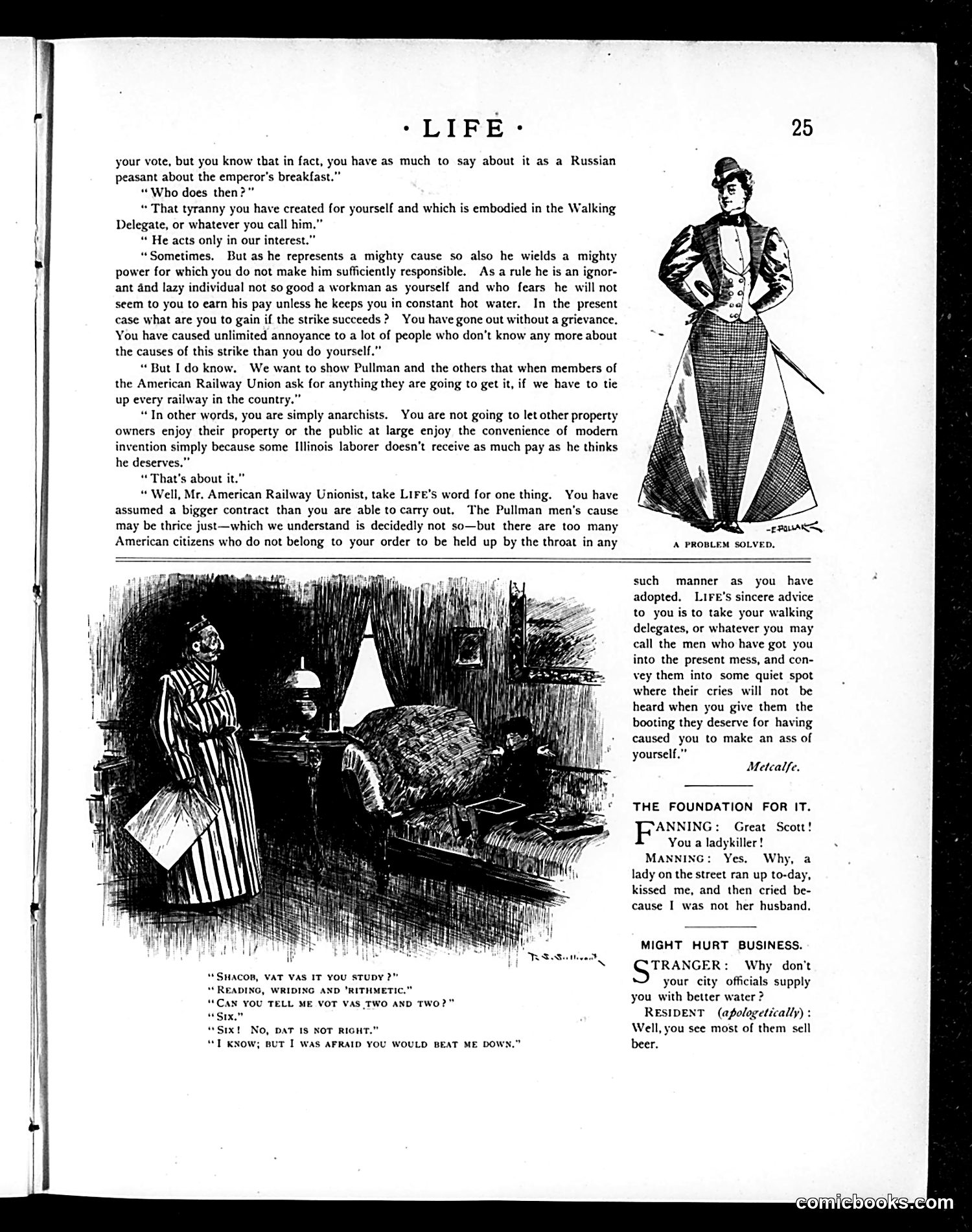
This page satirizes labor union activism, specifically targeting railroad union strikes. The main text mocks a "Walking Delegate" (union organizer) for calling strikes that inconvenience the public while claiming to represent workers' interests. The author argues the delegate assumes too much authority and suggests his actions are anarchistic. The cartoon at bottom-left depicts a domestic scene where a man reads while a woman works, captioned with dialogue about arithmetic and voting—apparently satirizing working-class illiteracy. The illustration at top-right labeled "A Problem Solved" shows a woman, likely referencing gender politics or women's roles during this labor-dispute era. The brief jokes below address unrelated topics: a "ladykiller," water quality, and beer sales by city officials—typical satirical filler of the period.
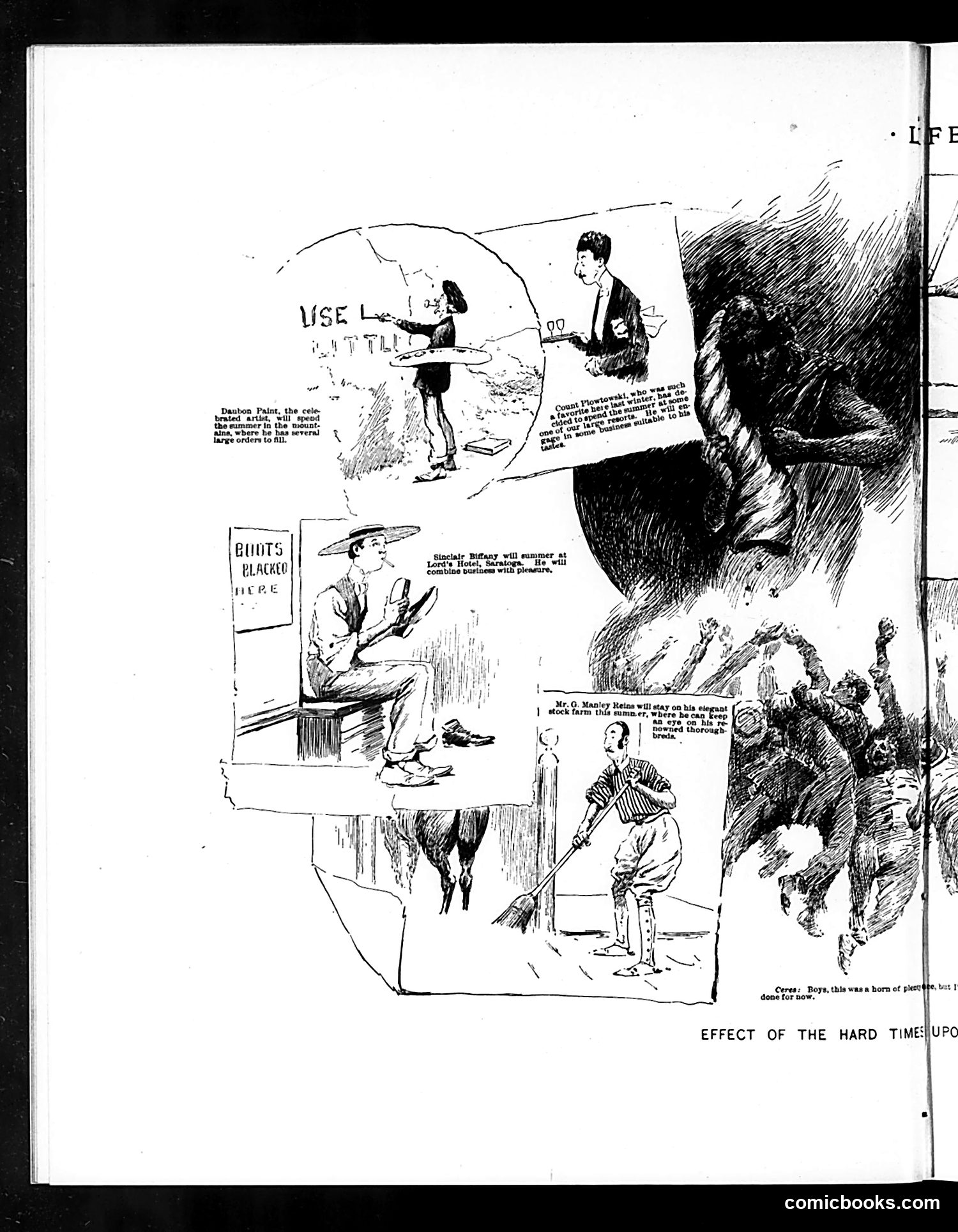
This satirical cartoon depicts the economic hardship of what appears to be a depression or recession era (likely early 20th century, based on style). The central image shows a large figure representing "Hard Times" casting a shadow over various scenes of struggling Americans: - A figure painting a sign reading "USE LITTLE" (rationing advice) - Someone at a desk labeled "BOOTS BLACKED HERE" (makeshift income) - A man in western attire (unclear reference) - Lower panels showing what appears to be homelessness or poverty conditions The satire illustrates how economic depression forces people into desperate circumstances—creating odd jobs, rationing consumption, and leaving many destitute. The looming shadow suggests Hard Times as an omnipresent threat controlling daily life and forcing survival strategies.
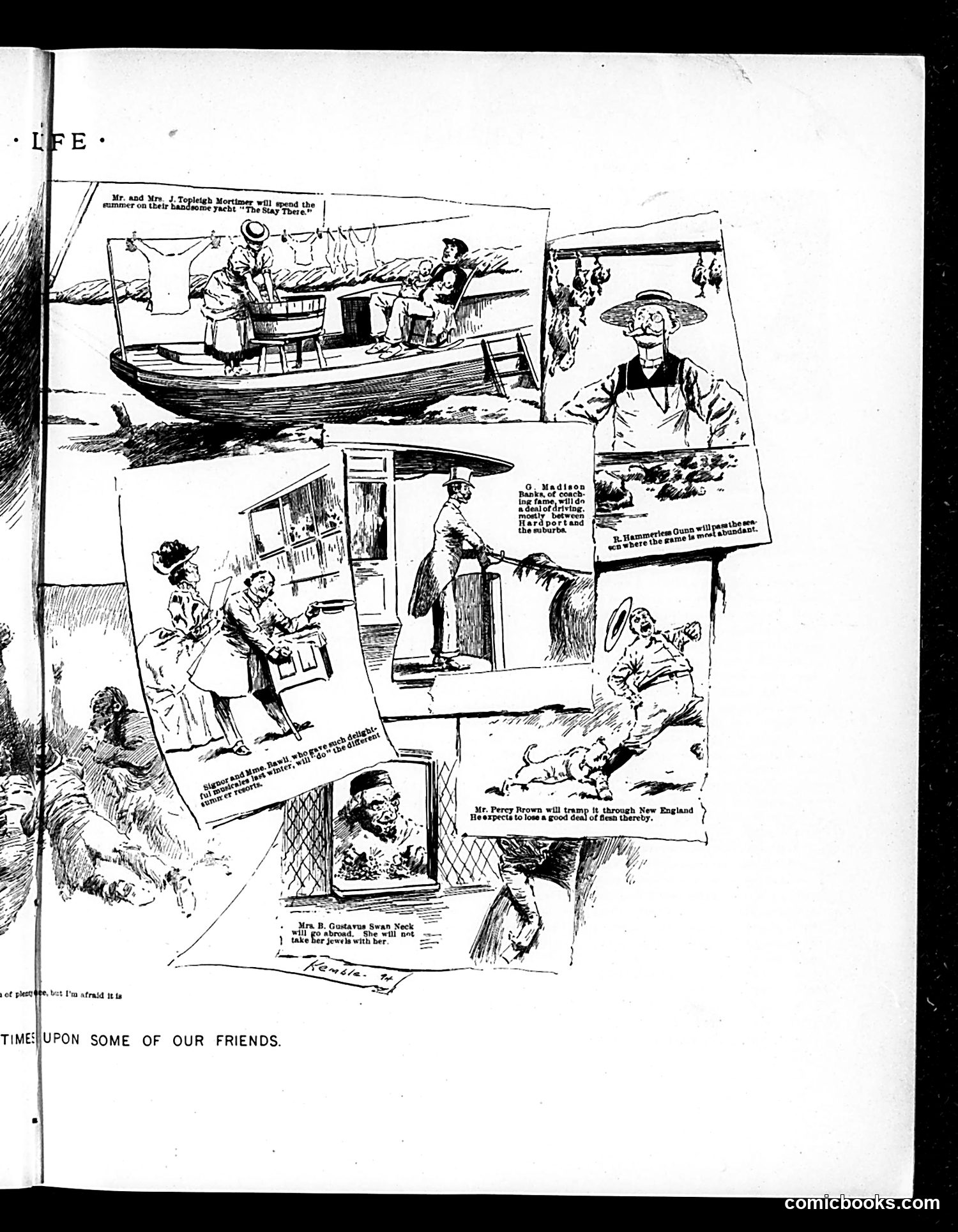
This satirical illustration page collects humorous character sketches depicting various acquaintances or public figures of the era. The vignettes show people in different scenarios—a couple on a boat, someone in formal dress, domestic scenes, and outdoor situations. Each small panel includes a caption identifying the character and their defining trait or foible. The overall title suggests the piece gently mocks familiar personality types rather than targeting specific political figures. The sketches employ exaggerated physical characteristics typical of period caricature to highlight quirks—fashion choices, mannerisms, or social behaviors. Without clearer caption text, the specific identities and precise satirical targets remain partially illegible in this reproduction, though the intent appears to be lighthearted social commentary on recognizable contemporary character types.
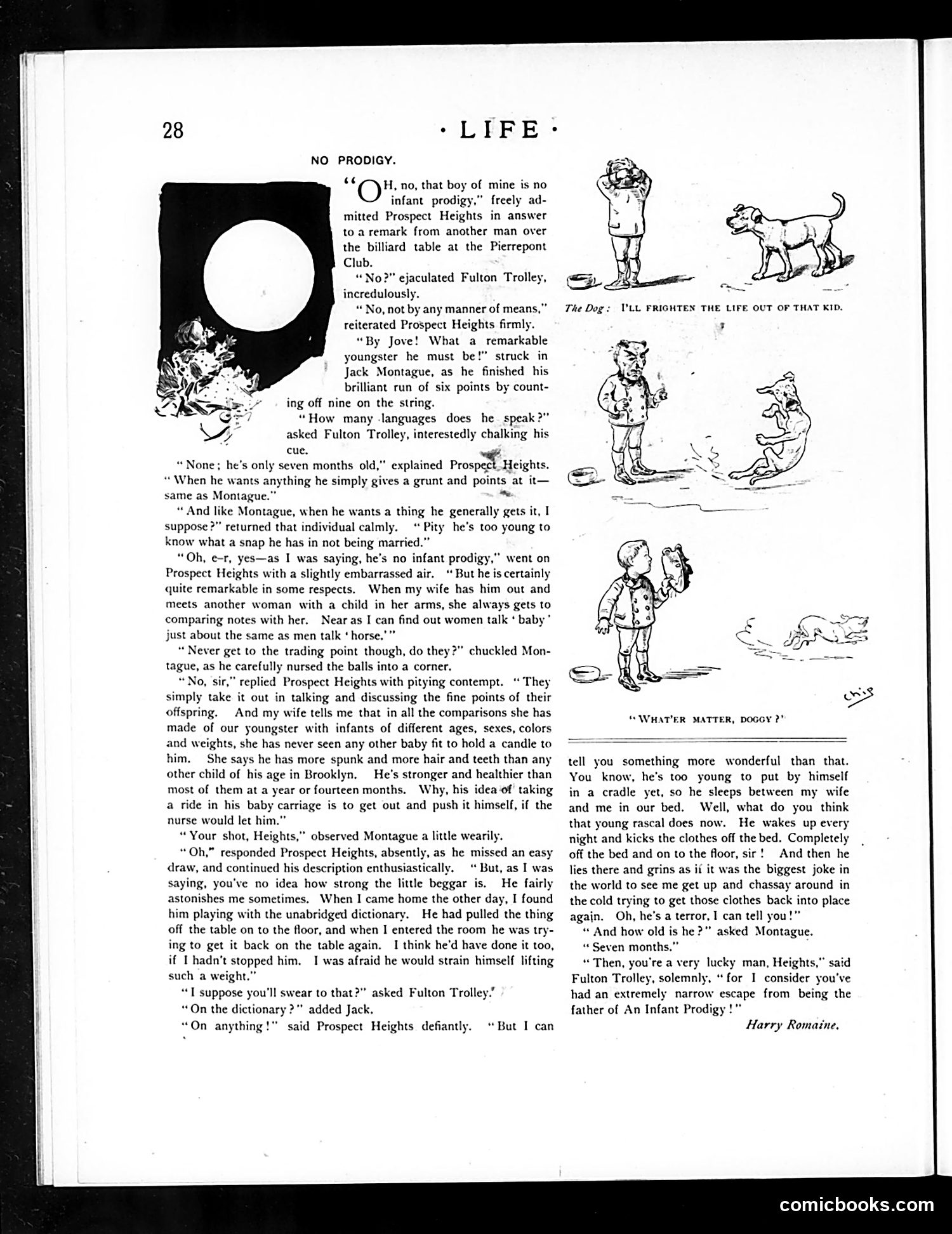
This is a humorous short story with accompanying illustrations satirizing *new fathers and their boasting*. At a billiard club, Prospect Heights claims his seven-month-old son is "no prodigy"—then immediately contradicts himself by exaggerating the child's abilities: exceptional strength (pulling an unabridged dictionary off a table), intelligence, physical development, and a supposed sense of humor (kicking off bedclothes and grinning). His friends—Fulton Trolley and Jack Montague—grow increasingly weary listening to these obviously exaggerated claims. The joke is that Prospect Heights is exactly the type of boastful parent he denies being. The final illustration shows a dog being frightened, possibly reinforcing the theme that even animals find the boy's antics absurd. The satire targets the universal tendency of fathers to view their children as exceptional while lacking self-awareness about their own tedious bragging.
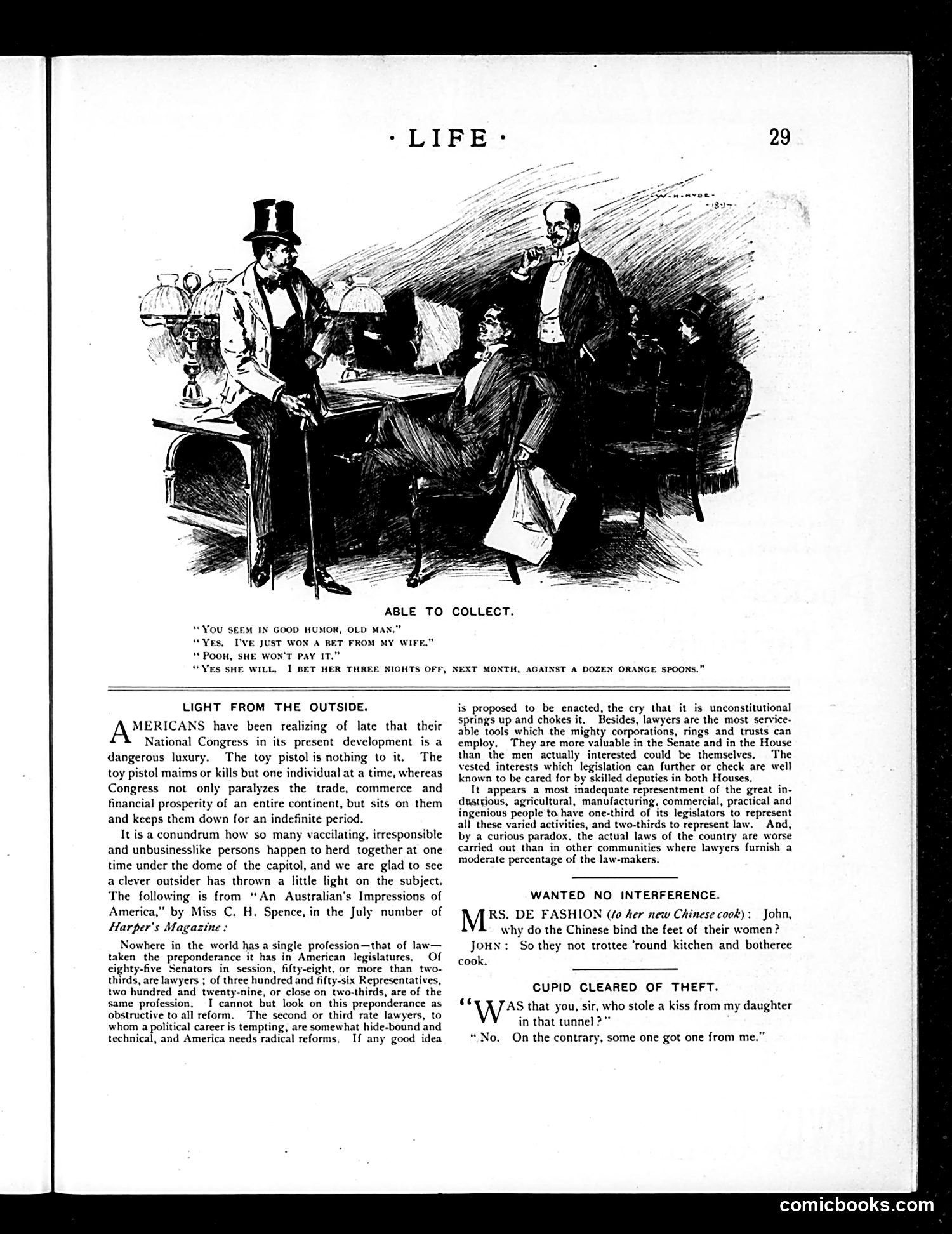
**Top Cartoon ("Able to Collect"):** A husband boasts to friends that he won a bet from his wife—wagering "three nights off next month" against "a dozen orange spoons." The joke reflects contemporary attitudes about marital relations and domestic disputes, suggesting husbands could wager conjugal privileges as casually as material goods. The "orange spoons" detail suggests the wife's materialism. **"Light from the Outside":** An article critiquing the U.S. Congress, quoting Australian observer C.H. Spence. The satire attacks lawyer-dominance in legislatures (two-thirds of Congress), claiming lawyers obstruct reform by invoking "unconstitutional" objections and serve corporate interests better than actual businesspeople. The piece argues practical, industrial people should represent themselves rather than rely on lawyers. **Lower Cartoons:** Brief joke exchanges—one about Chinese foot-binding (the cook's explanation), another about stolen kisses in a tunnel (wordplay on who initiated the kiss). These are light social humor typical of the era.
This page contains two satirical anecdotes about evasive answers to direct questions. **"The Old, Old Sorrow"** references Frank Stockton's famous 1882 short story "The Lady or the Tiger?" — a widely-discussed tale that deliberately ends without revealing which choice the protagonist made. The cartoon illustrates Stockton's reputation for avoiding commitment: at a Washington dinner, when a hostess serves him an ice sculpture shaped like a lady and tiger, directly asking which he'd take, Stockton replies "Some of both, please"—perfectly capturing his characteristic refusal to give a definitive answer. The second anecdote mocks a Wisconsin senator who, while reading his newspaper during senate proceedings, moves to "dispense with" reading the *Times*, *Inter-Ocean*, and other papers—conspicuously omitting his beloved *Madison Journal* he's holding. It's satire about transparent self-interest disguised as procedural neutrality. Both jokes target public figures who employ clever evasion rather than honest commitment. The remainder consists of period advertisements.
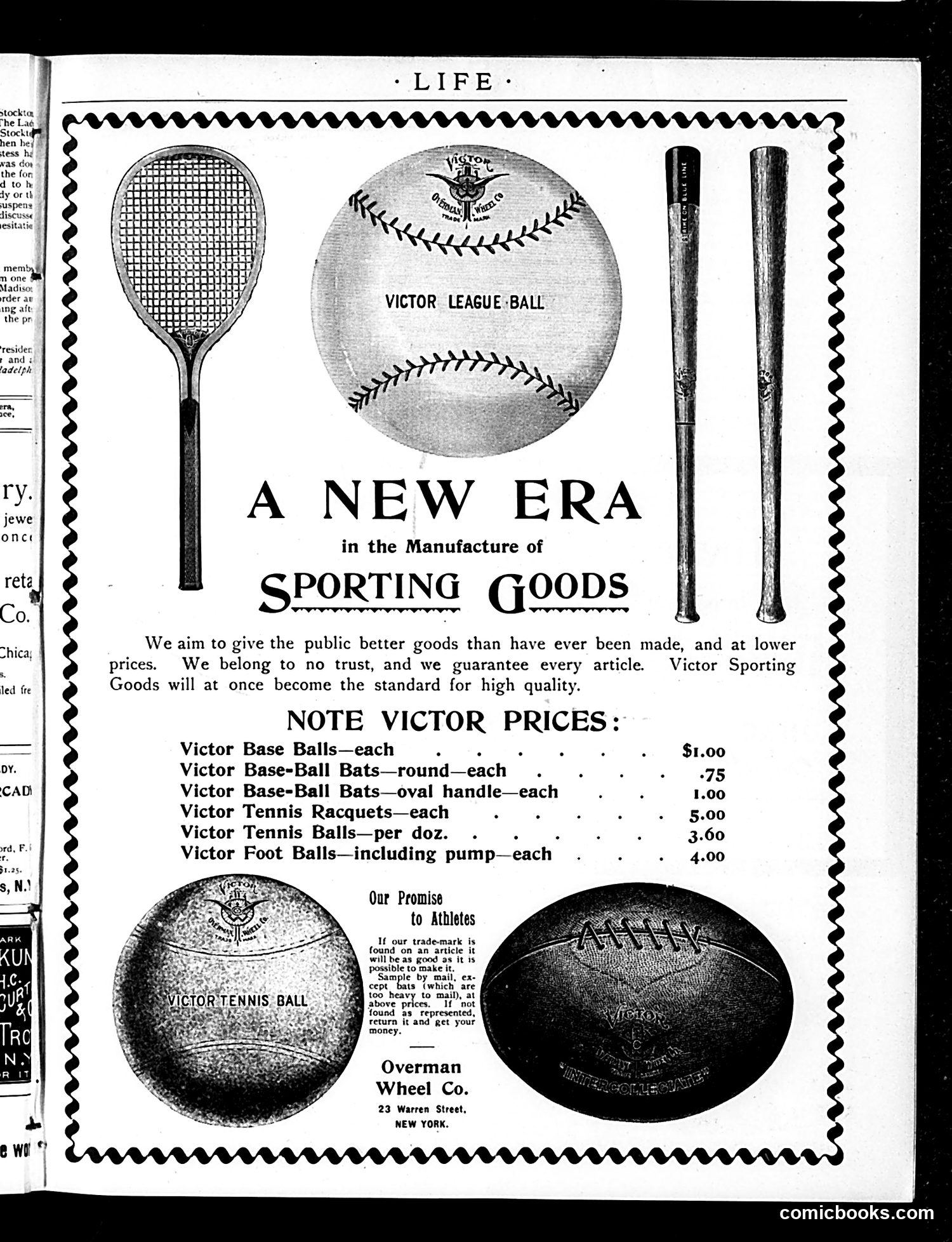
This is a **sporting goods advertisement**, not a political cartoon. The Overman Wheel Company is advertising their "Victor" brand sports equipment through Life magazine. The page displays various athletic products—baseballs, bats, tennis racquets, and footballs—with prices ranging from 75 cents to $5.00. The company's pitch emphasizes quality and fair pricing, claiming they belong to "no trust" (a direct reference to the anti-monopoly sentiment of the early 1900s, when large industrial trusts were widely criticized). The "New Era" language suggests this is positioning Victor sporting goods as a modern, trustworthy alternative to established manufacturers. The promise to athletes guarantees product authenticity and satisfaction. For modern readers, the key historical context is understanding that "trust" meant monopolistic corporations—the advertiser is claiming independence and integrity during an era of significant public concern about corporate consolidation and fair competition.
This page contains three humorous anecdotes illustrating miscommunication and awkward social situations: 1. **The Whistle Incident**: A young man misinterprets a clerk's whistle (summoning a bellboy) as a dismissive gesture, creating embarrassment. The joke hinges on outdated hotel communication methods unfamiliar to the visitor. 2. **The Whisky & Whisk Broom**: A Western bartender places a broom beside whisky glasses. A tenderfoot watches a rough patron brush sand from the floor before drinking, then collapses—suggesting the whisky's potency requires floor-sweeping preparation. This satirizes exaggerated frontier stereotypes. 3. **The Jury Duty Dodge**: A man claims deafness to escape jury duty but inadvertently proves he can hear perfectly, trapping himself into service. The judge catches his dishonesty through a verbal trap. The page also includes period advertisements for Haviland China and Higgins & Seiter glassware. These pieces mock human nature: misunderstandings, pretense, and self-deception.
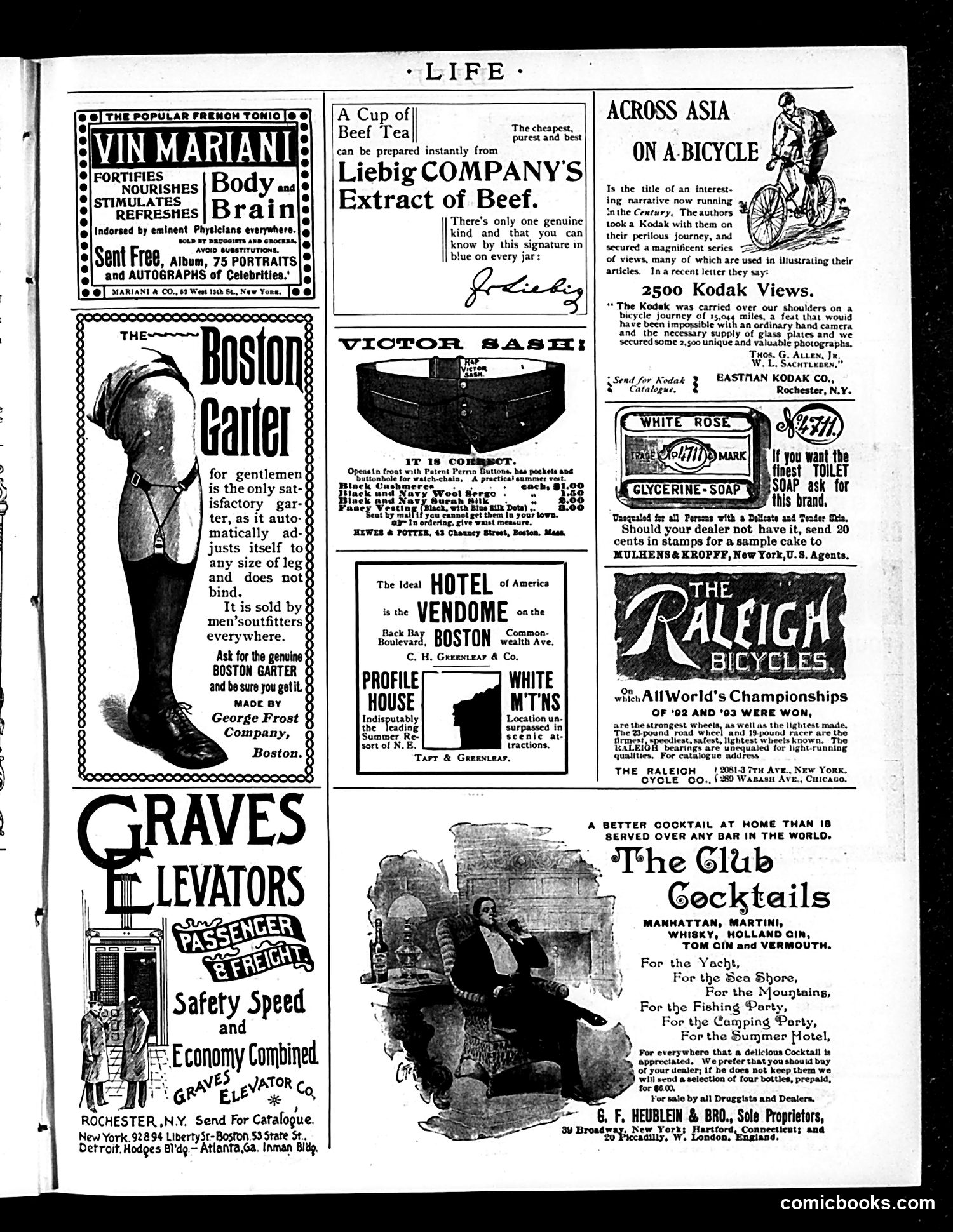
This is primarily an **advertising page** from Life magazine, not a satirical cartoon page. It contains multiple commercial advertisements typical of early 20th-century publications. The main content includes ads for: - **Vin Mariani** (fortified wine tonic) - **Liebig's Extract of Beef** (instant beef tea) - **Boston Garter** (men's leg garters) - **Graves Elevators** - **Raleigh Bicycles** (emphasizing championship wins) - **White Rose Glycerine Soap** - **The Club Cocktails** (pre-mixed spirits) - Various hotels and other products There is one *editorial* piece: "Across Asia on a Bicycle," describing a traveler's 15,000-mile bicycle journey documented with 2,500 Kodak photographs—essentially a Kodak advertisement. **No political satire is present.** The page reflects period consumer culture, targeting gentlemen with luxury goods, sporting equipment, and pre-packaged conveniences. The bicycle and cocktail ads reflect leisure interests of the era's middle/upper classes.
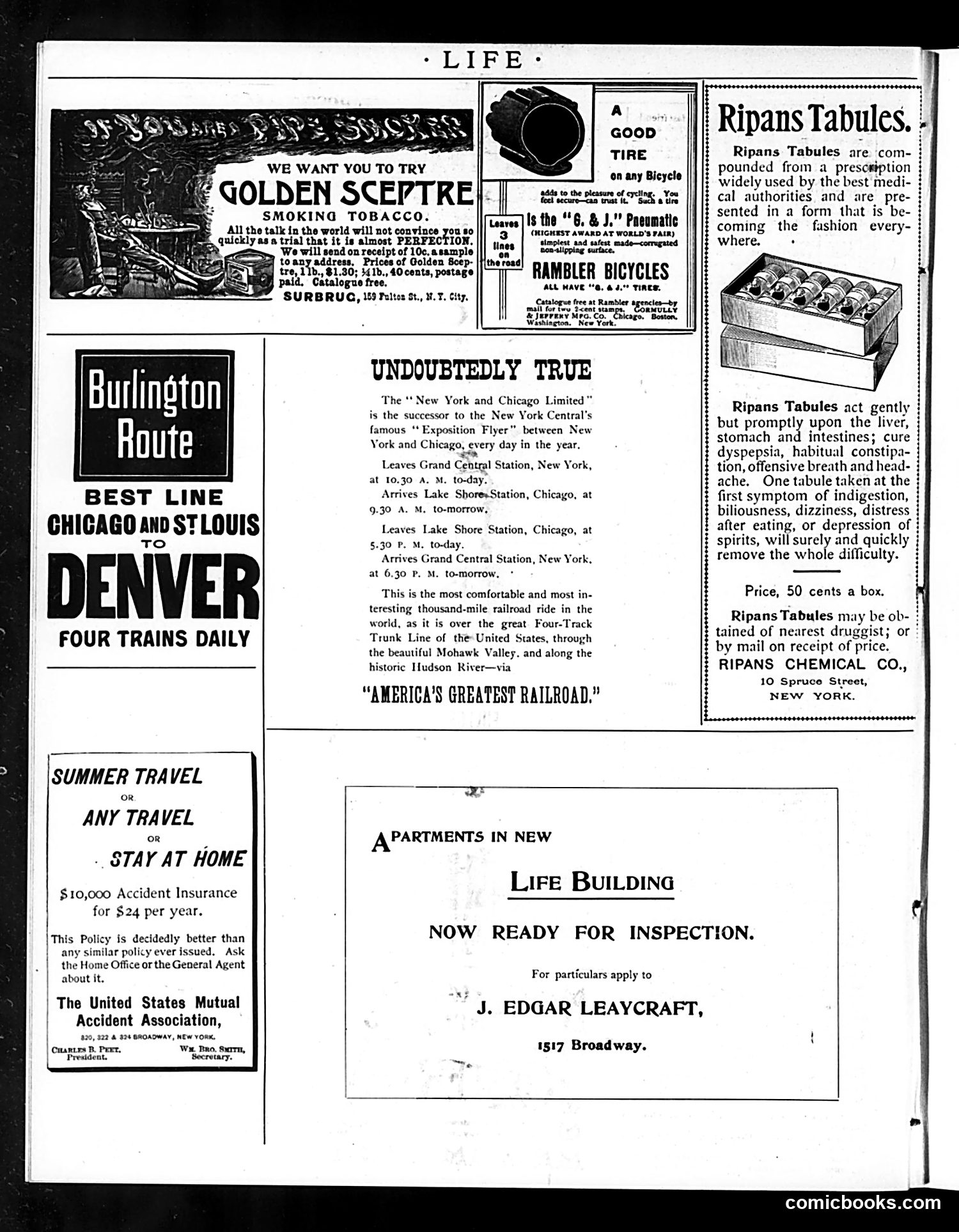
This is primarily an **advertising page**, not a satirical cartoon page. It contains commercial advertisements typical of early 1900s Life magazine: **Key advertisements include:** - **Golden Sceptre Tobacco** — promoting a smoking product - **Burlington Route** — railroad service to Denver - **Rambler Bicycles** — featuring pneumatic tires - **Ripans Tabules** — a patent medicine claiming to cure digestive issues, constipation, and various ailments (50 cents per box) - **United States Mutual Accident Association** — offering $10,000 insurance for $24 yearly - **Life Building apartments** — rental properties in New York The page reflects early 20th-century consumer culture and the prevalence of patent medicines, many of questionable efficacy. The Ripans Tabules ad is particularly notable as an example of the largely unregulated medical marketing that preceded FDA oversight. There is no political satire or cartoon content visible on this page.
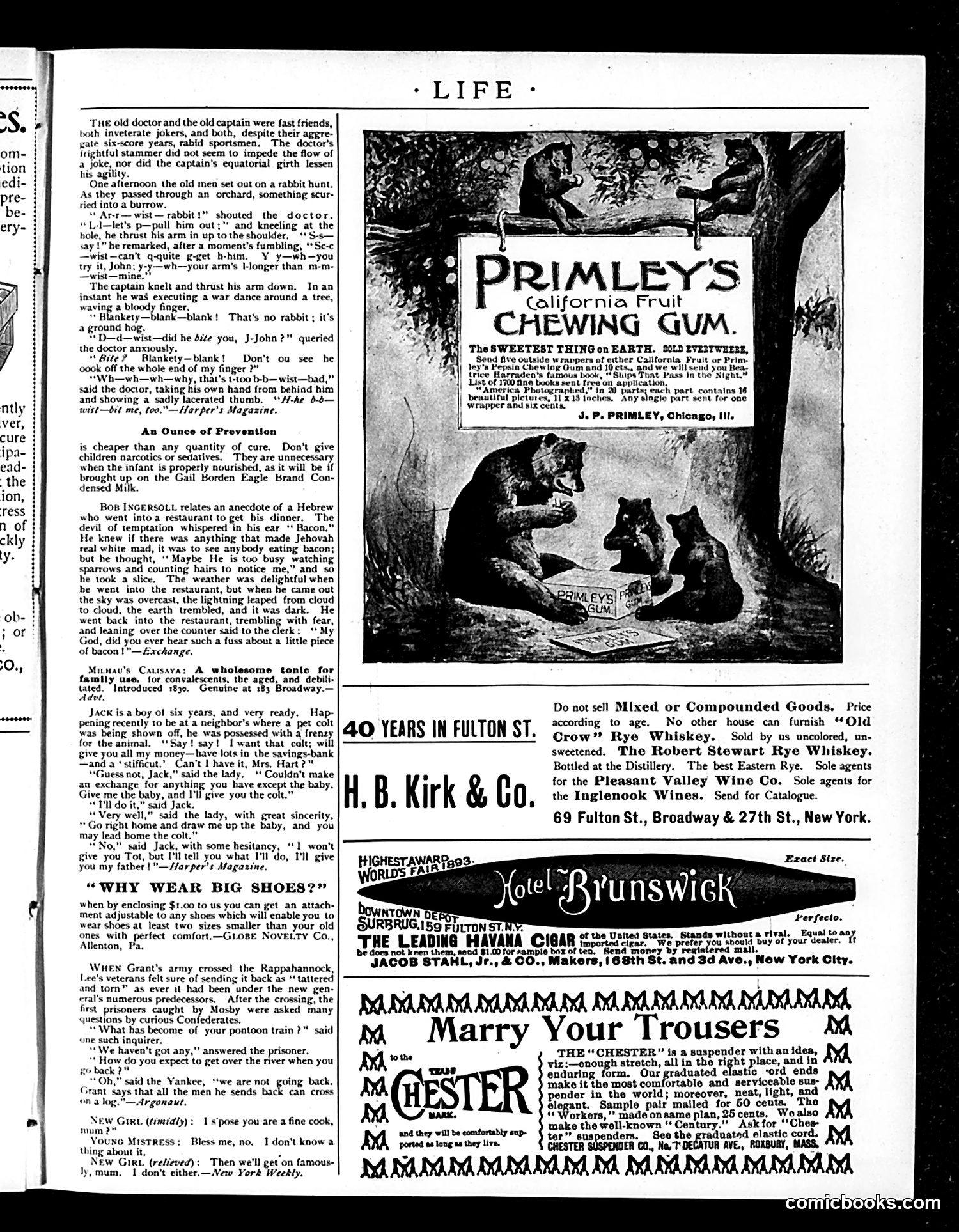
This page contains primarily **humorous anecdotes** rather than political cartoons. The main story describes two elderly sportsmen—a doctor and captain—on a rabbit hunt who both get bitten by a groundhog they mistake for a rabbit. The humor derives from their stammering dialogue and the ironic twist (it's not a rabbit). The page also includes several other brief comedic stories and **advertisements**, including pitches for Primley's Chewing Gum, H.B. Kirk & Co. whiskey, the Hotel Brunswick, Chester trousers, and various patent remedies and products. The humor is characteristic of early 20th-century *Life* magazine—folksy, pun-based, relying on dialect and physical comedy rather than political satire. References to figures like Robert Ingersoll and General Grant appear in anecdotes, but without specific contemporary political commentary. This is primarily a **humor and advertising page** rather than satirical editorial content.
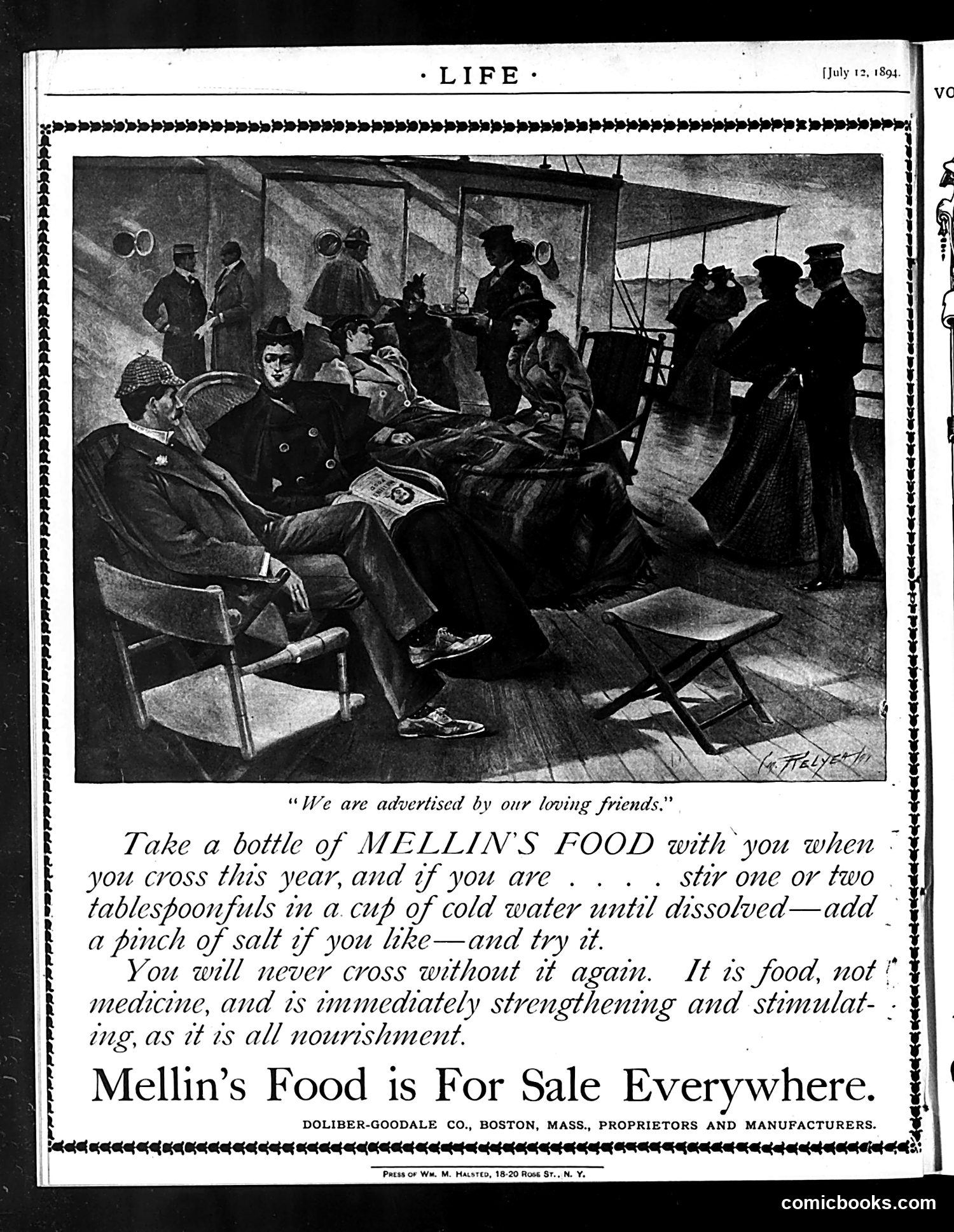
This is primarily a **product advertisement**, not political satire. The illustration shows passengers aboard a ship, establishing the context: ocean travel in the 1890s. The ad promotes **Mellin's Food**, an infant nutritional product made by a Boston manufacturer. The caption "We are advertised by our loving friends" suggests satisfied customers recommend it. The pitch targets travelers crossing the Atlantic, claiming the product provides immediate strengthening and nourishment when mixed with water—useful for the discomforts of sea voyages. The satire is gentle: the implicit joke is that "loving friends" aren't really promoting it out of affection, but the advertisement itself *is* that friend recommending it. The advice to never cross without it again humorously exaggerates the product's benefits. This reflects the era's marketing of patent foods and tonics as cure-alls, before modern FDA regulation.