
Life, 1894-07-12 · page 6 of 20
Life — July 12, 1894 — page 6: what you’re looking at
What you’re looking at
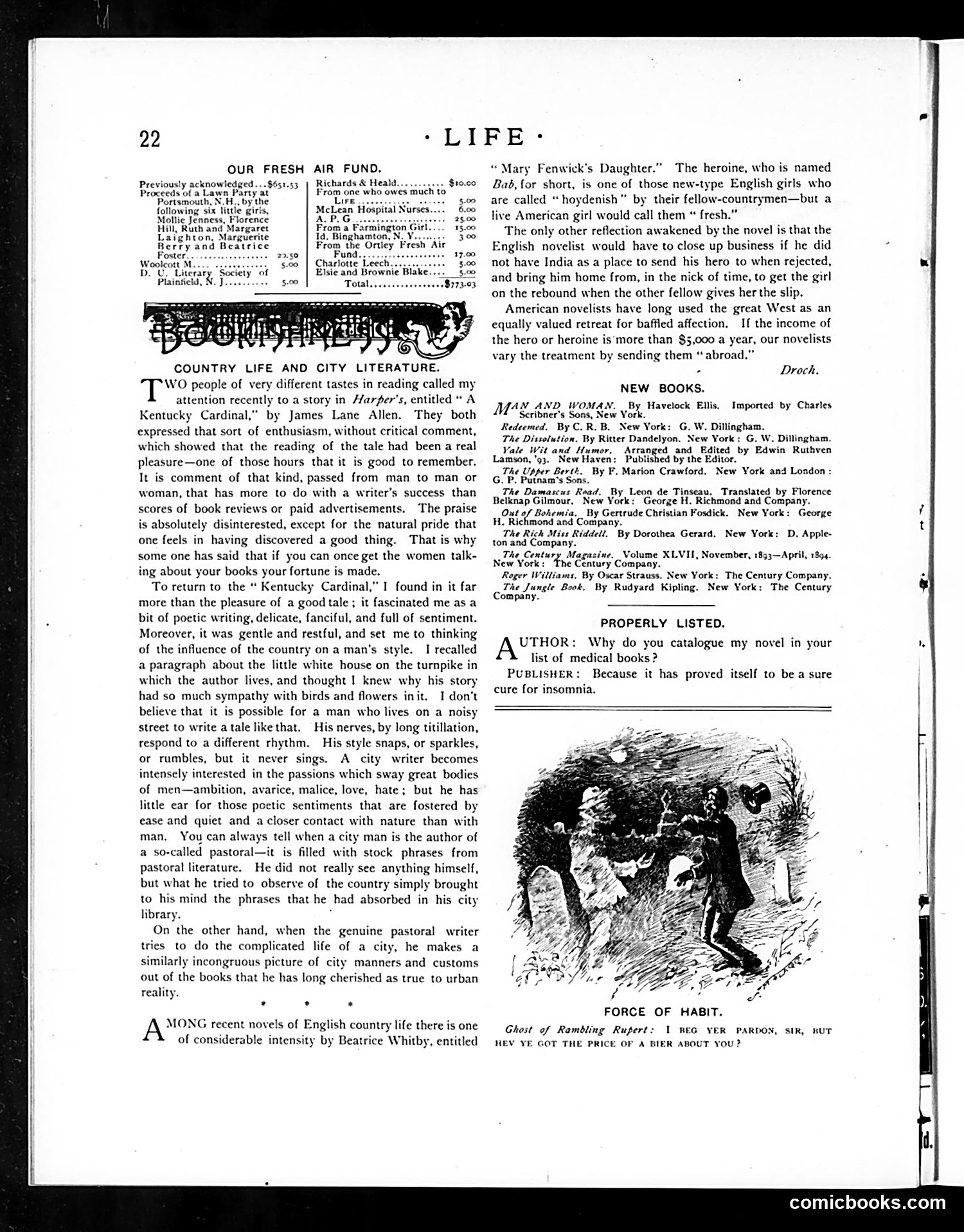
This page contains a literary discussion and book review section rather than political cartoons. The main content discusses country versus city literature, analyzing how authors capture rural versus urban settings authentically. The single illustration titled "FORCE OF HABIT" shows a sketch of what appears to be a rural or working-class figure, accompanied by text reading: "Ghost of Rambling Robert: I BEG VER PARDON, SIR, BUT HEV YE GOT THE PRICE OF A BIER ABOUT YOU?" This is a gentle satirical sketch depicting an apparition asking for money in dialect-heavy speech, likely poking fun at either rural character types or the persistence of poverty-stricken figures even in the afterlife. The humor relies on period stereotypes about rural speech patterns and persistent vice.
📄 Transcribed text from this page (OCR, searchable)
Machine-transcribed from the original scan — historical spelling and the odd misread are preserved.
22 OUR FRESH Previously acknowledged...$651.53, Proceeds of a Lawn Party at Portsmouth, N.H.. by the following six littie girls, Mollie Jenness, Florence Hill, Ruth and Margaret Laighton, Marguerite ‘LIFE: AIR FUND. Richards & Heald........... $10.00 From one who owes much to Lire... MeLean Hospital A.P.G 5.00 6.00 25.00 15.00 3.00 ‘urses. Farmington Girl. Id. Binghamton, N.Y. From the Ortley Fresh Air Fund....... Charlotte Leech Elsie and Brownie Blake. Berry and Beatrice Foster... i Woolcott M.. Bs DU. Literary ‘Society’ ‘of Plainfield, N. J.......+ COUNTRY LIFE AND CITY LITERATURE. ‘WO people of very different tastes in reading called my attention recently to a story in Harper's, entitled “ A Kentucky Cardinal,” by James Lane Allen. They both expressed that sort of enthusiasm, without critical comment, which showed that the reading of the tale had been a real pleasure—one of those hours that it is good to remember. It is comment of that kind, passed from man to man or woman, that has more to do with a writer’s success than scores of book reviews or paid advertisements. The praise is absolutely disinterested, except for the natural pride that one feels in having discovered a good thing. That is why some one has said that if you can once get the women talk- ing about your books your fortune is made. To return to the “ Kentucky Cardinal,” I found in it far more than the pleasure of a good tale ; it fascinated me as a bit of poetic writing, delicate, fanciful, and full of sentiment. Moreover, it was gentle and restful, and set me to thinking of the influence of the country on a man’s style. I recalled a paragraph about the little white house on the turnpike in which the author lives, and thought | knew why his story had so much sympathy with birds and flowers init. I don't believe that it is possible for a man who lives on a noisy street to write a tale like that. His nerves, by long titillation, respond to a different rhythm. His style snaps, or sparkle: or rumbles, but it never sings. A city writer becomes intensely interested in the passions which sway great bodit of men—ambition, avarice, malice, love, hate; but he has little ear for those poetic sentiments that are fostered by ease and quiet and a closer contact with nature than with man. You can always tell when a city man is the author of a so-called pastoral—it is filled with stock phrases from pastoral literature. He did not really see anything himself, but what he tried to observe of the country simply brought to his mind the phrases that he had absorbed in his city library. ‘ On the other hand, when the genuine pastoral writer tries to do the complicated life of a city, he makes a similarly incongruous picture of city manners and customs out of the books that he has long cherished as true to urban reality. ’ . * Aone: recent novels of English country life there is one of considerable intensity by Beatrice Whitby, entitled “Mary Fenwick’s Daughter.” The heroine, who is named Bab, for short, is one of those new-type English girls who are called “ hoydenish” by their fellow-countrymen—but a live American girl would call them “ fresh.” The only other reflection awakened by the novel is that the English novelist would have to close up business if he did not have India as a place to send his hero to when rejected, and bring him home from, in the nick of time, to get the girl on the rebound when the other fellow gives her the slip. American novelists have long used the great West as an equally valued retreat for baffled affection. If the income of the hero or heroine is‘more than $5,000 a year, our novelists vary the treatment by sending them “ abroad.’ - Droch. NEW BOOKS. MAN AND WOMAN. | By Havelock Ellis. Scribner's Sons, New York. Redeemed. By C.R. B. New York: G. W. Di The Dissolution, By Ritter Dandelyon. Ni . W. Dillingham. Yale Wit and Humor, Arranged and Edited by Edwin Ruthven Lamson, '93. New Haven: Published by the Editor. The Upper Berth. By F, Marion Crawford. New York and London : G.P. Putnam's Sons. The Damascus Road. By Leon de Tinseau, Translated by Florence Belknap Gilmour. New York: George H. Richmond and Company. Out of Bohemia. By Gertrude Christian Fosdick. New York: George H, Richmond and Company. The Rich Miss Riddell. By Dorothea Gerard. ton and Company. The Century Magazine, Volume XLVII, November, 1833—April, 1894. New York: Fhe Century Company, Roger Williams, By Oscar Strauss. New York: The Century Company. The Jungle Book, By Rudyard Kipling. New York: The Century Company, Imported by Charles New York: D, Apple PROPERLY LISTED. UTHOR: Why do you catalogue my novel in your list of medical books ? PUBLISHER: Because it has proved itself to be a sure cure for insomnia. FORCE OF HABIT. Ghost of Rambling Rupert: 1 REG YER PARDOX, HEV YE GOT THE PRICE OF A BIER ABOUT YOU? SIR, KUT comicbooks.com