
Life, 1894-07-12 · page 4 of 20
Life — July 12, 1894 — page 4: what you’re looking at
What you’re looking at
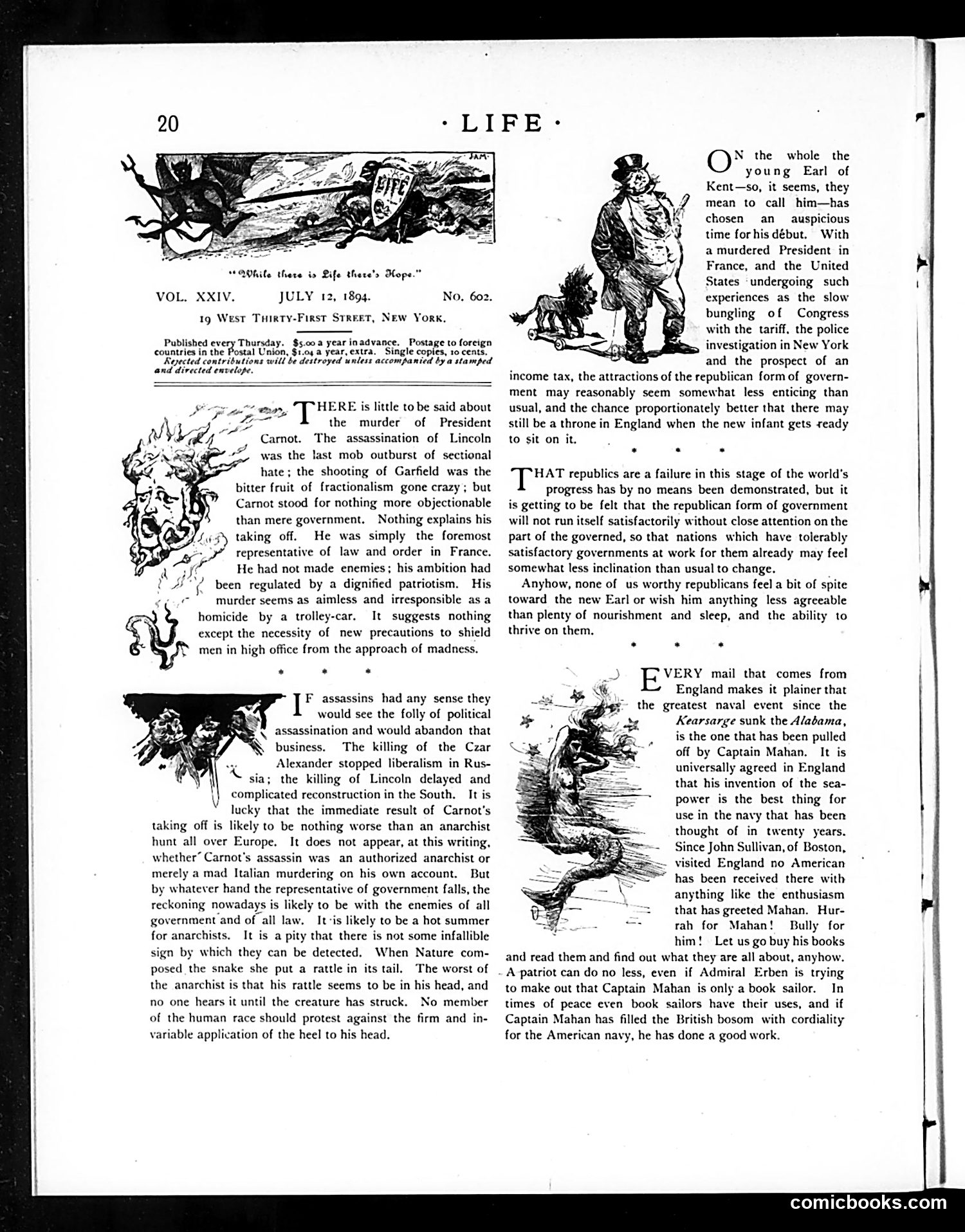
This page discusses the assassination of French President Carnot (murdered June 24, 1894) and its political implications. The text argues that while Carnot's killer was merely a madman rather than an anarchist conspirator, the incident raises concerns about anarchist violence across Europe. The cartoons illustrate anarchist threats: one depicts an anarchist as a wild, chaotic figure; another shows what appears to be a bomb or explosive device. The page also praises Captain Mahan's naval innovations, celebrating his advocacy for sea-power as beneficial to American naval strength. The overall message reflects contemporary anxiety about political violence and anarchism spreading internationally, while promoting American naval superiority as a stabilizing force.
📄 Transcribed text from this page (OCR, searchable)
Machine-transcribed from the original scan — historical spelling and the odd misread are preserved.
“OMKile there is Life there's Hope.” XXIV. JULY 12, 1894. No, 602. 1g West THirty-First STREET, New York. VOL. Published every Thursday. $5.00 a year inadvance. Postage to foreign countries in the Postal Union, $1.04 a year, extra. Single copies, 10 cents- Rejected contributions will be destroyed unless accompanied by a stamped and directed envelope. HERE is little to be said about the murder of President Carnot. The assassination of Lincoln was the last mob outburst of sectional hate; the shooting of Garfield was the bitter fruit of fractionalism gone crazy; but Carnot stood for nothing more objectionable than mere government. Nothing explains his ERS taking off. He was simply the foremost g oi Uy” representative of law and order in France. 0 He had not made enemies; his ambition had a been regulated by a dignified patriotism. His murder seems as aimless and irresponsible as a homicide by a trolley-car. It suggests nothing except the necessity of new precautions to shield men in high office from the approach of madness. . . F assassins had any sense they _would see the folly of political business, The killing of the Czar Alexander stopped liberalism in Rus- © sia; the killing of Lincoln delayed and complicated reconstruction in the South. It is lucky that the immediate result of Carnot’s taking off is likely to be nothing worse than an anarchist hunt all over Europe. It does not appear, at this writing, whether’ Carnot’s assassin was an authorized anarchist or merely a mad Italian murdering on his own account. But by whatever hand the representative of government falls, the reckoning nowadays is likely to be with the enemies of all government and of all law, It-is likely to be a hot summer for anarchists. It is a pity that there is not some infallible sign by which they can be detected. When Nature com- posed the snake she put a rattle in its tail. The worst of the anarchist is that his rattle seems to be in his head, and no one hears it until the creature has struck. No member of the human race should protest against the firm and in- variable application of the heel to his head. O* the whole the young Earl of Kent—so, it seems, they mean to call him—has chosen an auspicious time forhis début, With a murdered President in France, and the United States ‘undergoing such experiences as the slow bungling of Congress with the tariff. the police investigation in New York ‘ and the prospect of an income tax, the attractions of the republican form of govern- ment may reasonably seem somewhat less enticing than usual, and the chance proportionately better that there may still be a throne in England when the new infant gets ready to sit on it. . * . HAT republics are a failure in this stage of the world’s progress has by no means been demonstrated, but it is getting to be felt that the republican form of government will not run itself satisfactorily without close attention on the part of the governed, so that nations which have tolerably satisfactory governments at work for them already may feel somewhat less inclination than usual to change. Anyhow, none of us worthy republicans feel a bit of spite toward the new Earl or wish him anything less agreeable than plenty of nourishment and sleep, and the ability to thrive on them. ° . . VERY mail that comes from England makes it plainer that the greatest naval event since the Kearsarge sunk the Alabama, is the one that has been pulled off by Captain Mahan. It is universally agreed in England that his invention of the sea- power is the best thing for use in the navy that has been thought of in twenty years. Since John Sullivan, of Boston, visited England no American has been received there with anything like the enthusiasm that has greeted Mahan. Hur- rah for Mahan! Bully for him! Let us go buy his books and read them and find out what they are all about, anyhow, A patriot can do no less, even if Admiral Erben is trying to make out that Captain Mahan is only a book sailor. In times of peace even book sailors have their uses, and if Captain Mahan has filled the British bosom with cordiality for the American navy, he has done a good work. comicbooks.com