
A complete issue · 19 pages · 1894
Life — June 28, 1894
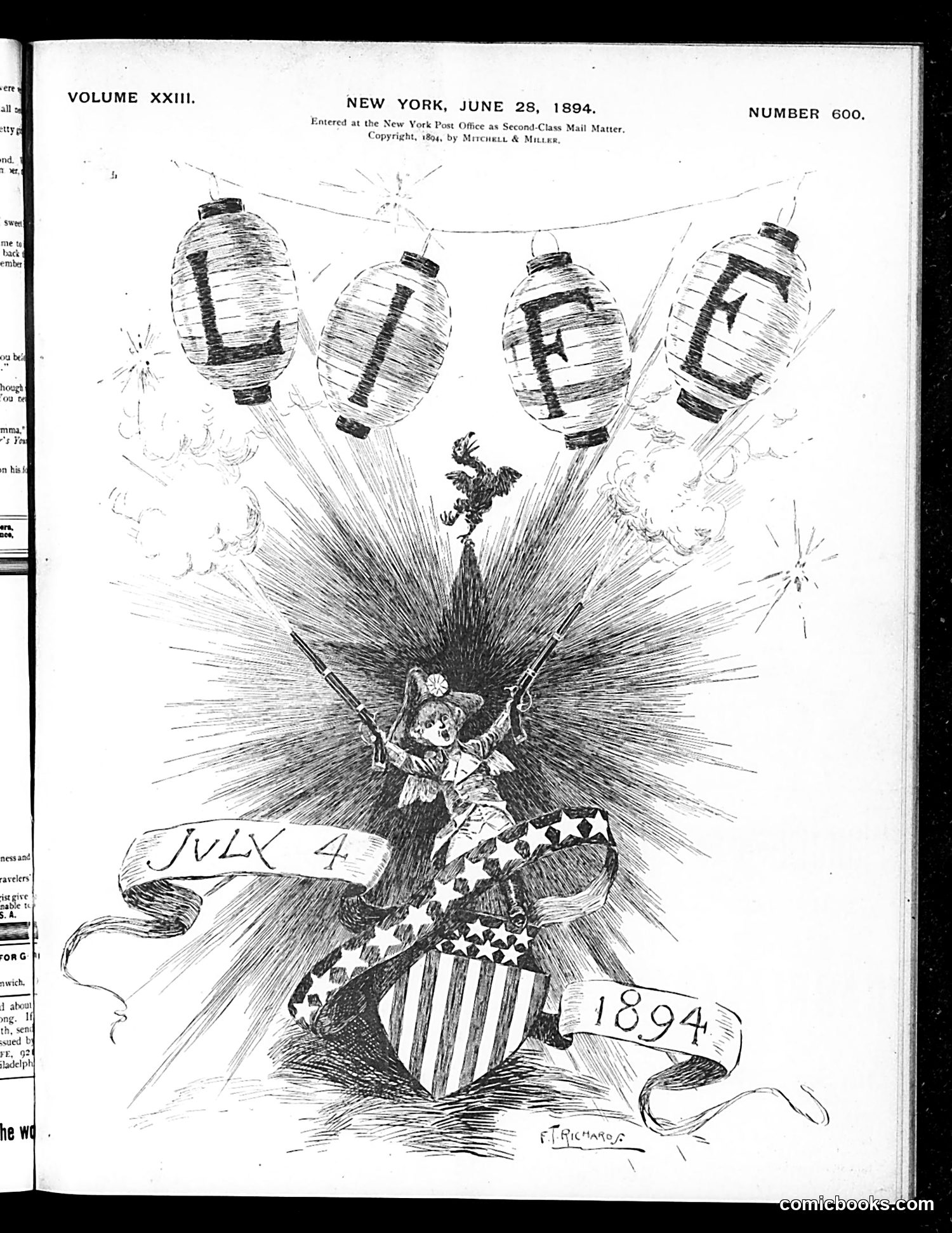
This is a July 4th, 1894 political cartoon from *Life* magazine. A figure representing Uncle Sam (identifiable by the stars-and-stripes clothing and characteristic appearance) stands triumphantly in the center, holding rifles aloft with a radiating burst of light behind him. He's launching four Chinese lanterns into the air, labeled (reading the banners) "JULY 4" and "1894." The satire appears to commentary on American imperialism or military expansion around the 1890s. The Chinese lanterns—likely referencing both the festive July 4th celebration and China itself—suggest the U.S. is aggressively projecting power or military might abroad during this era of American expansion. The cartoon's celebratory tone mixed with weaponry creates ironic commentary on American independence day paired with overseas military ambitions.
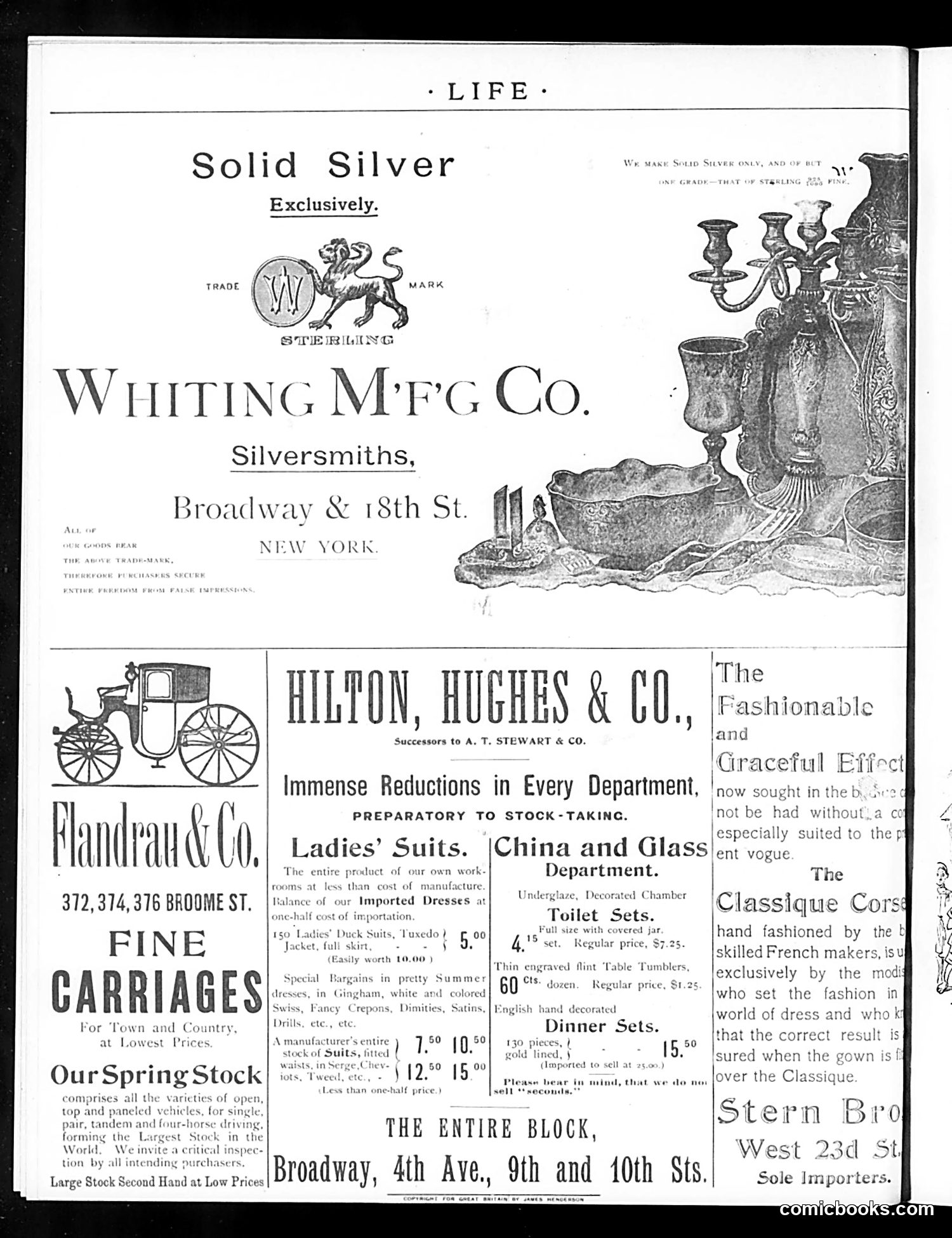
This page is **primarily advertising**, not satirical content. It features several late 19th-century advertisements: - **Whiting Mfg. Co.** (top): A silversmith advertising solid silver goods from their Broadway location in New York - **Flandau & Co.** (left): Carriage manufacturer promoting fine carriages and their spring stock inventory - **Hilton, Hughes & Co.** (center): Department store advertising dramatic price reductions on ladies' suits, china, glassware, and dinner sets across multiple locations in New York The page contains no political cartoons or caricatures. The decorative illustrations—classical urns, a horse-drawn carriage, ornamental vessels—are commercial design elements typical of period magazine advertising. This represents standard commercial content from *Life* magazine's advertising pages.
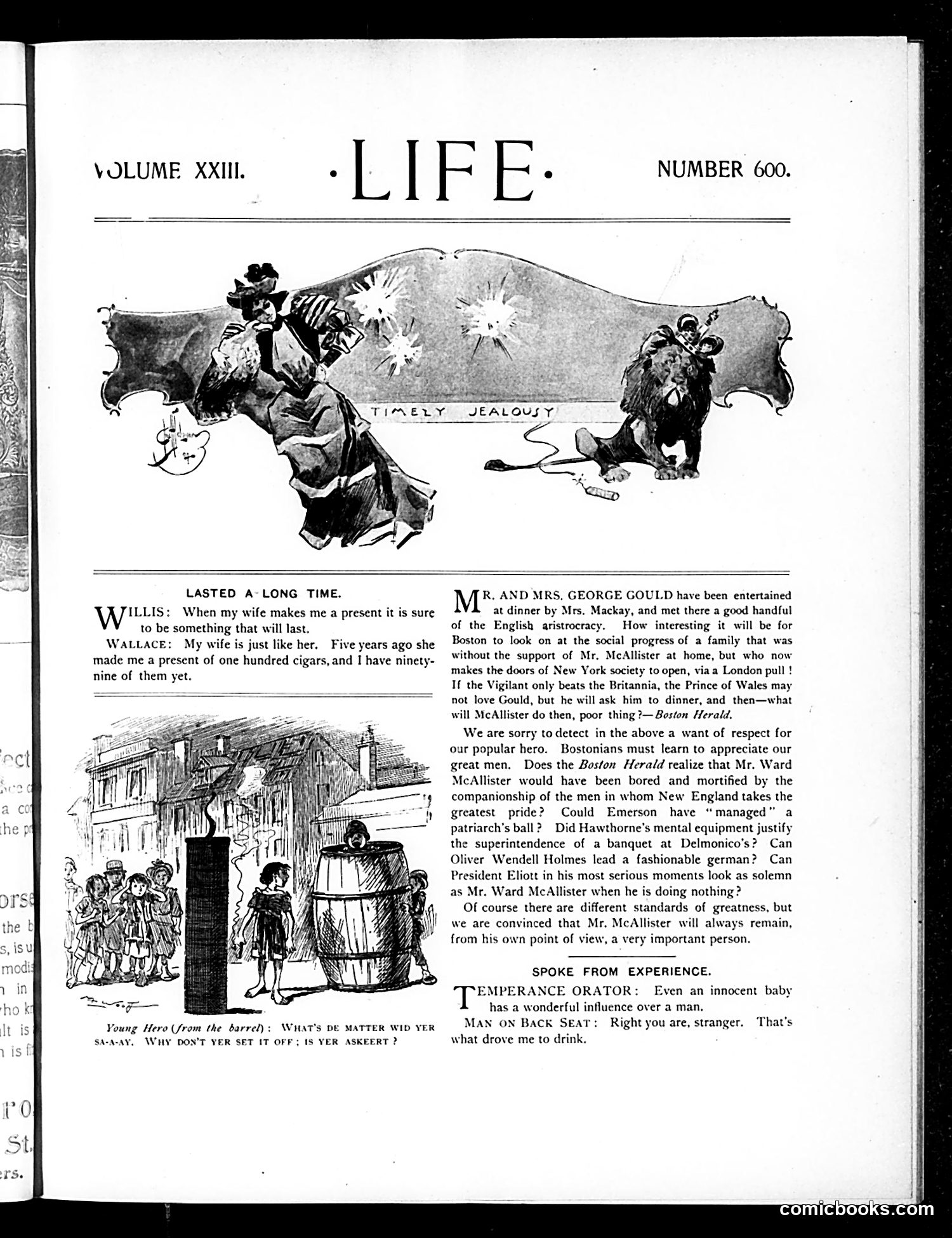
The top cartoon, titled "Timely Jealousy," depicts a woman throwing objects at two men, illustrating marital discord. The accompanying joke about cigars suggests domestic tension over a husband's habits. The lower cartoon shows a street scene with a young person emerging from a barrel, captioned with dialogue about setting it off. This appears to be a visual gag about pranks or mischief. The right column discusses Mr. and Mrs. George Gould's dinner entertaining Boston society and critiques Mr. Ward McAllister's social prominence, suggesting satirical commentary on New York's upper-class social hierarchy and who deserves recognition as a "great man." The "Spoke From Experience" section presents brief humorous observations on temperance and drinking, typical of Life's satirical humor format.
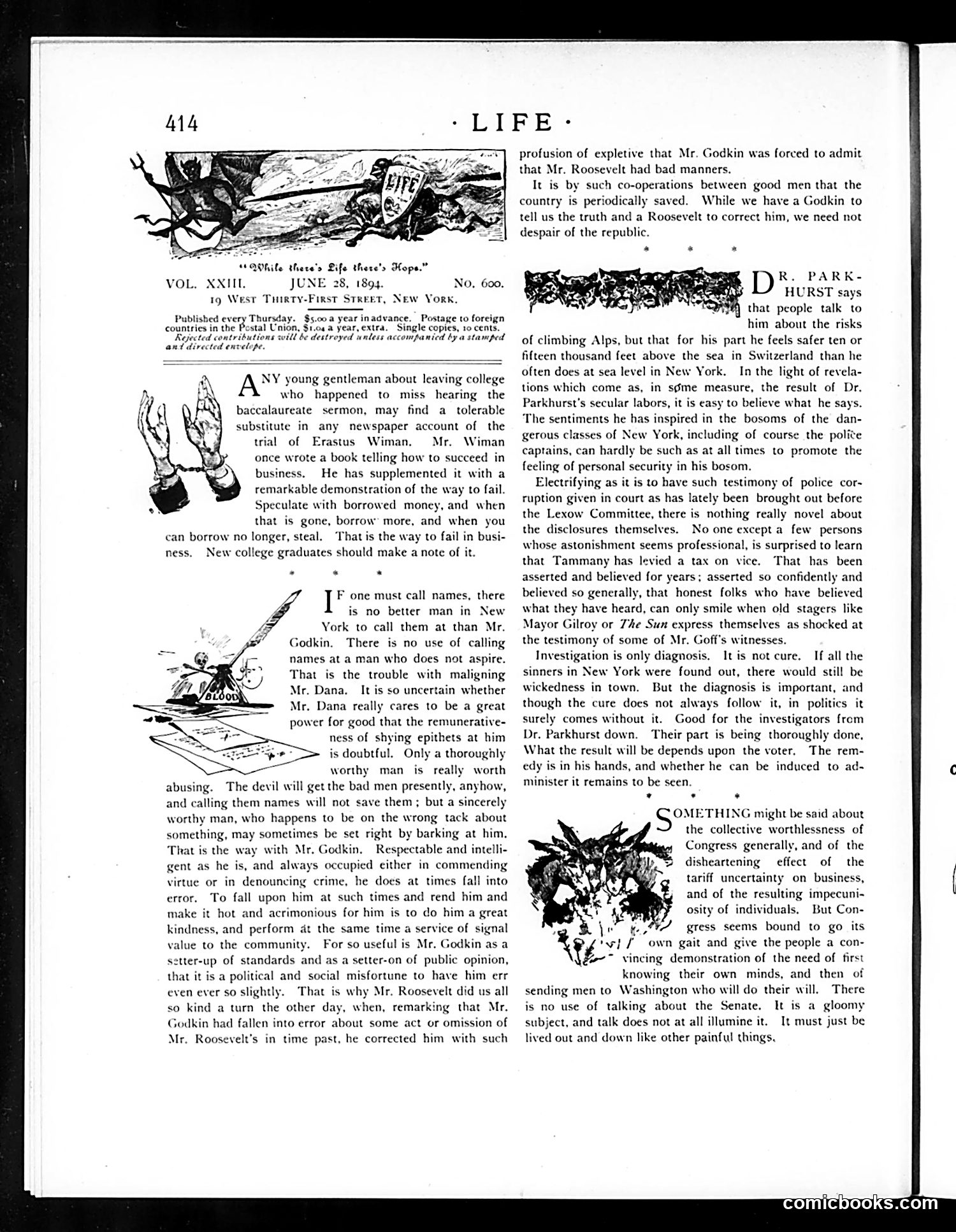
This page critiques prominent New York figures through satire. The main text attacks **Mr. Godkin** (likely E.L. Godkin, influential editor) for his harsh criticism of President Roosevelt's manners, arguing that while Godkin exposes truths, Roosevelt's corrections are necessary. The accompanying illustrations mock **Dana** (likely Charles Dana of The Sun newspaper) and satirize New York's political corruption. One cartoon depicts a man "shying epithets"—suggesting Dana recklessly hurls insults without meaningful substance. The satire's thrust: these newspaper editors engage in personal attacks rather than substantive reform. The final section mocks **Congress** for ineffectual hand-wringing over tariff policy while avoiding real solutions—a broader critique of political theater over action.
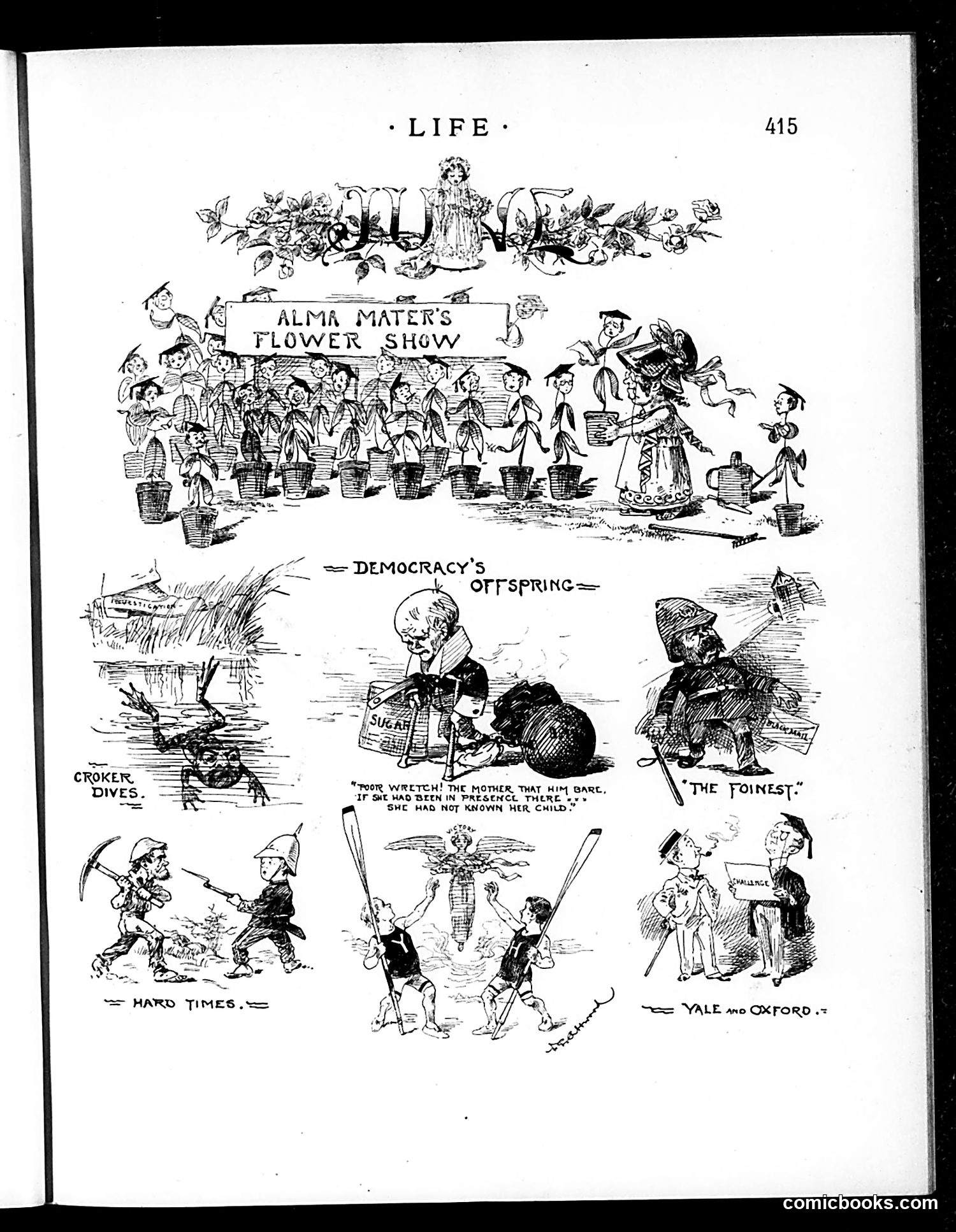
This page contains several satirical cartoons attacking democracy's failures and social problems: **"Alma Mater's Flower Show"** depicts young people as flowers being cultivated by an elderly institution, satirizing how education shapes (or fails) youth. **"Democracy's Offspring"** presents a series of social ills as democracy's "children": "Croker Dives" references political corruption (likely Boss Croker of Tammany Hall); "Poor Wretch!" shows poverty; "The Foinest" depicts crime; "Hard Times" shows labor conflict; and two figures appear to represent privileged institutions ("Yale and Oxford"). The overall message: democracy produces corruption, poverty, crime, and class inequality rather than prosperity. The cartoons use dark humor to critique American political and social systems of the era.
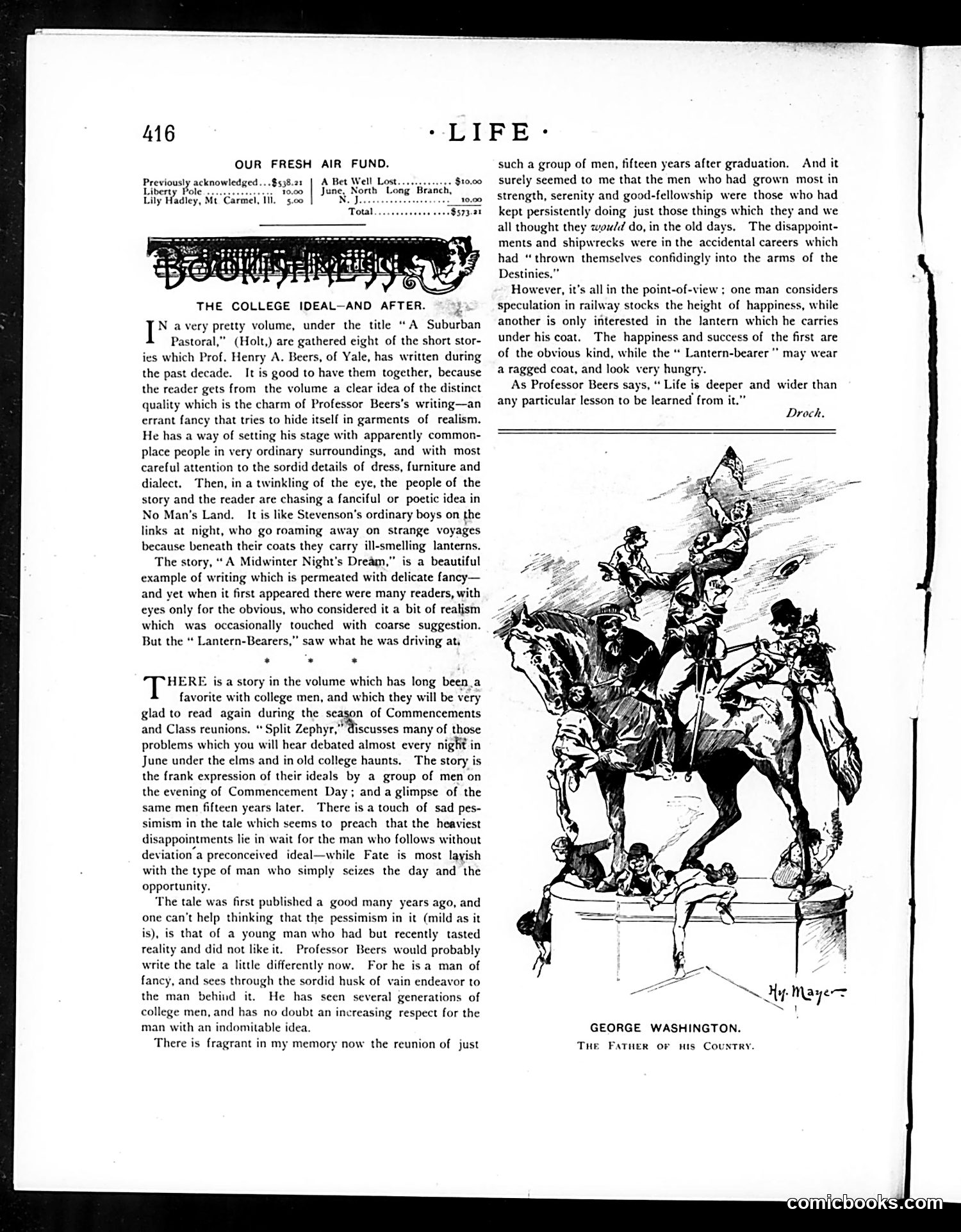
This page contains literary commentary rather than political satire. The text discusses Professor Beers's collection of short stories titled "A Suburban Pastoral" and praises another work called "Split Zephyr." The illustration labeled "GEORGE WASHINGTON: THE FATHER OF HIS COUNTRY" depicts Washington on horseback leading soldiers in what appears to be a Revolutionary War battle scene. This is a straightforward historical illustration rather than satirical commentary. The "Our Fresh Air Fund" section at the top lists charitable donations, a typical feature of the magazine. The page functions primarily as a book review and cultural criticism piece rather than political or social satire. The Washington illustration serves as patriotic decoration accompanying the literary discussion.
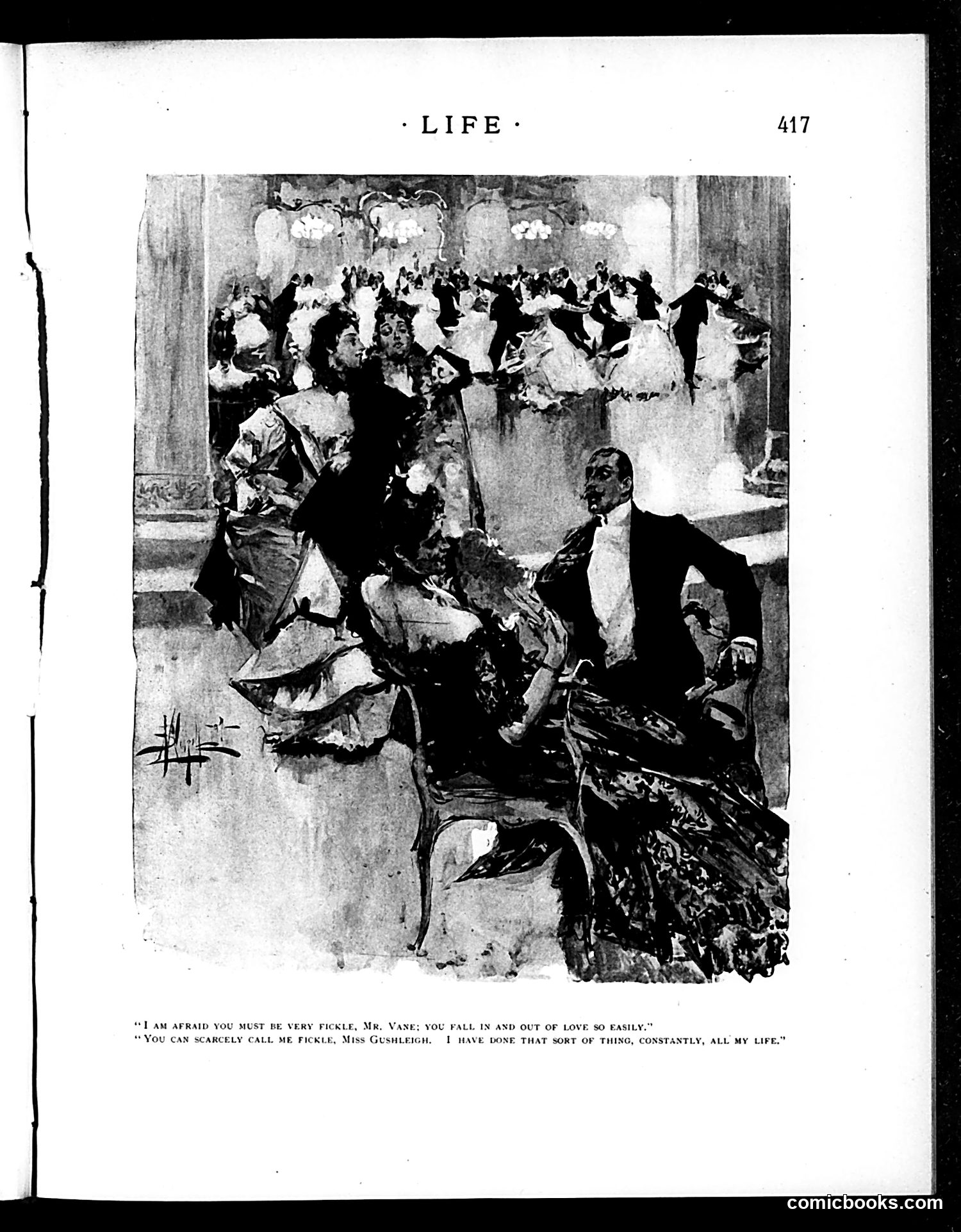
This page shows an illustration from *Life* magazine (page 417) depicting an elegant social gathering, likely a ball or formal party. The scene features well-dressed figures in the foreground, with a crowded ballroom visible in the background. The dialogue suggests a romantic or social comedy scenario. A character named Vane is being teased about his fickleness in love by Miss Gushleigh, who claims he "falls in and out of love so easily." Vane responds that she cannot call him "fickle" because he has "done that sort of thing, constantly, all my life"—essentially admitting to chronic infidelity while reframing it as his consistent character trait. The satire mocks both superficial romance and wealthy society's casual attitudes toward commitment and fidelity.
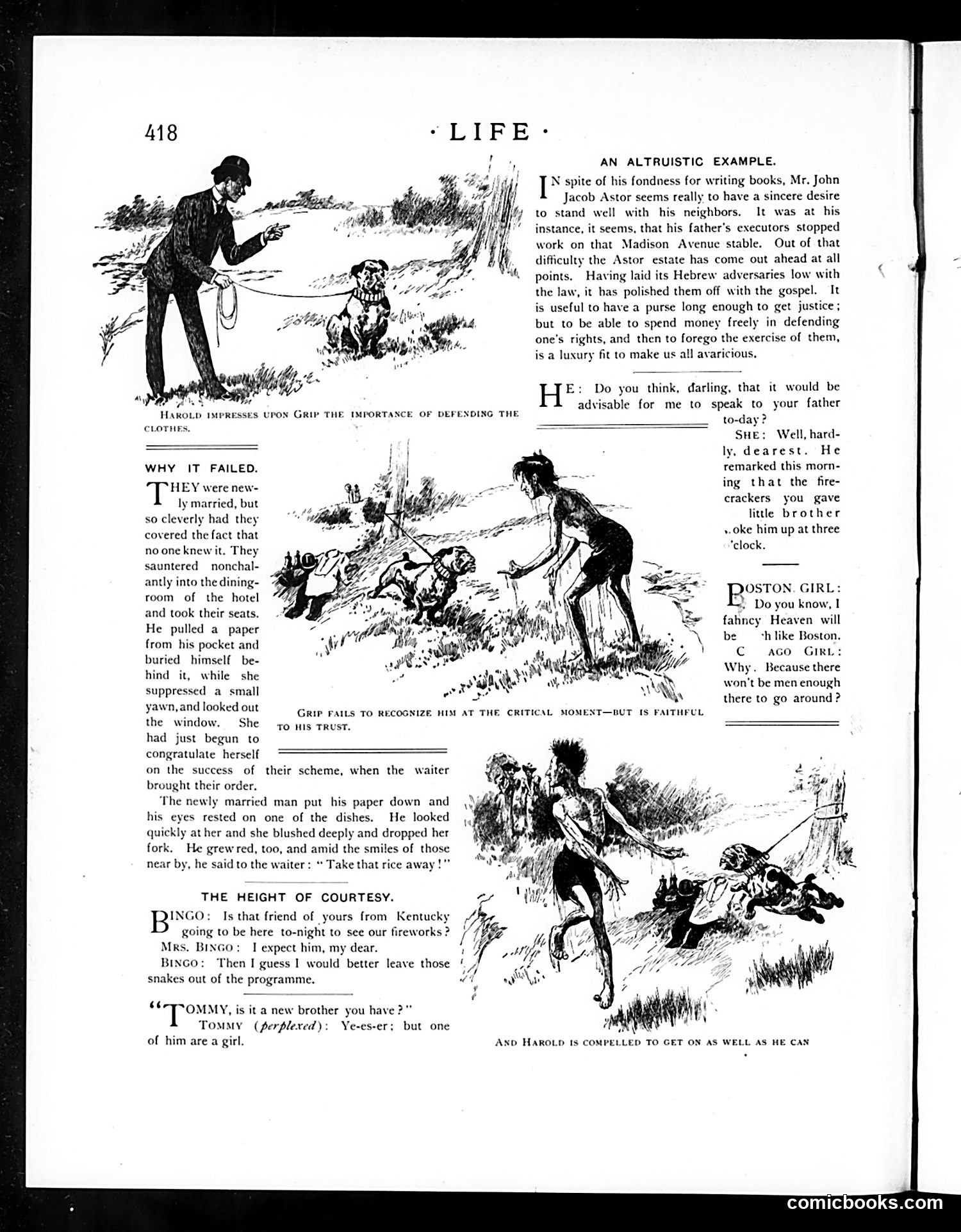
This page contains multiple short humorous anecdotes and comic illustrations rather than political cartoons. **"An Altruistic Example"** depicts John Jacob Astor (a wealthy industrialist) helping his neighbors—a satirical reference to his reputation. The joke mocks how the wealthy sometimes publicize charitable acts. **"Why It Failed"** shows newlyweds attempting to dine discreetly at a hotel, but the husband's attempt to hide their new marriage backfires when he's caught checking if his bride is watching him. **"The Height of Courtesy"** and other brief dialogues are simple jokes about social etiquette and family relationships with no specific political references. The illustrations are generic domestic and social scenes meant to amuse through relatable awkwardness rather than commentary on current events or figures.
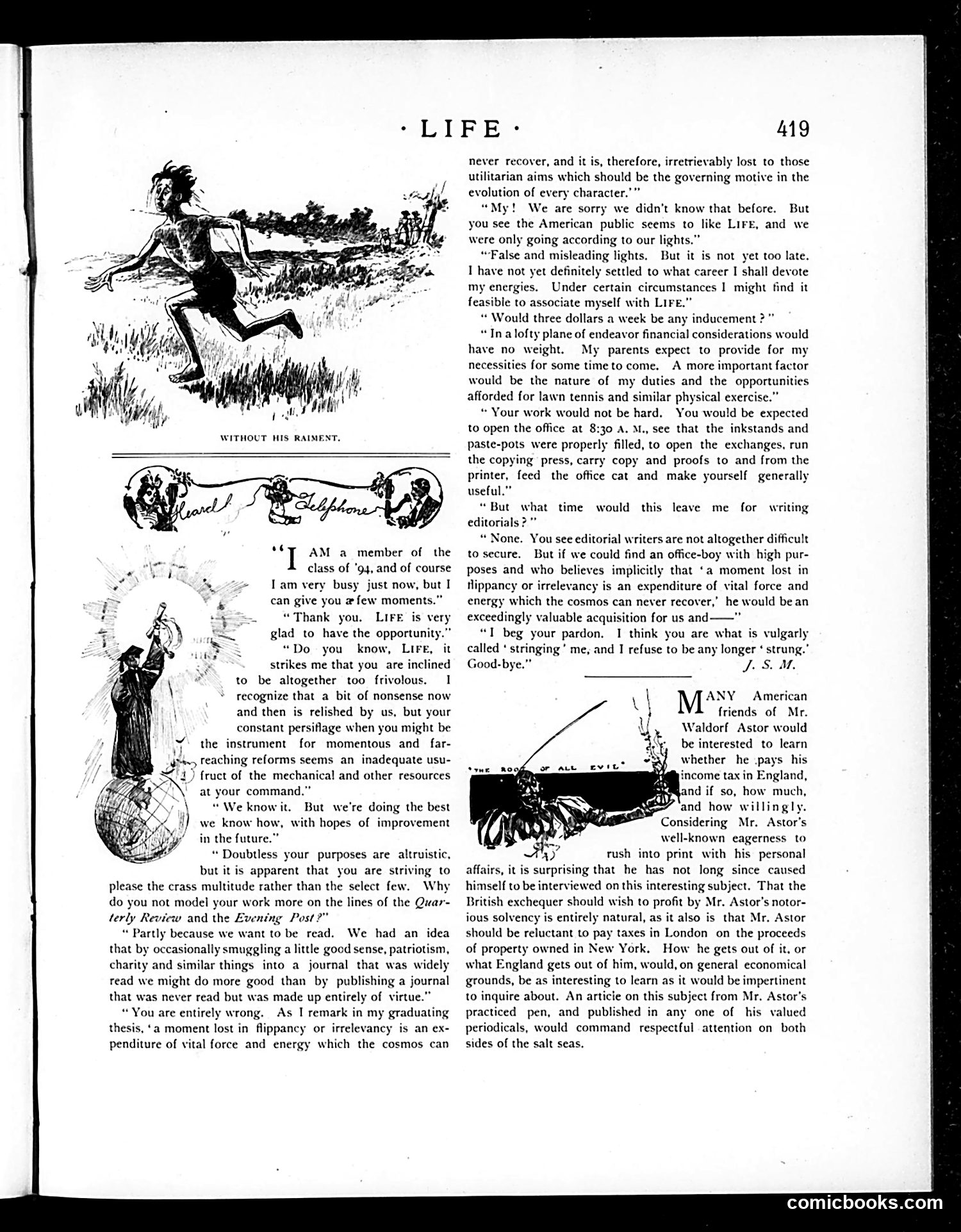
This page contains a satirical letter exchange about editorial work at *Life* magazine. The cartoons illustrate the correspondent's complaints about office duties. The top cartoon, captioned "WITHOUT HIS RAIMENT," shows a disheveled figure fleeing—likely representing a writer stripped of dignity by mundane office tasks. The correspondent, identified as "a member of the class of '94," complains that *Life* offers no time for serious editorial writing due to required office work: opening at 8:30 AM, managing paste-pots, running the copying press, feeding the office cat. The editor responds that editorial writers aren't "difficult to secure" and dismisses the correspondent's concern about "wasted" moments as philosophically unsound—a cosmos couldn't spare such valuable energy for mere editorial work. The satire mocks both overqualified contributors and editorial pretension.
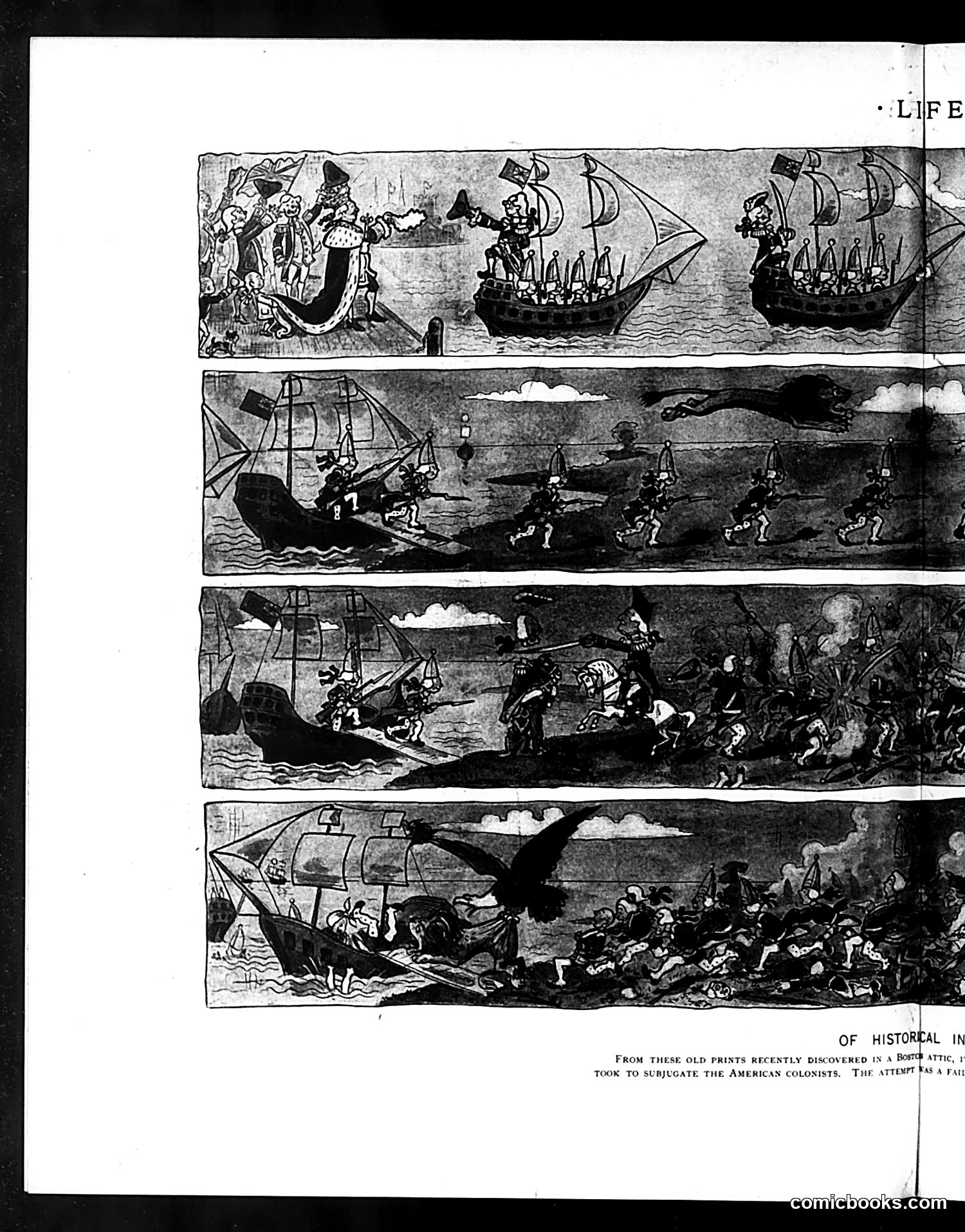
This page presents four sequential panels depicting a naval encounter rendered in an old engraving style. The caption indicates these are "old prints recently discovered in a Boston attic" that supposedly show an attempt "to subjugate the American colonists. The attempt was a fail[ure]." The panels progress from diplomatic contact (top) through military escalation—showing ships, armed conflict on water, and finally a chaotic beach battle with numerous casualties. The satire appears to mock either British colonial efforts or a foreign power's failed invasion attempt against early America. By presenting fabricated "historical documents," the artist humorously critiques or celebrates American colonial resistance. The specific identity of the attacking force remains unclear from the visible text.
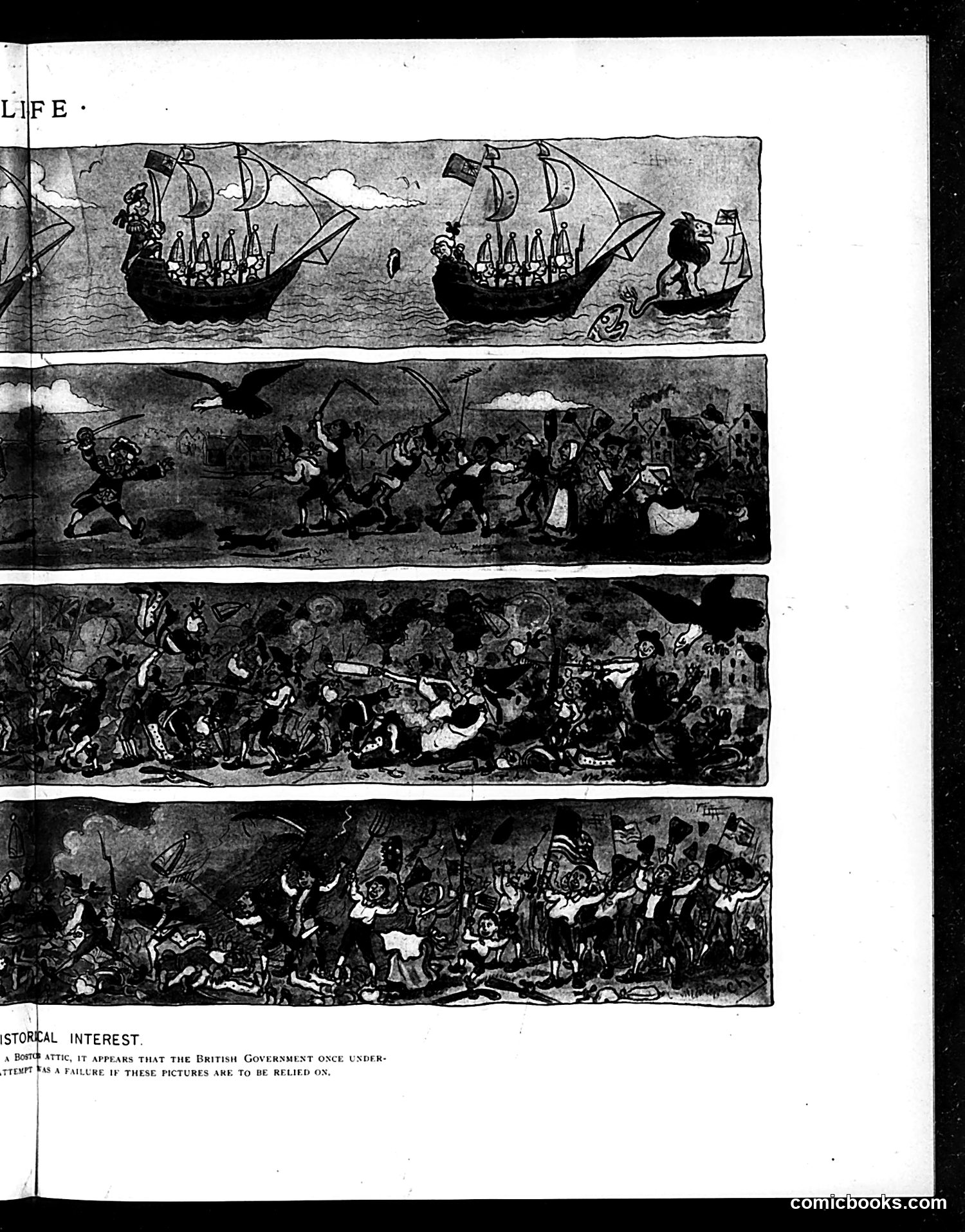
This page shows four sequential historical scenes depicting what appears to be a colonial or naval encounter. The top panel shows European sailing ships with flags meeting smaller vessels. The subsequent panels depict increasingly chaotic scenes with large crowds of people, suggesting escalating conflict or encounter between Europeans and indigenous or local populations. The caption references "historical interest" and mentions "the British Government once undertook as a failure if these pictures are to be relied on" — suggesting these images satirize a failed British colonial or military venture. Without clearer identification of the specific event, figures, or publication date, I cannot definitively state which colonial episode this critiques. The progression from organized ships to warfare to apparent defeat or chaos likely mocks British imperial overreach or incompetence in a specific historical incident.
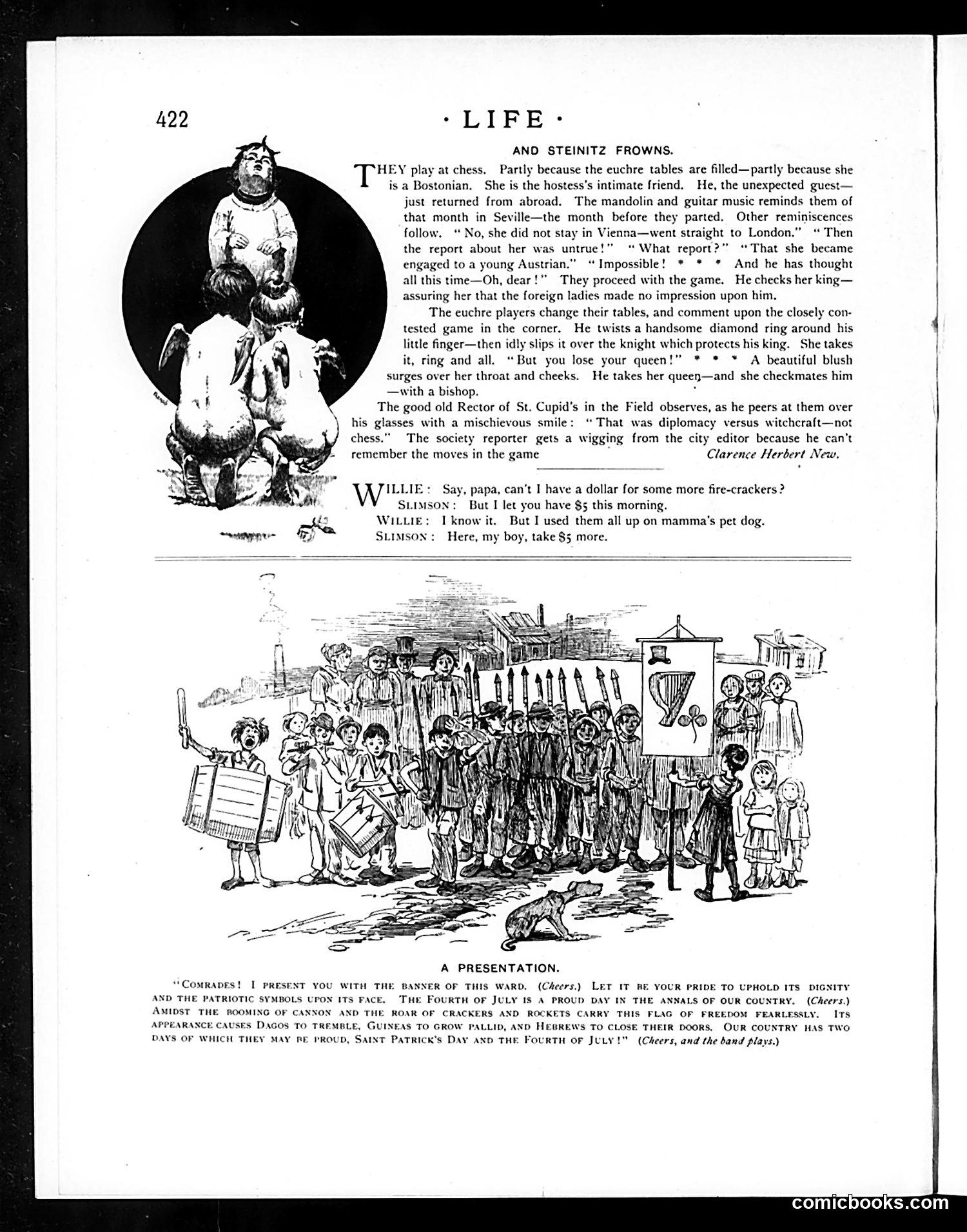
This page contains three satirical pieces: **Top story ("And Steinitz Frowns"):** A romantic narrative about euchre players—an unexpected male guest recently returned from abroad reconnects with his female hostess amid tension about their past separation and rumored engagements. Their game becomes flirtatious innuendo (exchanging a diamond ring, losing queens). The "Rector of St. Cupid's" observes wryly that their interaction represents "diplomacy versus witchcraft—not chess," mocking the social pretense masking romantic maneuvering. **Middle dialogue:** A brief comic exchange where a boy named Willie has spent his $5 allowance on firecrackers for his mother's dog, then asks his father for more money. The father indulgently grants it—satirizing parental weakness and children's manipulation. **Bottom cartoon ("A Presentation"):** A political speech presenting a ward banner on the Fourth of July. The speaker's rhetoric ironically reveals nativist prejudice: the flag's appearance "causes Dagos to tremble, Guineas to grow pallid, and Hebrews to close their doors"—mocking xenophobic politicians who invoke patriotic symbols while expressing contempt for immigrant groups.
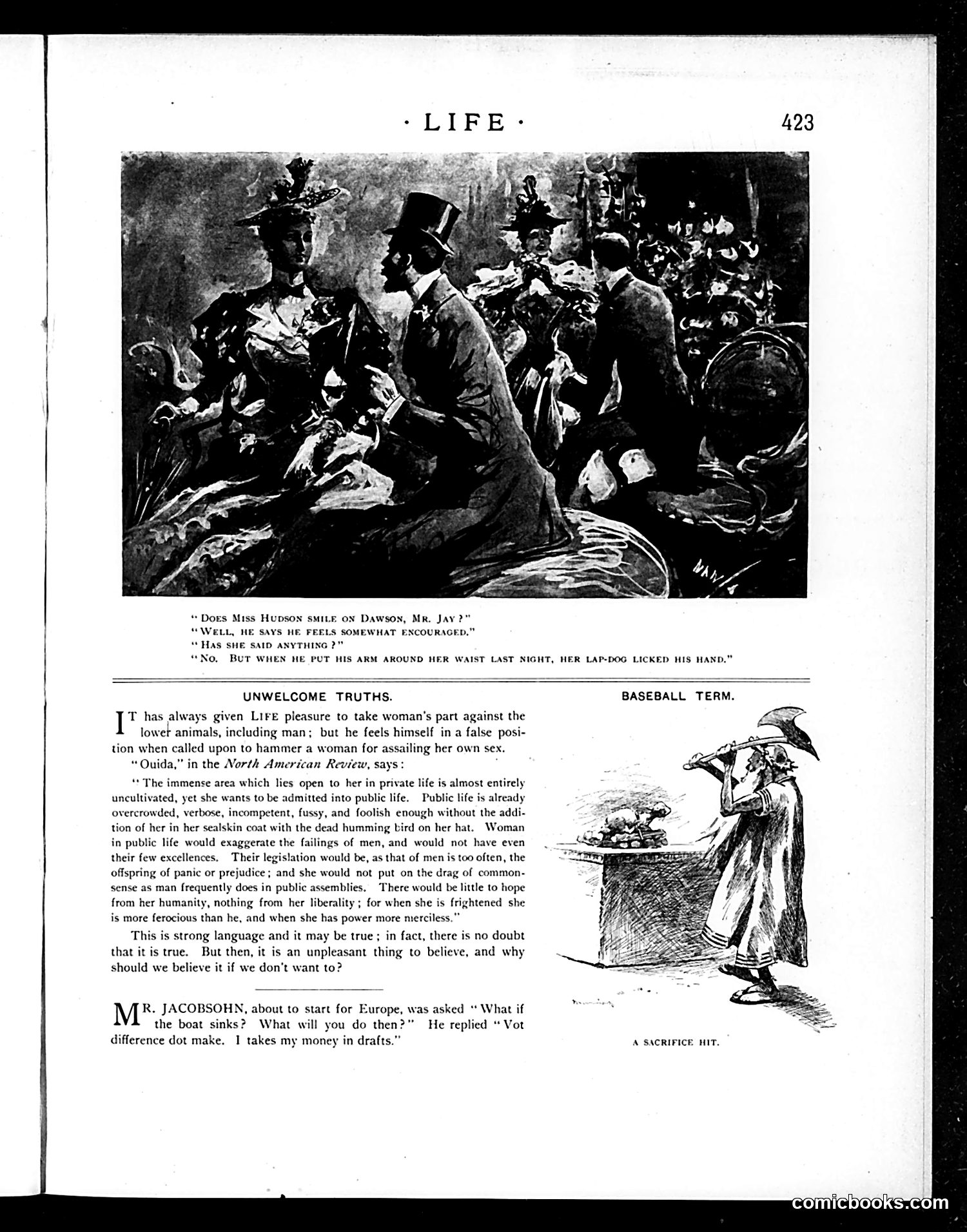
This page contains satirical commentary on women's social roles and public participation, common themes in early Life magazine. The top illustration depicts a social scene where "Miss Hudson" smiles at "Mr. Dawson," with accompanying dialogue suggesting romantic interest. The joke hinges on the lap-dog's reaction—licking the man's hand—as evidence of encouragement, treating the woman's agency as incidental. The main article, quoting the *North American Review*, presents deliberately inflammatory anti-feminist arguments: that women seeking public roles would corrupt politics with emotionalism, poor judgment, and cruelty, while their private sphere remains "uncultivated." Life's framing—"strong language...may be true"—appears to mock these positions as "unwelcome truths" people prefer ignoring, suggesting satirical critique of such attitudes rather than endorsement. The bottom anecdote about "Mr. Jacobsohn" uses Yiddish-inflected dialect humor (common period stereotyping) to deliver a punchline about financial security through drafts. The baseball cartoon titled "A Sacrifice Hit" appears unrelated to the text above.
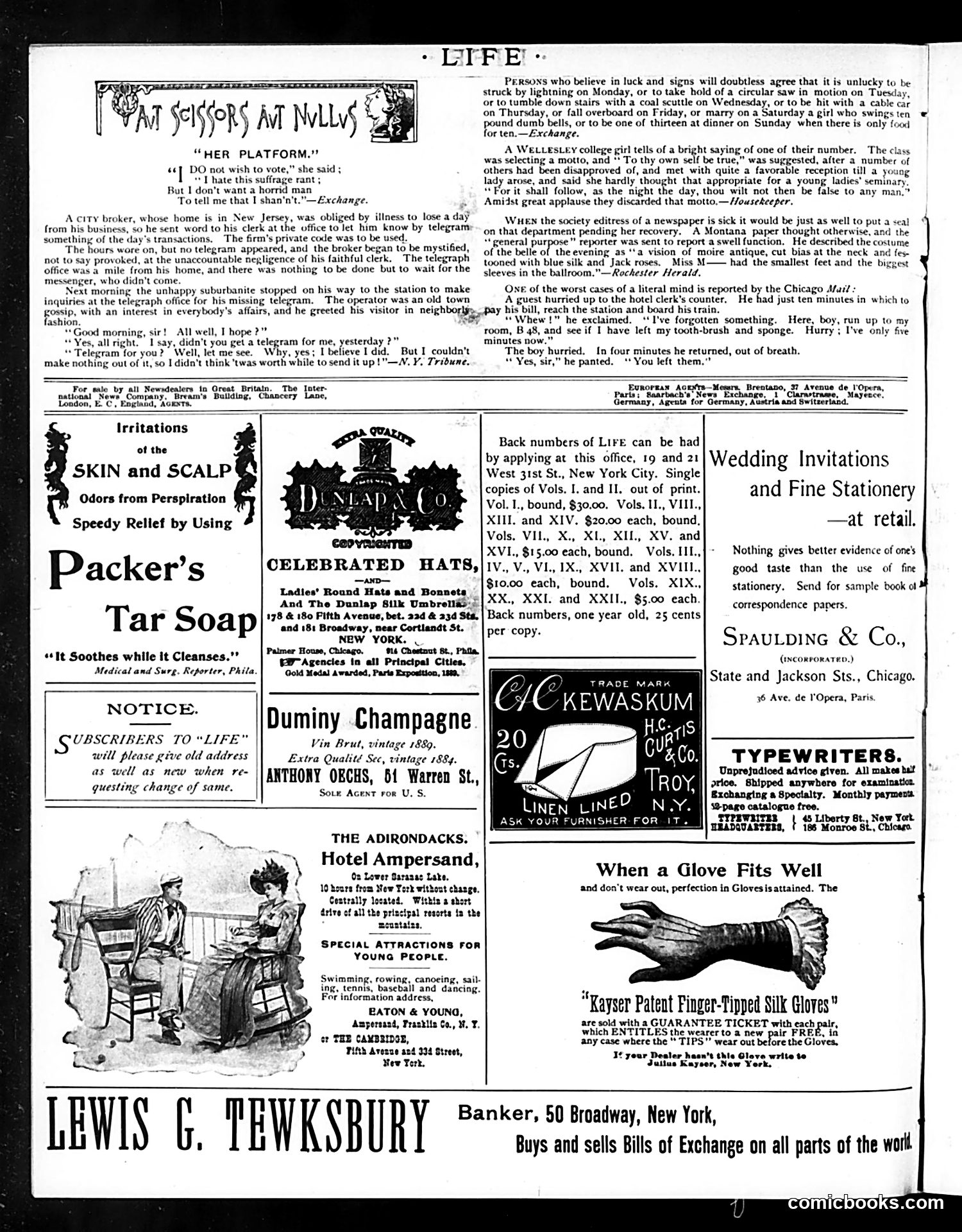
This page contains three humorous prose pieces typical of early-20th-century satirical journalism: **"Her Platform"** mocks women's suffrage debates—a woman asserts she doesn't want to vote but refuses men telling her she *can't*, capturing the contradictions opponents perceived in the suffrage movement. **"The Telegraph Tale"** ridicules a small-town telegraph operator's stubborn literalism: when he receives a message in code he doesn't understand, he assumes it's worthless and doesn't deliver it, resulting in business consequences. **Three anecdotes** lampoon social absurdities: superstitions about lucky/unlucky dates, a Wellesley student's witty rejection of "To thy own self be true" as college advice, a newspaper reporter's malapropisms describing a society event, and a hotel boy's pedantic literalness when a guest asks if he left his toiletries. The page is primarily advertising—for Packer's Tar Soap, Kewaskum linen, typewriters, and gloves—with these brief satirical pieces filling space between ads, a common Life magazine format.
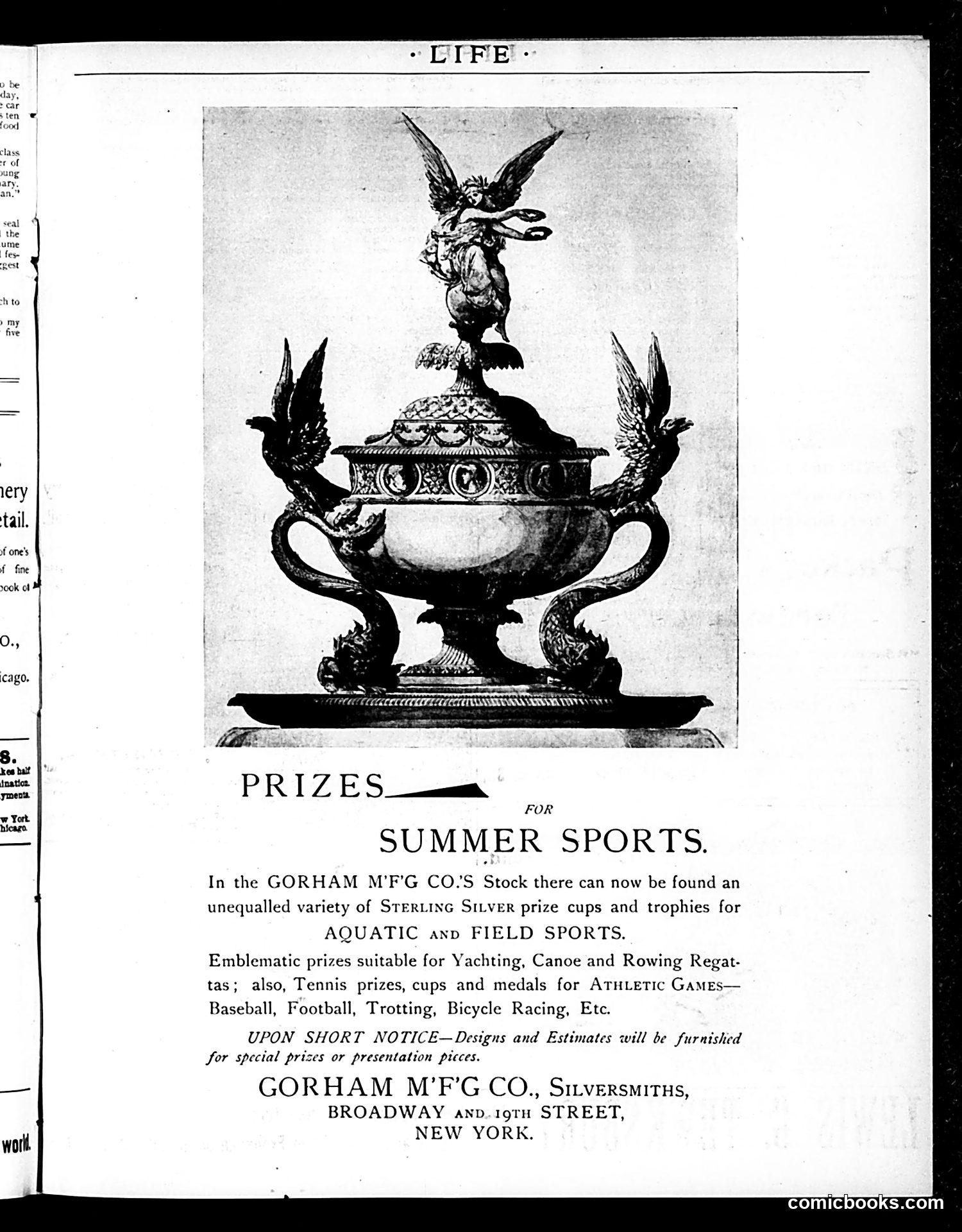
This is primarily a **full-page advertisement**, not a cartoon or satirical content. It advertises the Gorham Manufacturing Company's sterling silver prize cups and trophies for summer sports competitions—yachting, rowing, tennis, baseball, football, and bicycle racing. The ornate decorative image at the top shows an elaborate trophy cup with winged figures and dragons as handles, topped by a winged cherub—representing the kind of prestigious, high-quality silverware the company produced. This was a real luxury goods manufacturer catering to wealthy Americans sponsoring athletic events. The ad emphasizes their ability to create custom designs and estimates for special presentation pieces, positioning them as the supplier for genteel competitive sports of the Gilded Age era. There is no satire or political commentary—it's straightforward commercial promotion in *Life* magazine's pages.
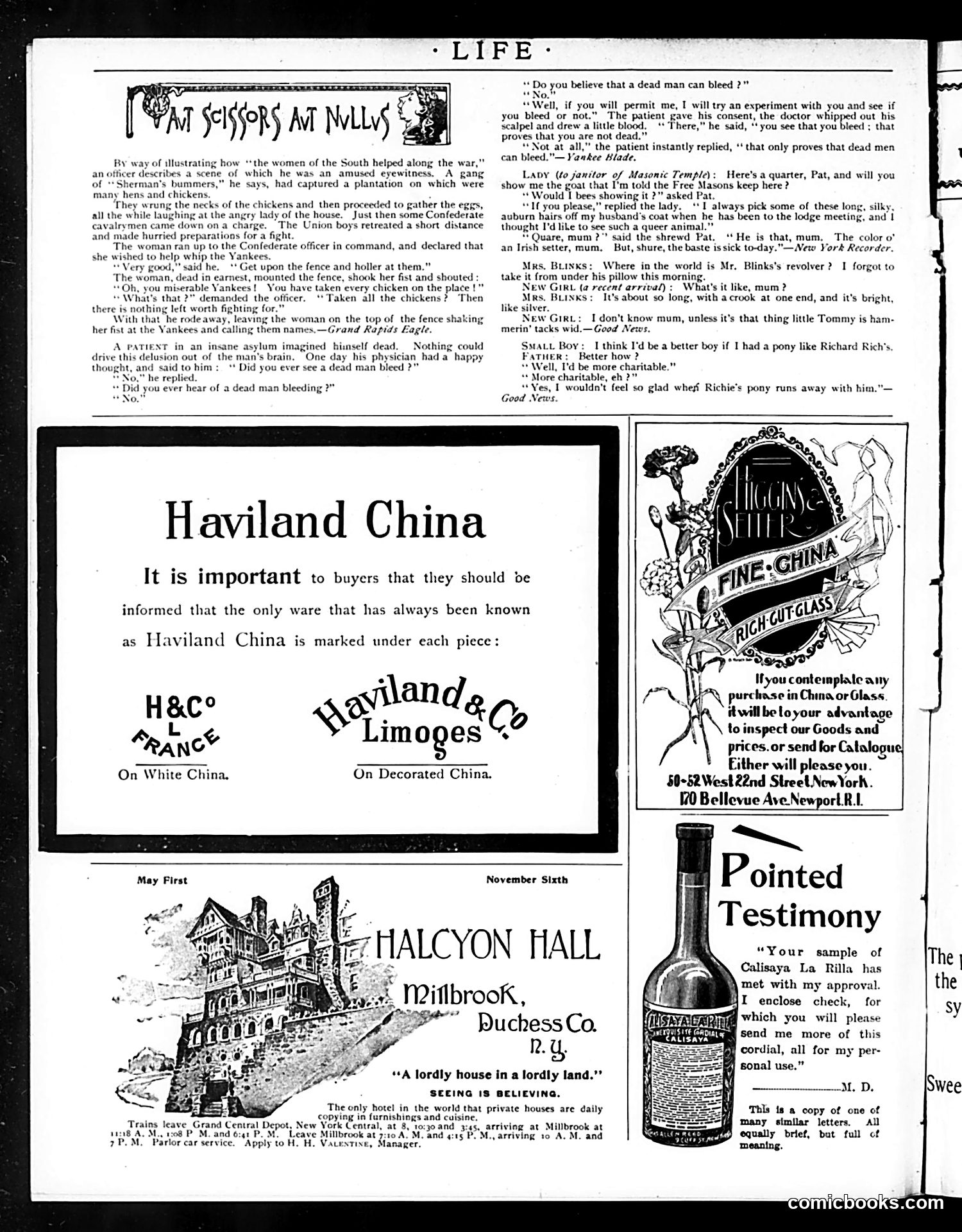
This *Life* magazine page contains several humorous anecdotes and advertisements typical of the publication's satirical style. **The Main Cartoon/Story ("I'm Scissors Am Nullus"):** Depicts a Civil War anecdote where Union soldiers ("Sherman's bummers") raid a Southern plantation for chickens. When Confederate cavalry counterattack, the plantation woman—frustrated the soldiers took the chickens—shouts insults at the Yankees from a fence. The joke satirizes the woman's misplaced priorities: she's more upset about losing poultry than about the military conflict itself. It mocks Southern civilian attitudes during the war. **The Shorter Jokes:** Include a doctor proving a "dead" man can bleed (absurdist humor), a lady asking an Irish janitor about Masons keeping a goat (playing on fraternal lodge stereotypes), and a child wishing for a pony to become more charitable (ironic children's logic). **Advertisements:** For Haviland China and Higgins & Hill fine china dominate the lower half—standard period commercial content. The page reflects mid-19th-century American humor: topical Civil War references, Irish servant stereotypes, and domestic comedy.
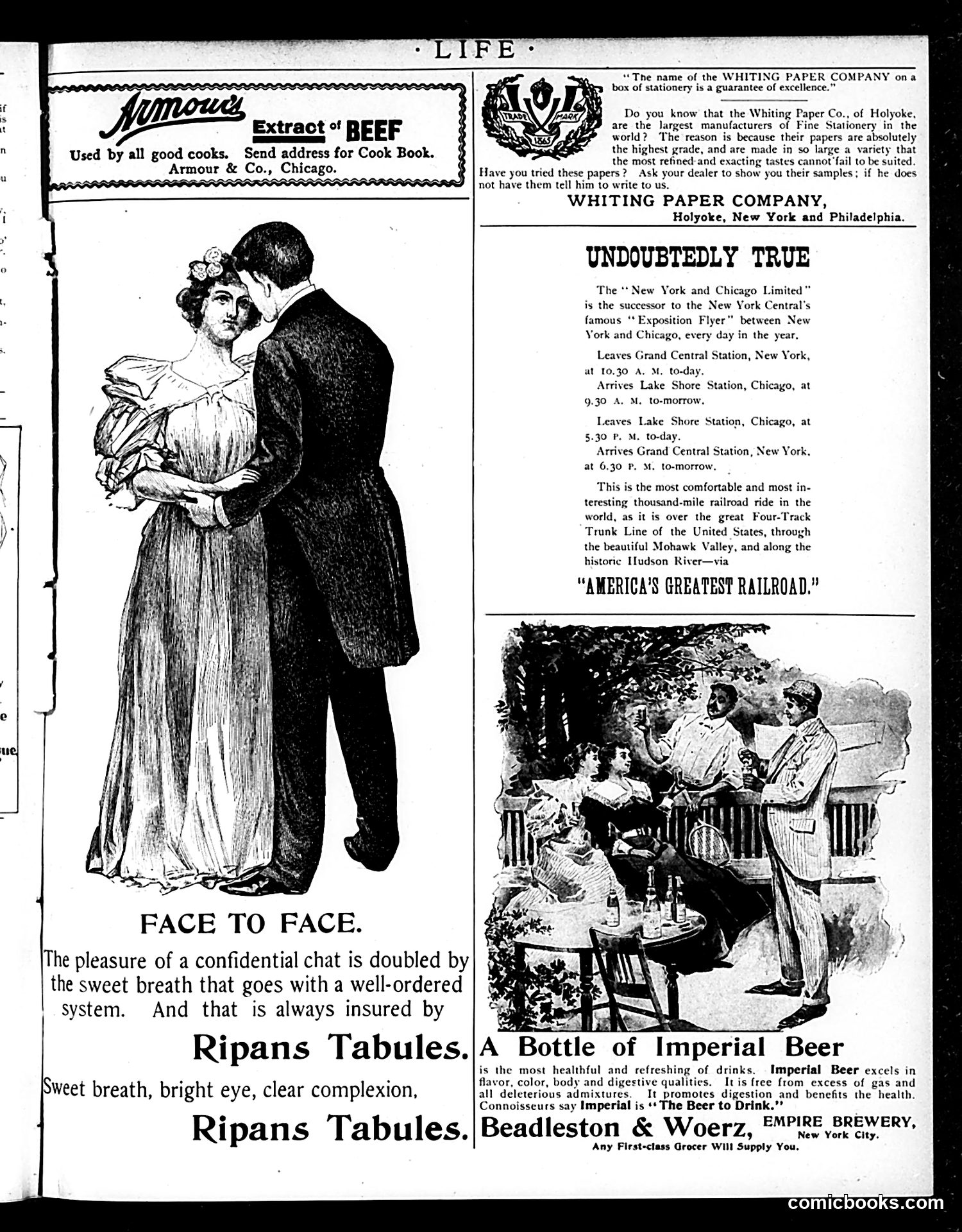
This page is **primarily advertising** rather than editorial content or political satire. It contains four distinct advertisements: 1. **Armour's Beef Extract** — a cooking product 2. **Whiting Paper Company** — fine stationery manufacturer 3. **New York and Chicago Limited Railroad** — a luxury train service 4. **Ripans Tabules and Imperial Beer** — digestive aid and beverage The only illustration with narrative content is the "Face to Face" section, showing a well-dressed couple in intimate conversation, used to advertise **Ripans Tabules** (a digestive tablet). The copy implies that good digestion ensures "sweet breath" necessary for romance—a common advertising trope of the era linking health products to social success and attractiveness. There is **no political cartoon or satire** on this page. It represents typical early 20th-century magazine advertising emphasizing propriety, refinement, and products promoting health and social advantage.
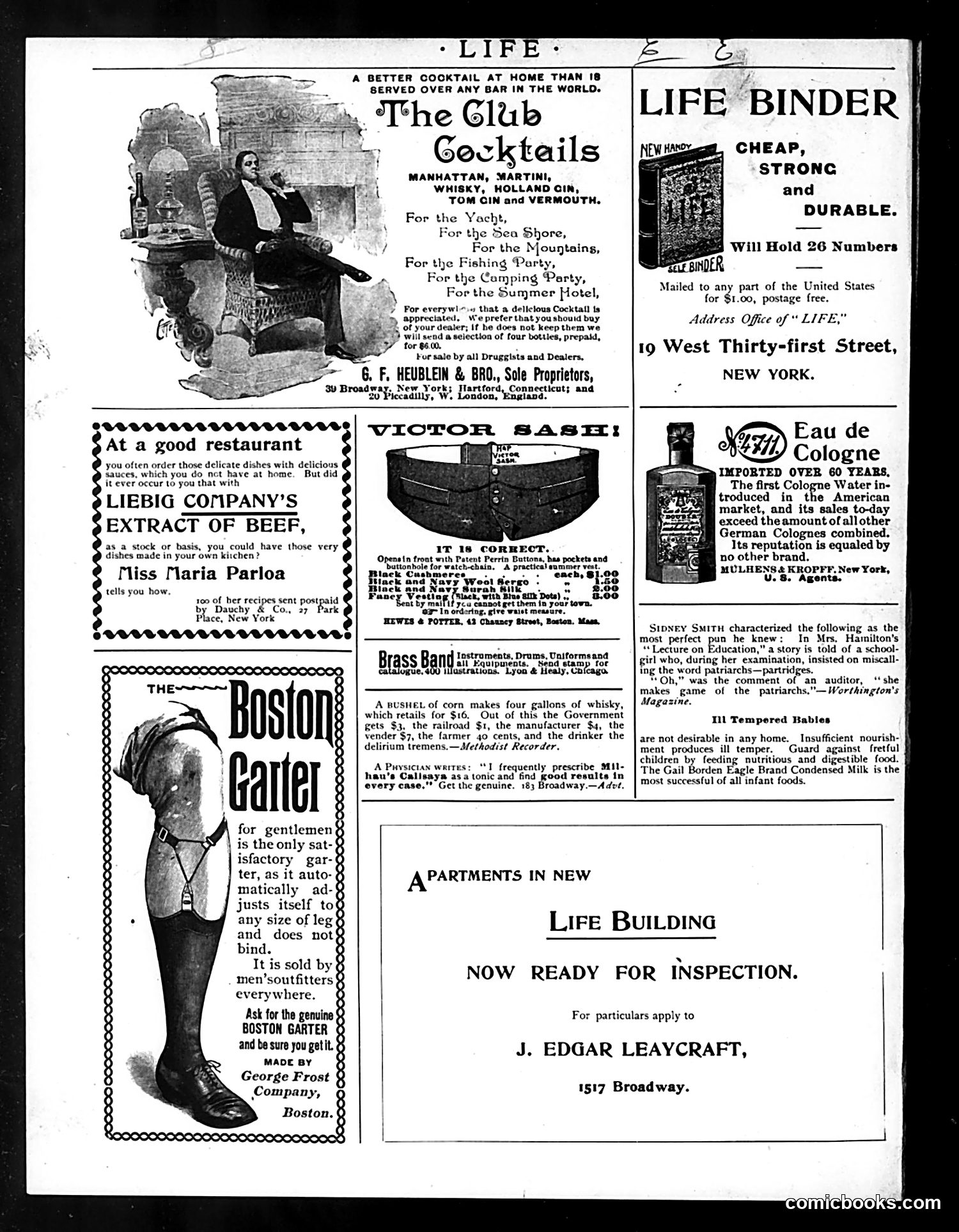
This is primarily an **advertising page** from Life magazine (early 20th century), featuring product promotions with minimal political content. The main elements include: **Key Advertisements:** - Heublein cocktail mixers (marketed as superior to bar drinks) - Liebig's Extract of Beef (cooking ingredient) - Boston Garter (men's suspenders) - Victor Sash Company (window products) - 4711 Cologne **Social/Historical Context:** The page reflects Pre-Prohibition attitudes toward alcohol—cocktails are brazenly marketed as desirable home purchases. The Liebig's and Gail Borden ads target domestic cooking, reflecting early 20th-century marketed convenience foods. **One Notable Satirical Item:** A quote from the *Methodist Recorder* mocking whisky economics: tracking a bushel of corn's profit distribution through government, railroads, manufacturers, vendors, and farmers—with only "delirium tremens" for the drinker. This is a **temperance movement critique**, ironically placed among alcohol ads. The page is otherwise standard commercial advertising without significant political cartooning.
I can see this is a page from Life magazine, but the image is almost entirely black with only faint vertical lines and text fragments visible along the left margin. The main content area is not legible enough for me to identify any cartoon figures, political references, or satirical content with confidence. The OCR text only shows "comicbooks.com" at the bottom, which appears to be a watermark rather than original magazine content. To properly analyze this page's political or social satire, I would need a clearer image where the cartoon(s) and accompanying text are actually readable. As it stands, I cannot responsibly identify specific figures or explain the satire intended.