
Life, 1894-06-28 · page 6 of 19
Life — June 28, 1894 — page 6: what you’re looking at
What you’re looking at
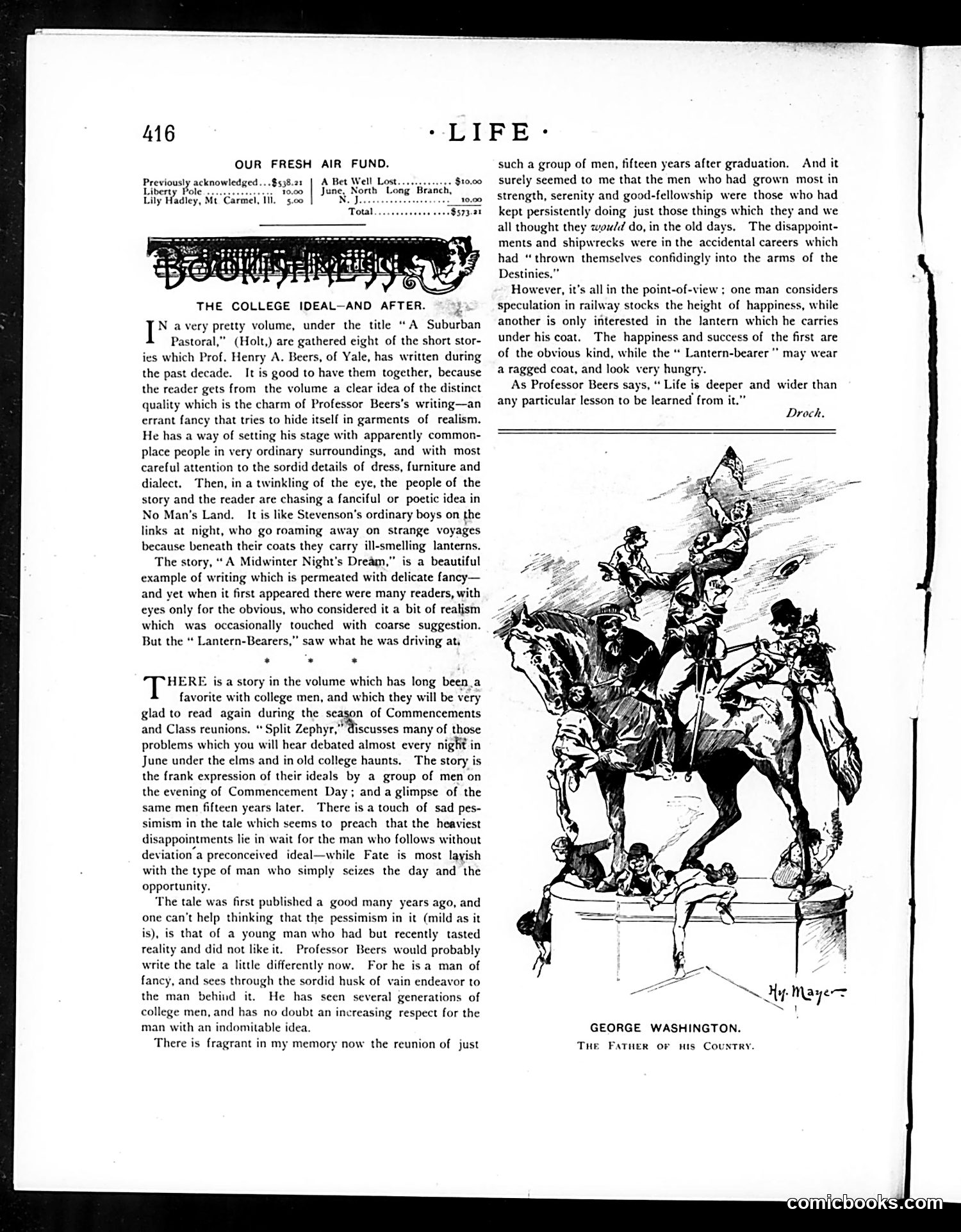
This page contains literary commentary rather than political satire. The text discusses Professor Beers's collection of short stories titled "A Suburban Pastoral" and praises another work called "Split Zephyr." The illustration labeled "GEORGE WASHINGTON: THE FATHER OF HIS COUNTRY" depicts Washington on horseback leading soldiers in what appears to be a Revolutionary War battle scene. This is a straightforward historical illustration rather than satirical commentary. The "Our Fresh Air Fund" section at the top lists charitable donations, a typical feature of the magazine. The page functions primarily as a book review and cultural criticism piece rather than political or social satire. The Washington illustration serves as patriotic decoration accompanying the literary discussion.
📄 Transcribed text from this page (OCR, searchable)
Machine-transcribed from the original scan — historical spelling and the odd misread are preserved.
OUR FRESH AIR FUND. Previously acknowledged...$538.21 | A Bet Well Lost............. $10.00 rty Pole 10.00 | June, North Long Branch, Hadley, it Carmel, tii, "S00 No J... sees Total... $573.81 THE COLLEGE IDEAL—AND AFTER. z I N avery pretty volume, under the title “A Suburban Pastoral,” (Holt,) are gathered eight of the short stor- ies which Prof. Henry A. Beers, of Yale, has written during the past decade. It is good to have them together, because the reader gets from the volume a clear idea of the distinct quality which is the charm of Professor Beers’s writing—an errant fancy that tries to hide itself in garments of realism. He has a way of setting his stage with apparently common- place people in very ordinary surroundings, and with most careful attention to the sordid details of dress, furniture and dialect. Then, in a twinkling of the eye, the people of the story and the reader are chasing a fanciful or poetic idea in No Man's Land. It is like Stevenson's ordinary boys on the links at night, who go roaming away on strange voyages because beneath their coats they carry ill-smelling lanterns. The story, ‘A Midwinter Night's Dream,” is a beautiful example of writing which is permeated with delicate fancy— and yet when it first appeared there were many readers, with eyes only for the obvious, who considered it a bit of reatism which was occasionally touched with coarse suggestion. But the “ Lantern-Bearers,” saw what he was driving at, HERE isa story in the volume which has long been.a favorite with college men, and which they will be very glad to read again during the season of Commencements and Class reunions. “ Split Zephyr,” discusses many of those problems which you will hear debated almost every night in June under the elms and in old college haunts. The story is the frank expression of their ideals by a group of men on the evening of Commencement Day; and a glimpse of the same men fifteen years later. There is a touch of sad pes- simism in the tale which seems to preach that the heaviest disappointments lie in wait for the man who follows without deviation’a preconceived ideal—while Fate is most layish with the type of man who simply seizes the day and the opportunity. ‘The tale was first published a good many years ago, and one can’t help thinking that the pessimism in it (mild as it is), is that of a young man who had but recently tasted reality and did not like it. Professor Beers would probably write the tale a little differently now, For he isa man of fancy, and sees through the sordid husk of vain endeavor to the man behind it. He has seen several generations of college men, and has no doubt an increasing respect for the man with an indomitable idea. There is fragrant in my memory now the reunion of just - LIFE: such a group of men, fifteen years after graduation. And it surely seemed to me that the men who had grown most in strength, serenity and good-fellowship were those who had kept persistently doing just those things which they and we all thought they wou/d do, in the old days. The disappoint- ments and shipwrecks were in the accidental careers which had “thrown themselves confidingly into the arms of the Destinies.” However, it’s all in the point-of-view ; one man considers speculation in railway stocks the height of happiness, while another is only interested in the lantern which he carries under his coat. The happiness and success of the first are of the obvious kind, while the * Lantern-bearer " may wear a ragged coat, and look very hungry. As Professor Beers says, “ Life is deeper and wider than any particular lesson to be learned from it.” Droch. - ™ Ay Mayes GEORGE WASHINGTON. THe FaTuer oF nis Country.