
Life, 1894-06-28 · page 9 of 19
Life — June 28, 1894 — page 9: what you’re looking at
What you’re looking at
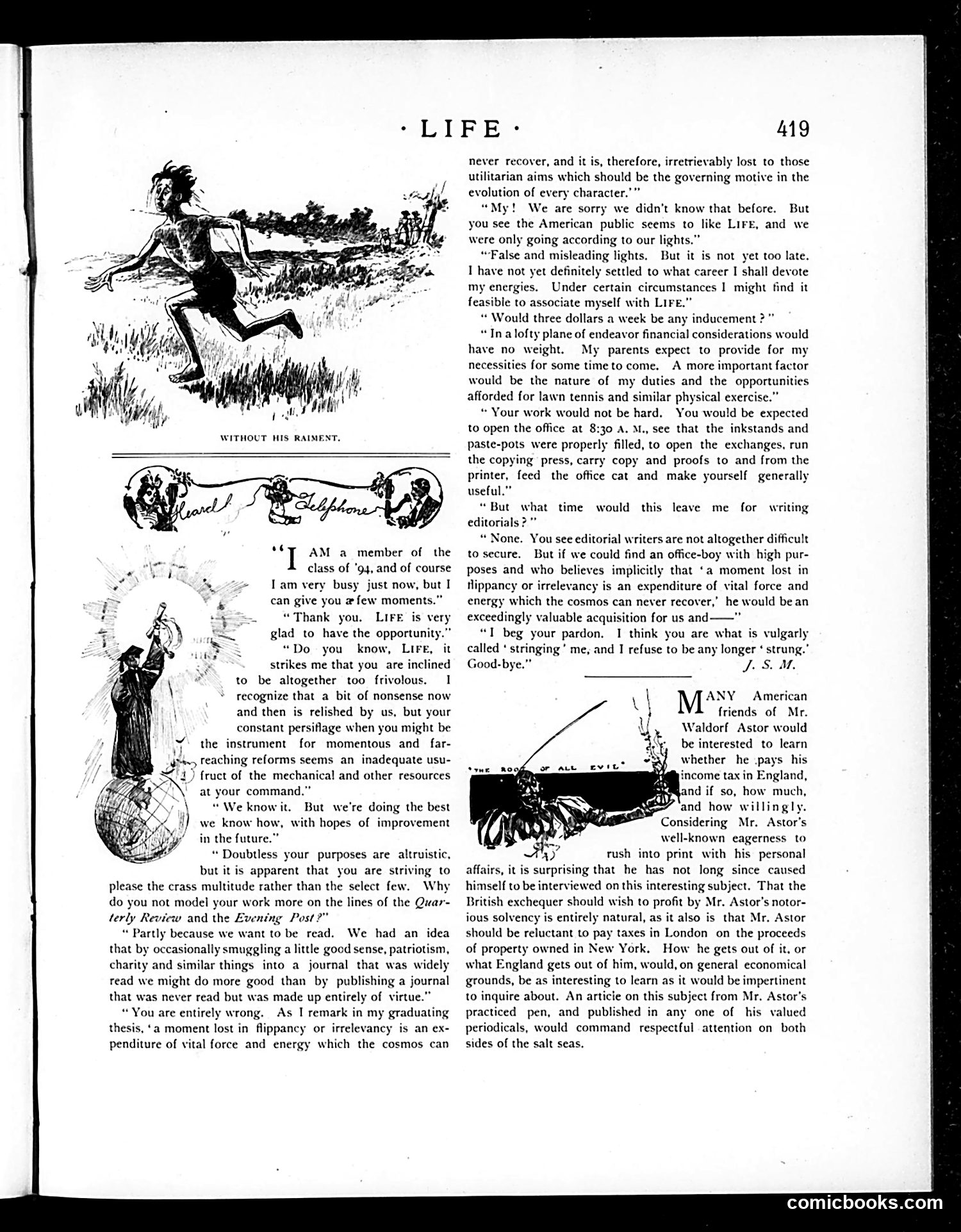
This page contains a satirical letter exchange about editorial work at *Life* magazine. The cartoons illustrate the correspondent's complaints about office duties. The top cartoon, captioned "WITHOUT HIS RAIMENT," shows a disheveled figure fleeing—likely representing a writer stripped of dignity by mundane office tasks. The correspondent, identified as "a member of the class of '94," complains that *Life* offers no time for serious editorial writing due to required office work: opening at 8:30 AM, managing paste-pots, running the copying press, feeding the office cat. The editor responds that editorial writers aren't "difficult to secure" and dismisses the correspondent's concern about "wasted" moments as philosophically unsound—a cosmos couldn't spare such valuable energy for mere editorial work. The satire mocks both overqualified contributors and editorial pretension.
📄 Transcribed text from this page (OCR, searchable)
Machine-transcribed from the original scan — historical spelling and the odd misread are preserved.
- LIFE: aS *€7 AM a member of the class of ‘94, and of course Iam very busy just now, but I can give you #few moments.” “Thank you. LIFE is very glad to have the opportunity.” “Do you know, Lire, it strikes me that you are inclined to be altogether too frivolous. 1 recognize that a bit of nonsense now and then is relished by us, but your constant persiflage when you might be \Y the instrument for momentous and far- ges> reaching reforms seems an inadequate usu- S41) fruct of the mechanical and other resources uN at your command.” \ “ We know it. i] we know how, with hopes of improvement in the future.” “Doubtless your purposes are altruistic, but it is apparent that you are striving to But we're doing the best please the crass multitude rather than the select few. Why do you not model your work more on the lines of the Quar- terly Review and the Evening Post?” “ Partly because we want to be read. We had an idea that by occasionally smuggling a little good sense, patriotism, charity and similar things into a journal that was widely read we might do more good than by publishing a journal that was never read but was made up entirely of virtue.” “You are entirely wrong. As I remark in my graduating thesis, ‘a moment lost in flippancy or irrelevancy is an ex- penditure of vital force and energy which the cosmos can 419 never recover, and it is, therefore, irretrievably lost to those utilitarian aims which should be the governing motive in the evolution of every character.’” “My! We are sorry we didn’t know that before. But you see the American public seems to like LiFE, and we were only going according to our lights. “False and misleading lights. But it is not yet too late. I have not yet definitely settled to what career I shall devote my energies. Under certain circumstances 1 might find it feasible to associate myself with LiF “ Would three dollars a week be any inducement ?” “In a lofty plane of endeavor financial considerations would have no weight. My parents expect to provide for my necessities for some time to come. A more important factor would be the nature of my duties and the opportunities afforded for lawn tennis and similar physical exercise.” “ Your work would not be hard. You would be expected to open the office at 8:30 A. M., see that the inkstands and paste-pots were properly filled, to open the exchanges, run the copying press, carry copy and proofs to and from the printer, feed the office cat and make yourself generally useful.” “But what time editorials?” “None. You see editorial writers are not altogether difficult to secure. But if we could find an office-boy with high pur- poses and who believes implicitly that ‘a moment lost in Nippancy or irrelevancy is an expenditure of vital force and energy which the cosmos can never recover,’ he would be an exceedingly valuable acquisition for us and ——” “I beg your pardon. I think you are what is vulgarly called ‘ stringing’ me, and I refuse to be any longer ‘ strung.’ Good-bye.” J. S. Mf. would this leave me for writing ANY American friends of Mr. Waldorf Astor would be interested to learn whether he .pays his come tax in England, ind if so, how much, and how willingly. Considering Mr. Astor's well-known eagerness to tush into print with his personal affairs, it is surprising that he has not long since caused himself to be interviewed on this interesting subject. That the British exchequer should wish to profit by Mr. Astor's notor- ious solvency is entirely natural, as it also is that Mr. Astor should be reluctant to pay taxes in London on the proceeds of property owned in New York. How he gets out of it, or what England gets out of him, would, on general economical grounds, be as interesting to learn as it would be impertinent to inquire about. An articie on this subject from Mr. Astor's practiced pen, and published in any one of his valued periodicals, would command respectful attention on both sides of the salt seas. Syme comicbooks.com