
Life, 1894-06-28 · page 4 of 19
Life — June 28, 1894 — page 4: what you’re looking at
What you’re looking at
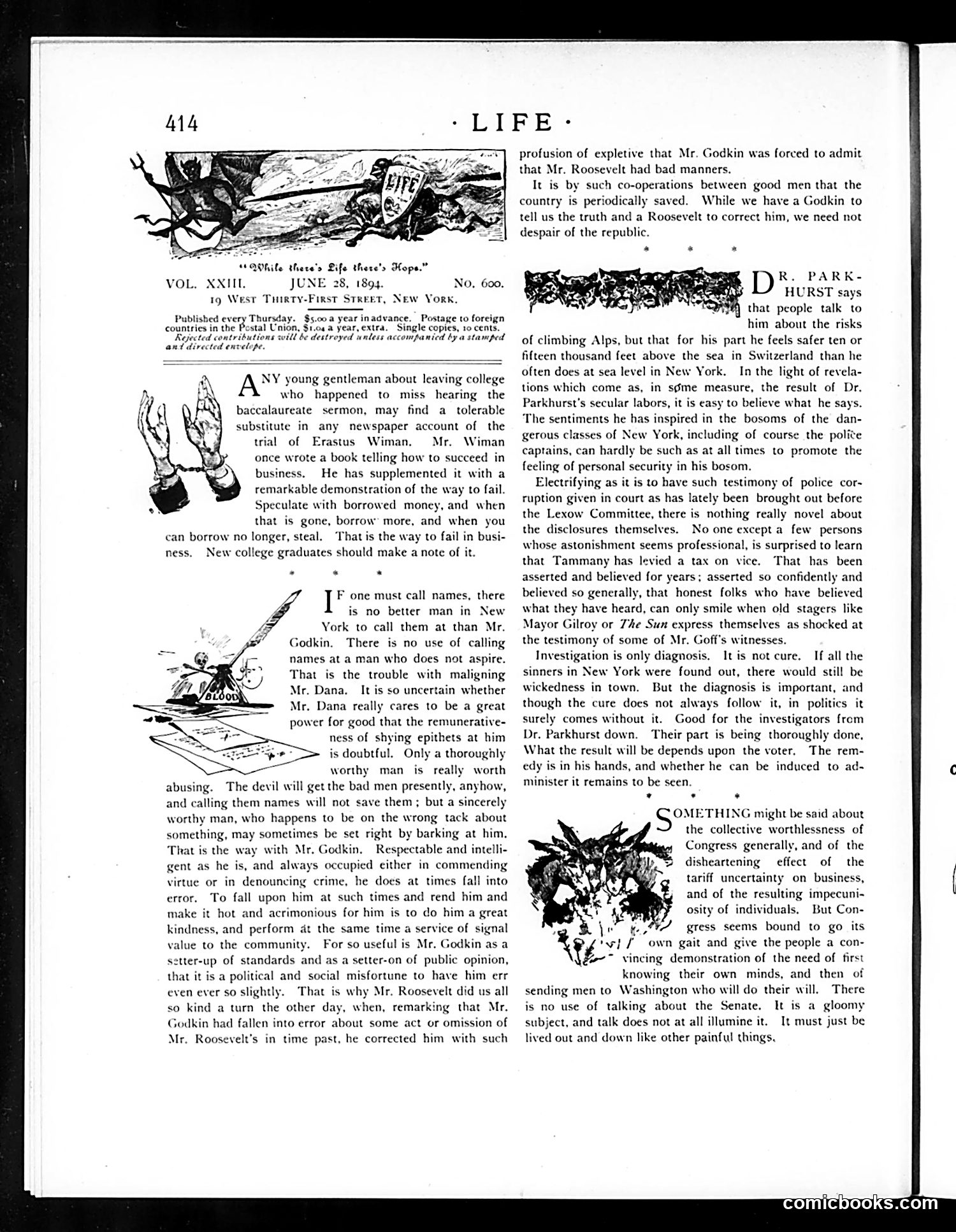
This page critiques prominent New York figures through satire. The main text attacks **Mr. Godkin** (likely E.L. Godkin, influential editor) for his harsh criticism of President Roosevelt's manners, arguing that while Godkin exposes truths, Roosevelt's corrections are necessary. The accompanying illustrations mock **Dana** (likely Charles Dana of The Sun newspaper) and satirize New York's political corruption. One cartoon depicts a man "shying epithets"—suggesting Dana recklessly hurls insults without meaningful substance. The satire's thrust: these newspaper editors engage in personal attacks rather than substantive reform. The final section mocks **Congress** for ineffectual hand-wringing over tariff policy while avoiding real solutions—a broader critique of political theater over action.
📄 Transcribed text from this page (OCR, searchable)
Machine-transcribed from the original scan — historical spelling and the odd misread are preserved.
- LIFE: “QMhile there's Life there's Hope.” XIE JUNE 28, 1894. No, 600. 1g West Tuirty-First Street, New York, Published every Thursday. $5.00a year inadvance. Postage to foreign countries in the Postal Union, $1.04 a year, extra. Single copies, 10 cents. Rejected contributions will be destroyed unless accompanied by a stamped ant directed envelope. iN A VY young gentleman about leaving college ty who happened to miss hearing the baccalaureate sermon, may find a_ tolerable substitute in any newspaper account of the trial of Erastus Wiman, Mr. Wiman once wrote a book telling how to succeed in business. He has supplemented it with a remarkable demonstration of the way to fail. Speculate with borrowed money, and when that is gone, borrow’ more, and when you can borrow no longer, steal. That is the way to fail in busi- ness. New college graduates should make a note of it. F one must call names, there is no better man in New York to call them at than Mr. Godkin. There is no use of calling names at a man who does not aspire. That is the trouble with maligning Mr. Dana. It is so uncertain whether Mr. Dana really cares to be a great power for good that the remunerative- ness of shying epithets at him is doubtful. Only a thoroughly worthy man is really worth abusing. The devil will get the bad men presently, anyhow, and calling them names will not save them; but a sincerely worthy man, who happens to be on the wrong tack about something, may sometimes be set right by barking at him, That is the way with Mr. Godkin, Respectable and intelli- gent as he is, and always occupied either in commending virtue or in denouncing crime, he does at times fall into error. To fall upon him at such times and rend him and make it hot and acrimonious for him is to do him a great kindness, and perform at the same time a service of signal value to the community. For so useful is Mr. Godkin as a setter-up of standards and as a setter-on of public opinion, that it is a political and social misfortune to have him err even ever so slightly. That is why Mr. Roosevelt did us all so kind a turn the other day, when, remarking that Mr, Godkin had fallen into error about some act or omission of Mr. Roosevelt's in time past, he corrected him with such profusion of expletive that Mr. Godkin was forced to admit that Mr. Roosevelt had bad manners. It is by such co-operations between good men that the country is periodically saved. While we have a Godkin to tell us the truth and a Roosevelt to correct him, we need not despair of the republic. PARK- HURST says that people talk to him about the risks of climbing Alps, but that for his part he feels safer ten or fifteen thousand feet above the sea in Switzerland than he often does at sea level in New York. In the light of revela- tions which come as, in séme measure, the result of Dr, Parkhurst’s secular labors, it is easy to believe what he says. ‘The sentiments he has inspired in the bosoms of the dan- gerous classes of New York, including of course the polite captains, can hardly be such as at all times to promote the feeling of personal security in his bosom. Electrifying as it is to have such testimony of police cor- ruption given in court as has lately been brought out before the Lexow Committee, there is nothing really novel about the disclosures themselve: No one except a few persons whose astonishment seems professional, is surprised to learn that Tammany has levied a tax on vice, That has been asserted and believed for years; asserted so confidently and believed so generally, that honest folks who have believed what they have heard, can only smile when old stagers like Mayor Gilroy or Zhe Sun express themselves as shocked at the testimony of some of Mr. Goff Investigation is only diagnosis. sinners in New York were found out, there would stil! be witnesses. It is not cure. If all the wickedness in town. But the diagnosis is important, and though the cure docs not always follow it, in politics it surely comes without it. Good for the investigators from Dr. Parkhurst down. Their part is being thoroughly done, What the result will be depends upon the voter, The rem- edy is in his hands, and whether he can be induced to a minister it remains to be seen. . . . OMETHING might be said about the collective worthlessness of Congress generally, and of the disheartening effect. of the tariff uncertainty on business, and of the resulting impecuni- osity of individuals. But Con- gress seems bound to go its own gait and give the people a con- - vincing demonstration of the need of first knowing their own minds, and then of sending men to Washington who will do their will. There is no use of talking about the Senate. It is a gloomy subject, and talk does not at all illumine it. It must just be lived out and down like other painful things,