
A complete issue · 16 pages · 1894
Life — June 7, 1894
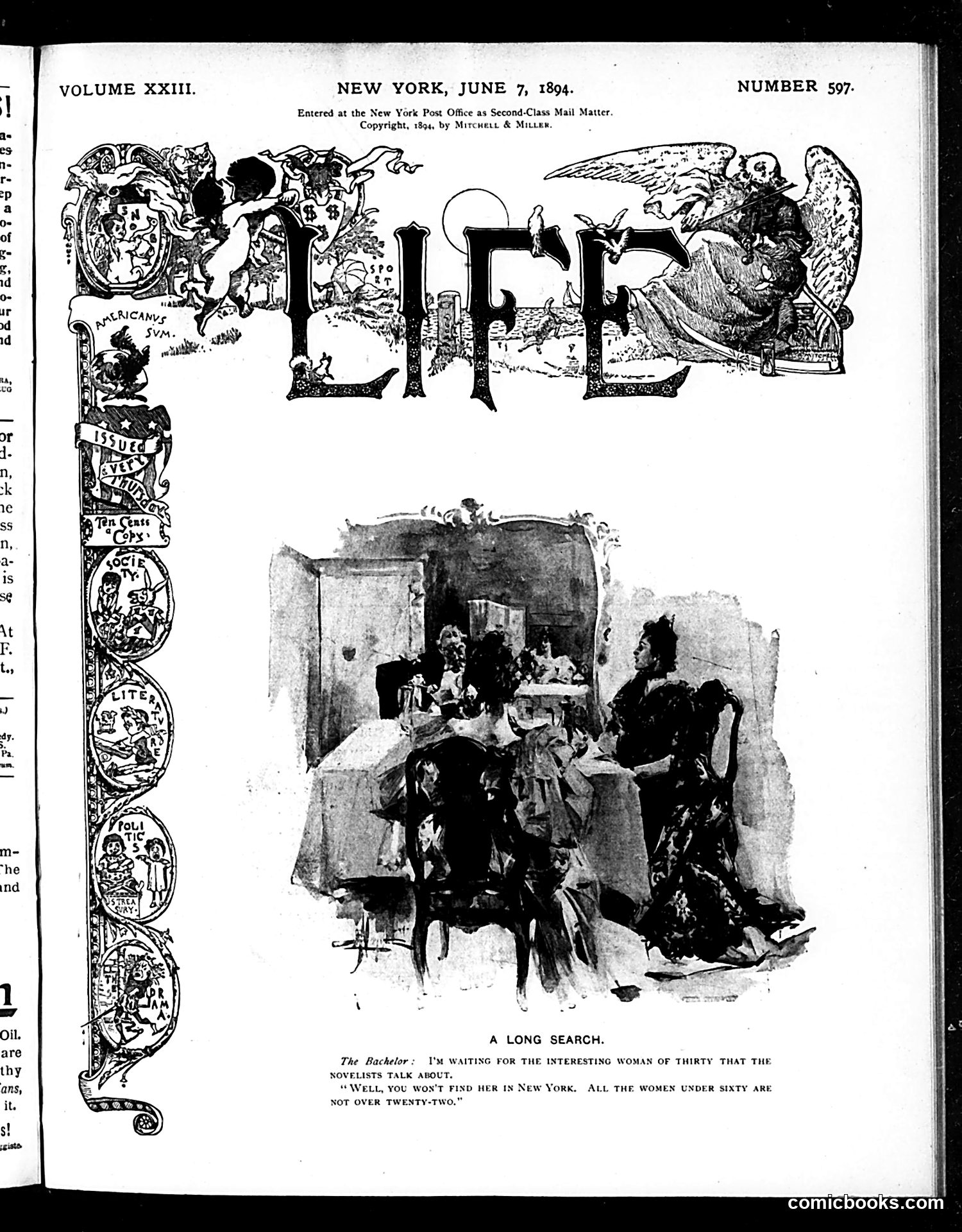
This satirical illustration depicts a bachelor (labeled "The Bachelor") searching for an "interesting woman of thirty" whom novelists discuss. The caption quotes him saying: "Well, you won't find her in New York. All the women under sixty are not over twenty-two." The joke satirizes contemporary literary conventions and romantic ideals. Novelists of the 1890s frequently romanticized women of a specific age and character type, yet the Bachelor's frustrated search reveals this as fictional fantasy—such women apparently don't exist in reality, or if they do, they're invisible in actual society. The cartoon mocks both the literary pretense and male expectations about women's age and attractiveness.
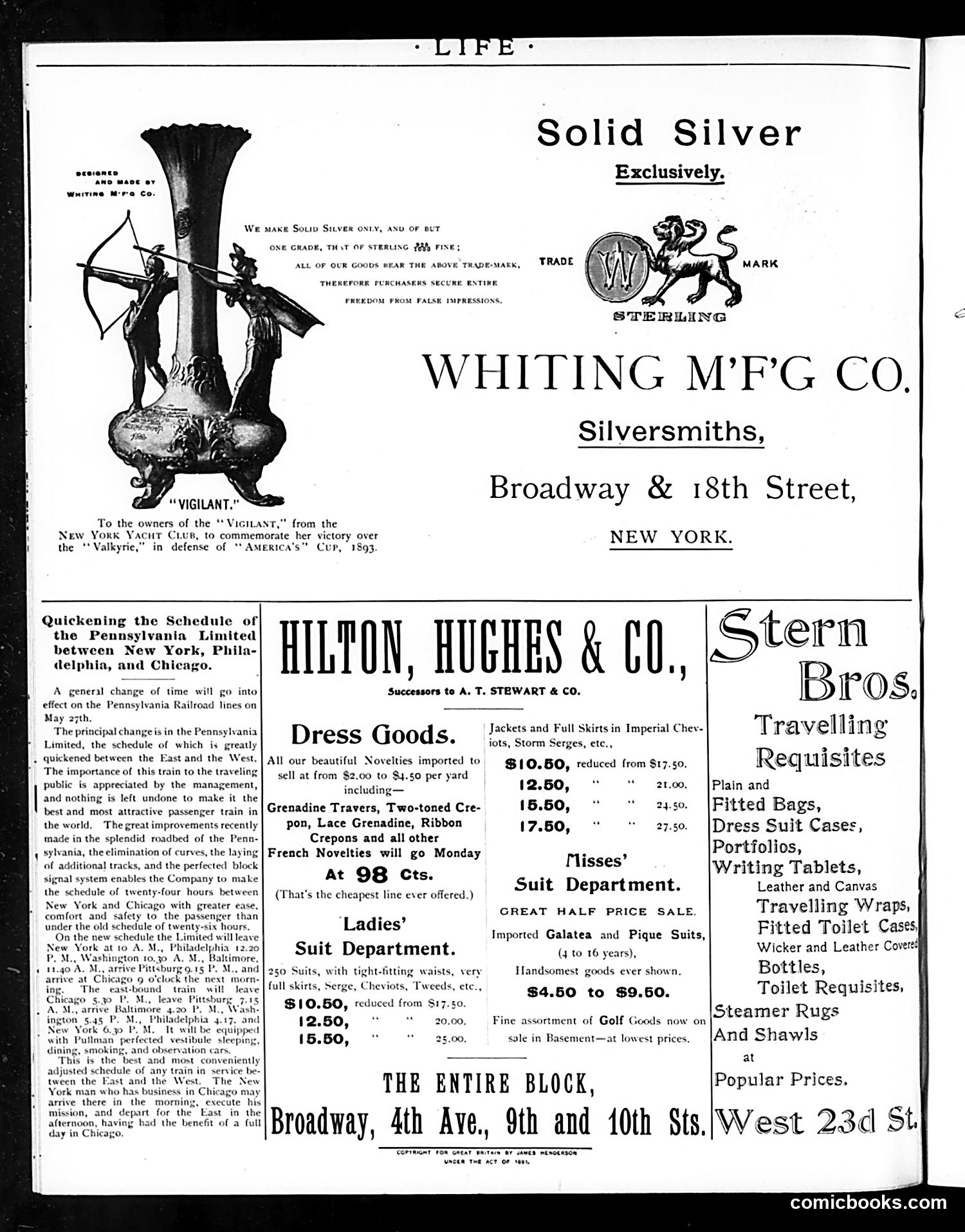
This page is **primarily advertising** for upscale goods and services circa 1890s New York. However, the main illustration features "Vigilant," a yacht, commemorating her victory over the "Valkyrie" in defense of the America's Cup in 1893. The cartoon shows allegorical figures (appearing to represent American maritime supremacy) flanking an ornamental vase. This celebrates American yacht racing dominance—a source of national pride during the Gilded Age, when wealthy industrialists sponsored racing yachts as symbols of American technological and economic superiority. The surrounding ads for Whiting Manufacturing Company (silversmiths), dress goods, and luxury travel items reflect the haute bourgeoisie audience Life magazine served.
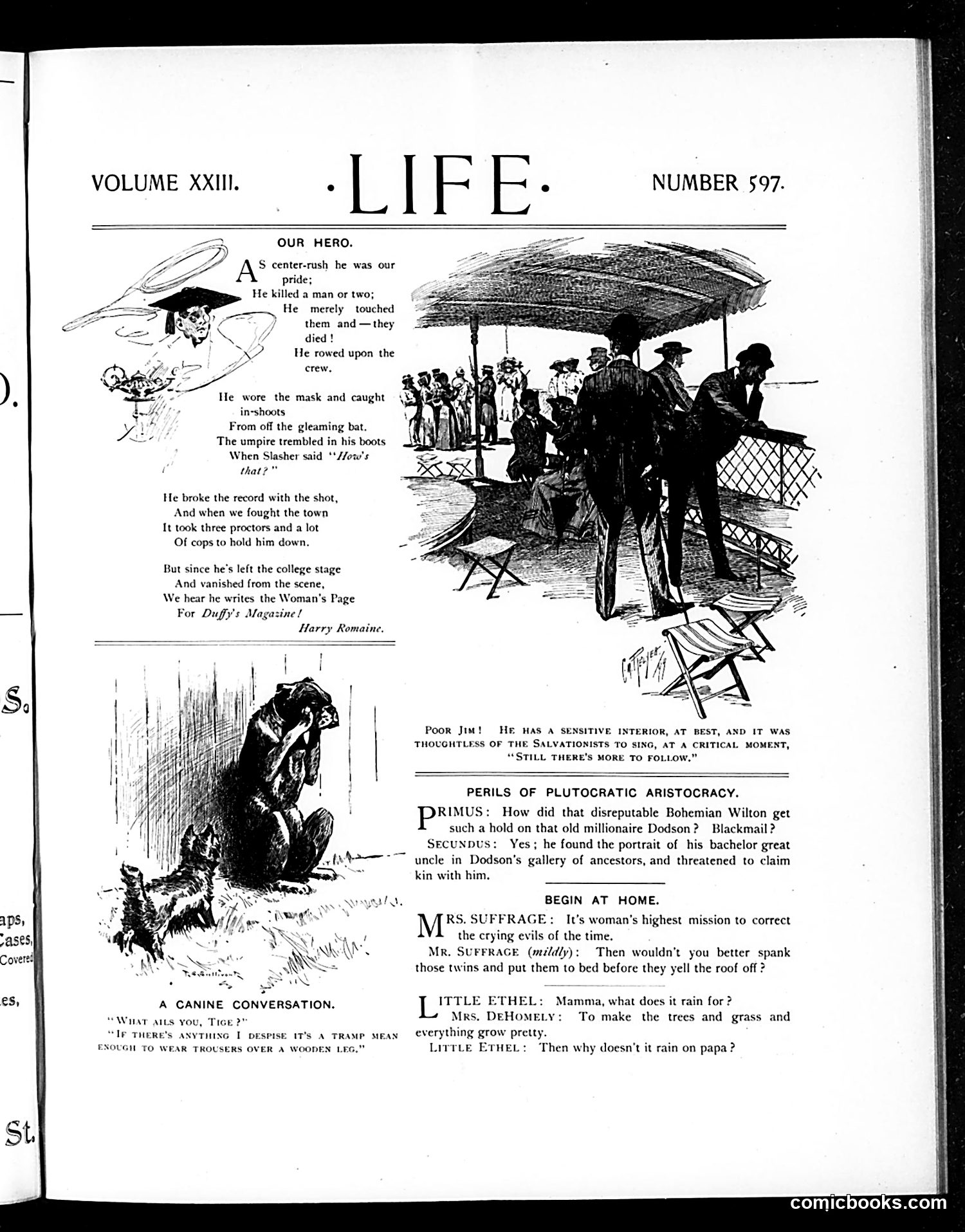
This page contains several satirical pieces typical of early 20th-century LIFE magazine: **"Our Hero"** - A poem by Harry Romaine celebrating a baseball player ("center-rush" hero) who achieved fame, then transitioned to writing for women's magazines after leaving "the college stage." The satire mocks the trajectory from athletic stardom to lighter publishing work. **"Perils of Plutocratic Aristocracy"** - A brief dialogue mocking wealthy social climbers who exploit dubious family connections to gain status (a Bohemian finding "kin" through portrait galleries). **"Begin at Home"** and **"A Canine Conversation"** - Humorous domestic dialogues with children and animals, typical of the magazine's light humor content. The overall tone reflects LIFE's characteristic satirizing of American social pretension and class dynamics.
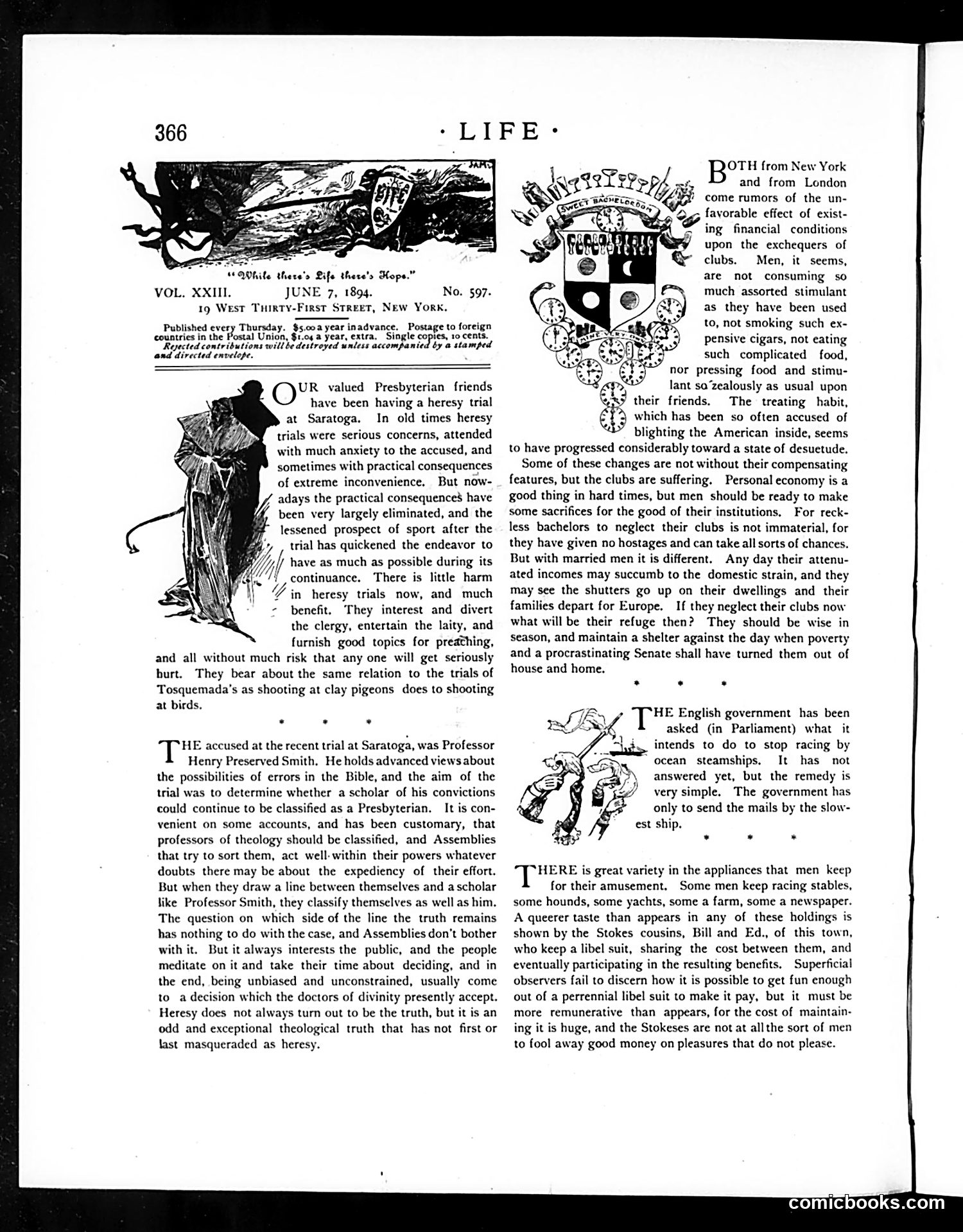
This page contains three satirical pieces. The main text discusses Presbyterian heresy trials at Saratoga involving Professor Henry Preserved Smith, a scholar facing ecclesiastical judgment for theological views. The satire critiques how religious institutions handle doctrinal disputes—suggesting the trials bear little practical consequence, unlike real-world problems. A second section mocks the English government's inability to stop ocean steamship racing despite parliamentary pressure, presenting the issue as foolishly overblown. The final piece ridicules the "Stokes cousins" and similar wealthy men who maintain expensive hobbies (yachts, newspapers, libel suits) purely for amusement. The satire suggests these pursuits waste money on frivolous litigation and status symbols. The cartoons appear decorative rather than specific political commentary.
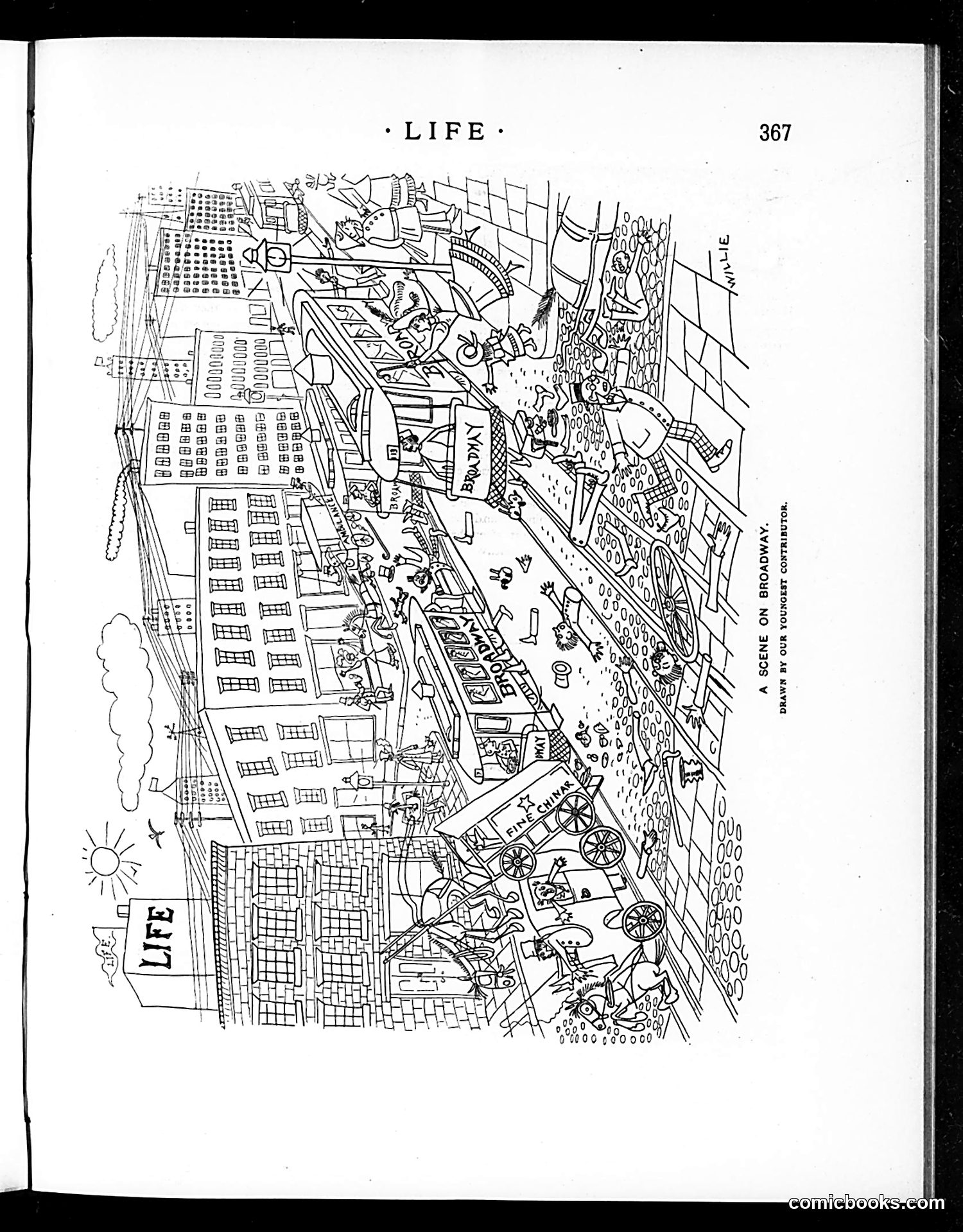
This page from *Life* magazine (page 367) contains a satirical illustration titled "A SCENE ON BROADWAY" depicting a busy street scene rotated 90 degrees. The cartoon shows a crowded urban thoroughfare with various commercial establishments, pedestrians, vehicles, and activity characteristic of Broadway in New York City. The illustration appears to be social satire about modern urban life and commercialism—showing the chaos, density, and sensory overload of a major metropolitan street. The detailed rendering captures multiple layers of activity: storefronts, signage, crowds, and transportation. Without being able to read all text clearly in the illustration itself, the specific satirical targets are difficult to identify precisely, though the cartoon likely mocks contemporary urban society, consumerism, or Broadway culture. The rotated perspective may itself be part of the satirical effect, presenting the familiar disorienting or absurd.
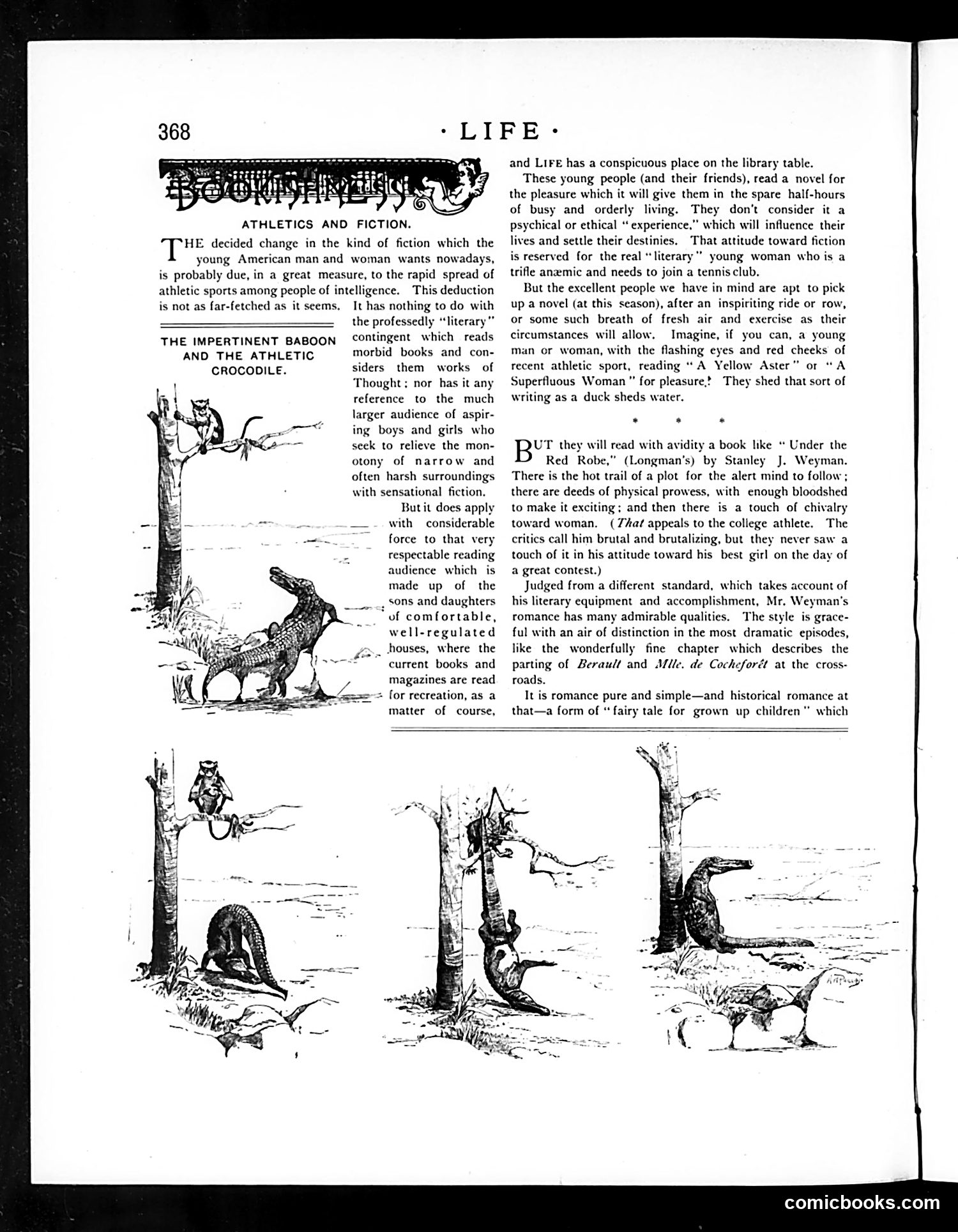
This page discusses how athletics and fiction appeal to young Americans, arguing the connection isn't contradictory. The text defends popular fiction against literary snobs, suggesting young people benefit from both athletic activity and entertaining novels. The illustrations appear to be a humorous sequence titled "The Impertinent Baboon and the Athletic Crocodile," depicting animals engaged in various activities around trees—likely anthropomorphic satire commenting on human behavior or physical pursuits. The broader point seems to be defending middlebrow entertainment and athletic pursuits against criticism from cultural elites who dismiss such interests as intellectually inferior. The magazine advocates for a balanced life combining physical activity and accessible popular reading.
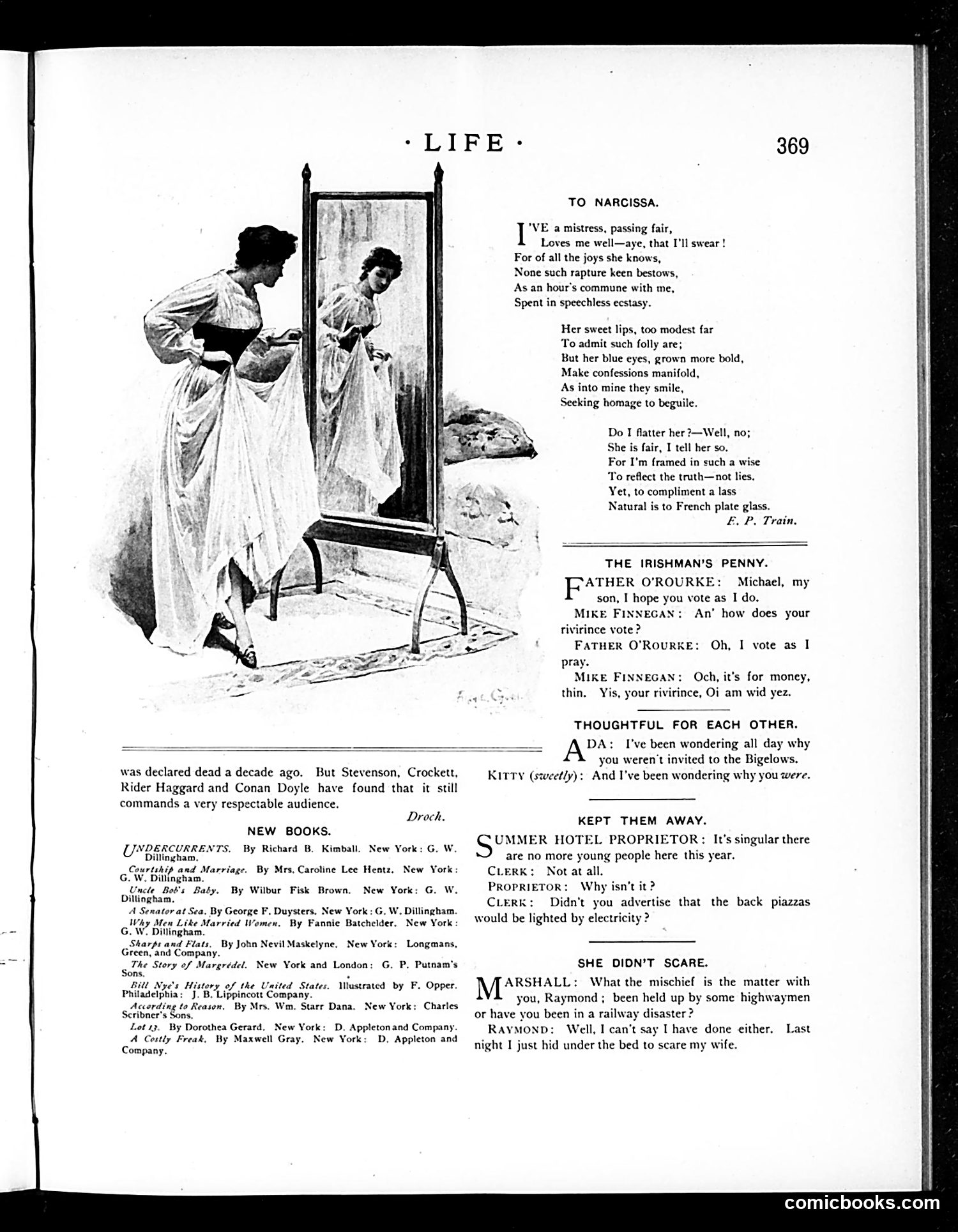
This page from *Life* magazine contains literary content rather than political cartoons. The main illustration shows a woman admiring her reflection in a mirror—a visual accompaniment to the poem "To Narcissa" by E. P. Train, which playfully addresses a vain woman. The humor derives from the classical allusion: Narcissa echoes the mythological Narcissus, who fell in love with his own reflection. The poem ironically claims the speaker won't flatter her, yet does so throughout, noting her "sweet lips" and "blue eyes" while pretending to be "framed in such a wise / To reflect the truth." The page also includes several comedic prose sketches about Irish voting habits and hotel mishaps—typical of *Life's* light satirical approach to everyday social situations rather than hard political commentary.
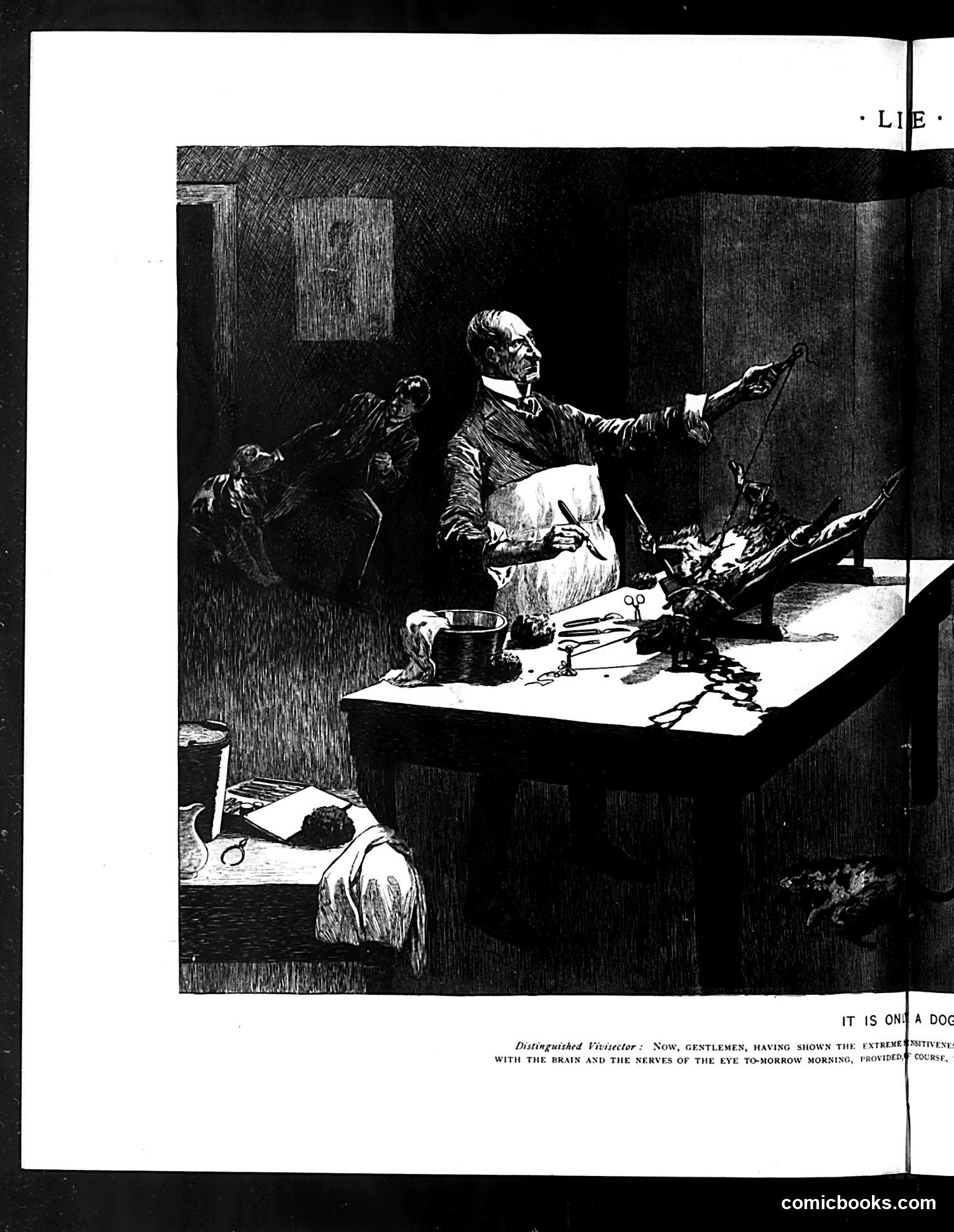
This appears to be a satirical illustration from *Life* magazine titled "Distinguished Vivisector." The image depicts an older gentleman in an apron, gesturing dramatically while conducting what appears to be a medical or scientific demonstration or lecture. The caption references "shows the extreme shiftiness with the brain and the nerves of the eye to-morrow morning, provided course." The text is partially obscured, making the complete context unclear. The satire likely critiques vivisection (animal experimentation) or medical showmanship—possibly mocking either overly dramatic scientific lecturers or the ethics of animal testing. The "distinguished visitor" may be a caricature of a specific contemporary scientist or medical figure, though the identity isn't definitively clear from the visible text.
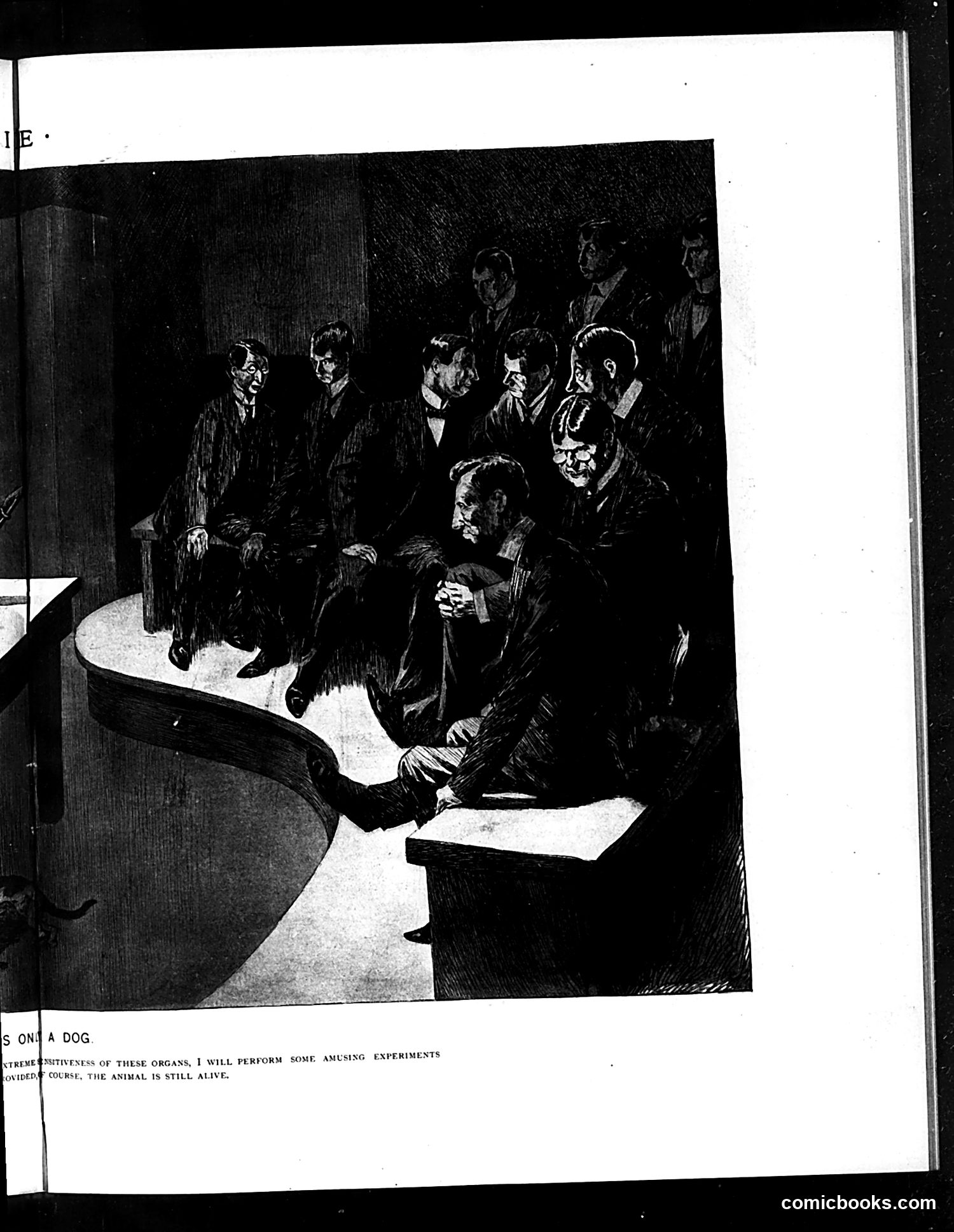
This appears to be a satirical illustration from Life magazine depicting a medical or scientific demonstration. The visible text references "experiments" being performed on a dog while "the animal is still alive," suggesting dark humor about vivisection—the practice of operating on live animals for research purposes. The scene shows well-dressed men (likely scientists, doctors, or authority figures) gathered around what appears to be an operating table. The stark black-and-white illustration style and formal attire emphasize the clinical nature of the proceedings. The satire likely critiques either the cruelty of animal experimentation or the callous attitudes of the scientific establishment toward animal welfare—a concern that was emerging as a social issue during the publication period of this magazine.
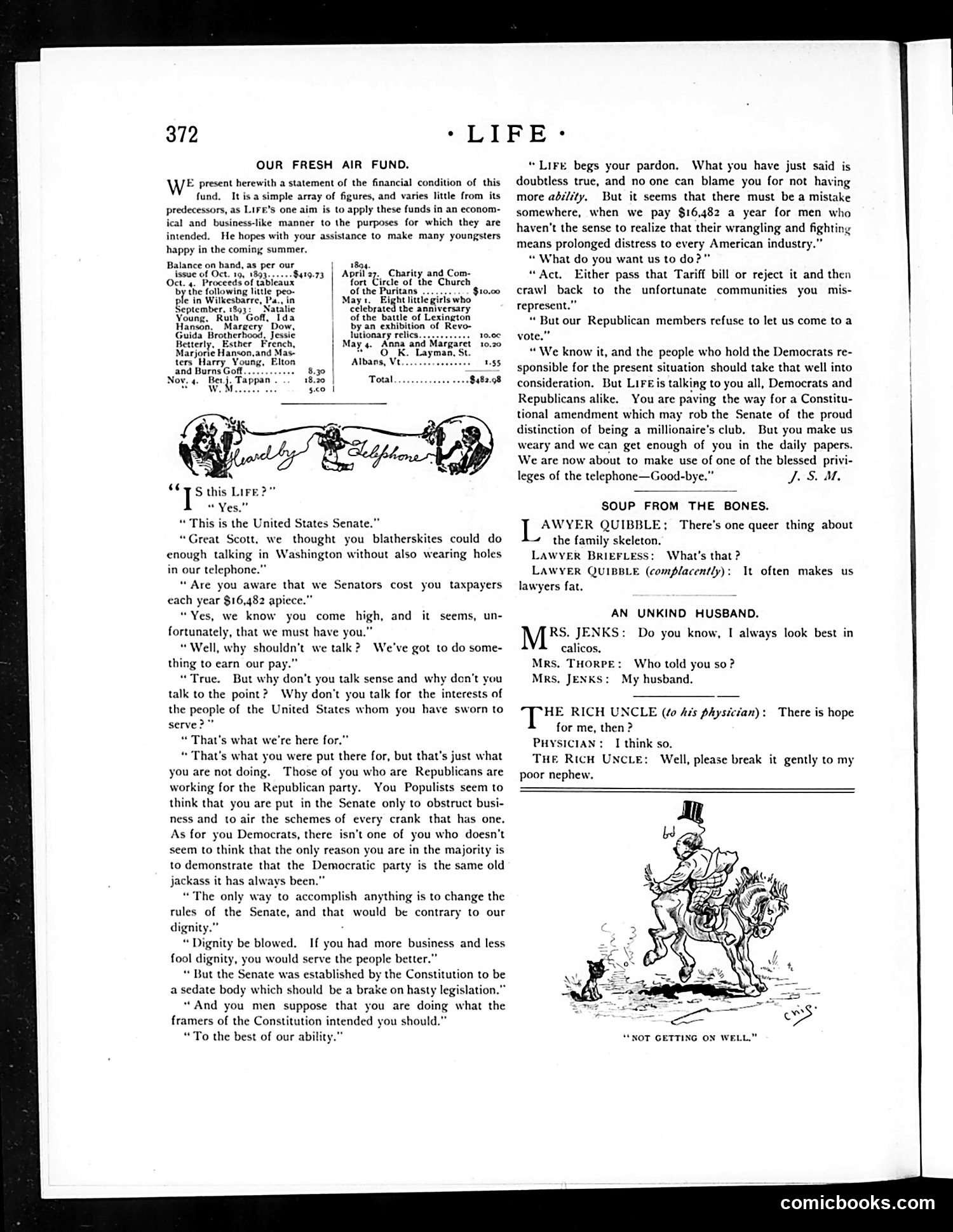
This page contains political satire criticizing the U.S. Senate, particularly Republican members. The main dialogue mocks Senators for high cost to taxpayers ($16,482 annually each) and accuses them of obstructing legislation while serving party interests rather than the public. The cartoon "Not Getting On Well" (lower right) depicts a wealthy man in a top hat riding a bucking horse labeled with social unrest—visual metaphor for the rich struggling to maintain control during turbulent times. Supporting humor pieces include "Soup from the Bones" (about lawyers) and "An Unkind Husband" (domestic comedy). The page targets Republican Senate obstruction of Democratic initiatives, a recurring Progressive Era critique of institutional gridlock and aristocratic indifference to ordinary citizens' welfare.
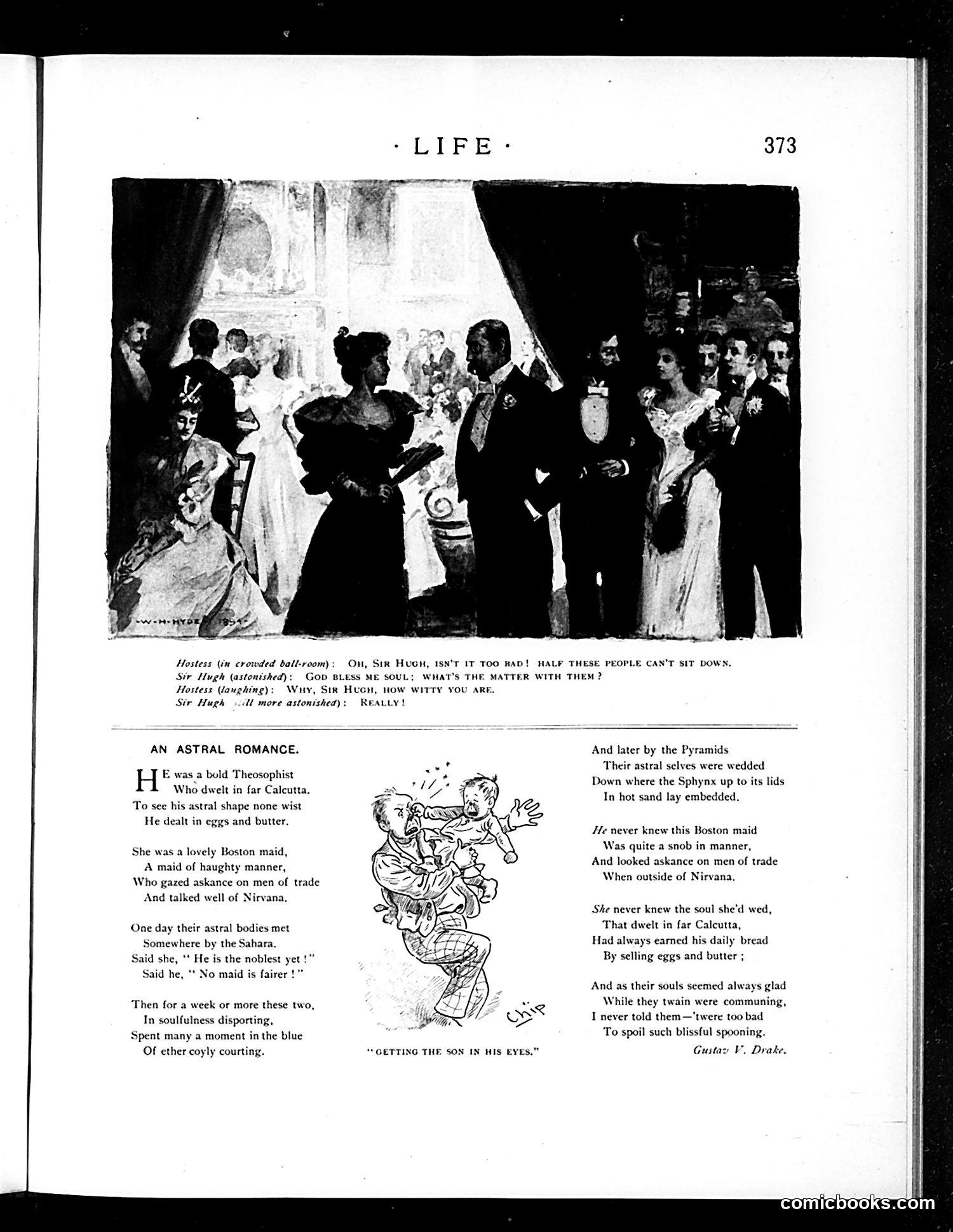
**Top Image:** A crowded formal ballroom scene depicts a hostess overwhelmed by guests. The dialogue satirizes poor event management—the hostess complains people "can't sit down," while Sir Hugh dismisses her concerns as excessive worry. The humor targets the social chaos of overcrowded formal gatherings and the gap between hosts' expectations and reality. **Bottom Content:** "An Astral Romance" is a humorous poem by Gustav V. Drake about a Theosophist from Calcutta who spiritually "courts" a Boston maid through astral projection, while she remains unaware. The joke mocks Theosophy—a popular early-20th-century spiritual movement—by depicting its supernatural claims as absurd. The couple's souls commune while their earthly selves remain strangers, satirizing both Theosophical pretension and romantic incompetence.
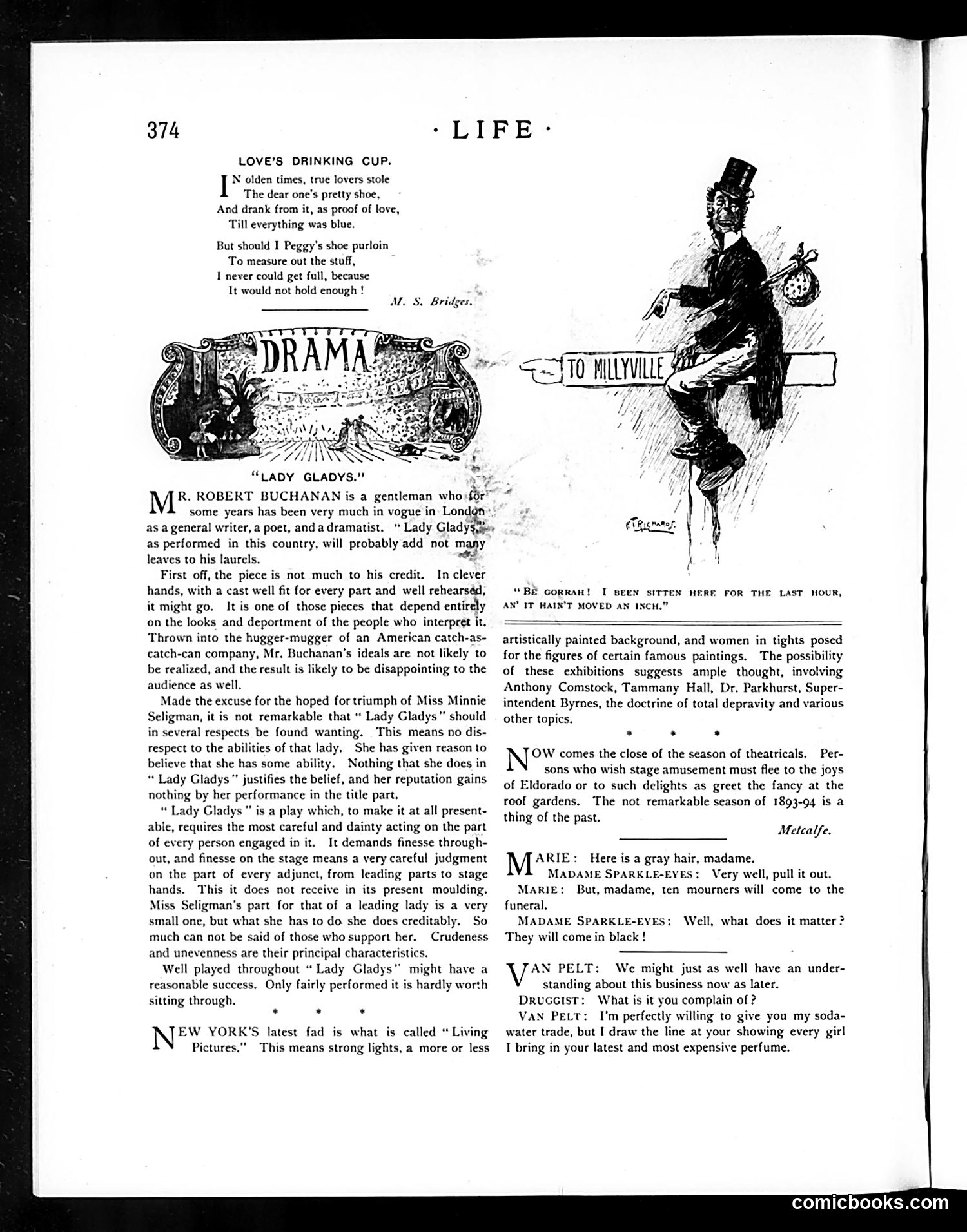
This page contains three distinct pieces of satire typical of 1890s Life magazine: **"Love's Drinking Cup"** (top): A humorous poem mocking an old romantic tradition of drinking from a lover's shoe. The joke: the speaker's girlfriend Peggy has such large feet that her shoe couldn't hold enough liquid—a crude size-based insult disguised as sentiment. **"Lady Gladys" review** (center): A theatrical critique of Robert Buchanan's play, performed by actress Minnie Seligman. The reviewer argues the play requires refined acting but received clumsy execution from its American cast, making it disappointing. **"Living Pictures" reference** (bottom): A brief mention of New York's latest fad—women posing in tights to recreate famous paintings with theatrical lighting. The text notes this raises moral concerns involving reformer Anthony Comstock and Tammany Hall (political corruption), suggesting the exhibits border on indecency. **Right illustration**: A caricatured dandy directing someone "To Millyville," satirizing affected speech or pretension. **Bottom dialogues**: Two brief comedic exchanges about a woman's gray hair and a druggist's perfume sales tactics.
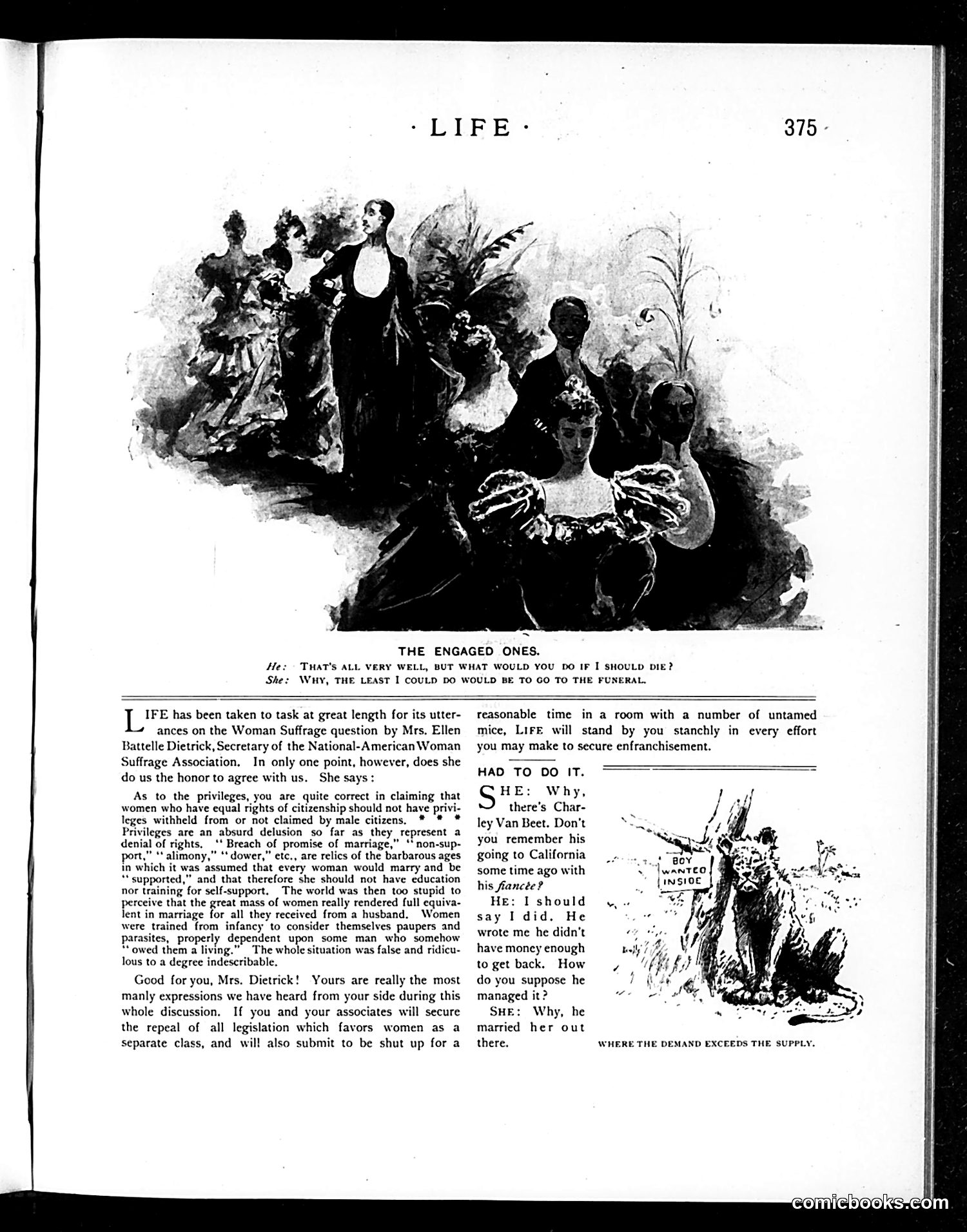
This page contains two satirical pieces about women's rights and marriage from an early 20th-century American magazine. **Top cartoon ("The Engaged Ones"):** A couple discusses mortality. When the man asks what she'd do if he died, she replies she'd "at least" attend his funeral—a cutting joke about the minimal emotional investment in their engagement. **Main article:** Life responds to suffragist Ellen Battelle Dietrick's criticism of their stance on women's suffrage. While agreeing that legal privileges like "alimony" and "dower" are outdated relics, Life sarcastically offers support only if suffragists also agree to be locked in a room with untamed mice—mocking their demand for equality while denying them are truly serious. **Bottom cartoon ("Where the Demand Exceeds the Supply"):** A man who claimed poverty in California actually married his fiancée to afford passage home. The joke satirizes both male deception and women as financial solutions to men's problems. The overall message ridicules women's suffrage advocates while reinforcing traditional gender hierarchies.
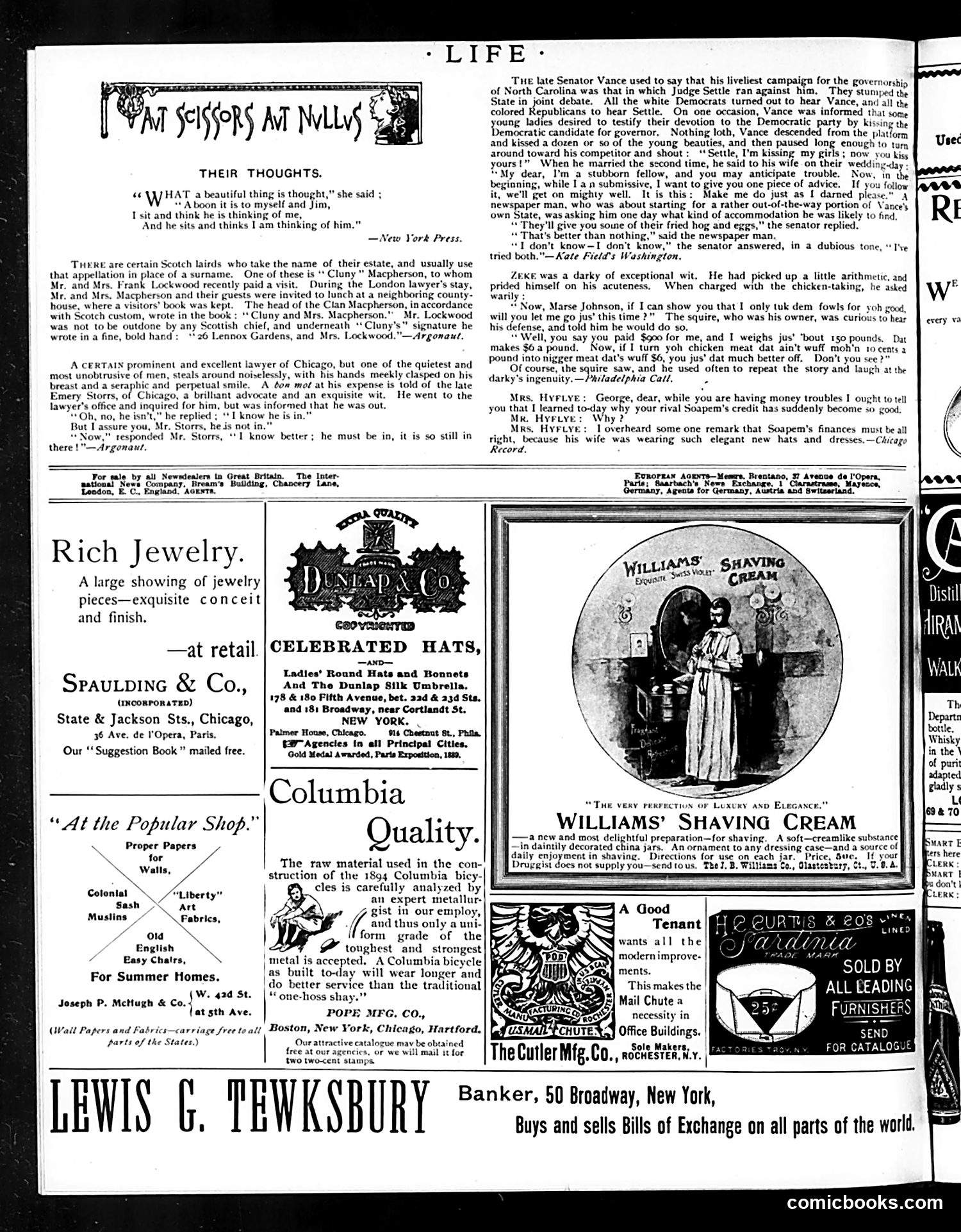
This page from *Life* magazine contains several satirical anecdotes rather than political cartoons. The content reflects late-19th/early-20th-century American humor: **"Their Thoughts"** presents a sentimental poem contrasting with crude male reality—a common satirical device mocking romantic idealization. **The Scotch Lairds story** ridicules Scottish naming conventions where landowners use estate names as surnames. The joke: a visitor's cheeky response ("26 Lennox Gardens") deflates the pretension by listing his actual London address instead. **The Chicago Lawyer anecdote** plays on the contrast between a quiet, unassuming appearance and sharp intellect—a setup for wit by the late advocate Emery Storrs. **The Zeke story** uses dialect humor (common in period publications) depicting an enslaved man's arithmetic to explain why stealing chickens was economically justified to his owner—satirizing both the absurdity of the argument and the moral framework it operates within. These pieces represent *Life's* brand of satirical humor targeting social pretension, regional stereotypes, and human foibles rather than specific political figures.
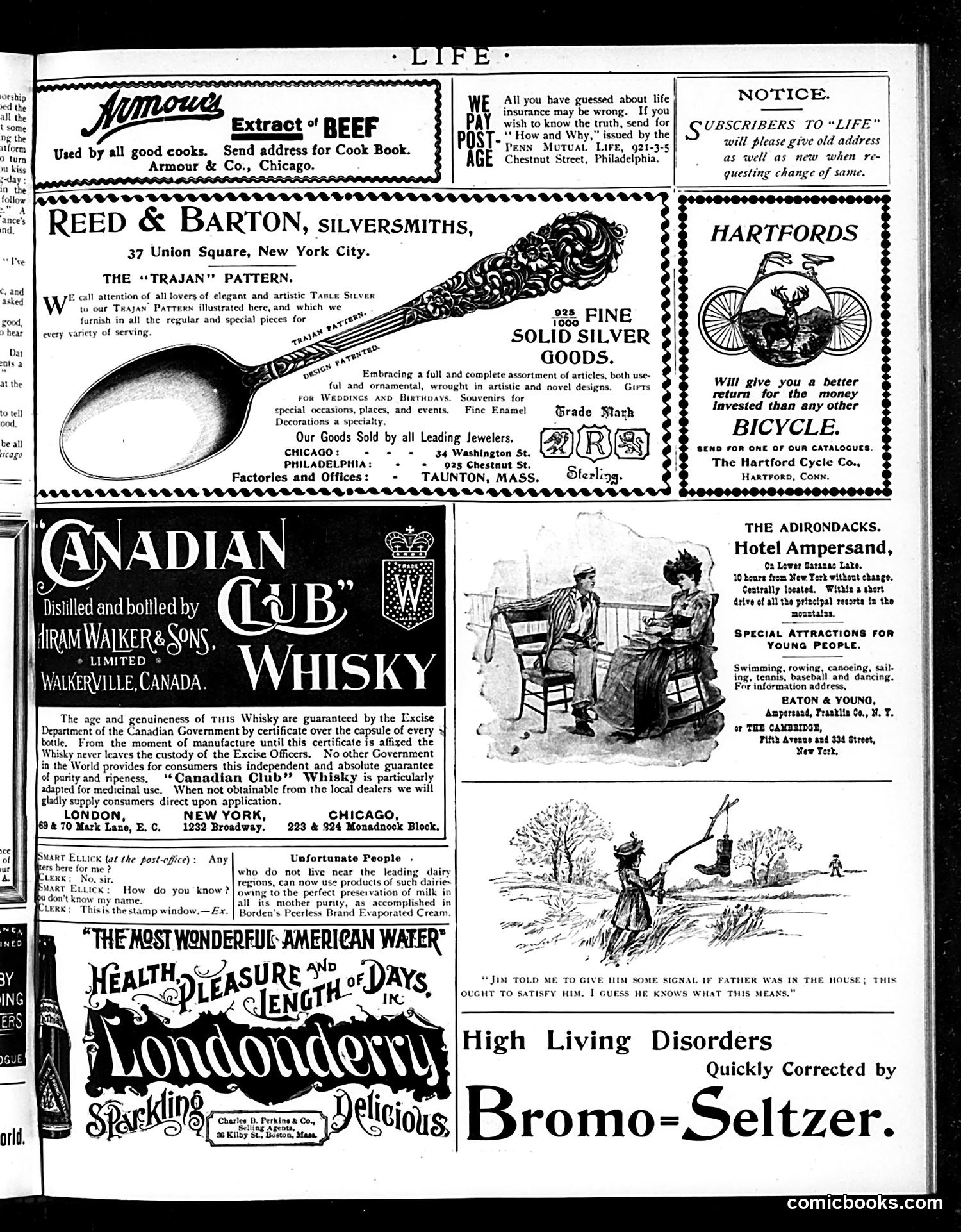
This is primarily an **advertising page** with one small cartoon at the bottom. The cartoon depicts "Smart Ellick" at a post office asking if there's mail for him. The clerk says no. Ellick responds that Jim told him to give a signal if their father was home—implying the clerk should know this private arrangement. The joke is a **satirical jab at postal inefficiency**: the clerk doesn't actually check for mail or know anything about the customers' personal business, yet Ellick expects him to participate in a secret family code. It mocks the assumption that postal workers are all-knowing or invested in patrons' private affairs. The remainder of the page consists of period advertisements for luxury goods (silverware, whisky, bicycles, hotels), patent medicines (Bromo-Seltzer for digestive complaints), and beef extract—typical of early 1900s Life magazine content, blending satirical humor with commercial sponsorship.
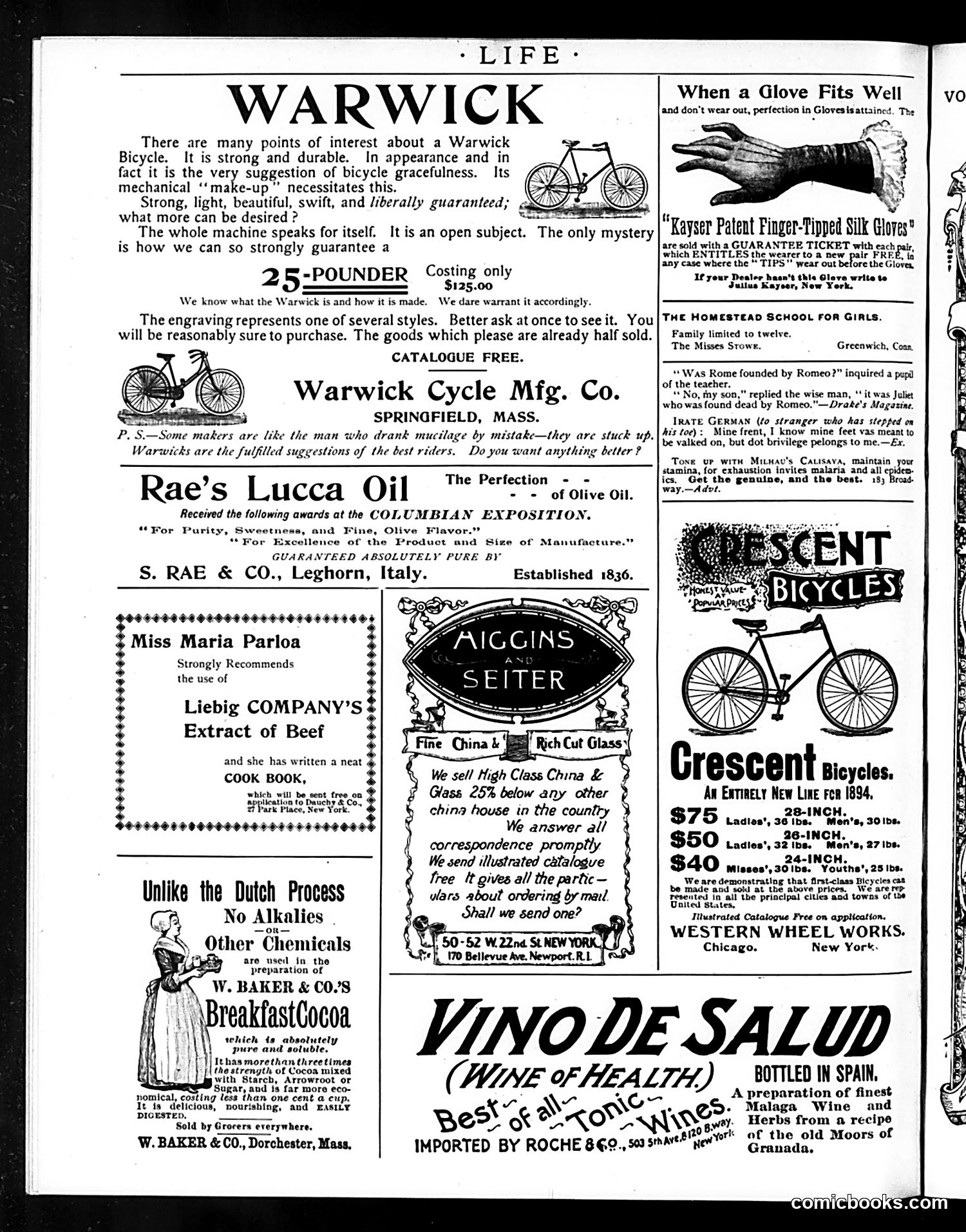
This is primarily an **advertising page** from Life magazine, circa 1894, featuring various consumer products targeting middle and upper-class readers. The notable content includes: **Warwick Bicycles** (top): Promotes a "25-pounder" bicycle at $125, emphasizing durability and "graceful" design. The small joke ("Some makers are like the man who drank mucilage by mistake—they are stuck up") is a mild self-promotion comparing competitors unfavorably. **Other advertisements** include olive oil, cocoa, beef extract, silk gloves, and bicycles—all luxury goods of the era. The **Crescent Bicycles** ad specifically promotes "An Entirely New Line for 1894," reflecting the bicycle craze of the 1890s. **Two brief jokes** appear: one about Romeo founding Rome (a pun on the names), and another about a German complaining someone stepped on his toe. There are **no political cartoons** on this page. It's a commercial advertising section with minimal satirical content—typical of Life's mixed format combining humor with paid advertisements.