
Life, 1894-06-07 · page 4 of 16
Life — June 7, 1894 — page 4: what you’re looking at
What you’re looking at
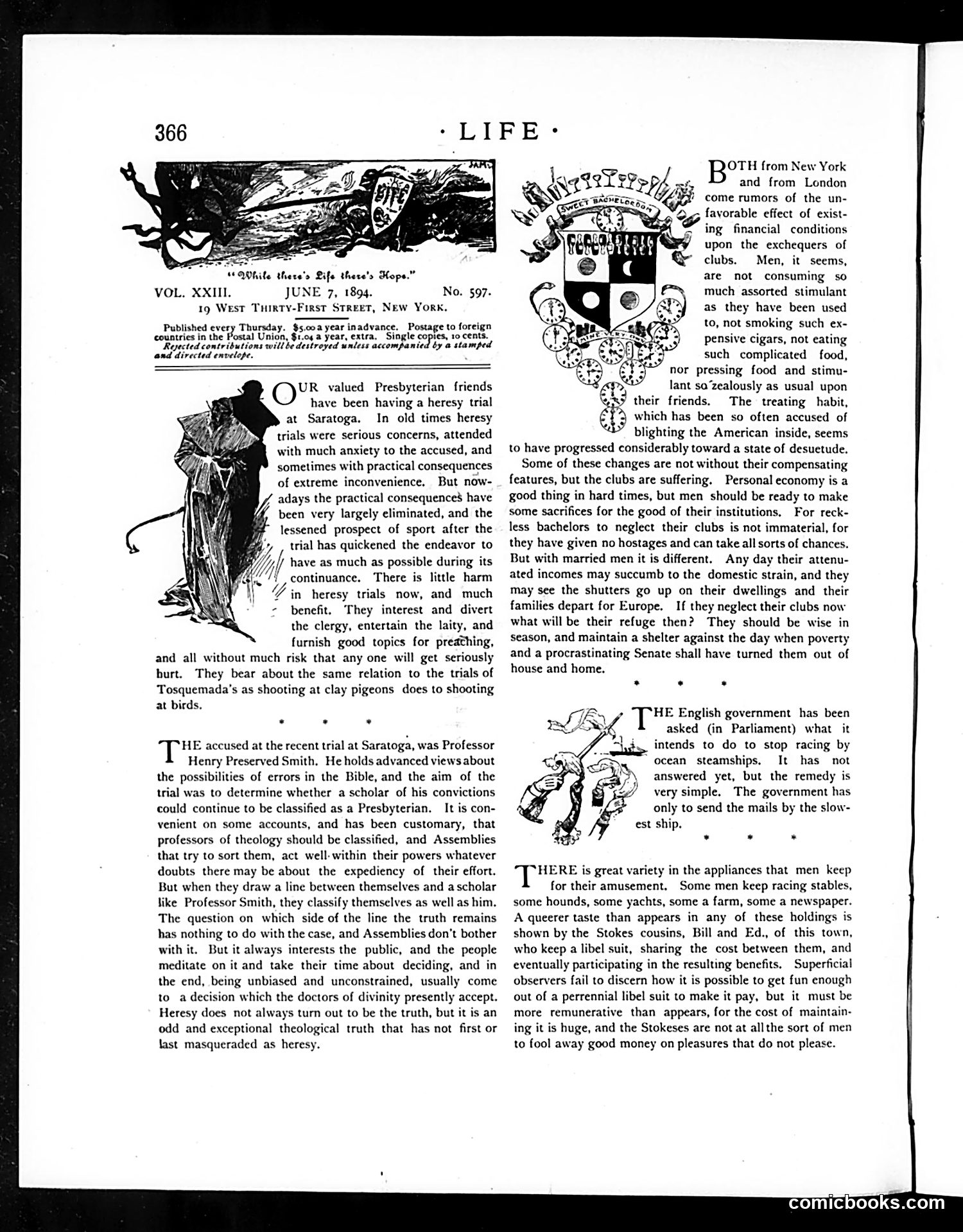
This page contains three satirical pieces. The main text discusses Presbyterian heresy trials at Saratoga involving Professor Henry Preserved Smith, a scholar facing ecclesiastical judgment for theological views. The satire critiques how religious institutions handle doctrinal disputes—suggesting the trials bear little practical consequence, unlike real-world problems. A second section mocks the English government's inability to stop ocean steamship racing despite parliamentary pressure, presenting the issue as foolishly overblown. The final piece ridicules the "Stokes cousins" and similar wealthy men who maintain expensive hobbies (yachts, newspapers, libel suits) purely for amusement. The satire suggests these pursuits waste money on frivolous litigation and status symbols. The cartoons appear decorative rather than specific political commentary.
📄 Transcribed text from this page (OCR, searchable)
Machine-transcribed from the original scan — historical spelling and the odd misread are preserved.
“While there's Life there's Hope.” VOL. XXIII. JUNE 7, 1894. No. 597. 1g West Tuirty-Fixst STREET, New York. Published every Thursday. $5.00a year inadvance. Postage to foreign countries in the Postal Union, $1.04 a year, extra. Single copies, 10 cents. Reyected contributions willbe destroyed unites accompanied by a stamped and directed envelope. OO” valued Presbyterian friends have been having a heresy trial at Saratoga. In old times heresy trials were serious concerns, attended with much anxiety to the accused, and sometimes with practical consequences of extreme inconvenience, But now- adays the practical consequenced have been very largely eliminated, and the lessened prospect of sport after the 'y | trial has quickened the endeavor to have as much as possible during its continuance. There is little harm Gin heresy trials now, and much - benefit, They interest and divert the clergy, entertain the laity, and furnish good topics for preathing, and all without much risk that any one will get seriously burt. They bear about the same relation to the trials of Tosquemada’s as shooting at clay pigeons does to shooting at birds. eel i\he . . . HE accused at the recent trial at Saratoga, was Professor Henry Preserved Smith. He holds advanced views about the possibilities of errors in the Bible, and the aim of the trial was to determine whether a scholar of his convictions could continue to be classified as a Presbyterian. It is con- venient on some accounts, and has been customary, that professors of theology should be classified, and Assemblies that try to sort them, act well-within their powers whatever doubts there may be about the expediency of their effort. But when they draw a line between themselves and a scholar like Professor Smith, they classify themselves as well as him. The question on which side of the line the truth remains has nothing to do with the case, and Assemblies don’t bother with it. But it always interests the public, and the people meditate on it and take their time about deciding, and in the end, being unbiased and unconstrained, usually come toa decision which the doctors of divinity presently accept. Heresy does not always turn out to be the truth, but it is an odd and exceptional theological truth that has not first or last masqueraded as heresy. OTH from New York and from London come rumors of the un- favorable effect of exist- upon the exchequers of clubs. Men, it seems, are not consuming so much assorted stimulant as they have been used to, not smoking such ex- pensive cigars, not eating such complicated food, hry G33) nor pressing food and stimu- EP, 4 lant soZealously as usual upon > their friends. The treating habit, ef which has been so often accused of blighting the American inside, seems to have progressed considerably toward a state of desuetude. Some of these changes are not without their compensating features, but the clubs are suffering. Personal economy is a good thing in hard times, but men should be ready to make some sacrifices for the good of their institutions, For reck- less bachelors to neglect their clubs is not immaterial, for they have given no hostages and can take all sorts of chances. But with married men it is different. Any day their attenu- ated incomes may succumb to the domestic strain, and they may see the shutters go up on their dwellings and their families depart for Europe. If they neglect their clubs now what will be their refuge then? They should be wise in season, and maintain a shelter against the day when poverty and a procrastinating Senate shall have turned them out of house and home, . . . HE English government has been asked (in Parliament) what it intends to do to stop racing by “ ocean steamships. It has not answered yet, but the remedy is very simple. The government has only to send the mails by the slow- est ship. . * * “EEE is great variety in the appliances that men keep for their amusement, Some men keep racing stables, some hounds, some yachts, some a farm, some a newspaper. A queerer taste than appears in any of these holdings is shown by the Stokes cousins, Bill and Ed., of this town, who keep a libel suit, sharing the cost between them, and eventually participating in the resulting benefits. Superficial observers fail to discern how it is possible to get fun enough out of a perrennial libel suit to make it pay, but it must be more remunerative than appears, for the cost of maintain- ing it is huge, and the Stokeses are not at allthe sort of men to fool away good money on pleasures that do not please. comicbooks.com