
A complete issue · 16 pages · 1894
Life — May 10, 1894
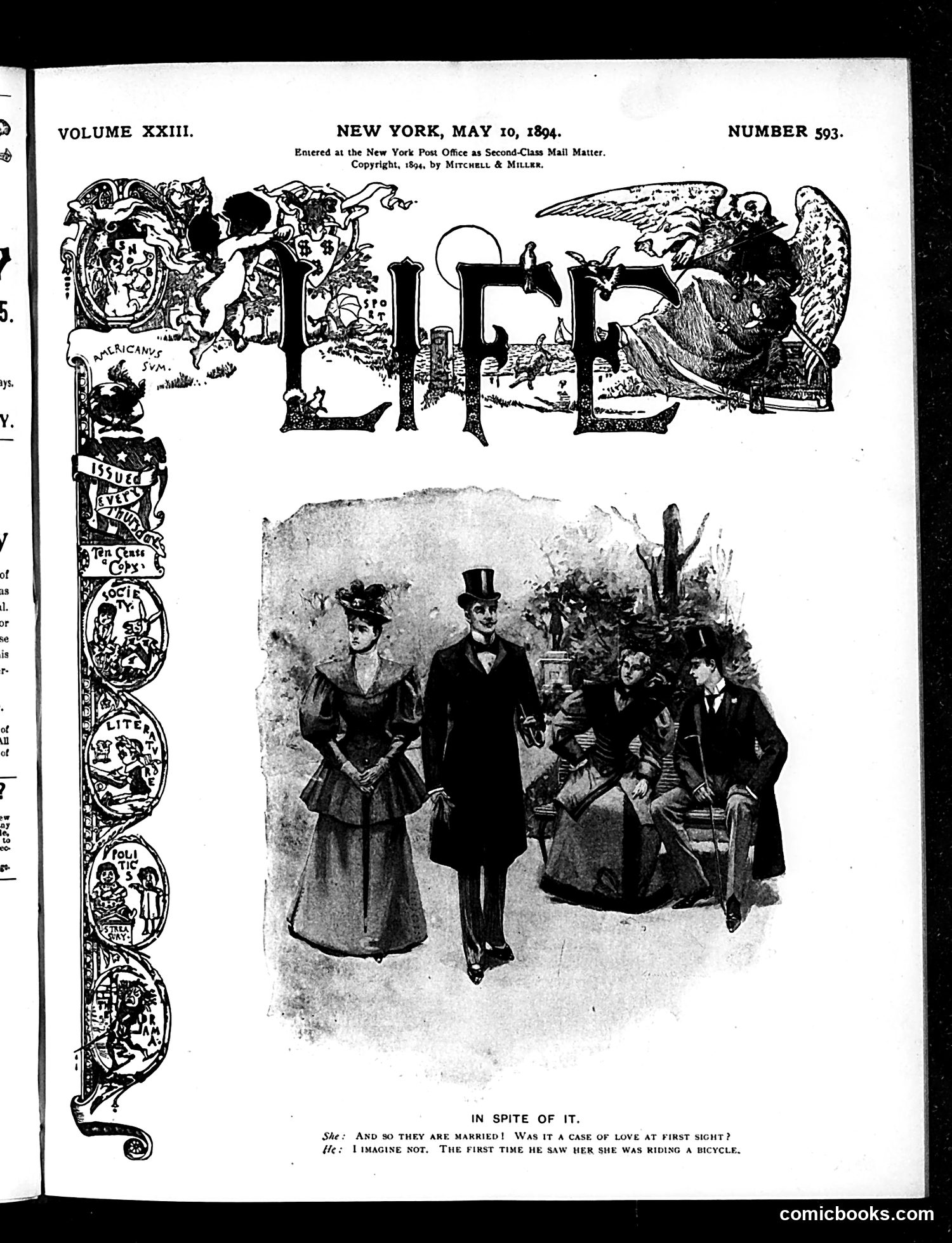
This cartoon satirizes a Victorian-era marriage based on an unconventional meeting. The dialogue reveals the joke: when asked if theirs was "a case of love at first sight," the husband responds that he first saw his wife riding a bicycle. The satire targets the bicycle craze of the 1890s and evolving attitudes toward women. Bicycles were controversial—considered unfeminine, dangerous to morality, and a symbol of women's independence. The cartoon mocks how a woman riding a bicycle (scandalous behavior) led to marriage despite this impropriety. The phrase "in spite of it" suggests that despite her modern, unconventional behavior, they married anyway—poking fun at both bicycle culture and changing gender norms in fin-de-siècle America.
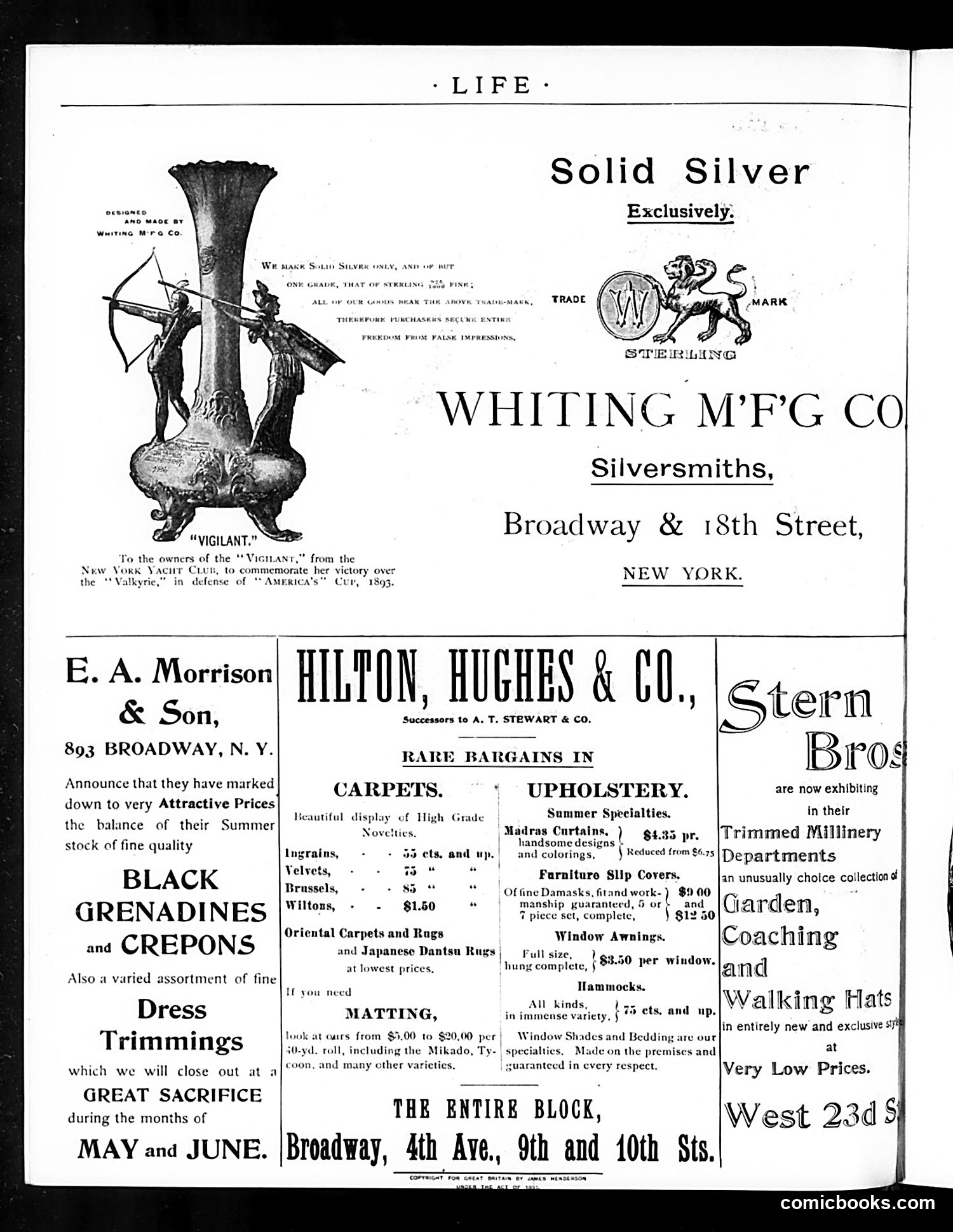
This page is primarily **advertising**, not satire or political commentary. The main content features: 1. **Whiting Mfg Co** (top): A solid silver goods advertisement showing a decorative vessel called "Vigilant," commissioned by the New York Yacht Club to commemorate a victory over the "Valkyrie" in defense of America's Cup in 1895. 2. **Lower section**: Multiple ads for New York retailers selling carpets, upholstery, dress trimmings, hats, and other goods at reduced prices. The single illustrated element—the "Vigilant" trophy—references the real 1895 America's Cup yacht race, but this appears to be straightforward commercial promotion rather than satirical commentary. The page demonstrates how *Life* magazine monetized its readership through advertisements alongside editorial content.
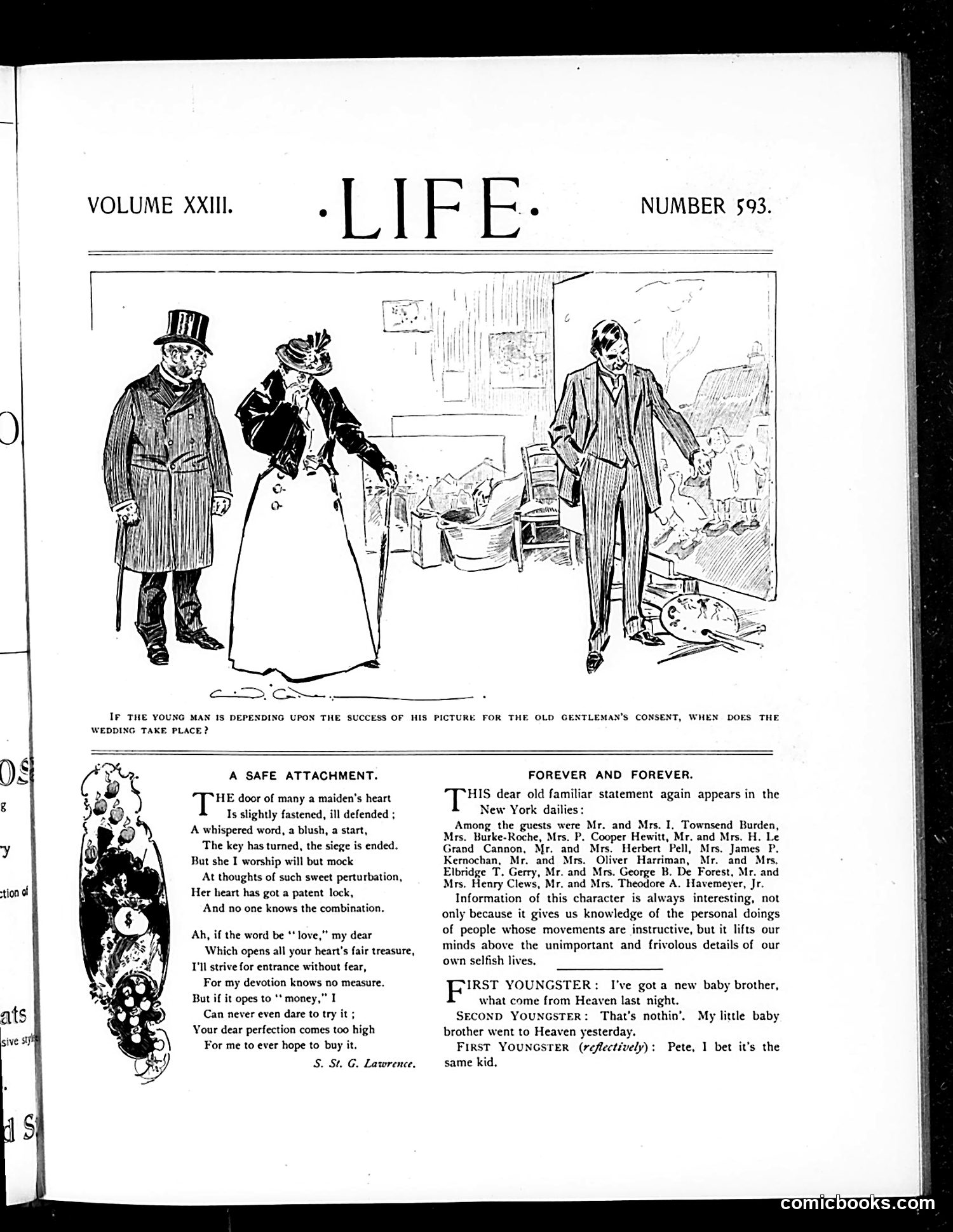
The top cartoon depicts a young artist seeking an old gentleman's consent for marriage—suggested by the caption asking when the wedding will occur if the young man's picture's success depends on the old gentleman's approval. This appears to be satirizing the social convention where a suitor needed parental or paternal blessing before marrying. The lower section contains poetry ("A Safe Attachment" by S.S.G. Lawrence) about romantic devotion, followed by "Forever and Forever," listing society engagement announcements from New York newspapers—typical Life magazine content mocking high-society customs. The small dialogue between "First Youngster" and "Second Youngster" jokes about babies being born or dying, likely satirizing common period experiences with infant mortality or the casual way children discussed death.
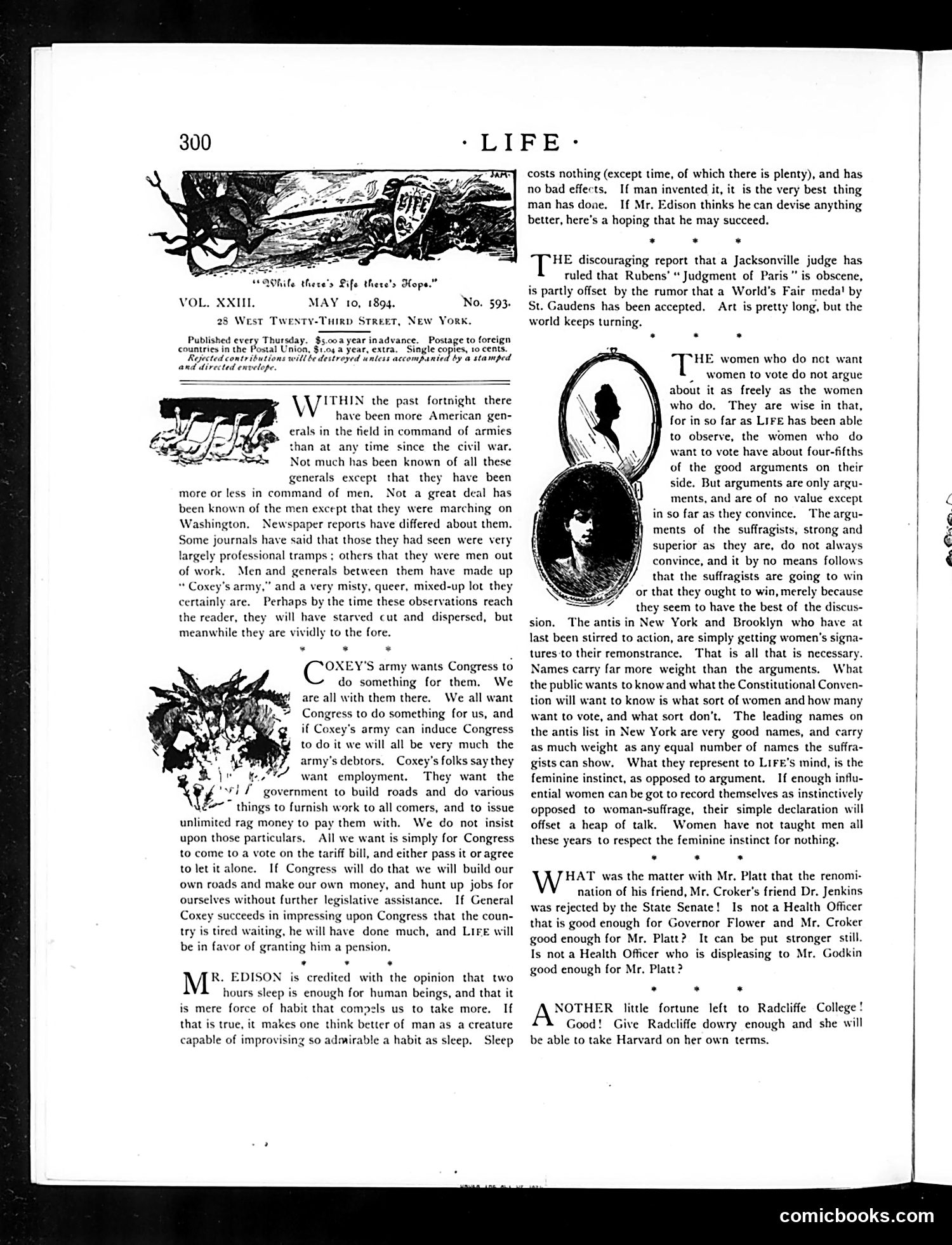
This page contains editorial commentary rather than cartoons. The main topics addressed are: 1. **Military command**: Discussion of American generals leading armies, noting their competence despite criticism from newspapers and mixed public perception. 2. **Coxey's Army**: References to a demand that Congress provide employment and road-building projects, suggesting federal intervention to address joblessness. 3. **Women's suffrage debate**: The text argues that anti-suffrage women's arguments lack persuasive force compared to suffragists' positions. It suggests women's "feminine instinct" opposing suffrage carries weight despite logical weakness. 4. **Mr. Platt's political setback**: Mentions rejection of Platt's friend Dr. Jenkins by the State Senate, questioning why Jenkins is unsuitable for Governor Flower. The illustrations are decorative period drawings rather than political cartoons, and the content reflects late-19th-century American political debates.
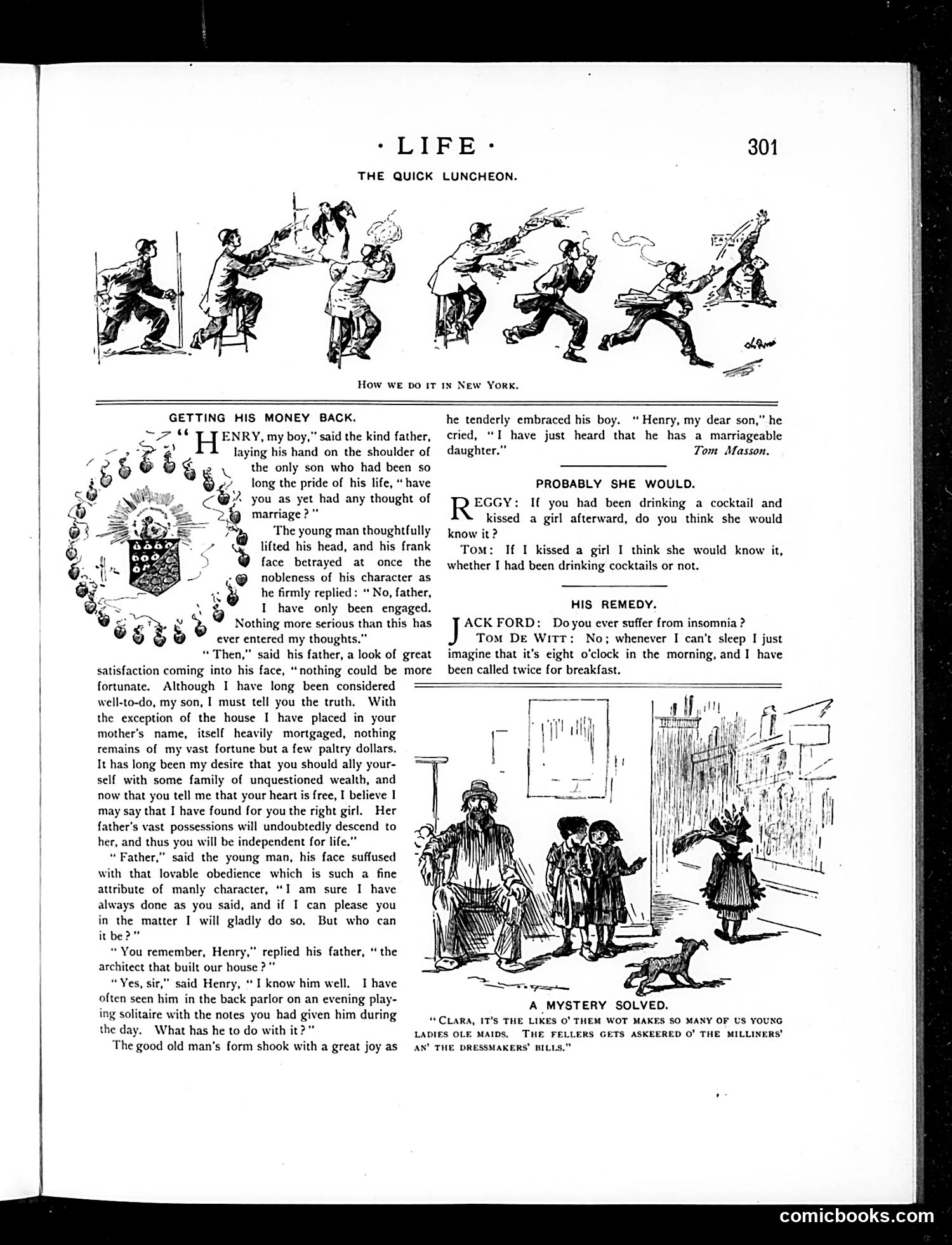
This page contains three satirical vignettes about New York social customs circa early 1900s: **"Getting His Money Back"**: A father discovers his son is engaged rather than married, and lectures him about financial prudence—the family's wealth and reputation depend on careful matches. The joke satirizes wealthy families' obsession with marital alliances as financial transactions. **"Probably She Would"** and **"His Remedy"**: Brief comedic exchanges about cocktails, kissing, and insomnia that mock upper-class social pretensions and romantic conventions. **"A Mystery Solved"**: Shows working-class women discussing how young ladies' maids somehow rack up substantial dressmakers' bills—satirizing servants' petty thievery or kickback schemes from tradespeople. The overall theme mocks class-specific anxieties: wealth management among the rich, social rituals, and economic exploitation of domestic workers.
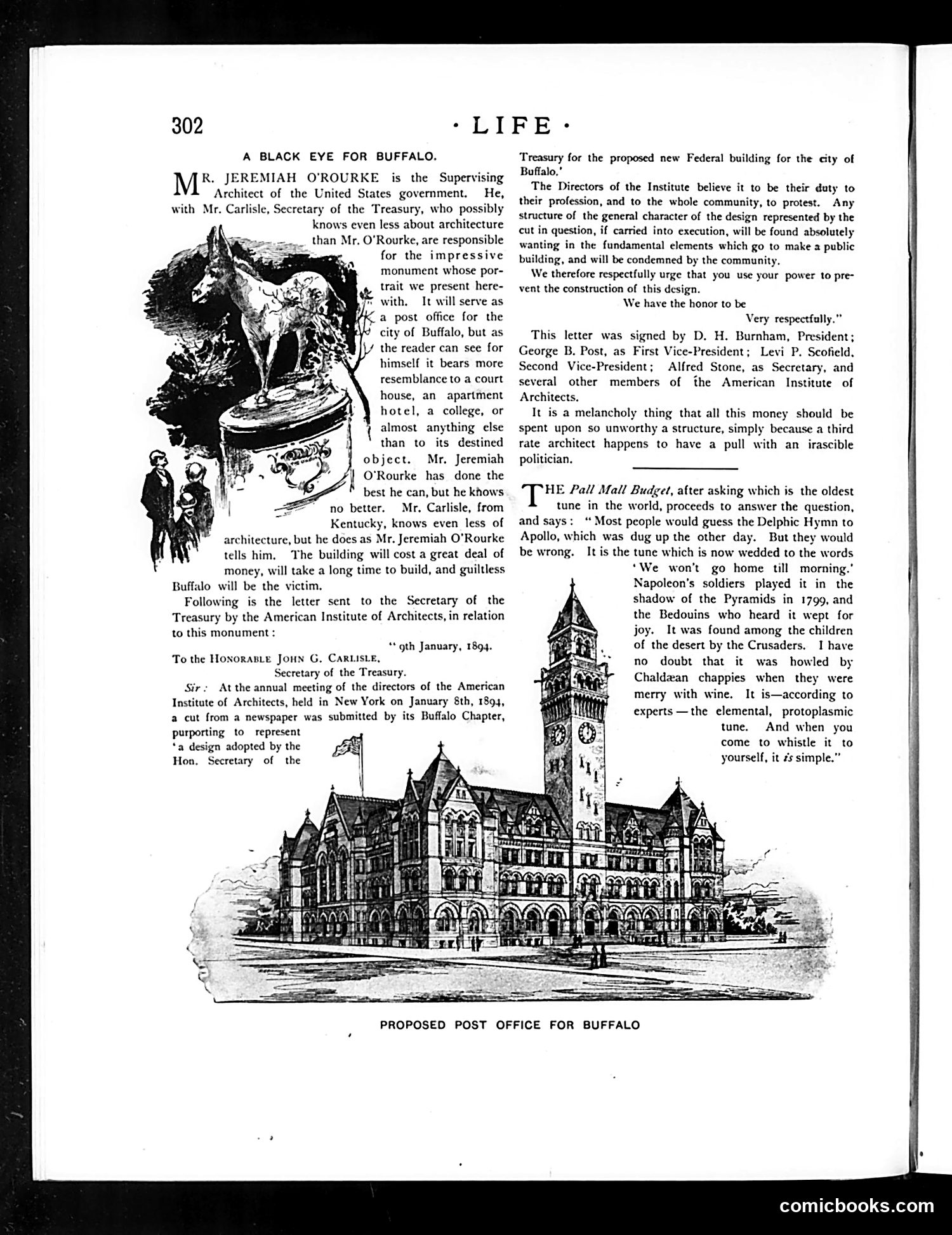
This satirical piece criticizes the proposed federal post office design for Buffalo. The illustration shows Mr. Jeremiah O'Rourke, the U.S. government's Supervising Architect, depicted as having a "black eye"—metaphorically speaking. The satire targets O'Rourke's architectural choices. The American Institute of Architects formally protested the design, arguing it lacks fundamental quality and will be "condemned by the community." The letter suggests the building will embarrass Buffalo simply because O'Rourke—apparently politically connected rather than architecturally talented—has influence over the project. The "black eye" represents public shame and professional disgrace. The satirists argue that unqualified politicians controlling architectural decisions produces inferior civic structures, damaging a city's reputation and wasting public funds.
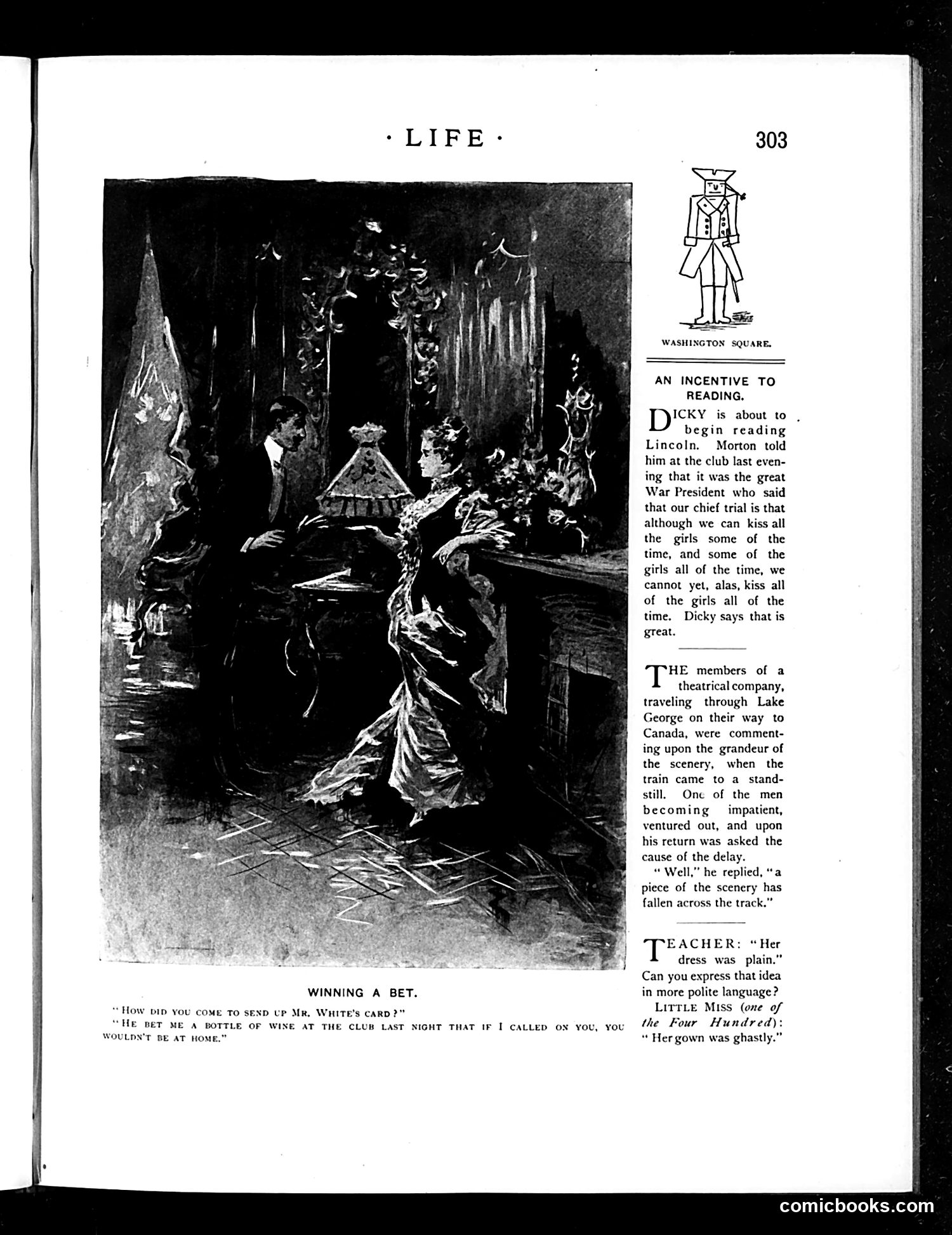
The main illustration depicts a theatrical scene in an ornate interior with elegantly dressed figures. The caption "Winning a Bet" describes a wager made at a club: one man bet another he wouldn't send his card to Mr. White, and wagered "a bottle of wine at the club last night that if I called on you, you wouldn't be at home." This satirizes upper-class social conventions and the gaming culture of wealthy men's clubs. The joke appears to center on predictable social behavior—that wealthy gentlemen would be out at their clubs rather than receiving callers at home. The bet mocks the ritualistic nature of formal social calls and club life among the leisure class. The accompanying text sections discuss reading habits and a theatrical anecdote, suggesting miscellaneous humor content typical of *Life* magazine's format.
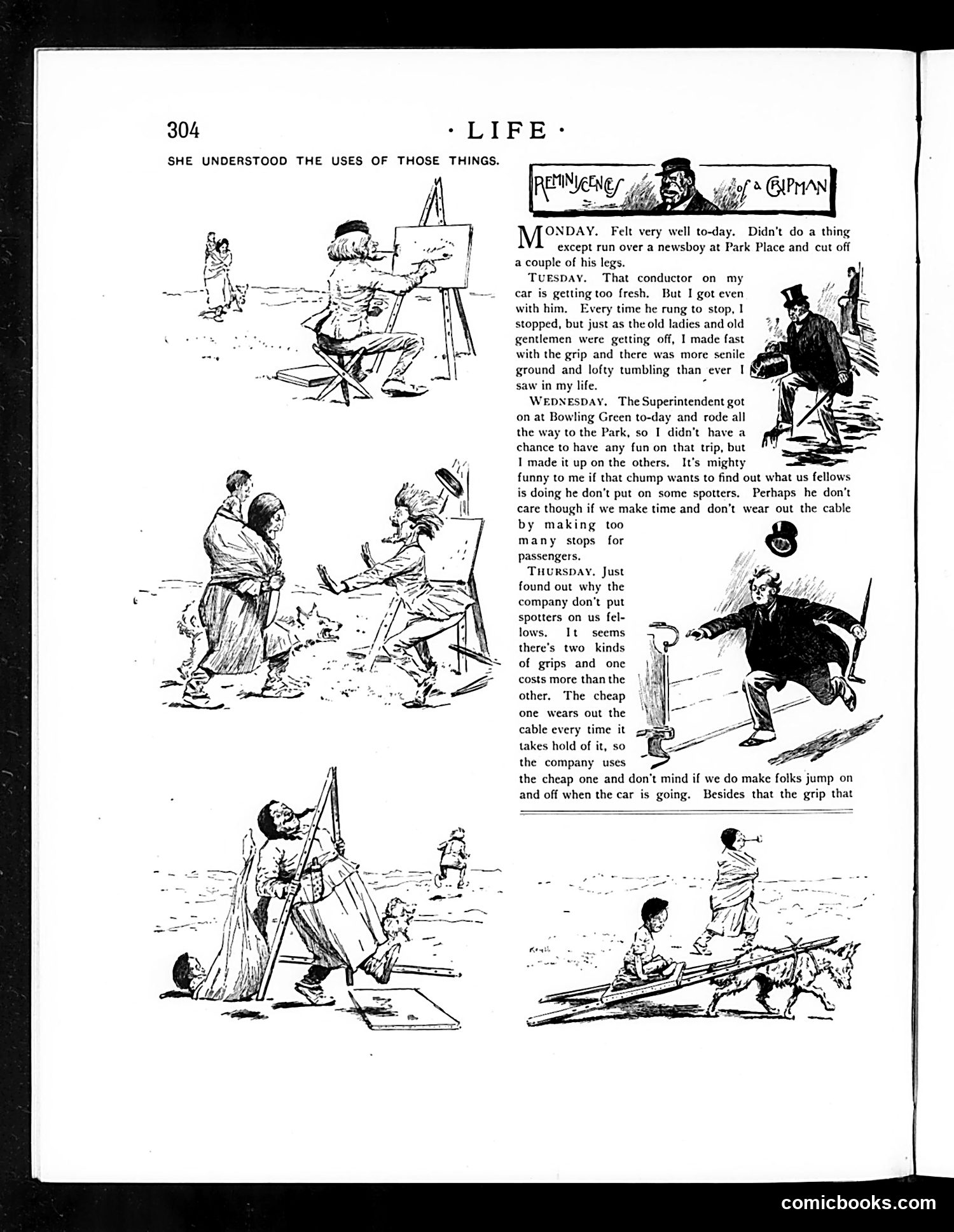
This is a humorous first-person account by a cable car gripman (the operator who controls San Francisco's famous cable cars). The narrative spans Monday through Thursday, describing workplace incidents and frustrations. The accompanying illustrations show the gripman's various mishaps: running over a newsboy, struggling with a difficult conductor, and dealing with passengers jumping on and off the moving car. The satirical point concerns the company's cost-cutting by using cheaper cable grips that wear out quickly, forcing frequent stops that inconvenience passengers. The humor derives from the gripman's deadpan description of chaos—injured newsboys, acrobatic passengers—presented as routine occupational hazards. The satire critiques corporate penny-pinching that prioritizes profit over safety and service quality.
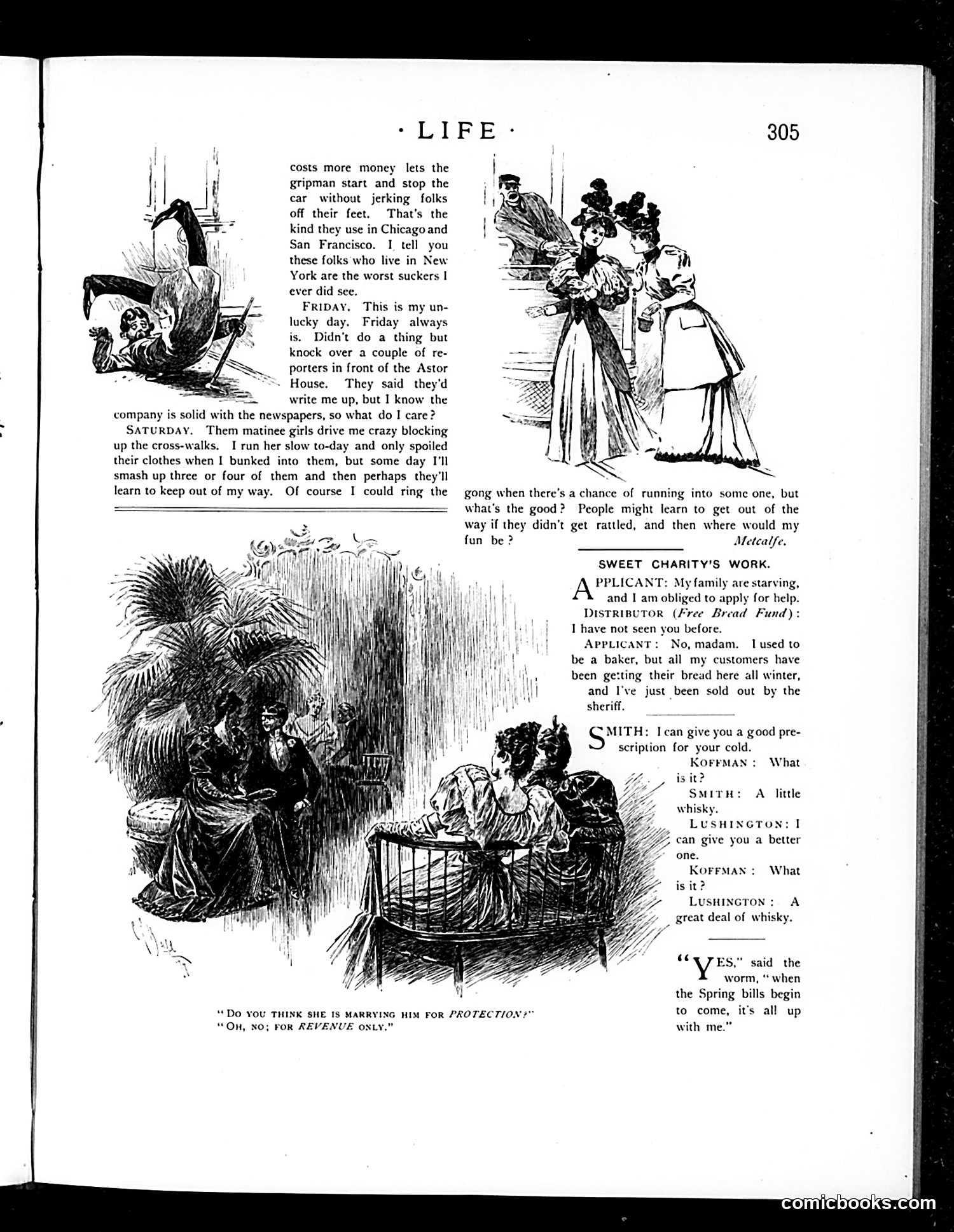
This page contains two satirical pieces: **Top section**: A taxi driver complains about Friday being unlucky, claiming he knocked over reporters at the Astor House. He boasts about deliberately hitting matinee-going women on Saturdays, hoping to eventually injure them seriously enough to keep them off the streets. **Bottom section ("Sweet Charity's Work")**: A sketch mocks charity distribution, showing an applicant (former baker, now destitute) seeking bread assistance. Various figures offer ineffective "remedies"—whisky, pills—instead of actual aid. The caption "Do you think she is marrying him for *protection*? Oh no; for *revenge* only" suggests dark commentary on poverty-stricken marriages. Both pieces satirize indifference to suffering: the taxi driver toward pedestrians, and charity workers toward genuine need. The satire highlights callousness toward vulnerable populations.
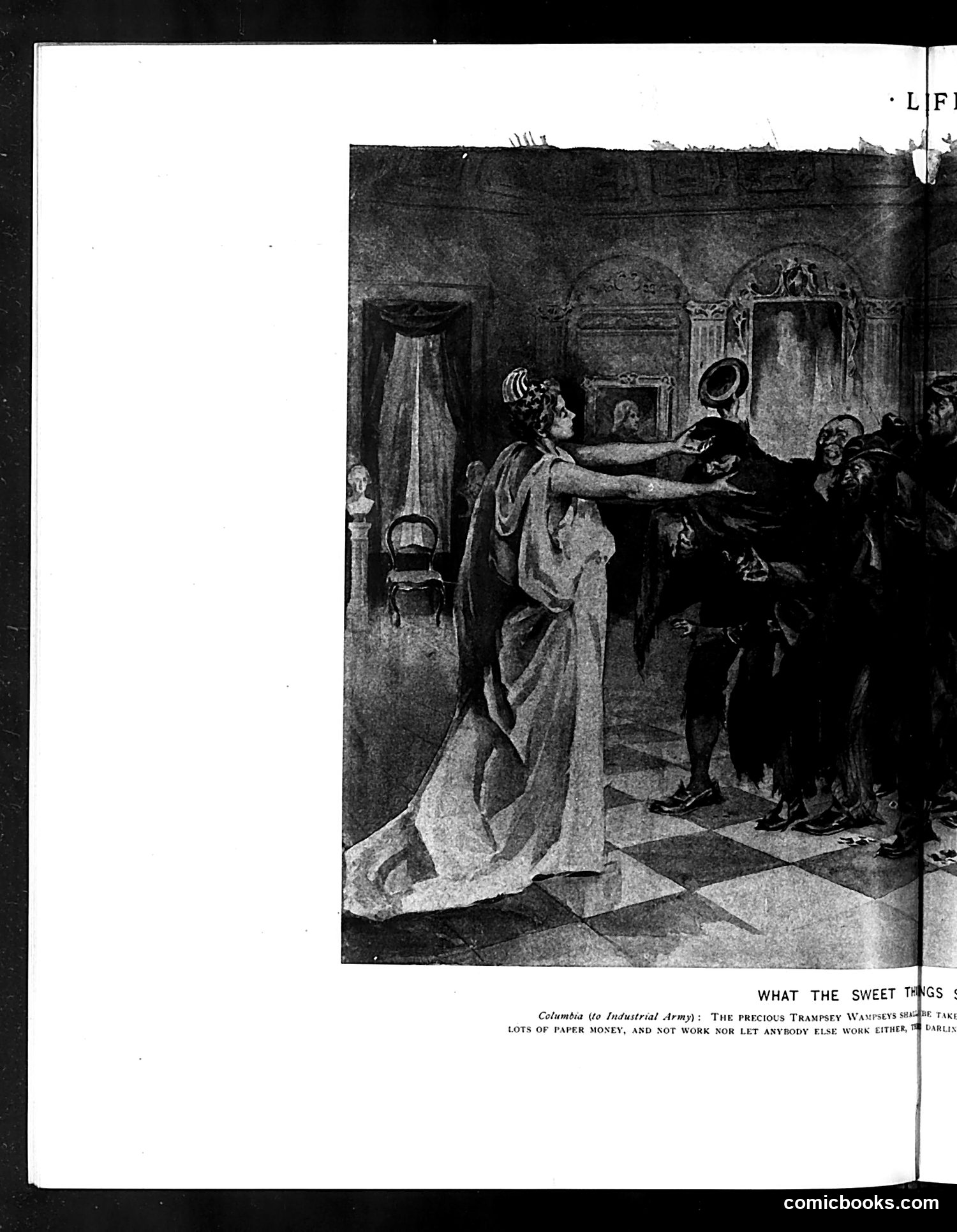
This satirical illustration depicts a scene titled "What the Sweet Things Say," with a caption referencing "Colombia (in Industrial Army)" and mentioning "The Precious Trampsey Wauskeys" who "take lots of paper money, and not work nor let anybody else work either, Dublin." The image shows a woman in an elegant gown with a long train being confronted by what appear to be rough, working-class or military figures in a formal interior. The satire appears to target wealthy, idle women ("sweet things") who accept money without labor, contrasted against references to industrial workers and labor disputes. The "Industrial Army" reference and Dublin location suggest commentary on labor movements and class conflict, likely from the early 20th century. The cartoon mocks privileged women's economic parasitism during a period of labor unrest.
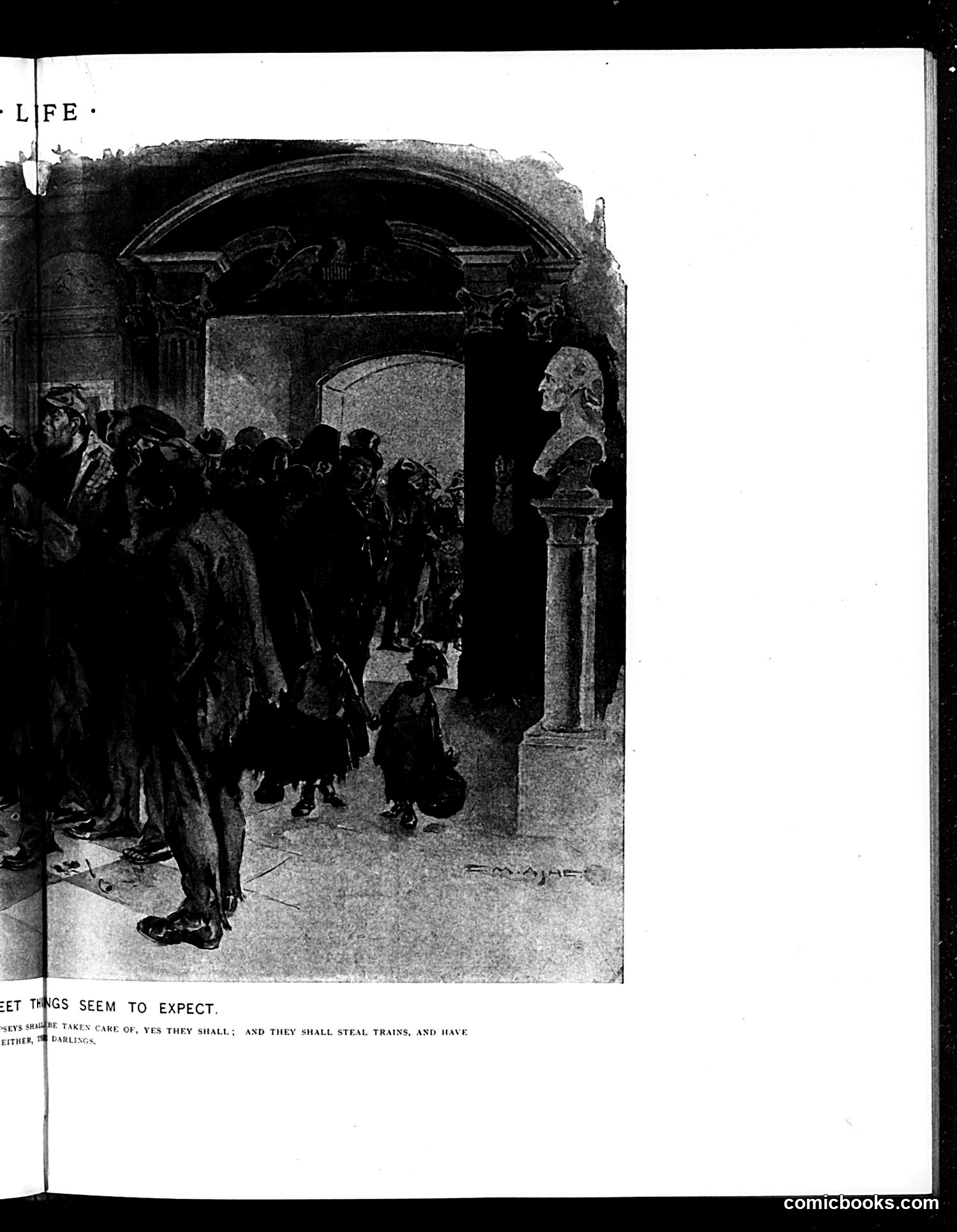
This appears to be a satirical illustration from *Life* magazine showing a classical interior with a bust on a pedestal. A crowd of visitors views the sculpture while text below references expectations about taking care of something and stealing trains, with mention of "darlings." Without clearer identifying information visible in the image, I cannot definitively state which specific political figure or event this satirizes. The classical architectural setting and formal bust suggest it may be mocking a prominent contemporary figure being commemorated or revered. The fragmented text about trains and theft hints at criticism of corruption or mismanagement, possibly by a politician or public official. The satirical intent is clear—presenting someone as worthy of classical honor while the accompanying text undermines that dignity—but the specific target remains unclear from this reproduction.
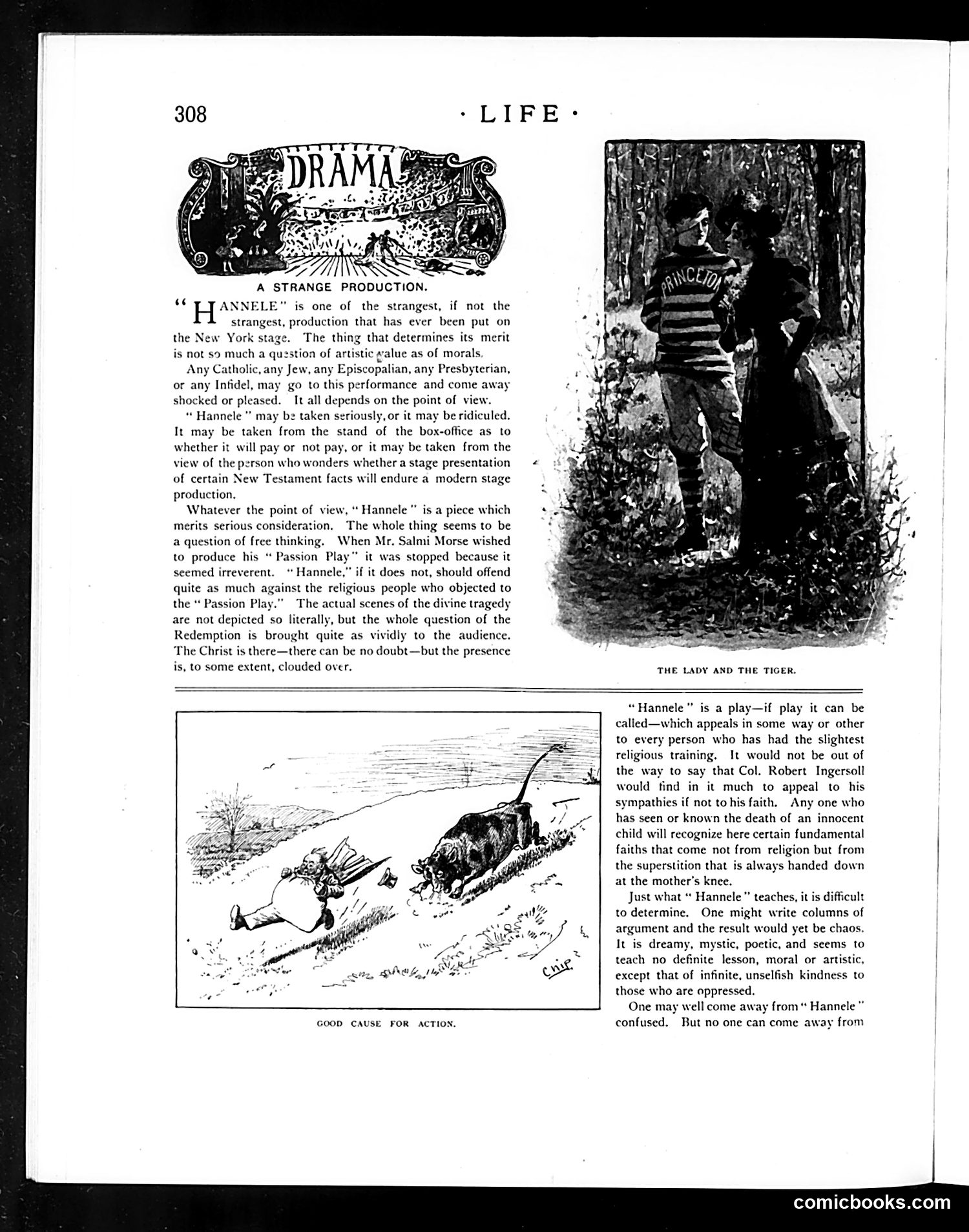
This page reviews a controversial New York stage production of "Hannele," a play depicting New Testament themes and the death of an innocent child. The review debates whether the play's merit should be judged on artistic or moral grounds. The piece notes the production's divisive nature: Catholics, Jews, Episcopalians, Presbyterians, and "Infidels" might each react differently depending on their worldview. The reviewer compares it to Salmi Morse's halted "Passion Play," suggesting "Hannele" similarly challenges religious sensibilities by vividly presenting redemption themes, though less literally than depicting Christ directly. The two illustrations—"The Lady and the Tiger" and "Good Cause for Action"—appear to depict dramatic moments, likely from the play itself. The review concludes that while "Hannele" teaches "infinite, unselfish kindness to those who are oppressed," it remains ambiguous and "dreamy" rather than offering clear moral lessons, leaving audiences potentially confused about its ultimate purpose.
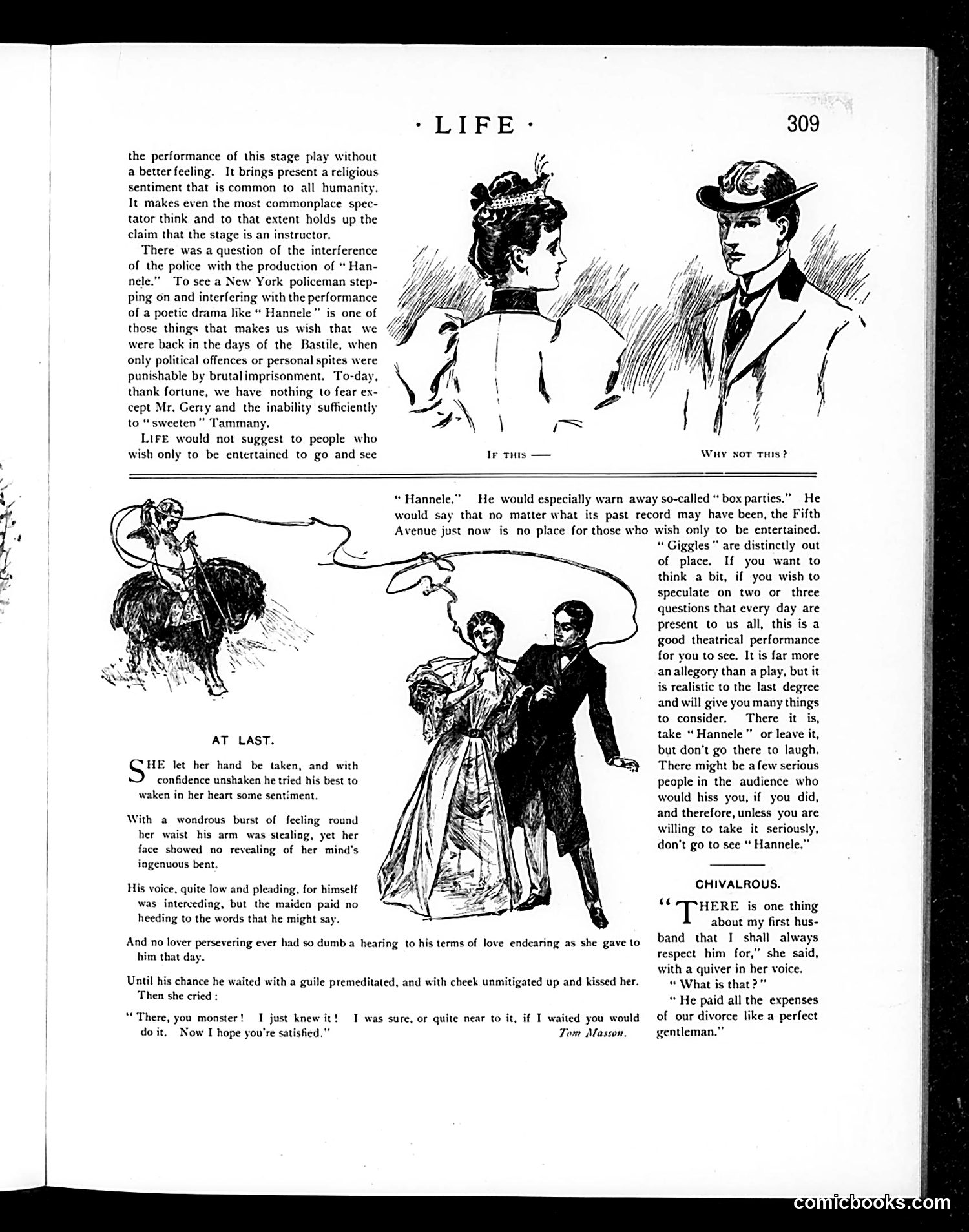
This page from Life magazine contains theatrical criticism and romantic/marital humor sketches typical of early 20th-century satirical journalism. **Main content:** A review of the play "Hannele," a poetic drama that sparked police interference in New York. Life argues the play has serious artistic merit and criticizes those seeking mere entertainment—particularly wealthy patrons of "box parties" on Fifth Avenue who would laugh inappropriately at its allegorical, philosophical content. The critic warns away frivolous audiences, stating the play demands serious consideration. **Illustrations and humor:** The page includes three separate comic vignettes about courtship and marriage—"At Last" (a man finally kissing a reluctant woman), "Why Not This?" (contrasting romantic scenarios), and "Chivalrous" (a woman praising her ex-husband's gentlemanly conduct in paying divorce expenses). These appear to be unrelated humor pieces satirizing contemporary romantic and marital conventions. The page reflects Life's dual purpose: sophisticated cultural commentary alongside lighthearted social satire.
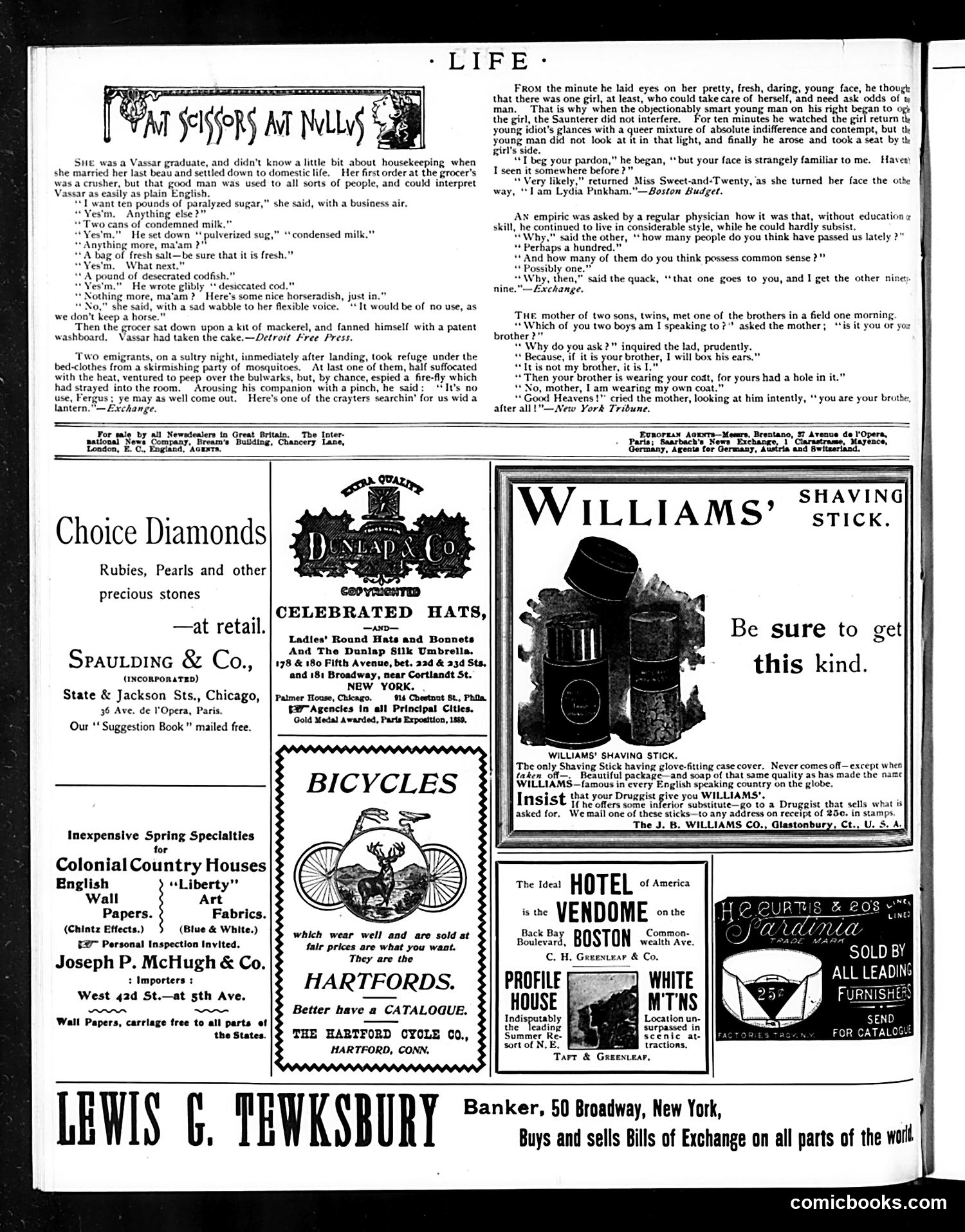
This page is primarily **advertisements interspersed with short humorous stories** typical of Life magazine's format. The illustrated cartoon titled "Scissors at Nulls" depicts a **Vassar graduate's misunderstanding of grocery terms**—she orders "paralyzed sugar" (paralyzed), "condemned milk" (condensed), and "desecrated codfish" (desiccated). The satire mocks both her pretentious education and the grocer's patience. The other anecdotes include: - A woman claiming to be "Lydia Pinkham" (a famous patent medicine advertiser) when a stranger approaches her - A mother unable to distinguish her twin sons - Emigrant men mistaking a firefly for someone searching for them with a lantern - A quack doctor's success exploiting public stupidity The **satire targets** foolishness, miscommunication, and social pretension. The advertisements below (Dunlap Hats, Hartfords bicycles, Williams' Shaving Stick) are period products seeking customers through magazine placement.
This is not a cartoon but rather a **full-page advertisement** for Gorham Manufacturing Company, a silversmith firm located on Broadway and 19th Street (New York). The ad promotes silver wedding gifts as foundational purchases for family heirlooms. It emphasizes that buyers should seek not just the "Sterling" stamp but the **Gorham Trade-Mark**, which the company claims guarantees superior quality and craftsmanship after rigorous testing. The phrase "The Family Silver" plays on the expression "selling the family silver"—a metaphor for liquidating inherited assets. Here, Gorham inverts it: their products *become* the family silver passed down through generations. For modern readers, this reflects early 20th-century consumer marketing: emphasizing brand reputation, quality assurance, and emotional/aspirational value (heirlooms) rather than price. The ad targets middle-to-upper-class wedding gift-givers.
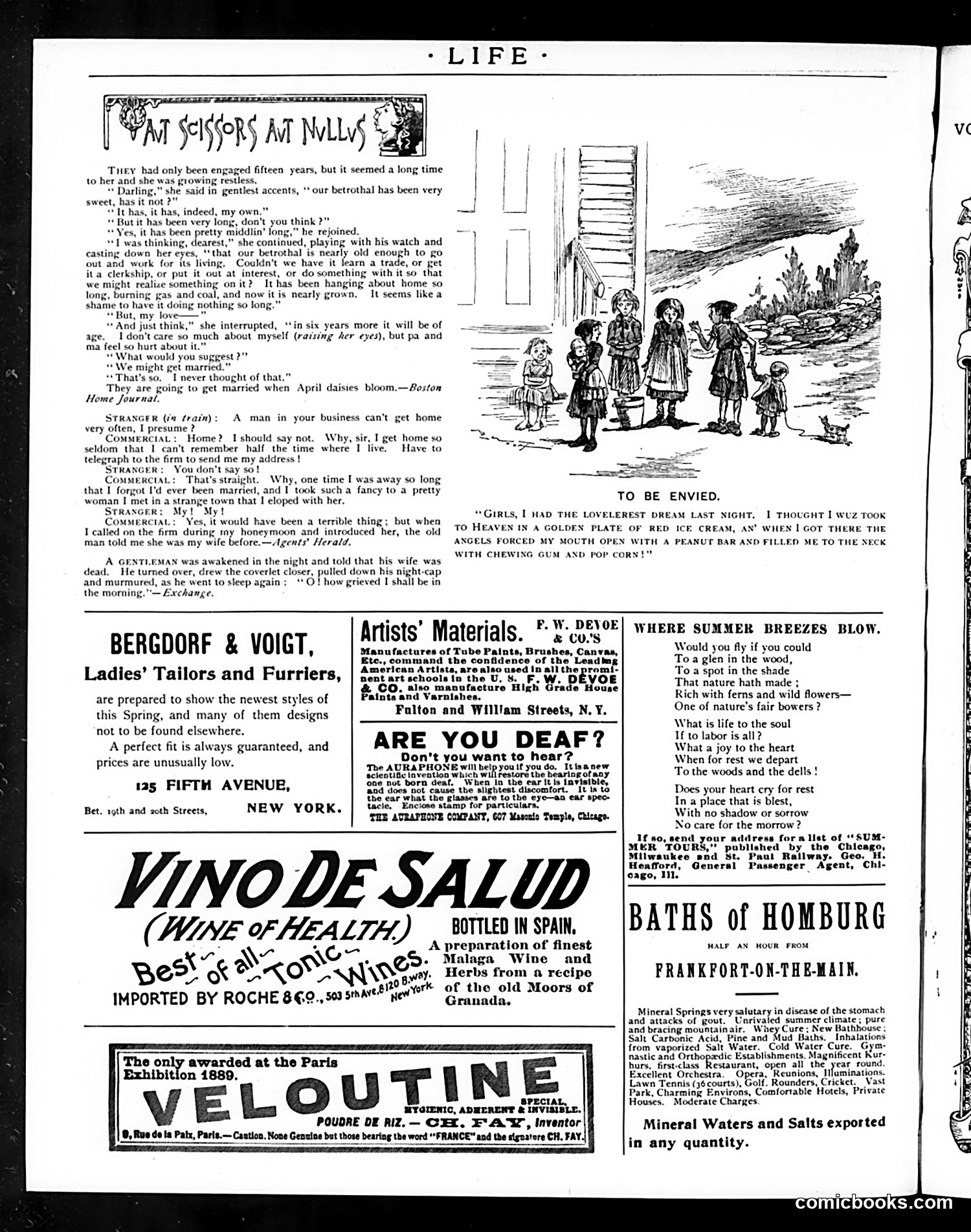
This satirical story mocks the absurdity of lengthy betrothals in Victorian society. A couple has been engaged for **fifteen years**—so long that the woman jokes their engagement itself has "grown up" and should be put to work or apprenticed. She suggests they finally marry, framing matrimony as a practical solution to their engagement's uselessness. The accompanying anecdotes ridicule other social conventions: a traveling businessman so perpetually absent he forgets he's married and nearly elopes with another woman; a grieving husband so emotionally detached he naps when told his wife has died. The humor targets **Victorian courtship delays** (often caused by financial constraints or parental disapproval) and male indifference to domestic life. The page's heavy advertising suggests this is a commercial magazine balancing satirical content with revenue-generating ads for wine tonics, hearing aids, and ladies' tailoring.