
Life, 1894-05-10 · page 5 of 16
Life — May 10, 1894 — page 5: what you’re looking at
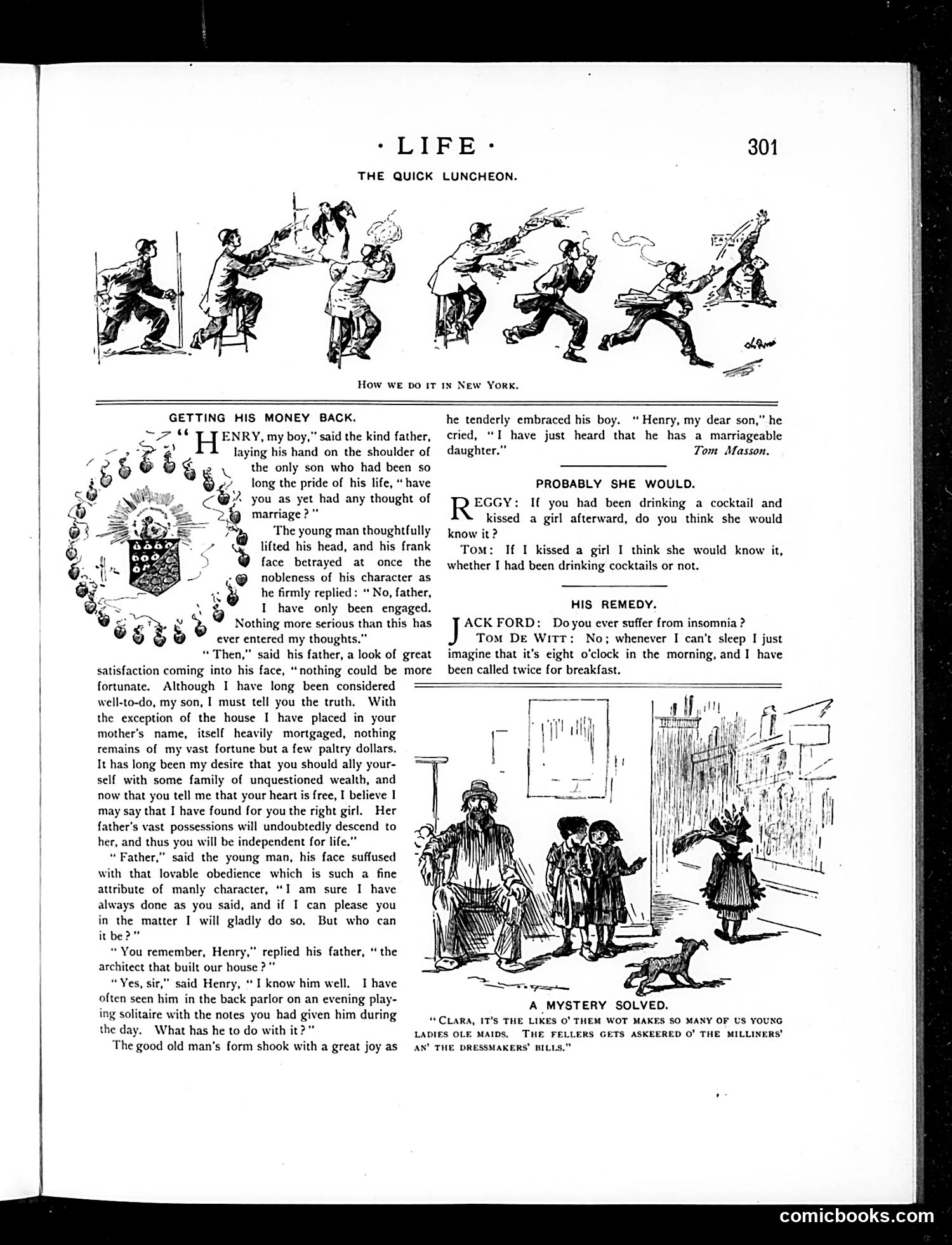
What you’re looking at
This page contains three satirical vignettes about New York social customs circa early 1900s: **"Getting His Money Back"**: A father discovers his son is engaged rather than married, and lectures him about financial prudence—the family's wealth and reputation depend on careful matches. The joke satirizes wealthy families' obsession with marital alliances as financial transactions. **"Probably She Would"** and **"His Remedy"**: Brief comedic exchanges about cocktails, kissing, and insomnia that mock upper-class social pretensions and romantic conventions. **"A Mystery Solved"**: Shows working-class women discussing how young ladies' maids somehow rack up substantial dressmakers' bills—satirizing servants' petty thievery or kickback schemes from tradespeople. The overall theme mocks class-specific anxieties: wealth management among the rich, social rituals, and economic exploitation of domestic workers.
📄 Transcribed text from this page (OCR, searchable)
Machine-transcribed from the original scan — historical spelling and the odd misread are preserved.
LI FE THE QUICK LUNCHEON. How WE bo iT 1n New York. he tenderly embraced his boy. ‘“ Henry, my dear son,” he cried, “I have just heard that he has a marriageable daughter.” Tom Masson. PROBABLY SHE WOULD. EGGY: If you had been drinking a cocktail and kissed a girl afterward, do you think she would know it? Tom: If I kissed a girl I think she would know it, whether I had been drinking cocktails or not. HIS REMEDY. ACK FORD: Doyou ever suffer from insomnia ? Tom De Witt: No; whenever I can’t sleep I just imagine that it’s eight o'clock in the morning, and I have been called twice for breakfast. GETTING HIS MONEY BACK. ENRY, my boy,” said the kind father, laying his hand on the shoulder of $e the only son who had been so b> long the pride of his life, “ have G ce * you as yet” had any thought of gS 6 marriage ? “Se The young man thoughtfully ~ 7 lifted his head, and his frank D) r) face betrayed at once the nobleness of his character as he firmly replied: “ No, father, r?) I have only been engaged. > Nothing more serious than this has ever entered my thoughts.” “Then,” said his father, a look of great satisfaction coming into his face, “nothing could be more fortunate. Although I have long been considered well-to-do, my son, I must tell you the truth, With the exception of the house I have placed in your mother’s name, itself heavily mortgaged, nothing remains of my vast fortune but a few paltry dollars. It has long been my desire that you should ally your- self with some family of unquestioned wealth, and now that you tell me that your heart is free, I believe | may say that I have found for you the right girl. Her father’s vast possessions will undoubtedly descend to her, and thus you will be independent for life.” “Father,” said the young man, his face suffused with that lovable obedience which is such a fine attribute of manly character, “I am sure I have always done as you said, and if I can please you in the matter I will gladly do so. But who can it be?” “You remember, Henry,” replied his father, “ the architect that built our house ?"” “Yes, sir,” said Henry, “I know him well. I have often seen him in the back parlor on an evening play- ing solitaire with the notes you had given him during the day. What has he to do with it?” The good old man’s form shook with a great joy as A MYSTERY SOLVED. “CLARA, IT'S THE LIKES 0’ THEM WOT MAKES SO MANY OF US YOUNG LADIES OLE MAIDS, THE FELLERS GETS ASKEERED O' THE MILLINERS’ AN’ THE DRESSMAKERS’ BILLS.” comicbooks.com