
A complete issue · 20 pages · 1894
Life — April 26, 1894
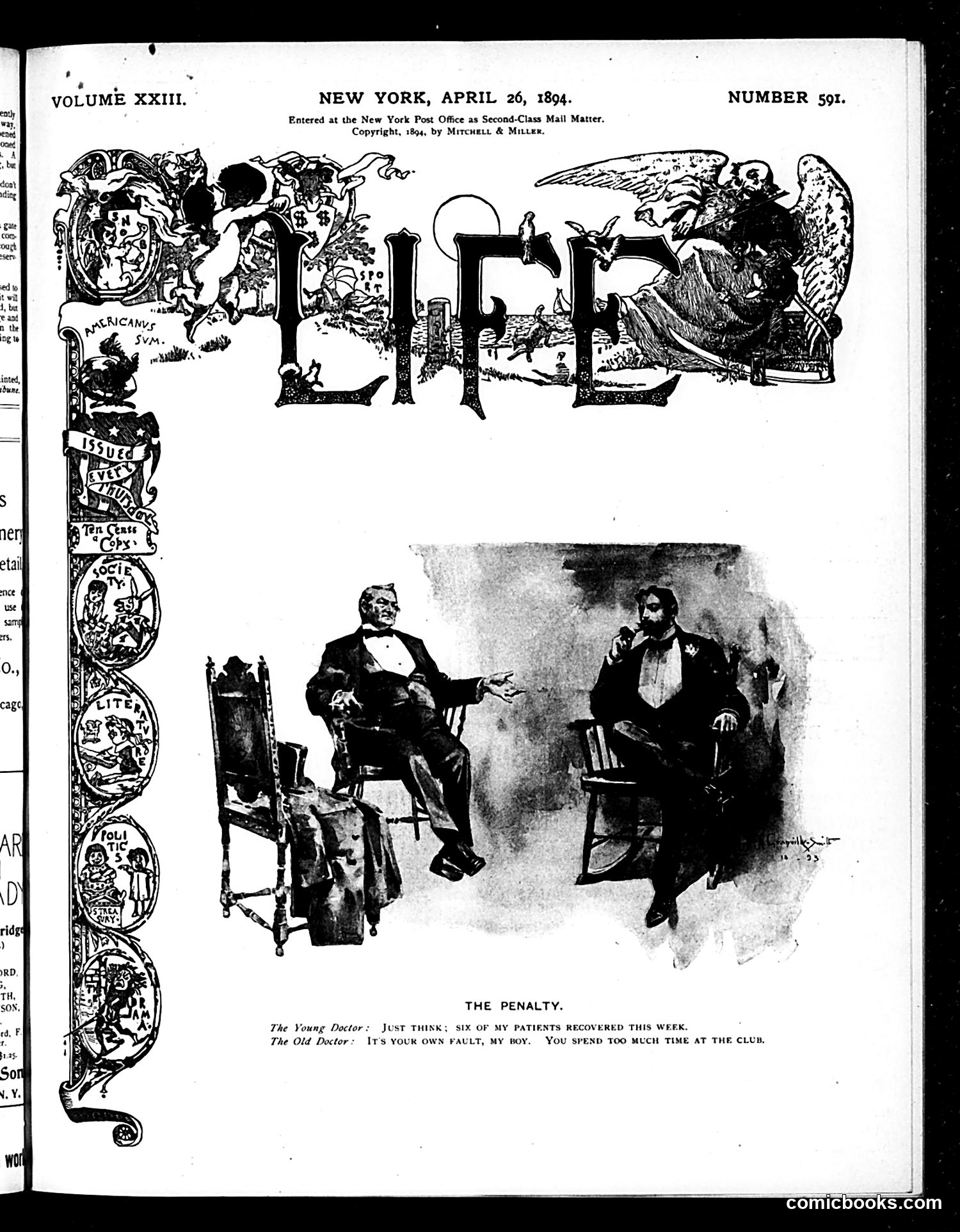
This cartoon depicts a confrontation between a young doctor and an older physician. The caption reveals the satire: the young doctor boasts that six of his patients recovered this week, while the older doctor retorts that the young man spends too much time at the club rather than attending to his practice. The joke satirizes medical negligence and dilettantism among privileged practitioners. The "penalty" appears to be professional consequence—the young doctor's patients' recoveries despite (not because of) his inattention, contrasted with an older doctor's implied diligence. This reflects period anxieties about professionalism in medicine and the contrast between serious practitioners and wealthy doctors who treated medicine casually.
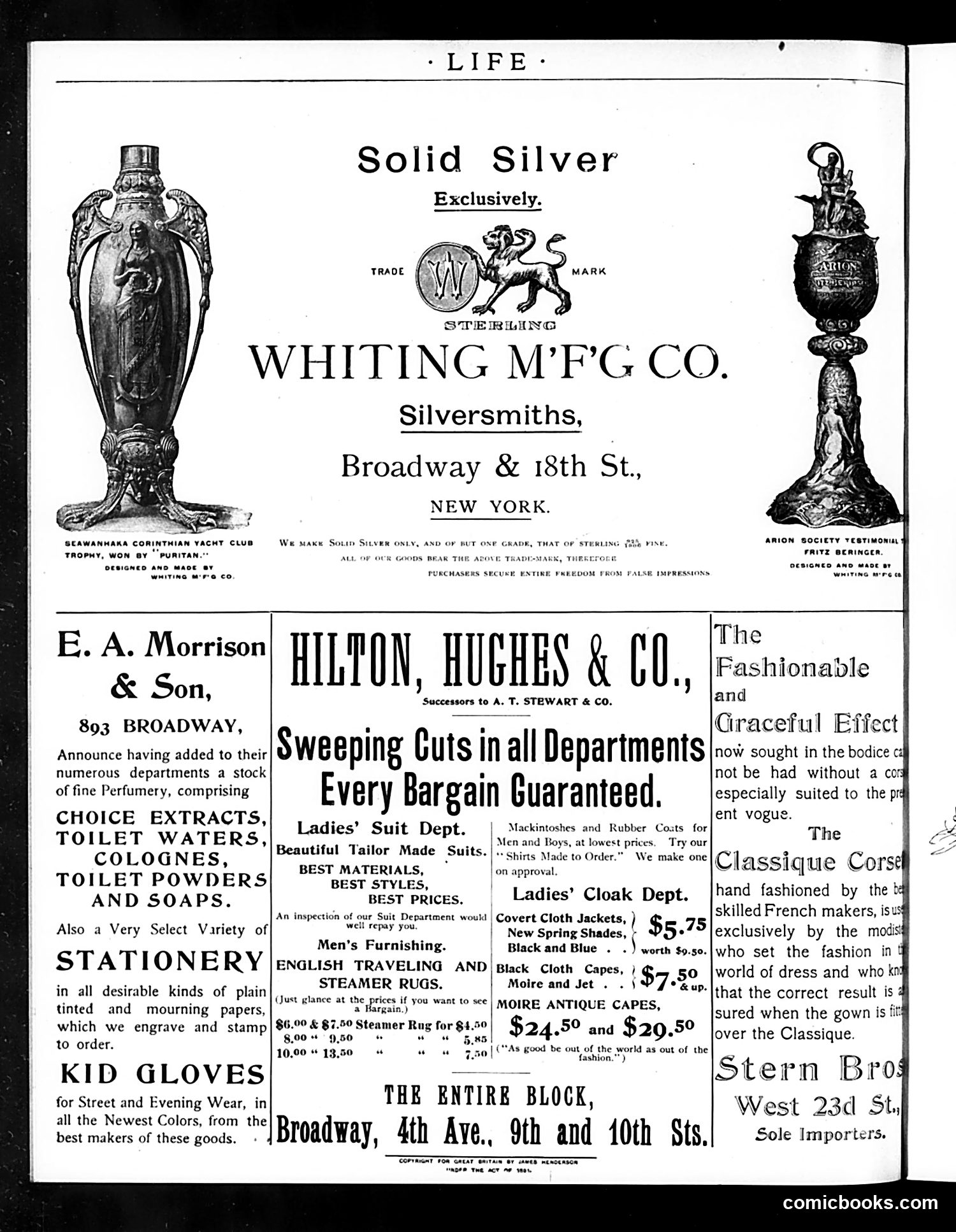
This page is primarily **advertising, not political satire**. It contains luxury goods advertisements from late 19th or early 20th-century New York City. The top half features Whitting M'fg Co., a sterling silversmith located on Broadway & 18th Street, showcasing ornate silver vessels and trophies (including one for a yacht club and another for an "Arion Society" testimonial). Below are advertisements for: - **E.A. Morrison & Son** (perfumery and stationery) - **Hilton, Hughes & Co.** (department store with clothing sales) - **Stern Bros** (fashion corsets) These are straightforward commercial notices targeting wealthy New York consumers, with no evident political content or satirical intent. The page represents how *Life* magazine supplemented editorial content with upscale retail advertising.
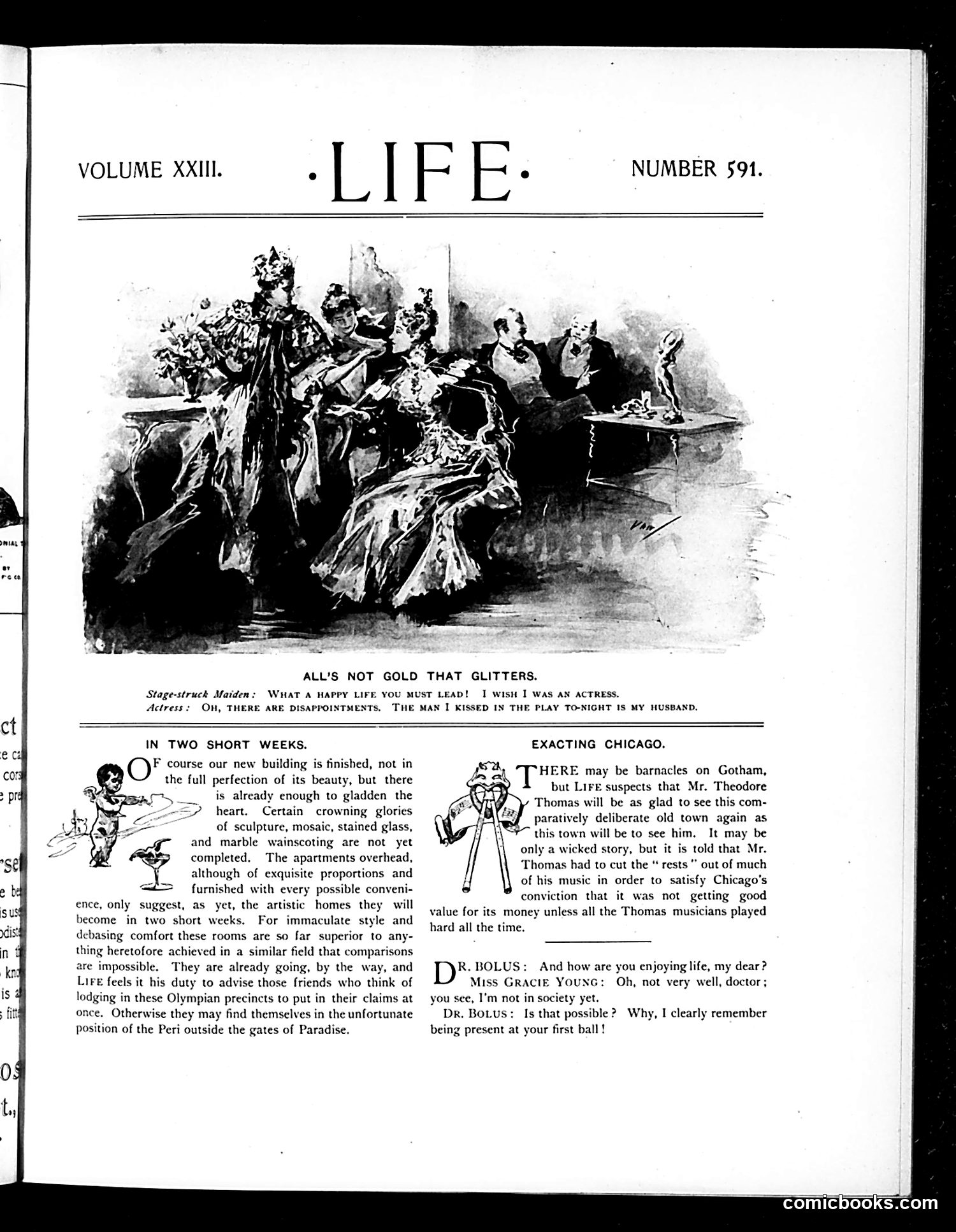
The main illustration depicts a theatrical scene titled "All's Not Gold That Glitters," featuring stage-struck characters discussing an actress's life. The dialogue between a maiden and actress reveals the satirical point: despite glamorous appearances, theatrical life brings disappointment rather than happiness. The actress's husband is present in the play, highlighting the blurred lines between stage performance and personal reality. Below, two separate pieces appear: "In Two Short Weeks" mocks the rushed construction of ornate buildings in Chicago, suggesting aesthetic shortcuts compromise quality. A dialogue between "Dr. Dolus" and "Miss Gracie Young" discusses social dissatisfaction, with the doctor referencing her first ball, implying social climbing anxieties among young women. The satire targets theatrical illusions, hasty urban development, and social pretension.
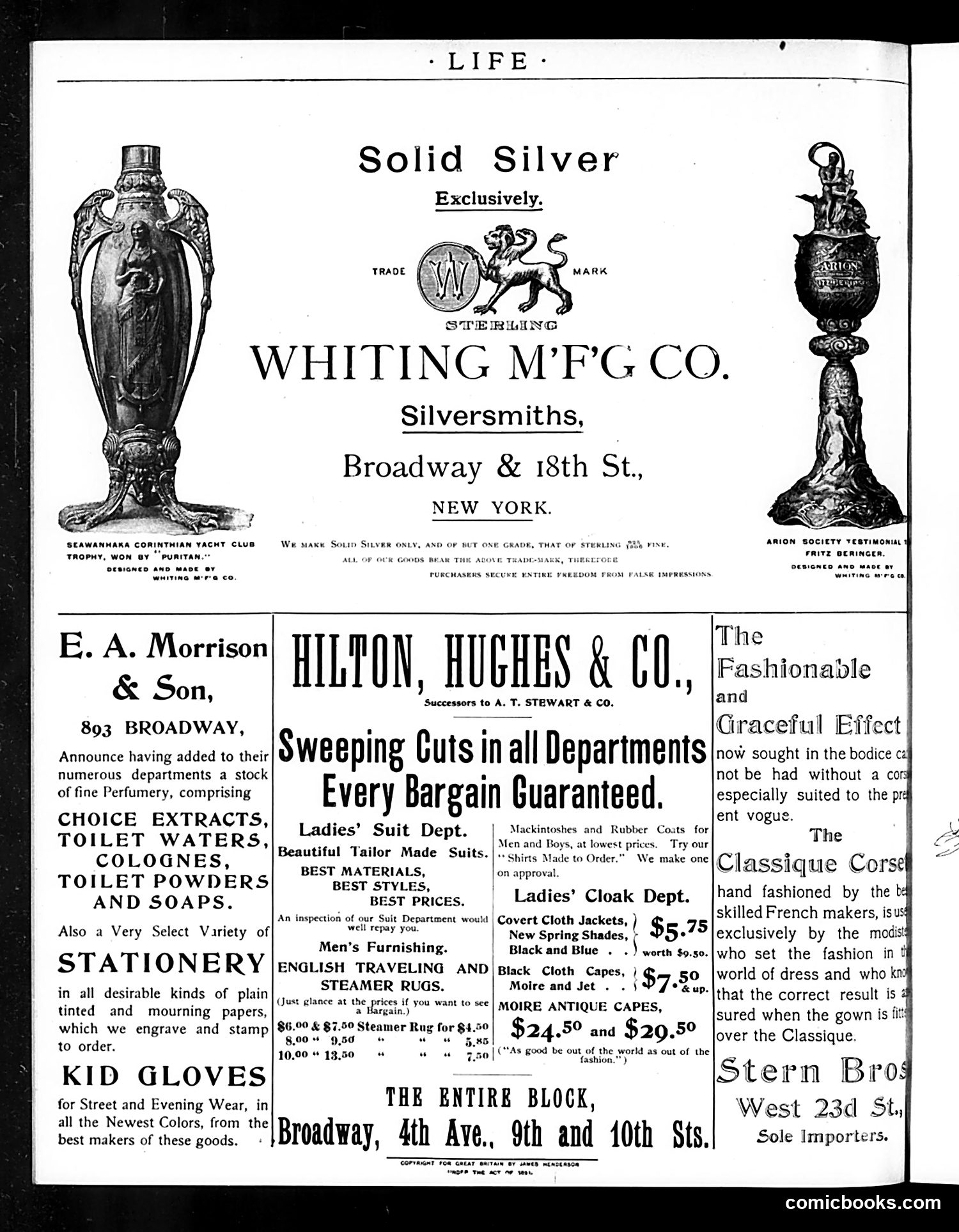
This page is **primarily advertising**, not editorial content or political satire. It contains multiple commercial advertisements for late 19th/early 20th-century retailers: - **Whiting M'fg Co.**: Sterling silver tableware manufacturer, emphasizing quality and authenticity - **E.A. Morrison & Son**: Perfumery and stationery shop - **Hilton, Hughes & Co.**: Department store advertising clothing, textiles, and household goods with "sweeping cuts" (price reductions) - **Stern Bros**: Corset manufacturer claiming exclusive French design The ornamental silver vessels depicted serve as product showcases rather than satirical commentary. This appears to be a standard advertising page from *Life* magazine's commercial section, targeting affluent New York consumers interested in luxury goods and fashionable merchandise.
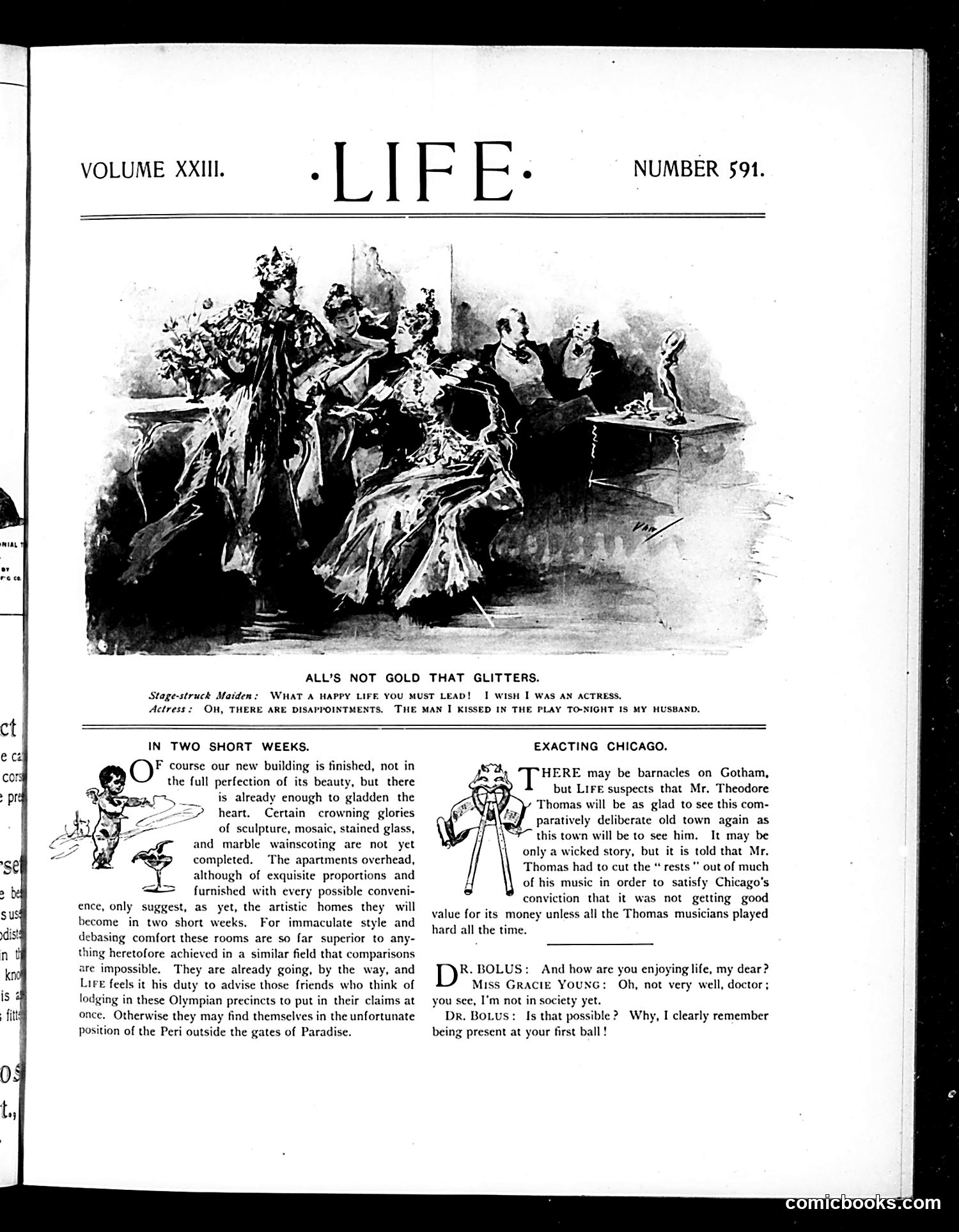
This page from *Life* magazine (Volume XXIII, Number 591) contains satirical theatrical and social commentary. The main illustration, titled "All's Not Gold That Glitters," depicts a stage scene with actors in elaborate costumes, satirizing theatrical pretension. The quoted dialogue mocks the contrast between an actress's glamorous stage persona and her real life disappointments—"a happy life you must lead! What an actress" versus the reality of marital discord. The text sections discuss architectural ambitions and Chicago society. "In Two Short Weeks" praises a new building's artistic merit despite incomplete finishing details. "Exacting Chicago" appears to criticize Theodore Thomas (likely the conductor) for supposedly cutting corners on musical quality for financial gain. The dialogue between Dr. Bolus and Miss Gracie Young offers social commentary on class aspirations and societal expectations of the era.
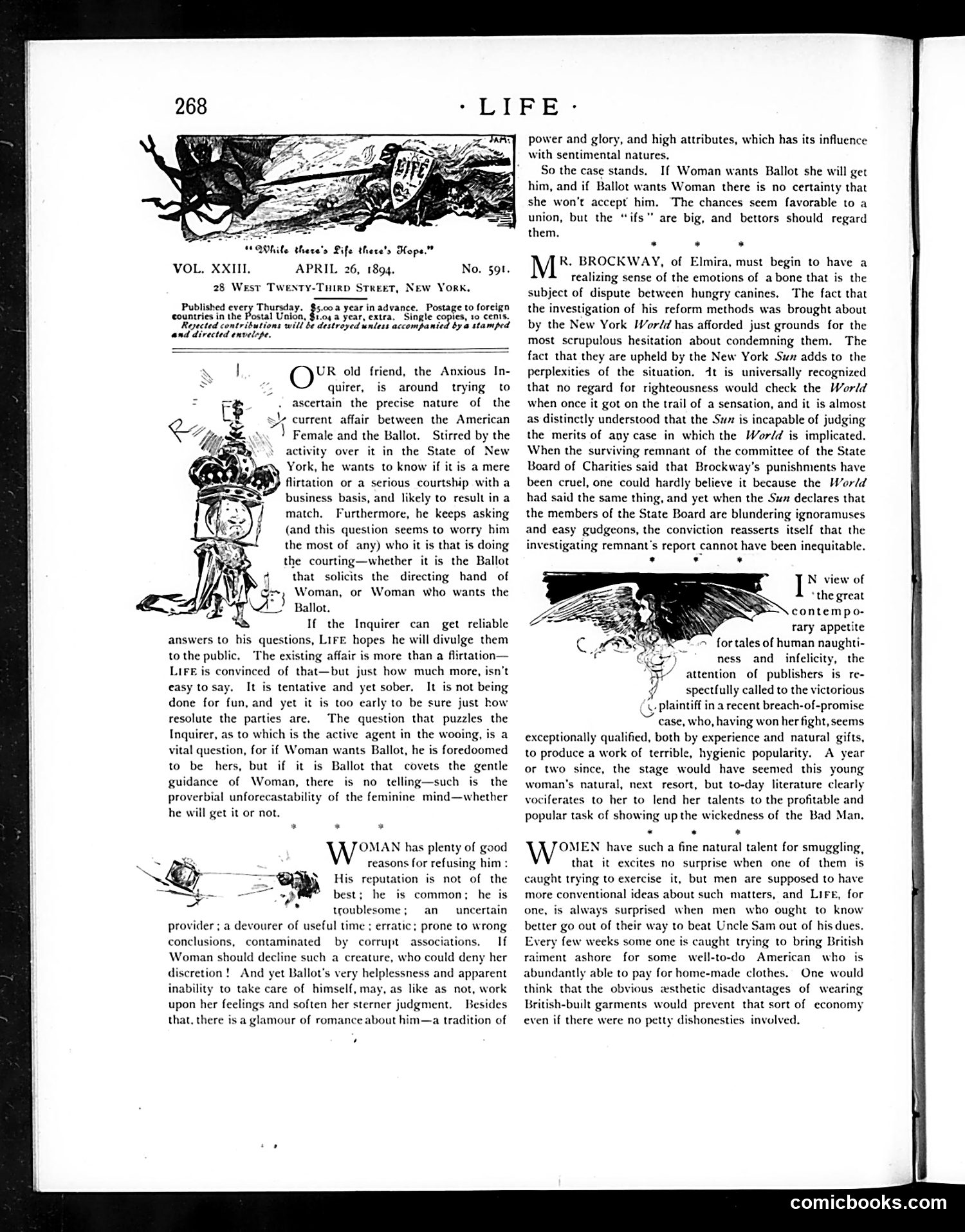
This April 25, 1924 page satirizes contemporary debates about courtship and marriage prospects between American women and foreign nobility—specifically European "titles" (aristocrats). The text's central joke: An "Anxious Inquirer" asks whether a relationship between an American woman and a foreign nobleman constitutes serious courtship or mere flirtation. Life sarcastically suggests that women have "good reasons for refusing" such men—they're unreliable, disreputable, and poor providers—yet the romantic glamour of titles makes women overlook these obvious flaws. The accompanying illustrations (appearing as small vignettes) reinforce this satirical message through caricature, though specific figures remain unclear from the image alone. The satire critiques both the shallow materialism of American women pursuing foreign titles and the opportunism of impoverished European aristocrats seeking wealthy American wives.
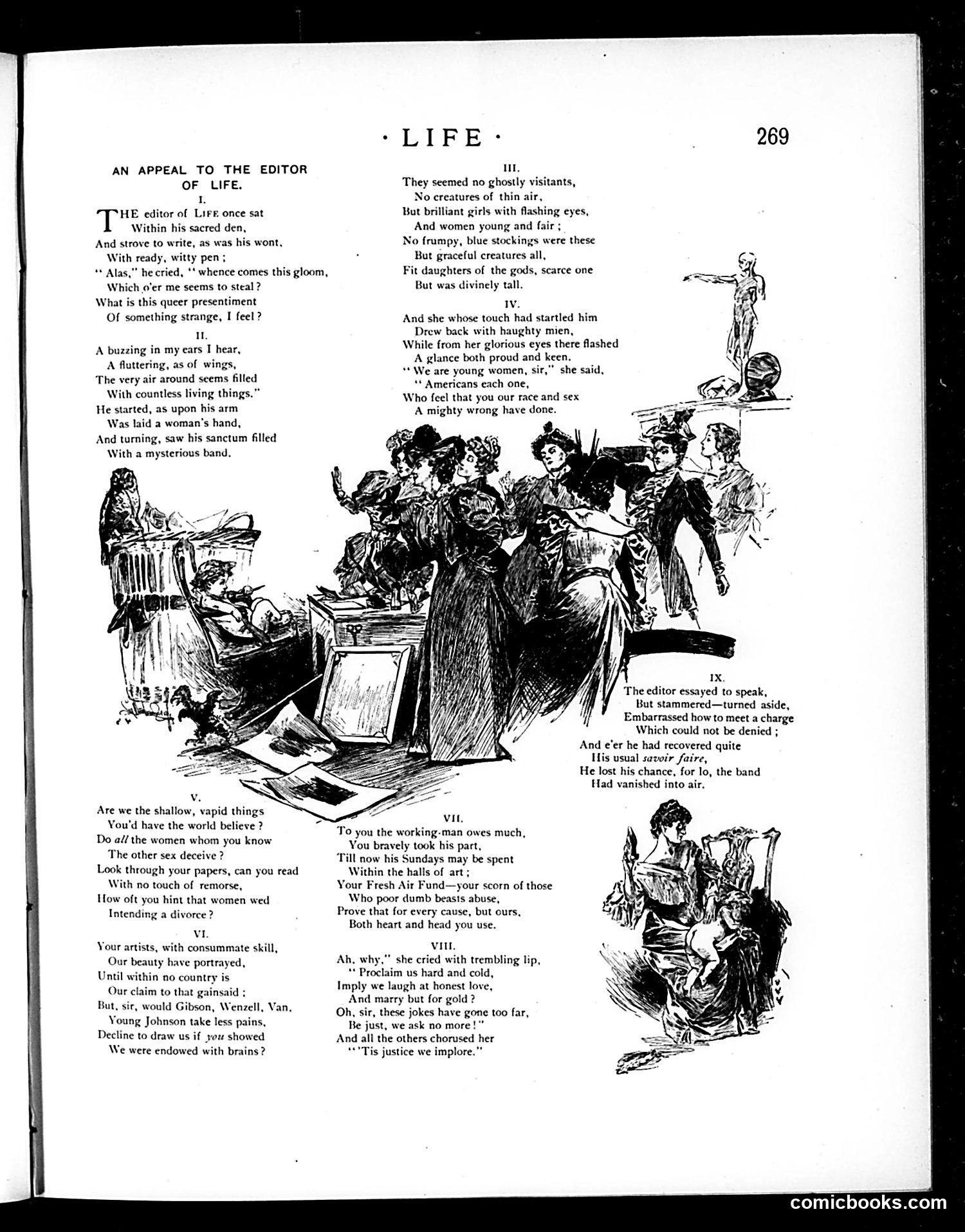
This satirical poem critiques the editorial practices of *Life* magazine itself. The speaker describes visiting the editor's office, where he encounters a mysterious, supernatural disturbance—"a buzzing," "fluttering," and "creatures" filling the air—that he feels stealing away something indefinable and strange. The accompanying illustrations show the editorial office as chaotic, populated by well-dressed figures in animated conversation or apparent distress. The satire suggests the magazine's editorial process transforms or corrupts submissions, or that the office environment itself possesses a strange, almost ghostly quality that affects writers and their work. The poem ultimately critiques how *Life's* editors reshape or reject contributions, leaving writers bewildered about what happened to their "usual *savoir faire*."
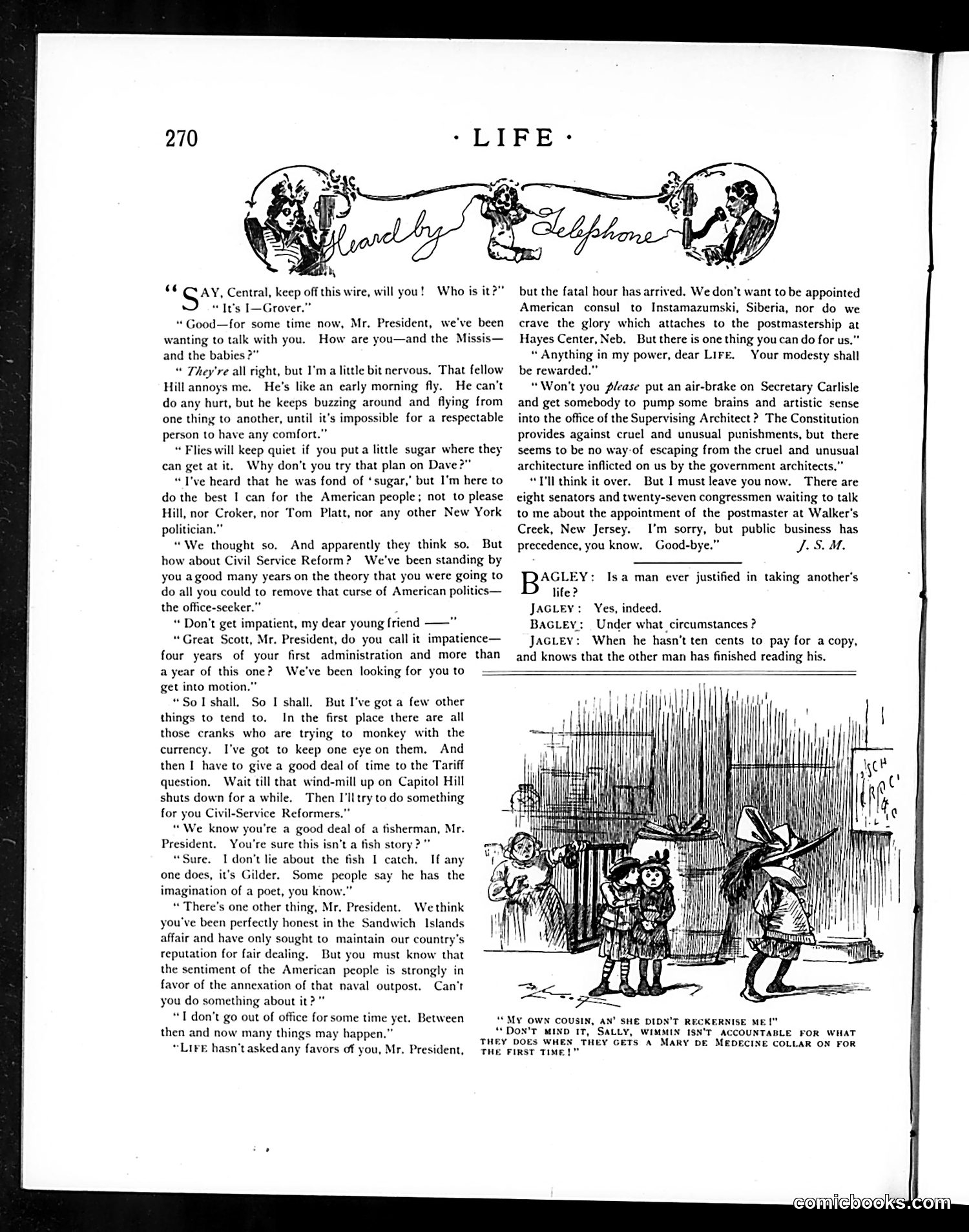
This page contains a "Heard by Telephone" satirical dialogue between a caller and "Grover" (likely President Grover Cleveland), discussing political frustrations. The caller complains about various issues: a troublesome official named Hill, Civil Service Reform delays, currency manipulation by political "cranks," and tariff politics. The humor targets Cleveland's slow administrative progress on promised reforms. The dialogue mocks the gap between campaign promises and actual governance—a perennial political complaint. The bottom cartoon depicts street children, with the caption joking about a girl receiving a "Mary de Medecine collar"—likely mocking either medical fads or cheap imitation jewelry marketed to poor children. The satire targets both political incompetence and commercial exploitation of the vulnerable.
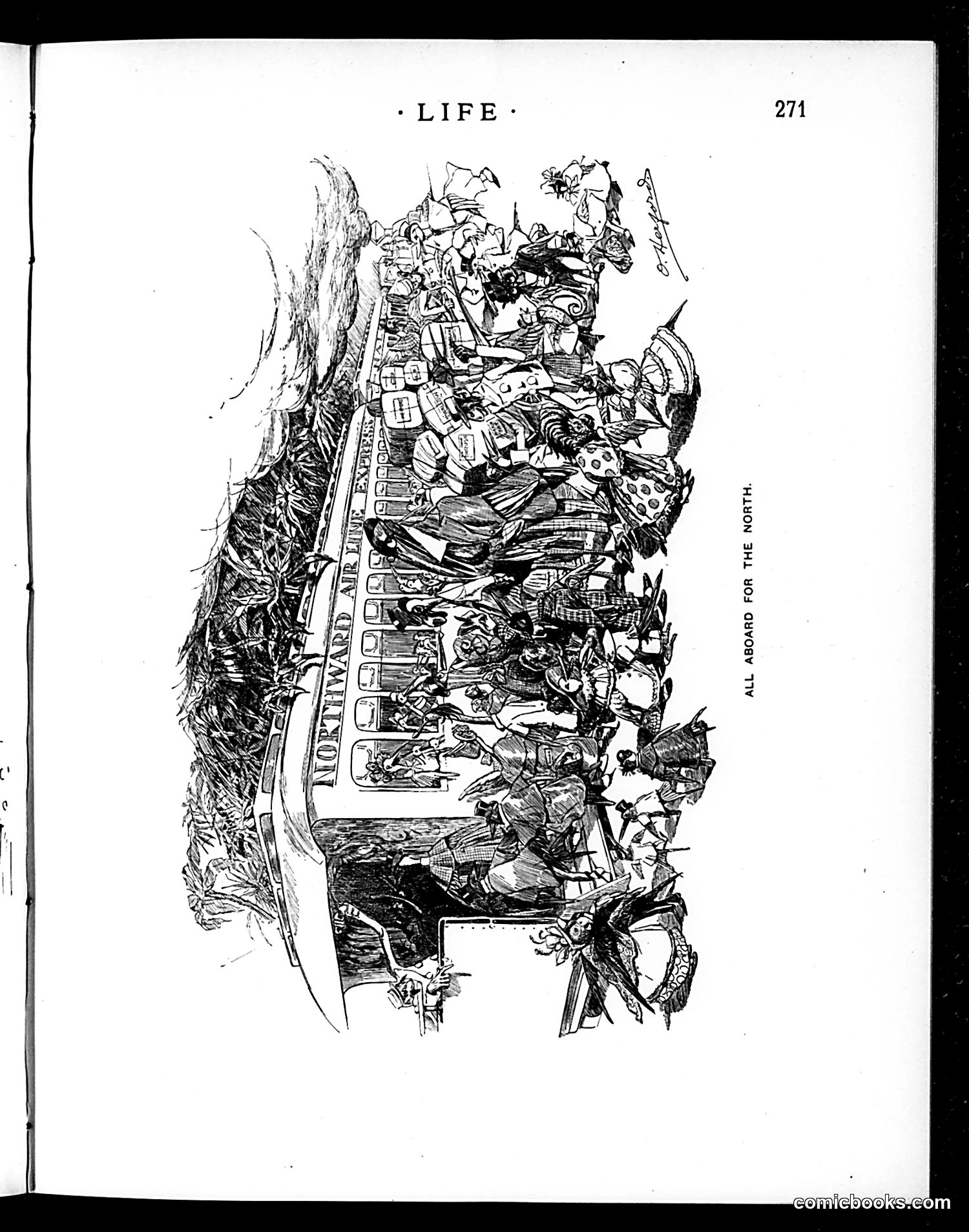
This page from *Life* magazine (page 271) shows a single detailed satirical illustration titled "ALL ABOARD FOR THE NORTH." The image depicts a crowded ship or vessel packed with numerous figures in 19th-century dress, appearing to be in chaotic motion. The cartoon likely references mass migration, immigration, or possibly the Great Migration. The cramped, disorderly conditions and the directional title suggest commentary on either transportation conditions or social movement patterns of the era. The figures' expressions and positioning convey satirical criticism of overcrowding or the circumstances surrounding travel. Without additional context about the specific publication date, the precise historical event referenced remains unclear, though the artistic style and subject matter suggest Gilded Age or Progressive Era American social concerns.
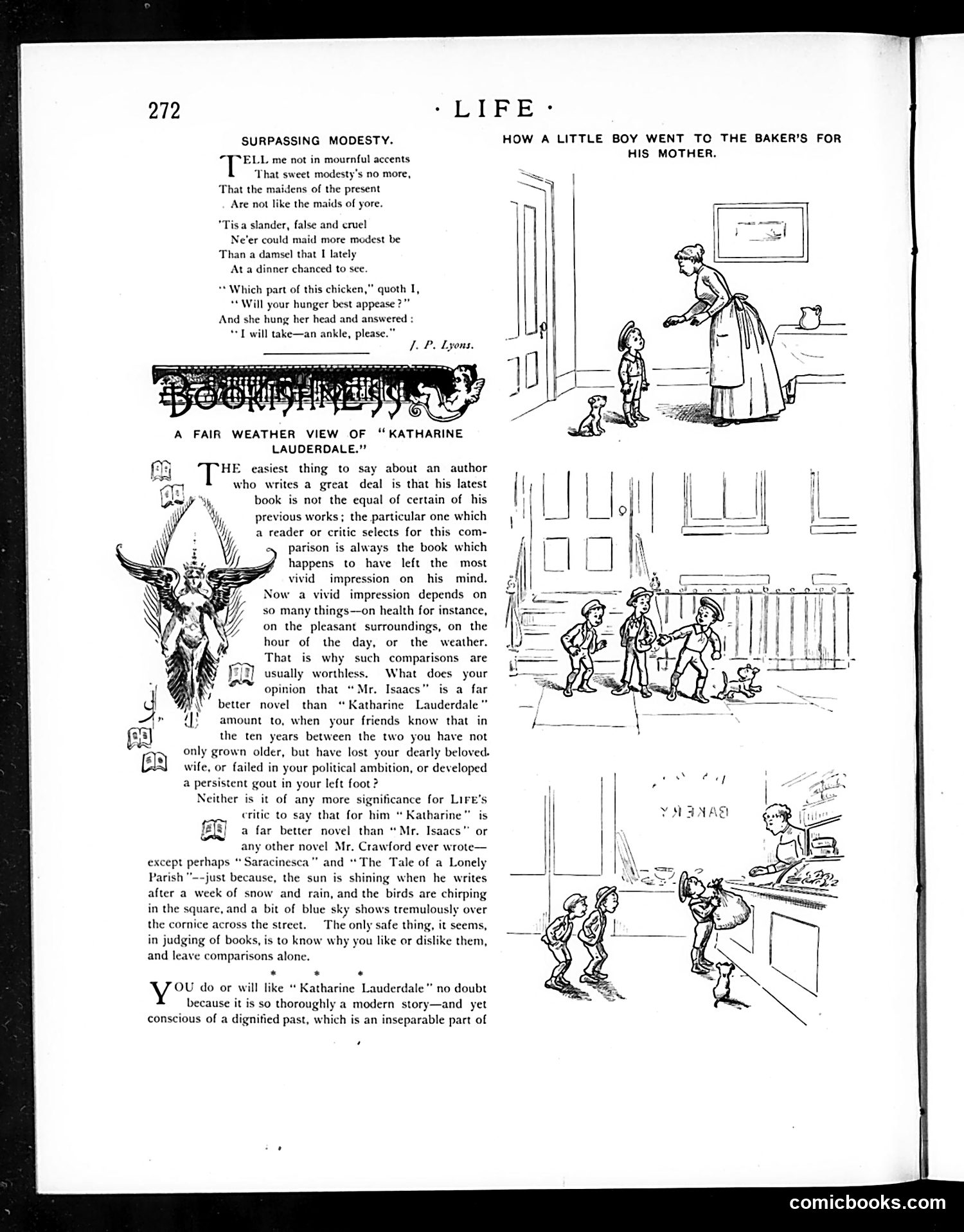
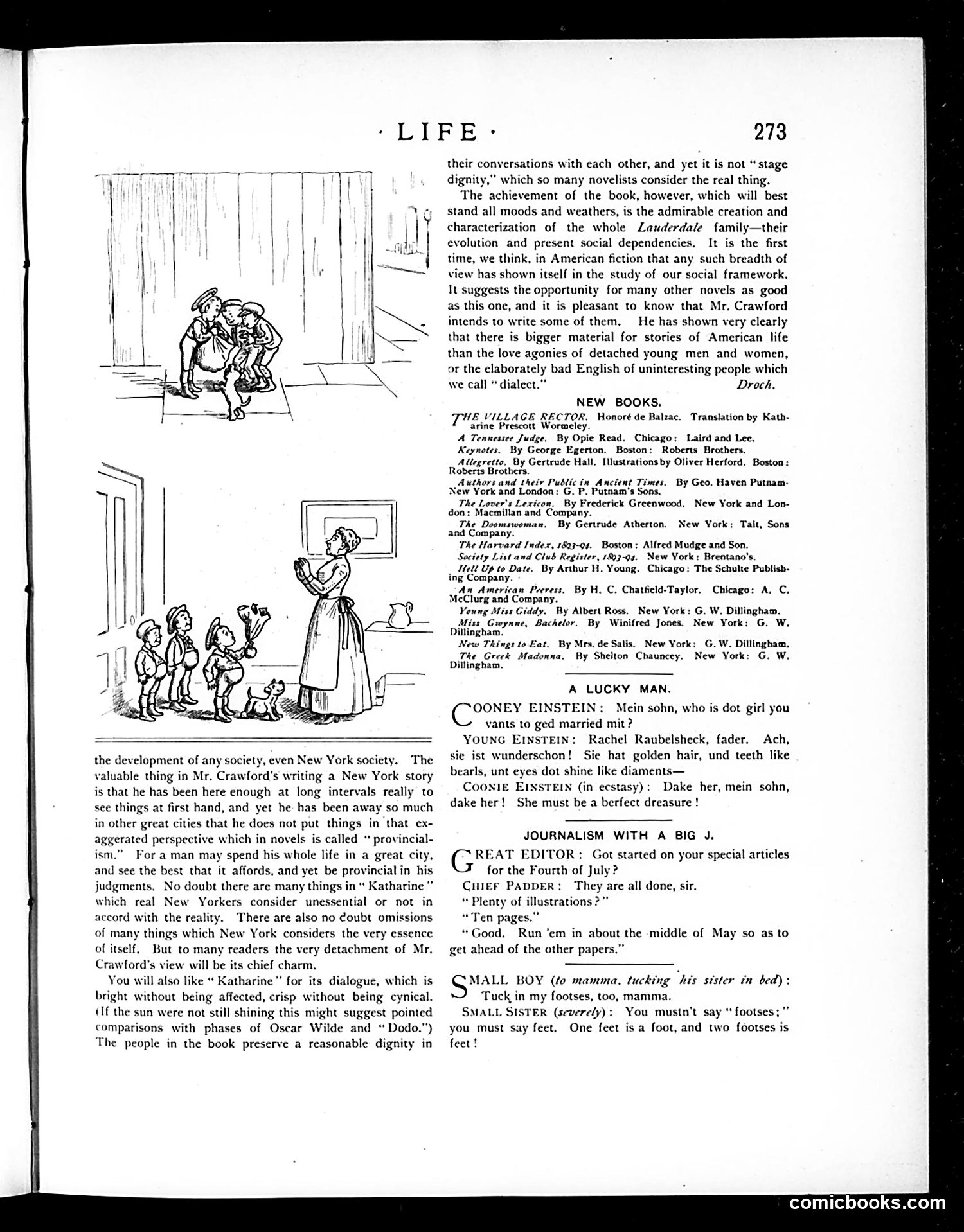
This page contains two illustrated vignettes and dialogue snippets rather than political cartoons. The top illustration shows children huddled in a doorway or corner—appearing to depict poverty or homelessness. The lower illustration shows a woman instructing children, possibly in a school or institutional setting. The dialogue sections below ("A Lucky Man" and "Journalism with a Big J") appear to be humorous sketches rather than political commentary. They feature mundane domestic and professional scenarios presented as social satire. The "New Books" section lists contemporary publications, suggesting this is a literary and cultural review page rather than hard political commentary. Without clearer context about specific current events referenced, the satirical intent remains unclear to modern readers.
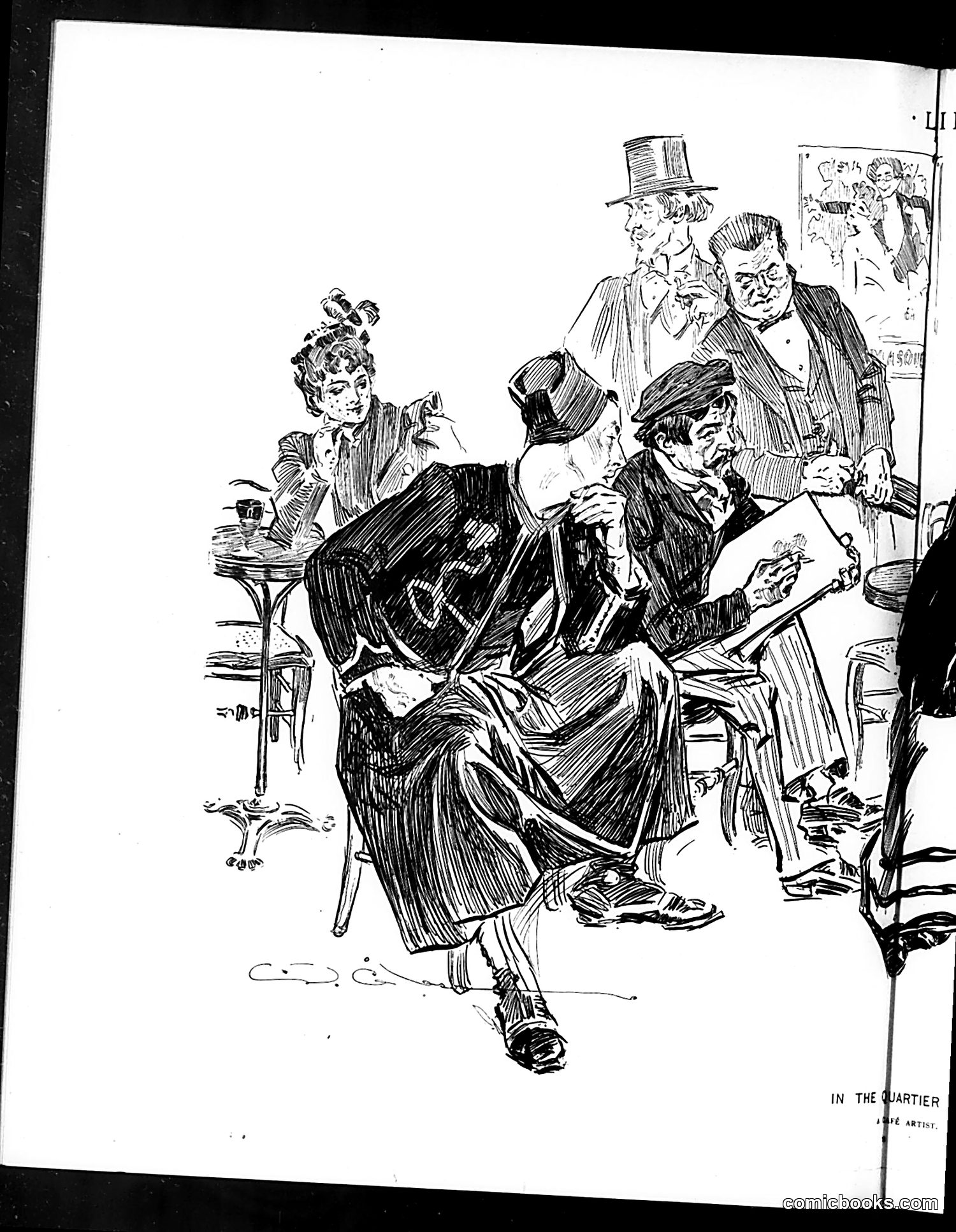
This ink sketch depicts a social scene in what appears to be a Parisian café or entertainment district (the "Quartier" likely refers to a bohemian neighborhood). The cartoon shows well-dressed figures—men in top hats and suits, and a woman in the center wearing dark clothing—gathered in an interior space with casual postures suggesting animated conversation or socializing. The style is characteristic of early Life magazine satirical illustration. The exaggerated facial features and caricatured body language suggest social satire, possibly mocking the pretensions of café society or artistic bohemian circles. However, without accompanying text explaining the specific satirical point, the exact subject of ridicule remains unclear from the image alone. The title suggests commentary on Parisian quarter life and manners.
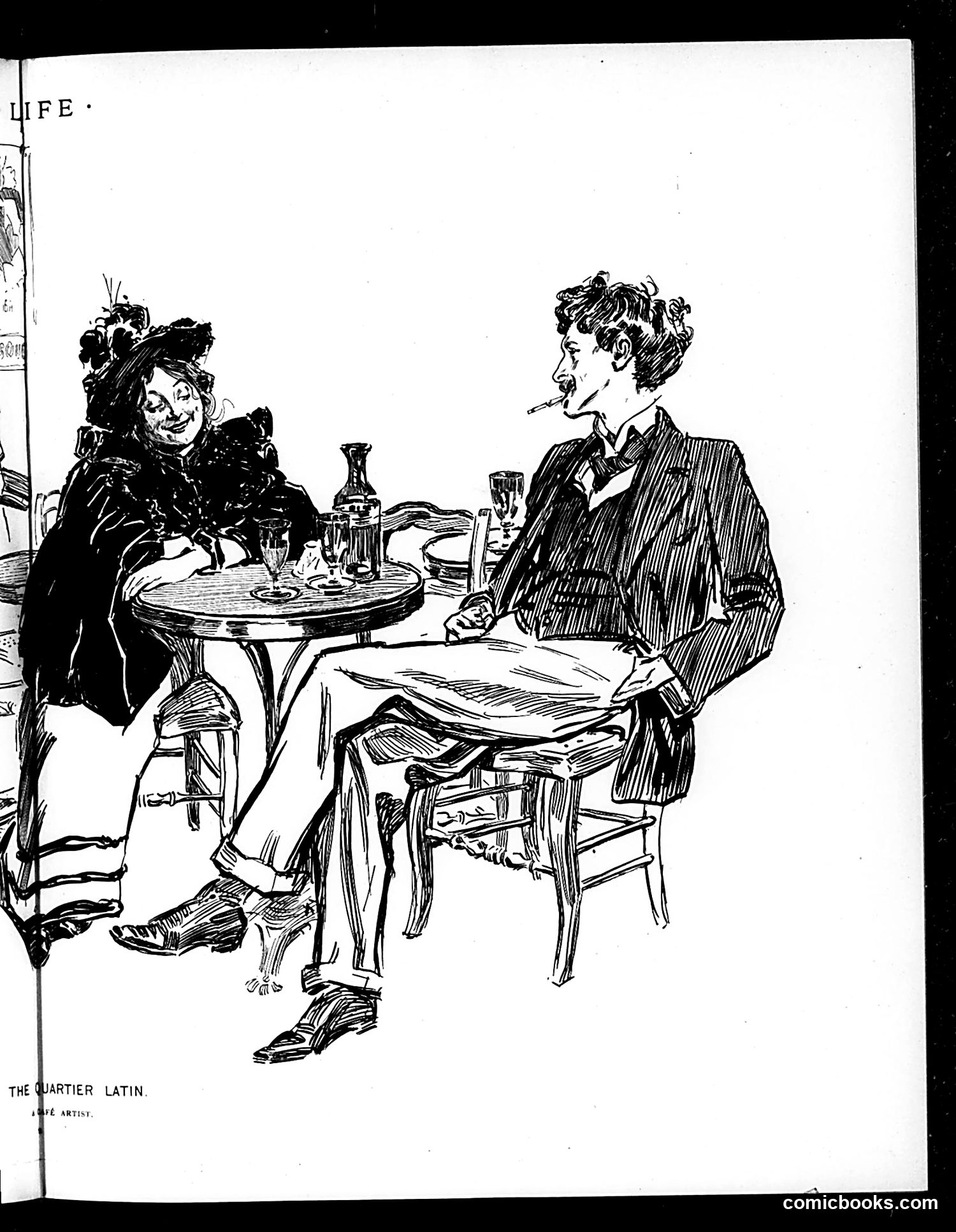
This sketch depicts two figures in what appears to be a Parisian café setting (the Quartier Latin is Paris's Left Bank student district). The man on the right smokes a cigarette while reading a newspaper, dressed in formal attire with striped jacket. The woman on the left wears an elaborate hat and fur-collared coat, leaning toward him with an animated expression. The cartoon likely satirizes bohemian Parisian culture or the contrast between pretentious fashion and intellectual pursuits. The woman's exaggerated hat and jewelry suggest vanity, while the man's newspaper reading implies serious engagement—possibly mocking the affectations of artists and intellectuals in Paris's famous bohemian quarter. Without a caption visible, the specific satirical point remains unclear, though it appears to comment on Parisian social types or gender dynamics in café society.
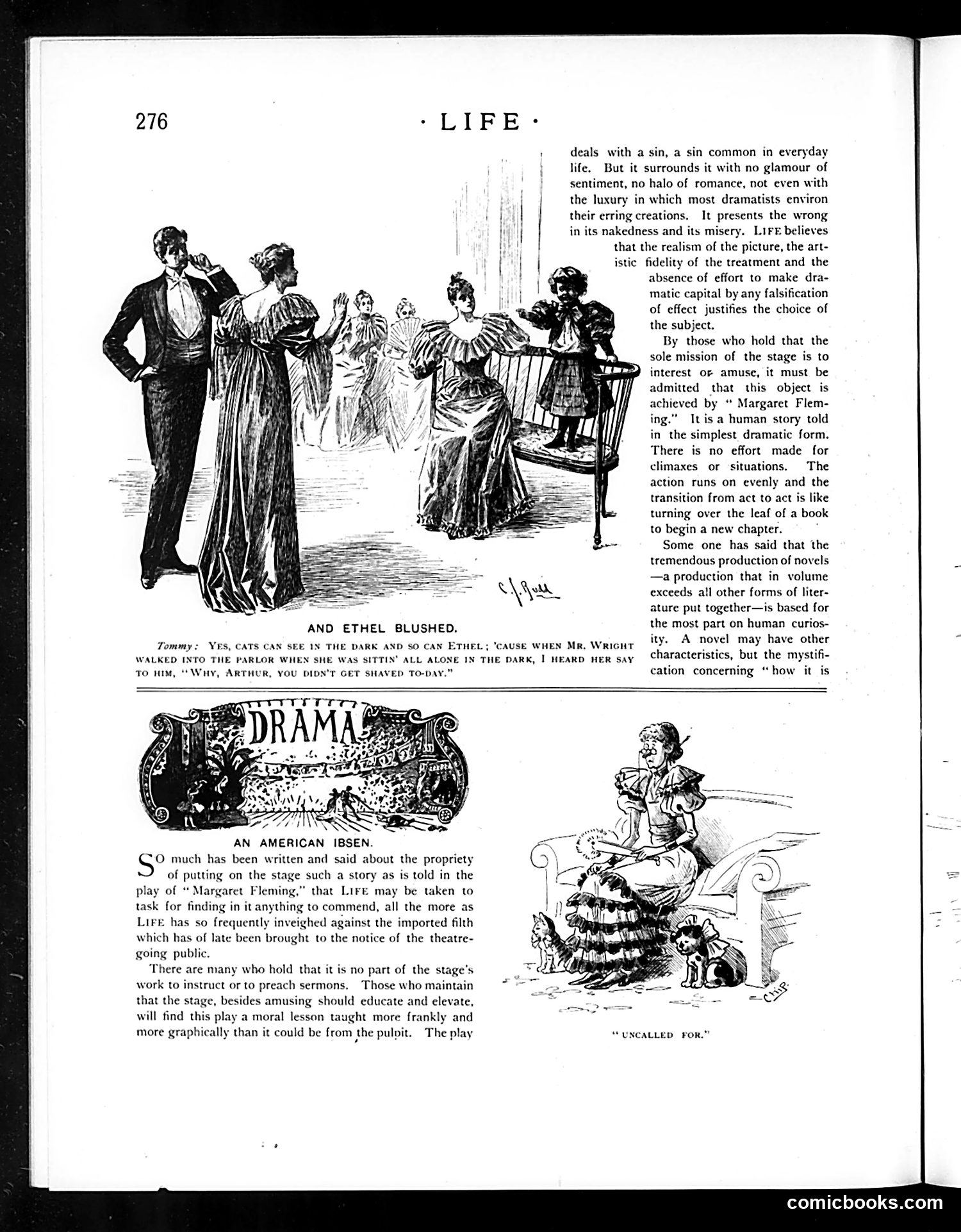
This page discusses "Margaret Fleming," a play by American dramatist James A. Herne, comparing it to Henrik Ibsen's realistic drama approach. Life defends the play against critics who objected to its frank treatment of infidelity—described as "a sin common in everyday life." The top cartoon "And Ethel Blushed" is a domestic humor piece: Tommy innocently reveals that he heard Ethel (a maid or servant) with Mr. Wright alone in the dark, then comments that Arthur didn't get shaved—implying an affair. The joke plays on the child's unintentional exposure of adult impropriety. The lower illustration "Uncalled For" appears to depict someone being dismissed or ejected, though the specific reference is unclear. Life's broader argument: realistic drama addressing moral failings serves education better than sentimentalized versions, and shouldn't be dismissed as mere imported European "filth."
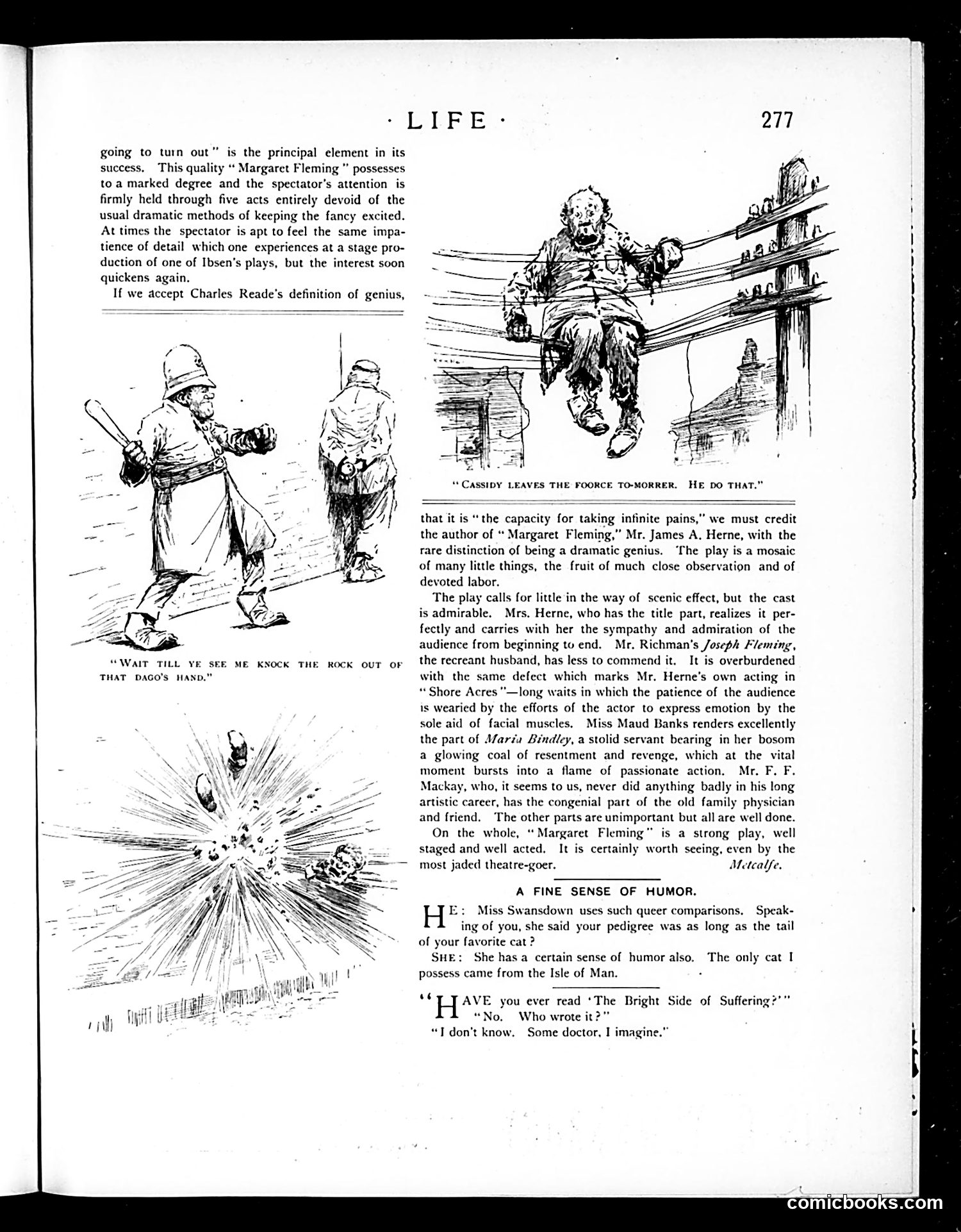
This page reviews James A. Herne's play "Margaret Fleming," praising it as a work of dramatic genius requiring "infinite pains." The three cartoon panels satirize Irish-American stereotypes common to the era. The sketches depict working-class Irish characters, identifiable by dialect ("DAGO," "FOORCE," "TO-MORRER"). The top panels show physical altercations—one involving a rock, another titled "Cassidy Leaves the Force To-Morrow"—portraying Irish laborers and policemen as prone to violence and intemperance. The large explosion illustration likely depicts similar crude, violent behavior. Below, "A Fine Sense of Humor" offers a genteel joke about cat pedigrees, contrasting sharply with the crude Irish caricatures above. This juxtaposition—sophisticated wordplay versus ethnic stereotyping—reflects period attitudes: educated society humor versus mockery of working-class immigrant groups. The offensive language and characterizations reflect late-19th-century American prejudices against Irish immigrants.
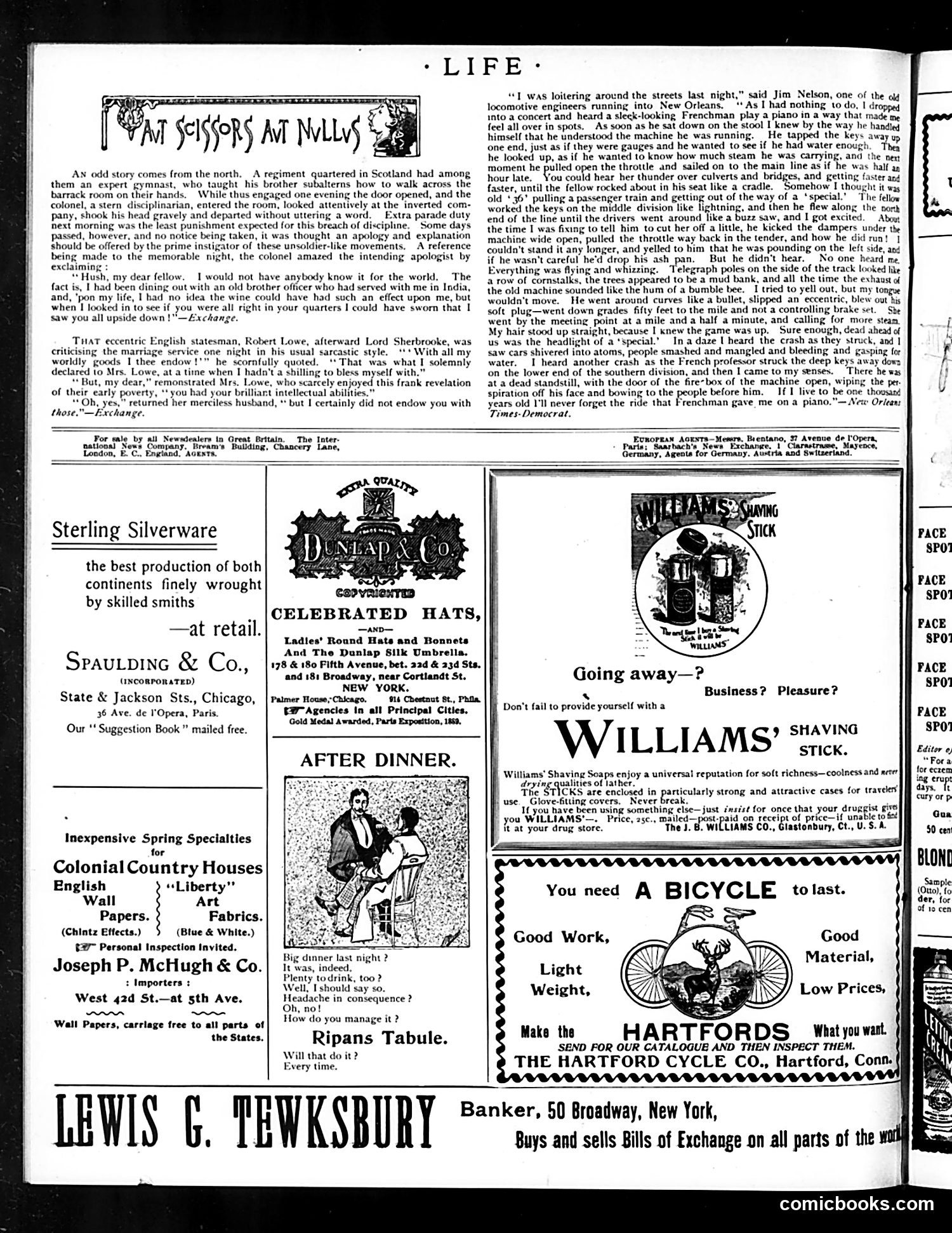
This page contains anecdotal humor typical of the era's satirical magazine format. The three stories use exaggeration and incongruity for comic effect: 1. **The Handstand Story**: A colonel enters barracks to find soldiers doing handstands but says nothing. When confronted later, he admits he was drunk during dinner and thought *he* was seeing them upside down—the joke being on the officer's inebriation, not the soldiers' misconduct. 2. **Robert Lowe anecdote**: A famous statesman boasts about marriage vows while admitting poverty, then cruelly tells his wife he didn't endow her with his "brilliant intellectual abilities"—satire of pompous hypocrisy. 3. **The Locomotive Anecdote**: A lengthy comparison of a piano performance to operating a locomotive at full speed, treating musical virtuosity through mechanical metaphor. The humor lies in describing refined artistry in crude railroad terminology. The advertisements below are period-appropriate (silverware, bicycles, shaving sticks). No political cartoons appear on this page.
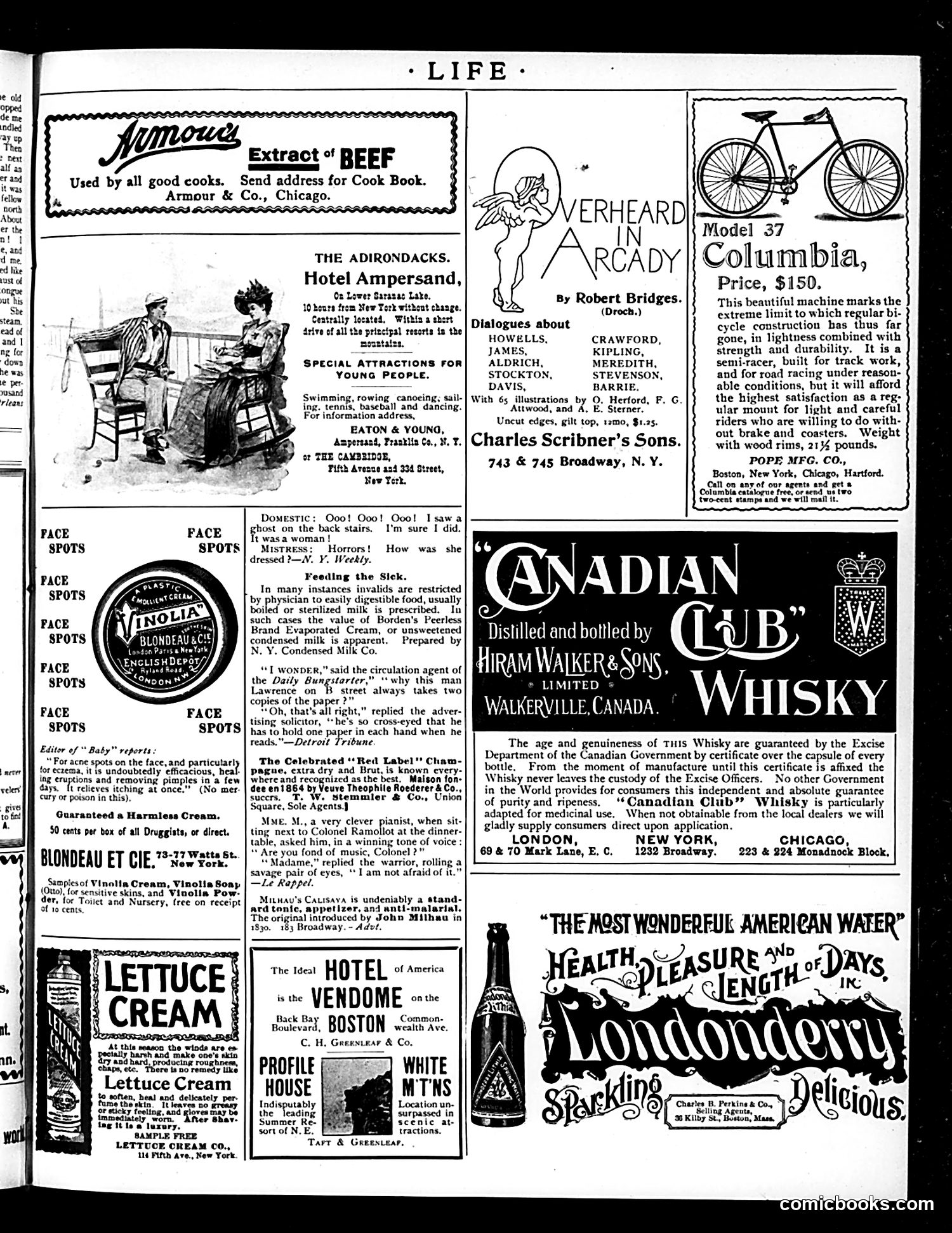
This is primarily an **advertising page** from Life magazine, typical of late 19th/early 20th-century publications. The content is commercial rather than satirical. The page contains product advertisements (Armour's beef extract, face creams, hotels, bicycles, whisky) interspersed with brief humorous anecdotes and jokes—standard filler material for the era. Notable humor includes: - A domestic servant joke about a ghost on the stairs being a woman - A joke about a cross-eyed newspaper subscriber needing two copies to read properly - Anecdotes about a pianist and a colonel discussing music preferences The **"Overheard in Arcady"** section advertises a book of dialogues about American writers (Howells, James, Kipling, etc.), suggesting literary commentary was popular content. The page reflects **turn-of-the-century consumer culture**—bicycles ($150), whisky, beauty products, and hotel accommodations aimed at affluent readers. There is **no political satire** visible; this is a conventional advertisement-heavy magazine page offering leisure-class products and light entertainment.
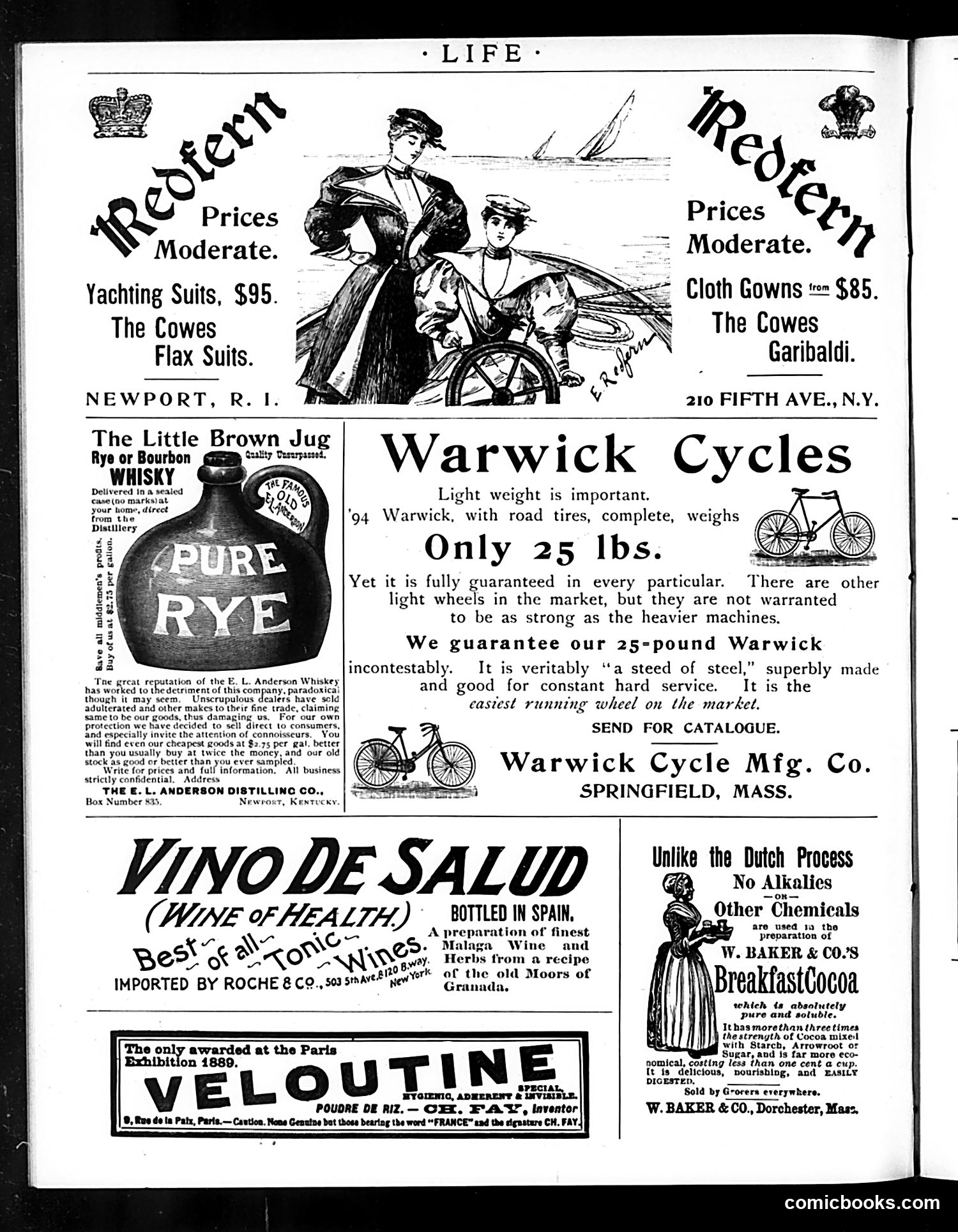
This is primarily an **advertising page** from Life magazine, not a political cartoon. It showcases late-19th-century consumer products targeting wealthy Americans. Notable advertisements include: - **Fashion ads** (Irdern/Redern): Yachting and cloth gowns from Newport and New York establishments, reflecting the leisure class's summer social season - **Warwick Cycles**: A bicycle advertisement emphasizing the novelty of lightweight construction (25 pounds) while guaranteeing strength—relevant as bicycles were booming consumer goods in the 1890s - **Liquor and tonics**: E.L. Anderson whiskey and Vino de Salud wine, marketed as health tonics (reflecting era when alcohol was sold medicinally) - **W. Baker & Co. Breakfast Cocoa**: Emphasizing purity and Dutch processing, a premium product The page reflects Gilded Age consumer culture: expensive imported goods, leisure activities (yachting, cycling), and patent medicines marketed to affluent readers.
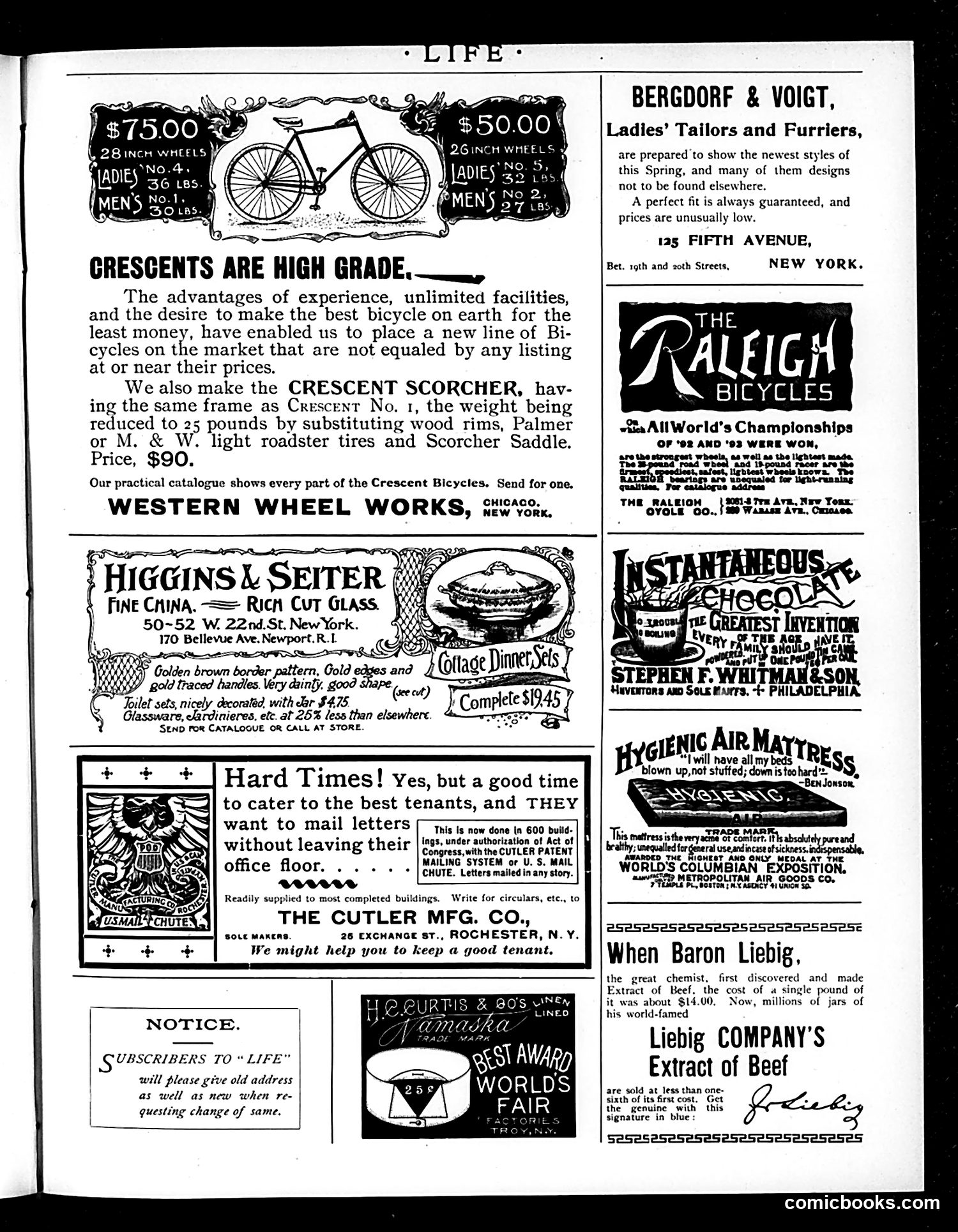
This is primarily an **advertising page** from Life magazine, not a satirical cartoon spread. It contains various product advertisements typical of the era (appears to be 1890s-early 1900s based on bicycle and product styles). The notable content includes: **Crescent Bicycles** advertisement emphasizing quality and affordability—bicycles were major consumer goods and status symbols of this period. **The Cutler Mailing System** ad plays on "Hard Times" (economic depression), pitching an office mail system that lets tenants mail letters without leaving their floor—a practical innovation for modern office buildings. **Liebig's Extract of Beef** uses "Baron Liebig" (a real 19th-century chemist) to market beef extract, emphasizing how democratized a once-expensive luxury product has become through mass production. Other ads promote china, bicycles, corsets, chocolate, and mattresses. The page reflects consumer culture and technological progress of the Gilded Age, with products marketed as modern conveniences and quality goods for aspiring middle-class readers.
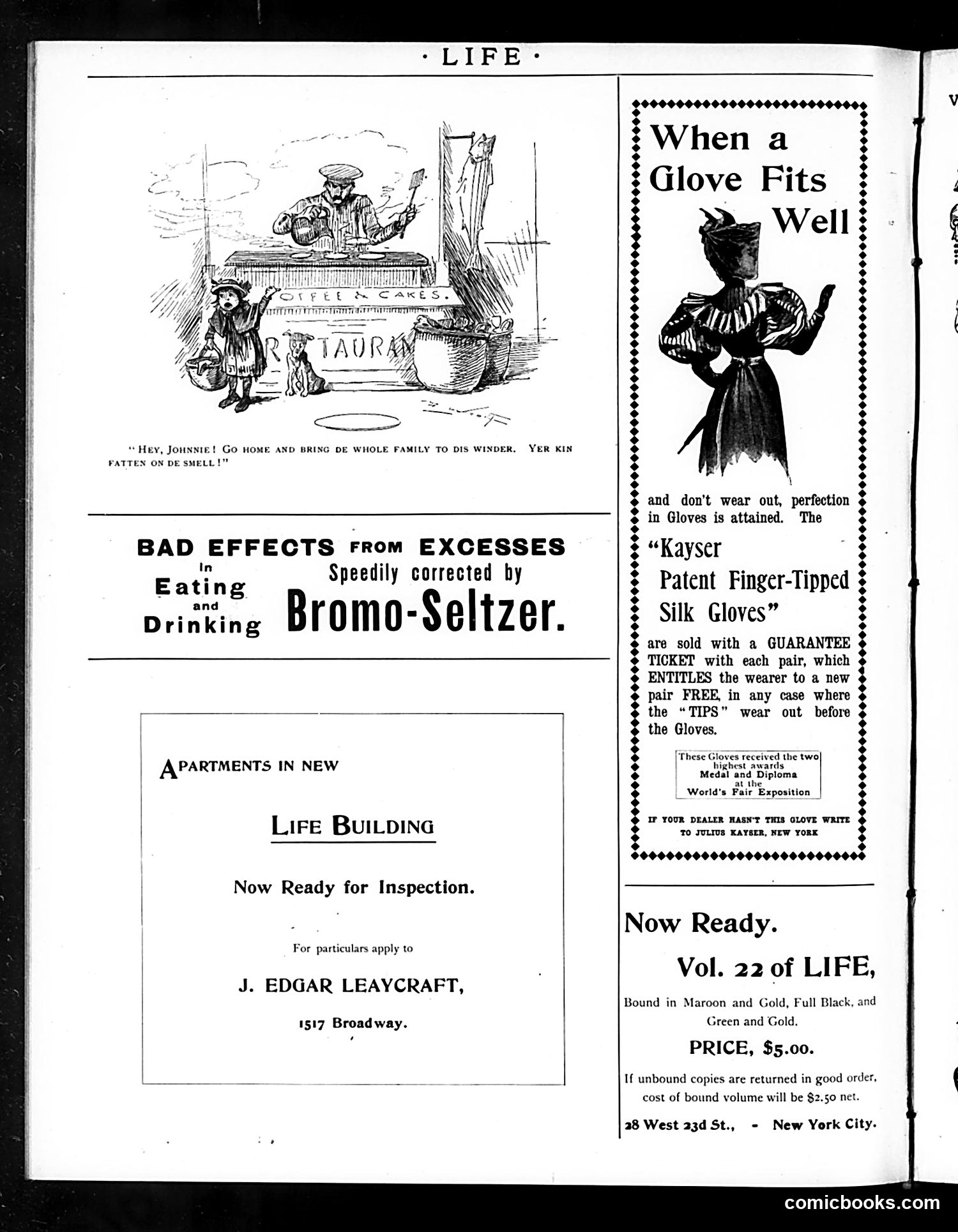
This page is primarily **advertisements and announcements** rather than political satire. The main cartoon (upper left) depicts an immigrant vendor at a restaurant window, using exaggerated dialect ("Hey, Johnnie! Go home and bring de whole family to dis winder, yer kin fatten on de smell!"). This reflects **early 1900s ethnic stereotyping**, mocking immigrant speech patterns—likely Irish or Eastern European—common in period humor. The page contains three advertisements: **Bromo-Seltzer** (a digestive remedy), **Kayser Patent Silk Gloves** (with a World's Fair award claim), and **Life Building apartments** for rent. The bottom section announces **Volume 22 of Life magazine** itself, priced at $5.00 in decorative bindings. The ethnic caricature represents casual period discrimination, while the overall page reflects Life's dual identity as both satirical magazine and commercial publication selling goods to middle-class readers.