
Life, 1894-04-26 · page 11 of 20
Life — April 26, 1894 — page 11: what you’re looking at
What you’re looking at
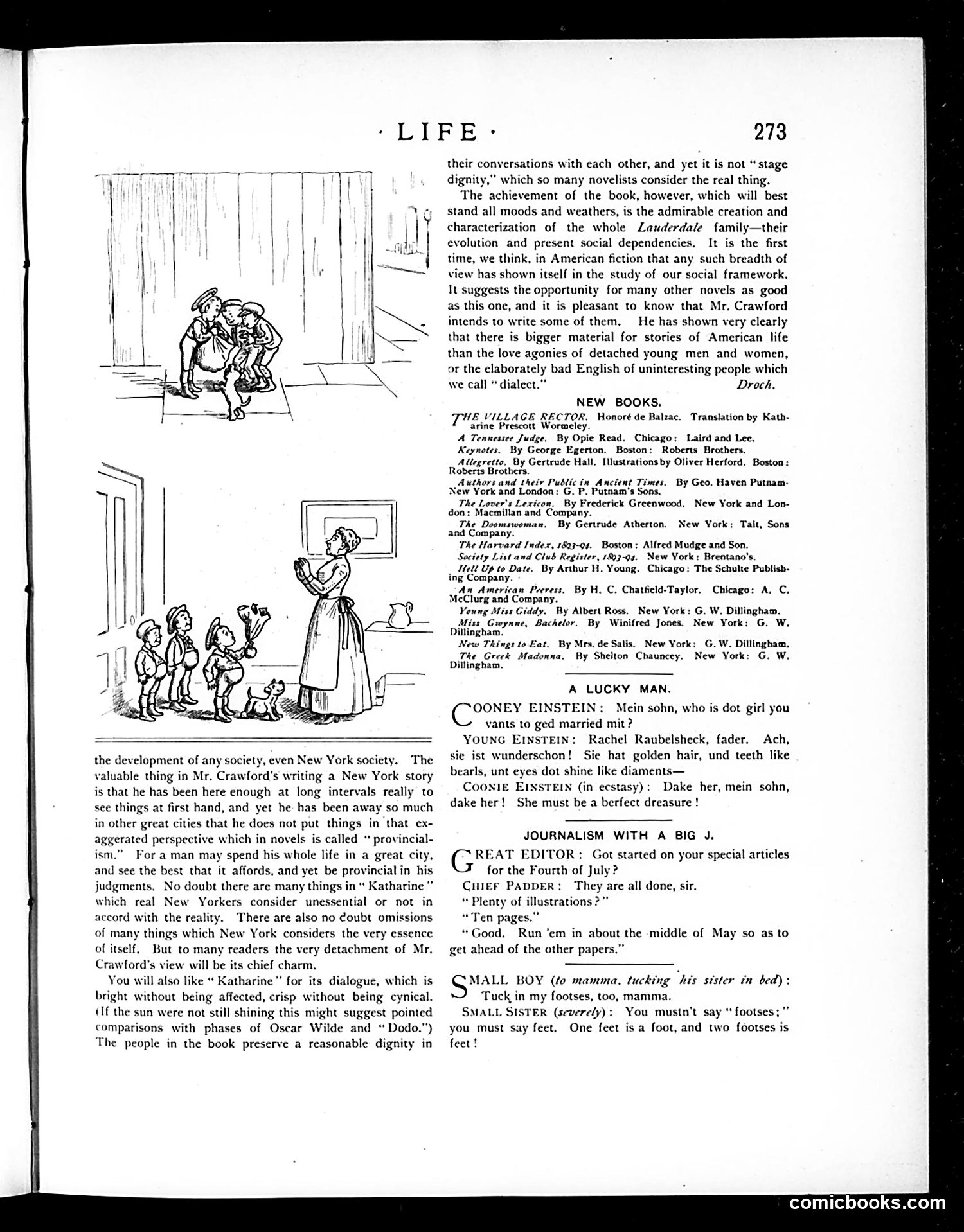
This page contains two illustrated vignettes and dialogue snippets rather than political cartoons. The top illustration shows children huddled in a doorway or corner—appearing to depict poverty or homelessness. The lower illustration shows a woman instructing children, possibly in a school or institutional setting. The dialogue sections below ("A Lucky Man" and "Journalism with a Big J") appear to be humorous sketches rather than political commentary. They feature mundane domestic and professional scenarios presented as social satire. The "New Books" section lists contemporary publications, suggesting this is a literary and cultural review page rather than hard political commentary. Without clearer context about specific current events referenced, the satirical intent remains unclear to modern readers.
📄 Transcribed text from this page (OCR, searchable)
Machine-transcribed from the original scan — historical spelling and the odd misread are preserved.
‘LIFE: the development of any society, even New York society. The valuable thing in Mr. Crawford's writing a New York story is that he has been here enough at long intervals really to see things at first hand, and yet he has been away so much in other great cities that he does not put things in that ex- aggerated perspective which in novels is called “ provincial- ism.” For a man may spend his whole life in a great city, and see the best that it affords, and yet be provincial in his judgments. No doubt there are many things in “ Katharine” which real New Yorkers consider unessential or not in accord with the reality. There are also no coubt omissions of many things which New York considers the very essence of itself. But to many readers the very detachment of Mr. Crawford's view will be its chief charm. You will also like “ Katharine" for its dialogue, which is bright without being affected, crisp without being cynical. (If the sun were not still shining this might suggest pointed comparisons with phases of Oscar Wilde and “ Dodo.") The people in the book preserve a reasonable dignity in 273 their conversations with each other, and yet it is not “stage dignity,” which so many novelists consider the real thing. The achievement of the book, however, which will best stand all moods and weathers, is the admirable creation and characterization of the whole Lauderdale family—their evolution and present social dependencies. It is the first time, we think, in American fiction that any such breadth of view has shown itself in the study of our social framework. It suggests the opportunity for many other novels as good as this one, and it is pleasant to know that Mr. Crawford intends to write some of them. He has shown very clearly that there is bigger material for stories of American life than the love agonies of detached young men and women, or the elaborately bad English of uninteresting people which we call “dialect.” Droch, NEW BOOKS. THE VILLAGE RECTOR. Honoré de Balzac. Translation by Kath- arine Prescott Wormeley. A Tennessee Judge, By Opie Read. Chicago: Laird and Lee. Keynotes, By George Egerton. Boston: Roberts Brothers. Allegretto. By Gertrude Hall, Illustrations by Oliver Herford. Boston: Roberts Brothers. Authors and their Public in Ancient Times, New York and London: G. P. Putnam's S The Lover's Lexicon. By Frederick Greenwood, New York and Lon- don: Macmillan and Company. The Doomswoman. By Gertrude Atherton. and Company. The Harvard Index, 1893-94. Boston: Alfred Mudge and Son. Society List and Club Register, 1893-94. New York: Brentano's, Helt Up to Date. By Arthur H. Young. Chicago: The Schulte Publish- ing Company. An American Peeress, McClurg and Company. Young Miss Giddy. By Albert Ross. New York: G. W. Dillingham, Miss Gwynne, Bachelor, By Winifred Jones. New York: G. W. Dillingham: New Things to Eat, By Mrs. de Sal The Greek Madonna, By Shelton Chauncey. Dillingham. By Geo. Haven Putnam- New York: Tait, Sons By H. C. Chatfield-Taylor. Chicago: A. C. New York: G. W. Dillingham, New York: G. W. A LUCKY MAN. OONEY EINSTEIN: Mein sohn, who is dot girl you vants to ged married mit? YOUNG EINSTEIN: Rachel Raubelsheck, fader. Ach, sie ist wunderschon! Sie hat golden hair, und teeth like bearls, unt eyes dot shine like diaments— CoonlE EINSTEIN (in ecstasy): Dake her, mein sohn, dake her! She must be a berfect dreasure ! JOURNALISM WITH A BIG J. REAT EDITOR: Got started on your special articles for the Fourth of July ? Cer PADDER: They are all done, sir. “Plenty of illustrations ? “Ten pages.” “Good. Run ‘em in about the middle of May so as to get ahead of the other papers.” GMaut BOY (fo mamma, tucking “his sister in bed) : Tuck, in my footses, too, mamma. SMALL SISTER (severely): You mustn't say *“ footses;" you must say feet. One feet is a foot, and two footses is feet! comicbooks.com