
A complete issue · 14 pages · 1894
Life — April 19, 1894
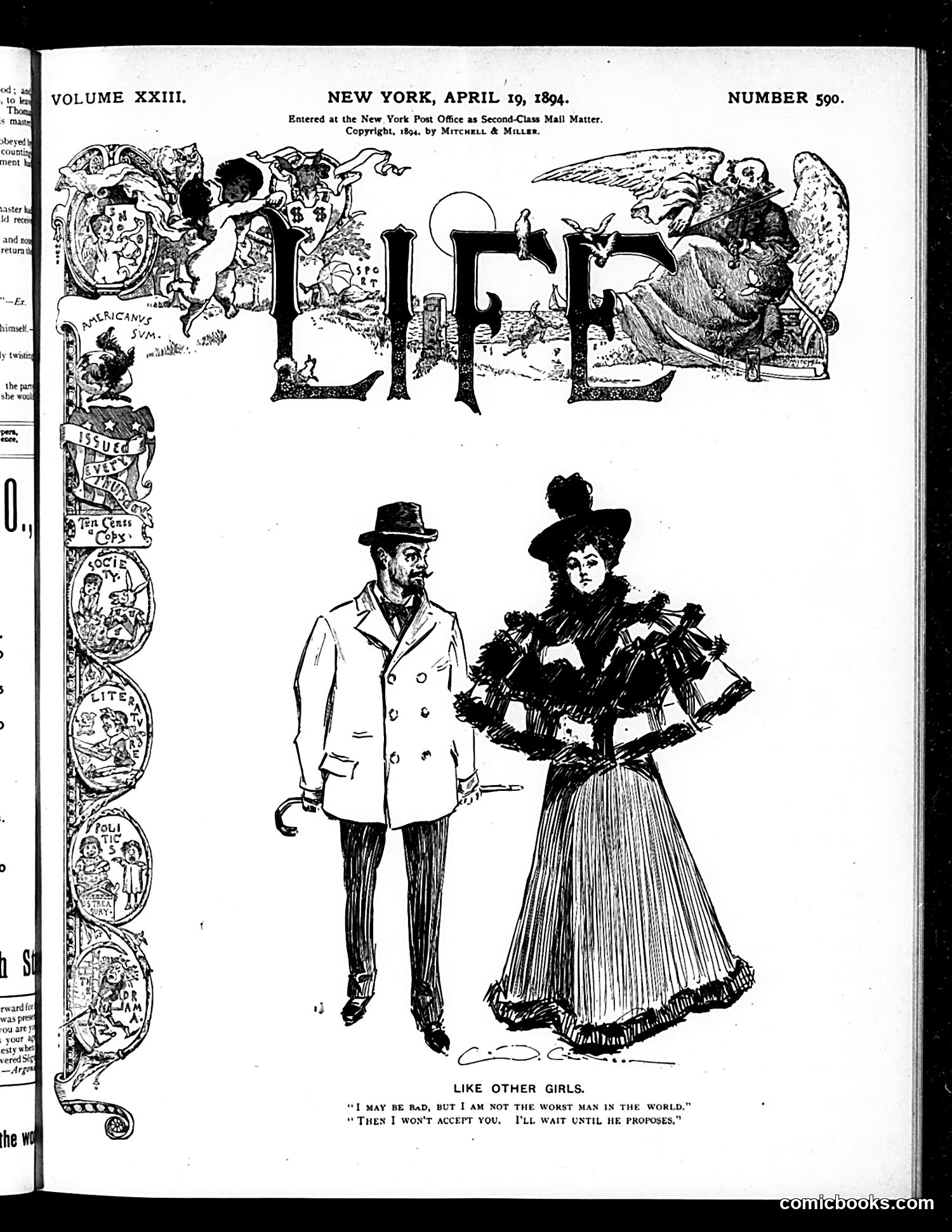
This page features a satirical illustration titled "Like Other Girls" depicting a well-dressed couple. The woman, fashionably attired in an elaborate 1890s gown with distinctive puffy sleeves and feathered hat, stands beside a man in a double-breasted coat and bowler hat. The accompanying dialogue reveals the satire's point: the woman declares "I may be bad, but I am not the worst man in the world" and "Then I won't accept you. I'll wait until he proposes." This inverts traditional gender expectations—she's rejecting the suitor while waiting for someone worse, mocking both romantic conventions and the era's attitudes about female choice in marriage. The cartoon satirizes how women navigated marriage prospects and social expectations during the 1890s.
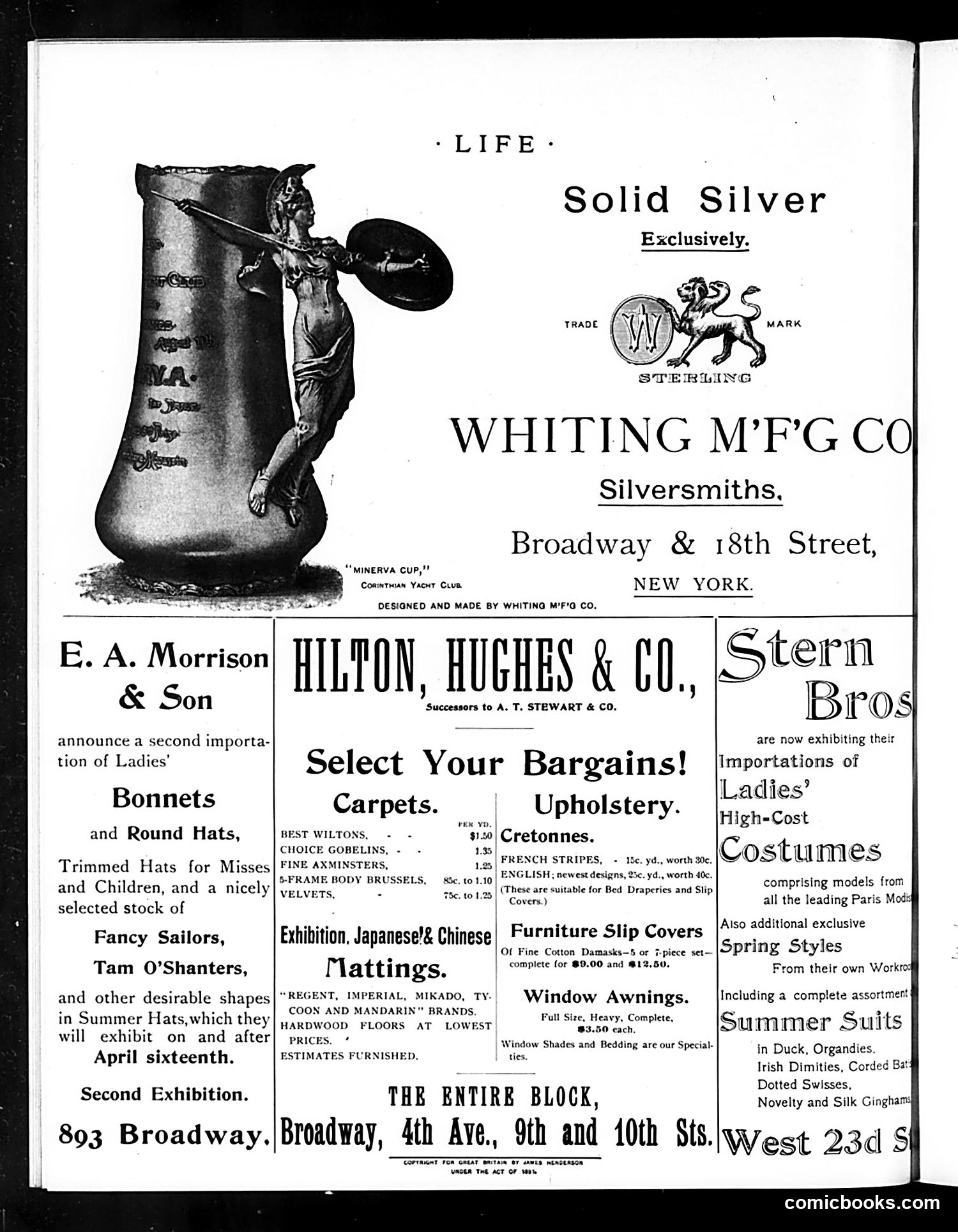
This page is primarily **advertising**, not satirical content. It features multiple merchants advertising goods in what appears to be late 19th-century New York City. The prominent image shows the "Minerva Cup," a decorative silver vessel made by Whiting Manufacturing Company (silversmiths on Broadway & 18th Street). The classical female figure (Minerva, goddess of wisdom) adorning the cup was a common design motif of the era, suggesting quality and refinement. Other advertisements promote ladies' bonnets, hats, carpets, upholstery, furniture covers, window awnings, and summer clothing. The page emphasizes imported goods and fashionable items from Paris and Europe—luxury products targeting wealthy urban consumers. No political satire is evident; this is a straightforward commercial page from Life magazine's advertising section.
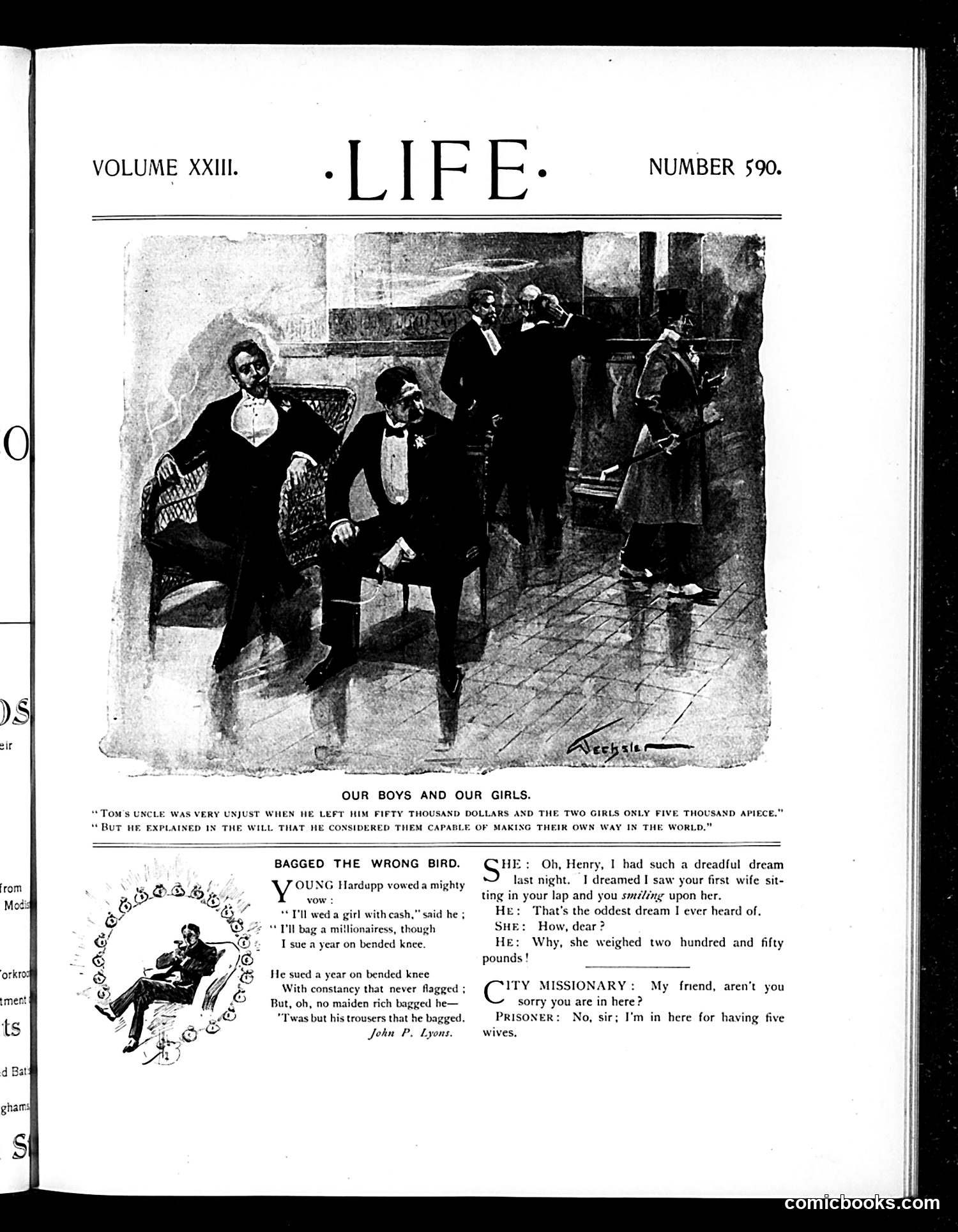
**Main Cartoon - "Our Boys and Our Girls":** This satirizes wealth disparity and social climbing. The caption quotes someone explaining they left their nephew fifty thousand dollars while giving two girls only five thousand each, claiming the nephew could make his own way in the world. The illustration depicts what appears to be a formal social gathering, likely critiquing the arbitrary and gendered nature of inheritance decisions among the wealthy. **Secondary Pieces:** "Bagged the Wrong Bird" humorously depicts a suitor unsuccessfully courting a wealthy woman through persistent effort. The brief jokes below include a City Missionary and Prisoner exchange—likely social commentary on urban poverty and incarceration. Overall, the page satirizes wealth, class distinctions, and social pretensions of early 20th-century American society.
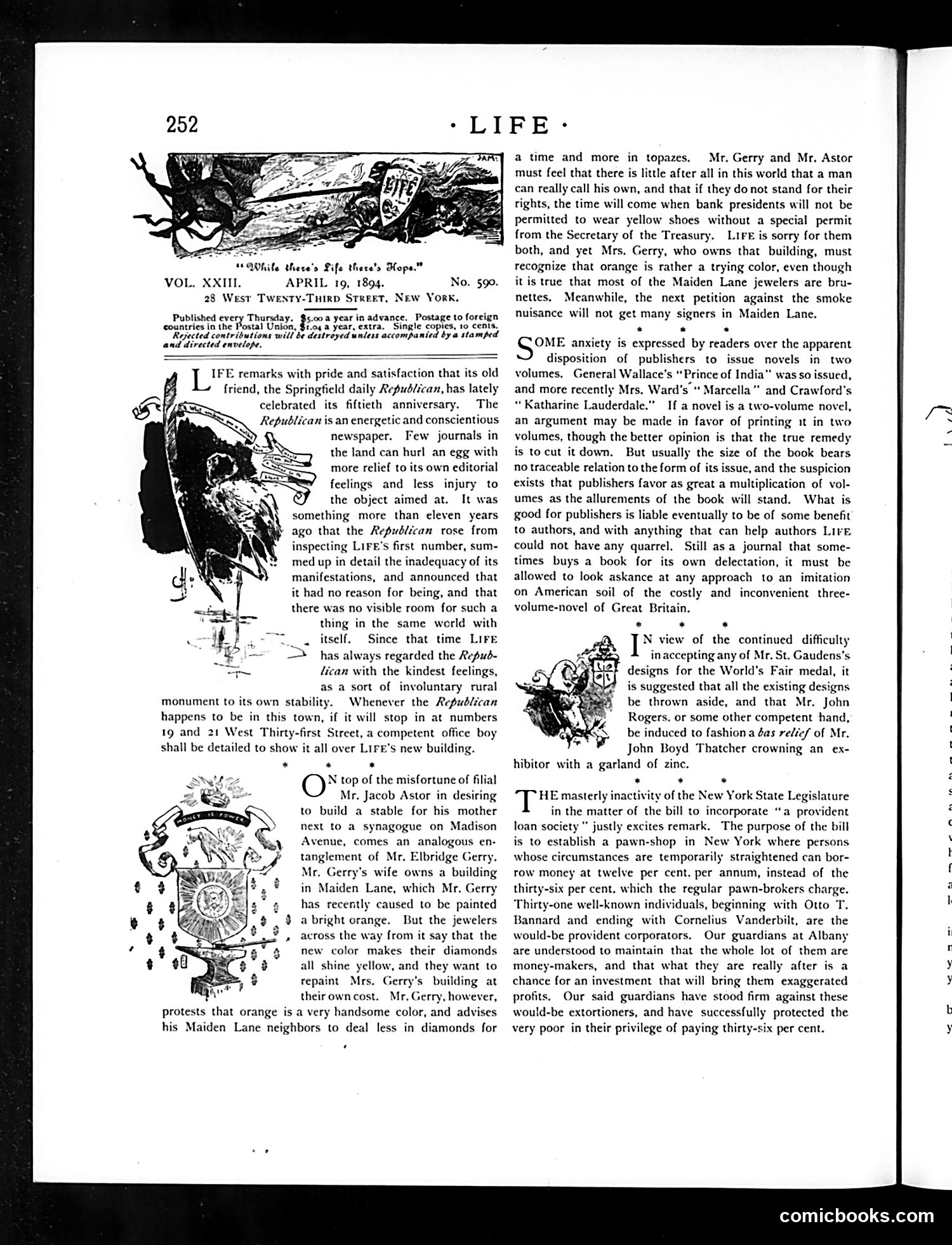
This page contains editorial commentary rather than political cartoons. The text discusses two main issues: 1. **The Springfield Republican newspaper's anniversary**: Life praises the newspaper for its long-standing editorial integrity, noting it has always supported honest journalism. 2. **Maiden Lane jewelry disputes**: The editorial addresses conflicts between Mr. Gerry (likely a building owner) and Mr. Astor over property rights on Maiden Lane in New York. Mrs. Gerry's building was painted orange, which Mr. Gerry argues enhances diamonds but which neighbors dislike. The piece satirizes wealthy property owners' disputes over building aesthetics. 3. **A proposed pawn-loan bill**: The text criticizes the New York State Legislature's inactivity regarding legislation to establish a provident loan society to help poor people at reasonable interest rates (twelve percent annually instead of thirty-six percent). The page uses satire to critique both petty wealthy disputes and legislative neglect of working-poor citizens.
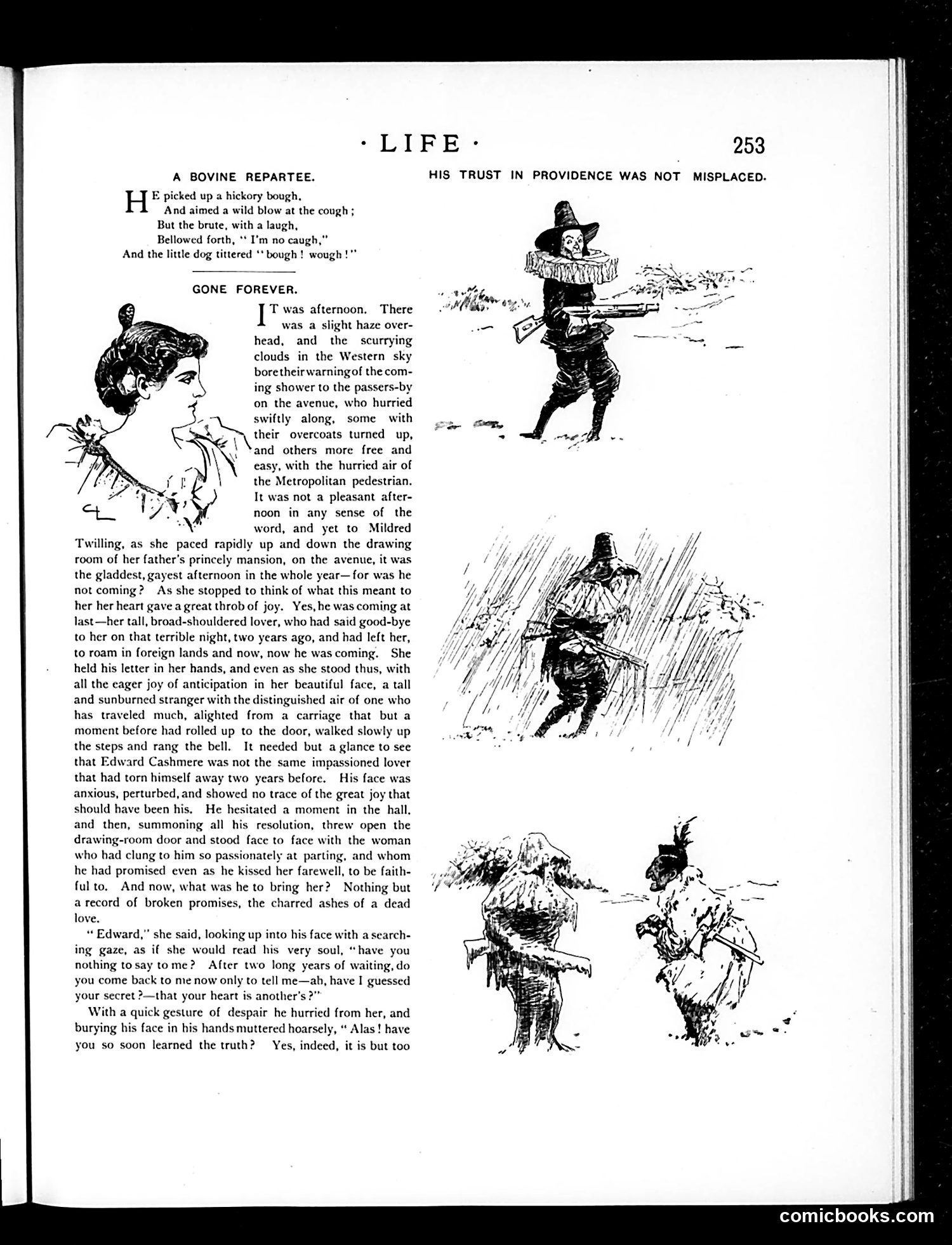
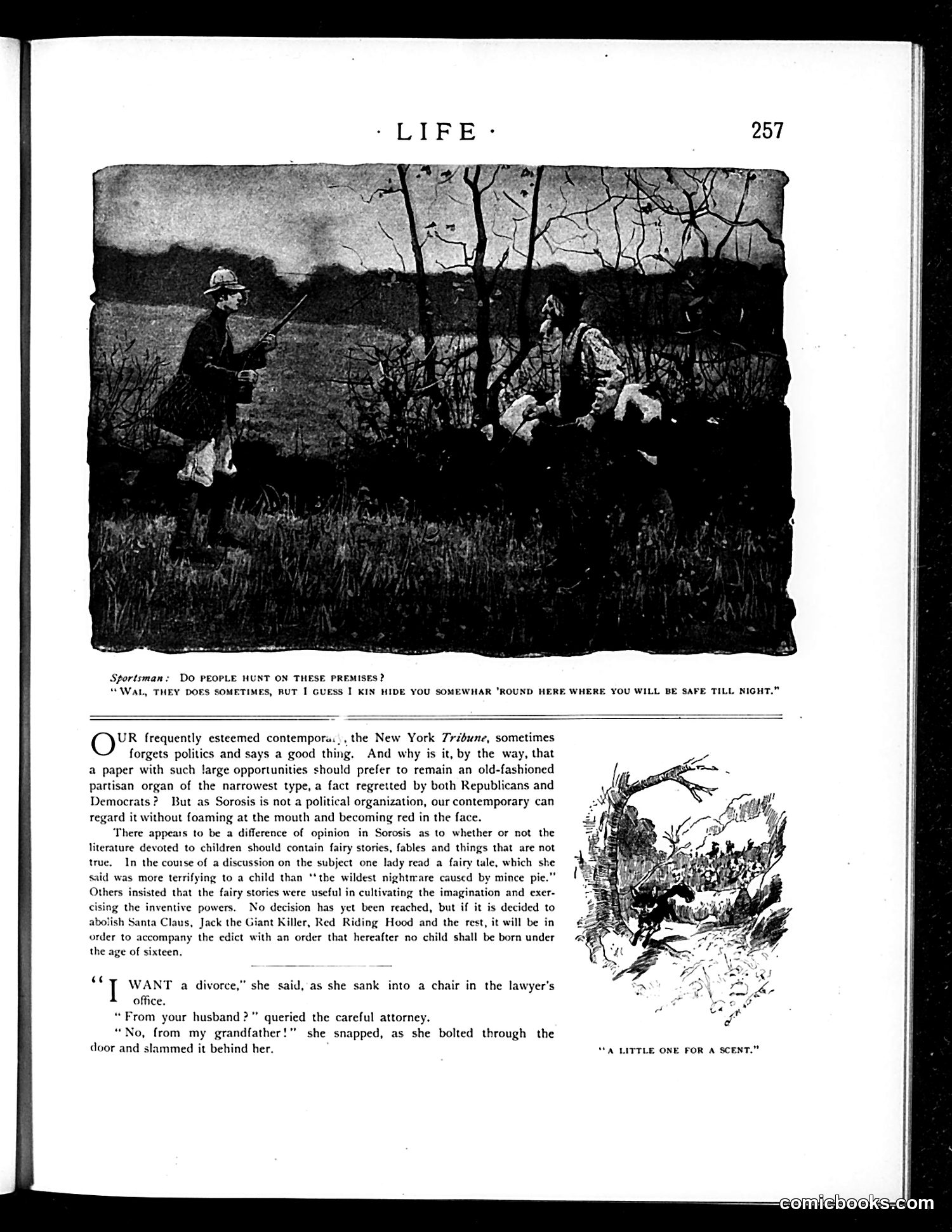
This page contains two distinct pieces: **"A Bovine Repartee"** (upper left): A humorous four-line poem about a cow, dog, and cough—a light-hearted joke with no political content. **"Gone Forever"** (main text): A romantic short story about a woman named Mildred waiting for her absent lover, Edward Cashmere, to return after two years abroad. The narrative describes her emotional turmoil upon his unexpected arrival, only to discover he is not the same devoted man who left her. The accompanying illustrations depict rural/Western scenes (a cowboy with a rifle, figures in rain and fields) that appear to illustrate the story's setting or provide thematic accompaniment rather than direct political satire. This page represents *Life's* broader editorial content beyond political commentary—mixing light verse with serialized fiction typical of early 20th-century periodicals.
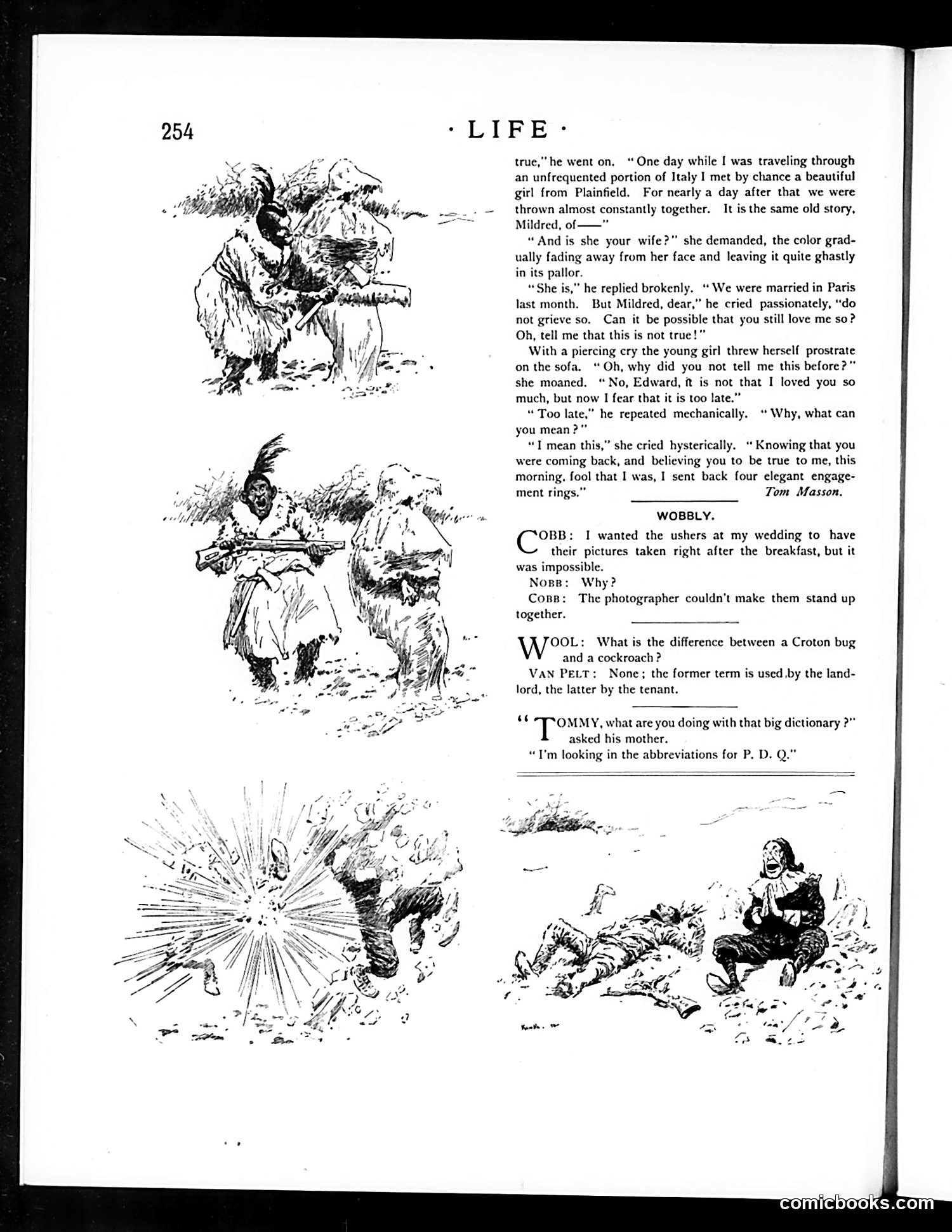
This page combines several unrelated items typical of *Life* magazine's satirical format: **Top section**: A sentimental narrative about a man reuniting with a woman from his past, now married. The story emphasizes romantic regret and lost opportunities—common *Life* themes mocking sentimentality. **"Wobbly" section**: Brief humorous anecdotes, including one about wedding photography logistics and another distinguishing "Croton bug" (landlord's term) from "cockroach" (tenant's term)—class-based humor about shared housing disputes. **Final joke**: A child seeking "P.D.Q." abbreviation in a dictionary—likely a mild pun or wordplay joke, though the specific reference is unclear without additional context. The sketches throughout appear to be illustrative rather than caricatural, depicting everyday scenes without specific political figures or events.
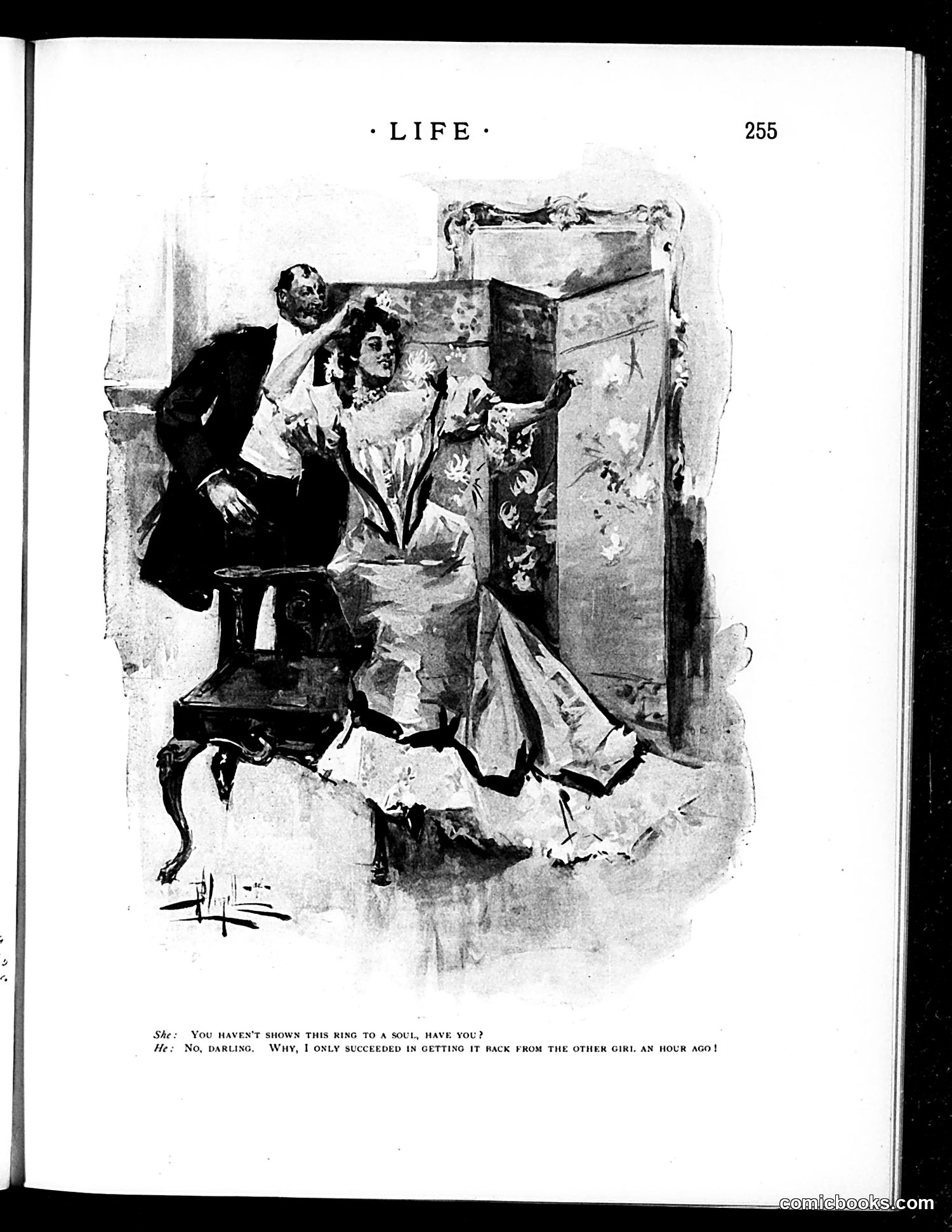
This is a single-panel cartoon depicting a domestic scene with romantic/marital tension. A man in formal evening wear stands behind a seated woman in an elaborate gown, displaying a ring. The woman appears surprised or concerned. The dialogue reveals the joke's context: She questions whether he's shown the ring to "a soul," and he responds that he "only succeeded in getting it back from the other girl an hour ago." The satire mocks infidelity and male duplicity in courtship—the implication being that he's recycled an engagement ring from a previous romantic interest to propose to this current woman. It's a commentary on shallow male behavior and the commodification of romantic gestures during this era (appears to be early 20th century based on style). The humor relies on the woman's ignorance of the ring's dubious history.
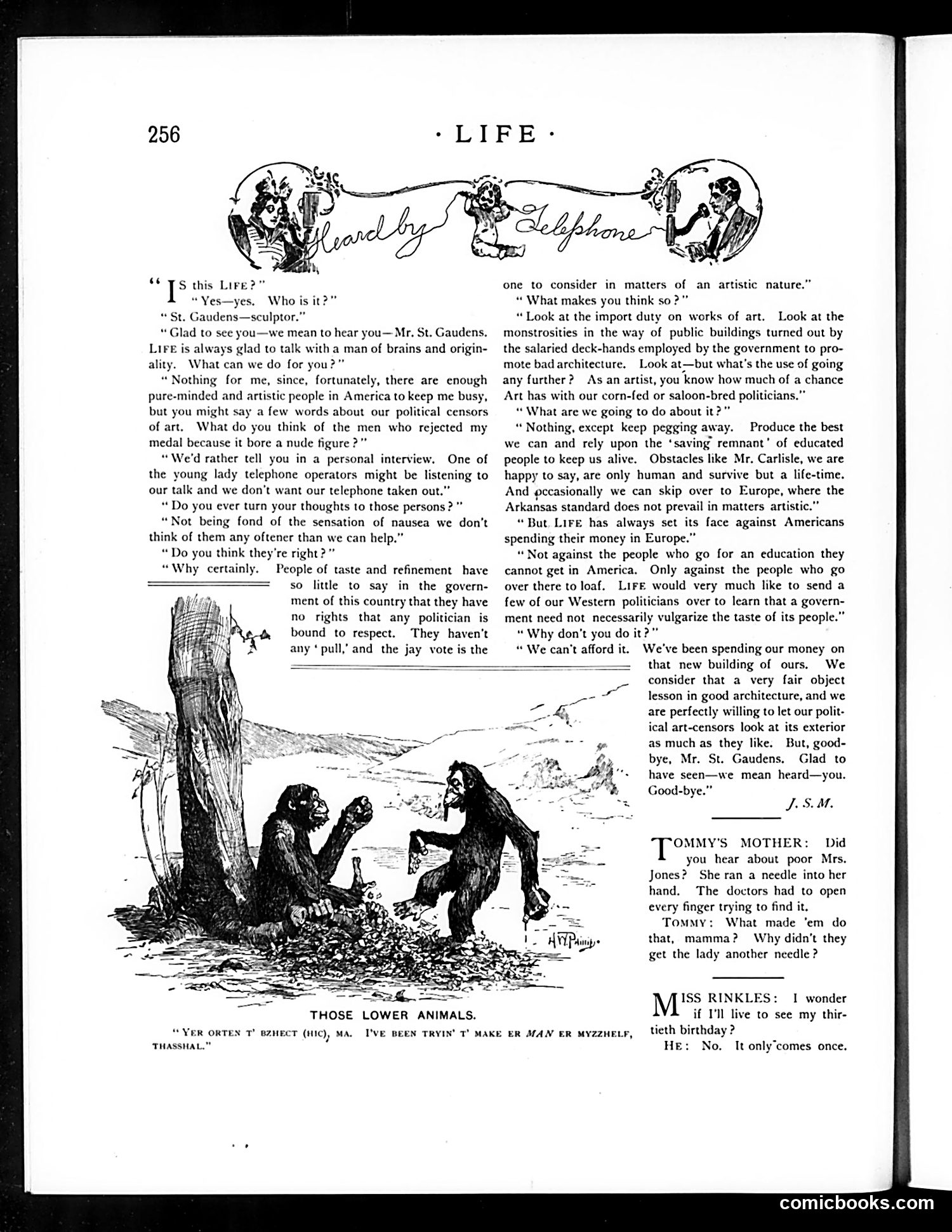
This cartoon depicts two apes examining a human figure, satirizing the then-controversial theory of human evolution. The caption reads: "YER OFTEN T' REJECT (HIC), MA. I'VE BEEN TRYIN' T' MAKE ER MAN ER MYZSELF, THASSAL." The joke mocks both Darwinian evolution and contemporary political incompetence. By suggesting apes could "make" a man, the cartoon implies certain politicians or public figures are so poorly evolved or ineffectual they're practically sub-human. This reflects early-20th-century Life magazine's satirical approach to American governance and social pretension, using Darwinian frameworks to ridicule those in power or attempting reform. The colloquial dialect emphasizes the mockery's class dimension.
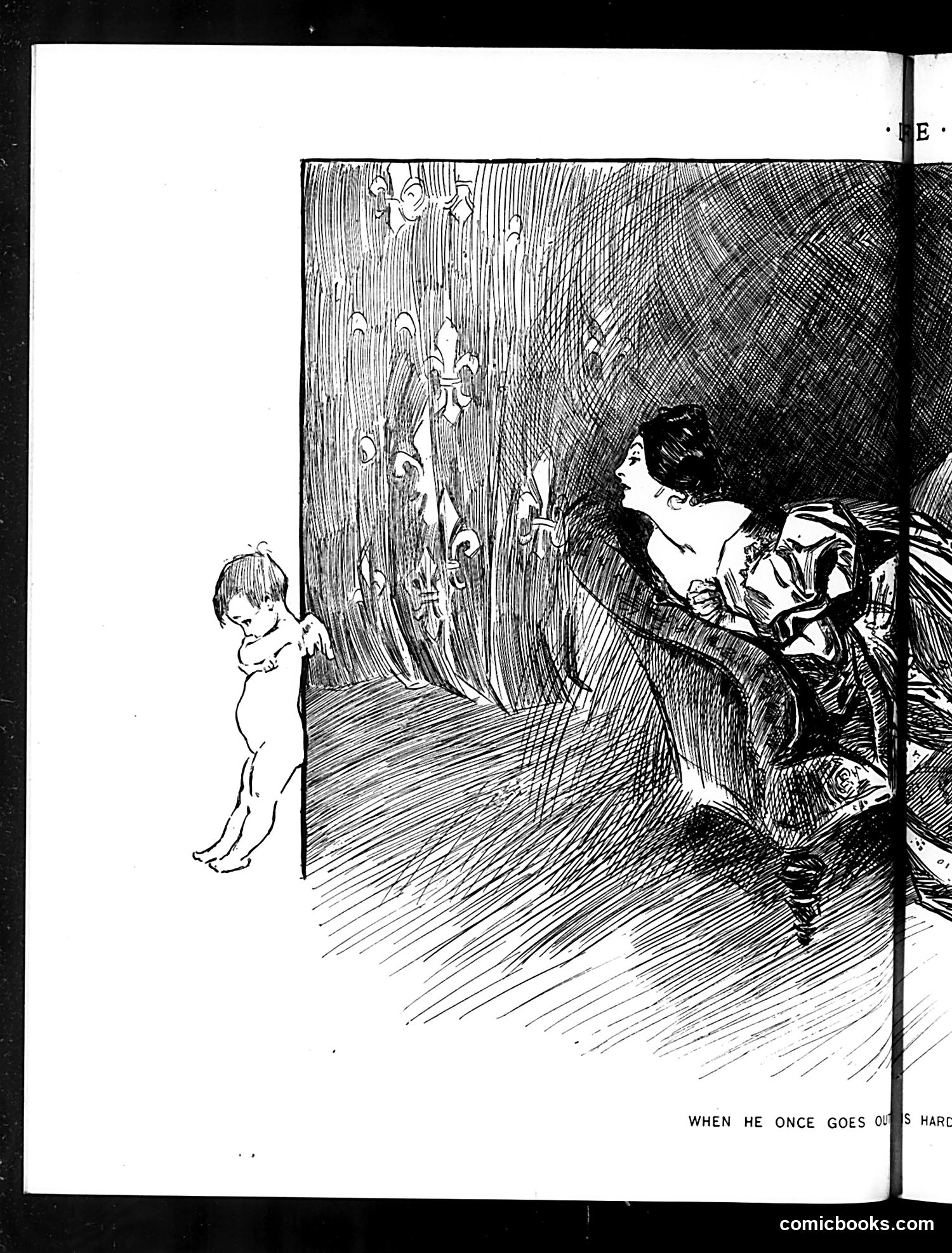
This appears to be a satirical illustration from *Life* magazine depicting a scene of moral disapproval. On the left, a nude or partially-clothed child stands alone. On the right, an elegantly-dressed woman (likely representing a society figure or authority) observes with a disapproving expression, accompanied by another figure. The partial caption at bottom reads "WHEN HE ONCE GOES O[FF] S HARD," suggesting commentary on parental discipline or social expectations about child-rearing. The satire likely critiques either: attitudes toward childhood innocence, hypocrisy in social morality standards, or parental/societal responses to children's behavior. The contrast between the vulnerable child and the judgmental observer emphasizes the satirical point about moral standards or parenting approaches of the era.
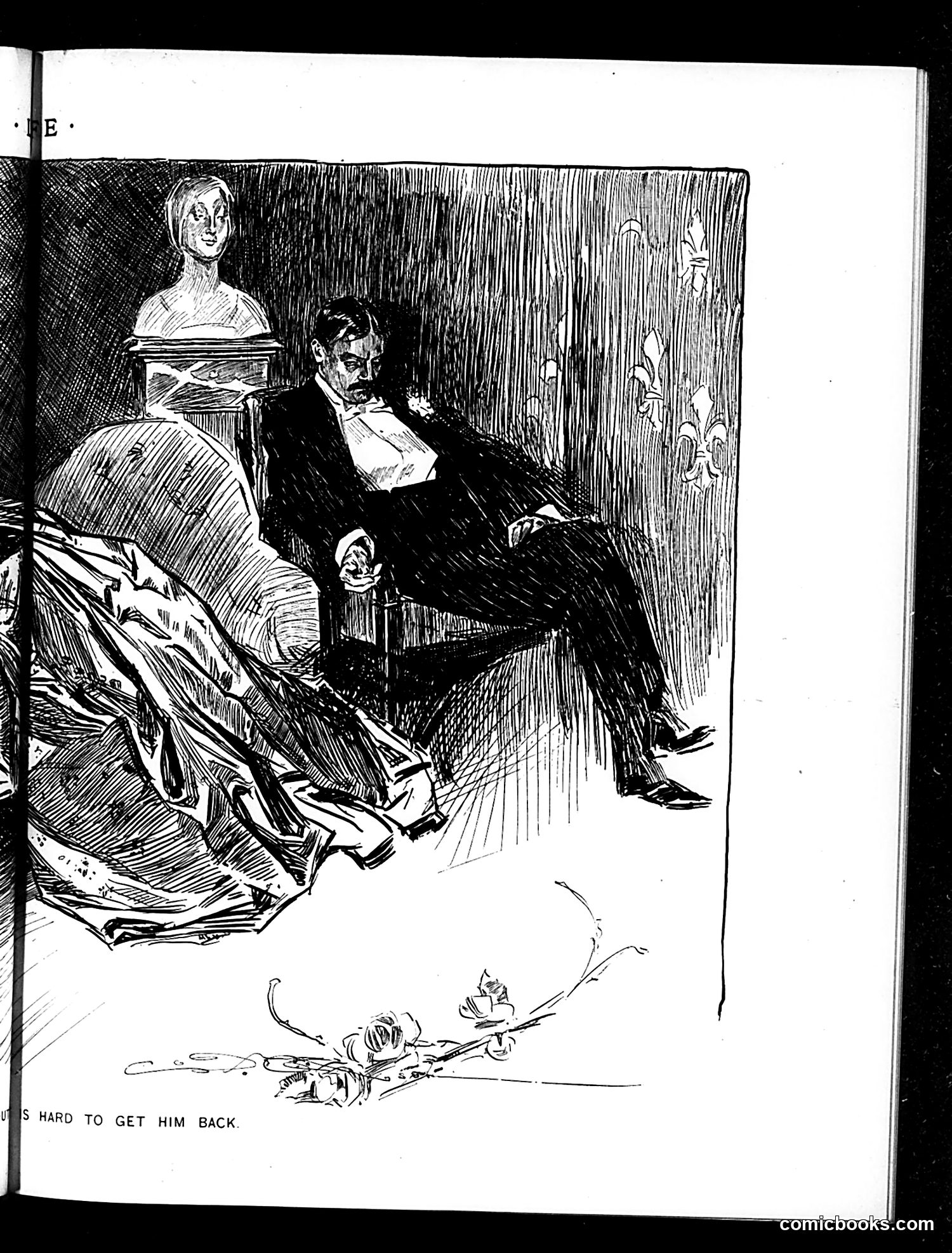
This appears to be a satirical cartoon from Life magazine showing a wealthy man in formal attire reclining in a chair, with a bust sculpture visible behind him. The caption reads "S HARD TO GET HIM BACK." The joke likely concerns a man of means whose expensive tastes or lifestyle make him difficult to "get back" — either financially or socially. The bust sculpture suggests classical refinement or artistic pretension, while his lounging posture conveys leisure and indulgence. The satire appears aimed at the idle wealthy classes and their self-indulgent habits. Without additional context about the specific issue date or identifiable figures, the precise target remains unclear, but the general point mocks upper-class excess and inaccessibility.
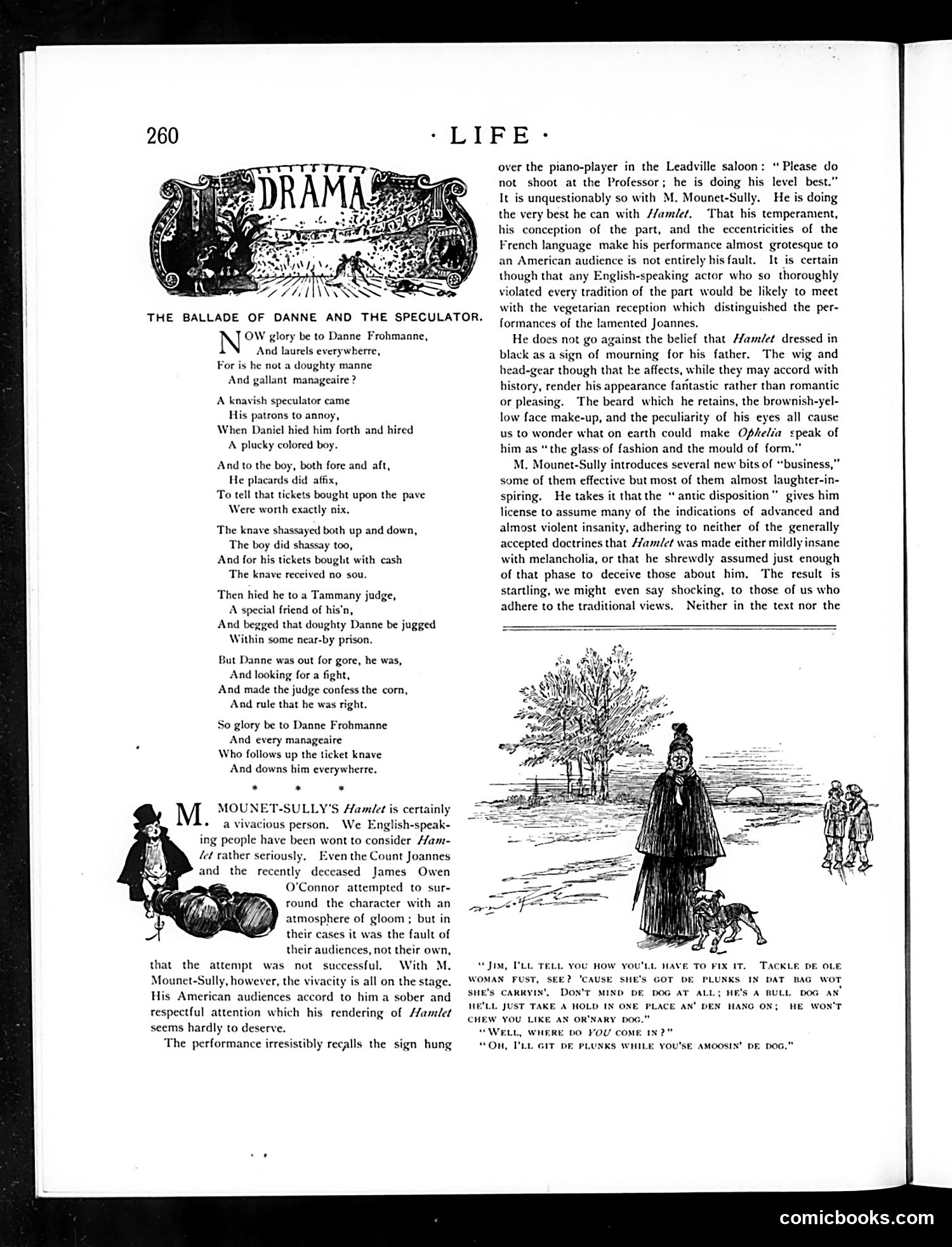
This page contains a satirical poem about theatrical ticket scalping and a critique of French actor M. Mounet-Sully's American performance of *Hamlet*. **"The Ballade of Danne and the Speculator"** celebrates theater manager Daniel Frohman's victory against a ticket scalper. A speculator hired a Black boy to sell counterfeit tickets on the street; Frohman countered by posting disclaimers and brought the case before a Tammany Hall judge (referencing NYC's corrupt political machine). Frohman "won" and exposed the judge's corruption. **The Hamlet critique** mocks Mounet-Sully's unconventional, physically comedic interpretation. Life argues his exaggerated mannerisms, peculiar makeup, and "antic disposition" violate theatrical tradition. The comparison to a saloon sign reading "Please do not shoot at the Professor"—suggesting tolerating bad performances—implies American audiences were undeservedly patient with his grotesque portrayal. The bottom illustration and dialogue appear to be unrelated genre humor about dogs and tickets.
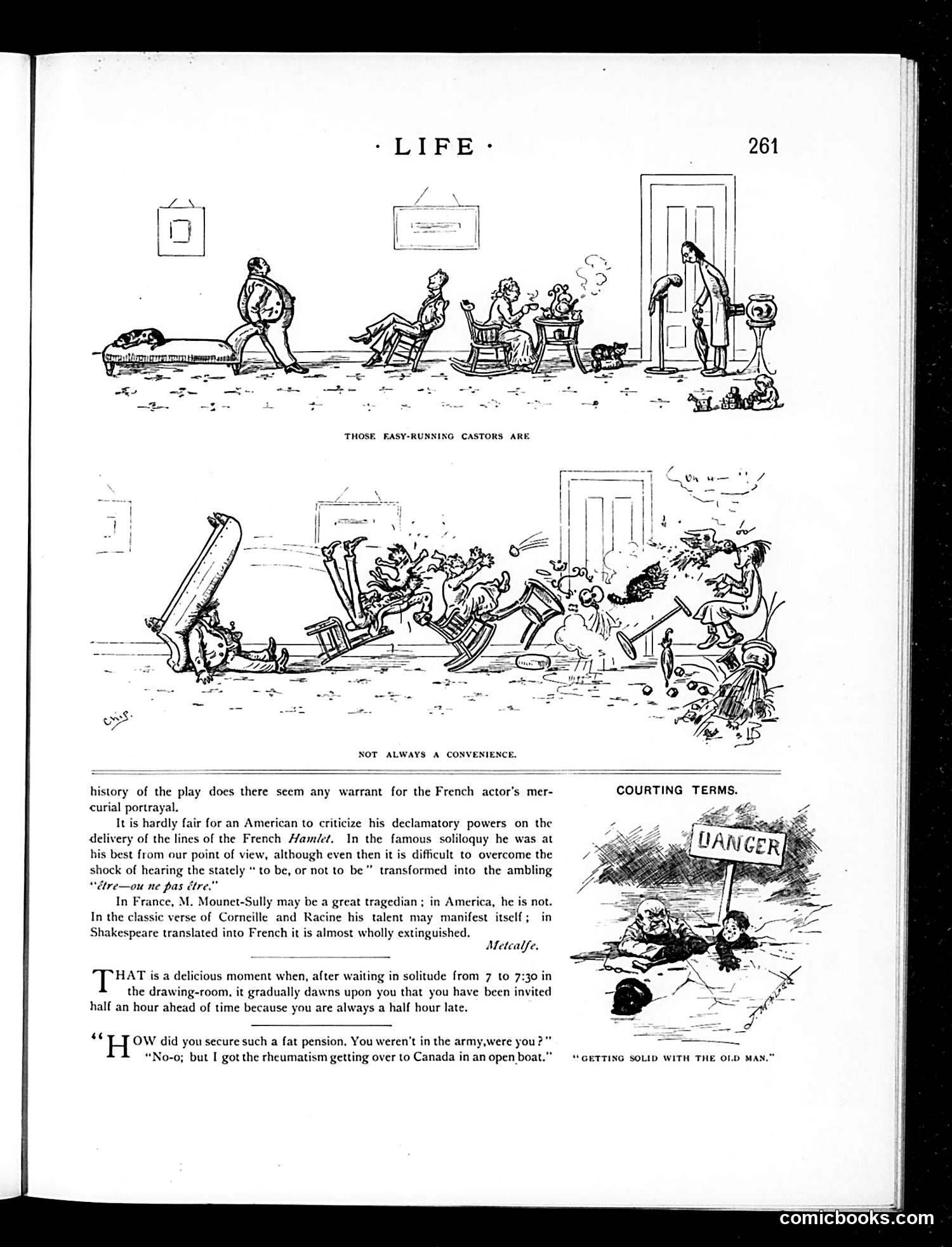
This page contains three satirical cartoons mocking early 20th-century inconveniences and social awkwardness. **Top two cartoons**: "Those Easy-Running Castors Are Not Always a Convenience" contrasts furniture with wheels working smoothly in an orderly home versus creating chaos when children play with them—a joke about how labor-saving devices can backfire. **Bottom cartoon**: "Courting Terms" shows a young man trying to impress an older father figure ("Getting Solid with the Old Man") by claiming he earned a military pension through hardship rather than service—a darkly humorous comment on how people exaggerate hardships to gain status or approval. The accompanying text discusses French actor Mounet-Sully's performance of *Hamlet* in French, criticizing his theatrical style, and includes a joke about chronic lateness making guests arrive early to compensate. The satire targets social pretension, family dynamics, and the gap between appearance and reality in Edwardian society.
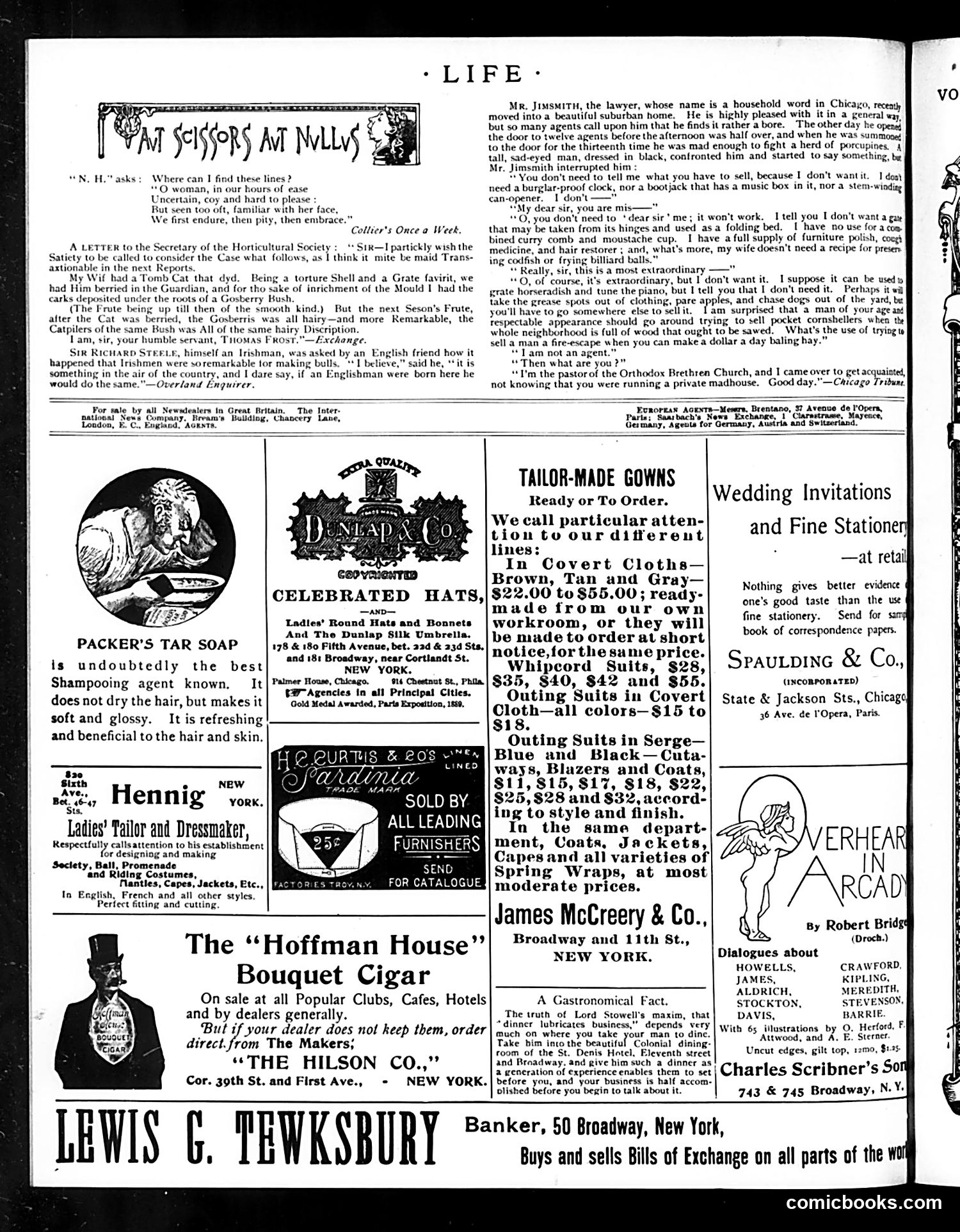
This *Life* magazine page collects brief satirical pieces mocking human folly and miscommunication. The main cartoon titled "Am Schoors at Nullus" presents humorous anecdotes, including: **"The Case of the Tomb Cat"**: A letter to a horticultural society claiming that after burying a dead cat under a gooseberry bush, the subsequent fruit grew hairy—implying the cat somehow altered plant growth. The satire mocks pseudoscientific reasoning and absurd cause-and-effect logic. **Sir Richard Steele anecdote**: Steele (an Irish-born English writer) humorously explains why Irishmen are known for making "bulls" (logical blunders)—blaming the Irish air itself. **Mr. Jimsmith story**: A Chicago lawyer, bombarded by salesmen, launches an increasingly unhinged rant rejecting increasingly absurd products (a music-box bootjack, a curry comb-mustache cup hybrid), only to discover he's been haranguing a *pastor* trying to introduce himself neighborly. The humor lies in his paranoid misreading of innocent intentions. The page satirizes gullibility, miscommunication, and the absurdities of modern commercial life.