
Life, 1894-04-19 · page 12 of 14
Life — April 19, 1894 — page 12: what you’re looking at
What you’re looking at
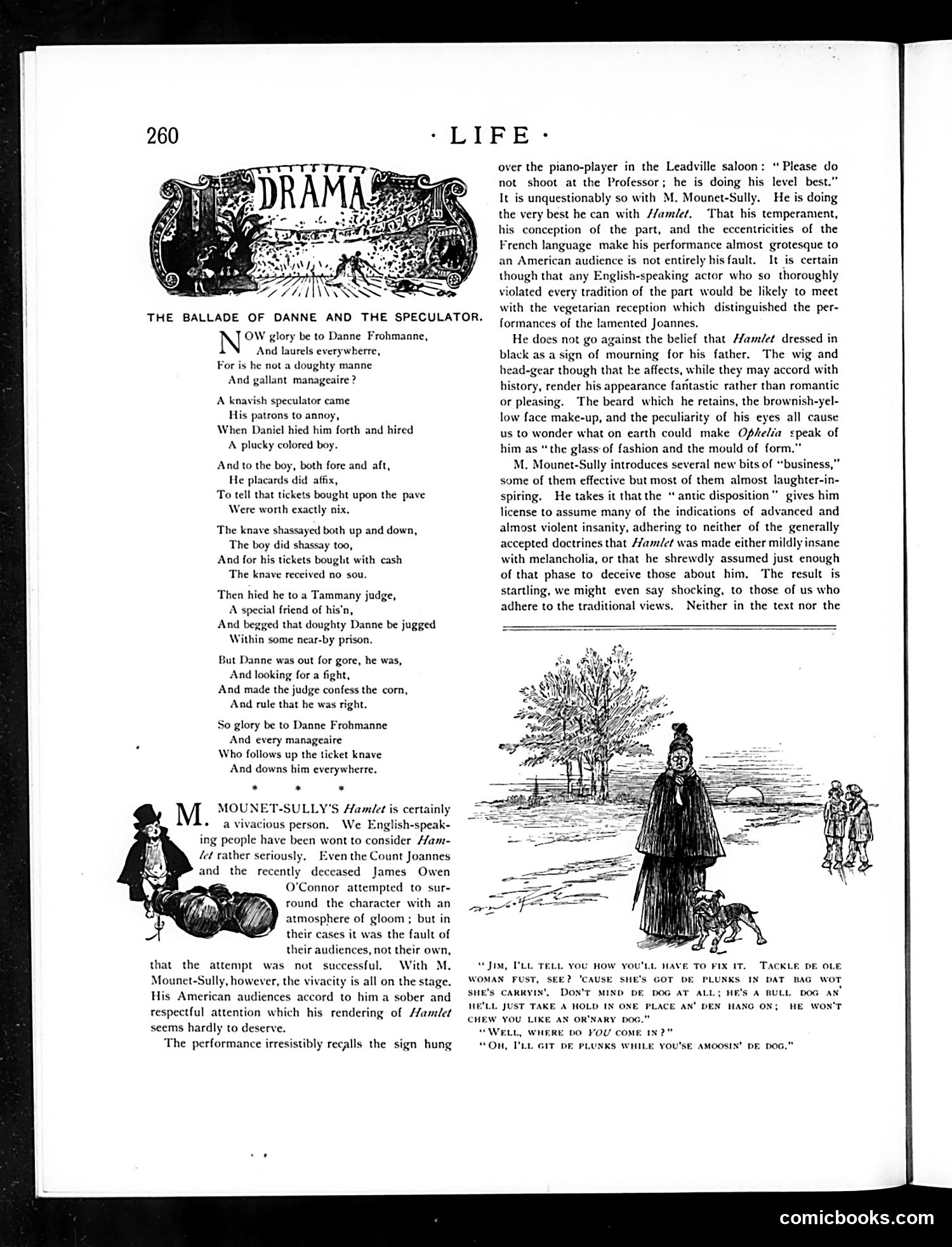
This page contains a satirical poem about theatrical ticket scalping and a critique of French actor M. Mounet-Sully's American performance of *Hamlet*. **"The Ballade of Danne and the Speculator"** celebrates theater manager Daniel Frohman's victory against a ticket scalper. A speculator hired a Black boy to sell counterfeit tickets on the street; Frohman countered by posting disclaimers and brought the case before a Tammany Hall judge (referencing NYC's corrupt political machine). Frohman "won" and exposed the judge's corruption. **The Hamlet critique** mocks Mounet-Sully's unconventional, physically comedic interpretation. Life argues his exaggerated mannerisms, peculiar makeup, and "antic disposition" violate theatrical tradition. The comparison to a saloon sign reading "Please do not shoot at the Professor"—suggesting tolerating bad performances—implies American audiences were undeservedly patient with his grotesque portrayal. The bottom illustration and dialogue appear to be unrelated genre humor about dogs and tickets.
📄 Transcribed text from this page (OCR, searchable)
Machine-transcribed from the original scan — historical spelling and the odd misread are preserved.
- LIFE: THE BALLADE OF DANNE AND THE SPECULATOR. OW glory be to Danne Frohmaane, And laurels everywhere, For is he not a doughty manne And gallant manageaire ? A knavish speculator came His patrons to annoy, When Daniel hied him forth and hired A plucky colored boy. And to the boy, both fore and aft, He placards did affix, To tell that tickets bought upon the pave Were worth exactly nix. The knave shassayed both up and down, The boy did shassay too, And for his tickets bought with cash The knave received no sou. Then hied he to a Tammany judge, A special friend of his'n, And begged that doughty Danne be jugged Within some near-by prison. But Danne was out for gore, he was, And looking for a fight, And made the judge confess the corn, And rule that he was right. So glory be to Danne Frohmanne And every manageaire Who follows up the ticket knave And downs him everywherre. . ing people have been wont to consider Ham- det rather seriously. Even the Count Joannes and the recently deceased James Owen O'Connor attempted to sur- round the character with an atmosphere of gloom ; but in their cases it was the fault of their audiences, not their own, that the attempt was not successful. With M. Mounet-Sully, however, the vivacity is all on the stage. His American audiences accord to hima sober and respectful attention which his rendering of /amtlet seems hardly to deserve. The performance irresistibly recalls the sign hung over the piano-player in the Leadville saloon: ‘“ Please do not shoot at the Professor; he is doing his level best.” It is unquestionably so with M. Mounet-Sully. He is doing the very best he can with //amlef, That his temperament, his conception of the part, and the eccentricities of the French language make his performance almost grotesque to an American audienc not entirely his fault. It is certain though that any English-speaking actor who so thoroughly violated every tradition of the part would be likely to meet with the vegetarian reception which distinguished the per- formances of the lamented Joannes. He does not go against the belief that Hamlet dressed in black as a sign of mourning for his father. The wig and bead-gear though that ke affects, while they may accord with history, render his appearance fantastic rather than romantic or pleasing. The beard which he retains, the brownish-yel- low face make-up, and the peculiarity of his eyes all cause us to wonder what on earth could make Opselia speak of him as “the glass:of fashion and the mould of form. M. Mounet-Sully introduces several new bits of “business, some of them effective but most of them almost laughter- spiring. He takes it thatthe “ antic disposition” gives him license to assume many of the indications of advanced and almost violent insanity, adhering to neither of the generally accepted doctrines that am/et was made either mildly insane with melancholia, or that he shrewdly assumed just enough of that phase to deceive those about him. The result is startling, we might even say shocking, to those of us who adhere to the traditional views. Neither in the text nor the “Jim, PLL TELL you How WOMAN FUST, SEE? ‘CAUSE se’ SHE'S CARRY Don't MIND DE HE'LL JUST TAKE A HOLD IN ON CHEW YOU LIKE AN OR'NARY 0 “WELL, WHERE DO YOU COME IN?” “On, Lt Git DE PLUD WHILE Yo HAVE TO FIX IT. TACKLE DE OLE OT DE PLUNKS IN DAT BAG woT DOG AT ALL; HE'S A BULL DOG AN’ PLACE AN’ HANG ON; HE WON'T E AMOOSIN’ DE DOG.” comicbooks.com