
Life, 1894-04-19 · page 4 of 14
Life — April 19, 1894 — page 4: what you’re looking at
What you’re looking at
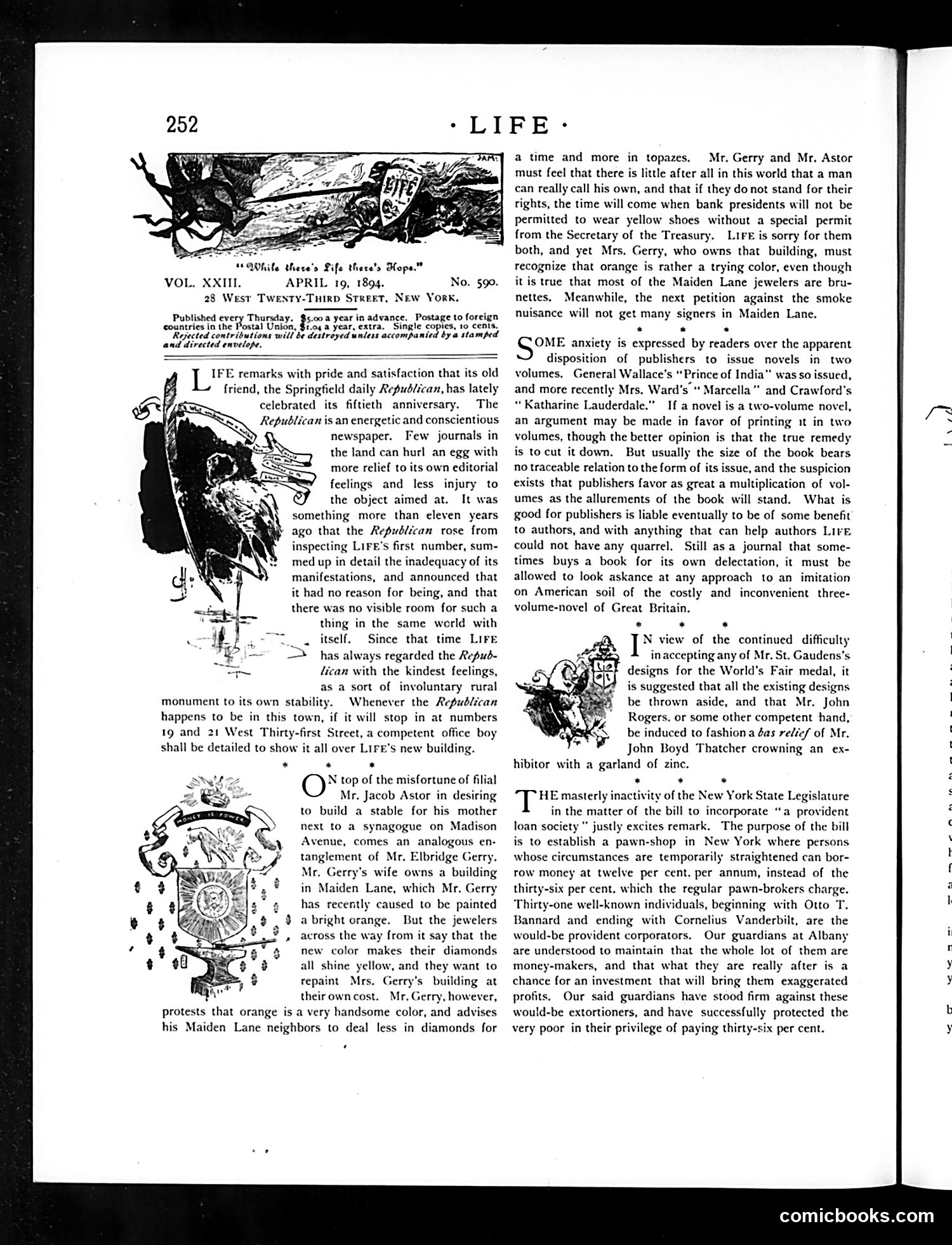
This page contains editorial commentary rather than political cartoons. The text discusses two main issues: 1. **The Springfield Republican newspaper's anniversary**: Life praises the newspaper for its long-standing editorial integrity, noting it has always supported honest journalism. 2. **Maiden Lane jewelry disputes**: The editorial addresses conflicts between Mr. Gerry (likely a building owner) and Mr. Astor over property rights on Maiden Lane in New York. Mrs. Gerry's building was painted orange, which Mr. Gerry argues enhances diamonds but which neighbors dislike. The piece satirizes wealthy property owners' disputes over building aesthetics. 3. **A proposed pawn-loan bill**: The text criticizes the New York State Legislature's inactivity regarding legislation to establish a provident loan society to help poor people at reasonable interest rates (twelve percent annually instead of thirty-six percent). The page uses satire to critique both petty wealthy disputes and legislative neglect of working-poor citizens.
📄 Transcribed text from this page (OCR, searchable)
Machine-transcribed from the original scan — historical spelling and the odd misread are preserved.
* LIFE: — “OWhile there's Life there's Hops.” VOL. XXIII. APRIL 19, 1894. 28 West TWENTY-THIRD STRE! No. 590. New York. Published every Thursday. $s.oo year in advance. Postage to foreign countries in the Postal Union, $1.04 a year, extra. Single copies, 10 cents, Rejected contributions will be destroyed unless accompanied bya stamped and directed envelope. IFE remarks with pride and satisfaction that its old friend, the Springfield daily Repudvican, has lately celebrated its fiftieth anniversary, The Republican is an energetic and conscientious newspaper. Few journals in the land can hurl an egg with more relief to its own editorial feelings and less injury to the object aimed at. It was something more than eleven years ago that the Republican rose from inspecting LiFE’s first number, sum- med up in detail the inadequacy of its manifestations, and announced that it had no reason for being, and that there was no visible room for such a thing in the same werld with _« itself. Since that time LiFE — has always regarded the Repub- “ican with the kindest feelings, as a sort of involuntary rural monument to its own stability. Whenever the Republican happens to be in this town, if it will stop in at numbers 19 and 21 West Thirty-first Street, a competent office boy shall be detailed to show it all over LiFE’s new building. . . \ top of the misfortune of filial Mr. Jacob Astor in desiring to build a stable for his mother next to a synagogue on Madison Avenue, comes an analogous en- tanglement of Mr. Elbridge Gerry. Mr. Gerry's wife owns a building in Maiden Lane, which Mr. Gerry has recently caused to be painted a bright orange. But the jewelers across the way from it say that the new color makes their diamonds all shine yellow, and they want to repaint. Mrs. Gerry's building at their owncost. Mr. Gerry, however, protests that orange is a very handsome color, and advises his Maiden Lane neighbors to deal less in diamonds for a time and more in topazes. Mr. Gerry and Mr. Astor must feel that there is little after all in this world that a man can really call his own, and that if they do not stand for their rights, the time will come when bank presidents will not be permitted to wear yellow shoes without a special permit from the Secretary of the Treasury. LIFE is sorry for them both, and yet Mrs. Gerry, who owns that building, must recognize that orange is rather a trying color, even though it is true that most of the Maiden Lane jewelers are bru- nettes. Meanwhile, the next petition against the smoke nuisance will not get many signers in Maiden Lane. * « . OME anxiety is expressed by readers over the apparent disposition of publishers to issue novels in two volumes. General Wallace's “Prince of India” was so issued, and more recently Mrs, Ward's “ Marcella” and Crawford's “ Katharine Lauderdale.” If a novel is a two-volume novel, an argument may be made in favor of printing it in two volumes, though the better opinion is that the true remedy is to cut it down. But usually the size of the book bears no traceable relation to the form of its issue, and the suspicion exists that publishers favor as great a multiplication of vol- umes as the allurements of the book will stand. What is good for publishers is liable eventually to be of some benefit to authors, and with anything that can help authors Lire could not have any quarrel. Still as a journal that some- times buys a book for its own delectation, it must be allowed to look askance at any approach to an imitation on American soil of the costly and inconvenient three- volume-novel of Great Britain, . . . ]* view of the continued difficulty in accepting any of Mr. St. Gaudens’s designs for the World's Fair medal, it is suggested that all the existing designs be thrown aside, and that Mr. John Rogers. or some other competent hand, be induced to fashion a bas relief of Mr. John Boyd Thatcher crowning an ex- hibitor with a garland of zinc. . . . HE masterly inactivity of the New York State Legislature in the matter of the bill to incorporate “a provident loan society ” justly excites remark. The purpose of the bill is to establish a pawn-shop in New York where persons whose circumstances are temporarily straightened can bor- row money at twelve per cent. per annum, instead of the thirty-six per cent, which the regular pawn-brokers charge. Thirty-one well-known individuals, beginning with Otto T. Bannard and ending with Cornelius Vanderbilt, are the would-be provident corporators. Our guardians at Albany are understood to maintain that the whole lot of them are money-makers, and that what they are really after is a chance for an investment that will bring them exaggerated profits. Our said guardians have stood firm against these would-be extortioners, and have successfully protected the very poor in their privilege of paying thirty-six per cent. comicbooks.com