
A complete issue · 22 pages · 1894
Life — March 22, 1894
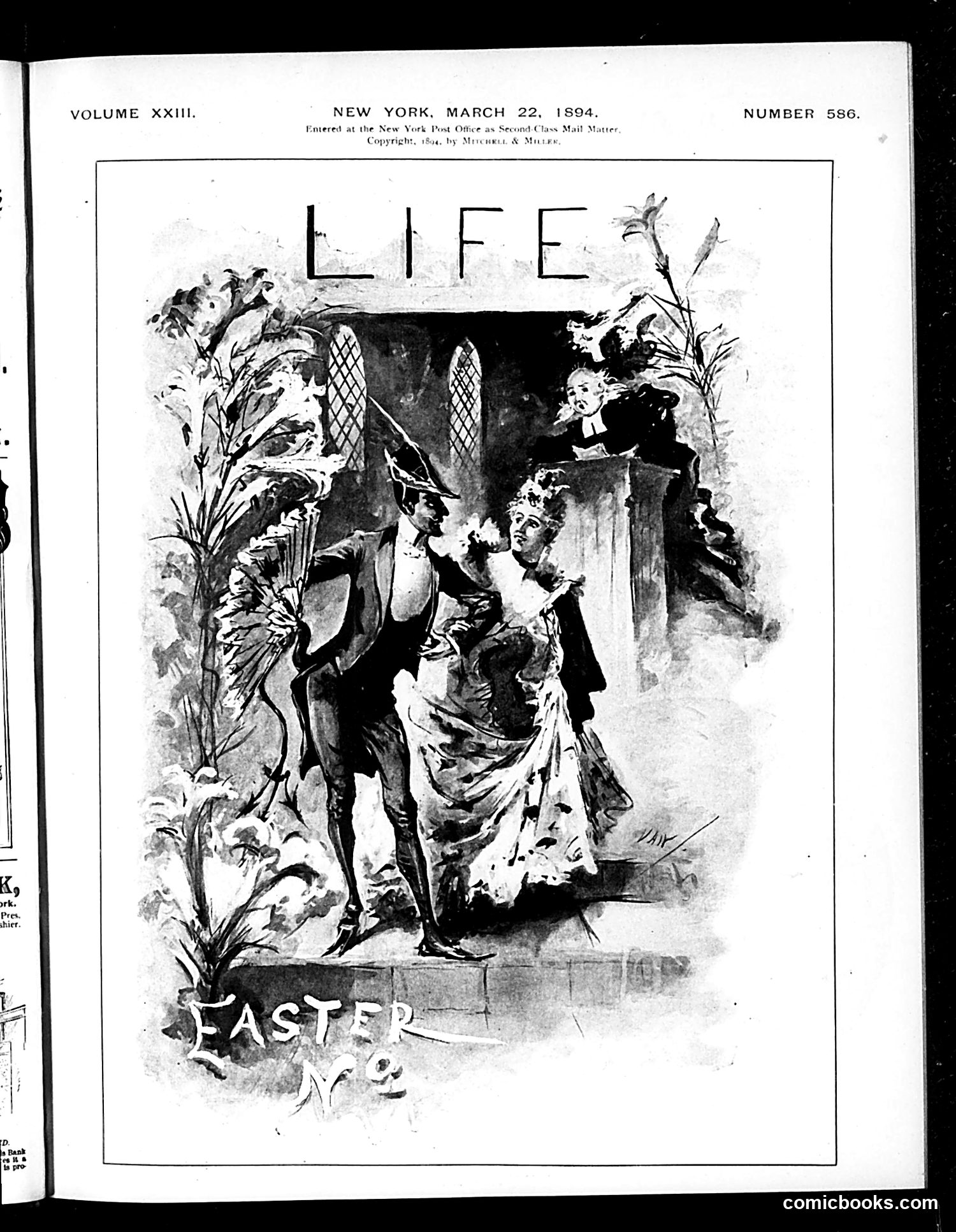
This is a "Life/Easter" cover illustration depicting an elegant social scene. A well-dressed man in formal attire stands with two fashionably dressed women near a doorway, with flowering plants flanking the composition. A third figure appears in the background. The illustration exemplifies the magazine's satirical approach to high society and social manners during the Gilded Age. The ornate dress, carefully posed figures, and domestic setting suggest commentary on courtship rituals, social pretense, or romantic entanglements among the upper classes—typical subjects of *Life* magazine's humor. The Easter theme connects to themes of renewal and spring courtship, common satirical subjects of the era. Without additional text visible, the specific social critique remains unclear, though the elegant staging suggests gentle mockery of Victorian-era social conventions and romantic conventions.
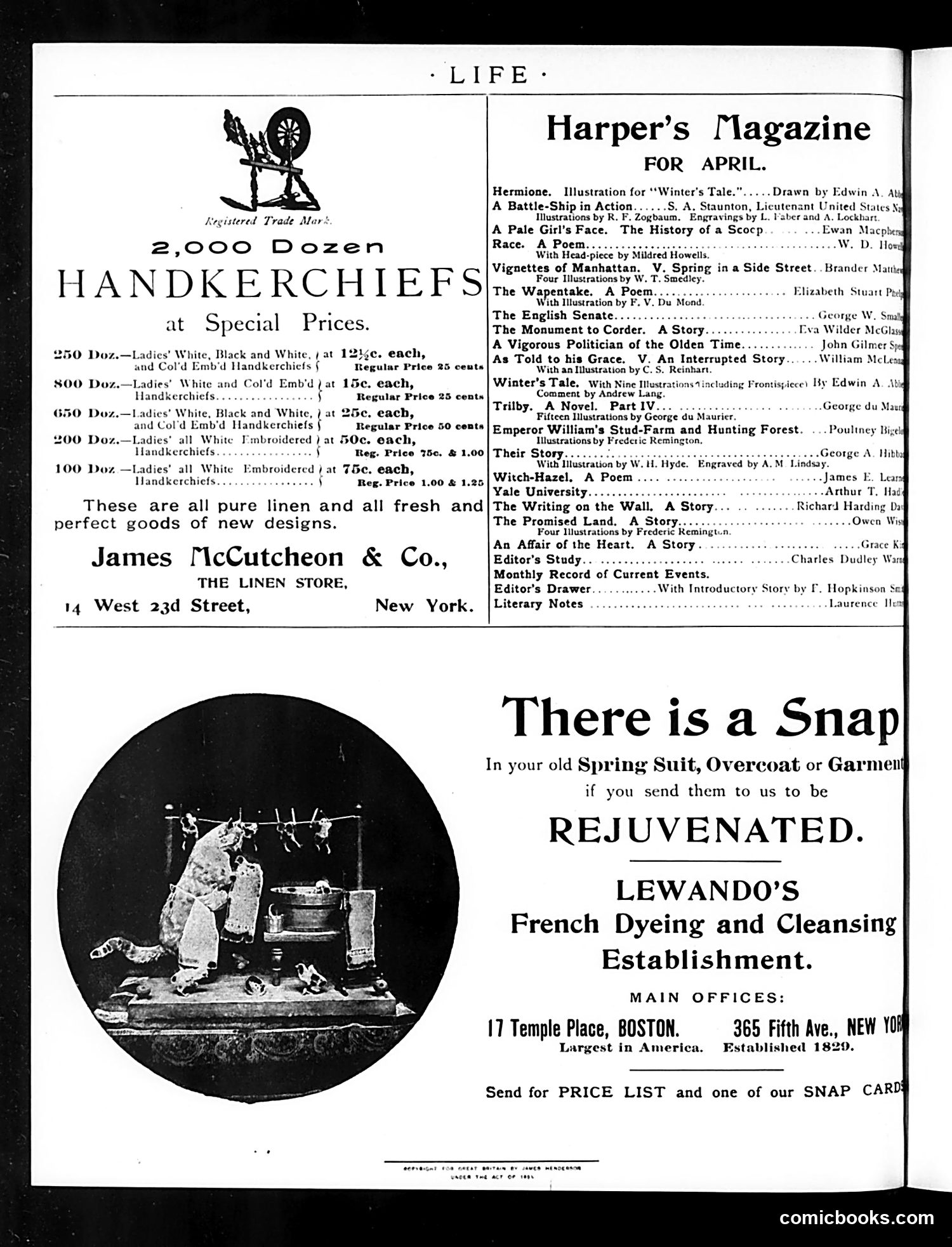
This page consists primarily of **advertisements** rather than editorial cartoons or political satire. The top half features ads for handkerchiefs (James McCutcheon & Co.) and Harper's Magazine's April contents listing. The lower half shows a **large circular illustration** depicting a figure in what appears to be period clothing doing laundry or cleaning work—likely a domestic scene meant to be humorous or illustrative. The main editorial content advertises **Lewando's French Dyeing and Cleaning Establishment**, emphasizing garment rejuvenation. The circular image supports this commercial message, though the specific joke or satirical point is unclear without additional context about what Lewando's offered or contemporary attitudes toward laundry services. This appears to be a typical turn-of-century magazine page mixing commercial advertising with minimal editorial material.
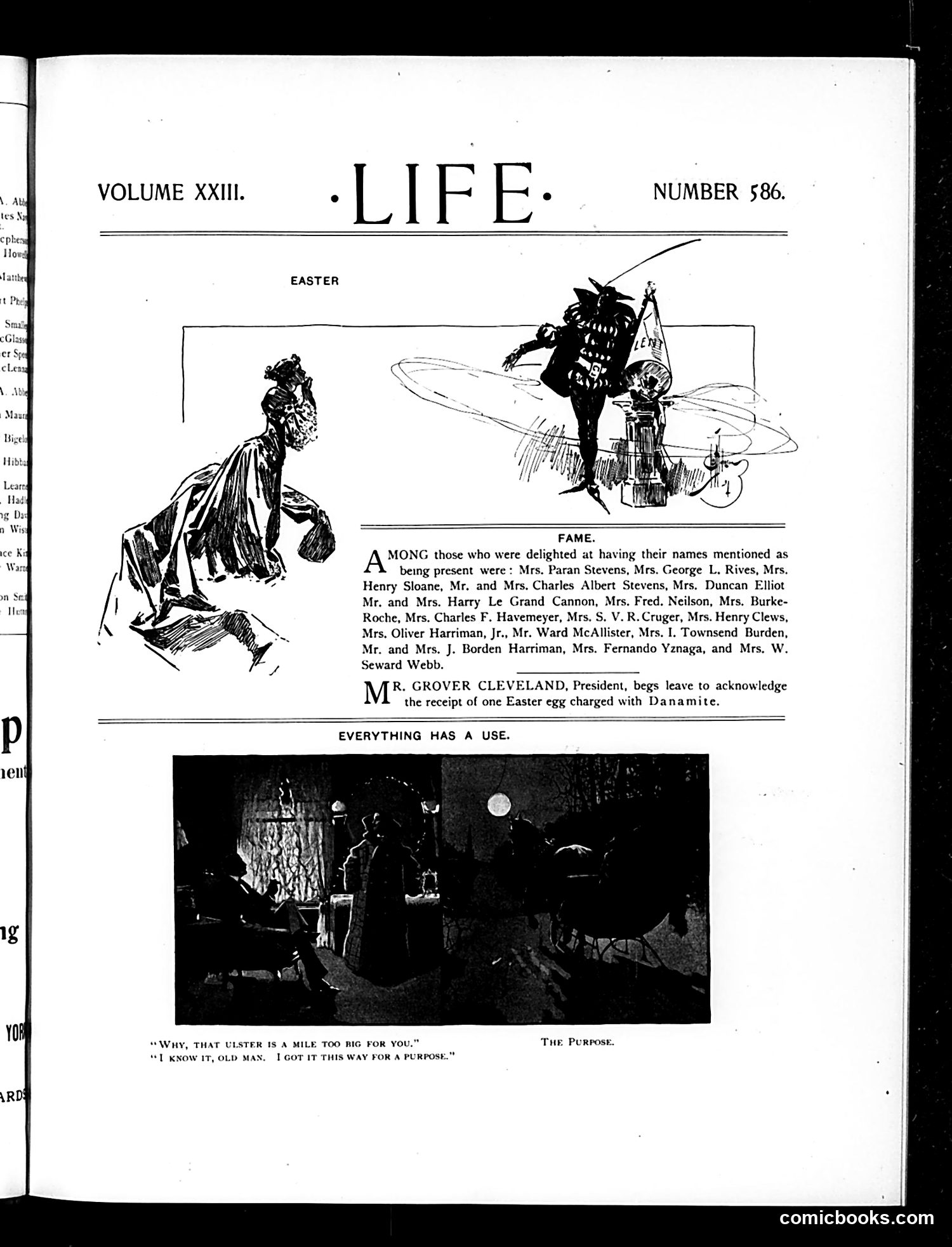
This Easter-themed page contains two satirical items: **"FAME"** section lists prominent attendees at an event, including names like Mrs. Paran Stevens and Mr. Grover Cleveland. Cleveland's note about receiving "one Easter egg charged with Dynamite" is a dark joke referencing anarchist violence that was a serious concern in the late 19th century—dynamite attacks were associated with radical political movements of that era. **"Everything Has a Use"** cartoon depicts a scene titled "The Purpose," with dialogue about an "Ulster" (a type of overcoat) being "too big" but useful as a "purpose." This appears to be wordplay or satire about fashion or practicality, though the specific reference remains unclear without additional context.
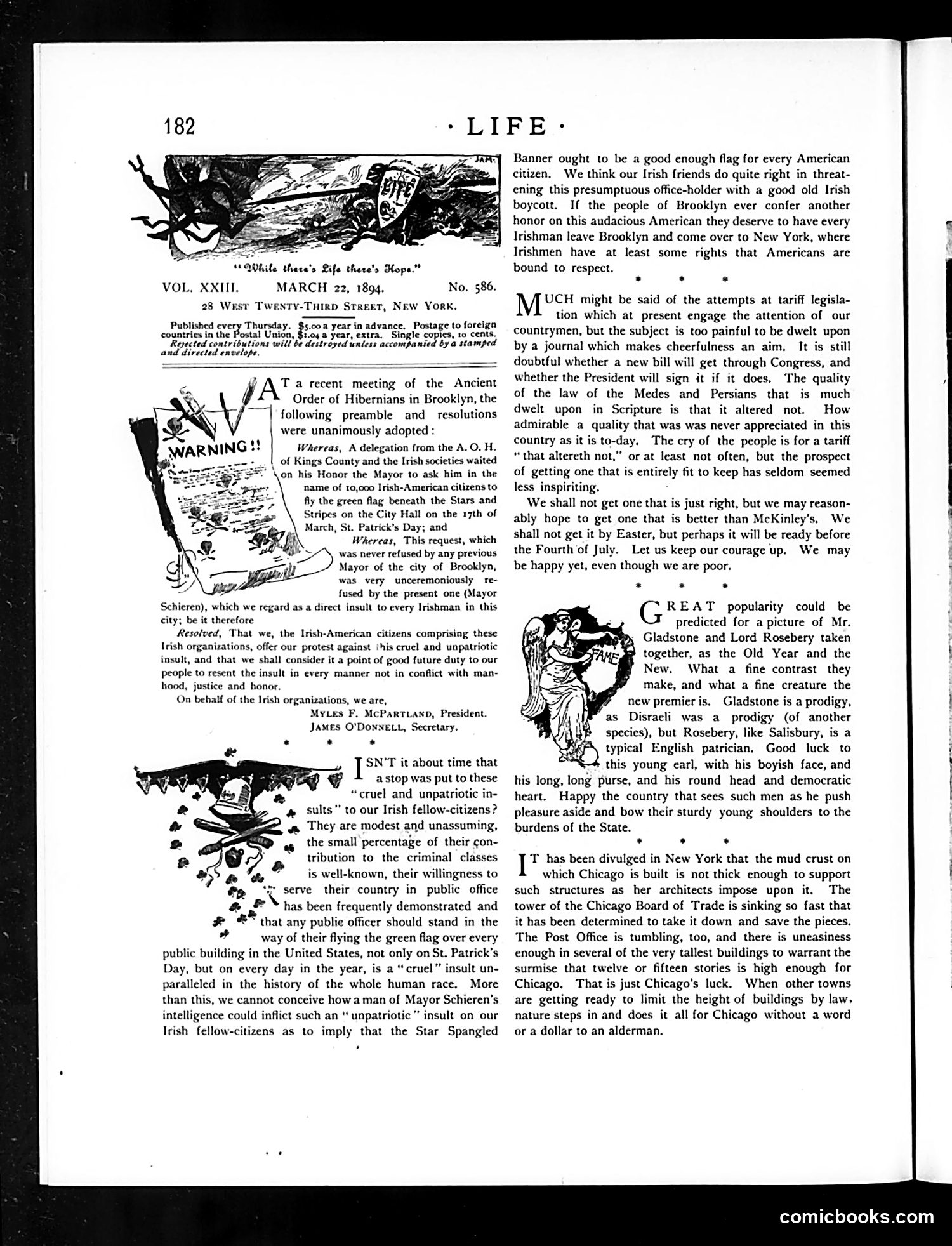
**The Main Cartoon:** The top illustration shows Irish-American organizations protesting Mayor Gould's refusal to display the Irish flag at Brooklyn City Hall on March 17 (St. Patrick's Day). The "WARNING!!" cartoon depicts the controversy: Irish groups demanded the flag be raised alongside the American flag, but the Mayor refused—apparently unprecedented defiance. The organizations protested this as an "unpatriotic insult" to Irish citizens. **The Satire:** Life's editorial mocks this dispute, suggesting Irish-Americans are being hypocritical by demanding flag honors while claiming patriotism. The piece ironically questions whether such "cruel and unpatriotic insults" warrant organized protests, implying the complaint is overblown.
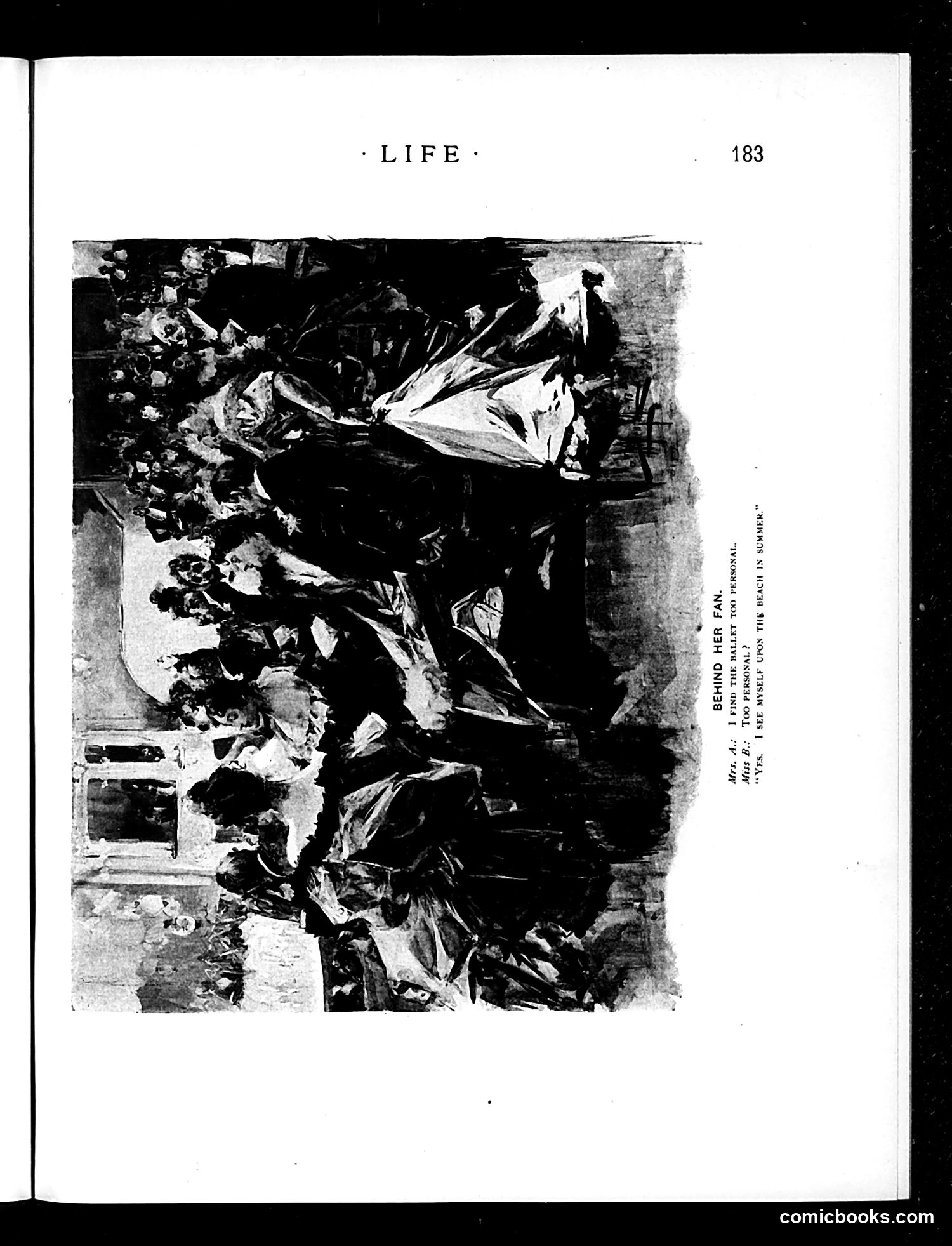
The image shows a chaotic scene that appears rotated 90 degrees, depicting multiple figures in what looks like a dramatic or violent confrontation. The caption reads "BEHIND HER FAN" with additional text mentioning "A Too Gracious Lady" and reference to "I Knew Gracious" and "The Right to Silence." The composition suggests social satire involving gender dynamics—likely about a woman using a fan (a common 19th-century accessory) as cover for observing or participating in improper behavior. The crowded, tangled composition emphasizes the chaos concealed "behind" polite appearances. However, without clearer visibility of individual figures or more specific text, I cannot definitively identify the particular social commentary or specific event being satirized. The satire appears to mock hypocrisy between public propriety and private conduct.
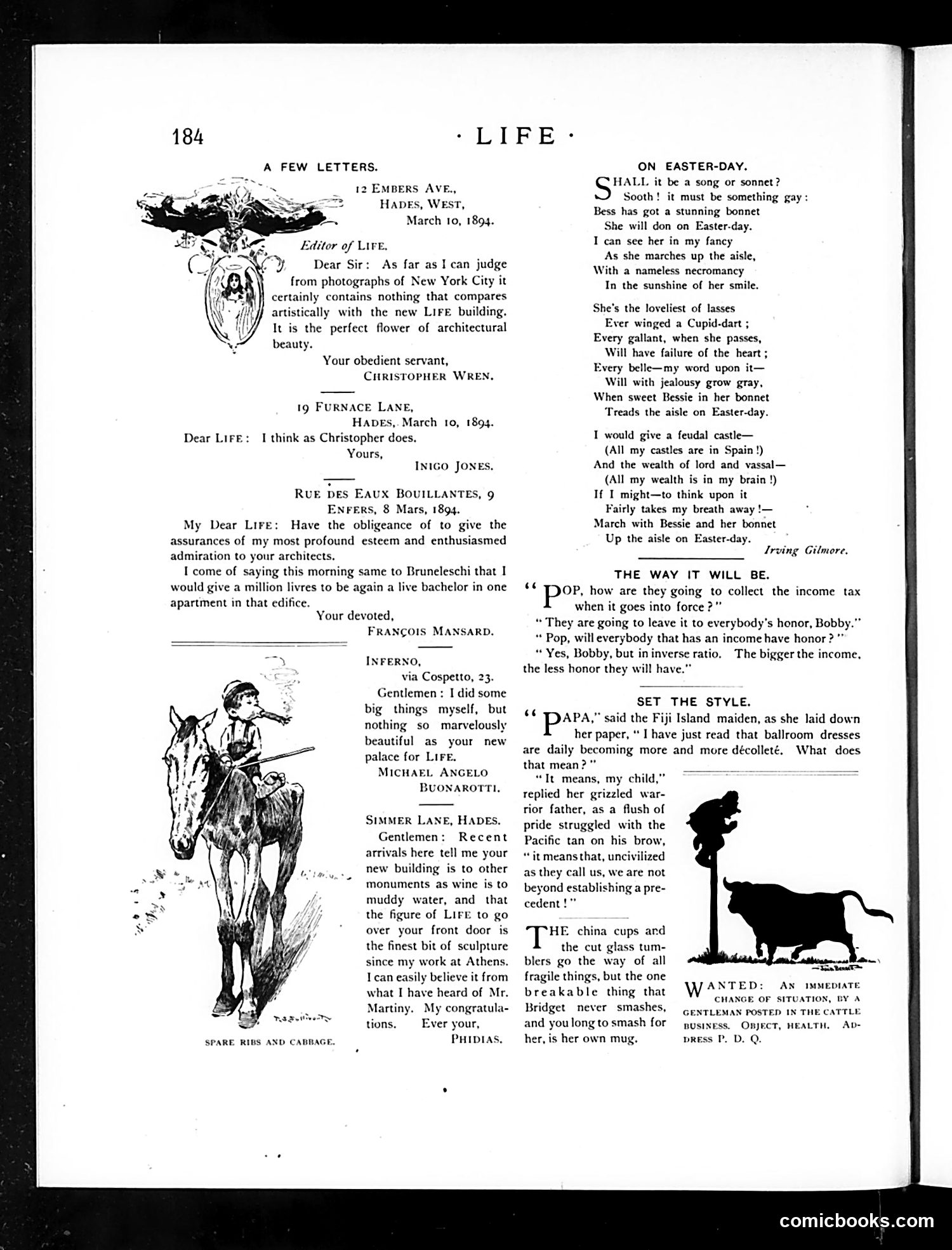
This page contains **letters to the editor** praising the new Life building's architecture, a **poem about Easter fashion**, and several short humor pieces. The cartoon labeled "Spare Ribs and Cabbage" depicts a rider on a thin, skeletal horse—likely satirizing either poverty or the poor condition of horses in urban areas. The accompanying text from "Phidias" compliments Life's new palace building while sarcastically comparing it to monuments, suggesting the magazine takes itself quite seriously. The humor pieces mock contemporary social issues: income tax collection, changing women's fashion (ballroom dresses becoming "more discollete"), and the breakability of dishware. These represent typical Victorian-era concerns about modernity, taxation, and propriety.
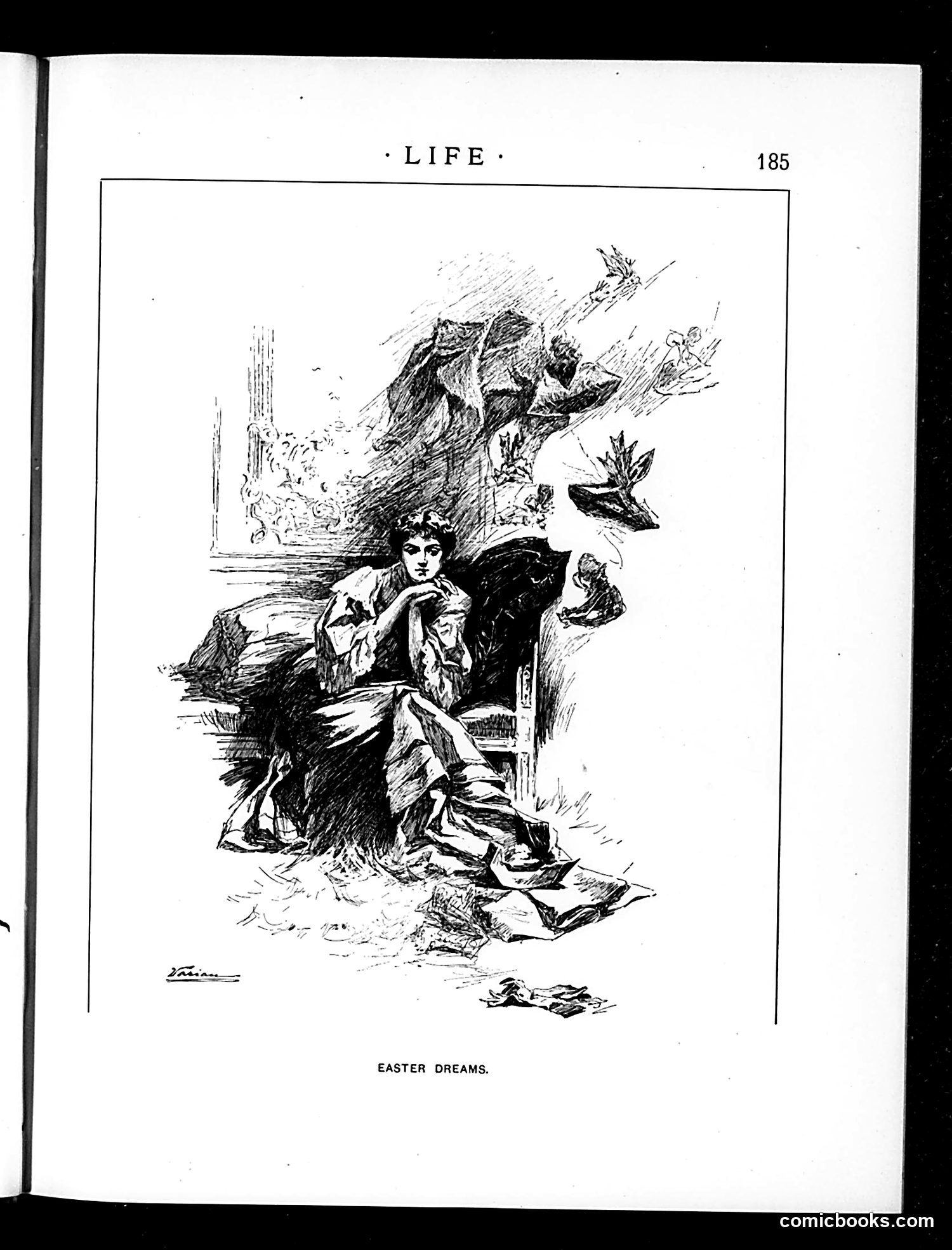
This single-panel cartoon depicts a young woman seated indoors, dressed in elegant clothing with a feathered hat, daydreaming. Above her head swirls a fantastical vision featuring cherubs and decorative elements—appearing to be romantic or whimsical Easter-themed imagery. The satire likely mocks the commercialization of Easter or critiques the romantic daydreams and aspirations society encouraged in young women of that era. The contrast between the woman's mundane indoor reality and her elaborate fantasy suggests commentary on how Easter—originally a religious holiday—had become associated with material consumption, fashion, and sentimental romanticism, particularly among women. The sketch style is characteristic of early 20th-century Life magazine's satirical illustration.
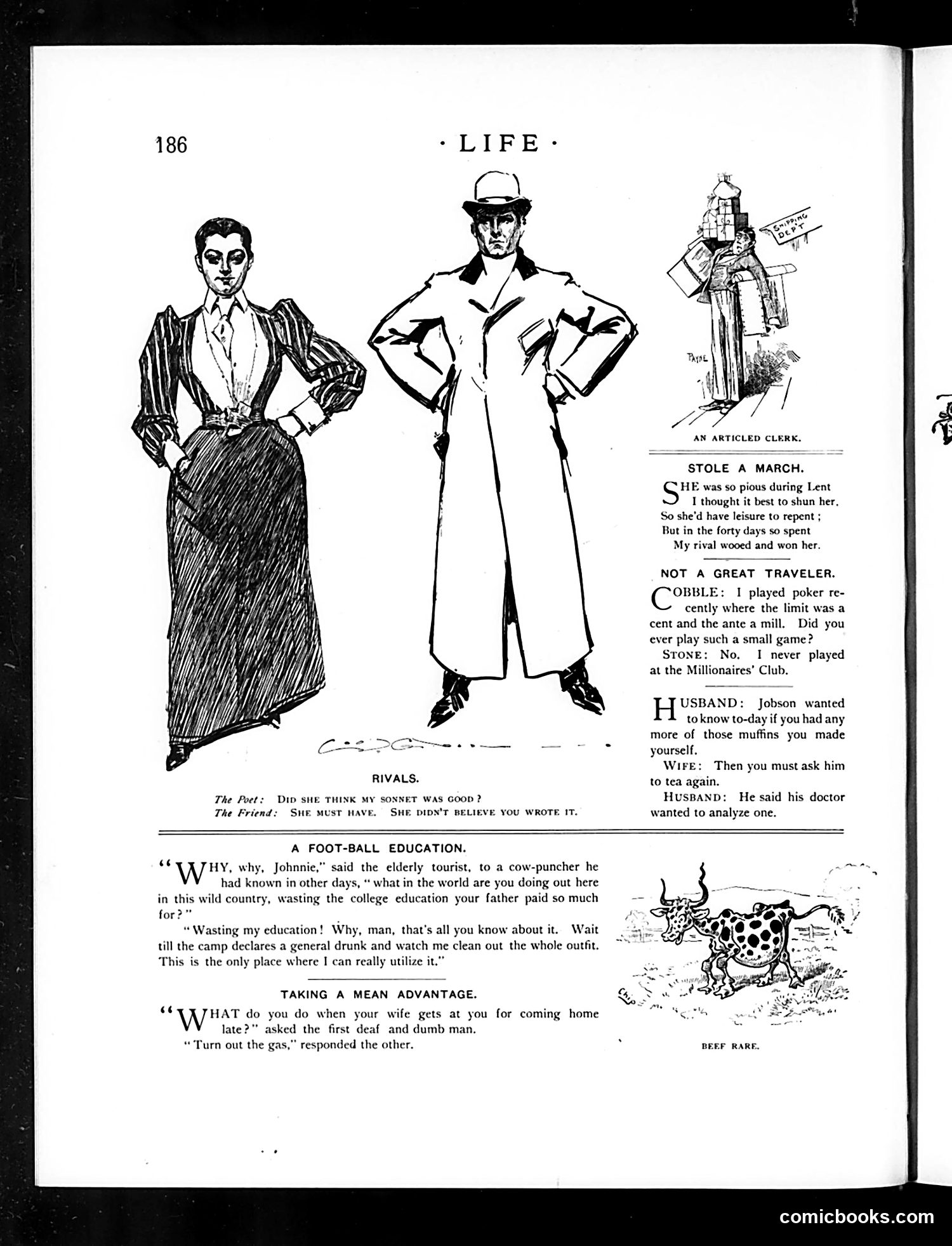
This page contains four unrelated humorous anecdotes and sketches typical of early 20th-century satirical magazines: 1. **"Rivals"** and **"Stole a March"**: Social commentary on courtship and romantic competition, with illustrated figures in period dress. 2. **"An Articled Clerk"**: A sketch of a cluttered office worker carrying excessive belongings—satirizing the disorganized, overburdened clerk class. 3. **"A Foot-Ball Education"** through **"Beef Rare"**: Brief joke pieces about cowboys, education, and marital dynamics—typical period humor targeting masculinity, class differences, and domestic relations. The cartoons employ visual caricature alongside witty text to mock social conventions, gender roles, and contemporary absurdities. No specific political figures are identifiable; the satire targets universal social situations rather than particular events or individuals.
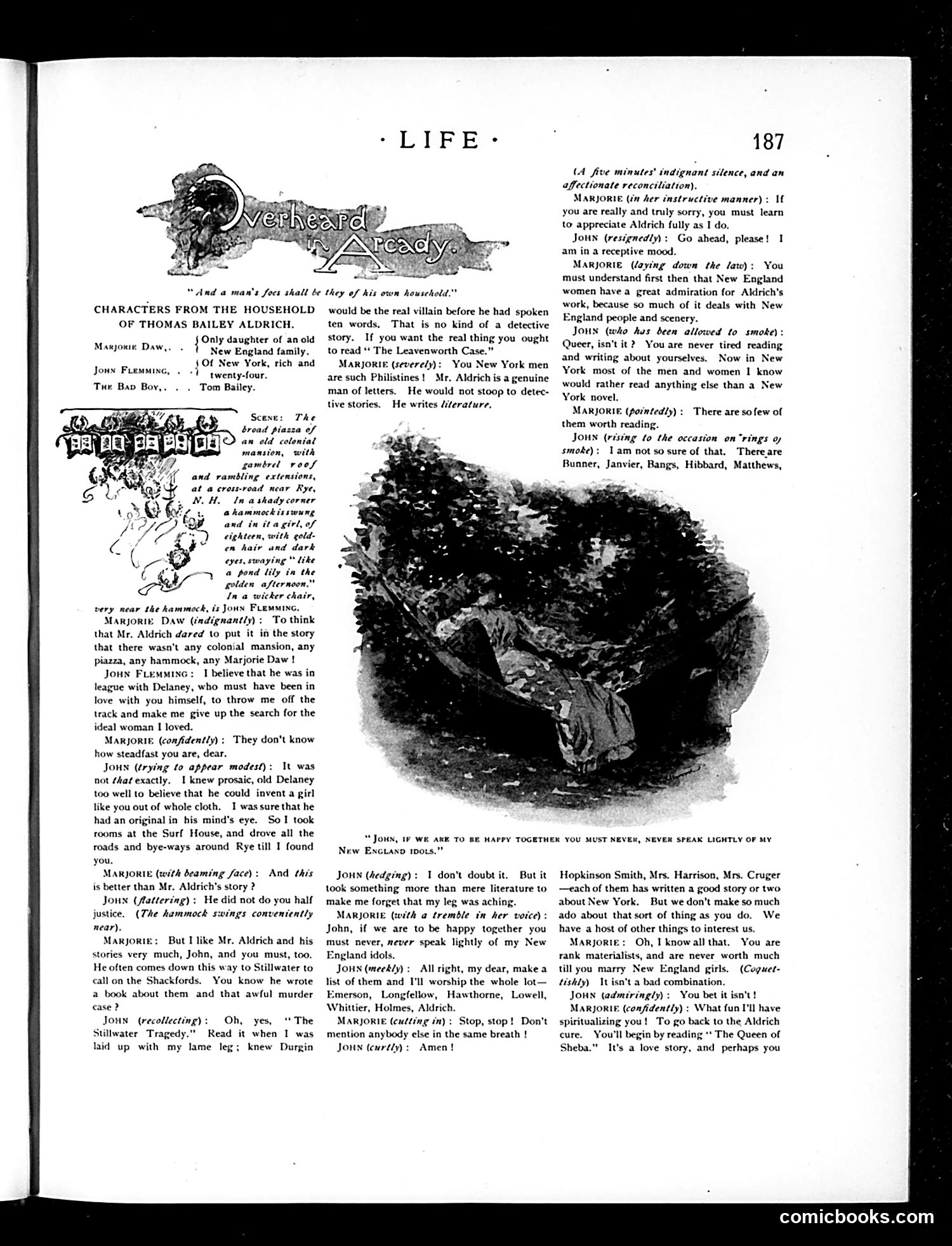
This page features dialogue from what appears to be a theatrical play or serialized story titled "Characters from the Household of Thomas Ashley Aldrich." The main cartoon shows a figure in a chair within an old colonial mansion interior, with period furnishings and architectural details. The dialogue discusses whether Mr. Aldrich included New England settings and colonial elements in his literary work. The characters debate whether Aldrich was writing serious literature or detective fiction, with references to "The Leavensworth Case." The humor stems from literary pretension and the question of whether regional American settings constitute genuine art versus mere popular entertainment—a common satirical theme in Life magazine's commentary on American letters.
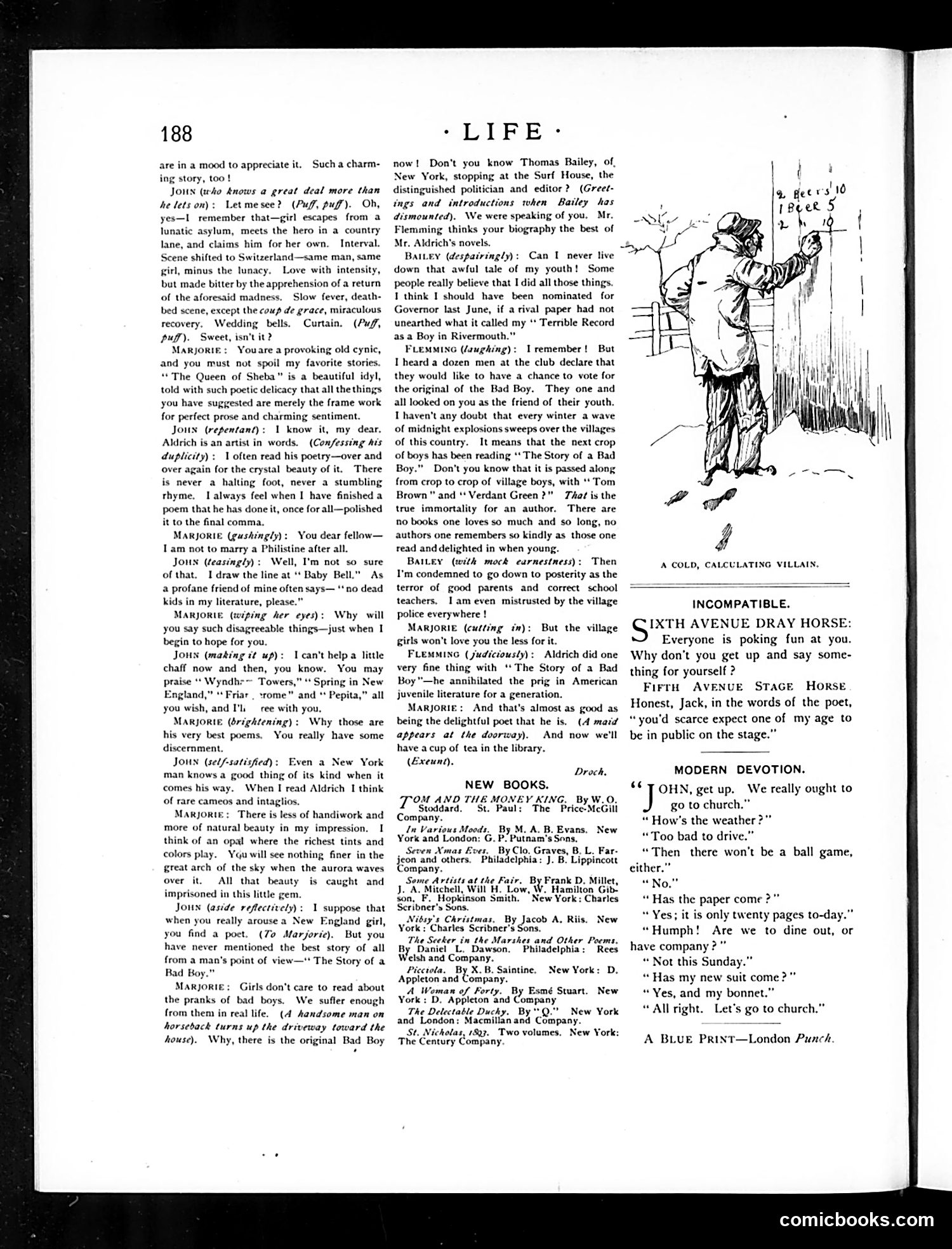
The page contains a satirical dialogue between literary characters discussing Thomas Bailey's work and biography. The main illustration, titled "A COLD, CALCULATING VILLAIN," depicts a gaunt figure in winter clothing—likely representing a literary antagonist or social type being mocked. The text references Bailey's controversial youth stories and his nomination for Governor, suggesting the satire targets both his literary reputation and political ambitions. The characters debate whether his early sensational tales (like "The Story of a Bad Boy") represent genuine talent or mere sensationalism. The "INCOMPATIBLE" and "MODERN DEVOTION" sections below are short humorous sketches about everyday social absurdities—a stage horse complaint and a dialogue about modern courtship priorities—typical of Life's lighter satirical content. The page primarily focuses on literary criticism rather than political commentary.
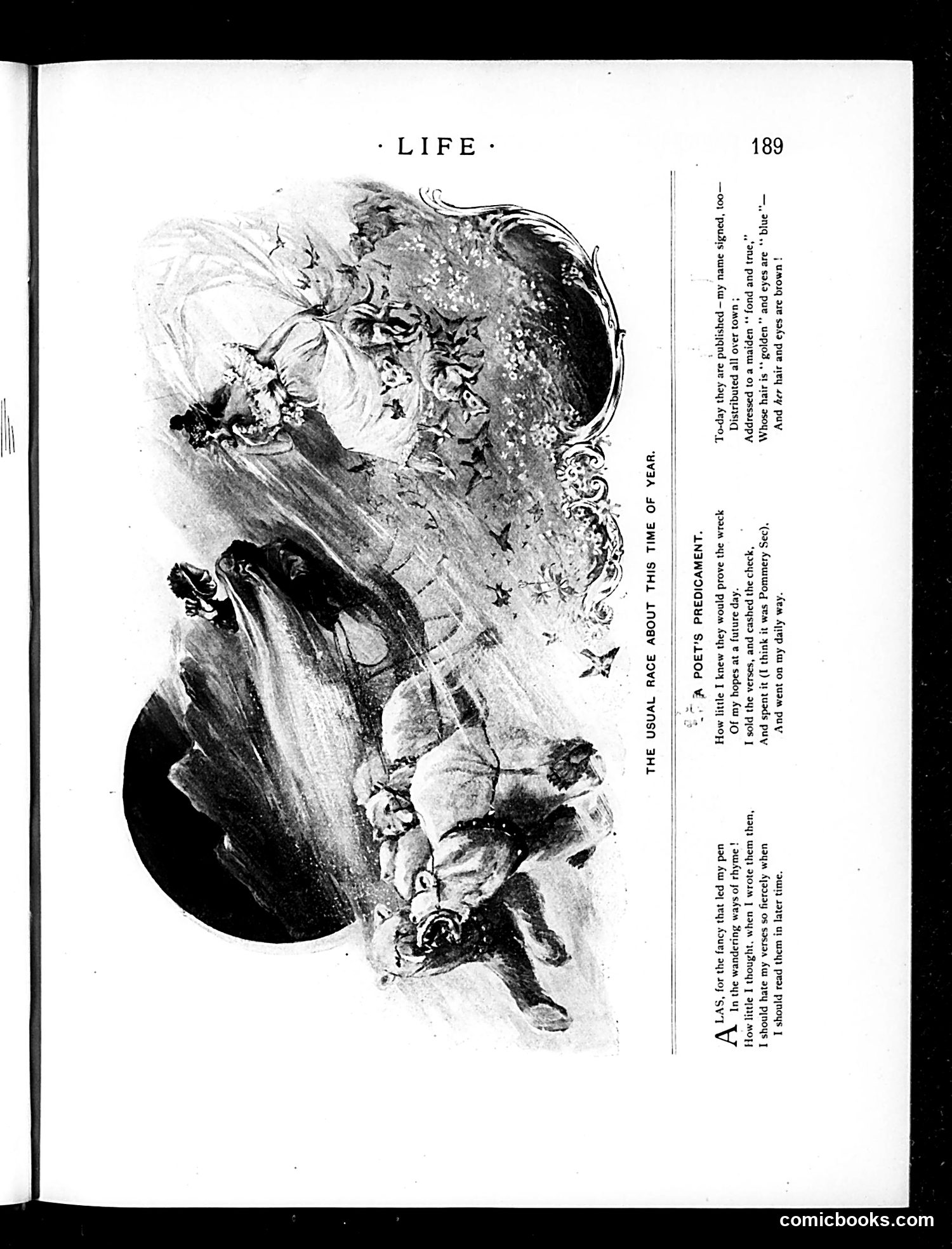
This satirical illustration depicts what appears to be a chaotic horse race among allegorical or caricatured figures. The title suggests this is an annual recurring event—likely referencing seasonal political or social competition. The accompanying verse (partially visible) discusses a "safety bid" and mentions "Primacy Sea," suggesting nautical or maritime metaphors mixed with competitive racing imagery. The sketch shows figures in dynamic, struggling positions around horses and racing elements, rendered in expressive ink work typical of early 20th-century Life magazine satire. Without clearer OCR of the full text or more specific historical dating, the exact political figures or events referenced remain uncertain, though the composition clearly mocks some form of predictable yearly scramble or competition among society's prominent figures.
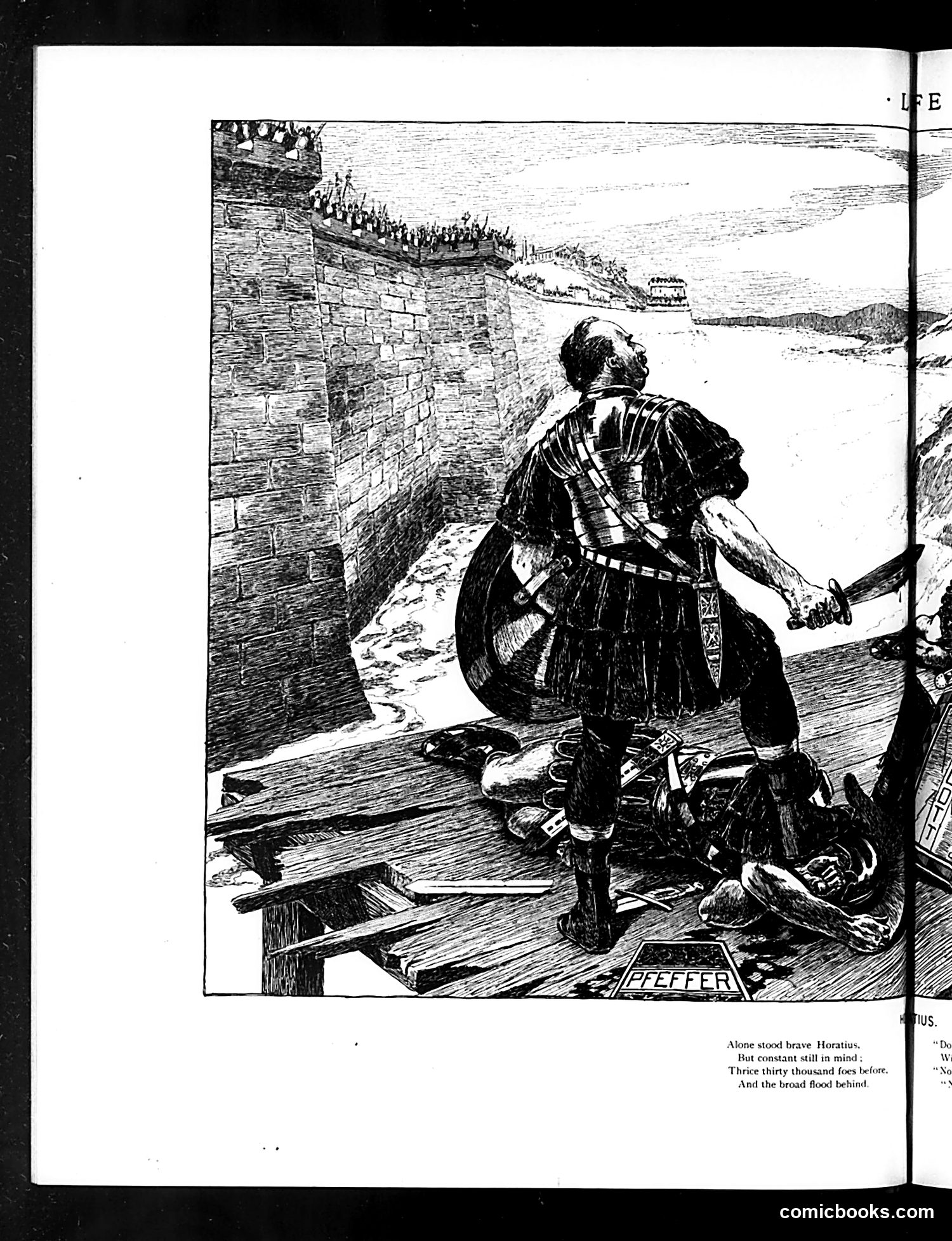
This illustration depicts a scene from Macaulay's famous poem "Lays of Ancient Rome," specifically the legend of Horatius Cocles. The figure shown is the Roman hero Horatius, standing alone at a bridge crossing (visible in background), defending Rome against invading forces. The quoted text describes the famous historical/legendary moment: Horatius holds a narrow bridge against an Etruscan army of "thirty thousand foes" while Romans cut the bridge behind him, forcing him to eventually jump into the river to escape. The image uses this classical Roman heroism narrative—a lone defender against overwhelming odds—as allegorical content. Without additional context about Life magazine's publication date, the specific satirical point remains unclear, though such imagery commonly referenced patriotism, duty, or sacrifice in early 20th-century American periodicals.
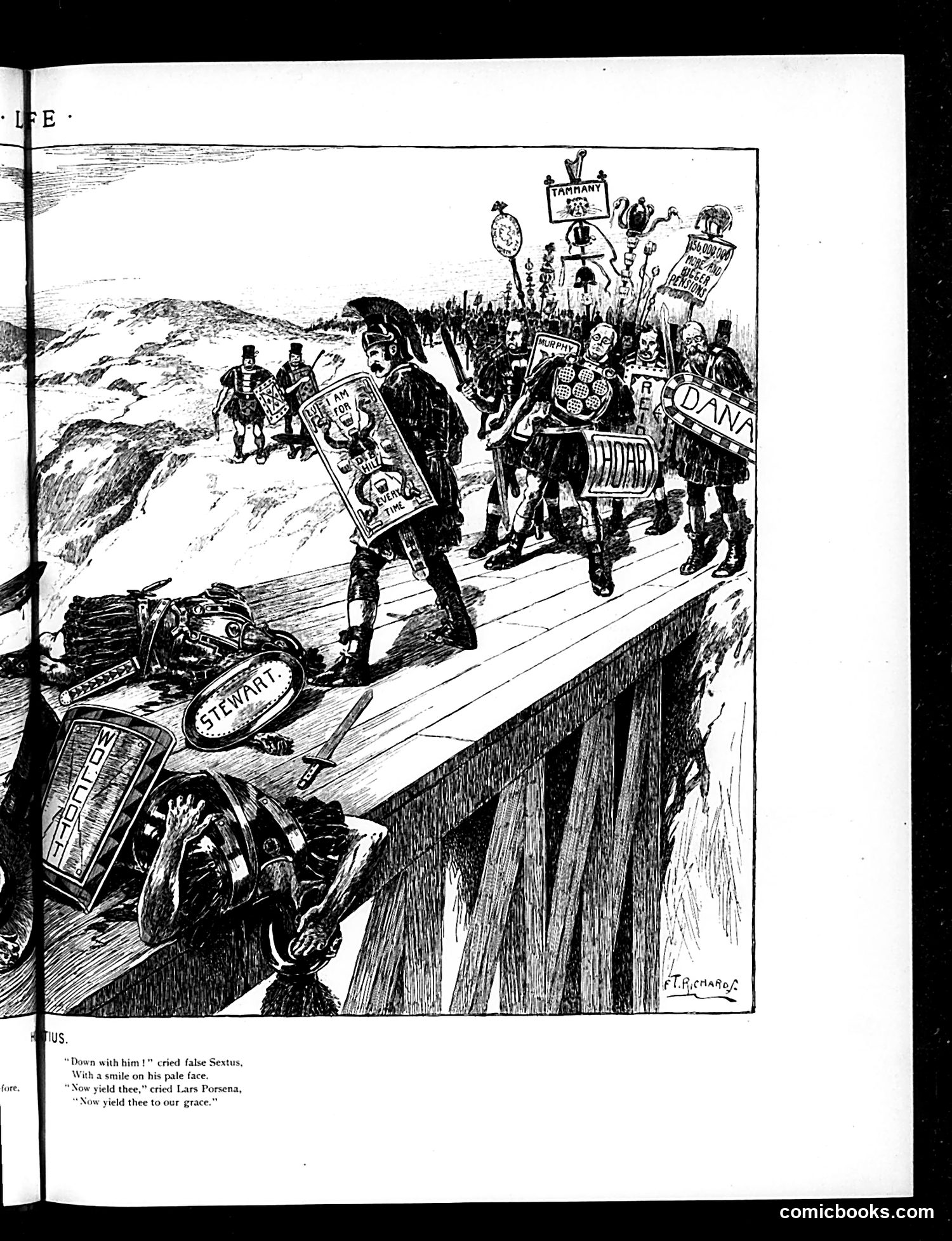
This appears to be a classical/historical allegory rather than contemporary political satire. The image depicts a procession with military figures carrying banners and signs, approaching what looks like a fortified structure or bridge (possibly referencing the famous "Bridge of Horatius" from Roman legend). The quoted text references "false Sextus" and "Lars Porsena," characters from Macaulay's *Lays of Ancient Rome*—a 19th-century poem about Roman heroism. The cartoon likely uses this classical framework to comment on contemporary politics or warfare, with the marching figures and raised banners suggesting conquest or coercion ("yield thee to our grace"). Without publication date context, the exact political target remains unclear, though the militaristic imagery and demand for submission suggest commentary on imperialism or invasion.
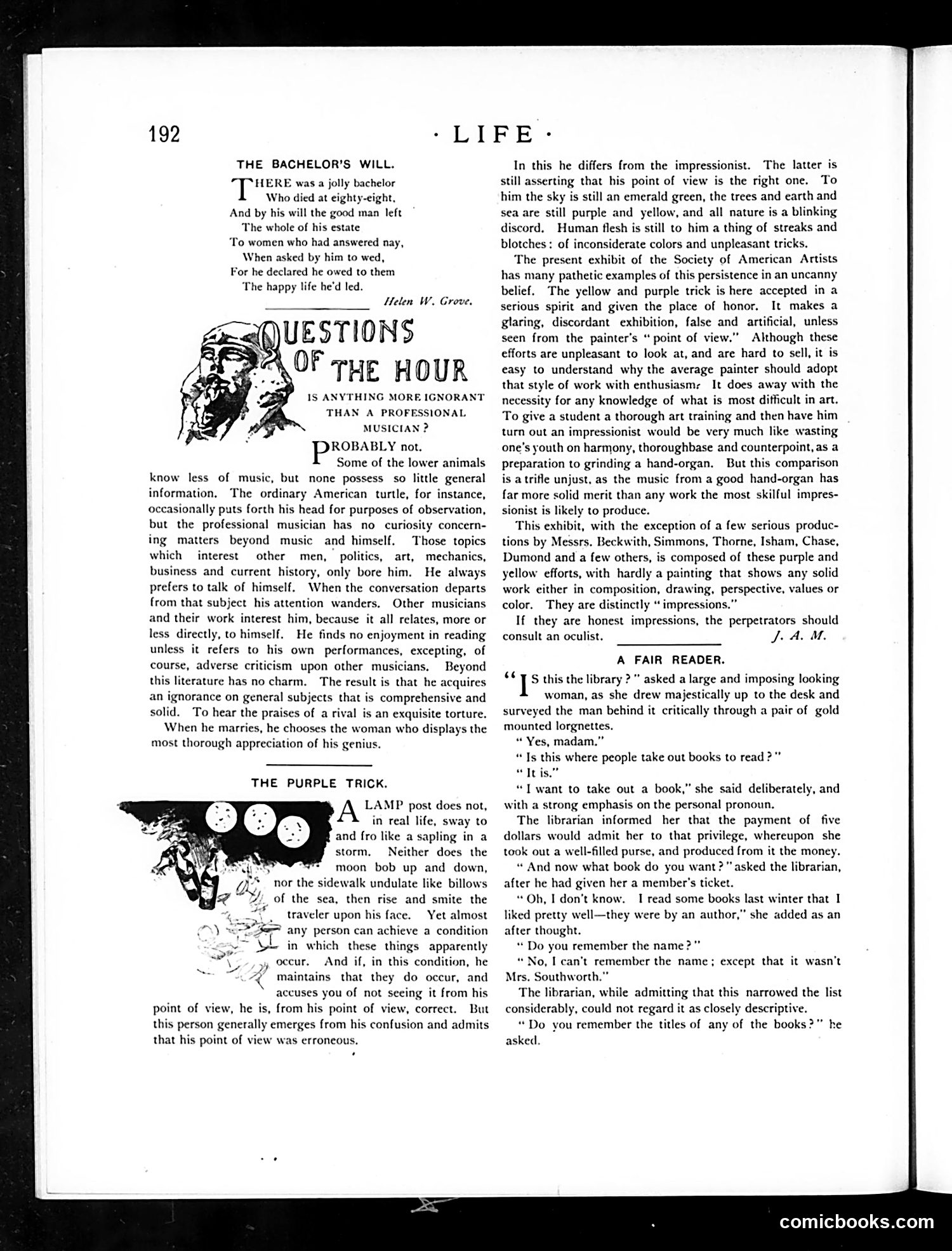
This page contains three satirical pieces typical of *Life* magazine's social commentary. **"The Bachelor's Will"** is a light verse poem about an elderly bachelor who bequeathed his estate to women who rejected his marriage proposals, crediting them with his happiness. **"Questions of the Hour"** sarcastically attacks professional musicians as uniquely ignorant and self-absorbed, caring only about music and their own performances while remaining indifferent to politics, art, history, and general knowledge. **"The Purple Trick"** critiques Impressionist painters, comparing their insistence on distorted colors (purples, yellows, greens) to optical illusions. The author argues Impressionists hide lack of technical skill behind subjective "point of view," suggesting their work requires less training than academic art. The piece mocks this movement as artistically lazy compared to classical training in composition and technique.
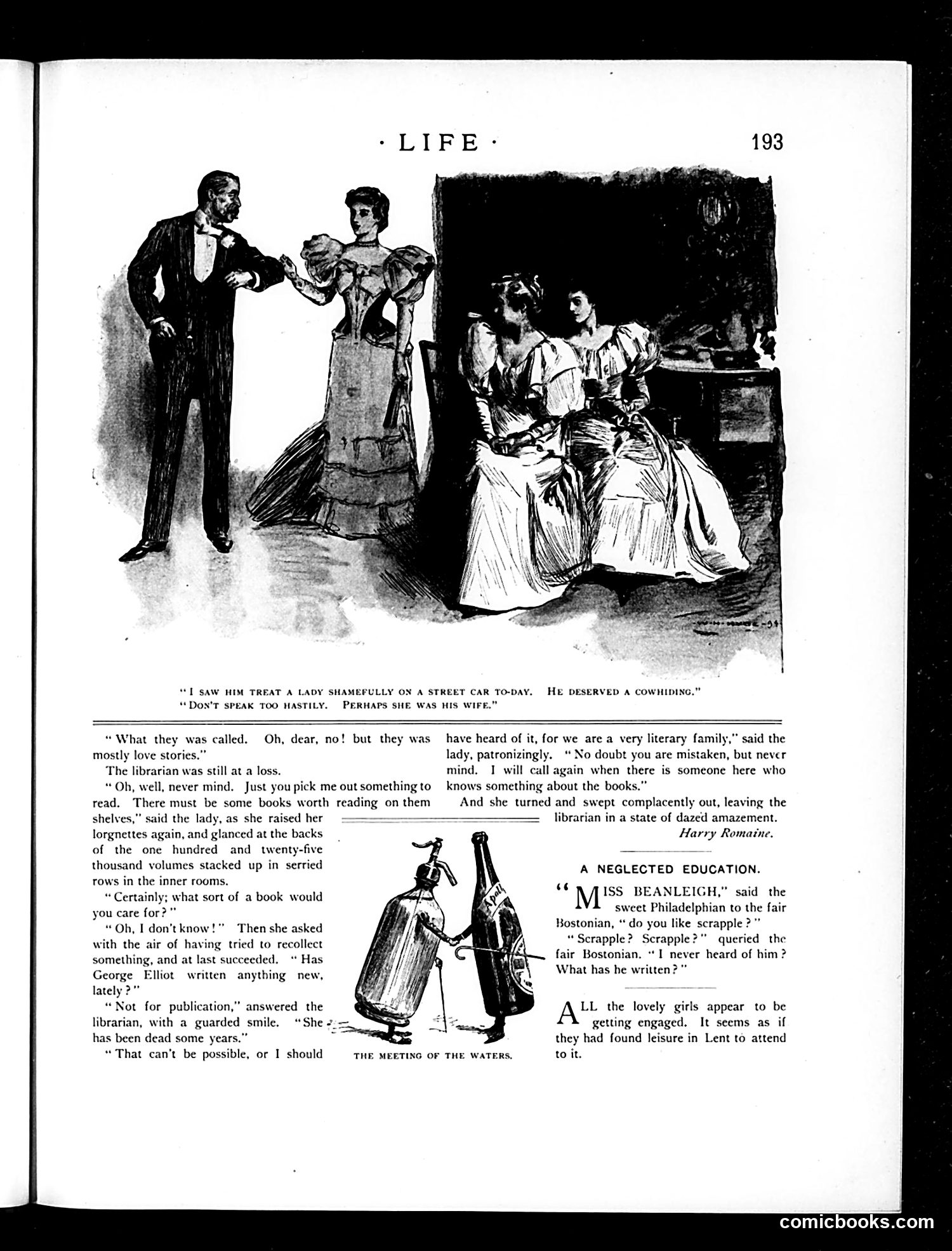
This page contains three separate satirical pieces mocking social pretension and ignorance: **Top cartoon**: A man is defended for treating a woman badly on a streetcar—the joke being the assumption she's his wife, implying husbands routinely mistreat wives without scandal. **Middle story ("A Neglected Education")**: A snobbish female patron demands reading recommendations from a librarian but proves completely ignorant. She asks for books by "George Elliot" (George Eliot, the famous novelist) without knowing the author died decades earlier. The librarian's "guarded smile" conveys his silent judgment of her pretentious ignorance. **Bottom story**: Two upper-class women discuss "scrapple" (a Pennsylvania food). The Bostonian misunderstands it as a person's name, asking "What has he written?"—revealing she's so out of touch she mistakes regional dishes for authors. All three pieces satirize wealthy, cultured women who perform sophistication while displaying profound ignorance, a common target of early 20th-century American humor.
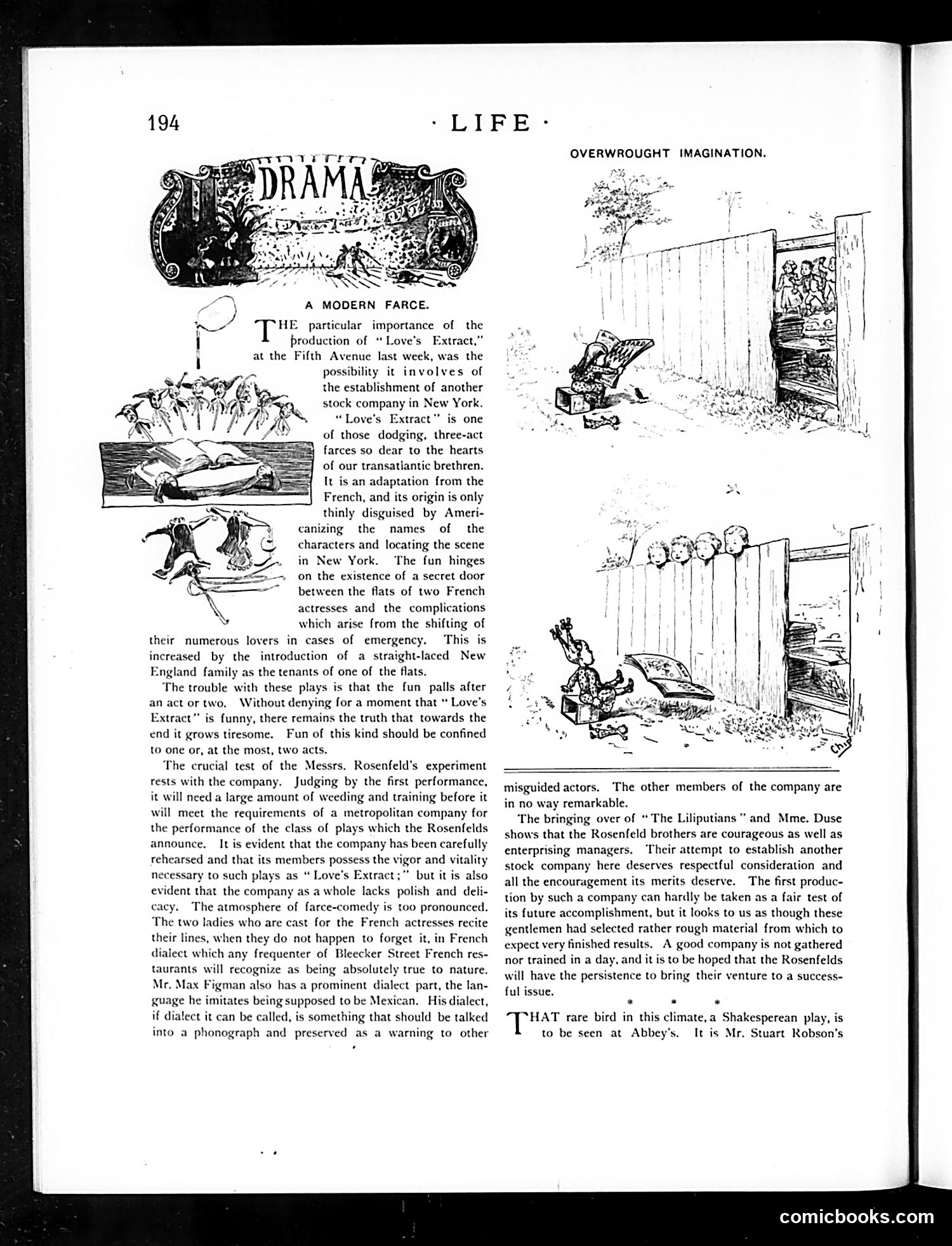
This page reviews a new farce production at the Fifth Avenue Theatre, potentially signaling a new stock company's launch in New York. The review is largely critical satire of both the play and its cast. **The Play:** "Love's Extract" is a French farce thinly adapted with Americanized names—a three-act comedy about secret doors between neighboring apartments housing French actresses and their shifting lovers, complicated by a prudish New England family. The critic mocks such plots as temporarily amusing but structurally tiresome. **The Satire:** The harshest criticism targets the cast's execution. The French actresses' accents are ridiculed as absurdly exaggerated (comparing them unfavorably to authentic Bleecker Street French restaurants). Max Figman's Mexican dialect is attacked so severely the critic suggests it should be phonographically preserved as a "warning to other misguided actors"—a cutting joke about incompetent performance. **The Point:** Despite respecting the Rosenfeld brothers' theatrical ambition, Life concludes the company lacks polish and refinement necessary for metropolitan standards. The rough material and undertrained cast undermine the venture's credibility.
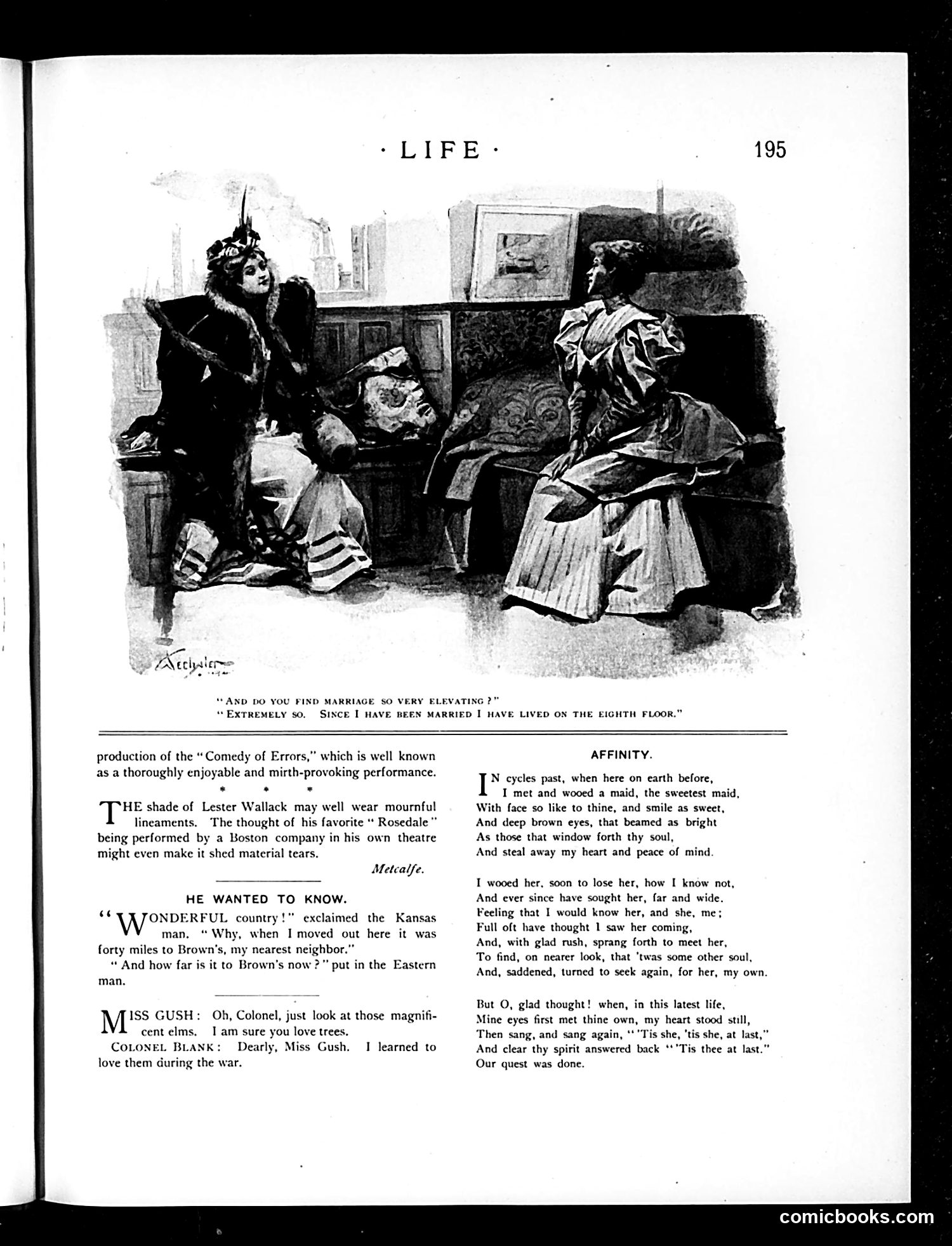
This page contains three separate humorous pieces typical of *Life* magazine's satirical format: **Top cartoon**: A joke about urban living and social climbing. A woman claims marriage is "elevating" because she now lives on the eighth floor—a pun equating literal height (apartment floor) with social elevation, mocking the era's real-estate-driven status anxiety. **Middle section**: Two brief dialogue jokes. One mocks a Kansas pioneer's amazement at civilization spreading (distance to nearest neighbor shrinking from forty miles). The other makes light fun of Colonel Blank claiming to love trees because of war experience—likely a gentle jab at romantic militarism or post-war nostalgia. **"Affinity" poem**: A sentimental poem about reincarnation and soulmates—the speaker believes he's finally reunited with a beloved from a past life. This satirizes Victorian-era spiritualism and romantic idealism, playing earnestly sentimental while the very concept invites gentle mockery. The page ridicules American social pretension, frontier mythology, war sentiment, and spiritualist romanticism—all recognizable targets of *Life*'s era.
This page's main content is a clever wordplay puzzle disguised as literary trivia. The questions pun on famous authors' and historical figures' names by treating them as if they were common adjectives or verbs—a play on English surnames. For example: "Was Thomas Hardy nowadays?" (making "Hardy" mean difficult), "Is Mone Savage?" (Oscar Wilde as a descriptor), "Was Laurence Sterne was Hermann Grimm?" (Sterne/stern, Grimm/grim). The anecdote about an Italian organ-grinder provides lighter humor: when arrested for disturbing the peace, he escapes the fine by feigning not understanding English ("Me no understan' mooch Inglese"), then claims he thought the magistrate's gestures meant the man *wanted* him to play and dance. The rest is advertising—bicycles, hats, cigars, and cream products typical of 1890s American magazines. The wordplay demonstrates Life magazine's sophisticated, literate audience expected to recognize classical authors.
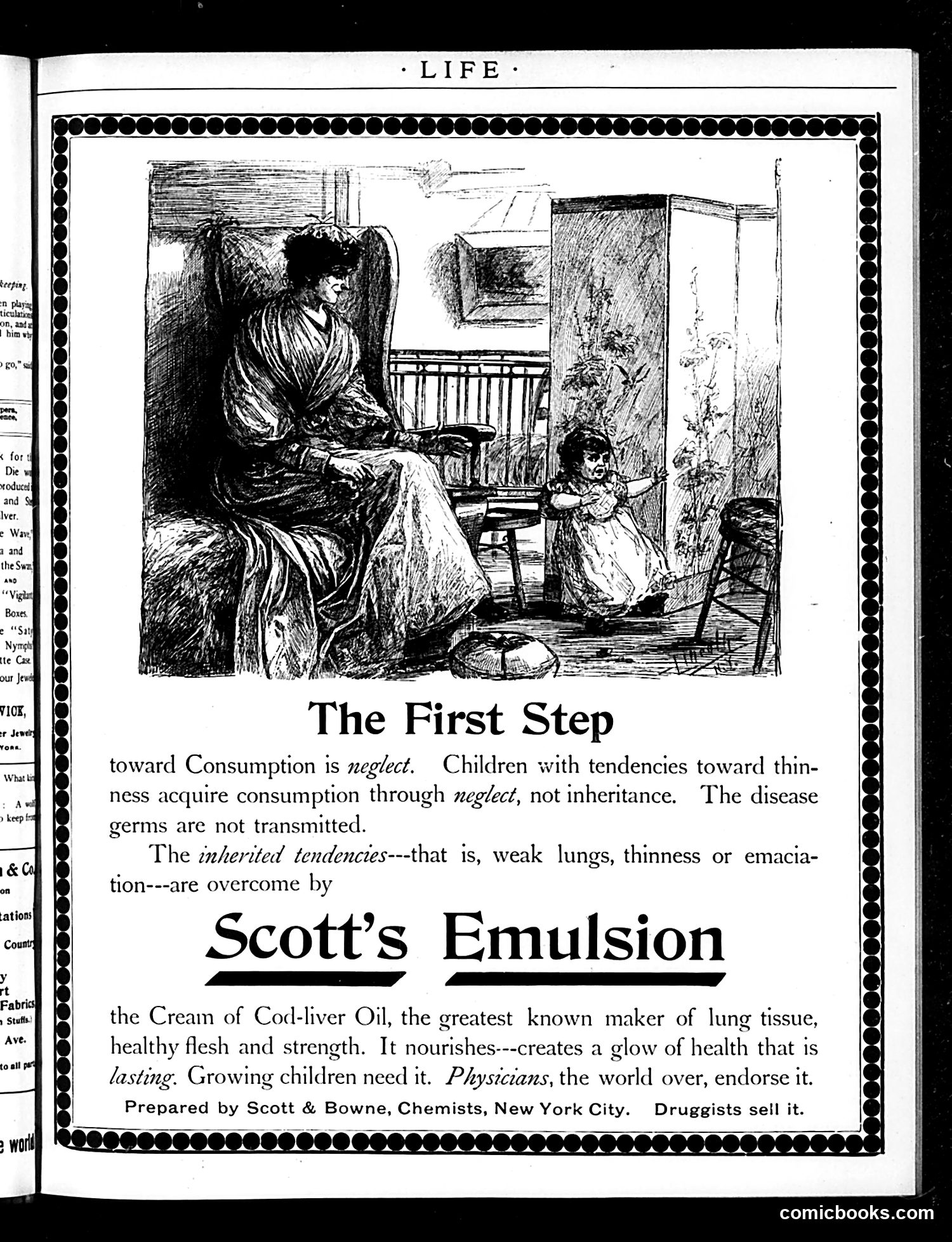
This page is primarily a **medical advertisement**, not satire. It promotes Scott's Emulsion (cod-liver oil) as a cure for tuberculosis ("consumption"), then a devastating disease. The illustration shows a well-dressed mother watching over a thin child, visualizing the advertisement's premise: that tuberculosis results from **neglect rather than inheritance**. The ad claims weak lungs and thinness can be overcome by the product. **Context for modern readers**: In the early 20th century, TB was epidemic and poorly understood. While the ad correctly notes disease isn't directly inherited, it misleadingly suggests parental neglect causes it and that cod-liver oil is curative—claims we now know are false. TB is actually bacterial and requires antibiotics (not available then). The advertisement's appeal to parental anxiety and physicians' endorsements represents common medical marketing tactics of the era, before modern drug regulation and advertising standards existed.
This page from *Life* magazine comprises humorous anecdotes rather than political cartoons. The jokes satirize contemporary social conventions and absurdities: **"At Seniors at Nulls"** mocks the disconnect between charitable causes and actual concern—lawyers joke about collecting money for "two little girls in blue" (the song reference), implying charity fundraising was sometimes performative. **The Washington conversation** satirizes women's exclusion from Congress by having a character note men criticize women for indecisiveness, yet Congress has no women—the irony being that women cannot participate in government at all. **The editor's mix-up** ridicules incompetence in advice-giving, where instructions for teething babies get switched with pest-control advice. **The Civil War anecdote** presents sentimentality about a soldier's romantic proposal to a visiting nurse—reflecting period romanticization of wartime interactions. The page also features period advertising for Remington bicycles, Ripans tablets, and Rogers silverware—typical of *Life's* commercial content.
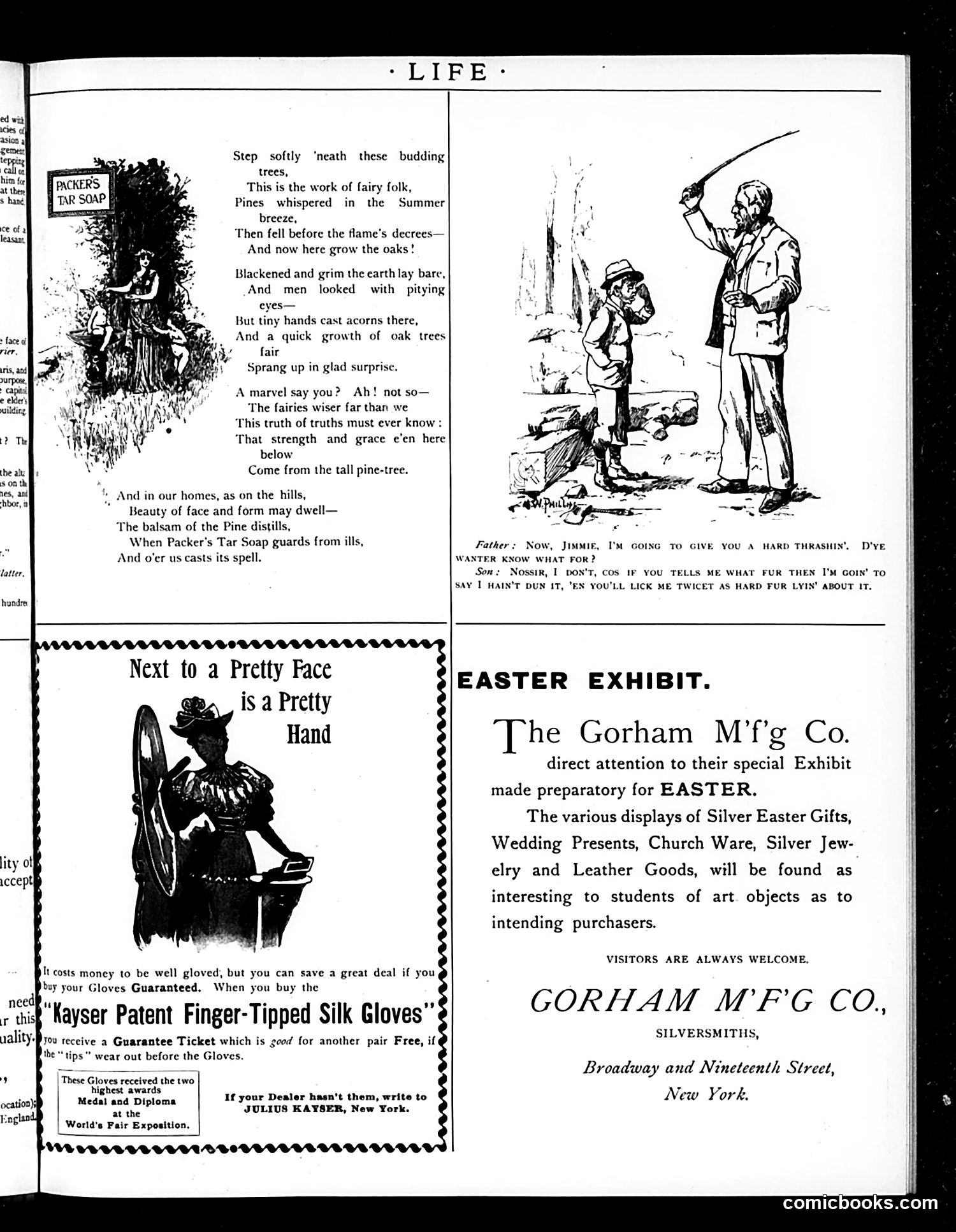
This page contains primarily **advertisements and light humor** rather than political satire. The main content includes: 1. **"Packer's Tar Soap" ad** (left): A poetic fantasy about fairy folk replanting oaks after forest fires, used to sell soap by claiming it protects beauty and health. 2. **Father-and-son cartoon** (center-right): A humorous domestic scene where a boy cleverly refuses to explain his misdeed, reasoning that admitting ignorance will result in lighter punishment than confessing and being beaten twice—once for the act and once for lying. 3. **"Kayser Patent Finger-Tipped Silk Gloves" ad** (lower left): Advertises guaranteed gloves with a replacement promise. 4. **"Gorham M'f'g Co." ad** (right): Announces an Easter exhibition of silver goods, jewelry, and leather merchandise in New York. The page reflects early 20th-century consumer culture and gentle family humor typical of Life magazine's satirical yet advertisement-heavy format.
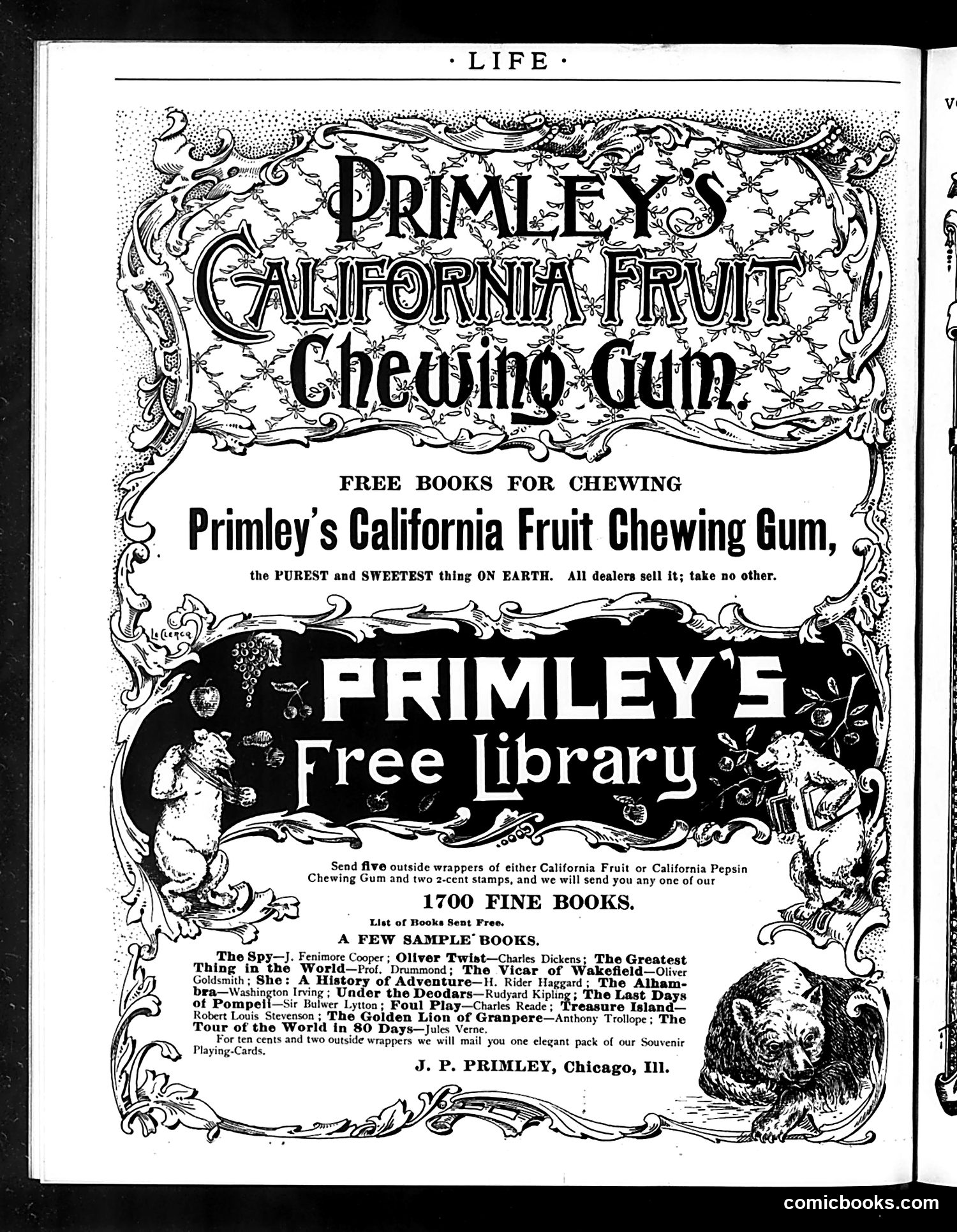
This is a **Primley's California Fruit Chewing Gum advertisement**, not political satire. It's a promotional scheme common in the late 19th/early 20th century: consumers could collect gum wrappers to claim free books from a "library" of 1700 titles. The ad lists classic literature—works by Dickens, Stevenson, Verne, and others—as incentives. Collecting five wrappers plus two-cent stamps would yield a free book; ten cents and two wrappers got decorative playing cards. This reflects the era's marketing strategy of packaging cultural refinement with commercial products, positioning chewing gum as a gateway to literature. The elaborate decorative border and classical references suggest advertisers positioned themselves as purveyors of genteel culture, not mere candy makers.