
Life, 1894-03-22 · page 10 of 22
Life — March 22, 1894 — page 10: what you’re looking at
What you’re looking at
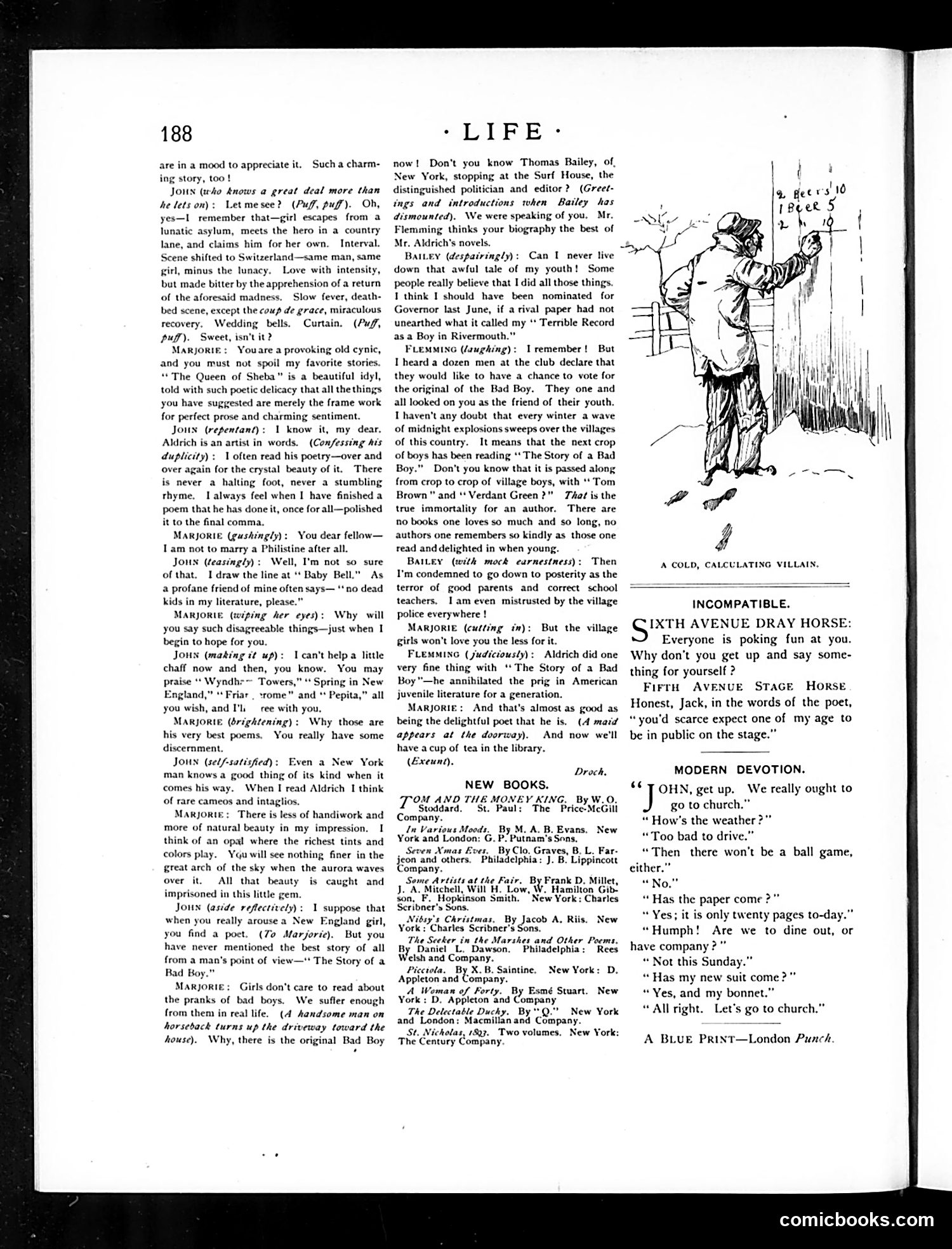
The page contains a satirical dialogue between literary characters discussing Thomas Bailey's work and biography. The main illustration, titled "A COLD, CALCULATING VILLAIN," depicts a gaunt figure in winter clothing—likely representing a literary antagonist or social type being mocked. The text references Bailey's controversial youth stories and his nomination for Governor, suggesting the satire targets both his literary reputation and political ambitions. The characters debate whether his early sensational tales (like "The Story of a Bad Boy") represent genuine talent or mere sensationalism. The "INCOMPATIBLE" and "MODERN DEVOTION" sections below are short humorous sketches about everyday social absurdities—a stage horse complaint and a dialogue about modern courtship priorities—typical of Life's lighter satirical content. The page primarily focuses on literary criticism rather than political commentary.
📄 Transcribed text from this page (OCR, searchable)
Machine-transcribed from the original scan — historical spelling and the odd misread are preserved.
188 are in a mood to appreciate it. ing story, too! Jous (who knows a great deal more than he lets on): Letmesee? (Puff, puff). Oh, yes—I remember that—girl escapes from a lunatic asylum, meets the hero in a country lane, and claims him for her own. Interval. Scene shifted to Switzerland—same man, same girl, minus the lunacy. Love with intensity, but made bitter by the apprehension of a return of the aforesaid madness. Slow fever, death- bed scene, except the coup de grace, miraculous recovery. Wedding bells. Curtain. (Puf, puff). Sweet, isn't it? Marjorie: Youare a provoking old cynic, and you must not spoil my favorite stories. “The Queen of Sheba” is a beautiful idyl, told with such poetic delicacy that all the things you have suggested are merely the frame work for perfect prose and charming sentiment. Joun (repentant): 1 know it, my dear. Aldrich is an artist in words. (Confessing his duplicity) : 1 often read his poetry—over and over again for the crystal beauty of it. There is never a halting foot, never a stumbling thyme, I always feel when I have finished a poem that he has done it, once for all—polished it to the final comma, MARJORIE (gushingly): You dear fellow— Tam not to marry a Philistine after all. Joun (teasingly): Well, I'm not so sure of that, I draw the line at Baby Bell." As Such a charm- a profane friend of mine often says— ‘no dead kids in my literature, please. MARJORIE (wiping her eyes): Why will you say such disagreeable things—just when I begin to hope for you. Joun (making it up): Lcan't helpa little chaff now and then, you know. You may praise “ Wyndh>~ Towers,” Spring in New England,” “Friar, srome” and * Pepita,” all you wish, and I'l ree with you, MARJORIE (brightening): Why those are his very best poems. You really have some discernment, JOUN (self-satisfied): Even a New York man knows a good thing of its kind when it comes his way. When I read Aldrich I think of rare cameos and intaglios. Manjorte: There is less of handiwork and more of natural beauty in my impression. I think of an opal where the richest tints and colors play. Yqu will see nothing finer in the great arch of the sky when the aurora waves over it. All that beauty imprisoned in this little gem. Joun (aside reflectively): 1 suppose that when you really arouse a New England girl, you find a poet. (7o Marjorie). But you have never mentioned the best story of all from a man’s point of view—"* The Story of a Rad Boy.” Manyorie: Girls don't care to read about the pranks of bad boys. We sufler enough from them in real life. (4 Aandsome man on horseback turns up the driveway toward the house). Why, there is the original Bad Boy is caught and * LIFE: now! Don't you know Thomas Bailey, of, New York, stopping at the Surf House, the distinguished politician and editor? (Greet- ings and introductions when Bailey has dismounted), \We were speaking of you. Mr. Flemming thinks your biography the best of Mr. Aldrich’s novels, Baiey (despairingly): Can I never live down that awful tale of my youth! Some people really believe that I did all those things. I think I should have been nominated for Governor last June, if a rival paper had not unearthed what it called my “ Terrible Record as a Boy in Rivermouth." FremMino (laughing): Lremember! But Theard a dozen men at the club declare that they would like to have a chance to vote for the original of the Bad Boy. They one and all looked on you as the friend of their youth. T haven't any doubt that every winter a wave of midnight explosions sweeps over the villages of this country. It means that the next crop of boys has been reading “The Story of a Bad Boy.” Don't you know that it is passed along from crop to crop of village boys, with * Tom Brown" and ‘** Verdant Green?" That is the true immortality for an author. There are no books one loves so much and so long, no authors one remembers so kindly as those one read and delighted in when young. BaiLey (with mock earnestness): Then I'm condemned to go down to posterity as the terror of good parents and correct school teachers, Iam even mistrusted by the village police everywhere ! MARJORIE (cucting im): But the village girls won't love you the less for it. FLEMMING (judiciously): Aldrich did one very fine thing with “The Story of a Bad Boy"—he annihilated the prig in American juvenile literature for a generation. Marjori And that's almost as good as being the delightful poet that he is. (4 maid appears at the doorway). And now we'll have a cup of tea in the library. (Exeunt, Droch. NEW BOOKS. TOM AND TH: Y_KING. By W,0. Stoddard. S The Price McGill Company. In Various Moods. York and London: G. P. Putnam's Sons. Seven Xmas Eves, By Clo. Graves, B. L. Far- jeon and others. Philadelphia: J. B. Lippincott Company. Some Artists at the Fair, By Frank D. Millet, J. A. Mitchell, Will H. Low, W, Hamilton Gib son, F. Hopkinson Smith. ‘New York: Charles Scribner's Sons. Nibsy's Christmas, By Jacob A, Riis. York : Charles Scribner's The Seeker in the Marshes and Other Poems. By Daniel L, Dawson, Philadelphia: Rees Welsh and Company. Picctola. By X.B. Saintine, Appleton and Company. A Woman of Forty. By Esmé Stuart. New York : D. Appleton and Company The Detectable Duchy. By" Q." New York and London: Macmillan and Company. St. Nicholas, 1&3. Two volumes, New York: The Century Company. By M. A. B. Evans. New New New York: D, A COLD, CALCULATING VILLAIN. INCOMPATIBLE. IXTH AVENUE DRAY HORSE: Everyone is poking fun at you. Why don’t you get up and say some- thing for yourself ? FirrH AVENUE STAGE HORSE Honest, Jack, in the words of the poet, “you'd scarce expect one of my age to be in public on the stage.” MODERN DEVOTION. S67 OHN, get up. We really ought to go to church.” “ How's the weather?” “Too bad to drive. “Then there won't be a ball game, ither.” “No.” “Has the paper come ?” “ Yes; it is only twenty pages to-day. “Humph! Are we to dine out, or have company?” “ Not this Sunday.” “ Has my new suit come “Yes, and my bonnet.” “ Allright. Let's go to church.” A BLUE Print—London Punch comicbooks.com