
Life, 1894-03-22 · page 14 of 22
Life — March 22, 1894 — page 14: what you’re looking at
What you’re looking at
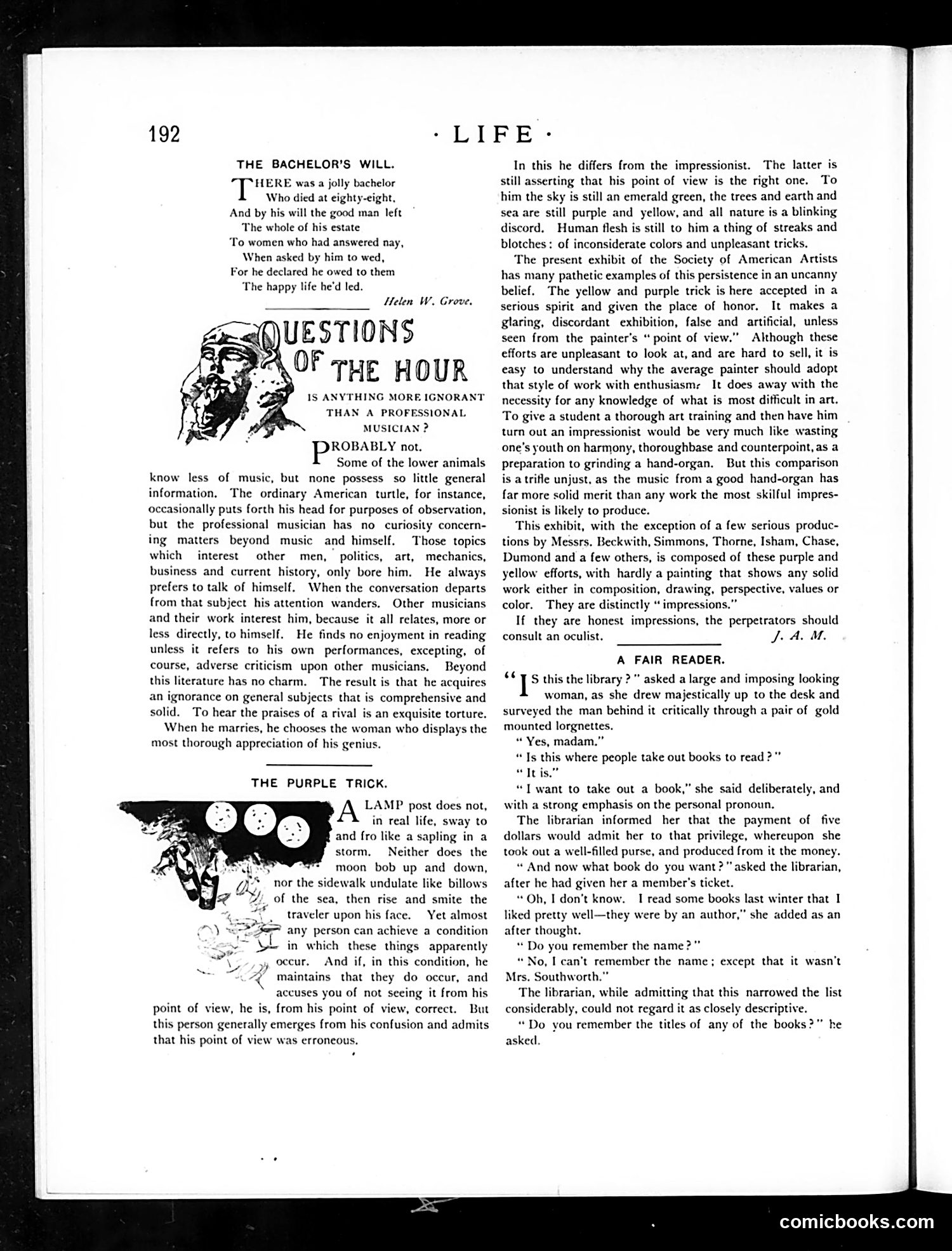
This page contains three satirical pieces typical of *Life* magazine's social commentary. **"The Bachelor's Will"** is a light verse poem about an elderly bachelor who bequeathed his estate to women who rejected his marriage proposals, crediting them with his happiness. **"Questions of the Hour"** sarcastically attacks professional musicians as uniquely ignorant and self-absorbed, caring only about music and their own performances while remaining indifferent to politics, art, history, and general knowledge. **"The Purple Trick"** critiques Impressionist painters, comparing their insistence on distorted colors (purples, yellows, greens) to optical illusions. The author argues Impressionists hide lack of technical skill behind subjective "point of view," suggesting their work requires less training than academic art. The piece mocks this movement as artistically lazy compared to classical training in composition and technique.
📄 Transcribed text from this page (OCR, searchable)
Machine-transcribed from the original scan — historical spelling and the odd misread are preserved.
->LIFE- THE BACHELOR'S WILL. HERE was a jolly bachelor Who died at eighty-eight, And by his will the good man left The whole of his estate ‘To women who had answered nay, When asked by him to wed, For he declared he owed to them The happy life he'd led. Helen W. Grove. UESTIONS OF tue HOUR 1S ANYTHING MORE IGNORANT THAN A PROFESSIONAL MUSICIAN ? ROBABLY not. Some of the lower animals know less of music, but none possess so little general information. The ordinary American turtle, for instance, occasionally puts forth his head for purposes of observation, but the professional musician has no curiosity concern- ing matters beyond music and himself. Those topics which interest other men, politics, art, mechanics, business and current history, only bore him. He always prefers to talk of himself. When the conversation departs Other musicians and their work interest him, because it all relates, more or less directly, to himself. He finds no enjoyment in reading unless it refers to his own performances, excepting, of course, adverse criticism upon other mu: ns. Beyond this literature has no charm. The result is that he acquires an ignorance on general subjects that is comprehensive and solid. To hear the praises of a rival is an exquisite torture. When he marries, he chooses the woman who displays the most thorough appreciation of his genius. from that subject his attention wanders. THE PURPLE TRICK. LAMP post does not, in real life, sway to and fro like a sapling in a storm. Neither does the moon bob up and down, nor the sidewalk undulate like billows of the sea, then rise and smite the traveler upon his face. Yet almost “Se= any person can achieve a condition = in which these things apparently yy occur, And if, in this condition, he “@ maintains that they do occur, and accuses you of not seeing it from his point of view, he is, from his point of view, correct. But this person generally emerges from his confusion and admits that his point of view was erroneous, In this he differs from the impressionist. The latter is still asserting that his point of view is the right one. To him the sky is still an emerald green, the trees and earth and sea are still purple and yellow, and all nature is a blinking discord. Human flesh is still to him a thing of streaks and blotches : of inconsiderate colors and unpleasant tricks. The present exhibit of the Society of American Artists has many pathetic examples of this persistence in an uncanny belief. The yellow and purple trick is here accepted in a serious spirit and given the place of honor. It makes a glaring, discordant exhibition, false and artificial, unless seen from the painter's “ point of view.” Although these efforts are unpleasant to look at, and are hard to sell, it is easy to understand why the average painter should adopt that style of work with enthusiasms It does away with the necessity for any knowledge of what is most difficult in art. To give a student a thorough art training and then have him turn out an impressionist would be very much like wasting one’s youth on harmony, thoroughbase and counterpoint, as a preparation to grinding a hand-organ. But this comparison is atrifle unjust, as the music from a good hand-organ has far more solid merit than any work the most skilful impres- sionist is likely to produce. This exhibit, with the exception of a few serious produc- tions by Messrs. Beckwith, Simmons, Thorne, Isham, Chase, Dumond and a few others, is composed of these purple and yellow efforts, with hardly a painting that shows any solid work either in composition, drawing, perspective, values or color. They are distinctly “ impressions.” If they are honest impressions, the perpetrators should consult an oculist. Jj. A.M. A FAIR READER. $61 S this the library ?” asked a large and imposing looking woman, as she drew majestically up to the desk and surveyed the man behind it critically through a pair of gold mounted lorgnettes. “Yes, madam,” “Is this where people take out books to read?” VTeis.” “IT want to take out a book,” she said deliberately, and with a strong emphasis on the personal pronoun, The librarian informed her that the payment of five dollars would admit her to that privilege, whereupon she took out a well-filled purse, and produced from it the money, “ And now what book do you want?" asked the librarian, after he had given her a member's ticket. “Oh, I don’t know. I read some books last winter that I liked pretty well—they were by an author,” she added as an after thought. “ Do you remember the name?” “No, [can't remember the name; except that it wasn’t Mrs. Southworth.” The librarian, while admitting that this narrowed the list considerably, could not regard it as closely descriptive. “Do you remember the titles of any of the books ? asked. comicbooks.com