
A complete issue · 16 pages · 1894
Life — March 15, 1894
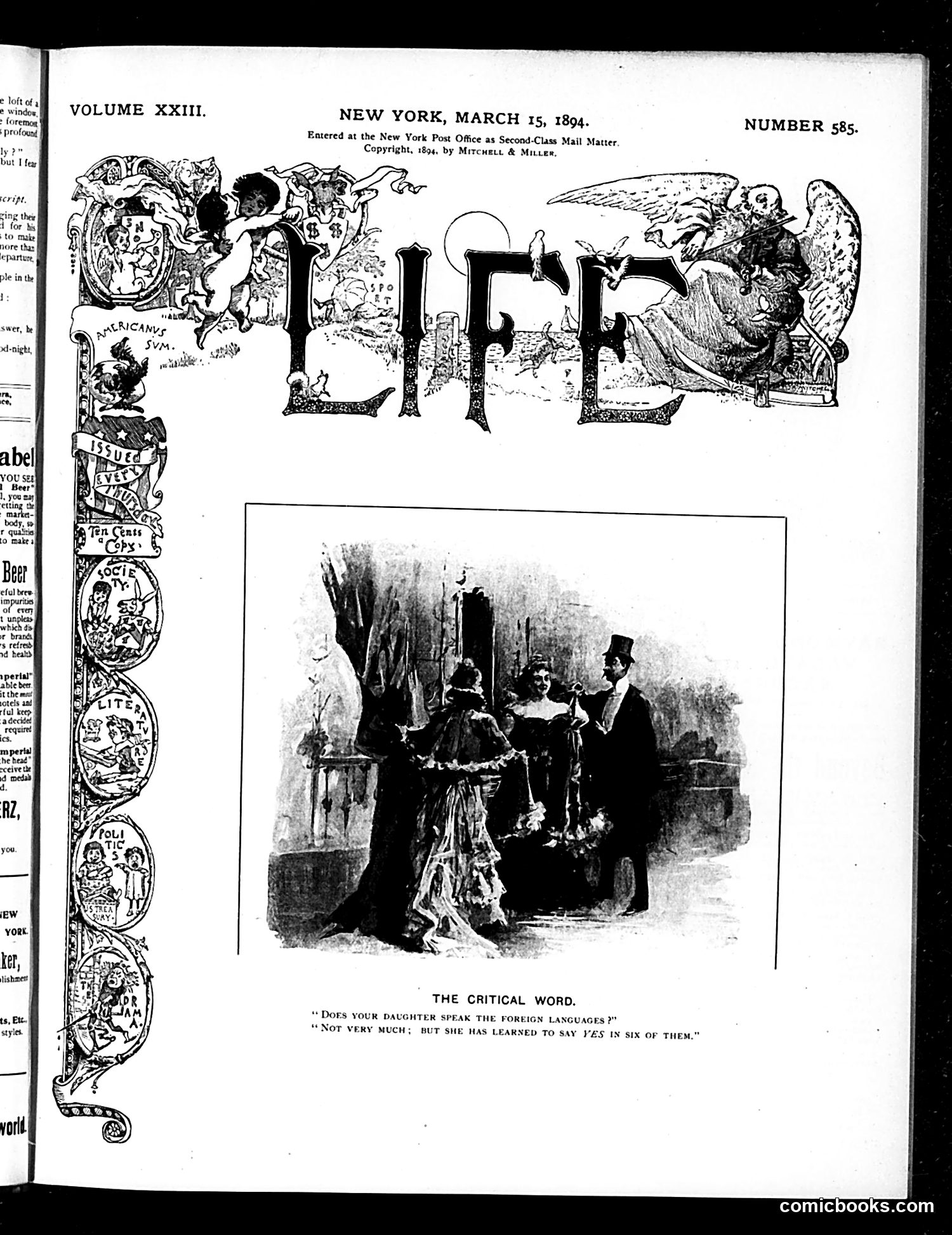
This cartoon satirizes upper-class parental pretension regarding children's education. The dialogue reads: "Does your daughter speak the foreign languages?" / "Not very much; but she has learned to say 'yes' in six of them." The scene depicts well-dressed Victorian society figures (likely a parent and suitor or family friend) discussing a young woman's accomplishments. The humor lies in exposing the gap between appearances and reality—the daughter has merely memorized a single word in multiple languages, yet this superficial achievement is presented as if it constitutes genuine linguistic education. This reflects 1890s anxieties about wealthy families prioritizing social status and cosmopolitan pretense over substantive learning for their daughters.
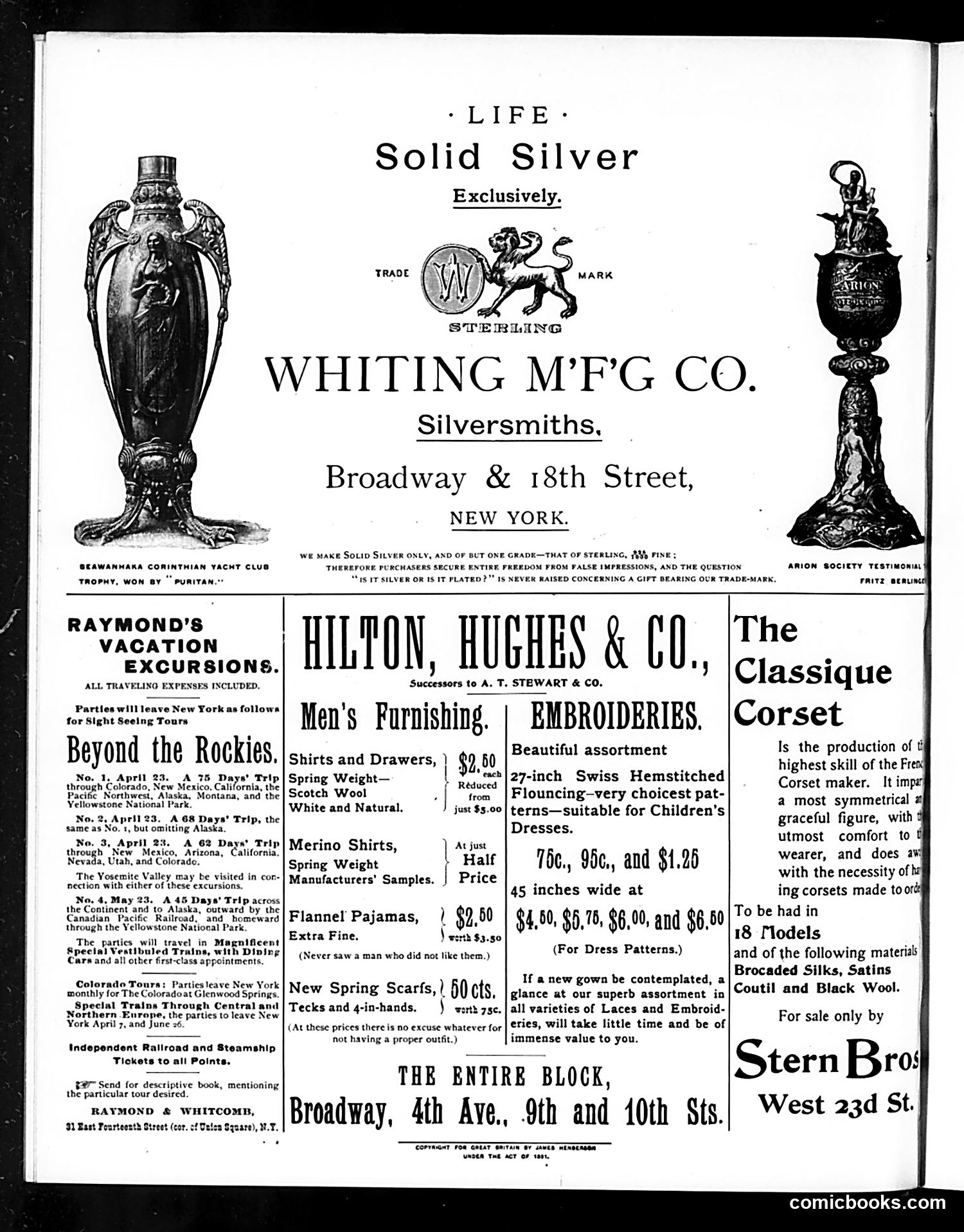
This page is predominantly **advertising** rather than editorial content or satire. It features ads for luxury goods typical of the early 1900s: - **Whiting M'FG Co.** (top): A silversmith advertising solid silver tableware and decorative pieces - **Hilton, Hughes & Co.** (center): Men's furnishings including shirts, pajamas, and scarves - **The Classique Corset** (right): Women's corsetry marketed as providing graceful figures with comfort - **Raymond's Vacation Excursions** (left): Travel packages to Western destinations There are no political cartoons or satire visible on this page. The decorative silver pieces shown represent status symbols for wealthy consumers of the era. The corset ad reflects period beauty standards emphasizing corseted silhouettes.
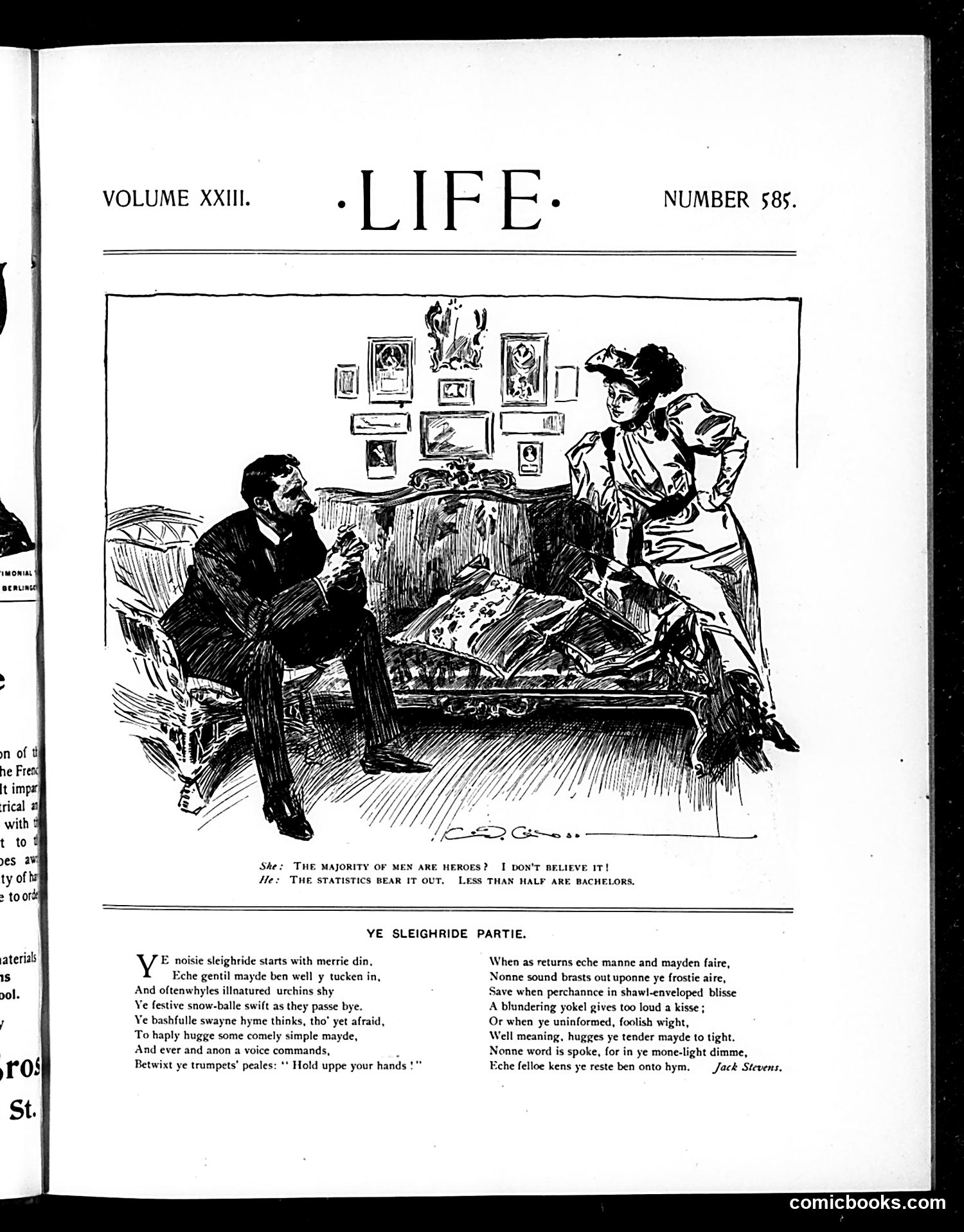
**The Cartoon:** The main illustration shows a man and woman in what appears to be a domestic interior with framed pictures on the wall. The caption reads: "The majority of men are heroes? I don't believe it! / The statistics bear it out. Less than half are bachelors." **The Joke:** This is a play on words about bachelor status versus heroism. The man claims most men aren't heroes; the woman counters that statistics prove otherwise—because fewer than half of men remain bachelors, meaning most are married. The implication is that marriage itself constitutes a heroic (or perhaps sacrificial) act for men. **Context:** This reflects early 20th-century attitudes about marriage as an obligation or burden for men, presented through a humorous domestic argument between a couple.
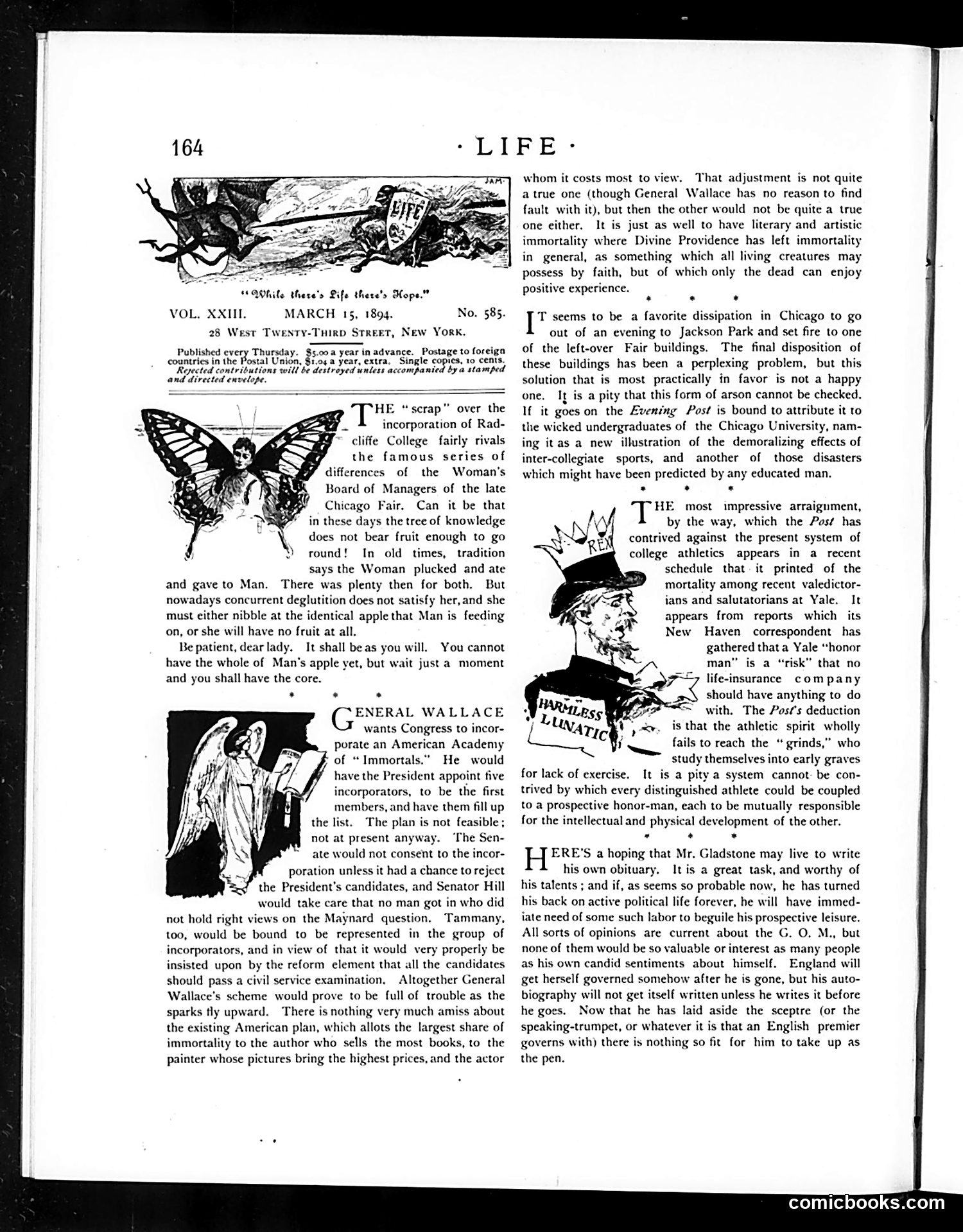
This page contains three distinct satirical pieces: **Top cartoon**: References a "scrap" over Radcliffe College's incorporation, comparing it to the famous "differences of the Woman's Board of Managers" from the Chicago Fair. The butterfly illustration satirizes ongoing disputes about women's education. **Middle section**: A winged figure (likely representing Divine Providence or similar concept) comments on General Wallace's proposal to incorporate an "Academy of Immortals"—a five-member body of distinguished Americans. The satire mocks this pretentious scheme as impractical and unnecessary. **Bottom section**: Commentary on Mr. Gladstone (the British Prime Minister), suggesting he should write his own obituary rather than leave it to others, as no written account could properly capture his character. All pieces employ characteristic fin-de-siècle satirical commentary on institutional politics and prominent figures.
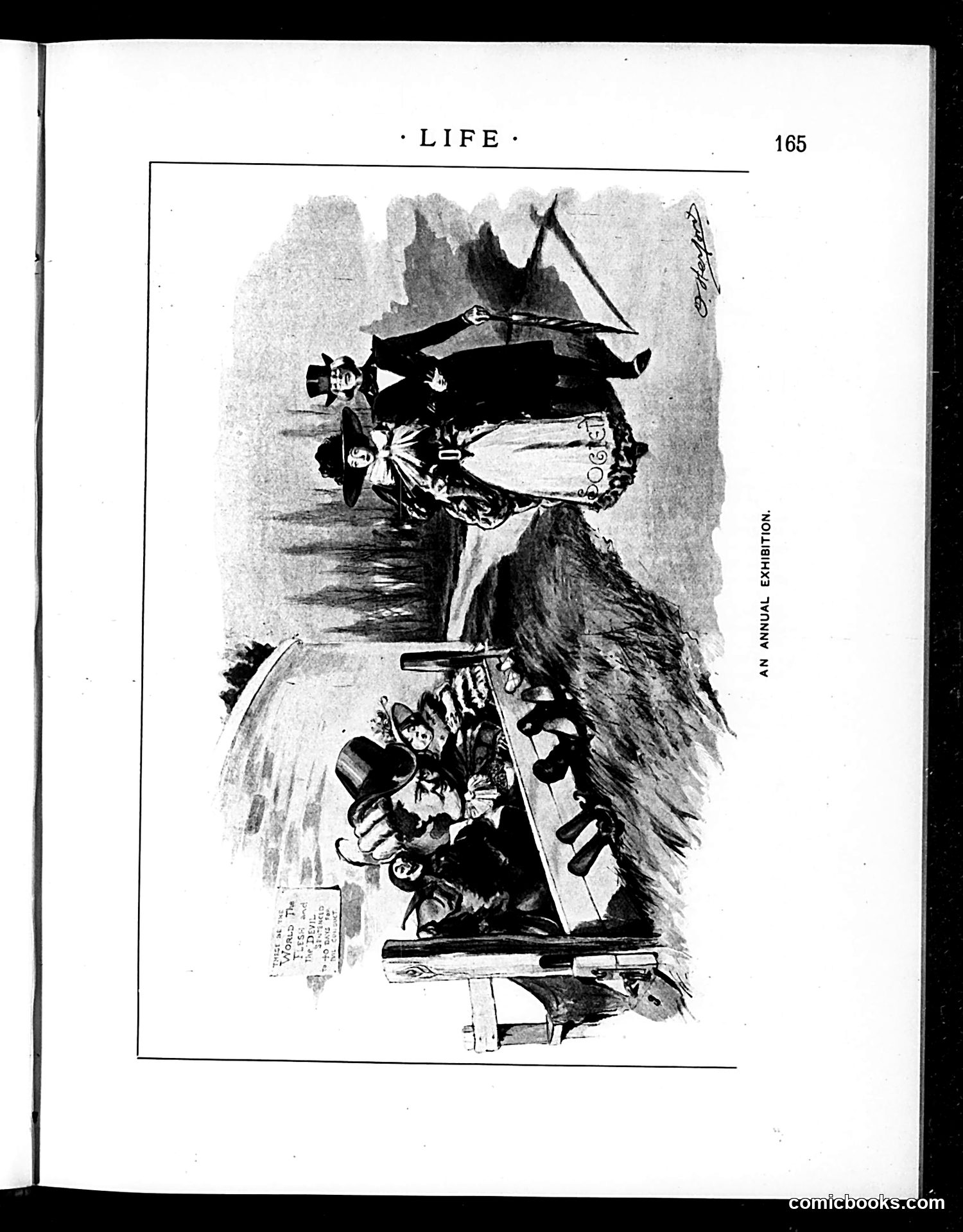
This page from *Life* magazine (page 165) contains a political cartoon that appears to be rotated or meant to be viewed sideways. The image shows a figure in formal dress (top hat visible) with exaggerated facial features typical of satirical caricature from the early 20th century. The text "AN ANNUAL EXHIBITION" on the right margin suggests this cartoon comments on some recurring annual event or tradition being mocked. The style and presentation indicate social or political satire, likely targeting a public figure or institution. However, without clearer visibility of specific identifying details, date information, or the OCR text content, I cannot definitively identify which political figure or event is being satirized or explain the specific point of the joke to modern readers. The image quality and orientation make precise interpretation difficult.
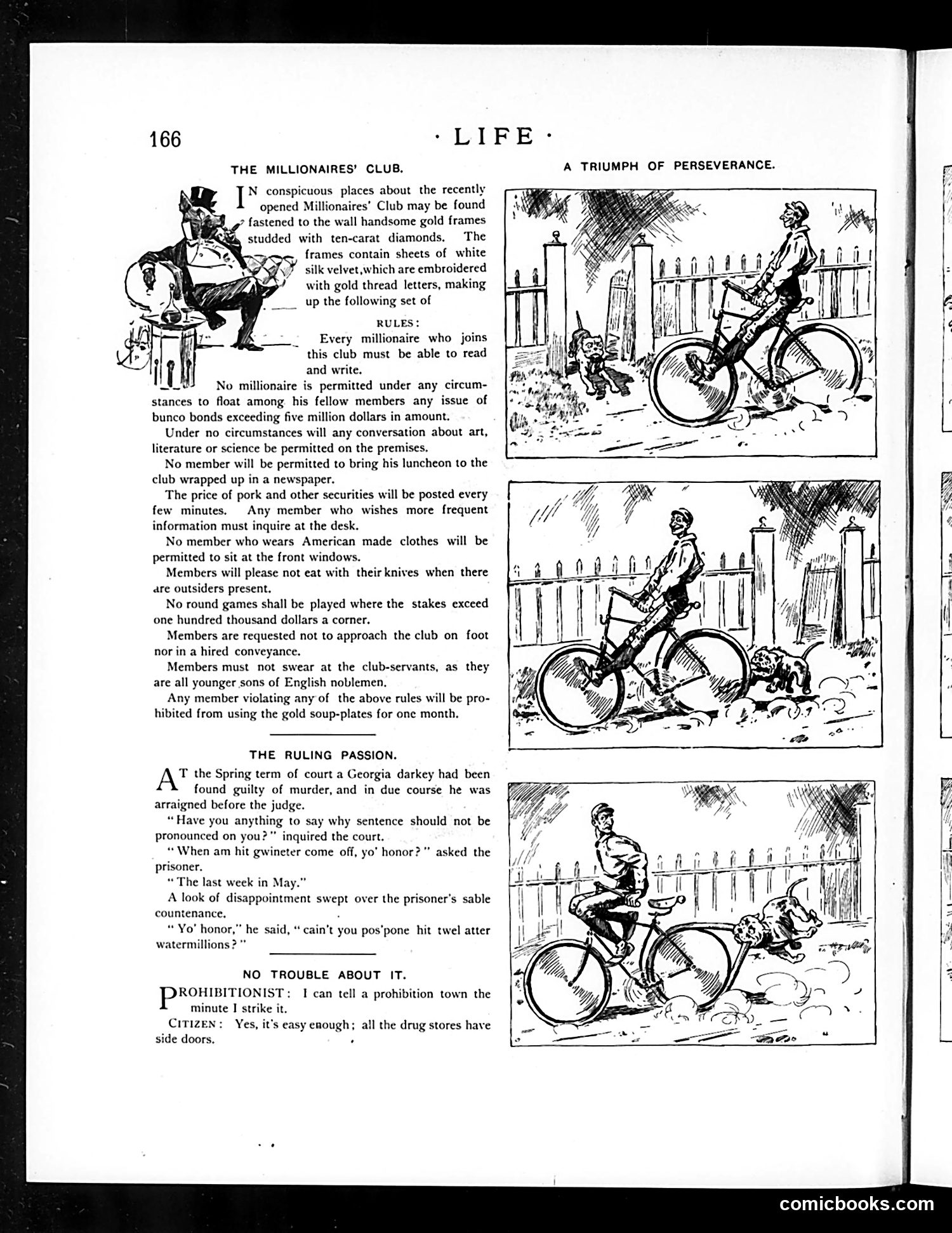
**"The Millionaires' Club"** section presents satirical "rules" for an exclusive club requiring members to be literate millionaires. The rules mock wealthy elites through absurd restrictions: prohibiting bunco bonds over $5 million, forbidding discussion of art/literature, requiring newspapers wrap lunch, and restricting card games to stakes under $100,000. The humor targets Gilded Age excess and the pretensions of the ultra-wealthy. **"A Triumph of Perseverance"** shows a three-panel comic of someone persistently attempting to ride a bicycle while repeatedly falling. This celebrates determination through failure—a common theme in period humor. **"The Ruling Passion"** features a Georgia murder case where the condemned prisoner, asked for last words, only requests a postponement to avoid missing watermelon season. This racial humor reflects period stereotypes. **"No Trouble About It"** is a brief joke about prohibition enforcement through drug store side doors.
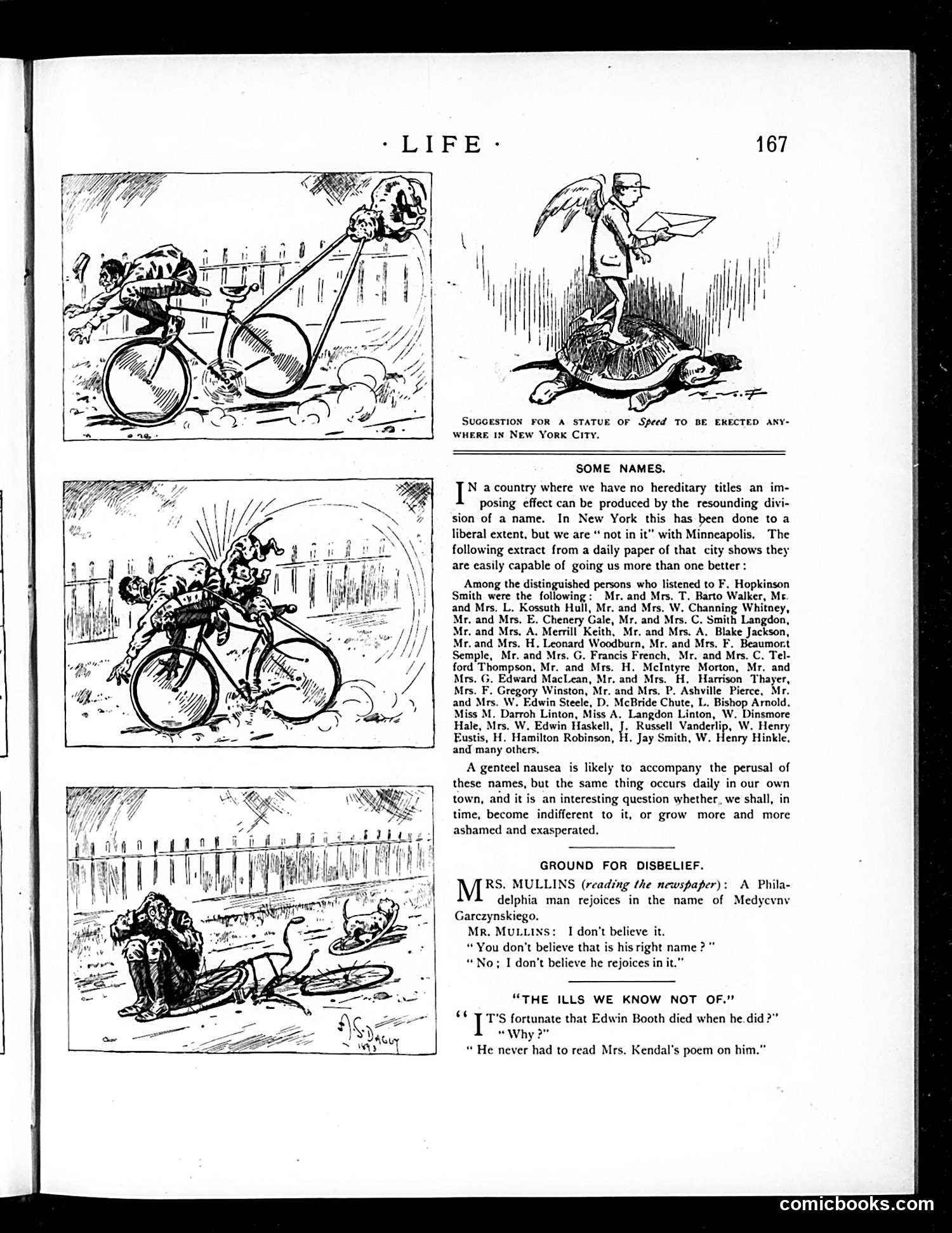
The cartoons on this page satirize the phenomenon of elaborate personal names in New York society. The top illustration mocks the idea of erecting a "Statue of Speed" in New York City, depicting a figure riding a bicycle atop a turtle—an absurd juxtaposition contrasting rapid modern life with slowness. The middle section lists prominent New York names (Hoar, Walker, Kossuth, Whitinge, etc.), suggesting that in America, lacking hereditary titles, people gain status through impressive-sounding names alone. The satirical point: New Yorkers obsess over names as status markers, while Minneapolis achieves this "to a liberal extent." The lower cartoons continue this theme with visual humor about name-consciousness among the city's social classes.
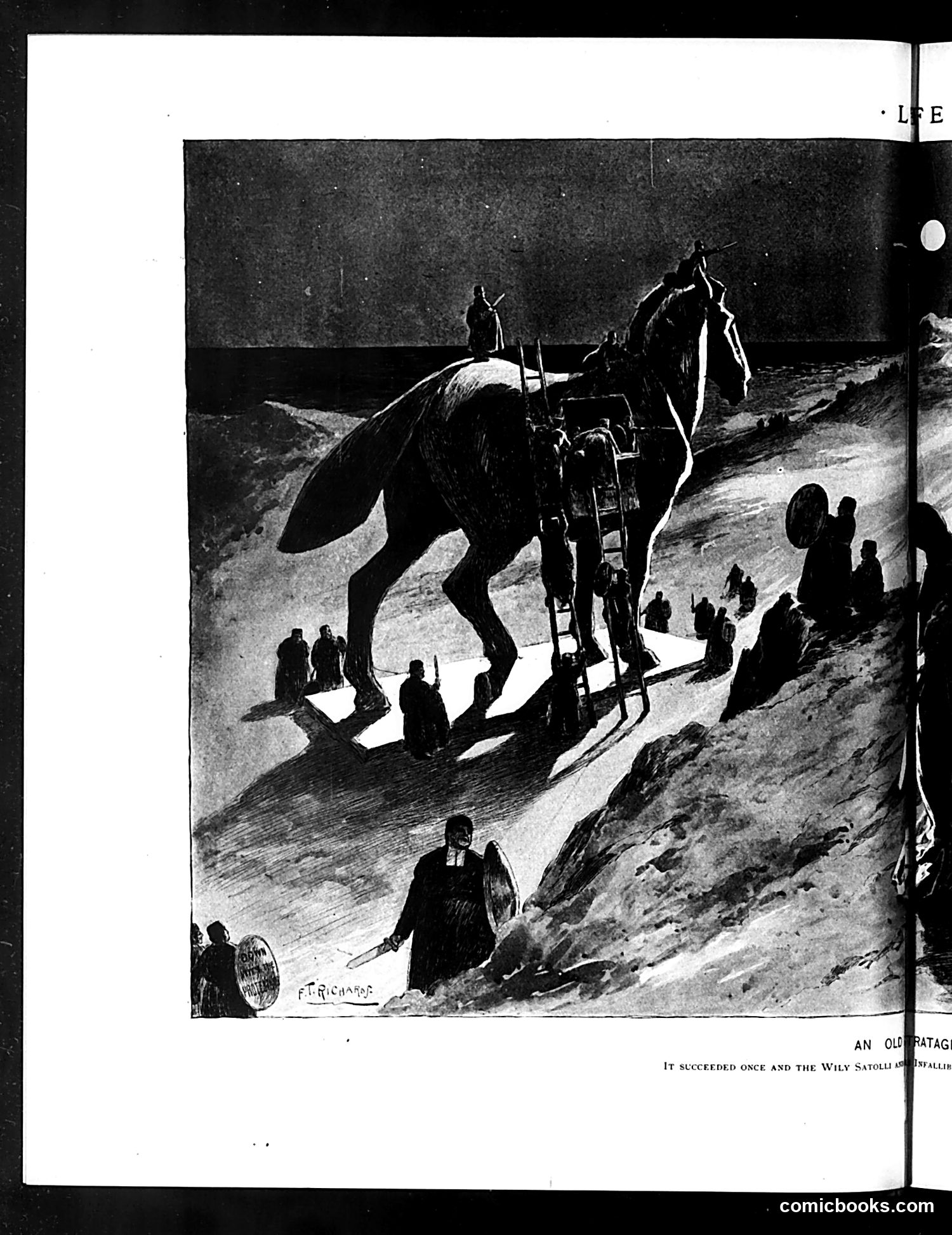
This appears to be a satirical illustration showing a giant elephant being worshipped or approached by small human figures in a desert or rocky landscape. The artist signature reads "F.OPPER" or similar. The caption references "AN OLD STRATAGEM" and mentions "the Wily Satoli" (likely a misspelling in OCR). **Without the full caption text visible**, the specific political meaning is unclear. However, the image likely satirizes either: - Blind devotion to a large, powerful entity (the elephant as symbol) - Colonial or imperial power dynamics - A specific historical event or political figure The elephant's dominance over the small figures suggests commentary on power imbalance, but the precise historical reference requires the complete caption to interpret accurately.
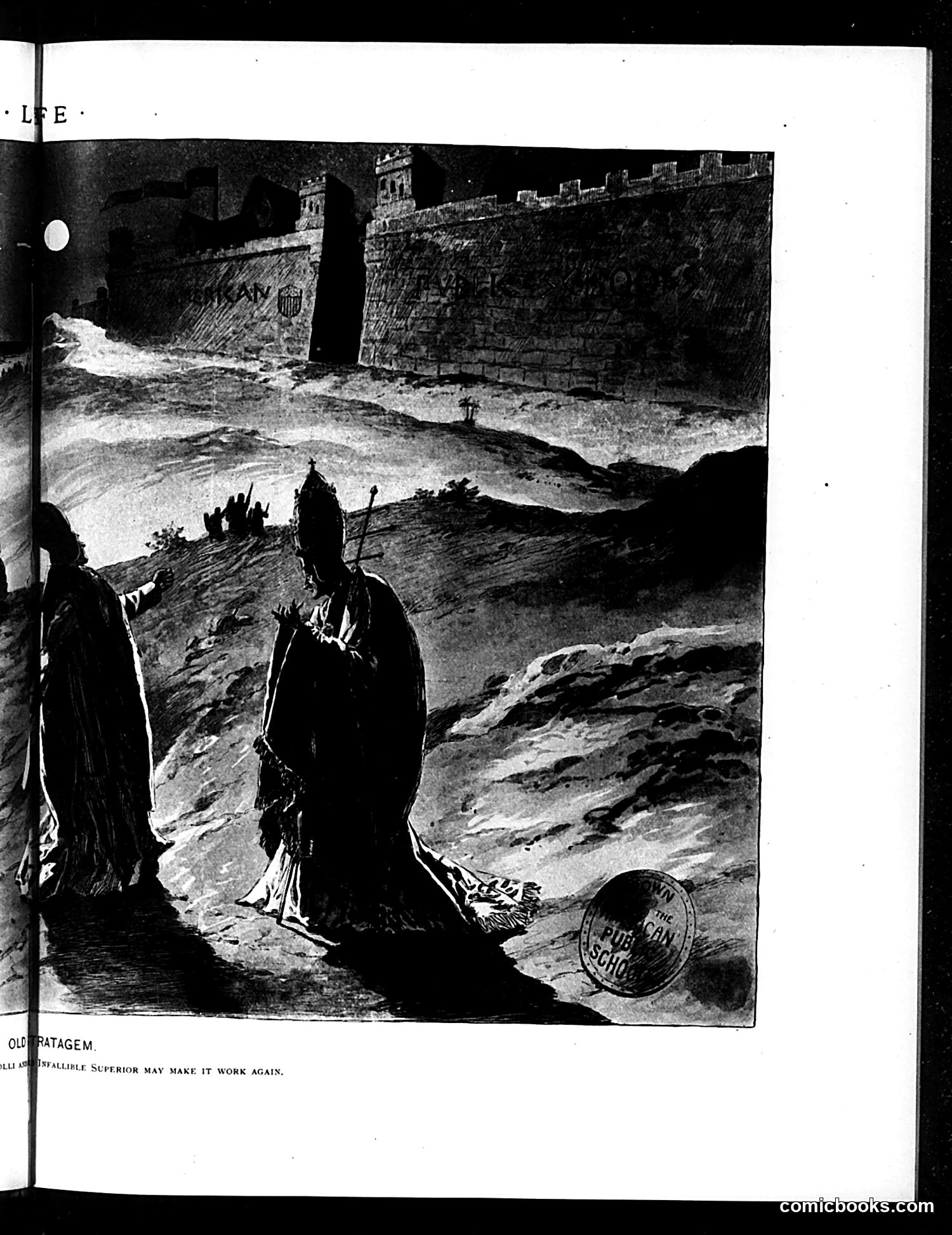
This appears to be a scene from a silent film or theatrical production rather than a political cartoon. The dramatic black-and-white image shows figures in medieval or historical costume near fortified castle walls, suggesting a narrative scene of conflict or intrigue. The caption reads "OLD GATAGE M." with partial text mentioning something about making "it work again," though the complete caption is partially obscured. Without clearer identification of the specific production, actors, or complete caption text, I cannot definitively explain what political or social satire this references. The theatrical nature and historical setting suggest it may parody political conflicts or power dynamics, but the specific meaning requires more context than the visible page provides.
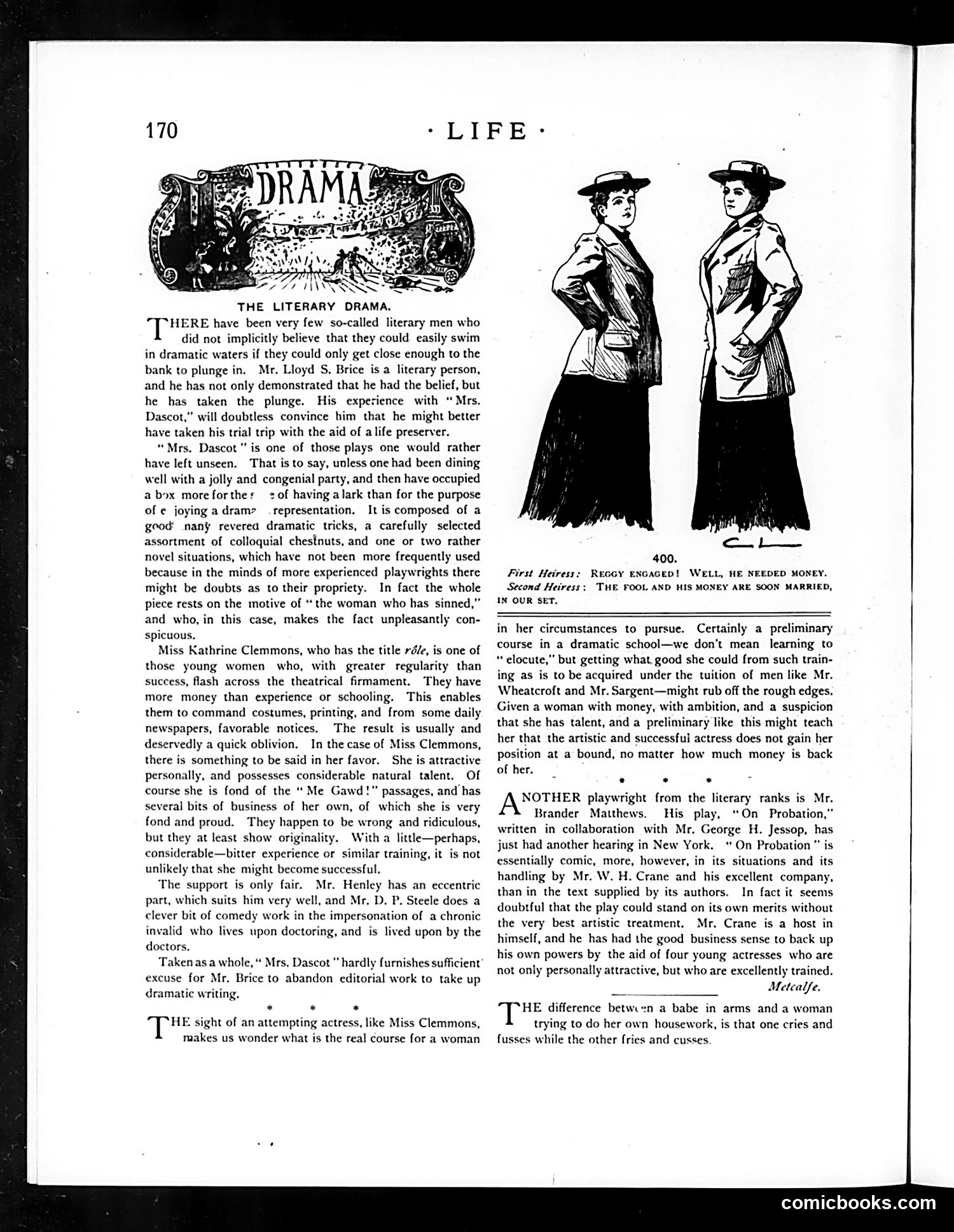
This page discusses theatrical adaptations of literary works. The illustration shows two fashionably dressed women in Edwardian-era clothing, labeled as characters from a play called "Mrs. Dascot" (likely an adaptation). The article critiques literary figures who attempt playwriting, citing Lloyd S. Brice as an example of someone with literary credentials but limited dramatic experience. It praises actress Kathrine Clemmons for her talent and natural ability, and discusses playwright Brander Matthews's work "On Probation" with director W. H. Crane. The satire targets the pretension of literary men attempting drama without proper training, while acknowledging that genuine talent—particularly in actresses—can overcome formal inexperience. The piece essentially argues that theatrical success requires more than literary credentials.
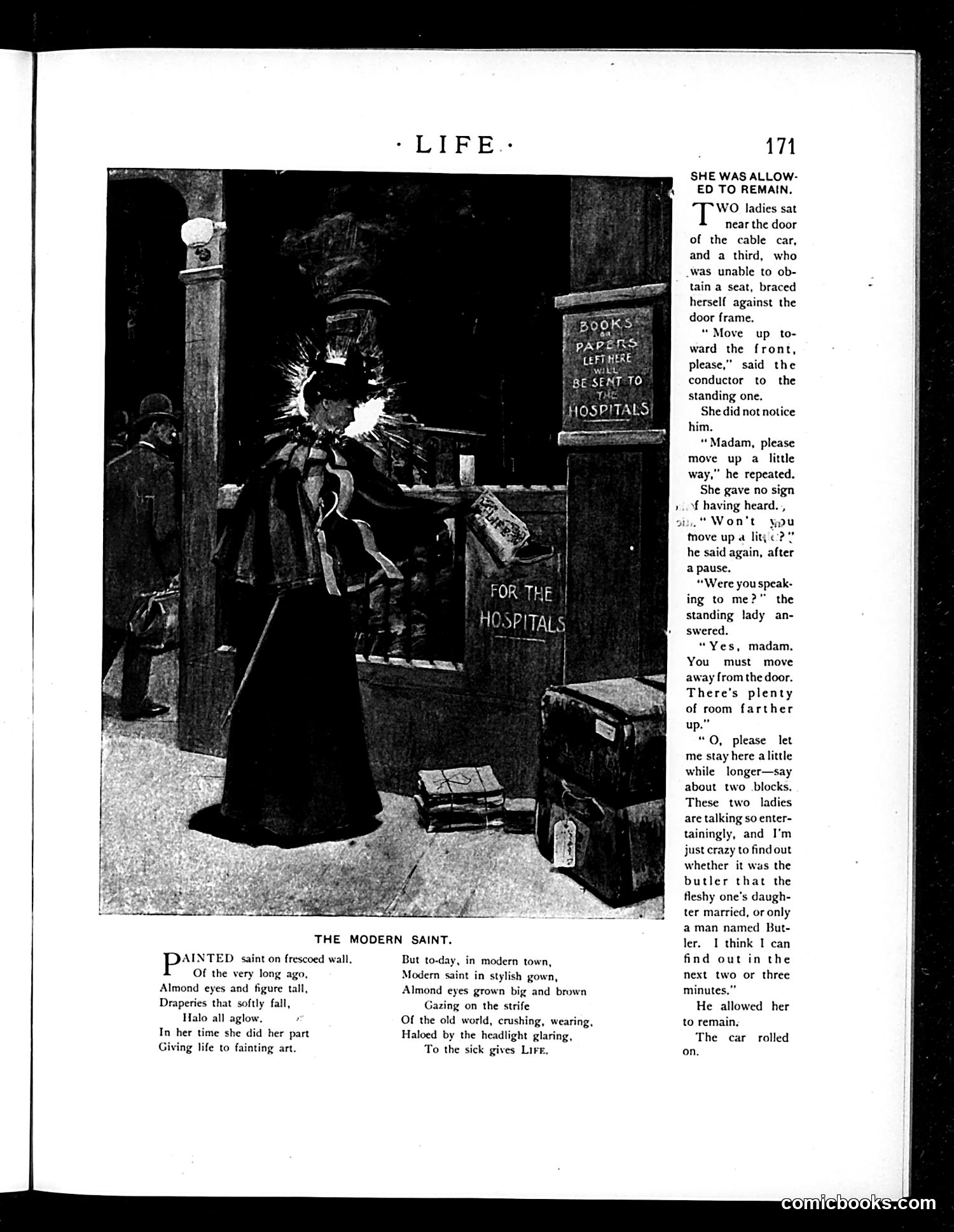
The page contains two distinct pieces: **"The Modern Saint"** — a poem with accompanying illustration depicting a woman in dark clothing in what appears to be a cable car. The poem contrasts painted saints of old (with "almond eyes" and "halos") to modern "saints" characterized by "big and brown" eyes, who bear the world's "crushing, wearing" burden and give "Life" to the sick. This appears to satirize contemporary women, likely nurses or social workers, as modern equivalents of religious saints — celebrating their self-sacrifice while critiquing the exhausting demands placed upon them. The narrative prose on the right depicts a crowded cable car with passengers discussing two entertaining ladies. It's a brief social vignette capturing urban transit life and gossip, though the specific reference is unclear without additional context.
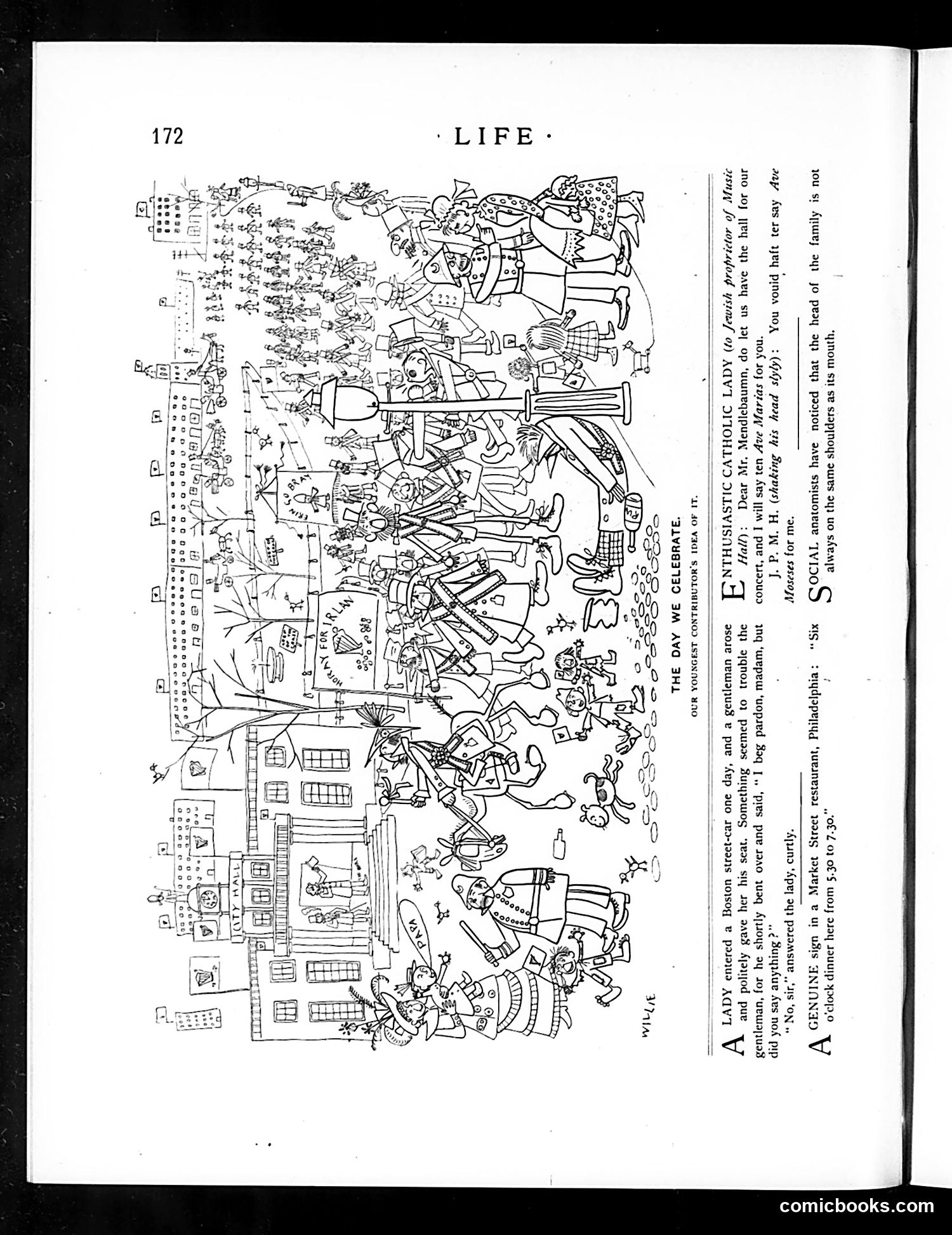
This page shows a chaotic domestic scene illustrating "A Day We Celebrate" — likely referring to a holiday when families gather. The cartoon depicts a crowded, hectic household with numerous figures engaged in various activities simultaneously: children playing, adults cooking/cleaning, people eating, and general pandemonium throughout rooms of a house. The satire appears to mock the idealized notion of celebratory family gatherings. Rather than the peaceful, joyful occasion such days are supposedly meant to be, the cartoon shows the reality: noise, disorder, exhaustion, and barely-controlled chaos. The dense, overlapping figures and activity suggest the stress and overwhelming nature of hosting or managing a large family event. The title and accompanying text (though partially obscured/corrupted in OCR) seem to present this comedic contrast between expectation and reality — a common theme in Life magazine's social commentary.
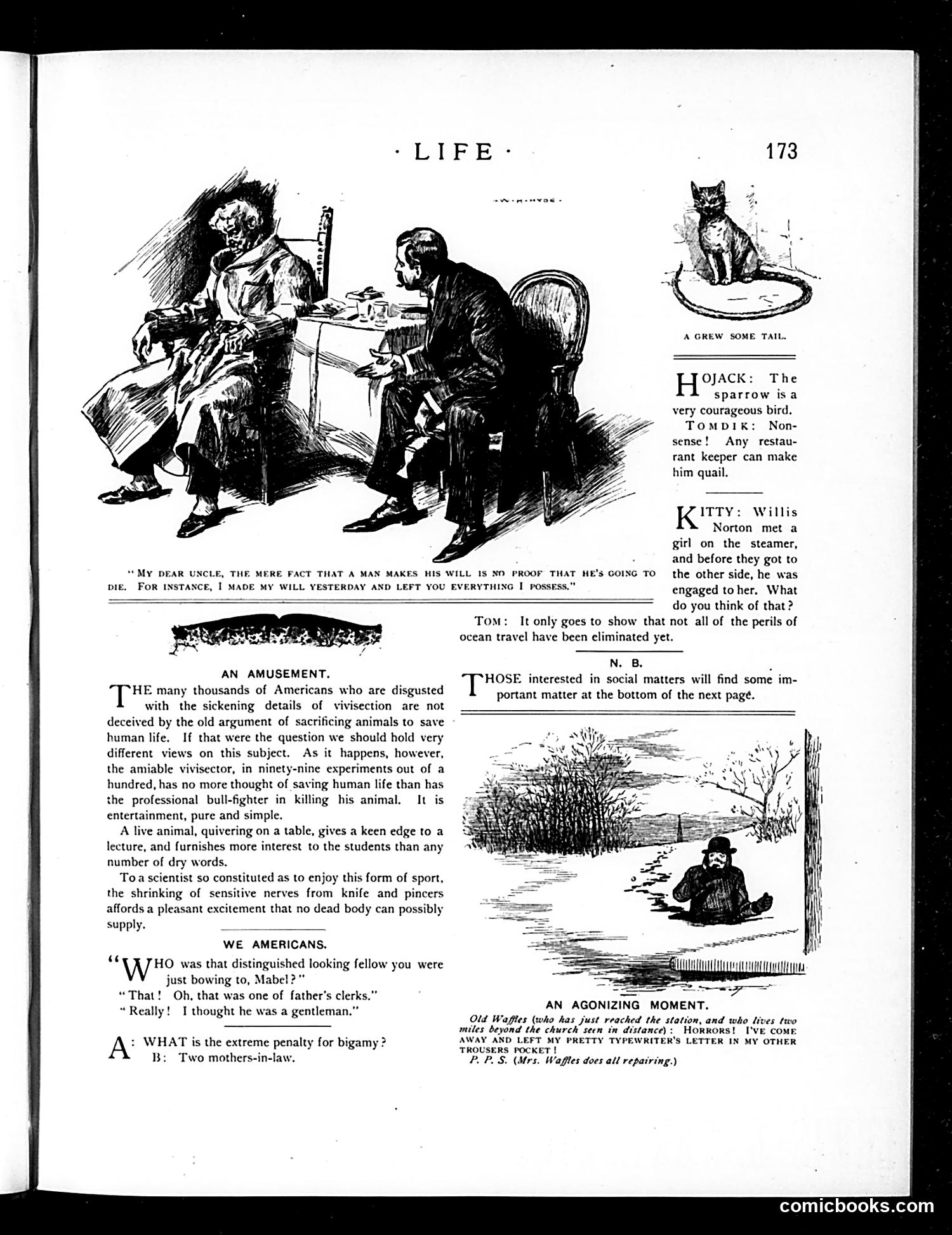
This page contains several brief satirical humor pieces typical of early Life magazine: **Main Cartoon**: Shows a nephew reassuring his uncle about making a will, joking that merely writing one doesn't guarantee death. The uncle responds that the nephew's hasty will-making suggests he has murder in mind—dark humor about inheritance motives. **"We Americans" Joke**: Satirizes American class consciousness. A woman dismisses a "distinguished looking fellow" as merely her father's clerk, not a gentleman—mocking the American pretense that appearance rather than occupation determines social standing. **"An Agonizing Moment"**: A country man (Old Waffles) realizes at the train station he's left his pretty typewriter's letter in his other trousers. The joke plays on absent-mindedness and the era's fascination with typewriters as modern technology. **Supporting jokes** involve wordplay (sparrow/quail puns) and a cynical observation about quick ocean-voyage engagements. The overall tone is lighthearted social commentary on American manners, technology, and relationships.
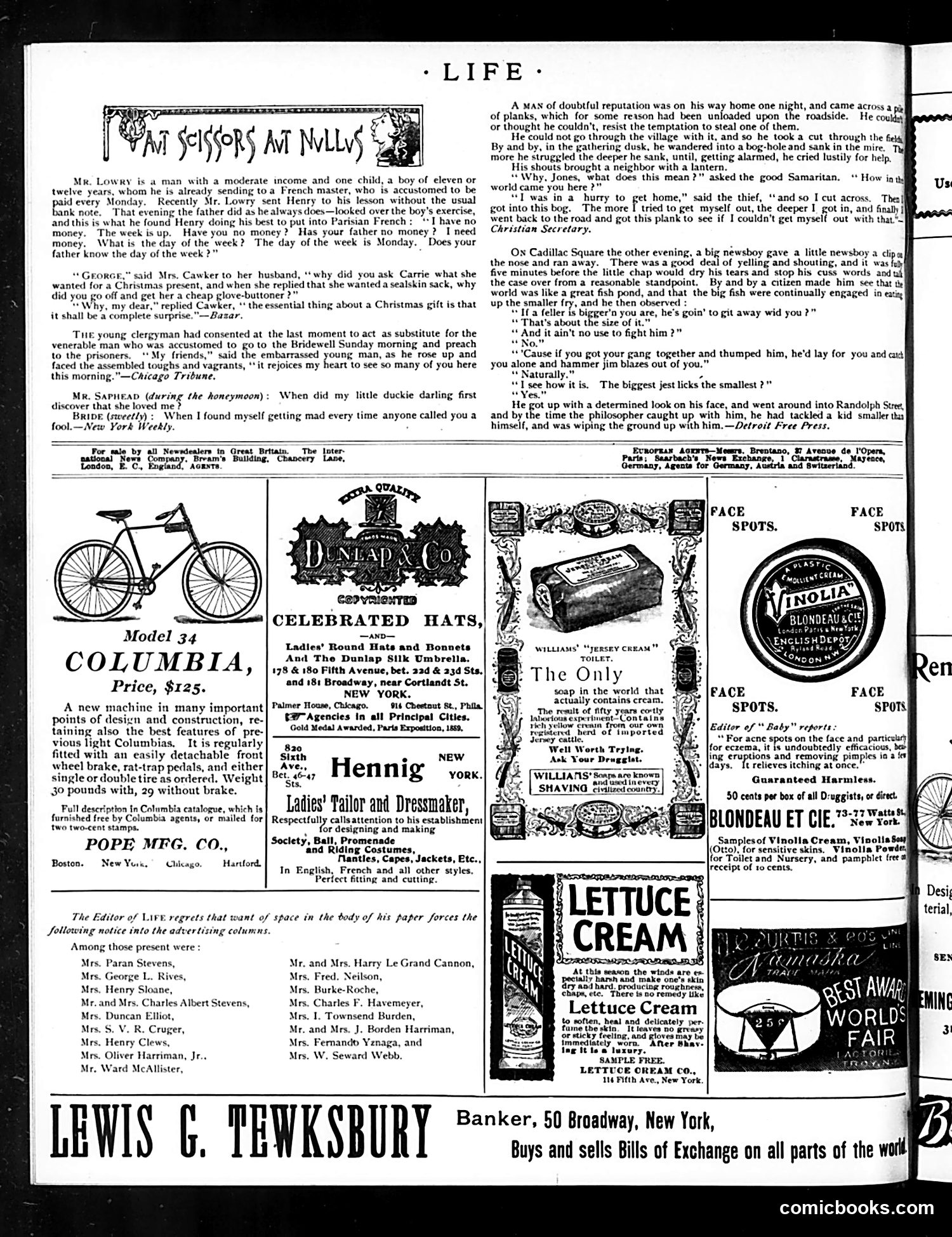
This page from *Life* magazine contains **humorous anecdotes and satirical commentary** rather than political cartoons. The pieces mock everyday human behavior and social hypocrisy: 1. **"Scissors at Nullus"**: Satirizes a French tutor's repetitive, meaningless lessons about money and days of the week—critiquing rote educational methods. 2. **The plank thief story**: A moral irony: a man stealing a plank gets stuck in a bog, then uses that same stolen plank to escape. The piece questions whether crime ever truly helps anyone. 3. **The newsboy anecdote**: Satirizes social Darwinism—a child learns that "might makes right," then immediately bullies a smaller child. It mocks both the philosophy and human nature's predictable hypocrisy. 4. **Other brief jokes** mock matrimonial surprise-giving and institutional insincerity. The page is primarily **advertisements** (Columbia bicycles, hats, face cream) mixed with satirical humor targeting working-class life, institutional pretense, and moral contradictions in late 19th/early 20th-century America.
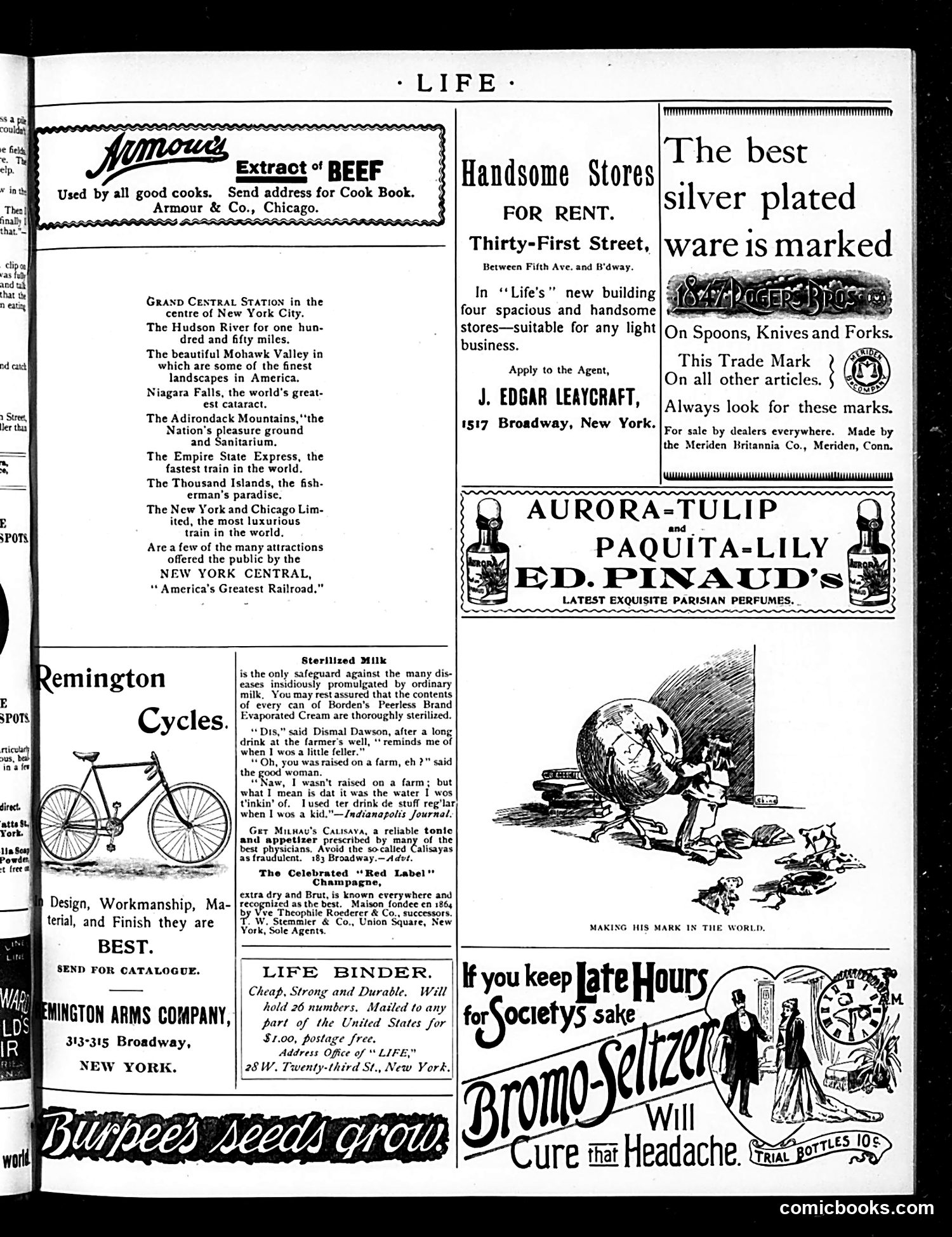
This page is primarily **advertising**, not satirical content. It's a collection of period advertisements and promotional material typical of early 1900s magazines. The main illustrated element—"Making His Mark in the World"—shows a figure (appears to be a farmer or laborer) with a large spherical object, likely referencing agricultural or industrial productivity. The accompanying text snippet is a humorous dialect anecdote about someone confusing farm water with city water, suggesting rural-versus-urban themes common to the era. The advertisements promote: - **Travel**: New York Central Railroad highlights natural attractions (Niagara Falls, Adirondacks) - **Consumer goods**: Bicycles, sterilized milk, silverware, champagne, remedies - **Magazine services**: Life binder subscriptions The "Bromo-Seltzer" ad at bottom promotes headache relief—a common patent medicine of the period. These pages served dual purposes: generating revenue while showcasing consumer products that defined modern American life at the turn of the century.
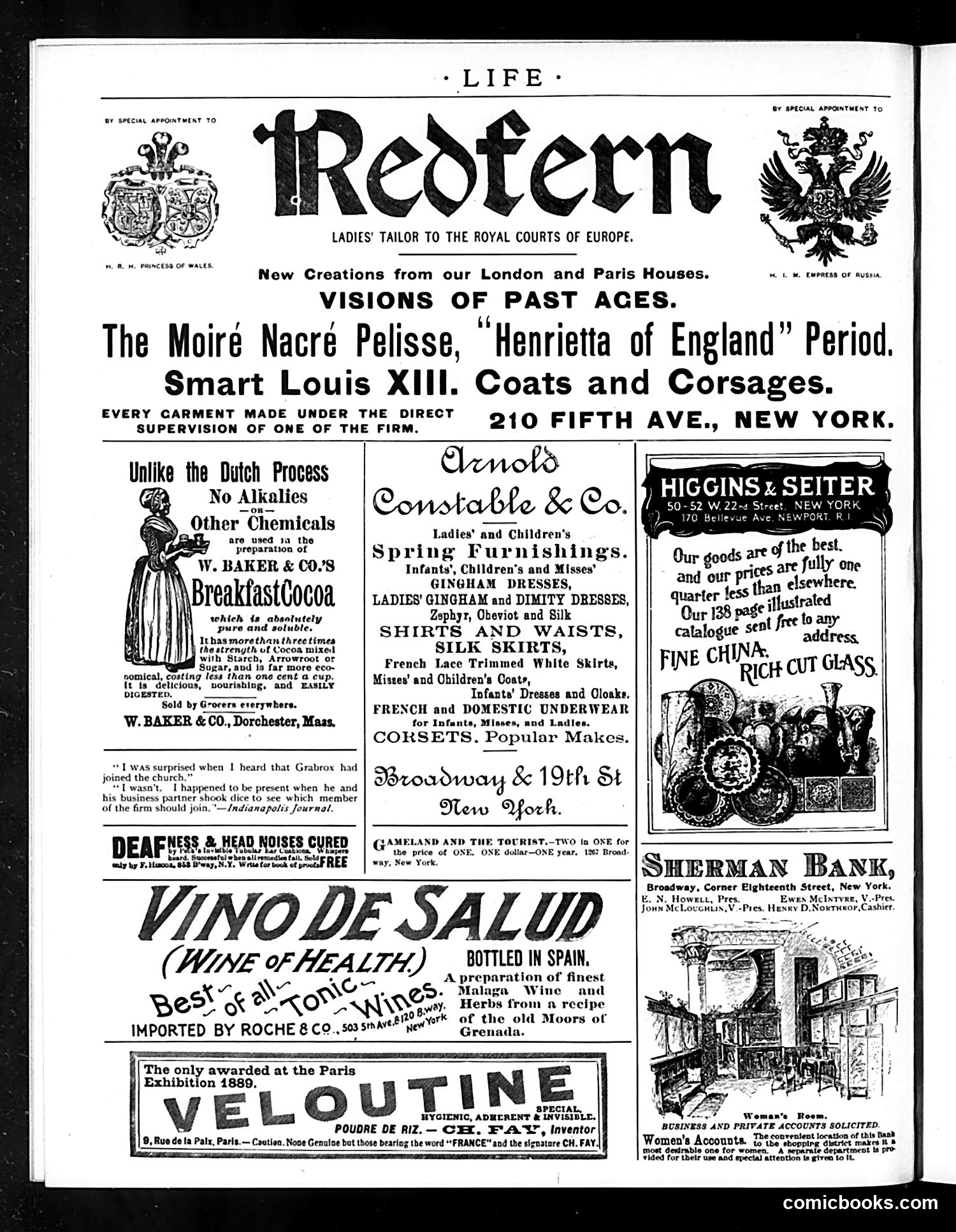
This is primarily a **fashion and product advertisement page**, not a satirical cartoon page. The main content showcases advertisements for luxury goods targeting wealthy American consumers in the late 19th/early 20th century. **Key Content:** The dominant advertisement is for **Redfern**, a high-end ladies' tailor with royal patronage (H.R.M. Princess of Wales, Russian Empress). They advertise "Visions of Past Ages"—historically-inspired clothing referencing the "Henrietta of England" period and Louis XIII styles, reflecting the era's fascination with historical revival fashion. **Supporting Advertisements** include: - W. Baker & Co.'s breakfast cocoa - Arnold Constable & Co. (children's and women's clothing) - Higgins & Seiter (fine china and glassware) - Sherman Bank - Vino de Salud (Spanish wine marketed as medicinal) - Veloutine (French beauty powder) The page reflects Gilded Age consumer culture, targeting affluent readers with imported luxuries and fashionable goods positioned as markers of refinement and social status.