
Life, 1894-03-15 · page 10 of 16
Life — March 15, 1894 — page 10: what you’re looking at
What you’re looking at
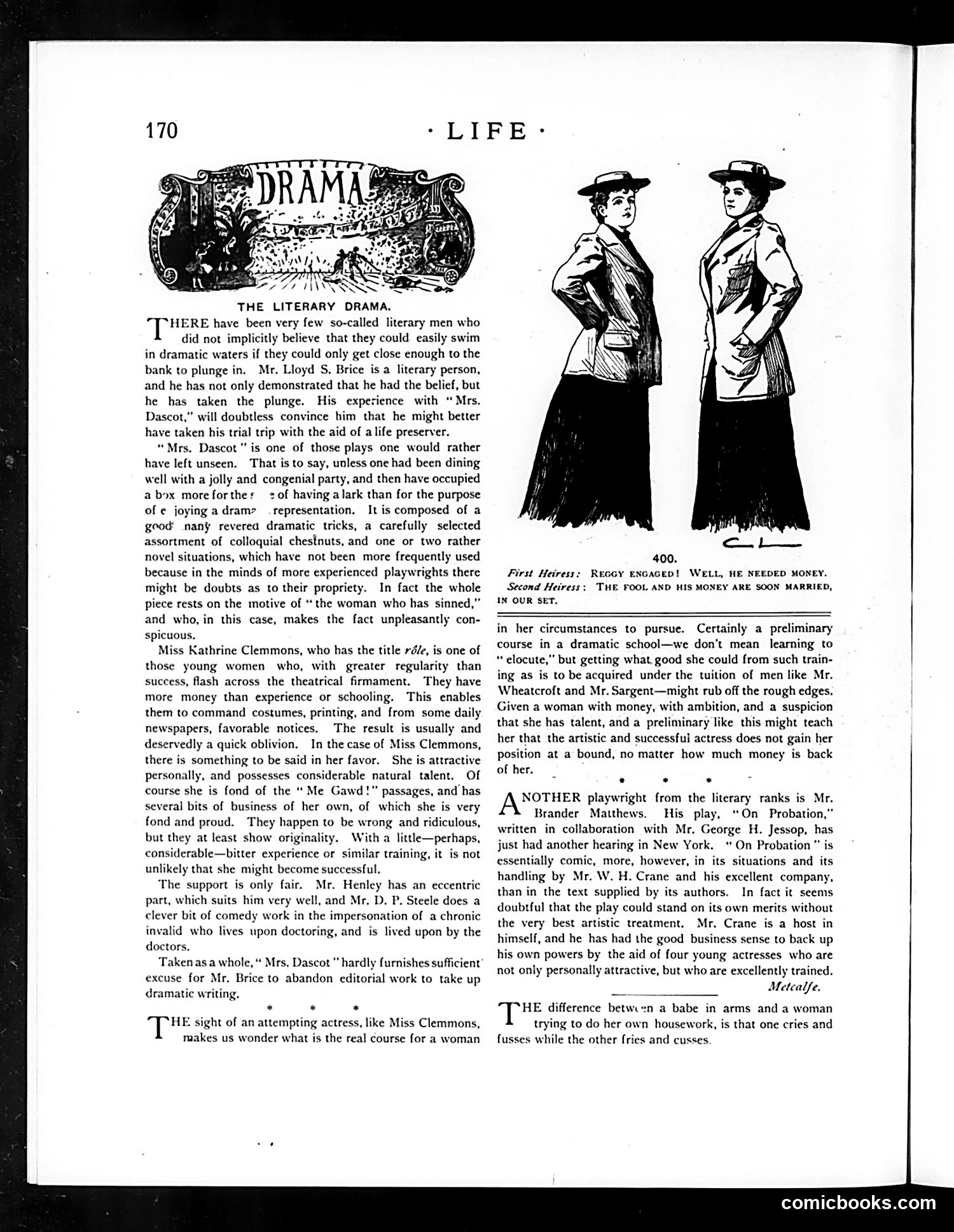
This page discusses theatrical adaptations of literary works. The illustration shows two fashionably dressed women in Edwardian-era clothing, labeled as characters from a play called "Mrs. Dascot" (likely an adaptation). The article critiques literary figures who attempt playwriting, citing Lloyd S. Brice as an example of someone with literary credentials but limited dramatic experience. It praises actress Kathrine Clemmons for her talent and natural ability, and discusses playwright Brander Matthews's work "On Probation" with director W. H. Crane. The satire targets the pretension of literary men attempting drama without proper training, while acknowledging that genuine talent—particularly in actresses—can overcome formal inexperience. The piece essentially argues that theatrical success requires more than literary credentials.
📄 Transcribed text from this page (OCR, searchable)
Machine-transcribed from the original scan — historical spelling and the odd misread are preserved.
THE LITERARY DRAMA. HERE have been very few so-called literary men who did not implicitly believe that they could. easily swim in dramatic waters if they could only get close enough to the bank to plunge in. Mr. Lloyd S, Brice is a literary person, and he has not only demonstrated that he had the belief, but he has taken the plunge. His experience with “Mrs. Dascot,” will doubtless convince him that he might better have taken his trial trip with the aid of a life preserver. “Mrs. Dascot is one of those plays one would rather have left unseen. That is to say, unless one had been dining well with a jolly and congenial party, and then have occupied abox moreforthes + of having alark than for the purpose of joying a dram? representation. It is composed of a good nany revered dramatic tricks, a carefully selected assortment of colloquial chestnuts, and one or two rather novel situations, which have not been more frequently used because in the minds of more experienced playwrights there might be doubts as to their propriety. In fact the whole piece rests on the motive of ‘the woman who has sinned,” and who, in this case, makes the fact unpleasantly con- spicuous. Miss Kathrine Clemmons, who has the title 7é/e, is one of those young women who, with greater regularity than success, flash across the theatrical firmament. They have more money than experience or schooling. This enables them to command costumes, printing, and from some daily newspapers, favorable notices. The result is usually and deservedly a quick oblivion. In the case of Miss Clemmons, there is something to be said in her favor. She is attractive personally, and possesses considerable natural talent. Of course she is fond of the Me Gawd!” passages, and’ has several bits of business of her own, of which she is very fond and proud. They happen to be wrong and ridiculous, but they at least show originality. With a littl—perhaps, considerable—bitter experience or similar training, it is not unlikely that she might become successful. The support is only fair. Mr. Henley has an eccentric part, which suits him very well, and Mr. D. P. Steele does a clever bit of comedy work in the impersonation of a chronic invalid who lives upon doctoring, and is lived upon by the doctors, Taken asa whole, “ Mrs, Dascot " hardly furnishes sufficient excuse for Mr. Brice to abandon editorial work to take up dramatic writing. . . . HE sight of an attempting actress, like Miss Clemmons, makes us wonder what is the real course for a woman 400. REGGY ENGAGED! WELL, HE NEEDED MONEY. THE FOOL AND HIS MONEY ARE SOON MARRIED, First Heiress: Second Heiress: IN OUR SET, in her circumstances to pursue. Certainly a preliminary course in a dramatic school—we don’t mean learning to “elocute,” but getting what. good she could from such train- ing as is to be acquired under the tuition of men like Mr. Wheatcroft and Mr. Sargent—might rub off the rough edges. Given a woman with money, with ambition, and a suspicion that she has talent, and a preliminary like this might teach her that the artistic and successful actress does not gain her position at a bound, no matter how much money is back of her, OTHER playwright from the literary ranks is Mr. Brander Matthews. His play, “On Probation,” written in collaboration with Mr. George H. Jessop, has just had another hearing in New York. ‘ On Probation ” is essentially comic, more, however, in its situations and its handling by Mr. W. H. Crane and his excellent company, than in the text supplied by its authors. In fact it seems doubtful that the play could stand on its own merits without the very best artistic treatment. Mr. Crane is a host in himself, and he has had the good business sense to back up his own powers by the aid of four young actresses who are not only personally attractive, but who are excellently trained. _ Metcalfe. HE difference betwcen a babe in arms and a woman trying to do her own housework, is that one cries and fusses while the other fries and cusses. comicbooks.com