
A complete issue · 14 pages · 1894
Life — March 8, 1894
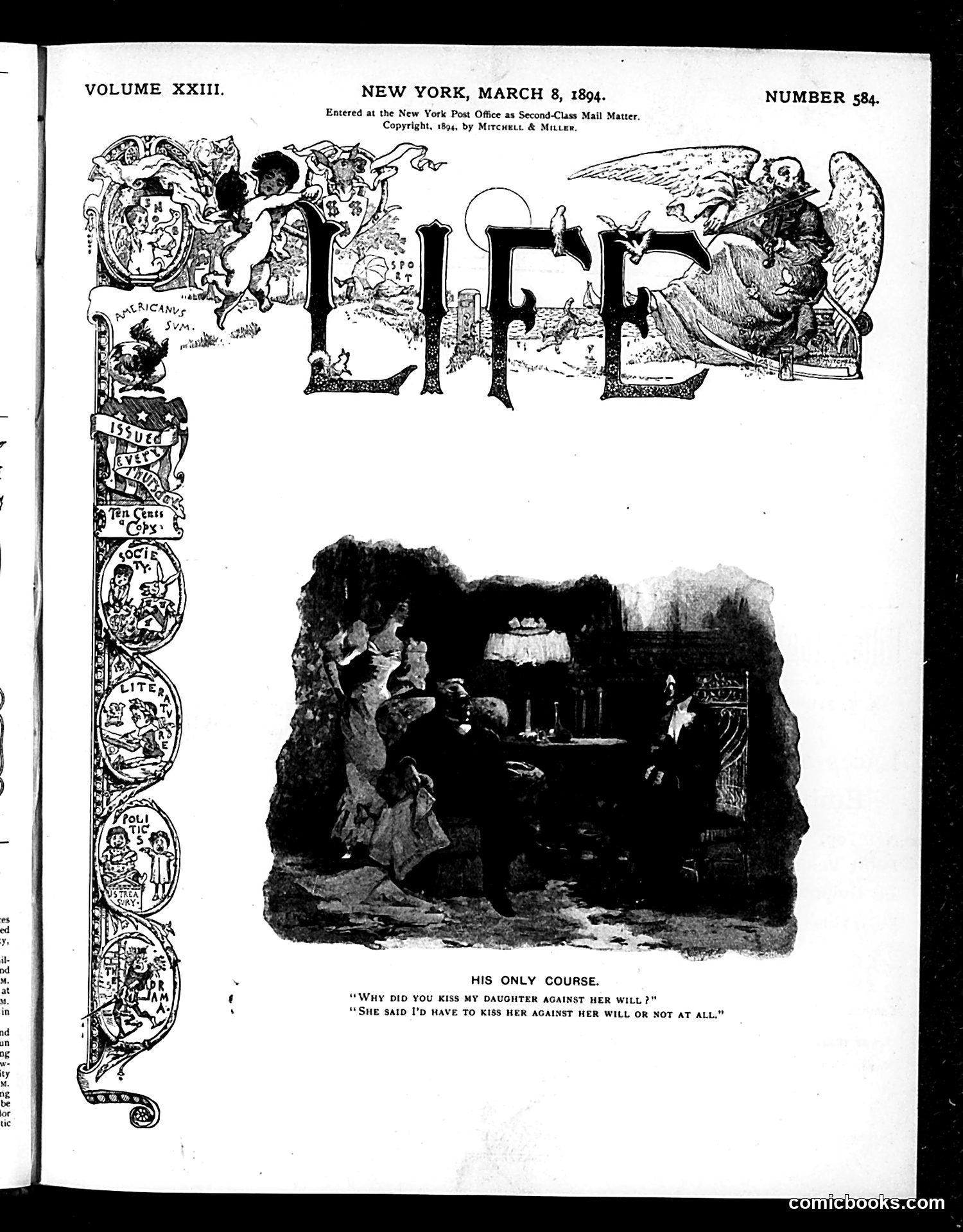
This page features a humorous domestic scene titled "His Only Course," depicting a marital dispute. The dialogue reveals a husband defending himself after kissing his daughter: he argues he had no choice, while his wife contends the daughter didn't have to accept the kiss. The joke plays on Victorian-era domestic tensions and parental authority. It satirizes rigid social conventions about proper behavior and the absurdity of marital quarrels over trivial matters. The ornate decorative border on the left—typical of Life's design—frames various vignettes suggesting the magazine's diverse content. Without identifying specific individuals, the cartoon appears to mock bourgeois respectability and the often-petty nature of domestic arguments among the educated classes of the 1890s.
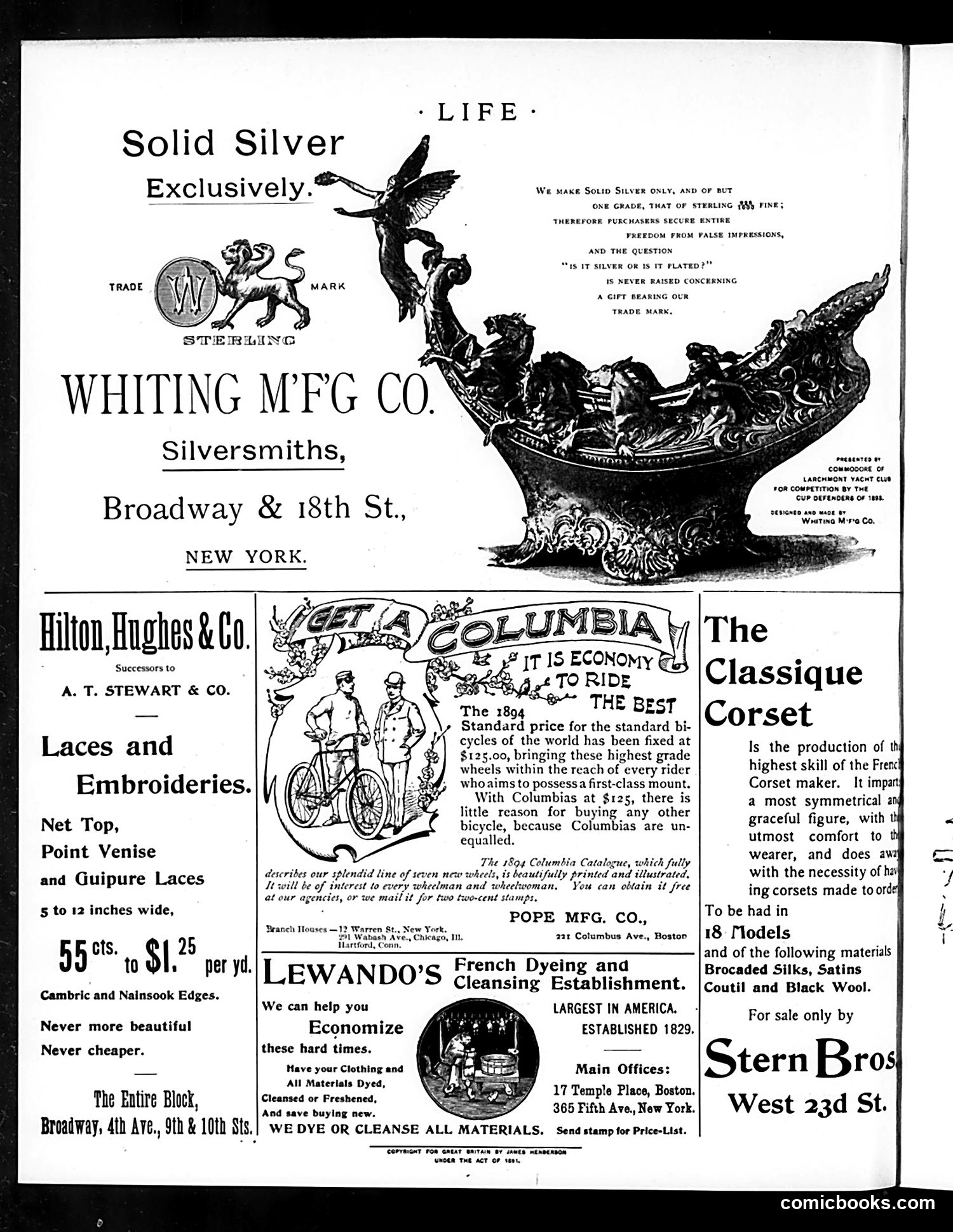
This page is primarily **advertisements**, not satirical content. The dominant ad features the Whiting Mfg Co., a New York silversmith emphasizing they make "Solid Silver Exclusively" — a marketing claim addressing consumer concerns about plated versus genuine silver. The central image shows an ornate silver boat or vessel, likely a presentation piece, demonstrating the company's craftsmanship. The page includes various period advertisements: laces and embroideries, Columbia bicycles, corsets, French dry cleaning services, and bicycle accessories. These represent typical turn-of-the-century American luxury goods and services. No political satire or comic content is evident. This appears to be a standard advertising section from *Life* magazine, reflecting late 19th/early 20th-century consumer culture and manufacturing claims.
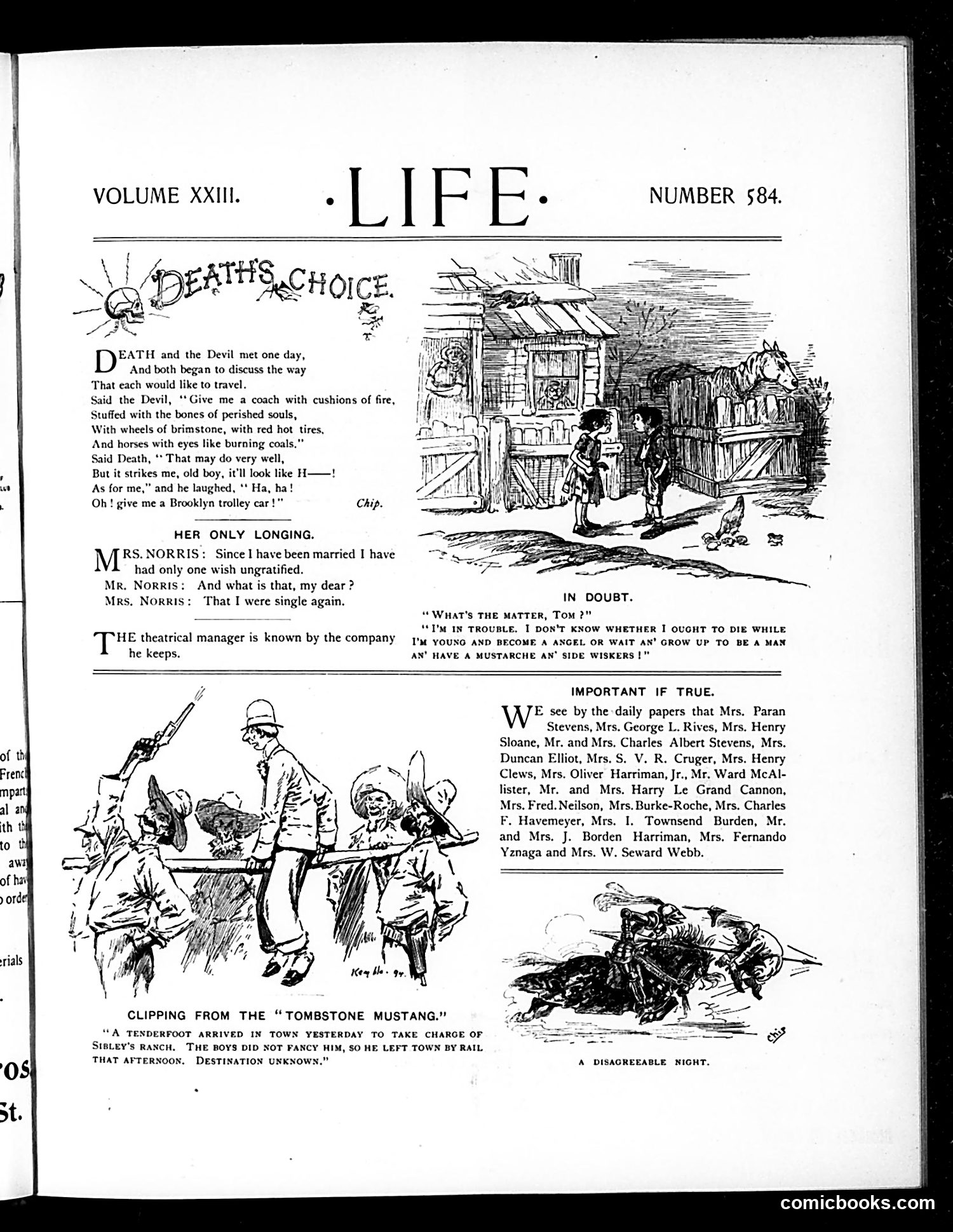
This page contains several distinct humorous pieces: **"Death's Choice"** is a poem-dialogue where Death and the Devil discuss transportation preferences. Death rejects the Devil's offer of a fancy coach, preferring a Brooklyn trolley car—satirizing the notorious danger of early trolleys as death traps. **"Her Only Longing"** presents a brief comedic exchange where a married woman expresses her sole wish: to be single again. **"In Doubt"** quotes a young man uncertainly questioning whether to die as an angel or live to become a man with a mustache and "side whiskers"—poking fun at masculine vanity. The illustrations include a domestic farm scene and cowboys, with the "Tombstone Mustang" clipping referencing a tenderfoot visiting a ranch. The page emphasizes everyday humor and social observation rather than specific political commentary.
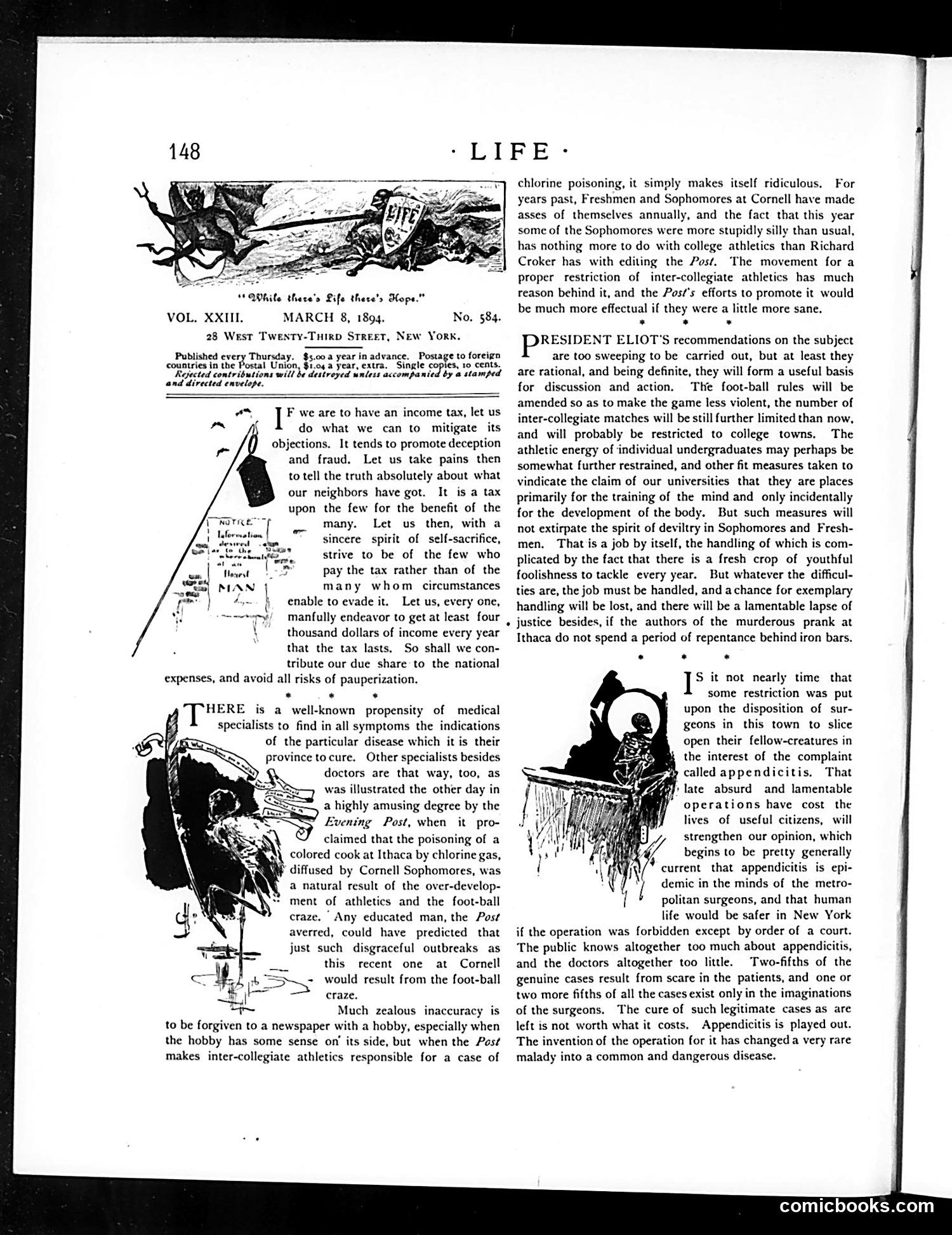
This page contains three distinct satirical pieces criticizing various institutions: 1. **Income Tax Satire** (top left): Mocks a proposed income tax, using imagery of a figure labeled "MAN" being bled dry. The satire argues that taxation disproportionately burdens citizens while politicians escape responsibility. 2. **Cornell Athletics Critique** (center): Attacks the *Evening Post* for falsely blaming chlorine gas poisoning at Cornell for athlete deaths, when the real culprit was excessive football-related stress. The satire criticizes medical specialists and newspapers for shifting blame rather than addressing dangerous athletic practices. 3. **Appendicitis Surgery Satire** (bottom right): Mocks surgeons performing unnecessary appendectomies, suggesting the operation became fashionable despite being dangerous and often unjustified—a common complaint about 1890s medical overtreatment.
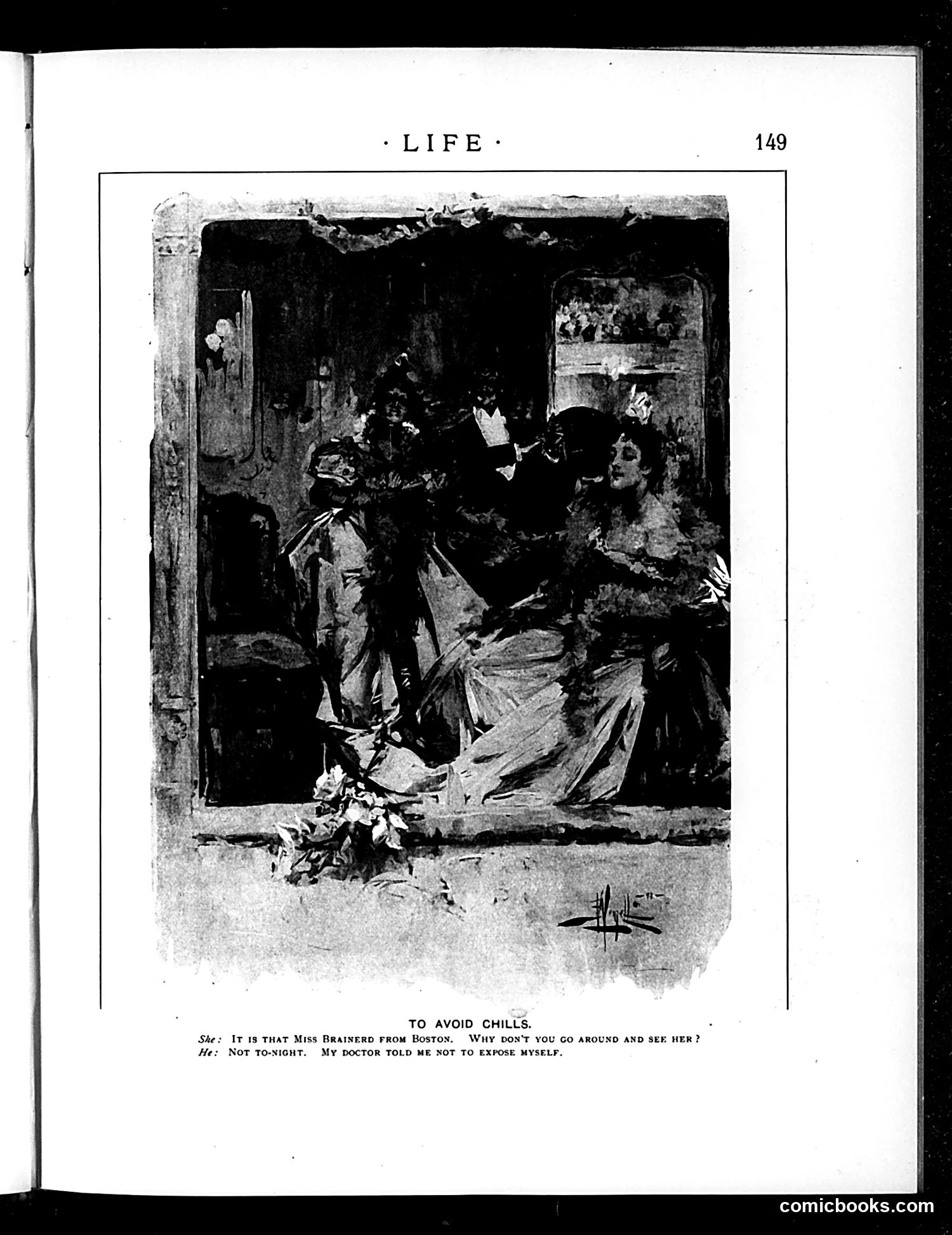
This cartoon depicts a social/medical satire about illness prevention. The dialogue shows a man trying to visit a woman (Miss Brainerd from Boston), but she refuses because her doctor advised against exposure to others. The man counters that his doctor told him the same thing. The joke critiques the medical advice of the era—likely early 20th century—when doctors frequently warned patients to avoid social contact to prevent catching colds or chills. The satire points out the absurdity: if everyone followed this advice strictly, no social interaction would occur at all, rendering the prohibition impractical and socially isolating. The cartoon mocks both the overcautious medical establishment and society's tendency toward excessive health anxiety.
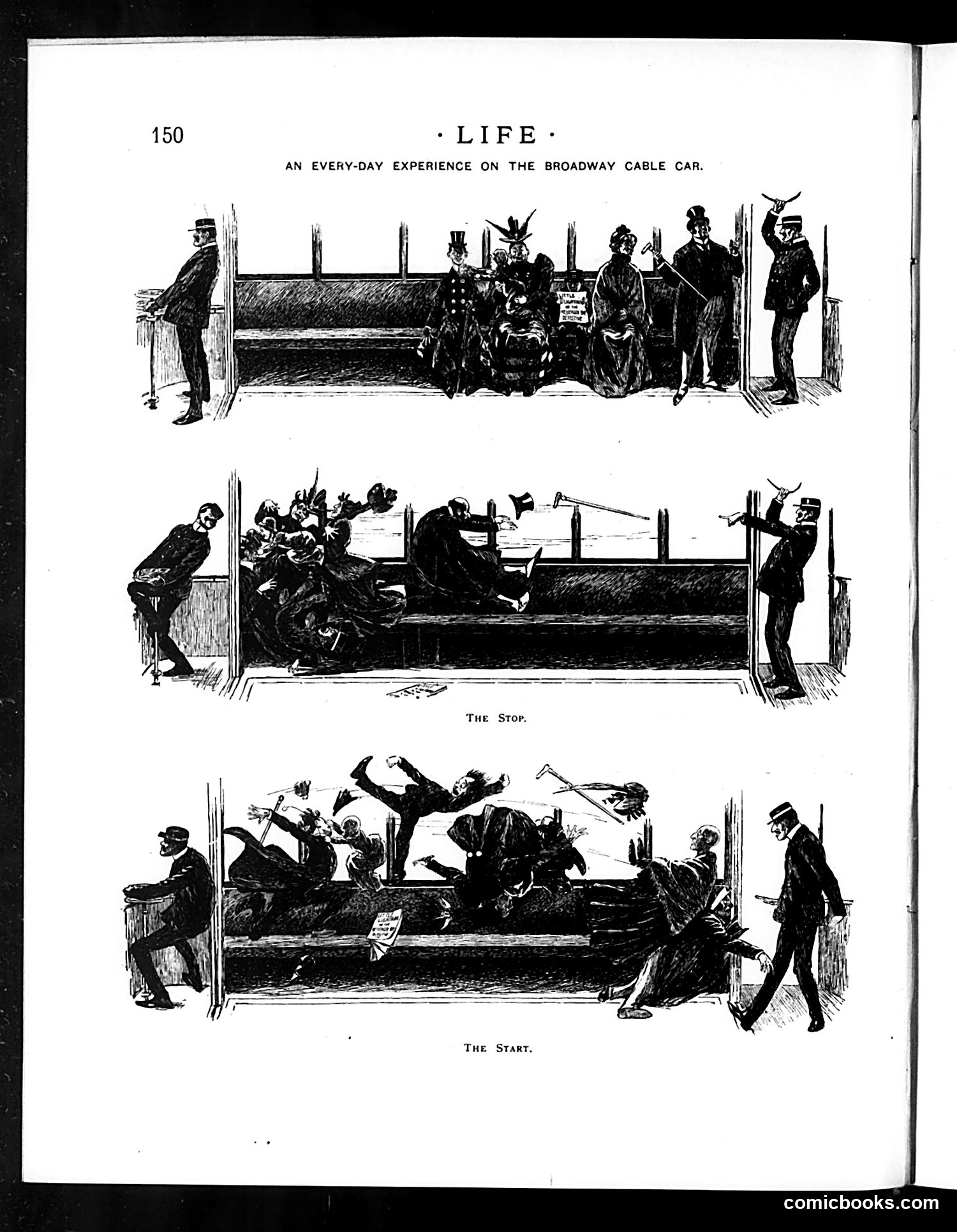
This satirical piece depicts the chaos of boarding and riding a Broadway cable car in what appears to be late 19th-century New York City. The three panels show: **Top panel ("The Stop")**: Orderly passengers waiting to board. **Middle panel ("The Stop" again)**: The car halted, with crowded passengers packed tightly together in uncomfortable positions. **Bottom panel ("The Start")**: Passengers being violently jostled and thrown about as the cable car suddenly accelerates. The satire mocks the brutal, chaotic reality of cable car travel—the contrast between the initial orderly queue and the pandemonium that follows. It humorously illustrates the jarring stops and starts that passengers endured, presenting an "every-day experience" of discomfort and indignity as comedic exaggeration.
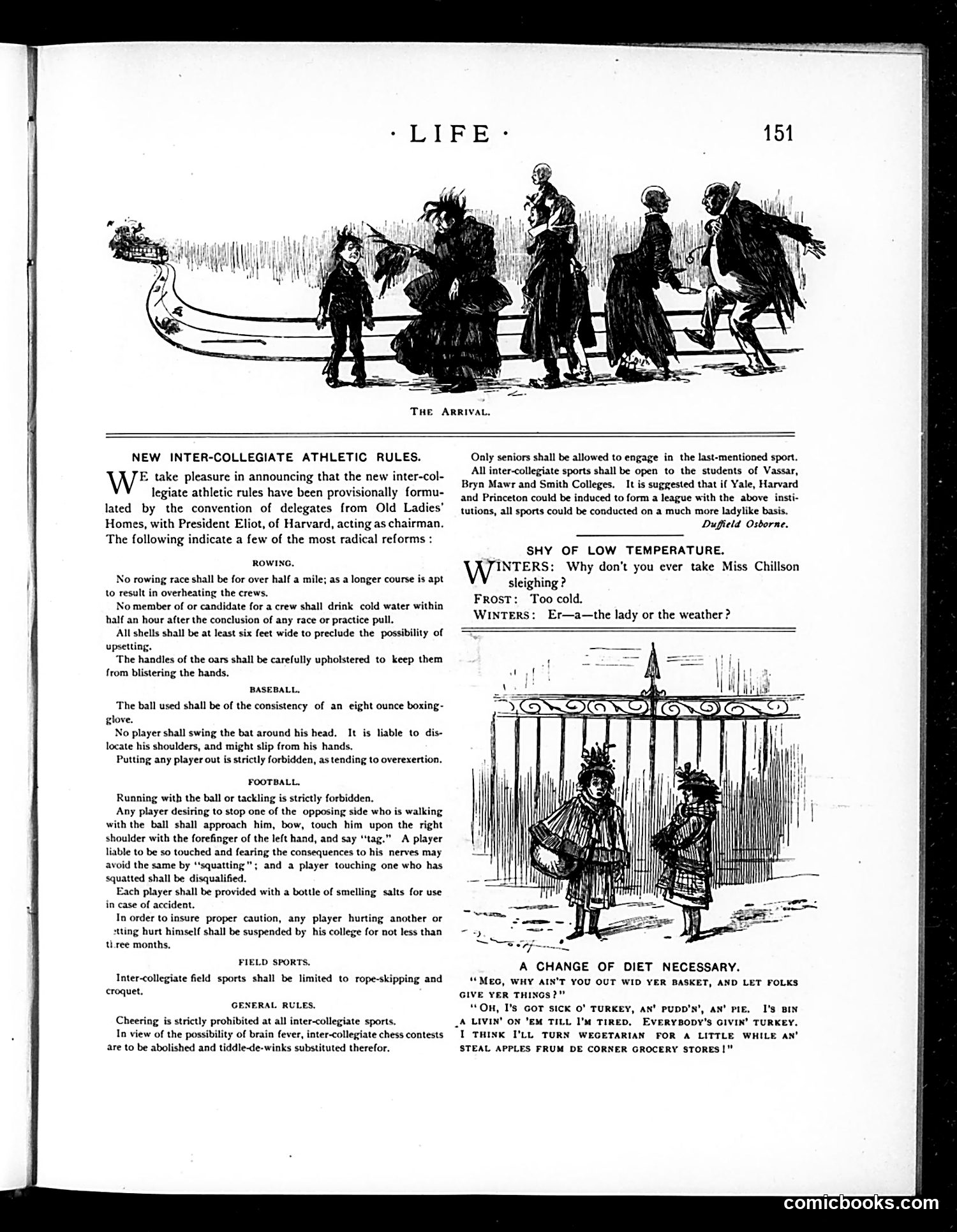
**"The Arrival"** (top illustration) depicts elegantly dressed figures greeting what appears to be a stylized boat or vessel arriving on shore—likely satirizing the reception of some notable person or group, though the specific reference is unclear from the image alone. **"New Inter-Collegiate Athletic Rules"** mocks proposed reforms at elite colleges (mentioning Harvard, Yale, Bryn Mawr, Smith, and Princeton), suggesting overly cautious restrictions on student sports—portraying administrators as excessively protective. **"Shy of Low Temperature"** is a brief joke about winter weather and reluctance to go sleighing. **"A Change of Diet Necessary"** features two figures discussing abandoning turkey for vegetarian fare, humorously complaining about repeated holiday meals—a domestic humor piece about seasonal eating. The page combines institutional satire with everyday comic observations typical of Life's editorial approach.
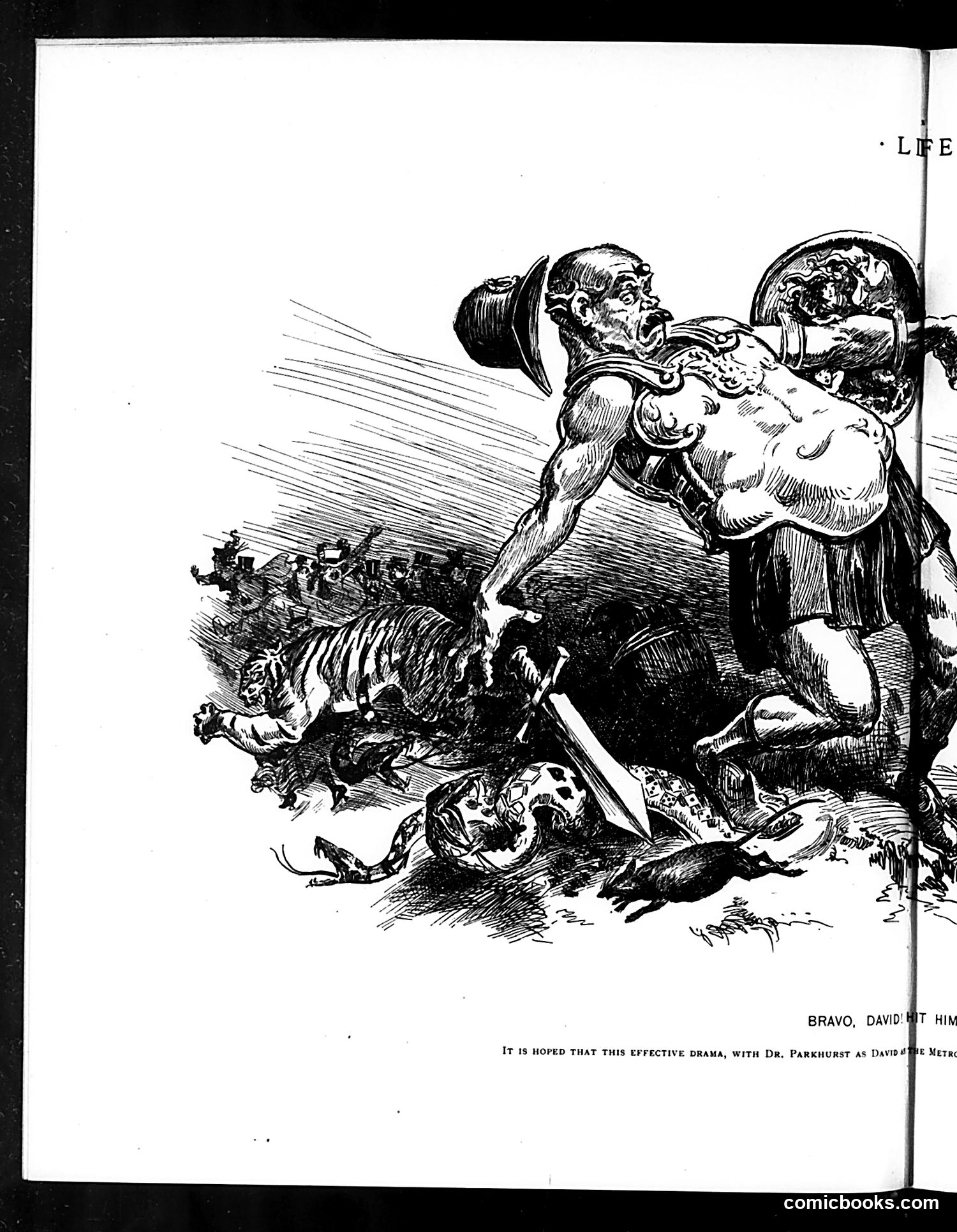
This is a satirical illustration from *Life* magazine depicting a classical allegorical scene. A muscular, bare-chested male figure (appearing to represent a classical hero or deity) stands triumphantly over fallen enemies or obstacles, wielding a sword. He wears a top hat and carries ornate armor or regalia. The caption reads "BRAVO, DAVID! HIT HIM" and references "Dr. Parkhurst as David" at the Metropolitan [likely]. This appears to satirize Dr. Charles Parkhurst, a real Reform crusader of the 1890s known for aggressive anti-corruption campaigns in New York City. The "David" reference suggests depicting him as a righteous fighter against larger institutional corruption—framed here as comical heroic hyperbole through the classical, over-the-top artistic treatment.
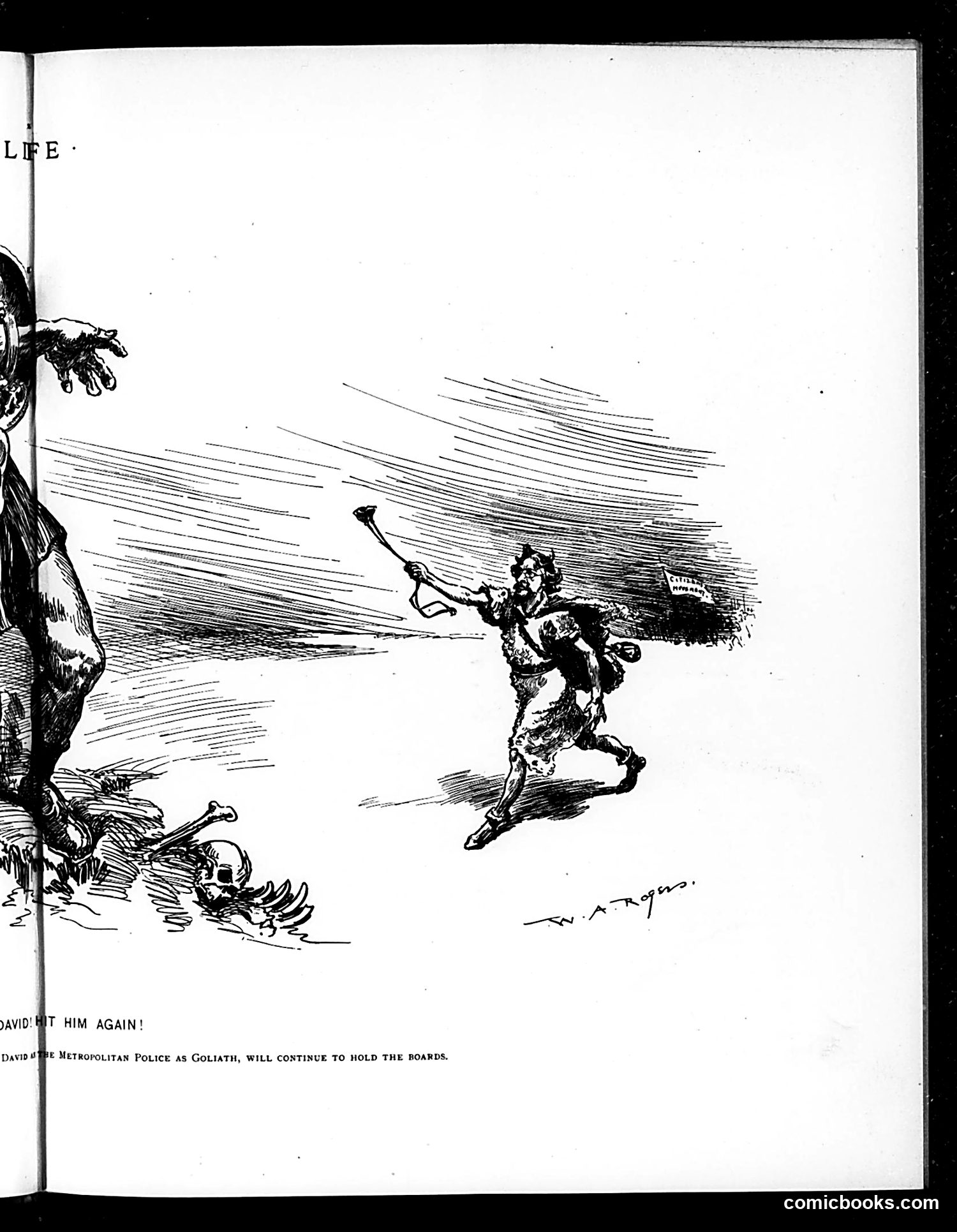
This is a satirical cartoon titled "David Bit Him Again!" The image shows a figure wielding a sling (like the biblical David with his sling against Goliath) attacking a large figure on the left side of the frame. The caption states: "David [as] the Metropolitan Police as Goliath, will continue to hold the boards." The cartoon uses the David and Goliath biblical metaphor to comment on a conflict between the Metropolitan Police (cast as the powerful Goliath) and some smaller opposing force (cast as David). The "biting" suggests repeated, aggressive actions by the underdog against the established authority. Without additional context about the specific historical moment, the exact identity of the opposing force remains unclear, though this appears to critique police power or authority using classical religious allegory.
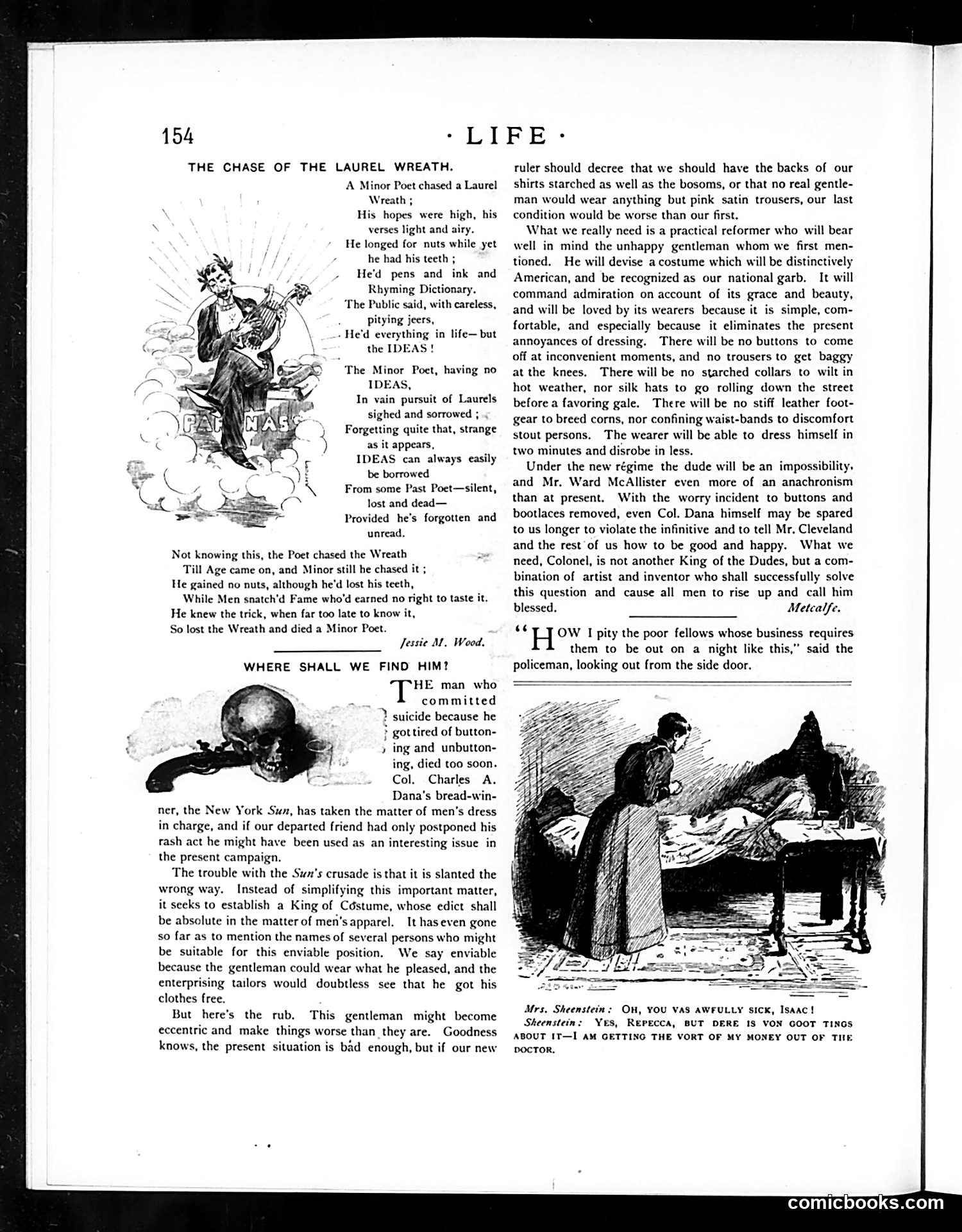
This page satirizes turn-of-the-century debates over American men's clothing and fashion reform. The main text discusses Col. Charles A. Dana's *New York Sun* campaign to establish a "King of Costume" who would dictate simplified, practical male dress—eliminating starched collars, tight waistbands, and other uncomfortable conventions. The upper cartoon shows a poet chasing the "Laurel Wreath" (artistic achievement), while the lower illustration depicts a sick man, accompanying a section titled "WHERE SHALL WE FIND HIM?" that sarcastically questions who could serve as this fashion arbiter. The satire criticizes Dana's proposal as absurdly authoritarian and impractical. The text mocks both the need for such reform and the idea that any single person could enforce dress standards, suggesting the project would create worse social problems than it solves.
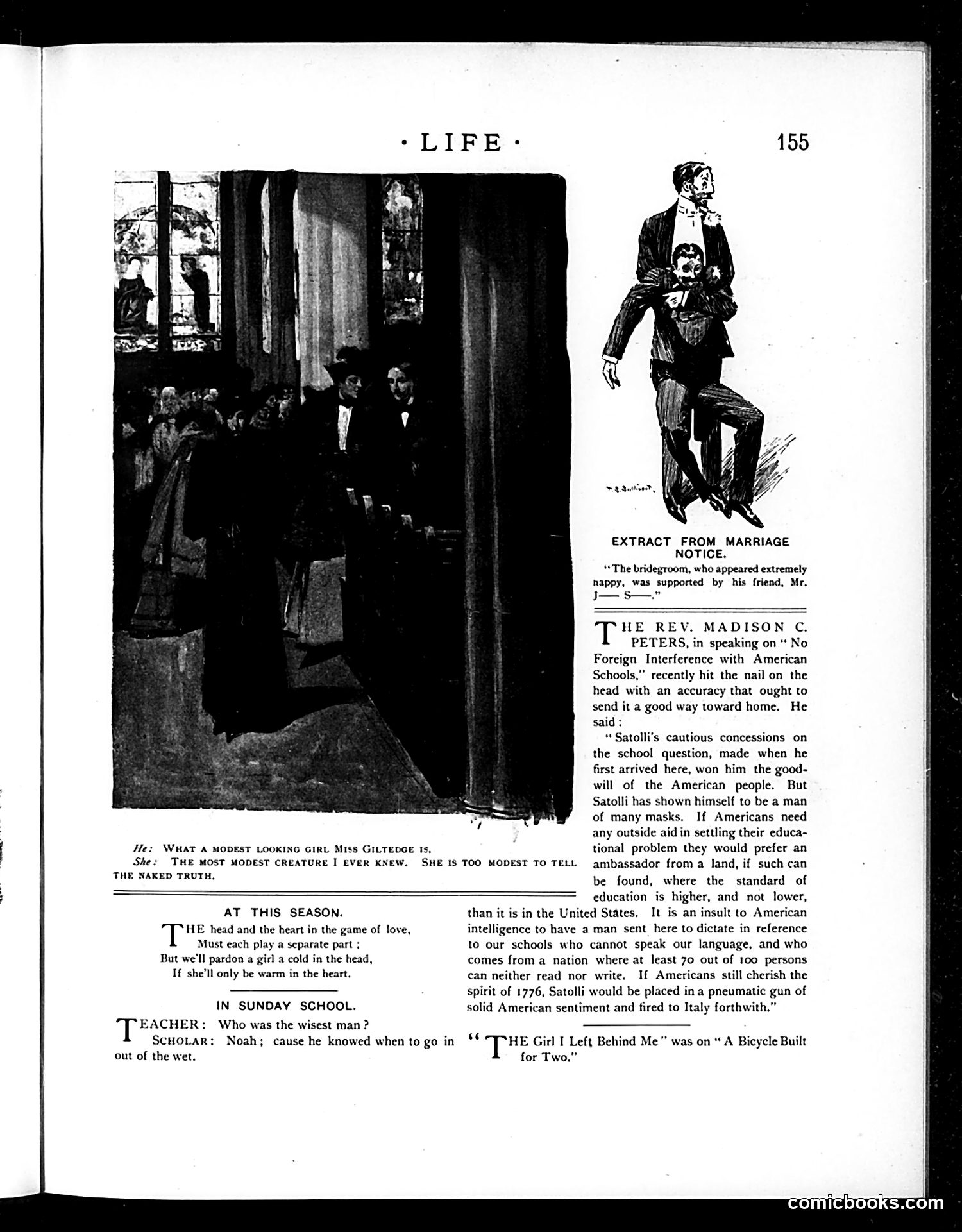
This page contains social humor and commentary typical of early 20th-century Life magazine. **Top illustration**: Shows a formal interior scene (appears to be a church or formal venue) with well-dressed men in tuxedos. The caption jokes about a modest-looking girl named Miss Giltedge, suggesting irony about her appearance versus her character. **Main content**: A substantial article by Rev. Madison C. Peters criticizing Italian educator Satoelli's involvement in American schools. Peters argues that sending a foreign educator to dictate school policy is insulting to American intelligence, particularly given Italy's literacy rates. He invokes Revolutionary patriotism ("spirit of 1776"), suggesting this represents unwelcome foreign interference in American education. **Bottom**: Brief humor pieces about love and a Sunday school riddle. The satire targets both pretension and foreign influence in American institutions.
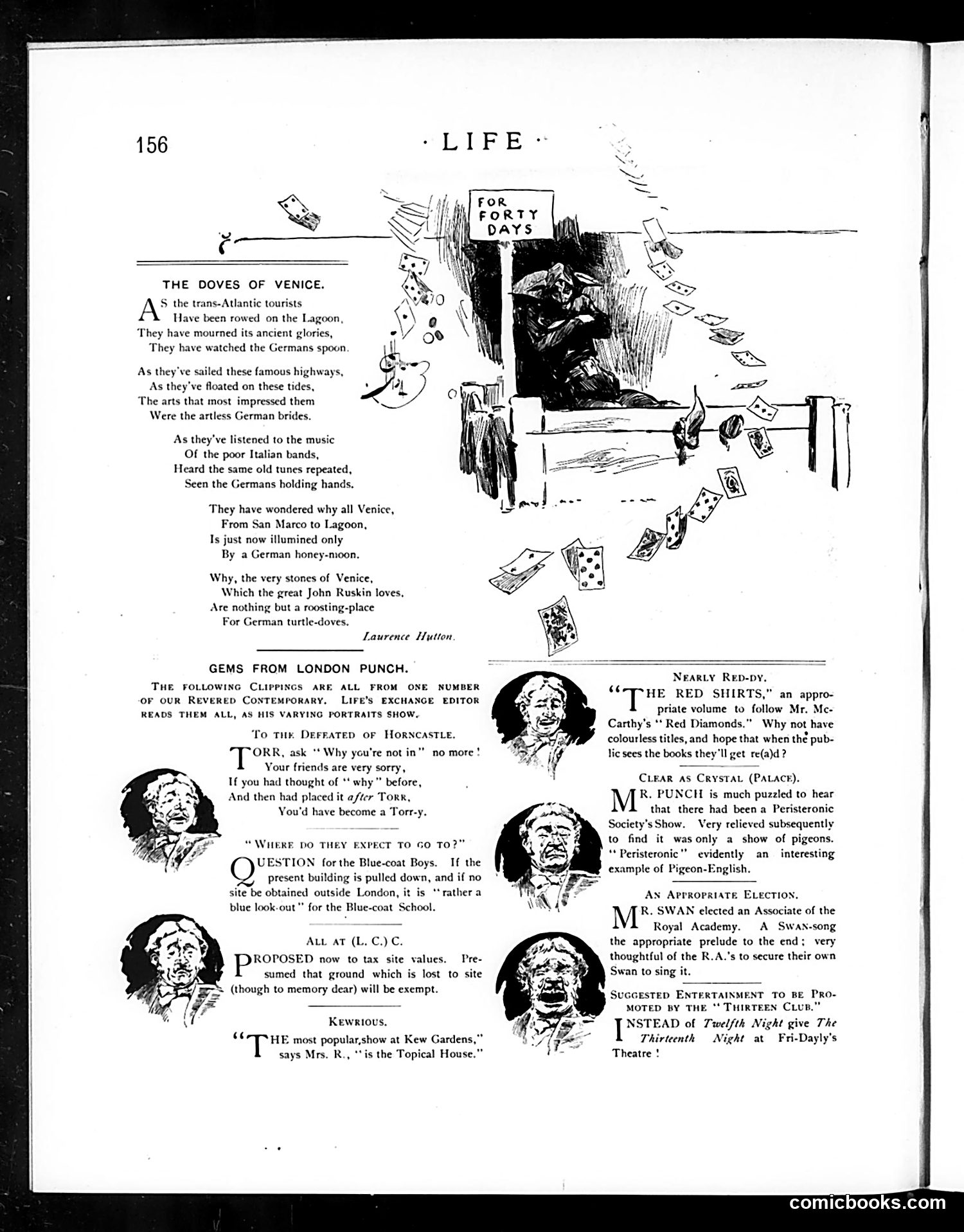
This page contains satirical humor pieces from *London Punch* magazine, reprinted in the American *Life* magazine. The main content includes: **"The Doves of Venice"** (top): A poem mocking American tourists in Venice who are distracted by German honeymooners ("turtle-doves") rather than appreciating the city's artistic and historical landmarks. The satire targets both American tourists' shallow priorities and the prevalence of German couples vacationing there. **"Gems from London Punch"** (bottom): A collection of brief puns and wordplay jokes, each with accompanying caricatures. These include: - Wordplay on "Torr-y" (Tory political party) - Puns on "blue look-out" and Blue-coat School - Visual jokes about taxation, Kew Gardens, book titles, and pigeon shows The humor relies entirely on verbal puns and contemporary London references that would have amused educated readers familiar with British politics, institutions, and cultural events. Modern readers would miss most specific allusions without research.
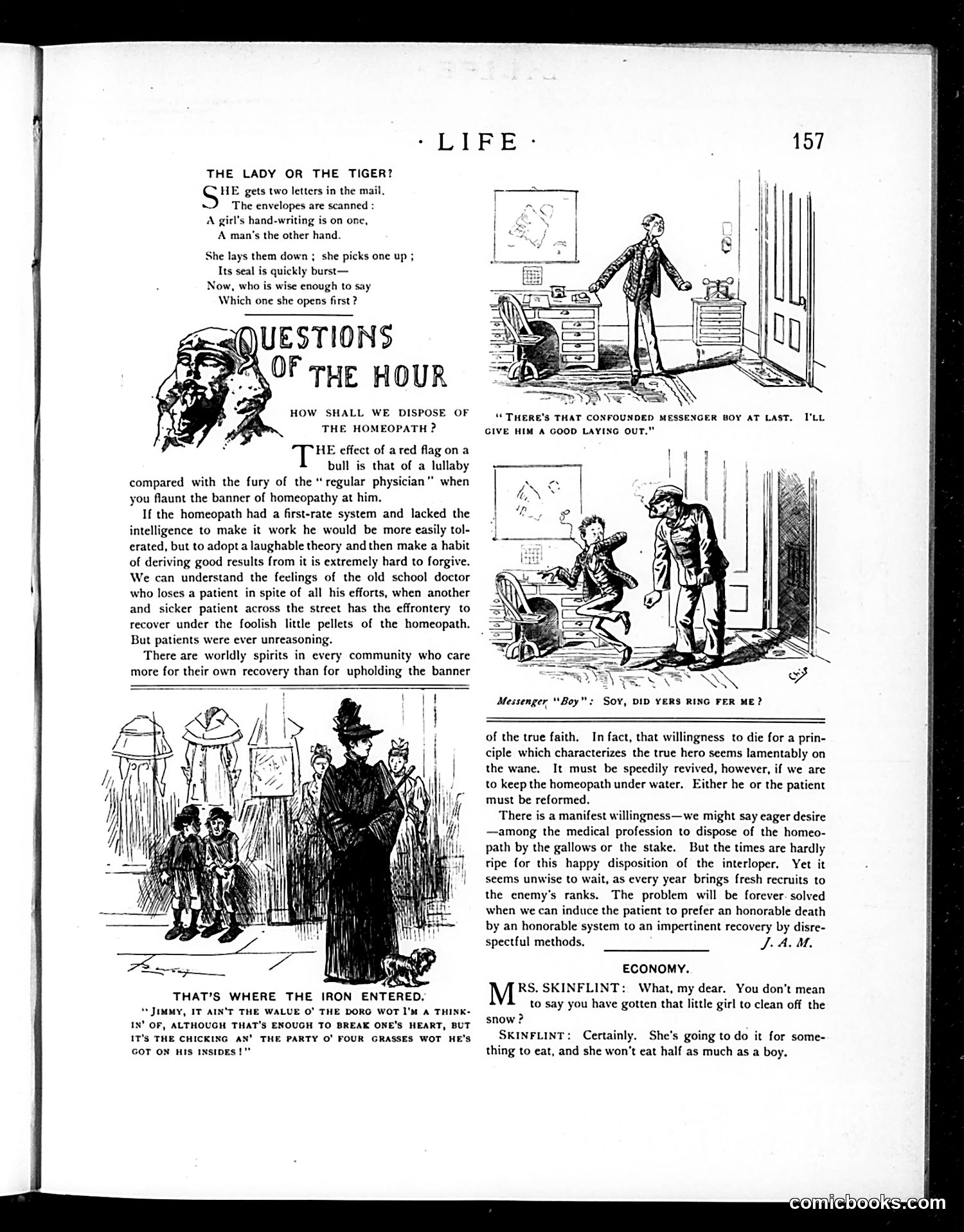
This page contains three distinct satirical pieces targeting professional and social hypocrisy: **"The Lady or the Tiger?"** — A humorous poem about a woman receiving two letters (one from a woman, one from a man) and which she opens first, playing on romantic uncertainty. **"How Shall We Dispose of the Homeopath?"** — The main satire mocks conventional medical doctors' fury at homeopathy's success. The piece ironically suggests that regular physicians resent homeopaths because patients *recover* under alternative medicine—contradicting their theoretical objections. The savage rhetoric ("gallows or the stake") satirizes doctors' professional jealousy masquerading as scientific principle. A messenger boy illustration accompanies this. **"Economy"** — A brief dialogue satirizing miserly exploitation: a woman (Mrs. Skinflint) has hired a poor girl to shovel snow for food scraps, deliberately choosing a child over a boy because she'll consume less. This exposes class cruelty disguised as frugality. The page's humor relies on exposing gap between stated principles and actual motives—whether romantic indecision, professional gatekeeping, or exploitation of poverty.
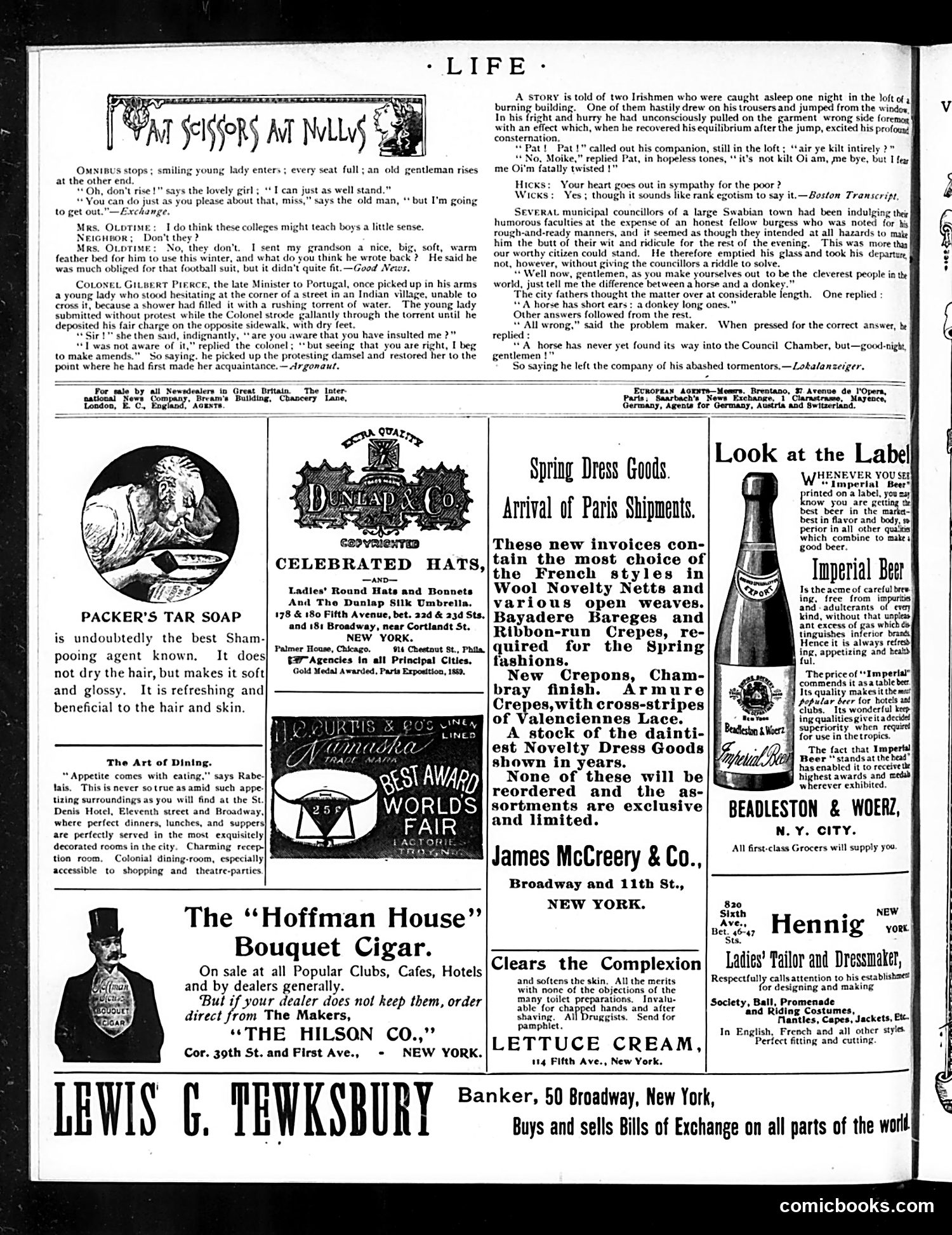
This is primarily an **advertising page with humorous anecdotes**, not political cartoons. The page contains several short jokes and stories typical of Life's satirical humor: 1. **Irish sleeping mishap**: Two Irishmen accidentally put trousers on backwards while fleeing a fire, leading to comic confusion about being "kilt" (killed). 2. **Colonel Pierce anecdote**: A gallant officer carries a woman across a flooded street, then must carry her back after she indignantly protests being touched—satirizing Victorian-era social proprieties and the absurdity of strict etiquette. 3. **The council riddle**: A working-class townsman embarrasses pompous municipal councillors by asking them to distinguish between a horse and donkey. When they guess incorrectly about ear length, he reveals the real answer: horses never enter council chambers—mocking intellectual pretension. The page is dominated by **product advertisements** (Packer's Tar Soap, Dennig Hats, Imperial Beer, etc.) interspersed with these humorous vignettes. The humor targets pretentiousness, rigid social convention, and pomposity rather than specific political figures.